
Identity Incident Response Market Size and Share
Market Overview
| Study Period | 2021 - 2032 |
|---|---|
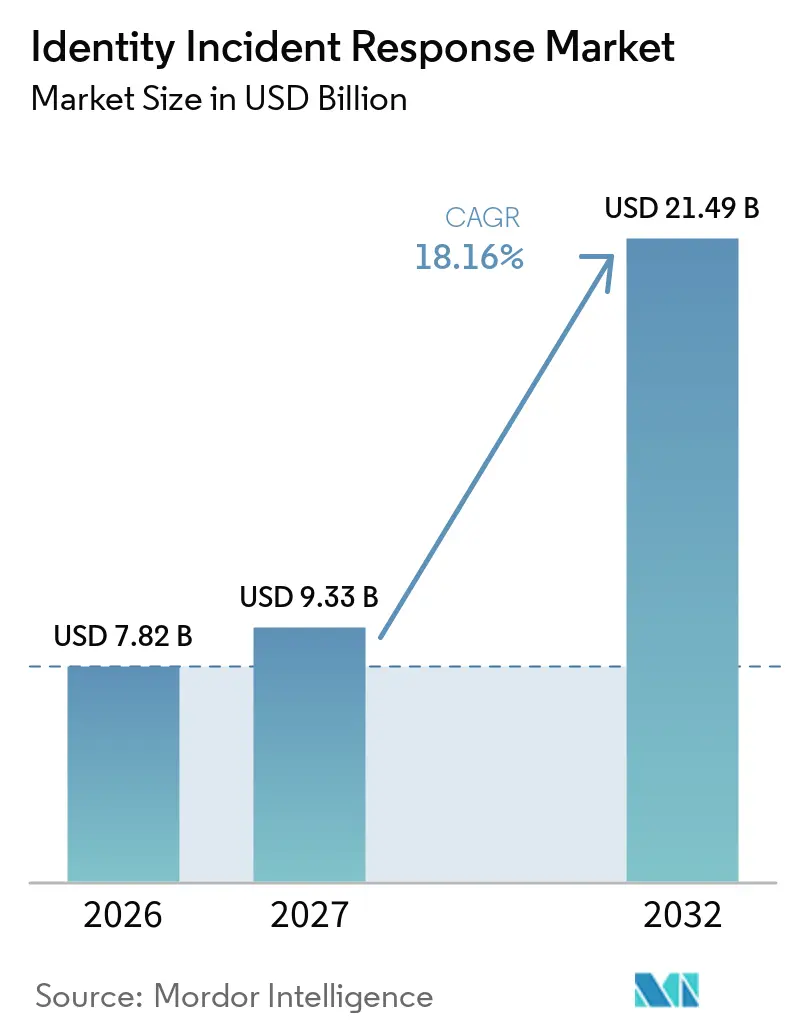
| Market Size (2027) | USD 9.33 Billion |
| Market Size (2032) | USD 21.49 Billion |
| Growth Rate (2027 - 2032) | 18.16 % |
| Fastest Growing Market | Asia-Pacific |
| Largest Market | North America |
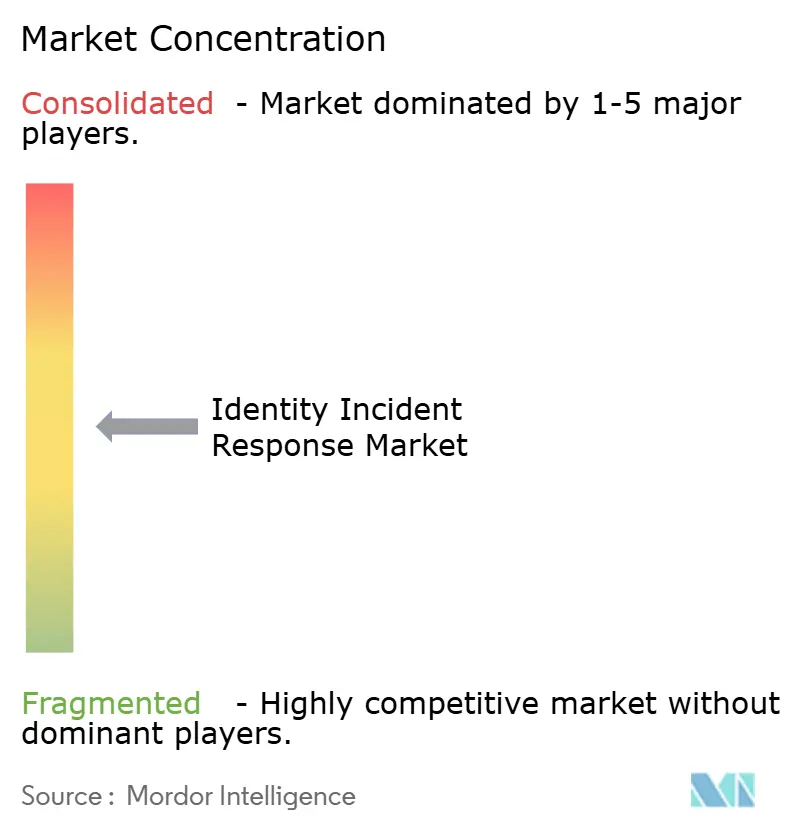
| Market Concentration | Medium |
Major Players *Disclaimer: Major Players sorted in no particular order Image © Mordor Intelligence. Reuse requires attribution under CC BY 4.0. | |
Identity Incident Response Market Analysis by Mordor Intelligence
The identity incident response market size is expected to increase from USD 7.82 billion in 2026 to USD 9.33 billion in 2027 and reach USD 21.49 billion by 2032, growing at a CAGR of 18.16% over 2027-2032. The identity incident response market is being shaped by credential misuse, social engineering, and the shorter period between unauthorized access and data removal. Automated containment has become more important because attackers can use valid credentials and avoid traditional perimeter controls. Cloud migration, automated workflows, and regulatory enforcement are broadening the need for identity monitoring across security operations. Organizations are increasingly treating the identity incident response market as part of their directory, cloud, and security operations architecture rather than as a stand-alone product purchase. Platform acquisitions focused on non-human and AI agent identities are also changing competitive strategies and expanding the range of capabilities buyers expect.
Key Report Takeaways
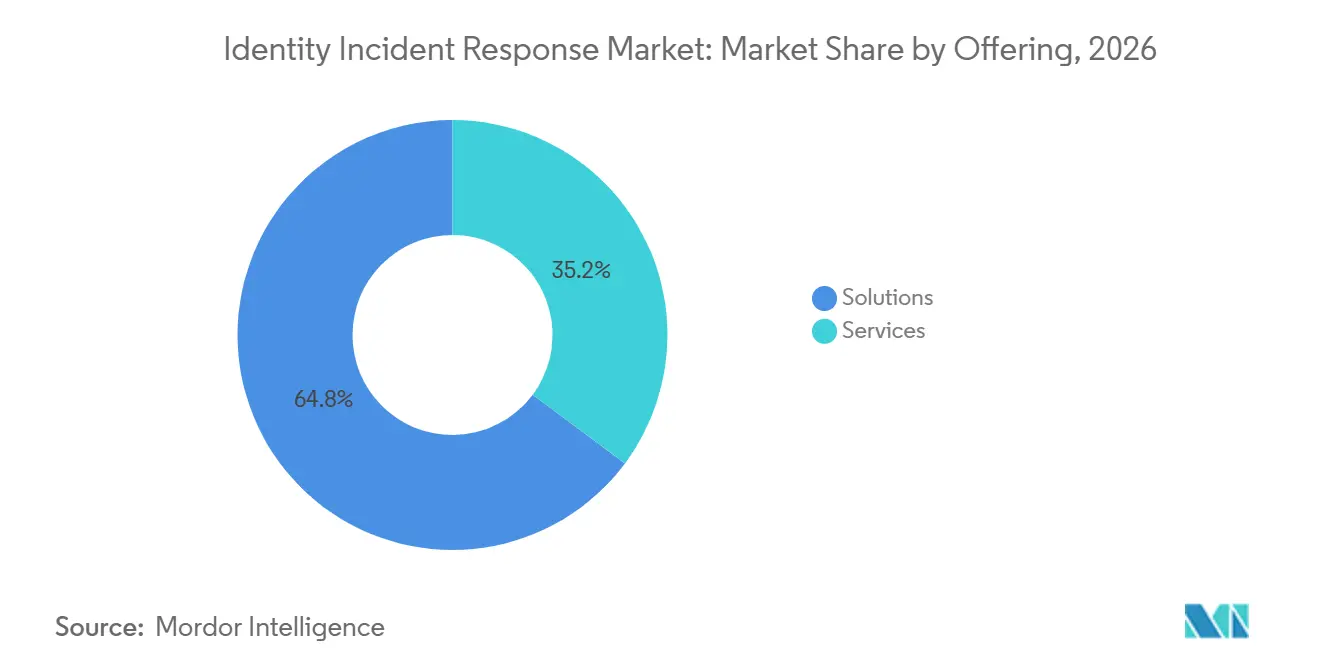
- By offering, solutions held 64.81% of the market in the identity incident response market in 2026, while services are projected to expand at a 19.76% CAGR through 2032.
- By deployment mode, cloud-based deployment accounted for 67.58% of the market in 2026 and is projected to expand at a 17.81% CAGR through 2032.
- By organization size, large enterprises held 68.54% of the market in the identity incident response market in 2026, while SMEs are projected to expand at a 16.72% CAGR through 2032.
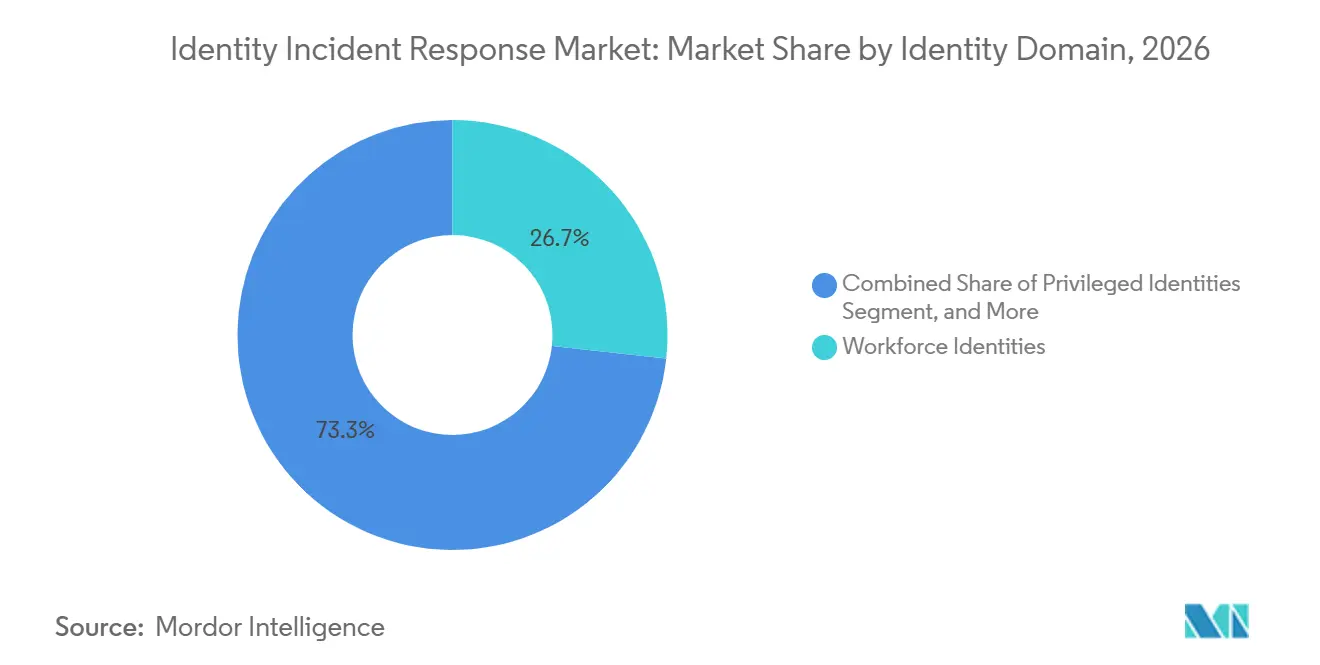
- By identity domain, workforce identities accounted for 26.74% of the market in 2026, while AI agent identities are projected to expand at a 21.72% CAGR through 2032.
- By end-user industry, BFSI held 27.69% of the market in 2026, while government and public administration is projected to expand at a 19.22% CAGR through 2032.
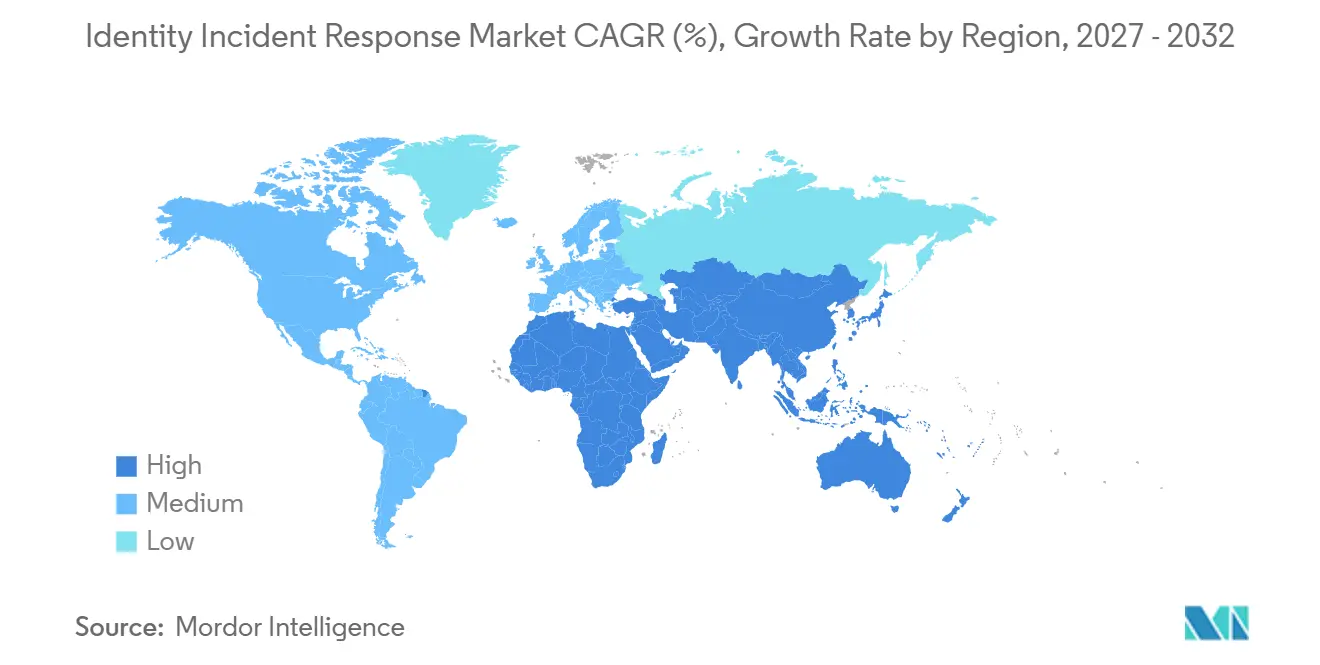
- By geography, North America held 41.64% of the market in the identity incident response market in 2026, while Asia-Pacific is projected to expand at a 17.93% CAGR through 2032.
Note: Market numbers in this report are based on Mordor Intelligence's proprietary estimation framework, which combines nine months of actuals with Q4 projections for base year 2026.
Market Trends and Insights
Drivers Impact Analysis of Identity Incident Response Market*
| DRIVER | (~) % IMPACT ON CAGR FORECAST | GEOGRAPHIC RELEVANCE | IMPACT TIMELINE |
|---|---|---|---|
| Escalation of Credential-Based Attacks and Account Takeovers | +4.2% | Global, most acute in North America and Europe | Short term (≤ 2 years) |
| Expansion of Cloud and Hybrid Identity Environments | +3.5% | Global, most pronounced in Asia-Pacific and North America | Medium term (2-4 years) |
| Regulatory Pressure for Identity Monitoring and Breach Readiness | +2.8% | North America and EU, with spillover to Asia-Pacific | Medium term (2-4 years) |
| Convergence of IAM, PAM, IGA, SIEM, SOAR, and XDR Controls | +2.4% | Global, with early adoption in North America and Western Europe | Medium term (2-4 years) |
| Identity Security Requirements for Non-Human and AI Agent Identities | +1.8% | Global | Long term (≥ 4 years) |
| Identity Telemetry as a Control Plane for Automated Response | +1.2% | North America and Western Europe | Long term (≥ 4 years) |
| Source: Mordor Intelligence | |||
Escalation of Credential-Based Attacks and Account Takeovers
Credential attacks are moving security investment from detection-led programs toward architectures that can contain an incident quickly. eSentire reported that account compromise increased 389% year over year and represented 50% of observed threats in its 2026 report.[1] The same report stated that attackers using valid credentials achieved an 85% intrusion success rate. Flare recorded 2.05 million enterprise credential exposures in 2025 across 18.7 million infostealer logs and reported that 63.2% of indexed credentials with identifiable authorization URLs were linked to authentication systems. RSA reported that 45% of respondents faced identity breach costs above USD 10 million, which brings identity response into financial and senior management planning. The identity incident response market, therefore, benefits from demand for behavioral monitoring after authentication, where valid credentials can otherwise bypass perimeter controls.
Expansion of Cloud and Hybrid Identity Environments
Cloud workloads, multiple SaaS applications, and hybrid Active Directory environments have divided identity data across more systems. IBM states that service accounts, API keys, managed identities, bots, and AI agents are often provisioned quickly with excessive permissions and remain outside controls designed for human identities.[2] This creates a need for monitoring that covers human, workload, and machine access in the same operating environment. The IETF WIMSE working group is developing AI agent identity specifications that include credentials linking a workload to an accountable person or organization. Cloud-based deployment held 67.58% in 2026, showing that the identity incident response market is increasingly centered on the environments where new identities and access paths are created. Cloud platforms can also centralize telemetry from identity providers and SaaS applications, which supports faster investigation and response.
Regulatory Pressure for Identity Monitoring and Breach Readiness
Regulatory requirements are making identity monitoring and incident readiness an operational obligation rather than a voluntary security practice. NIST issued Special Publication 800-63-4 in July 2025 with revised requirements for identity proofing, authentication, and federation. CISA and NIST issued Interagency Report IR 8587 in September 2026 with implementation guidance for securing SSO, federation, and API access tokens against theft and forgery. The guidance applies to federal agencies and cloud service providers and is aligned with Executive Order 14306. ISACA noted that NIS2 and DORA make incident evidence gathering and response testing central audit activities for critical sectors. These obligations support continuing demand in the identity incident response market, including among organizations that have not experienced a major breach.
Convergence of IAM, PAM, IGA, SIEM, SOAR, and XDR Controls
Organizations are seeking to reduce the operational burden of separate IAM, PAM, IGA, SIEM, SOAR, and XDR tools. Integrated controls allow identity signals to be shared with security operations teams and can support coordinated policy enforcement. Palo Alto Networks introduced Cortex ITDR 2.0 in 2026 with 17 preconfigured detectors that combine privileged access intelligence and behavioral analytics. CrowdStrike stated that its Falcon Privileged Access capability can automate Active Directory response actions, including disabling compromised accounts. Shared workflows can reduce the time needed to move from a suspicious identity signal to containment. The identity incident response market is consequently favoring vendors that connect identity context with security operations, while stand-alone products face greater pressure to prove interoperability.
Restraints Impact Analysis of Identity Incident Response Market*
| RESTRAINT | (~) % IMPACT ON CAGR FORECAST | GEOGRAPHIC RELEVANCE | IMPACT TIMELINE |
|---|---|---|---|
| Shortage of Identity Security and Incident Response Specialists | -2.1% | Global, most acute in Asia-Pacific and emerging markets | Short term (≤ 2 years) |
| Complexity of Integrating Identity Signals Across Legacy and Cloud Systems | -1.4% | Global, particularly in enterprises with long legacy estates | Medium term (2-4 years) |
| Fragmented Ownership of Identity Incident Evidence | -0.8% | Global | Medium term (2-4 years) |
| Privacy, Data Residency, and Cross-Border Telemetry Restrictions | -0.6% | EU, Asia-Pacific, particularly China and India, and Middle East | Long term (≥ 4 years) |
| Source: Mordor Intelligence | |||
Shortage of Identity Security and Incident Response Specialists
Identity incident response requires directory forensics, behavioral analysis, and response automation skills that are not widely available in one role. SANS found that organizations often detect attacks faster than they can contain them, which points to gaps in analyst capacity and response maturity. Sophos reported that 71% of surveyed organizations experienced an identity-related breach in the prior year and identified resource constraints among smaller organizations. This shortage limits the ability of some buyers to operationalize a newly acquired platform and can delay incident classification. At the same time, it supports services demand because managed providers can supply continuous monitoring and specialist response. Services are projected to expand at a 19.76% CAGR, showing how the identity incident response market is responding to the specialist capacity gap.
Complexity of Integrating Identity Signals Across Legacy and Cloud Systems
Many enterprises operate on-premises directories, cloud identity providers, SaaS logs, and developer credentials that use different formats and retention practices. IBM observed that programmatic accounts in cloud and CI/CD environments can retain excessive permissions while remaining outside conventional human identity governance processes. This makes it difficult to establish a complete evidence trail during an investigation. Existing PAM and IGA deployments may also be difficult to replace because they support established compliance processes and major prior investments. Privacy rules, data residency requirements, and restrictions on cross-border telemetry add further deployment constraints in the EU, Asia-Pacific, and the Middle East. Vendors with API-first architectures and prebuilt hybrid connectors can reduce these barriers, but integration complexity remains a restraint for the identity incident response market.
*Our forecasts treat driver/restraint impacts as directional, not additive. The impact forecasts reflect baseline growth, mix effects, and variable interactions.
Identity Incident Response Market Segment Analysis
By Offering:
Services Outpace Solutions as Managed Response ScalesSolutions held 64.81% of the identity incident response market share in 2026. This position in the identity incident response market reflects the need for dedicated detection modules, directory protection, and automated response tools as a security foundation. SpyCloud reported that organizations experiencing identity attacks averaged 8 incidents each year in its 2026 survey of cybersecurity leaders.[3] Frequent incidents make continuous coverage more useful than a one-time deployment. In practice, these platforms collect directory events, access changes, privileged activity, and behavioral signals that responders use to establish what happened. They also support repeatable investigation procedures when the same organization faces several incidents during the year. Solutions also provide the detectors and investigation data that managed teams use during an incident.
Services are projected to expand at a 19.76% CAGR from 2027 to 2032. Managed security service providers package identity incident response as an ongoing service for organizations that cannot maintain a specialized internal team. This model gives mid-market buyers and SMEs access to identity forensics, continuous monitoring, and response support. It can also provide documented playbooks, escalation processes, and access to analysts familiar with directory and cloud evidence. That operating model is useful when internal teams must maintain other security and technology responsibilities. The talent shortage makes retainer-based response services more attractive than isolated product purchases. The identity incident response industry is therefore seeing services complement solutions rather than replace them.
By Deployment Mode:
Cloud Leads on Both Scale and SpeedCloud-based deployment accounted for 67.58% of the market in 2026 and is projected to expand at a 17.81% CAGR through 2032. This combination shows that cloud delivery in the identity incident response market has become the standard choice for many new identity security deployments. It can centralize identity telemetry across cloud providers and SaaS applications. It also supports quicker implementation and elastic operating capacity. These advantages are important where identities, devices, and applications change frequently.
On-premises deployment remains relevant in defense, critical infrastructure, and locations with strict data residency expectations. NIST SP 800-63-4 provides requirements for digital identity practices that regulated buyers may consider during procurement.[3] Hybrid deployment connects established on-premises directories with cloud identity providers during migration. Microsoft described expanded identity defense features for hybrid environments, including improved correlation and policy controls. The identity incident response market must therefore support cloud-first architectures without excluding systems that remain on premises.
By Organization Size:
SMEs Drive the Fastest Expansion as ITDR DemocratizesLarge enterprises held 68.54% of the market in 2026. Their identity estates in the identity incident response market are broader, and they often manage hybrid systems with extensive compliance requirements. These buyers also have greater exposure to privileged accounts, third-party access, and large employee populations. Their scale supports direct investment in dedicated tools and security operations processes. They also need a clear record of access decisions and containment actions when an event involves several systems or business units. Large enterprises consequently remain the core revenue base for many providers.
SMEs are projected to expand at a 16.72% CAGR from 2027 to 2032. Managed providers and cloud-native platforms are bringing identity detection and response capabilities within reach of organizations with 100 to 1,000 employees. Sophos found that smaller organizations experience significant resource constraints in identity security. Turnkey services reduce the need to build a large internal specialist team. Identity protection bundled into broadly used business platforms also creates a starting point for smaller firms that later need more extensive protection.
By Identity Domain:
AI Agent Identities Define the Fastest-Growing FrontierWorkforce identities held 26.74% of the market in 2026. They remain a major target in the identity incident response market for phishing, credential theft, and account takeover. Privileged, customer, machine, service account, and API identities are also established domains that require monitoring. These identity types can hold broad access to applications, data, and infrastructure. Their different lifecycles create a need for controls that can associate access activity with the right owner and context.
AI agent identities are projected to expand at a 21.72% CAGR from 2027 to 2032. Autonomous software requires governed credentials to access SaaS platforms, databases, and cloud environments. The IETF WIMSE group is developing specifications for AI agent identities, including credential models that bind an agent workload to a responsible human or organization.[4] Short-lived credentials and clearer ownership can improve access control and incident investigation. The identity incident response industry must extend governance beyond human accounts as autonomous agents become part of enterprise systems.

By End-User Industry:
BFSI Anchors Revenue as Government Builds FastestBFSI held 27.69% of the market in 2026. Financial institutions in the identity incident response market manage real-time systems, valuable customer information, and tightly controlled privileged access. These conditions make rapid detection and containment central to their operating model. RSA reported that 45% of respondents had identity breach costs above USD 10 million. Regulatory readiness also makes identity incident response a continuing requirement for this sector.
Government and public administration are projected to expand at a 19.22% CAGR from 2027 to 2032. Government entities face persistent targeting and have growing requirements for documented, auditable response procedures. SpyCloud found that only 10% of government organizations had reached an optimized level of continuous monitoring and automated remediation in 2025, compared with 22% across sectors. Healthcare and life sciences also require protection for sensitive patient identities and privileged clinical access. Retail, telecommunications, media, travel, and hospitality maintain demand because they hold large customer identity records and depend on third-party access.
Geography Analysis
North America Identity Incident Response Market
North America held 41.64% of the identity incident response market share in 2026. The region has a concentration of large enterprise buyers, managed detection providers, and major identity security vendors. CISA and NIST issued IR 8587 in September 2026 to guide federal agencies and cloud service providers on token security for SSO, federation, and API access. Expel reported that 68.6% of incidents in its 2026 annual report were identity attacks and that 47.7% resulted in successful authentication. This exposure helps sustain high spending by North American organizations.
Europe Identity Incident Response Market
Within the identity incident response market, Europe is seeing compliance-led adoption as NIS2 and DORA expand the focus on resilience, reporting, and evidence collection. ISACA stated that these frameworks make incident evidence gathering and response testing important audit activities for critical sectors. The EU eIDAS 2.0 digital identity wallet framework is adding identity integration requirements across member states. The United Kingdom, Germany, and France are major adoption locations, while other European countries are building compliance capabilities.
APAC and MEA Identity Incident Response Market
Asia-Pacific is projected to expand at a 17.93% CAGR through 2032, the fastest geographic rate in the identity incident response market. Japan's identity and access management spending expanded in 2025 as organizations increased adoption of identity-as-a-service, identity governance, and privileged access management tools. India, Singapore, and Australia operate national digital identity programs through Aadhaar, SingPass, and myGovID, respectively. Saudi Arabia and the UAE are also increasing digital transformation activity through Vision 2030 and UAE Centennial 2071. South Africa and Nigeria represent early adoption markets in Africa, where fintech activity is building demand for identity monitoring.
Competitive Landscape
The identity incident response market is moving from a fragmented point-product environment toward a more consolidated platform structure. Large security providers are seeking capabilities for human, machine, non-human, and AI agent identities. Palo Alto Networks completed its acquisition of CyberArk in February 2026 and positioned the combined identity offering as Idira. CrowdStrike announced an agreement to acquire SGNL in January 2026 to add continuous, context-aware authorization across identity types. Cisco announced its acquisition of Astrix Security in May 2026 to add non-human identity discovery and lifecycle management to Cisco Identity Intelligence.
Specialists such as Semperis, Silverfort, BeyondTrust, Delinea, Varonis Systems, One Identity, Ping Identity, Saviynt, and SailPoint retain relevance through directory forensics, recovery, privileged access, governance, and deployment expertise. Semperis launched Ready1 Identity Crisis Management in October 2025, combining Active Directory recovery, Entra ID recovery, identity forensics, and crisis management functions. Sophos launched its ITDR offering in October 2025 and stated that it covers known MITRE ATT&CK credential access techniques and performs more than 80 cloud identity configuration checks. CrowdStrike expanded Falcon Next-Gen Identity Security in September 2025 with capabilities covering human, machine, and AI agent identities.
Competition also centers on audit trails, response playbooks, and sovereign deployment options. ISO/IEC 27001:2022 access control expectations and NIST SP 800-63-4 identity assurance requirements influence how buyers assess provider capabilities. White space remains in forensic-grade evidence collection for regulatory submissions and in operational technology environments that use nonstandard directory architectures. Providers that can support regional data residency requirements may be better placed to serve customers that cannot route identity telemetry through foreign jurisdictions. Buyers are also looking for protection that can connect a compromised session to account suspension, token revocation, and endpoint actions.
Identity Incident Response Industry Leaders
-
Microsoft Corporation
-
CrowdStrike Holdings, Inc.
-
CyberArk Software Ltd.
-
Proofpoint, Inc.
-
Palo Alto Networks, Inc.
- *Disclaimer: Major Players sorted in no particular order
Identity Incident Response Market Companies Covered in this Report
- Microsoft Corporation
- CrowdStrike Holdings, Inc.
- CyberArk Software Ltd.
- Proofpoint, Inc.
- Palo Alto Networks, Inc.
- BeyondTrust Corporation
- Okta, Inc.
- Varonis Systems, Inc.
- Delinea Inc.
- Silverfort, Inc.
- Semperis, Inc.
- Zscaler, Inc.
- SentinelOne, Inc.
- Tenable Holdings, Inc.
- Cisco Systems, Inc.
- International Business Machines Corporation
- One Identity LLC
- Ping Identity Corporation
- Rezonate, Inc.
- Vectra AI, Inc.
- Quest Software Inc.
- ZeroFox, Inc.
Recent Industry Developments in Identity Incident Response Market
- September 2026: CrowdStrike introduced Agentic Identity Provider within Falcon Next-Gen Identity Security at Fal.Con 2026 on September 2, 2026, giving every AI agent a cryptographically verifiable identity and brokering short-lived, scoped access tokens.
- September 2026: Okta formed the Blueprint Alliance with 11 vendors, including AWS, CrowdStrike, and Google Cloud, on September 22, 2026. The alliance created an open multivendor reference architecture for agent security, including token revocation, session termination, and network quarantine after agent compromise.
- May 2026: Cisco announced the acquisition of Astrix Security to integrate non-human identity discovery and lifecycle management into Cisco Identity Intelligence.
- March 2026: Delinea completed its acquisition of StrongDM, extending its privileged access management platform with just-in-time access for cloud infrastructure and developer tooling.
- February 2026: Palo Alto Networks completed its acquisition of CyberArk on February 11, 2026 and rebranded the combined identity security offering as Idira.
Global Identity Incident Response Market Report Scope
The identity incident response market covers solutions and services used to detect, investigate, contain, remediate, and recover from identity-based security incidents. It includes identity threat detection and response, identity forensics, automated containment, credential revocation, incident response retainers, and managed identity detection and response.
The Identity Incident Response Market Report is Segmented by Offering (Solutions, and Services), Deployment Mode (Cloud-Based, On-Premises, and Hybrid), Organization Size (Large Enterprises, and Small and Medium Enterprises), Identity Domain (Workforce Identities, Privileged Identities, Customer and Consumer Identities, Machine and Workload Identities, Service Accounts, Application Programming Interface Identities, and Artificial Intelligence Agent Identities), End-User Industry (Banking, Financial Services, and Insurance (BFSI), Government and Public Administration, Healthcare and Life Sciences, Retail and E-Commerce, Telecommunications and Media, Travel and Hospitality, and End-User Industries), and Geography (North America, South America, Europe, Asia-Pacific, Middle East, and Africa). The Market Forecasts are Provided in Terms of Value (USD).
Segmentation Overview
| Solutions |
| Services |
| Cloud-Based |
| On-Premises |
| Hybrid |
| Large Enterprises |
| Small and Medium-Sized Enterprises |
| Workforce Identities |
| Privileged Identities |
| Customer and Consumer Identities |
| Machine and Workload Identities |
| Service Accounts |
| Application Programming Interface Identities |
| Artificial Intelligence Agent Identities |
| Banking, Financial Services, and Insurance (BFSI) |
| Government and Public Administration |
| Healthcare and Life Sciences |
| Retail and E-Commerce |
| Telecommunications and Media |
| Travel and Hospitality |
| Other End-User Industries |
| North America | United States |
| Canada | |
| Mexico | |
| South America | Brazil |
| Argentina | |
| Rest of South America | |
| Europe | United Kingdom |
| Germany | |
| France | |
| Italy | |
| Rest of Europe | |
| Asia-Pacific | China |
| India | |
| Japan | |
| South Korea | |
| Rest of Asia-Pacific | |
| Middle East | Saudi Arabia |
| United Arab Emirates | |
| Turkey | |
| Rest of Middle East | |
| Africa | South Africa |
| Nigeria | |
| Rest of Africa |
| By Offering | Solutions | |
| Services | ||
| By Deployment Mode | Cloud-Based | |
| On-Premises | ||
| Hybrid | ||
| By Organization Size | Large Enterprises | |
| Small and Medium-Sized Enterprises | ||
| By Identity Domain | Workforce Identities | |
| Privileged Identities | ||
| Customer and Consumer Identities | ||
| Machine and Workload Identities | ||
| Service Accounts | ||
| Application Programming Interface Identities | ||
| Artificial Intelligence Agent Identities | ||
| By End-User Industry | Banking, Financial Services, and Insurance (BFSI) | |
| Government and Public Administration | ||
| Healthcare and Life Sciences | ||
| Retail and E-Commerce | ||
| Telecommunications and Media | ||
| Travel and Hospitality | ||
| Other End-User Industries | ||
| By Geography | North America | United States |
| Canada | ||
| Mexico | ||
| South America | Brazil | |
| Argentina | ||
| Rest of South America | ||
| Europe | United Kingdom | |
| Germany | ||
| France | ||
| Italy | ||
| Rest of Europe | ||
| Asia-Pacific | China | |
| India | ||
| Japan | ||
| South Korea | ||
| Rest of Asia-Pacific | ||
| Middle East | Saudi Arabia | |
| United Arab Emirates | ||
| Turkey | ||
| Rest of Middle East | ||
| Africa | South Africa | |
| Nigeria | ||
| Rest of Africa | ||
Key Questions Answered in the Report
What is the size of the identity incident response market?
The identity incident response market size is expected to increase from USD 7.82 billion in 2026 to USD 9.33 billion in 2027 and reach USD 21.49 billion by 2032, growing at a CAGR of 18.16% over 2027-2032.
What is driving demand for identity incident response?
Credential misuse, cloud and hybrid identity environments, compliance obligations, and the need for automated containment are increasing demand. These factors also make identity response part of wider directory, cloud, and security operations planning.
Which deployment model leads identity incident response adoption?
Cloud-based deployment held 67.58% in 2026 and is projected to expand at a 17.81% CAGR through 2032. It helps centralize telemetry from cloud identity providers and SaaS applications.
Which organizations are adopting identity incident response most quickly?
SMEs are projected to expand at a 16.72% CAGR as managed services and cloud-native platforms reduce the need for internal specialists. Turnkey support can provide monitoring and response without a large in-house team.
Which identity domain has the highest projected expansion?
AI agent identities are projected to expand at a 21.72% CAGR through 2032 as autonomous software needs governed credentials. This need extends to access across SaaS applications, databases, and cloud environments.
Which region is expanding fastest for identity incident response?
Asia-Pacific is projected to expand at a 17.93% CAGR through 2032, supported by digital identity programs and cloud adoption. Japan, India, Singapore, and Australia contribute through their identity infrastructure and adoption activity.