
IC Design Services Market Size and Share
Market Overview
| Study Period | 2021 - 2032 |
|---|---|
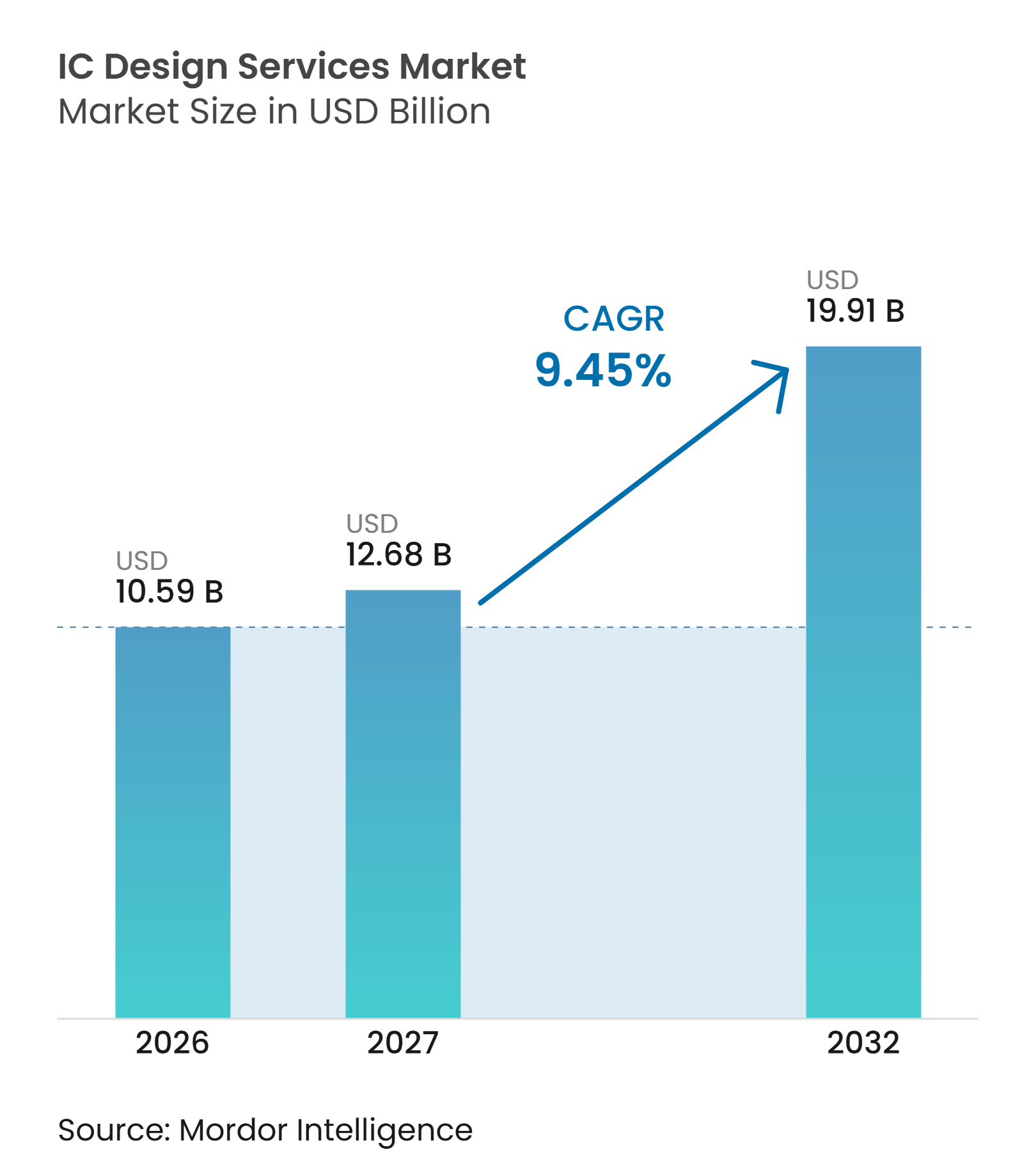
| Market Size (2027) | USD 12.68 Billion |
| Market Size (2032) | USD 19.91 Billion |
| Growth Rate (2027 - 2032) | 9.45 % |
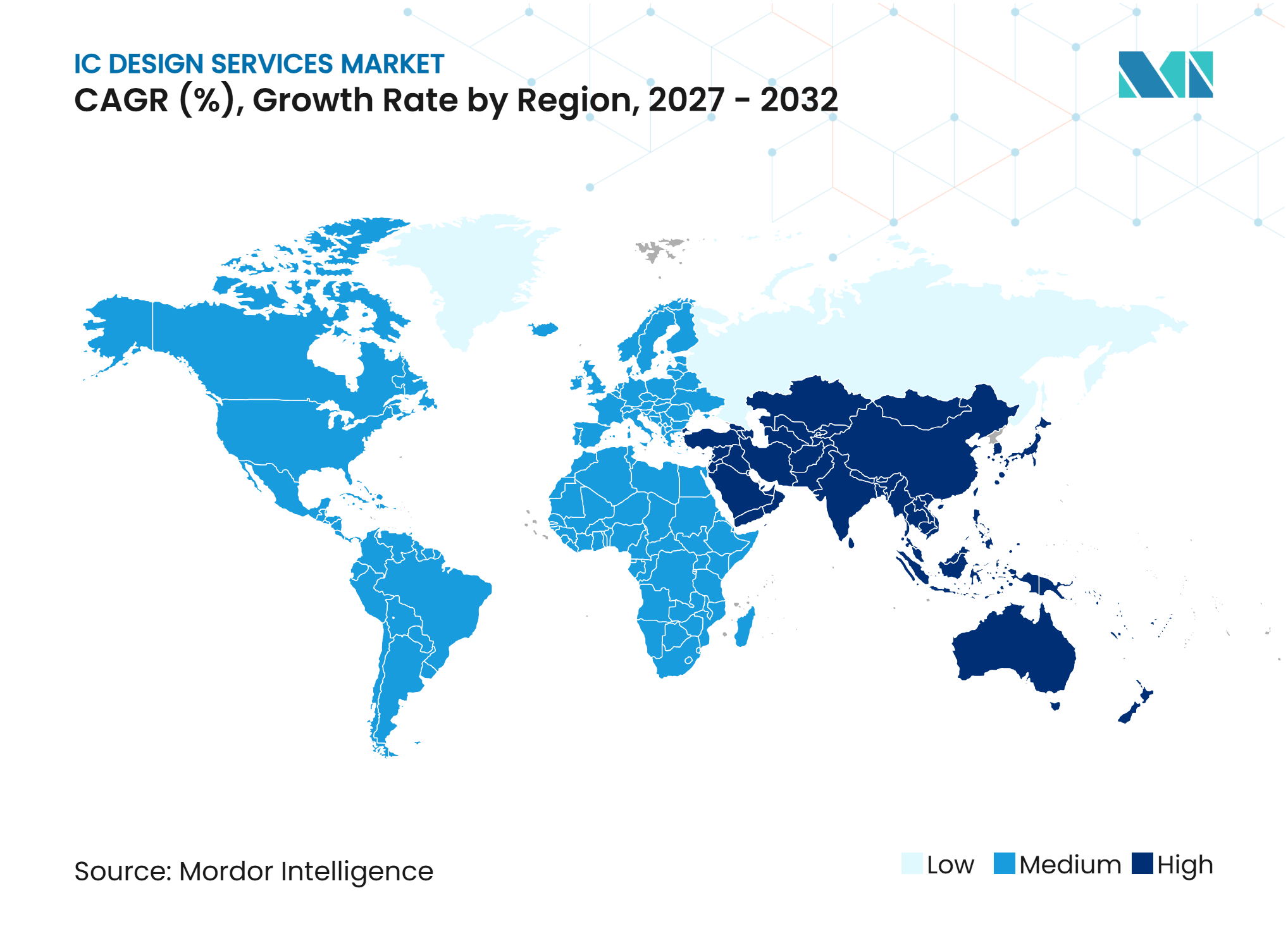
| Fastest Growing Market | Asia-Pacific |
| Largest Market | Asia-Pacific |
| Market Concentration | Medium |
Major Players *Disclaimer: Major Players sorted in no particular order Image © Mordor Intelligence. Reuse requires attribution under CC BY 4.0. | |
IC Design Services Market Analysis by Mordor Intelligence
The IC design services market size is projected to expand from USD 10.59 billion in 2026 to USD 12.68 billion in 2027, and to USD 19.92 billion by 2032, registering a CAGR of 9.45% between 2027 and 2032. Rising non-recurring engineering costs at advanced nodes are making specialized external design capacity more relevant to integrated device manufacturers and fabless companies. Demand is also supported by gaps in experienced design talent, especially in analog and mixed-signal work that cannot be scaled quickly through conventional hiring. Semiconductor sovereignty programs are increasing the need for design work that can be delivered in secure and compliant domestic environments. The IC design services market is therefore moving beyond basic cost-based outsourcing toward work requiring mature process design kits, reusable intellectual property, verification methods, and foundry coordination. AI compute, data center efficiency, automotive electronics, and chiplet programs are widening the opportunity set, while security requirements, export controls, and sub-3nm tool costs limit access to the highest-value programs.
Key Report Takeaways
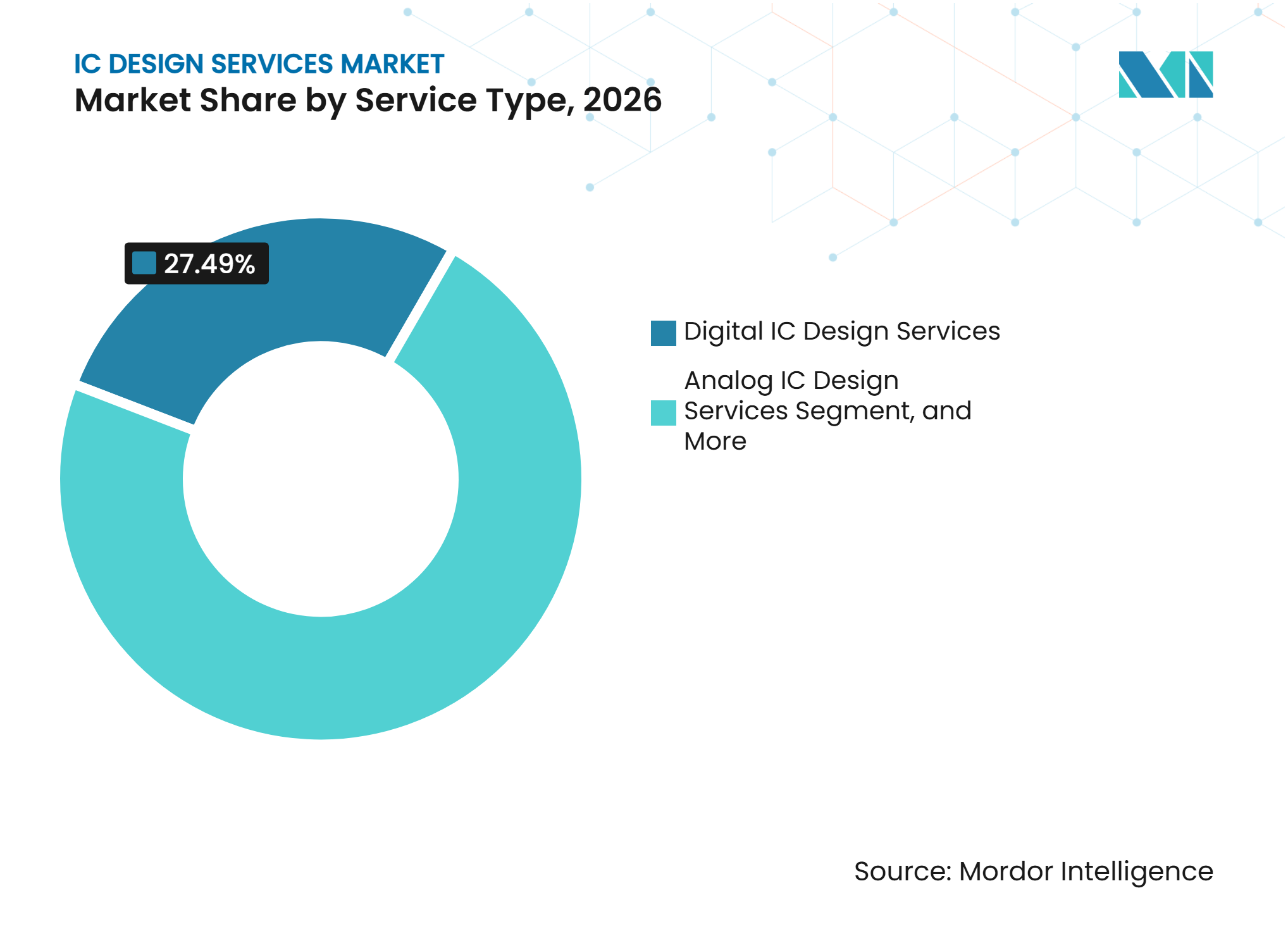
- By service type, digital IC design services held a 27.49% revenue share in 2026, while design verification services are projected to expand at a 10.67% CAGR through 2032 in the IC design services market.
- By end-user application, AI, high-performance computing, and data centers held a 28.52% revenue share in 2026 and are projected to expand at a 10.81% CAGR through 2032.
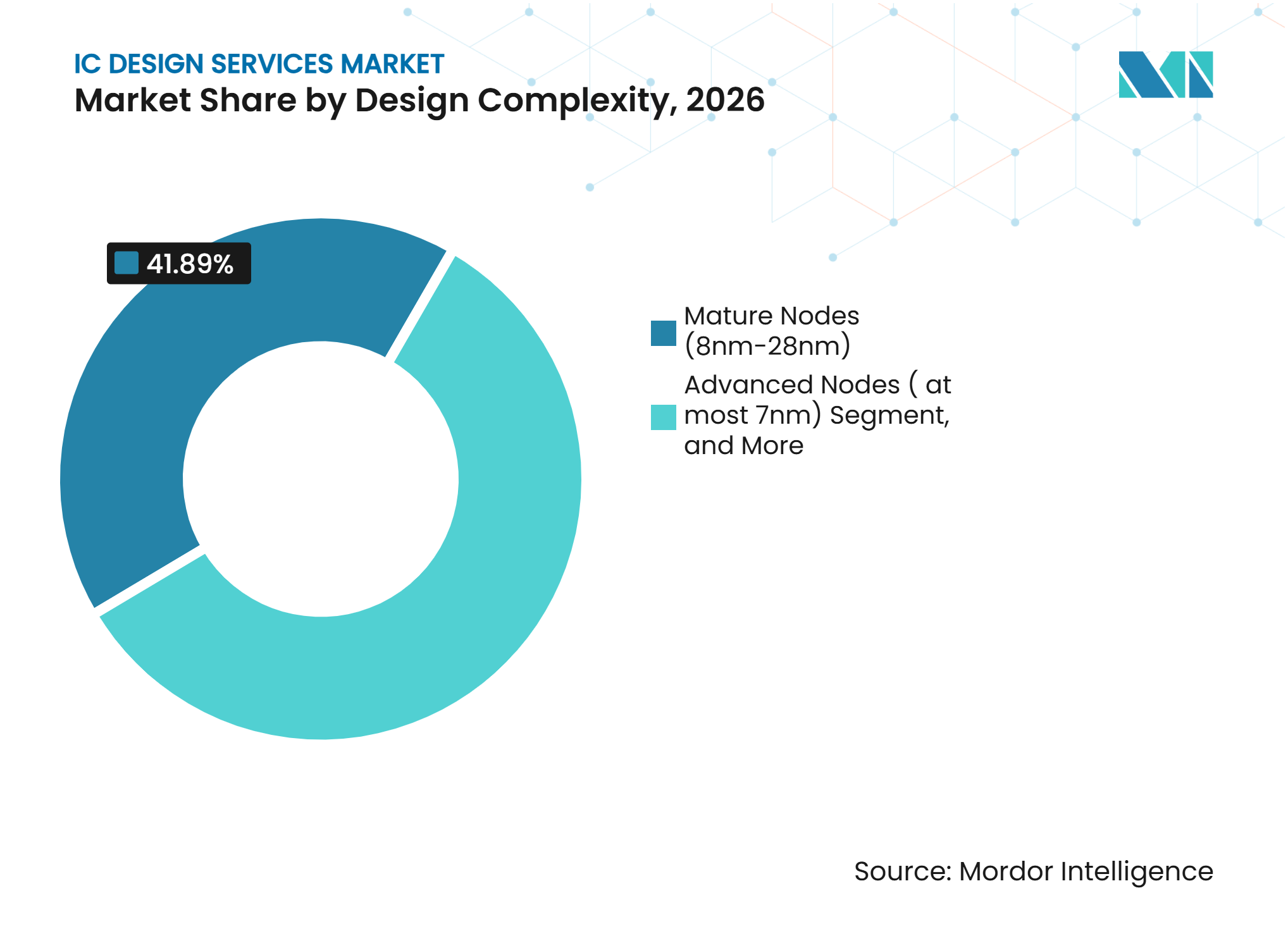
- By design complexity, mature nodes from 8nm to 28nm accounted for a 41.89% share in 2026, while advanced nodes at 7nm and below are projected to expand at a 10.04% CAGR through 2032.
- By geography, Asia-Pacific held a 48.61% revenue share in 2026 in the IC design services market and is projected to expand at a 10.26% CAGR through 2032.
Note: Market numbers in this report are based on Mordor Intelligence's proprietary estimation framework, which combines nine months of actuals with Q4 projections for base year 2026.
Market Trends and Insights
Drivers Impact Analysis of IC Design Services Market*
| Driver | (~) % Impact on CAGR Forecast | Geographic Relevance | Impact Timeline |
|---|---|---|---|
| AI and Generative AI Demand Across Data Centers, Automotive, and Edge Computing | +2.1% | Global, led by North America and Asia-Pacific | Medium term (2-4 years) |
| Rising Design Complexity and Costs Accelerating Outsourcing | +1.9% | Global | Long term (≥ 4 years) |
| Government-Led Semiconductor Sovereignty Programs | +1.5% | Asia-Pacific, North America, Europe | Medium term (2-4 years) |
| Shortage of Skilled Analog and Mixed-Signal Engineers | +1.1% | Global, with acute strain in North America and Europe | Long term (≥ 4 years) |
| Chiplet and Heterogeneous Integration Adoption | +0.9% | Asia-Pacific core, with spillover to North America and Europe | Medium term (2-4 years) |
| Fabless Cost Optimization, NRE Sharing, and Multi-Project Wafer Adoption | +0.6% | Global | Short term (≤ 2 years) |
| Source: Mordor Intelligence | |||
AI and Generative AI Growth Driving Demand Across Data Centers, Automotive, and Edge Computing
Custom silicon demand from cloud providers is becoming a central source of work for the IC design services market. Purpose-built ASICs can provide total-cost-of-ownership advantages of 40-65% over general-purpose GPUs in sustained inference workloads, according to the source material. The short iteration cycle for AI models also requires design teams in the IC design services market to validate software behavior well before tape-out, which increases demand for reusable IP and early verification work. CIER reported that Taiwanese firms are adapting their service models as ASIC demand extends from cloud accelerators to AI research institutes and inference start-ups. The International Energy Agency expects data center electricity consumption to exceed 830 TWh by 2030, which increases the importance of efficient inference silicon.[1] Automotive programs add another channel because autonomous-driving chips require dense compute, reliable integration, and functional-safety compliance.
Rising Design Complexity and Costs Accelerating Outsourcing by IDMs and Fabless Companies
Design economics have changed sharply below the 7nm node, increasing the appeal of specialist partners in the IC design services market. Design costs rise significantly from 28nm to 5nm and exceed the billion-dollar threshold at 3nm. These higher costs coincide with more extensive rule checking, physical design work, and the integration of third-party processor, memory, and connectivity IP in the IC design services market. Smaller fabless companies cannot readily absorb these requirements, while large IDMs are selectively using external partners for analog, mixed-signal, and packaging work. This shifts the buyer decision from labor-cost savings to access to design methods, process design kit maturity, and a higher likelihood of first-silicon success. HCLTech stated that AI-supported design workflows can improve productivity by up to 30% and that generative AI verification optimization can reduce simulation cycles by more than 50%.
Government-Led Semiconductor Sovereignty Programs Boosting Demand for Specialized IC Design Services
Government programs are supporting domestic capacity for IC design, intellectual property development, and access to electronic design automation tools. India approved Semicon 2.0 in July 2026 with INR 1,27,500 crore (USD 15.2 billion), and its first pillar focused on chip design incentives for IP cores, commercial chips, and system-on-chip programs. The Design Linked Incentive scheme had sanctioned 24 projects worth INR 900 crore (USD 95.30 million) and had provided EDA access to 72 companies by 2026. These programs support start-ups in the IC design services market that require external design capacity rather than complete internal teams. The US CHIPS and Science Act and the EU Chips Act are also supporting local talent and secure semiconductor capability, and as these programs move from policy commitments to practical implementation, the IC design services market can benefit from new demand for design support, IP work, and secure project delivery. This policy environment favors providers that can meet customer requirements for compliant data handling, security review, and local delivery.
Shortage of Skilled Analog and Mixed-Signal Engineers Driving Outsourced Design Demand
The shortage of analog and mixed-signal engineers remains a structural support for the IC design services market. This work requires practical experience with circuit behavior and silicon results that is difficult to replace through academic scaling alone. The source material identifies retiring senior designers as a further constraint in established semiconductor regions, where design knowledge has accumulated through repeated work on silicon rather than through short training cycles, making knowledge transfer, mentoring, and retention central operational issues for firms serving the IC design services market. Applied Materials, Renesas Electronics, and Marvell Technology are recruiting experienced designers from Taiwan, South Korea, and Singapore to address gaps in hands-on design capability. Analog front ends and precision data converters lack a direct equivalent of digital logic synthesis, so experienced manual design remains important. This supports specialist firms in the IC design services market such as ICsense and Racyics, which provide foundry-specific analog services that many customers cannot maintain internally.
Restraints Impact Analysis of IC Design Services Market*
| Restraint | (~) % Impact on CAGR Forecast | Geographic Relevance | Impact Timeline |
|---|---|---|---|
| IP Security and Confidentiality Concerns in Offshore Engagements | -0.9% | Global, most acute in North America and Europe | Long term (≥ 4 years) |
| Advanced Node Complexity at 3nm and Below | -0.8% | Global | Long term (≥ 4 years) |
| Geopolitical Restrictions and Export Controls | -0.7% | North America, East Asia, Europe | Medium term (2-4 years) |
| Geographic Concentration of Analog and Mixed-Signal Talent | -0.5% | Asia-Pacific emerging markets, South America | Long term (≥ 4 years) |
| Source: Mordor Intelligence | |||
IP Security and Confidentiality Concerns Restricting Offshore Design Engagements
Outsourced design requires customers to share RTL, circuit descriptions, test data, and other valuable technical materials throughout the development process. The source material estimates that IP theft causes substantial annual losses in the IC design field. Galois research published through NIST highlights the need for stronger cryptographic protection for circuit IP. NIST has also examined the security challenges in structured ASIC design, in which manufacturing and design activities are distributed across supply chains.[2] Leading design houses are adopting controls such as restricted tool access, encrypted transfers, and hardware IP obfuscation. These controls improve protection but can lengthen approvals and make onshore or secure-enclave delivery more attractive for sensitive IC design services market programs, while requiring providers to show customers how teams, files, development tools, and supplier access are governed throughout a project.
Advanced Node Complexity Increasing EDA and Talent Costs for Smaller Firms
Sub-3nm development entails costs and design complexity that many smaller firms cannot afford. The source material states that 2nm design and productization costs are expected to grow. Advanced nodes also require costly EDA licenses, extensive IP integration, and teams familiar with the latest design rules and packaging methods. Semiconductor Equipment and Materials International Association (SEMI) reported that semiconductor IP revenue increased 20.4% to USD 2,199.0 million in Q2 2026, while IC physical design and verification revenue increased 16.6% to USD 818.3 million. Investment in the IC design services market is therefore concentrating among providers capable of sustaining long-term commitments to tools, IP, and talent. The IC design services market is divided between full-stack suppliers with access to advanced-node contracts and a larger group focused on mature-node and specialist work.
*Our forecasts treat driver/restraint impacts as directional, not additive. The impact forecasts reflect baseline growth, mix effects, and variable interactions.
IC Design Services Market Segment Analysis
By Service Type:
Verification Services Anchor a Specialized Outsourcing Value ChainDesign verification services are projected to grow at a 10.67% CAGR from 2027 to 2032, outpacing the overall IC design services market. High sub-7nm respin costs make independent verification expertise valuable before tape-out, because a late defect can delay production, consume scarce engineering resources, and expose a customer to a second fabrication cycle. SEMI reported 16.6% year-over-year growth in IC physical design and verification revenue in Q2 2026. Digital IC design services accounted for 27.49% of revenue in 2026 because customers need broad RTL development for AI, networking, and consumer devices. This work serves customers who do not maintain complete in-house digital teams, and it allows product companies to add specialized capacity for specific projects without bearing the full fixed costs of a large, permanent design organization.
Analog IC design services serve power management, sensor, and radio-frequency applications requiring manual engineering judgment. Physical design and layout work translates RTL into GDSII while managing timing, power, area, and manufacturing rules. Analog and mixed-signal services address requirements that automation cannot fully meet, including device behavior that depends on noise, signal integrity, power performance, layout details, and the interaction between a design and its process technology. IP development can create recurring revenue when reusable blocks are licensed across several programs, and validated building blocks can reduce repeated engineering work for customers starting related products.



By End-User Application:
AI, HPC, and Data Centers Lead DemandAI, HPC, and data centers accounted for 28.52% of revenue in 2026 and are projected to grow at a 10.81% CAGR through 2032. This category leads both current share and forecast expansion in the supplied data. Custom AI ASIC shipments are projected to increase by 44.6% in 2026, compared with 16.1% for merchant GPU shipments, as large users seek hardware that more closely matches their software, memory, power, and data-movement requirements. Alchip stated that AI and HPC applications accounted for 83% of its revenue, with 87% from advanced-process designs at 7nm and below.
Automotive supports long-duration ASIC programs for driver assistance, vehicle networking, and electrification, in which qualification cycles, safety requirements, and long product lifecycles make early design choices particularly important. Consumer electronics manufacturers outsource work for display driver ICs, wireless charging controllers, and wearable health chips, particularly when brands require differentiated features but do not operate large internal semiconductor design groups. Industrial customers favor durable mature-node devices for automation and machine vision. Defense and aerospace, medical, and telecom work can require specialization in security, reliability, radio-frequency, and mixed-signal. The IC design services industry, therefore, has broad demand even as AI and data centers drive advanced-node programs.
By Design Complexity:
Mature Nodes Provide Scale and Advanced Nodes Drive ValueMature nodes from 8nm to 28nm accounted for 41.89% of the IC design services market in 2026. Automotive, industrial, consumer, and power-management programs use these geometries when leading-edge density does not improve the commercial result. TNO and Invest-NL place total design cost at USD 51 million for 28nm, a level that remains materially more manageable than the spending required to develop leading-edge products with more demanding tools and manufacturing rules. This level makes mature-node projects available to more customers and providers. Advanced nodes at 7nm and below are projected to expand at a 10.04% CAGR from 2027 to 2032.
Legacy nodes above 28nm support microcontrollers, sensor interfaces, and power ICs with long production cycles, where predictable supply, proven yield, and stable qualification can matter more than shrinking transistor dimensions. Gate-all-around transistors at 2nm introduce new rule requirements and specialized physical design needs. The physical-design workload increases substantially at advanced nodes because design rules and integration requirements are more demanding. Export controls and tool access narrow the field for advanced-node programs. Mature nodes provide scale in the IC design services market, while advanced nodes concentrate high-value work among well-equipped providers.

Geography Analysis
Asia-Pacific
Asia-Pacific accounted for 48.61% of the IC design services market share in 2026 and is projected to grow at a 10.26% CAGR from 2027 to 2032. The IC design services market benefits from proximity to foundries in Taiwan and South Korea, as well as a capable design base in China and India, which can shorten coordination across architecture, implementation, verification, tape-out, and production. CIER reported that Taiwanese firms are building end-to-end offerings as demand for ASICs reaches AI research groups and inference start-ups. SEMIFIVE reported 97% year-over-year revenue growth in the first half of 2026 and KRW 118.9 billion (USD 88.1 million) in new orders. India’s Semicon 2.0 program and China’s expanding full-stack supply base add alternative delivery options over time.
North America
North America hosts hyperscaler and AI laboratory programs that are reshaping demand for custom chips. Broadcom and Marvell translate customer specifications into manufacturable chips, which leaves openings for external design, verification, and IP specialists. HCLTech reported more than 230 tape-outs and a 95% first-silicon success rate in 2026. Samsung Foundry added HCLTech as a Design Solution Partner in March 2025, while security requirements and export controls remain material compliance factors.
Europe and Emerging Markets
Europe has analog and mixed-signal specialists, including ICsense, Racyics, and EnSilica, serving automotive, industrial, and medical customers. EnSilica secured 6 ASIC design and supply agreements in fiscal 2025, including contracts above USD 30 million and USD 31 million. ISO 26262 supports the demand for functional safety and analog capabilities in automotive designs. South America, the Middle East, and Africa remain early-stage design markets, although selected defense programs may draw specialist offshore providers. Europe is distinguished by specialist expertise, while consolidation and integrated design-to-production services are emerging across the wider region. The IC design services market in these locations depends on close links with customers who value certification, application knowledge, and reliable support throughout a device program.
Competitive Landscape
Market Concentration
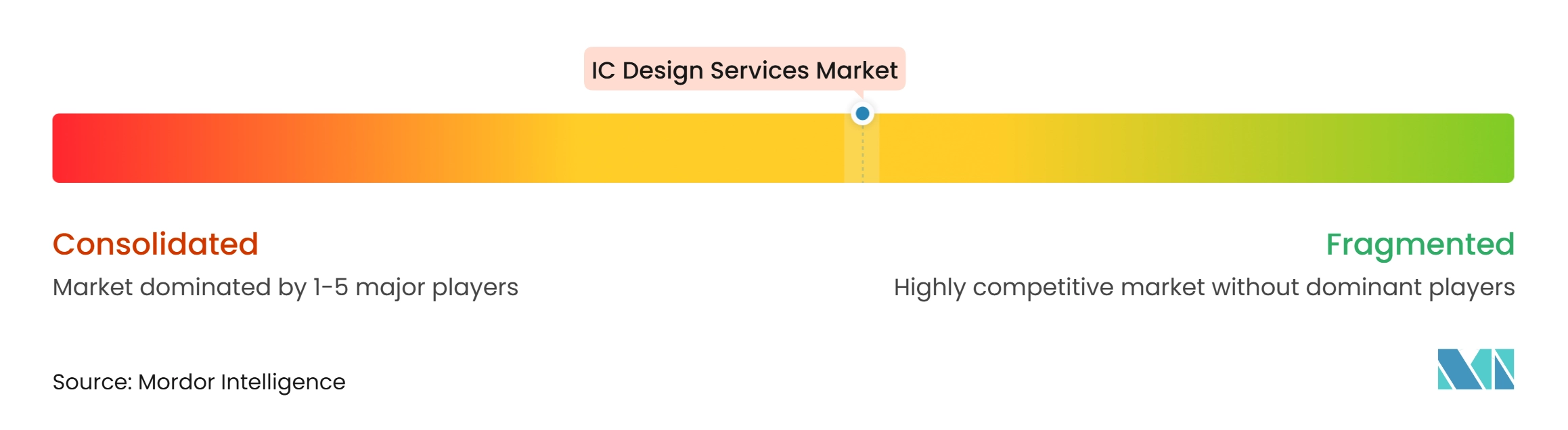
The IC design services market is moderately fragmented, although full-stack providers capture a substantial share of advanced-node revenue. VeriSilicon’s 2026 prospectus stated that full-stack providers generated more than 80% of combined revenue among the world’s 10 largest custom-silicon solution suppliers in 2025. Competition also comes from engineering services companies expanding into ASIC work, especially where they can combine customer relationships with access to foundry programs and specialized engineering teams. HCLTech joined Samsung Foundry’s SAFE ecosystem in 2025, widening its access to foundry programs. More entrants can put pressure on project margins and heighten the importance of advanced packaging and system-level performance, so providers must demonstrate that their engineering scope can address the interfaces among logic, memory, interconnect, package, and manufacturing requirements, rather than only a narrow design task.
Foundry relationships, IP depth, and packaging execution determine competitive position. GUC launched a 2.5D and 3D Advanced Package Technology platform in September 2025, combining TSMC 3DFabric, UCIe-A IP, and HBM4 PHY IP.[3] Alchip advanced its 2nm platform and joined the Arm Total Design ecosystem in 2026. These moves address chiplet programs that need coordinated die connectivity and packaging. Regional providers can serve mid-market fabless companies and industrial OEMs that prioritize mature-node support and specialist analog work.
Providers are seeking recurring supply revenue alongside non-recurring engineering fees. EnSilica’s fiscal 2025 agreements included USD 40 million in contracted non-recurring engineering expected through fiscal 2027. SEMIFIVE commenced mass production of HyperAccel’s LLM inference accelerator on Samsung’s 4nm node in September 2026. These engagements can increase switching costs because suppliers become embedded in design, manufacturing coordination, and supply execution.
IC Design Services Industry Leaders
-
Alchip Technologies, Ltd.
-
VeriSilicon Microelectronics
-
Faraday Technology Corporation
-
SEMIFIVE Inc.
-
Global Unichip Corporation
- *Disclaimer: Major Players sorted in no particular order
IC Design Services Market Companies Covered in this Report
- Global Unichip Corporation
- Alchip Technologies Limited
- Faraday Technology Corporation
- VeriSilicon Microelectronics (Shanghai) Co., Ltd.
- SEMIFIVE Inc.
- CoAsia SEMI Ltd.
- Sondrel Limited
- EnSilica plc
- Racyics GmbH
- ICsense NV
- eInfochips Private Limited
- HCL Technologies Limited
- L&T Technology Services Limited
- MosChip Technologies Limited
- Tessolve Semiconductor Private Limited
Recent Industry Developments in IC Design Services Market
- September 2026: SEMIFIVE commenced mass production of HyperAccel's LLM AI inference accelerator on Samsung Foundry's 4nm process node, with the chip exceeding 500 mm², marking SEMIFIVE's first large-scale, advanced-node mass-production project. The company secured KRW 42.3 billion (USD 31.3 million) in new mass-production orders in H1 2026, nearly double its full-year 2025 intake.
- August 2026: Alchip Technologies reported USD 242 million in Q2 2026 revenue, an 82.6% sequential increase, driven by N3 accelerator shipments to a North American cloud service provider that began ramping in May 2026.
- July 2026: The Government of India approved Semicon 2.0 with a fiscal outlay of INR 1,27,500 crore (USD 15.2 billion). At least 3 of the program’s 6 pillars target IC design, IP core development, and EDA tool access for startups and MSMEs, as implemented by the India Semiconductor Mission.
- February 2026: Baya Systems and Aion Silicon, formerly Sondrel, announced a strategic partnership to deliver joint SoC and chiplet design solutions for AI, HPC, and automotive applications, combining Baya’s WeaverPro FabricStudio IP with Aion’s end-to-end turnkey design capabilities.
Global IC Design Services Market Report Scope
The IC Design Services Market encompasses outsourced and specialized integrated circuit (IC) design, engineering, and development services for semiconductor companies, fabless firms, IDMs, OEMs, and system developers. The market includes services involved in the conceptualization, architecture, design, verification, validation, and physical implementation of semiconductor chips for various end-use applications.
The IC Design Services Market Report is Segmented by Service Type (Analog IC Design Services, Digital IC Design Services, Analog Mixed-Signal (AMS) IC Design Services, Physical Design and Layout Services, Design Verification Services, IP Development and Design Support Services, and Other Service Types), End-User Application (Automotive, AI, HPC, and Data Centers, Consumer Electronics, Industrial, Defense and Aerospace, Medical and Healthcare, Telecom and Networking, and Other End-User Applications), Design Complexity (Advanced Nodes (≤7nm), Mature Nodes (8nm–28nm), and Legacy Nodes (Above 28nm)), and Geography (North America, Europe, Asia-Pacific, and Rest of World). The Market Forecasts are Provided in Terms of Value (USD).
Segmentation Overview
| Analog IC Design Services |
| Digital IC Design Services |
| Analog Mixed-Signal (AMS) IC Design Services |
| Physical Design and Layout Services |
| Design Verification Services |
| IP Development and Design Support Services |
| Other Service Types |
| Automotive |
| AI, HPC,and Data Centers |
| Consumer Electronics |
| Industrial |
| Defense and Aerospace |
| Medical and Healthcare |
| Telecom and Networking |
| Other End-User Applications |
| Advanced Nodes (≤7nm) |
| Mature Nodes (8nm–28nm) |
| Legacy Nodes (Above 28nm) |
| North America | United States |
| Canada | |
| Mexico | |
| Europe | Germany |
| United Kingdom | |
| France | |
| Italy | |
| Rest of Europe | |
| Asia-Pacific | China |
| Japan | |
| South Korea | |
| Taiwan | |
| India | |
| Rest of Asia-Pacific | |
| Rest of the World |
| By Service Type | Analog IC Design Services | |
| Digital IC Design Services | ||
| Analog Mixed-Signal (AMS) IC Design Services | ||
| Physical Design and Layout Services | ||
| Design Verification Services | ||
| IP Development and Design Support Services | ||
| Other Service Types | ||
| By End-User Application | Automotive | |
| AI, HPC,and Data Centers | ||
| Consumer Electronics | ||
| Industrial | ||
| Defense and Aerospace | ||
| Medical and Healthcare | ||
| Telecom and Networking | ||
| Other End-User Applications | ||
| By Design Complexity | Advanced Nodes (≤7nm) | |
| Mature Nodes (8nm–28nm) | ||
| Legacy Nodes (Above 28nm) | ||
| By Geography | North America | United States |
| Canada | ||
| Mexico | ||
| Europe | Germany | |
| United Kingdom | ||
| France | ||
| Italy | ||
| Rest of Europe | ||
| Asia-Pacific | China | |
| Japan | ||
| South Korea | ||
| Taiwan | ||
| India | ||
| Rest of Asia-Pacific | ||
| Rest of the World | ||
Key Questions Answered in the Report
What is the 2026 to 2032 value outlook for IC design services?
The IC design services market is projected to increase from USD 10.59 billion in 2026 and USD 12.68 billion in 2027 to USD 19.92 billion by 2032, at a 9.45% CAGR. The outlook reflects higher demand for specialist design, verification, physical implementation, and reusable IP as chip programs become more difficult to execute internally.
Which service type has the largest share in IC design services?
Digital IC design services held the largest share at 27.49% in 2026. Design verification is projected to be the fastest-expanding service type at a 10.67% CAGR through 2032.
Why are companies outsourcing IC design work?
Advanced-node design requires high spending on tools, IP, verification, and experienced talent. Customers are using specialists for capability, process knowledge, and lower execution risk. External teams can provide targeted analog, mixed-signal, verification, layout, and packaging support where those capabilities are not continuously available within a customer organization. This arrangement also allows internal engineering leaders to focus permanent staff on product definition, architecture decisions, and relationships with manufacturing partners.
Which end-user application leads demand for IC design services?
AI, high-performance computing, and data centers led with a 28.52% share in 2026 and are projected to expand at a 10.81% CAGR through 2032.
Which region leads IC design services?
Asia-Pacific led with 48.61% share in 2026 and is projected to expand at a 10.26% CAGR through 2032, supported by foundry proximity and design capacity. Taiwan, South Korea, China, and India contribute through different combinations of manufacturing access, established engineering skills, policy support, and developing domestic customers.
What are the main constraints on advanced-node design services?
IP protection needs, export controls, and the high cost of EDA tools and specialized talent make sub-3nm programs difficult for smaller providers.