
Hydrogen Energy Storage Market Size and Share
Market Overview
| Study Period | 2022 - 2032 |
|---|---|
| Market Size (2027) | USD 25.84 Billion |
| Market Size (2032) | USD 68.14 Billion |
| Growth Rate (2027 - 2032) | 21.39 % |
| Fastest Growing Market | North America |
| Largest Market | Asia-Pacific |
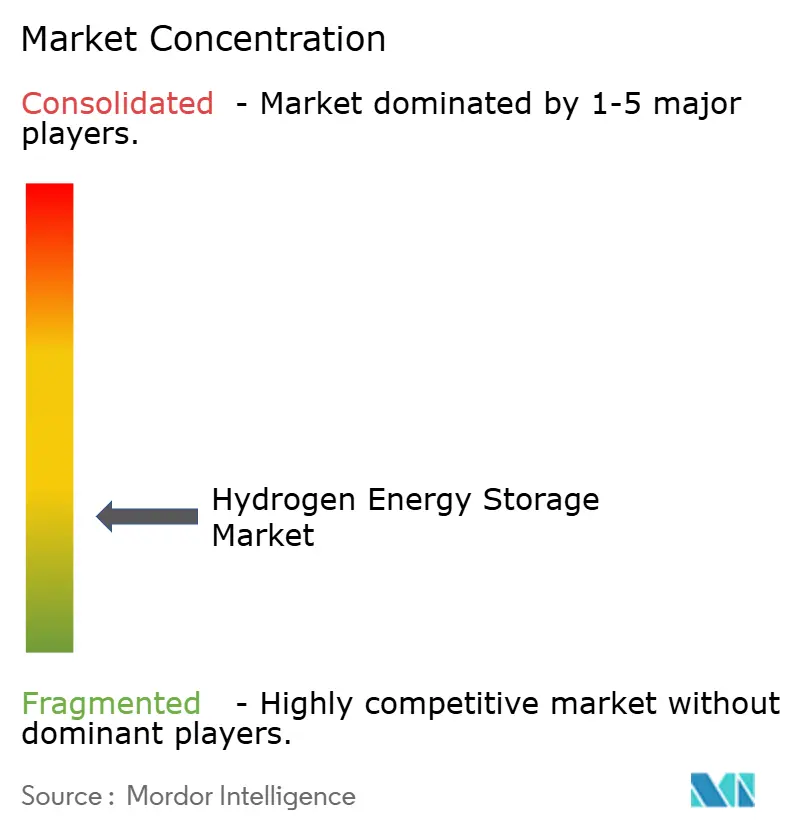
| Market Concentration | Low |
Major Players *Disclaimer: Major Players sorted in no particular order Image © Mordor Intelligence. Reuse requires attribution under CC BY 4.0. | |
Hydrogen Energy Storage Market Analysis by Mordor Intelligence
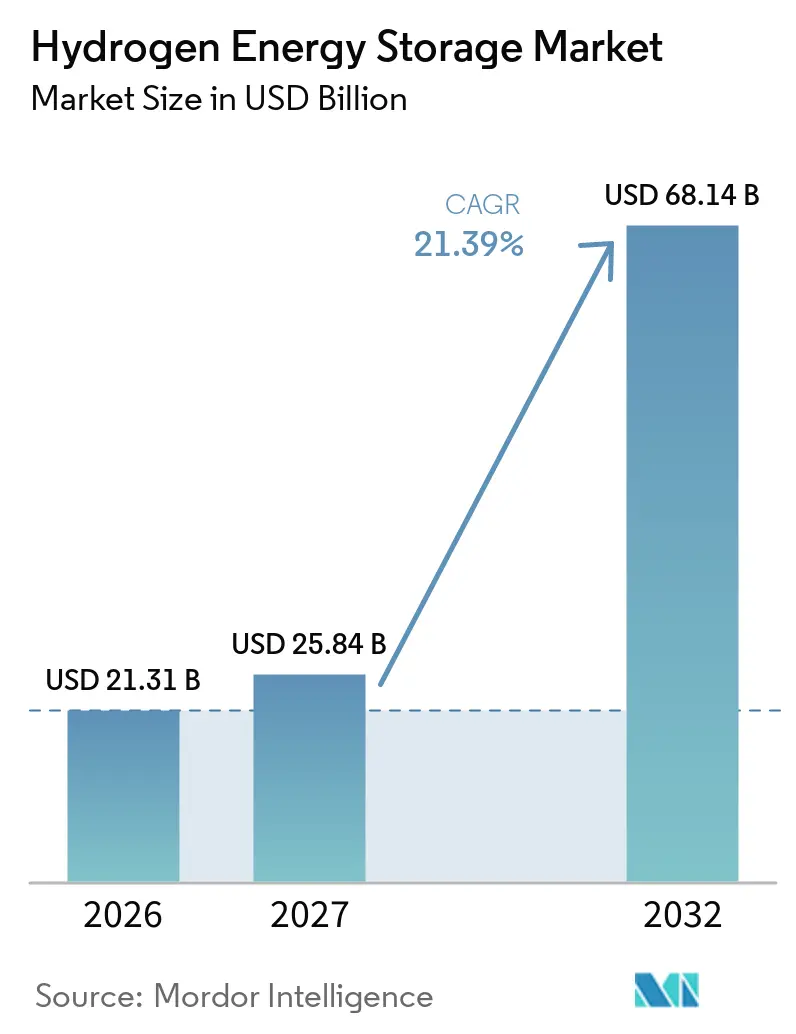
The Hydrogen Energy Storage Market size is projected to expand from USD 21.31 billion in 2026 and USD 25.84 billion in 2027 to USD 68.14 billion by 2032, at a CAGR of 21.39% between 2027 and 2032. The Global hydrogen energy storage market is supported by rising renewable generation, which can exceed grid absorption capacity during some periods. Industrial users are also seeking dependable hydrogen supply for steel, chemicals, refining, and cement. Long-term offtake agreements and public programs are improving the basis for project financing. Global hydrogen demand exceeded 100 million tons in 2025, while low-emissions production remained below 1% of total supply, leaving substantial room for new storage infrastructure.[1]
Key Report Takeaways
- By storage technology, compression held 41.3% of the Global hydrogen energy storage market share in 2026, while material-based storage is forecast to expand at a 22.1% CAGR through 2032.
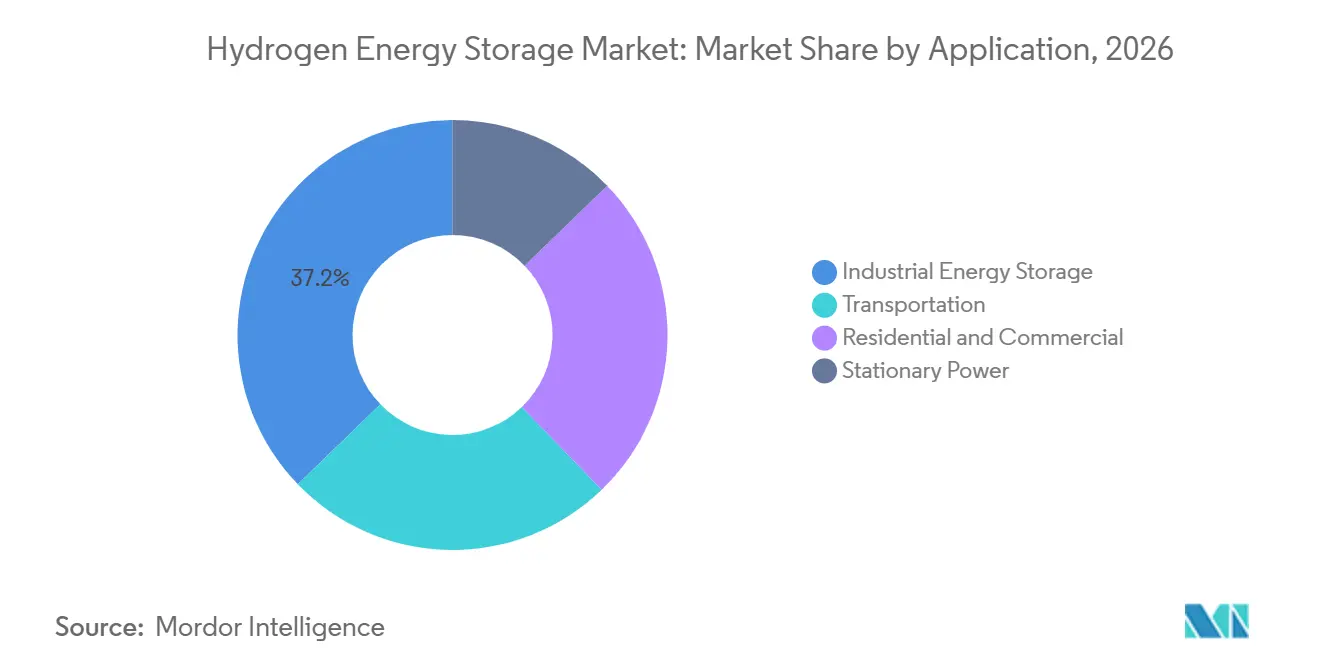
- By application, industrial energy storage accounted for 37.2% of the Global hydrogen energy storage market size in 2026, while stationary power recorded the highest projected CAGR at 24.4% through 2032.
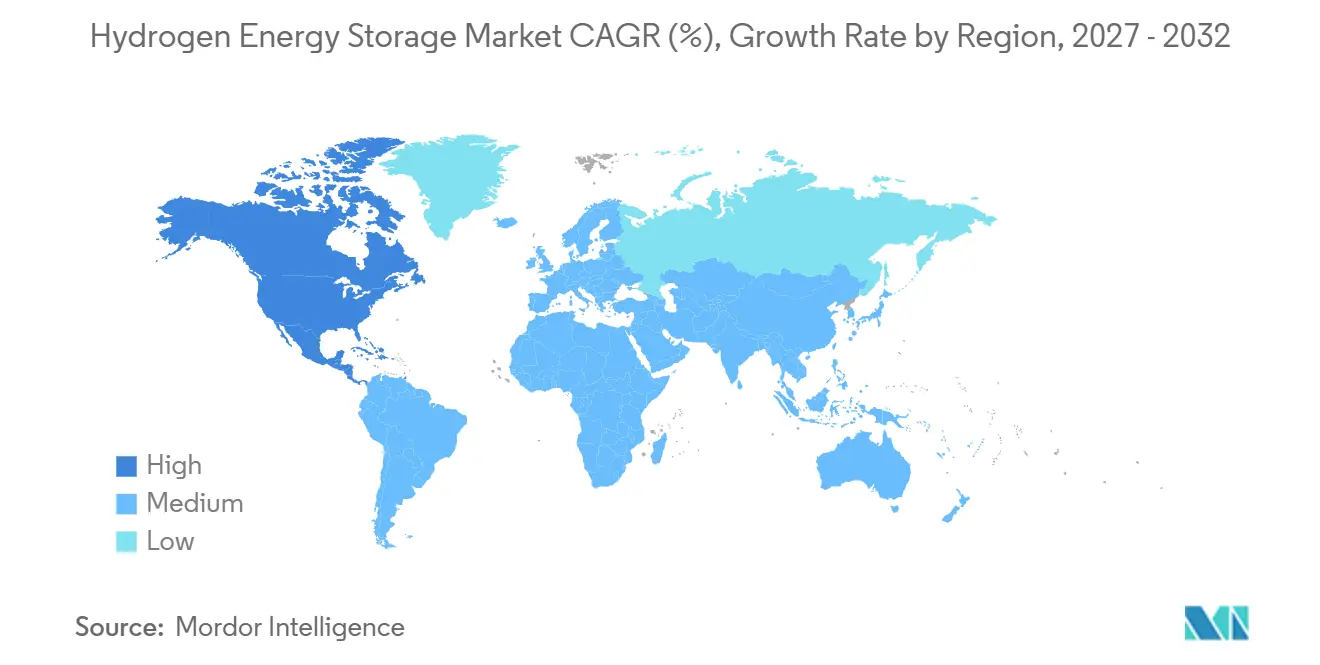
- By geography, Asia-Pacific held 39.4% of the Global hydrogen energy storage market share in 2026, while North America is forecast to grow at a 21.6% CAGR through 2032.
Note: Market numbers in this report are based on Mordor Intelligence's proprietary estimation framework, which combines nine months of actuals with Q4 projections for base year 2026.
Market Trends and Insights
Drivers Impact Analysis of Hydrogen Energy Storage Market*
| Driver | (~) % Impact on CAGR Forecast | Geographic Relevance | Impact Timeline |
|---|---|---|---|
| Renewable-Energy Curtailment and Long-Duration Storage Demand | +4.5% | Global, highest intensity in China, California, Germany, and Chile | Short term (≤ 2 years) |
| Industrial Decarbonization in Steel, Chemicals, Refining and Cement | +3.8% | Global, concentrated in the EU, China, India, Japan, and South Korea | Medium term (2-4 years) |
| Government Hydrogen Hubs, Subsidies and Clean-Energy Incentives | +3.2% | North America and Europe, with spillover to Asia-Pacific and the Middle East and Africa | Medium term (2-4 years) |
| Fuel-Cell Mobility and Hydrogen-Refueling Infrastructure Expansion | +2.8% | Asia-Pacific, especially Japan, South Korea, and China, with secondary relevance in Europe | Medium term (2-4 years) |
| Electrolyzer Cost Declines and Renewable-Power Integration | +3.1% | Global, with China leading and Europe and North America accelerating | Long term (≥ 4 years) |
| Co-Located Hydrogen Storage for Grid Congestion and Curtailment Management | +1.9% | Europe, especially Germany and the Netherlands, and high-renewable Asia-Pacific markets | Medium term (2-4 years) |
| Source: Mordor Intelligence | |||
Renewable-Energy Curtailment and Long-Duration Storage Demand
The Global hydrogen energy storage market benefits when renewable output cannot be fully absorbed by the grid. California curtailed 3.4 million MWh of utility-scale wind and solar generation in 2024, which was 29% higher than the prior year. China raised its national curtailment tolerance ceiling from 5% to 10%, while Tibet curtailed more than 30% of wind and solar output in the first half of 2025. Surplus electricity can reduce the effective power cost of electrolytic hydrogen and partly offset the lower efficiency of hydrogen storage. The same analysis projected curtailment of 8%, 13%, and 23% at variable renewable penetration rates of 45%, 65%, and 85%, respectively. Hydrogen Europe reported that global renewable curtailment volumes increased 55% in 2024, which strengthens the case for co-located electrolysis and underground storage.
Industrial Decarbonization in Steel, Chemicals, Refining and Cement
The Global hydrogen energy storage market has a strong near-term demand base in industrial feedstock substitution. Hydrogen-based direct reduced iron is one of the more advanced industrial applications. A 2026 Princeton study found that flexible hydrogen-based direct reduced iron and electric arc furnace operations could approach the cost of conventional steelmaking by 2035 under a USD 38 per tonne carbon price.[2] The study also found that multi-stage operational flexibility could lower the levelized cost of steel by 6% to 10%. Steel, chemicals, and refining consumed more than 57 million tonnes of hydrogen in 2025, but low-emissions hydrogen represented less than 1% of that volume.[3] These users require high throughput, continuous availability, and large reserves, which favors bulk storage over small tank systems.
Government Hydrogen Hubs, Subsidies and Clean-Energy Incentives
Public support remains important to the Global hydrogen energy storage market because it reduces development and risks. The U.S. Bipartisan Infrastructure Law authorized USD 8 billion for regional clean hydrogen hubs across 16 states.[4] The July 2025 One Big Beautiful Bill Act extended the Section 45V production tax credit to projects that begin construction before December 2027, while shortening the previous 2033 sunset. Japan selected 6 winners under its 15-year contract-for-difference scheme by May 2026, covering around 130,000 tons of annual low-emissions hydrogen production. By June 2026, 13 EU member states had completed national transposition of the Renewable Energy Directive III requirements for transport and industry. These measures provide clearer demand signals for storage assets.
Electrolyzer Cost Declines and Renewable-Power Integration
Lower electrolyzer costs and better renewable integration support the Global hydrogen energy storage market over the longer term. A peer-reviewed European dataset found learning rates of 32.1% for Proton Exchange Membrane (PEM)electrolyzers and 22.9% for alkaline electrolyzers. It estimated 2024 costs of EUR 1,303/kW for PEM equipment and EUR 1,188/kW for alkaline equipment, with lower costs expected as cumulative capacity rises. Direct use of curtailed renewable generation can reduce electricity costs, which account for 50% to 70% of the levelized cost of green hydrogen production. More than 200 projects had linked electrolyzers with solar generation and another 200 with wind generation by 2024. Co-located storage can help these projects retain value when generation and demand do not occur at the same time.
Restraints Impact Analysis of Hydrogen Energy Storage Market*
| Restraint | (~) % Impact on CAGR Forecast | Geographic Relevance | Impact Timeline |
|---|---|---|---|
| High Capital Cost of Electrolyzers, Storage and Reconversion Systems | -2.8% | Global, most acute in regions without access to Chinese equipment | Short term (≤ 2 years) |
| Low Round-Trip Efficiency Versus Battery Storage | -1.7% | Global, especially constraining for short- and medium-duration applications | Long term (≥ 4 years) |
| Hydrogen Leakage, Embrittlement and Safety-Compliance Requirements | -1.2% | Global, most significant for pipeline and underground storage applications | Medium term (2-4 years) |
| Lack of Standardized Commercial Models for Storage Capacity and Ancillary Services | -0.9% | Global, most acute where hydrogen pricing mechanisms are not established | Long term (≥ 4 years) |
| Source: Mordor Intelligence | |||
High Capital Cost of Electrolyzers, Storage and Reconversion Systems
The Global hydrogen energy storage market faces a high initial cost because each project needs production, storage, handling, and delivery infrastructure. These systems can include electrolyzers, vessels, compression or liquefaction equipment, reconversion equipment, and distribution links. A 25 MW PEM reference system had a levelized hydrogen energy storage cost of CNY 3.981/kWh in 2025, equal to USD 0.55/kWh, and capital expenditure plus stack replacement accounted for 66% of that cost. An Australian Renewable Energy Agency study found that hydrogen gas storage added 16% to 32% of project capital costs. The study projected a 7% to 18% reduction in storage-specific capital expenditure by 2035 under optimistic conditions. This burden is greatest where developers cannot access lower-cost equipment or established supply chains.
Low Round-Trip Efficiency Versus Battery Storage
The Global hydrogen energy storage market is constrained in short duration uses by lower round-trip efficiency than battery systems. Lithium-ion batteries deliver 85% to 95% AC-to-AC efficiency, while hydrogen systems return 30% to 40% under real operating conditions. This difference reflects losses in electrolysis, storage and handling, and fuel-cell reconversion. A 2025 assessment found that improving hydrogen system round-trip efficiency from 36% to 100% lowered total electricity system costs by only 7%. Batteries are therefore better positioned for 4- to 8-hour grid balancing, while hydrogen is suited to multi-week and seasonal needs. This division can lengthen cash-flow recovery periods and increase the value of long-term offtake contracts.
*Our forecasts treat driver/restraint impacts as directional, not additive. The impact forecasts reflect baseline growth, mix effects, and variable interactions.
Hydrogen Energy Storage Market Segment Analysis
By Storage Technology:
Compression Leads Current Deployment and Material-Based Storage Gains MomentumCompression held 41.3% of the Global hydrogen energy storage market size in 2026. The technology has been used for many years in ammonia, refining, and fuel-cell vehicle applications. Its position reflects proven equipment, established supply chains, and lower procurement risk for industrial buyers. Liquefaction is the second-largest storage technology and is advancing through large terminal investment. Kawasaki Heavy Industries and Japan Hydrogen Energy Co., Ltd. broke ground in November 2025 on a 50,000 kL commercial liquefied hydrogen terminal in Kawasaki City. The terminal is targeting commercial operations by 2030 under Japan’s New Energy and Industrial Technology Development Organization (NEDO) Green Innovation Fund.
Underground bulk storage remains a smaller revenue contributor, but it is important for high-volume applications. Sinopec commissioned a deep underground salt cavern storage site in Pingdingshan, Henan, in the first half of 2026. The facility has 1.5 million Nm³ of capacity and is 1,418 meters below ground. Material-based storage is forecast to grow at a 22.1% CAGR through 2032, the highest among storage technologies. Liquid organic hydrogen carriers can use existing liquid-fuel infrastructure and reduce the need for cryogenic or high-pressure handling. A 2026 study demonstrated reversible hydrogen release from reactive hydride composites below 393 K, which can support the use of lower-grade waste heat. The Global hydrogen energy storage industry is also testing carrier-based systems for distributed urban logistics.
By Application:
Industrial Demand Provides the Largest Base and Stationary Power Grows FastestIndustrial energy storage accounted for 37.2% of the Global hydrogen energy storage market size in 2026. Hydrogen is already central to refinery hydro processing, ammonia synthesis, methanol production, and emerging direct reduced iron production. These uses require dependable supply because disruption can impose high shutdown costs. Transportation is the second-largest application and includes hydrogen refueling for fuel-cell vehicles. Heavy-duty trucks and transit buses remain relevant because hydrogen can provide high energy density in uses where battery systems face operating constraints. Residential and commercial applications remain concentrated in Japan and South Korea, where combined heat and power installations continue to build a distributed base.
Stationary power is expected to expand at a 24.4% CAGR through 2032. The application is supported by fuel-cell grid integration and projects that replace diesel generation or peaking gas turbines. Equis began commercial operations in 2026 at a 40 MW fuel-cell power plant in Uijeongbu City, South Korea, under a 20-year offtake agreement with KEPCO. Ballard Power Systems received a 15 MW order for 150 stationary fuel-cell modules in June 2026. Wärtsilä also tested a large-scale 100% hydrogen engine supplying power to Spain’s national grid in June 2026. Long-term hydrogen supply contracts at fixed prices remain important for financing these systems.
Geography Analysis
Asia-Pacific accounted for 39.4% of the Global hydrogen energy storage market in 2026. China accounted for around 73% of new global electrolyzer installations during that year. China also commissioned the Pingdingshan salt cavern project in the first half of 2026. China Energy Investment Corp completed the Guohua Rudong project in Jiangsu in June 2026. The project pairs a 400 MW coastal solar plant with a 1,500 Nm³/hr hydrogen production unit and 500 kg/day of refueling capacity. Japan continued work on the Kawasaki liquefied hydrogen terminal, and South Korea started a program in June 2026 to localize liquefied hydrogen storage tank technology.
Europe’s development is shaped by ambitious policy targets and a smaller installed storage base. Germany identified a need for at least 15 TWh of hydrogen storage by 2035 and 76 to 80 TWh by 2045. Existing gas caverns could provide up to 36 TWh of the 2045 requirement. The H2CAST Etzel pilot injected around 90 tonnes of hydrogen into 2 salt caverns in March 2026 and achieved 100% gas-tightness. RWE Gas Storage West plans to begin filling its first commercial hydrogen cavern at Epe by the end of 2026, with commercial operations targeted for 2027. In Spain, Moeve broke ground on the 300 MW Onuba renewable hydrogen project in September 2026.
North America is forecast to record the highest regional CAGR at 21.6% through 2032. The ACES Delta project in Utah targets more than 300 GWh of hydrogen storage in 2 salt caverns. Canada expanded its Clean Hydrogen Investment Tax Credit in Budget 2025, while national hydrogen production capacity is expected to approach 3 million tonnes per year. South America is attracting export-focused green ammonia projects, particularly in Chile and Brazil. In the Middle East and Africa, Aramco acquired a 50% stake in Blue Hydrogen Industrial Gases Company in Saudi Arabia in 2025. Hyphen Hydrogen Energy also received a USD 5.93 million African Development Bank grant in September 2026 for its Namibia project.
Competitive Landscape
The Global hydrogen energy storage market is fragmented. Air Liquide, Linde, Air Products, and Chart Industries have established positions in compression and liquefaction. Their positions are supported by long-term supply relationships, logistics networks, and operating experience. Electrolyzer developers and material-storage specialists are competing in faster-growing areas of the Global hydrogen energy storage market. These companies often partner with energy firms and infrastructure funds rather than compete directly with industrial gas suppliers. The Global hydrogen energy storage industry therefore includes firms that compete on logistics and capital scale as well as firms that compete on equipment cost and system integration.
Nel ASA entered a framework agreement with Hydrasun in September 2026 to establish European assembly and integration capabilities for its MC Series containerized PEM platform. The arrangement moves the offering toward turnkey delivery as project sponsors seek integrated systems. ITM Power is building a 1 GW per year Chronos electrolyzer manufacturing line in Sheffield with GBP 86.5 million in public and equity capital. The investment addresses European manufacturing capacity and equipment cost competitiveness. The Global hydrogen energy storage market also has active competition in liquid organic hydrogen carrier systems and underground bulk storage. No single provider has established a dominant installed base in these areas.
Hydrogenious LOHC Technologies is among the providers using proprietary carrier chemistry to compete on infrastructure compatibility. Certification and design requirements can slow deployment of lower-cost systems in Europe and North America. IEC 62282 and ISO 22734 certification requirements apply to overseas market entry, while AMERICAN SOCIETY OF MECHANICAL ENGINEERS (ASME) B31.12 affects high-pressure system design. Chinese manufacturers are pursuing overseas manufacturing partnerships and third-party certification routes. Some suppliers are also offering energy-as-a-service models in stationary backup power and refueling. In these models, providers own the equipment and sell hydrogen by the kilogram rather than selling hardware. This approach shifts financing requirements from end users to specialized infrastructure funds.
Hydrogen Energy Storage Industry Leaders
-
Linde plc
-
Air Liquide
-
Air Products and Chemicals, Inc.
-
Chart Industries, Inc.
-
Nel ASA
- *Disclaimer: Major Players sorted in no particular order
Hydrogen Energy Storage Market Companies Covered in this Report
- Air Liquide
- Air Products and Chemicals, Inc.
- Chart Industries, Inc.
- Cummins Inc.
- ENGIE S.A.
- FuelCell Energy, Inc.
- GKN Hydrogen S.r.l.
- Hexagon Purus ASA
- Hydrogenious LOHC Technologies GmbH
- ITM Power PLC
- Iwatani Corporation
- Linde plc
- Luxfer Holdings PLC
- McPhy Energy S.A.
- Nel ASA
- Plug Power Inc.
- Siemens Energy AG
- Steelhead Composites, Inc.
- Vallourec S.A.
- Worthington Enterprises, Inc.
Recent Industry Developments in Hydrogen Energy Storage Market
- September 2026: Hy24 and COFIDES acquired a combined 29% stake in Moeve's Onuba project, which adds a large construction-stage development to the Global hydrogen energy storage market. The project has 300 MW of electrolysis capacity and EUR 1 billion+ in total investment, including EUR 304 million in EU NextGenerationEU subsidies. It officially broke ground in Huelva, Spain, establishing the continent’s most advanced green hydrogen storage and production complex at construction stage.
- September 2026: Hy24 signed an agreement to acquire Uniper's 20% stake in OPAL, a 470 km regulated hydrogen transmission corridor being repurposed as part of Germany's Hydrogen Core Network. The move extends the Global hydrogen energy storage market value chain from production into grid-level transport and marks Hy24's first investment in a hydrogen transmission infrastructure asset.
- September 2026: EWE awarded Bilfinger a contract to supply the hydrogen treatment plant at its Huntorf cavern storage facility in Lower Saxony, a core element of the Clean Hydrogen Coastline IPCEI project. The facility is expected to connect to Germany's national hydrogen core network by 2028 and will support the Global hydrogen energy storage market by buffering production, transport, and consumption fluctuations.
- August 2026: Equis commenced commercial operations of South Korea’s largest 40 MW hydrogen fuel cell power plant in Uijeongbu City under the Hydrogen Portfolio Standards regime. The facility is contracted with KEPCO under a 20-year revenue offtake agreement secured through South Korea’s inaugural HPS auction.
Global Hydrogen Energy Storage Market Report Scope
The hydrogen energy storage market refers to the global economic sector dedicated to the development, manufacturing, deployment, and operation of technologies used to capture, store, and discharge energy in the form of hydrogen. Surplus electricity, primarily from intermittent renewable sources such as solar and wind, is converted into hydrogen gas (H2) via water electrolysis, a process commonly referred to as Power-to-Gas (P2G). The stored H2 can be used as a clean fuel for transportation, converted back into electricity using fuel cells or turbines, or utilized as a feedstock for heavy industries such as steel and chemical manufacturing.
The global hydrogen energy storage market report is segmented by storage technology into compression, liquefaction, material-based storage, and underground bulk storage. Based on application, the market is divided into stationary power, transportation, industrial energy storage, and residential and commercial uses. The report also covers the market size and forecasts for the global hydrogen energy storage market across 26 countries in key regions. For each segment, the market sizing and forecasts have been provided on the basis of value (USD).
Segmentation Overview
| Compression |
| Liquefaction |
| Material-Based Storage |
| Underground Bulk Storage |
| Stationary Power |
| Transportation |
| Industrial Energy Storage |
| Residential and Commercial |
| North America | United States |
| Canada | |
| Mexico | |
| Europe | Germany |
| France | |
| Italy | |
| Spain | |
| United Kingdom | |
| Poland | |
| Russia | |
| Rest of Europe | |
| Asia-Pacific | China |
| India | |
| Japan | |
| South Korea | |
| Australia | |
| Indonesia | |
| Vietnam | |
| Thailand | |
| Rest of Asia-Pacific | |
| South America | Brazil |
| Argentina | |
| Chile | |
| Rest of South America | |
| Middle East and Africa | Saudi Arabia |
| United Arab Emirates | |
| Egypt | |
| South Africa | |
| Morocco | |
| Rest of Middle East and Africa |
| By Storage Technology | Compression | |
| Liquefaction | ||
| Material-Based Storage | ||
| Underground Bulk Storage | ||
| By Application | Stationary Power | |
| Transportation | ||
| Industrial Energy Storage | ||
| Residential and Commercial | ||
| By Geography | North America | United States |
| Canada | ||
| Mexico | ||
| Europe | Germany | |
| France | ||
| Italy | ||
| Spain | ||
| United Kingdom | ||
| Poland | ||
| Russia | ||
| Rest of Europe | ||
| Asia-Pacific | China | |
| India | ||
| Japan | ||
| South Korea | ||
| Australia | ||
| Indonesia | ||
| Vietnam | ||
| Thailand | ||
| Rest of Asia-Pacific | ||
| South America | Brazil | |
| Argentina | ||
| Chile | ||
| Rest of South America | ||
| Middle East and Africa | Saudi Arabia | |
| United Arab Emirates | ||
| Egypt | ||
| South Africa | ||
| Morocco | ||
| Rest of Middle East and Africa | ||
Key Questions Answered in the Report
What is the projected value of the Global hydrogen energy storage market by 2032?
The Global hydrogen energy storage market is forecast to reach USD 68.14 billion by 2032, from USD 25.84 billion in 2027, at a 21.39% CAGR.
Which storage technology leads hydrogen energy storage deployment?
Compression led deployment with a 41.3% share in 2026 because it has proven equipment, established supply chains, and broad industrial use.
Which hydrogen energy storage application is growing fastest?
Stationary power is forecast to grow at a 24.4% CAGR through 2032, supported by fuel-cell integration and backup power projects.
Which region has the largest hydrogen energy storage presence?
Asia-Pacific held a 39.4% share in 2026, supported by China's electrolyzer scale and regional investment in storage infrastructure.
Why does renewable curtailment support hydrogen storage projects?
Surplus renewable electricity can lower electrolytic hydrogen production costs and create a use case for long-duration storage.
What is limiting deployment of hydrogen energy storage systems?
High project capital costs and lower round-trip efficiency than batteries constrain short-duration applications and can lengthen investment recovery periods.