
Hydrogen-Based Steelmaking Refractories Market Size and Share
Market Overview
| Study Period | 2022 - 2032 |
|---|---|
| Market Size (2027) | USD 356.72 Million |
| Market Size (2032) | USD 540.60 Million |
| Growth Rate (2027 - 2032) | 8.67 % |
| Fastest Growing Market | Europe |
| Largest Market | Asia-Pacific |
| Market Concentration | Medium |
Major Players *Disclaimer: Major Players sorted in no particular order Image © Mordor Intelligence. Reuse requires attribution under CC BY 4.0. | |
Hydrogen-Based Steelmaking Refractories Market Analysis by Mordor Intelligence
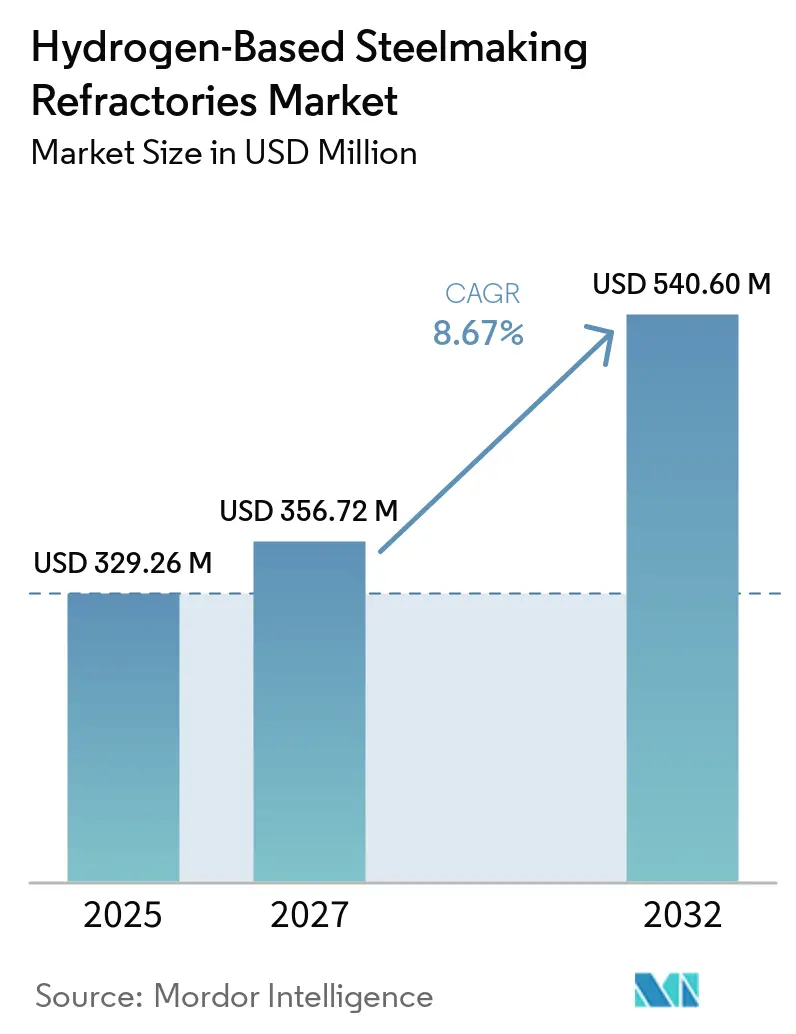
The hydrogen-based steelmaking refractories market was valued at USD 329.26 million in 2026 and is estimated to grow from USD 356.72 million in 2027 to USD 540.60 million by 2032, at a CAGR of 8.67% during the forecast period (2027-2032). The hydrogen-based steelmaking refractories market is being shaped by the steel industry's shift from blast furnace and basic oxygen furnace routes to direct reduced iron (DRI) and electric arc furnace routes that can use hydrogen. Green hydrogen DRI can reduce carbon dioxide emissions by more than 80% compared with conventional ironmaking, but the process exposes linings to higher hydrogen partial pressure, water vapor, and varying chemical wear conditions. These conditions make material qualification a central purchasing requirement rather than a routine specification decision. The EU Carbon Border Adjustment Mechanism regime came into full effect on January 1, 2026, and its carbon-cost framework is directing investment toward lower-emission steel routes in markets serving the European Union. The hydrogen-based steelmaking refractories market benefits when DRI projects advance from engineering into construction, as linings are installed before production begins and replaced through scheduled maintenance cycles.
Key Report Takeaways
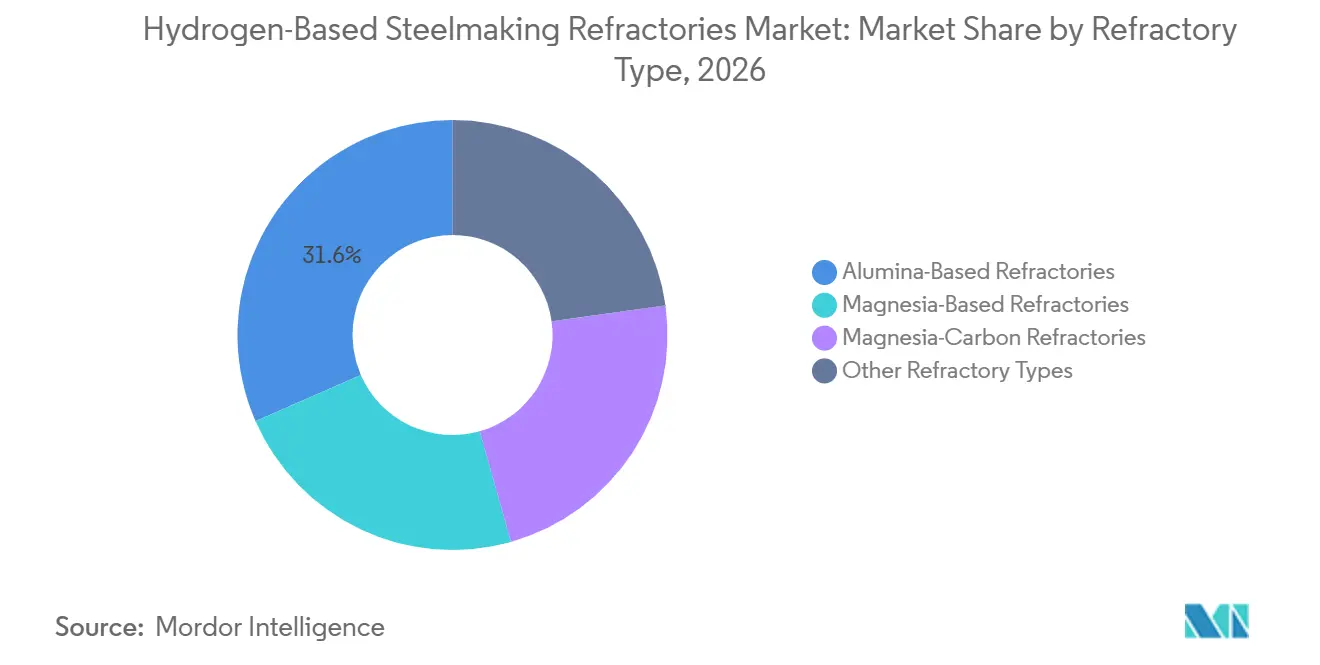
- By refractory type, alumina-based refractories held 31.56% of the hydrogen-based steelmaking refractories market share in 2026, while magnesia-carbon refractories are forecast to grow at a 9.34% CAGR through 2032.
- By form, bricks and shapes held 34.78% of the hydrogen-based steelmaking refractories market share in 2026, while precast refractories are forecast to grow at a 9.65% CAGR through 2032.
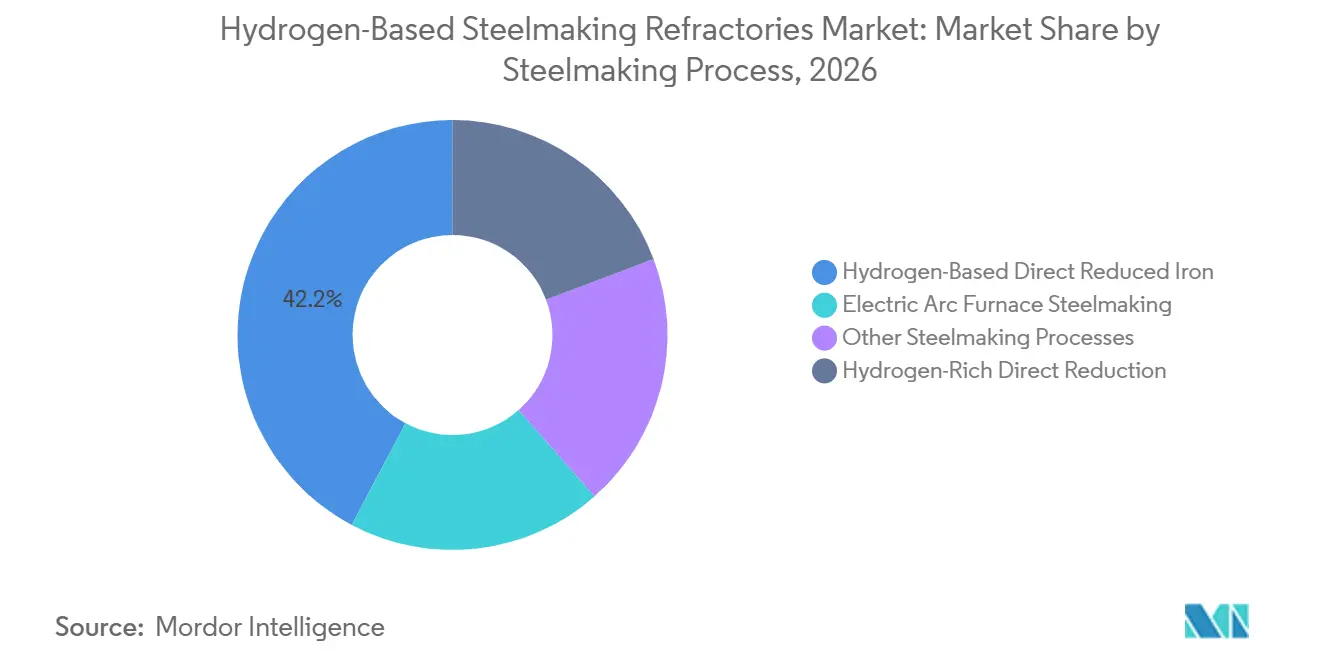
- By steelmaking process, Hydrogen-Based Direct Reduced Iron (DRI) held 42.23% of the hydrogen-based steelmaking refractories market share in 2026 and is forecast to grow at a 10.56% CAGR through 2032.
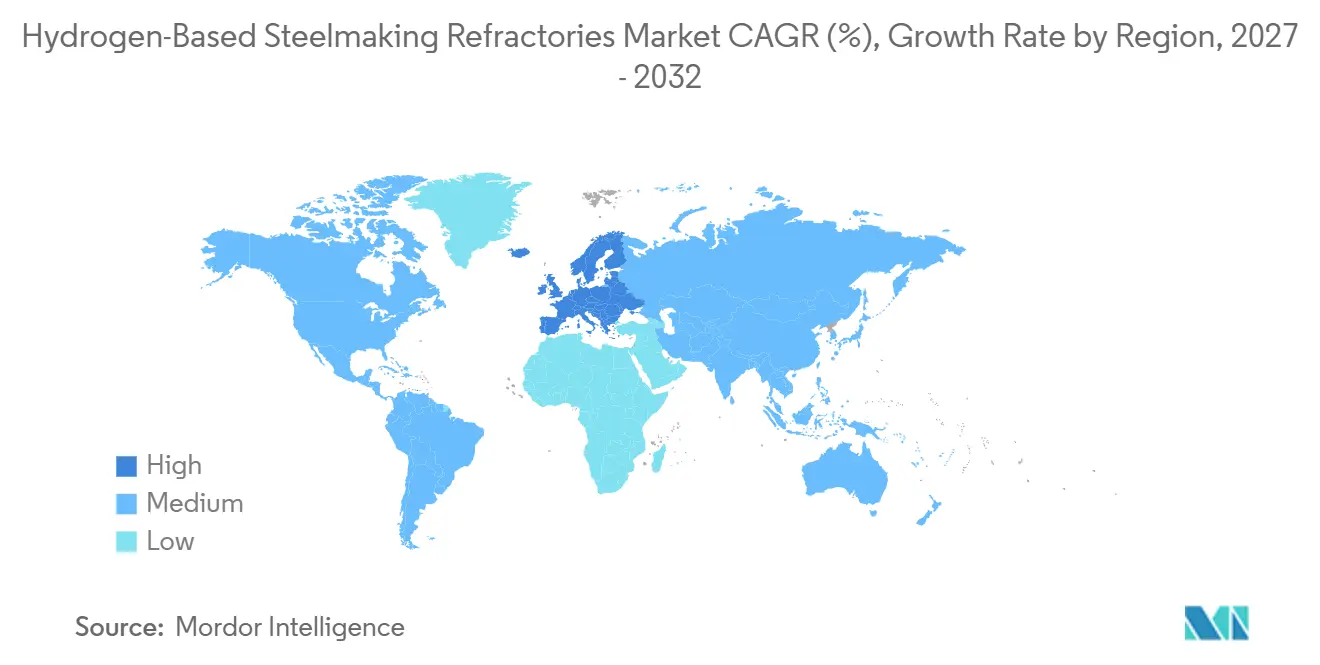
- By geography, Asia-Pacific held 39.17% of the hydrogen-based steelmaking refractories market share in 2026, while Europe is forecast to grow at a 10.11% CAGR through 2032.
Note: Market numbers in this report are based on Mordor Intelligence's proprietary estimation framework, which combines nine months of actuals with Q4 projections for base year 2026.
Global Hydrogen-Based Steelmaking Refractories Market Trends and Insights
Drivers Impact Analysis*
| Drivers | (~) % Impact on CAGR Forecast | Geographic Relevance | Impact Timeline |
|---|---|---|---|
| Decarbonization of Primary Steelmaking | +3.5% | Global | Long term (≥ 4 years) |
| Expansion of Hydrogen-Based Direct Reduced Iron Capacity | +2.2% | Europe, Asia-Pacific, North America | Medium term (2-4 years) |
| Growth of DRI-Electric Arc Furnace (EAF) Steelmaking Routes | +1.4% | Asia-Pacific, North America | Medium term (2-4 years) |
| Demand for Longer-Life Refractory Linings | +0.9% | Global | Short term (≤ 2 years) |
| Electrification and Modernization of Steel Plants | +0.8% | Asia-Pacific, Europe | Long term (≥ 4 years) |
| Source: Mordor Intelligence | |||
Decarbonization of Primary Steelmaking
According to research published in 2025, steel accounted for 8% to 10% of global carbon dioxide emissions and 5% of EU emissions. The Carbon Border Adjustment Mechanism (CBAM) and the planned phaseout of free allowances are changing the cost basis for steel production serving the European Union. The hydrogen-based steelmaking refractories market is seeing earlier demand as operators need to test linings before new Direct Reduced Iron (DRI) units begin operating. Conventional grades cannot be used directly in a hydrogen atmosphere without exposure to silica reduction, abrasion, and accelerated wear. Qualification programs typically take 18 to 24 months, which favors suppliers that enter projects before final equipment commissioning. Japan's New Energy and Industrial Technology Development Organization (NEDO) Green Innovation Fund supports the GREINS work of Nippon Steel, JFE Steel, and Kobe Steel on hydrogen shaft furnaces and electric melting technologies.
Expansion of Hydrogen-Based Direct Reduced Iron Capacity
DRI represented 9% of global ironmaking capacity but nearly 40% of capacity under development, indicating that investment activity is more weighted toward DRI than the current installed base. In June 2026, Midrex was selected to supply a 2.5 million metric ton per year Hot Direct Reduced Iron (HDRI) and Hot Briquetted Iron (HBI) plant at U.S. Steel's Big River Steel Works, with first production targeted for 2029. Hyundai Steel also selected ENERGIRON technology for a 2.5-million-metric-ton DRI facility in Louisiana[1]. Each shaft furnace requires separate refractory designs across its thermal zones. Midrex systems operate near 950°C and 1.5 bar, while ENERGIRON configurations can reach 1,150°C and 8 bar. The hydrogen-based steelmaking refractories market has a multiyear order pipeline as these projects move beyond the feasibility stage.
Growth of DRI-Electric Arc Furnace (EAF) Steelmaking Routes
Electric arc furnaces using more than 20% direct reduced iron (DRI) in their charge mix face higher slag quantities, greater iron oxide penetration, and faster lining wear than scrap-only operations. This increases the demand for higher-grade magnesia-carbon bricks and more frequent gunning maintenance. The effect extends the hydrogen-based steelmaking refractories market beyond shaft furnaces to the downstream steelmaking stage. In July 2026, JFE Steel produced Japan's first green-hydrogen reduced iron at its East Japan Works, using hydrogen transported from Yamanashi Prefecture. In March 2026, Nippon Steel's Hasaki research furnace completed 72 consecutive hours of 100% hydrogen operation. These trials provide operating evidence for refractory systems under full-hydrogen conditions.
Demand for Longer-Life Refractory Linings
Hydrogen can reduce oxide phases in a refractory lining, and long-term industrial wear patterns are still being established. As a result, operators place greater value on grades that can reduce unplanned relining outages. A relining interruption can halt production for several days and disrupt linked hydrogen supply arrangements. This is shifting the hydrogen-based steelmaking refractories industry from product purchases toward performance-based service arrangements. RHI Magnesita has developed its 4PRO performance-contract approach and maintains hydrogen-atmosphere testing capability at its Leoben technology center. Calderys found that high-alumina dense bricks performed better than castables under DRI hydrogen exposure, which affects the recommendations made to equipment suppliers.
Restraints Impact Analysis*
| Restraints | (~) % Impact on CAGR Forecast | Geographic Relevance | Impact Timeline |
|---|---|---|---|
| High Cost and Limited Availability of Low-Carbon Hydrogen | -1.6% | Global, particularly Europe and North America | Medium term (2-4 years) |
| Volatility of Magnesia, Alumina, Graphite, and Bauxite Supply | -1.1% | Global, concentrated in China, Guinea, and India | Medium term (2-4 years) |
| Hydrogen-Induced Silica Reduction and Refractory Corrosion | -0.7% | Global | Short term (≤ 2 years) |
| Source: Mordor Intelligence | |||
High Cost and Limited Availability of Low-Carbon Hydrogen
The cost and availability of low-carbon hydrogen determine how quickly planned Direct Reduced Iron (DRI) capacity converts into construction. A 2025 UC Berkeley technical review found that adapted DRI furnaces may require 50% to 70% higher cooling gas flow rates when the hydrogen content exceeds 70%[2]. Higher cooling requirements increase both capital and operating costs for a project. Delays in project financing or hydrogen supply postpone demand for refractory installation and maintenance. This creates a near-term constraint for the hydrogen-based steelmaking refractories market even when the longer-term project pipeline is strong. Producers also need to manage order timing because qualifying materials do not ensure that a plant will reach its planned startup date.
Volatility of Magnesia, Alumina, Graphite, and Bauxite Supply
Magnesia-carbon products used in DRI-Electric Arc Furnace (EAF) routes depend on raw materials that are subject to concentrated supply conditions. U.S. natural graphite imports were estimated at 79,000 tons in 2025, with China supplying a significant share of flake and high-purity graphite grades. China's graphite export control framework adds a policy risk alongside price and availability risk. Higher-purity grades are important where operators seek lining performance under more demanding DRI-EAF conditions. Raw material volatility can squeeze suppliers' margins or raise the delivered cost of upgraded products. The hydrogen-based steelmaking refractories market must therefore balance performance specifications with secure mineral sourcing.
*Our forecasts treat driver/restraint impacts as directional, not additive. The impact forecasts reflect baseline growth, mix effects, and variable interactions.
Segment Analysis
By Refractory Type: High-Alumina Grades Lead, Magnesia-Carbon Accelerates on EAF Demand
Alumina-based refractories held 31.56% of the hydrogen-based steelmaking refractories market share in 2026, making them the largest refractory type. High-alumina dense bricks reduce silica weight loss in hydrogen-rich reduction atmospheres and retain structural integrity in DRI shaft furnace conditions. Increasing alumina content can reduce silica-related wear but can also increase lining weight and alter heat-transfer coefficients. Magnesia-based grades remain relevant in ladle and tundish applications across the DRI-EAF sequence.
Magnesia-carbon refractories are forecast to expand at a 9.34% CAGR from 2027 to 2032, the fastest growth among refractory types. Their demand is centered on downstream EAF vessels rather than DRI shaft furnace linings. DRI-charged EAFs operate with more slag and more oxidizing conditions than scrap-only furnaces. RHI Magnesita has commercialized tempered MgO-C bricks with up to 30% circular raw material content and performance comparable to standard high-wear grades. Other specialty products, including phosphate-free high-alumina and MgO-phosphate grades, serve niche applications in DRI and experimental reduction.

By Form: Bricks Dominate, Precast Rises on Qualification Advantages
Bricks and shapes accounted for 34.78% of the hydrogen-based steelmaking refractories market share in 2026, supported by their pre-fired stability and consistent geometry. They are used in primary DRI shaft furnace working zones and EAF hot spots. Monolithic products remain important for complex geometries and targeted repairs. A 2025 study found that monolithic castables had lower resistance than dense bricks to hydrogen-driven oxide reduction at high temperatures.
Precast refractories are projected to grow at a 9.65% CAGR from 2027 to 2032. These pre-sintered components can be tested under controlled hydrogen-atmosphere conditions before delivery, which lowers installation risk for first-of-its-kind DRI units. Voestalpine's HY4SMELT project began construction in September 2025 and combines hydrogen-based direct reduction with electric smelting. Faster installation during planned relining outages is valuable for EAFs that process 2 to 3 million tons per year. The hydrogen-based steelmaking refractories market favors forms that combine verified material properties with shorter turnaround requirements.
By Steelmaking Process: Hydrogen-Based DRI Is the Market’s Structural Core
Hydrogen-based DRI held 42.23% of the hydrogen-based steelmaking refractories market share in 2026 and is forecast to grow at a 10.56% CAGR through 2032. Hydrogen changes the reduction profile in a shaft furnace and affects temperature gradients across the lining. It can also reduce silica, iron oxide, and phosphorus pentoxide phases, requiring the lining concept to avoid silica-bearing phases. Nippon Steel's Hasaki pilot reached 72 hours of continuous 100% hydrogen operation in March 2024. The Midrex selection for U.S. Steel's planned HDRI facility confirms that commercial investment is developing alongside pilot operations.
Hydrogen-rich direct reduction is the transition route for plants, increasing hydrogen use from the current 30% to 70% ranges toward 100% hydrogen targets. Each increase in hydrogen content requires reassessment of existing lining grades. Electric arc furnace steelmaking follows both DRI routes and must accommodate changing combinations of DRI and scrap charge. A 2025 Journal of Sustainable Metallurgy study found that higher hydrogen-DRI charge shares can increase slag output and the risk of refractory dissolution. Hydrogen plasma smelting reduction remains at the pilot stage, where 2026 experimental work identified MgO-phosphate refractory as more resistant than magnesia-alumina spinel in FeO-rich slag.
Geography Analysis
Asia-Pacific held 39.17% of the hydrogen-based steelmaking refractories market share in 2026. China, India, Japan, and South Korea account for a major share of crude steel production. Japan is advancing hydrogen-reduced iron technology through funded pilot programs. JFE Steel produced Japan's first green-hydrogen reduced iron in July 2026, and Nippon Steel's Hasaki pilot completed 72 hours of continuous hydrogen operation in March 2026. Calderys commissioned an acidic monolithics line at its CAPES facility in Odisha in April 2025, while RHI Magnesita and Khemka Refractories launched MINPRO in Odisha in June 2026.
Europe is forecast to grow at a 10.11% CAGR from 2027 to 2032, the highest regional rate. The Carbon Border Adjustment Mechanism (CBAM) and the EU Emissions Trading System (ETS) support investment in lower-emission steelmaking across the region. Stegra's Boden facility is a fully funded, large-scale green steel project and a defined demand location for hydrogen-specific linings. France's GravitHy project selected Energiron Zero Reformer technology for a 2 million-ton-per-year HBI project with on-site green hydrogen production. Germany, the Nordic countries, France, Italy, and the United Kingdom are key destinations for demand.
North America's market development is centered on planned DRI investments by U.S. Steel and Hyundai Steel. RHI Magnesita established a recycling joint venture with BPI in the United States in June 2025. In South America, growth is driven by Brazil, where Krosaki Harima formed a joint venture with IBAR for tap-hole clay and related refractory products. The Middle East and Africa present long-term potential through hydrogen-based hot briquetted iron (HBI) development and new regional manufacturing capacity. Calderys' Jubail facility is scheduled to serve iron, steel, aluminum, and cement producers through its partnership with Binzagr.
Competitive Landscape
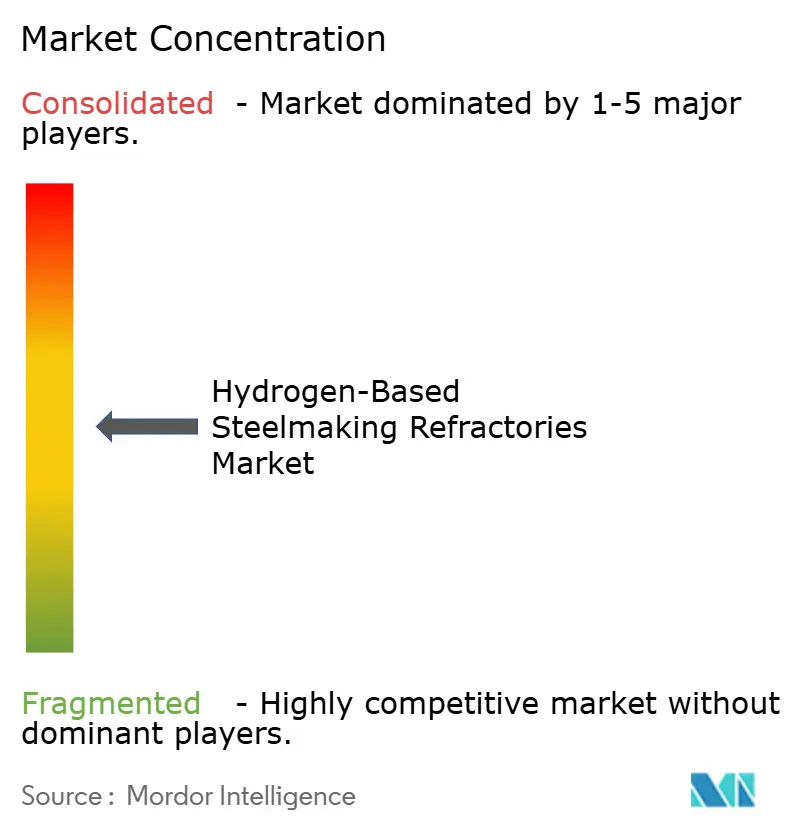
The hydrogen-based steelmaking refractories market is moderately fragmented, with RHI Magnesita, Calderys (including Harbison-Walker International), and Vesuvius forming the leading group. Their positions are supported by manufacturing scale, technical development capability, and access to hydrogen-atmosphere testing facilities. Krosaki Harima, Refratechnik, INTOCAST AG, and Shinagawa Refra serve as important regional specialists. RHI Magnesita reported a 42% adjusted EBITA improvement on a constant-currency basis in the first half of 2026, attributing the performance to its steel operations, its 4PRO model, and recycling initiatives. The company's scale supports both material development and maintenance contracts.
On March 27, 2025, RHI Magnesita operated an industrial refractory kiln on green hydrogen at Marktredwitz, Germany, at temperatures up to 1,500°C. In November 2025, Vesuvius completed the acquisition of Morgan Advanced Materials' Molten Metal Systems business for an enterprise value of GBP 92.7 million. In August 2025, Nippon Steel announced a tender offer to acquire full ownership of Krosaki Harima for JPY 75.8 billion. The proposed transaction aims to accelerate the co-development of EAF refractories for hydrogen-DRI charge and to integrate maintenance activities. These developments indicate that technology development, geographic reach, and supply integration are key competitive factors in this market.
Opportunities remain in DRI-specific precast systems and digitally integrated lining monitoring. Smaller suppliers face higher entry barriers, as hydrogen-atmosphere qualification requires specialized facilities and lacks standardization within ISO or equivalent certification frameworks. Raw material concentration presents an additional procurement risk.
Hydrogen-Based Steelmaking Refractories Industry Leaders
-
RHI Magnesita
-
Vesuvius
-
Calderys
-
Saint-Gobain
-
Krosaki Harima Corporation
- *Disclaimer: Major Players sorted in no particular order
Recent Industry Developments
- September 2026: Jacobs Solutions extended its project management role on thyssenkrupp Steel's 2.5 million ton per year hydrogen-capable DRI plant in Duisburg, Germany. Construction is progressing despite an adjusted hydrogen ramp-up timeline. The project, backed jointly by the German federal government and the state of North Rhine-Westphalia, requires a full hydrogen-grade refractory installation across the DRI shaft and the downstream open-bath furnace.
- June 2026: Stegra closed an additional EUR 1.4 billion (~USD 1.56 billion) in project financing for its green hydrogen steel facility in Boden, Sweden, reaching full funding. It is the first large-scale European green steel project to achieve this milestone. The facility is expected to be a primary demand anchor for hydrogen-atmosphere DRI refractories in northern Europe.
Global Hydrogen-Based Steelmaking Refractories Market Report Scope
Hydrogen-based steelmaking refractories are specialized, heat-resistant ceramic lining materials used inside furnaces, such as Direct Reduction Iron (DRI) shaft furnaces and Electric Arc Furnaces (EAF), where carbon-based fuels are partially or completely replaced by hydrogen gas (H₂) to produce green steel.
The hydrogen-based steelmaking refractories market is segmented by refractory type, form, steelmaking process, and geography. By refractory type, the market is segmented into alumina-based refractories, magnesia-based refractories, magnesia-carbon refractories, and other refractory types. By form, the market is segmented into bricks and shapes, monolithic refractories, precast refractories, and other forms. By steelmaking process, the market is segmented into hydrogen-based direct reduced iron, hydrogen-rich direct reduction, electric arc furnace steelmaking, and other steelmaking processes. The report also covers market sizes and forecasts for the global hydrogen-based steelmaking refractories across 15 countries in major regions. The market sizes and forecasts are provided in terms of value (USD).
| Alumina-Based Refractories |
| Magnesia-Based Refractories |
| Magnesia-Carbon Refractories |
| Other Refractory Types |
| Bricks and Shapes |
| Monolithic Refractories |
| Precast Refractories |
| Other Forms |
| Hydrogen-Based Direct Reduced Iron |
| Hydrogen-Rich Direct Reduction |
| Electric Arc Furnace Steelmaking |
| Other Steelmaking Processes |
| Asia-Pacific | China |
| India | |
| Japan | |
| South Korea | |
| ASEAN Countries | |
| Rest of Asia-Pacific | |
| North America | United States |
| Canada | |
| Mexico | |
| Europe | Germany |
| United Kingdom | |
| France | |
| Italy | |
| NORDIC Countries | |
| Rest of Europe | |
| South America | Brazil |
| Argentina | |
| Rest of South America | |
| Middle East and Africa | Saudi Arabia |
| South Africa | |
| Rest of Middle East and Africa |
| By Refractory Type | Alumina-Based Refractories | |
| Magnesia-Based Refractories | ||
| Magnesia-Carbon Refractories | ||
| Other Refractory Types | ||
| By Form | Bricks and Shapes | |
| Monolithic Refractories | ||
| Precast Refractories | ||
| Other Forms | ||
| By Steelmaking Process | Hydrogen-Based Direct Reduced Iron | |
| Hydrogen-Rich Direct Reduction | ||
| Electric Arc Furnace Steelmaking | ||
| Other Steelmaking Processes | ||
| By Geography | Asia-Pacific | China |
| India | ||
| Japan | ||
| South Korea | ||
| ASEAN Countries | ||
| Rest of Asia-Pacific | ||
| North America | United States | |
| Canada | ||
| Mexico | ||
| Europe | Germany | |
| United Kingdom | ||
| France | ||
| Italy | ||
| NORDIC Countries | ||
| Rest of Europe | ||
| South America | Brazil | |
| Argentina | ||
| Rest of South America | ||
| Middle East and Africa | Saudi Arabia | |
| South Africa | ||
| Rest of Middle East and Africa | ||
Key Questions Answered in the Report
What is current market size of Hydrogen-Based Steelmaking Refractories Market?
The hydrogen-based steelmaking refractories market was valued at USD 329.26 million in 2026 and is estimated to grow from USD 356.72 million in 2027 to USD 540.60 million by 2032, at a CAGR of 8.67% during the forecast period (2027-2032).
Which refractory type leads to hydrogen-based steelmaking applications?
Alumina-based refractories lead with a 31.56% share in 2026 because high-alumina dense bricks resist hydrogen-related silica reduction.
Which form is growing fastest for hydrogen DRI applications?
Precast refractories are projected to expand at a 9.65% CAGR through 2032 because they can be tested before installation.
Which steelmaking process has the highest growth outlook?
Hydrogen-based DRI is the largest process segment and is forecast to grow at a 10.56% CAGR through 2032.