
Hydrogen Aircraft Market Size and Share
Market Overview
| Study Period | 2020 - 2032 |
|---|---|
| Market Size (2027) | USD 0.76 Billion |
| Market Size (2032) | USD 4.34 Billion |
| Growth Rate (2027 - 2032) | 41.69 % |
| Fastest Growing Market | Asia-Pacific |
| Largest Market | Europe |
| Market Concentration | Low |
Major Players *Disclaimer: Major Players sorted in no particular order Image © Mordor Intelligence. Reuse requires attribution under CC BY 4.0. | |
Hydrogen Aircraft Market Analysis by Mordor Intelligence
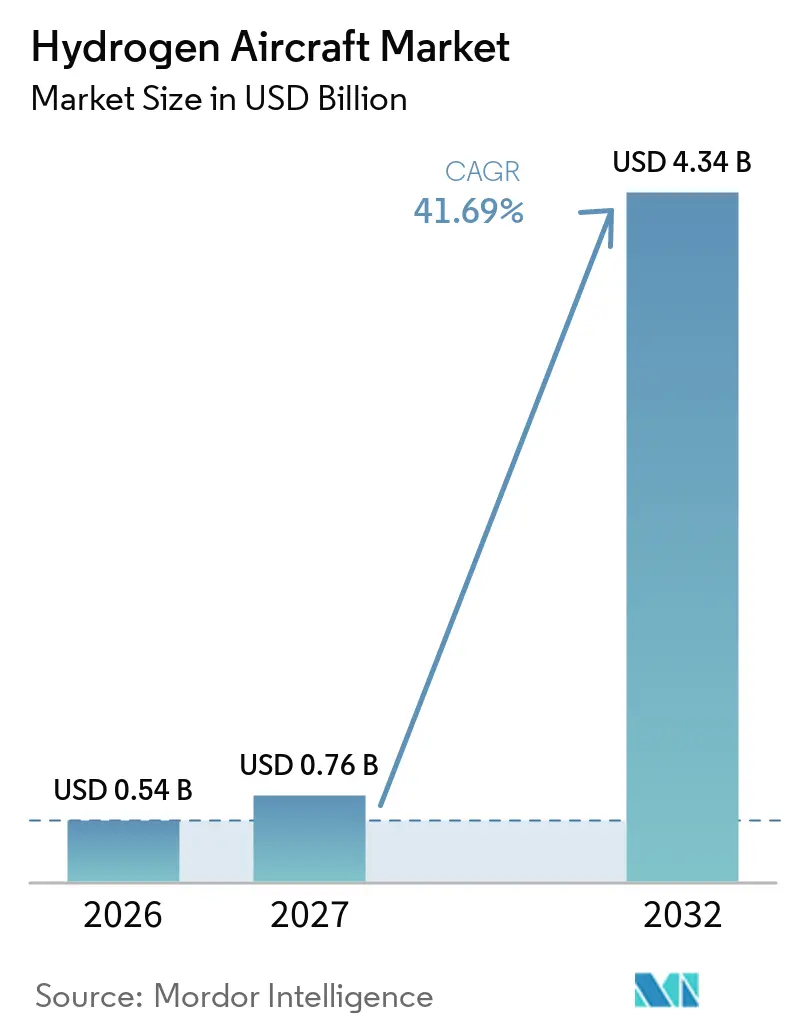
The hydrogen aircraft market size was valued at USD 0.54 billion in 2026 and is forecast to grow from USD 0.76 billion in 2027 to reach USD 4.34 billion by 2032, at a 41.69% CAGR during the forecast period (2027-2032). Growth reflects aviation decarbonization rules, fuel-cell progress, and public funding for flight demonstrations. Hydrogen offers a weight advantage over conventional fuel, which can protect range and payload where batteries remain heavy. Early activity centers on short routes, urban air mobility, and unmanned systems because these uses need less fuel and focused airport infrastructure. Larger regional aircraft are moving into testing and certification work. Commercial timing still depends on rules for storage, refueling, and airworthiness. The hydrogen aircraft market also needs coordinated supply plans.
Key Report Takeaways
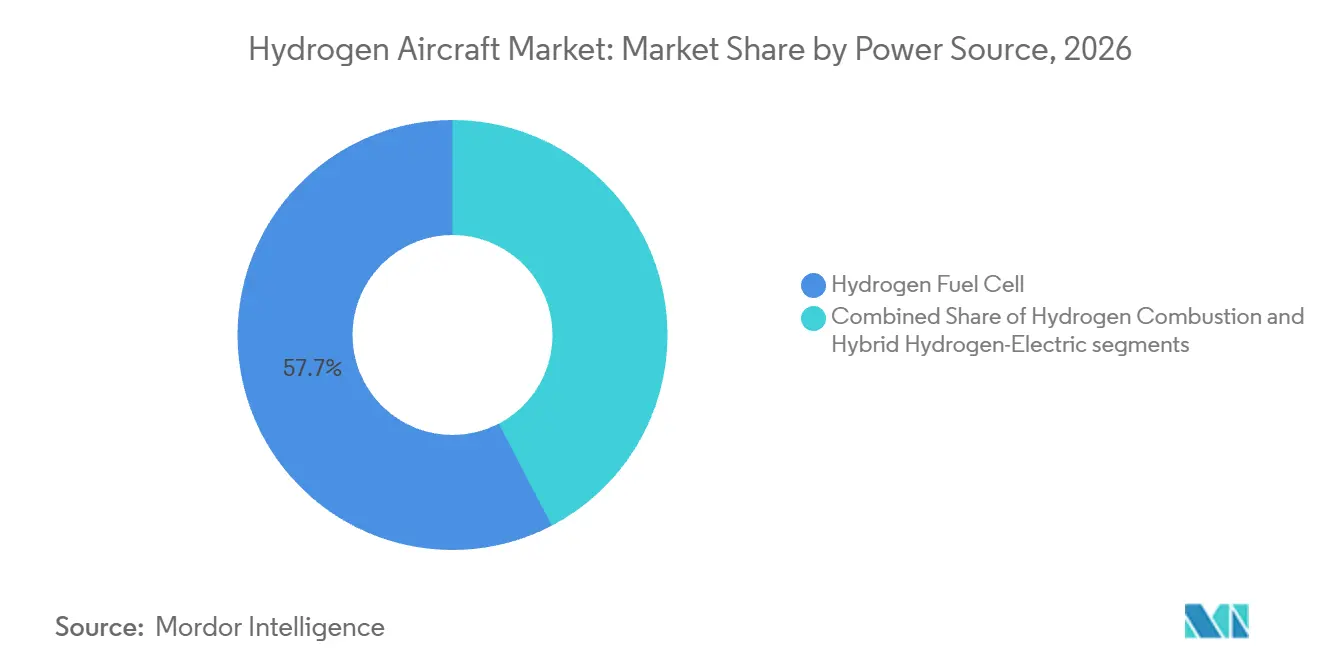
- By power source, hydrogen fuel cells held 57.65% of the hydrogen aircraft market share in 2026, while hydrogen combustion is forecast to expand at a 46.71% CAGR through 2032.
- By platform, urban air mobility (UAM) held 34.56% of the hydrogen aircraft market share in 2026, while regional jets recorded the highest projected CAGR at 47.89% through 2032.
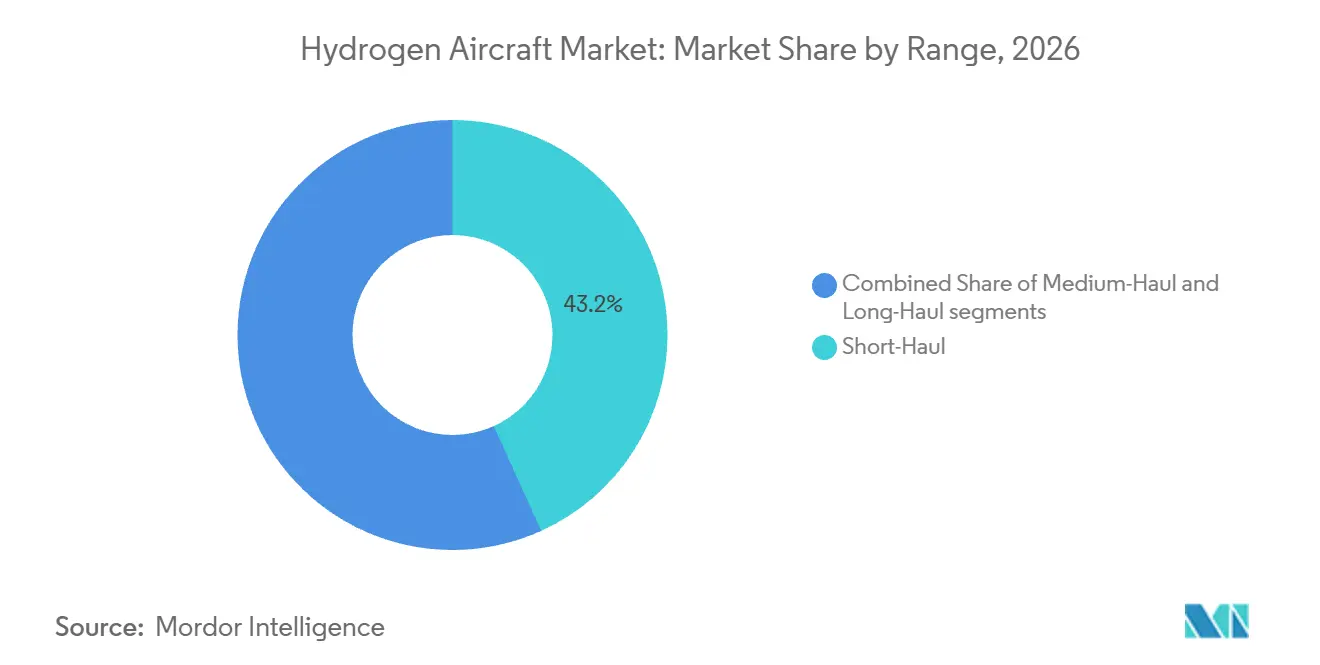
- By range, short-haul aircraft accounted for 43.23% of the hydrogen aircraft market share in 2026, while long-haul aircraft are advancing at a 44.67% CAGR through 2032.
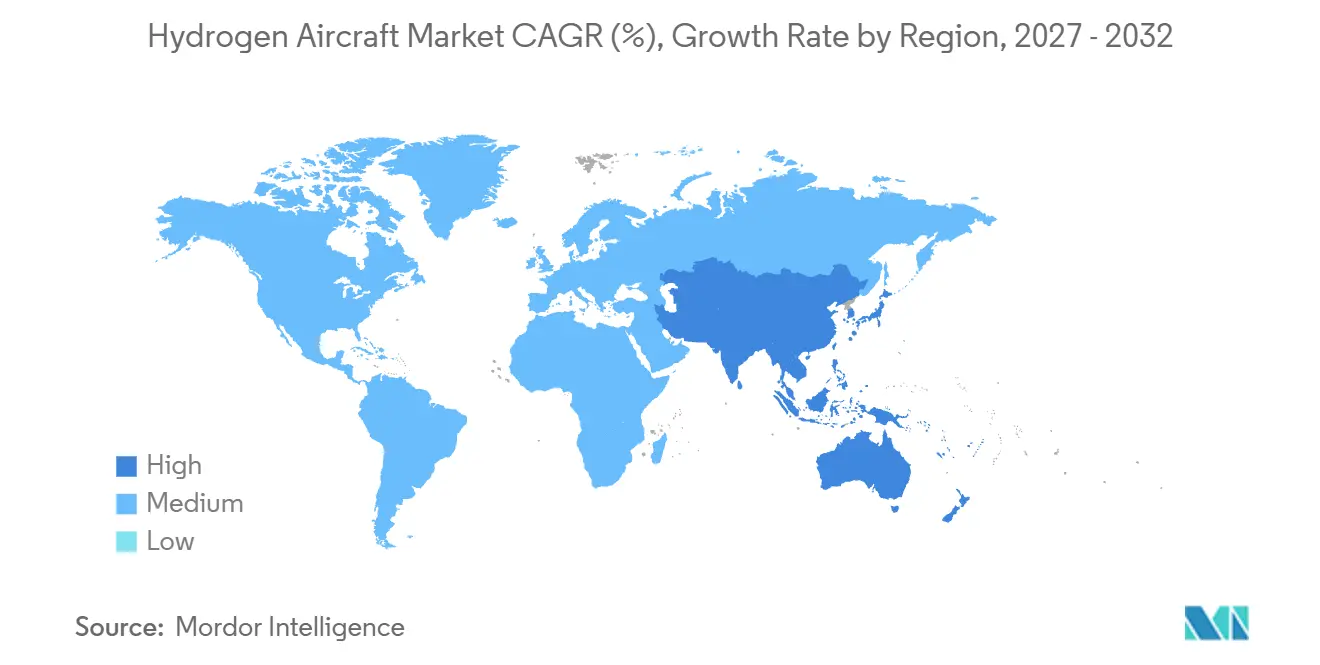
- By geography, Europe held 36.24% of the hydrogen aircraft market share in 2026, while Asia-Pacific is forecast to grow at a 45.22% CAGR through 2032.
Note: Market numbers in this report are based on Mordor Intelligence's proprietary estimation framework, which combines nine months of actuals with Q4 projections for base year 2026.
Market Trends and Insights
Drivers Impact Analysis of Hydrogen Aircraft Market*
| Driver | (~) % Impact on CAGR Forecast | Geographic Relevance | Impact Timeline |
|---|---|---|---|
| Aviation decarbonization mandates and net-zero fleet commitments | +8.50% | Global, concentrated in EU and the UK | Short term (≤ 2 years) |
| Progress in hydrogen fuel-cell power density | +7.20% | Global, led by the US, EU, and Japan | Medium term (2-4 years) |
| Public funding and cross-industry demonstration alliances | +6.80% | EU, the UK, the Netherlands, Australia | Short term (≤ 2 years) |
| Regional-first commercialization economics | +5.50% | Europe, North America | Medium term (2-4 years) |
| Airport hydrogen-hub development | +4.90% | EU, the UK, Asia-Pacific | Medium term (2-4 years) |
| Hydrogen’s high gravimetric energy advantage | +4.30% | Global | Long term (≥ 4 years) |
| Source: Mordor Intelligence | |||
Aviation Decarbonization Mandates and Net-Zero Fleet Commitments
European policy gives the hydrogen aircraft market a clearer demand signal than voluntary airline commitments alone. ReFuelEU Aviation entered into force in January, 2025 and requires the use of sustainable aviation fuel at EU airports. Its power-to-liquid requirement reaches 1.2% by 2030 and 35% by 2050. This directs investment toward production and distribution systems that can also support the direct use of hydrogen at airports. IATA reported that 1 million tons of sustainable aviation fuel were being purchased in Europe during 2025 for compliance. It also identified USD 1.70 billion in compliance costs above prevailing fuel prices, while the European Commission committed EUR 2.90 billion (USD 3.25 billion) through 2027.[1]
Progress in Hydrogen Fuel-Cell Power Density
Fuel-cell power density determines whether hydrogen propulsion can carry useful payloads without excessive system weight. ZeroAvia reported 1.40 kW/kg in certification-intent ground testing for its ZA600 system and targets 2-5 MW for the ZA2000 program. Higher specific power improves range first in smaller aircraft because each additional unit of output directly increases available mission distance. This explains why the hydrogen aircraft market has concentrated early development in UAM aircraft and smaller turboprops. China’s AVIC and Tsinghua University reported a 30-hour hydrogen UAS flight in April 2025, using fuel cells rated at 600 W/kg and recording 55% system efficiency at altitude. These results show that performance work includes thermal and pressure conditions relevant to flight, rather than laboratory output alone.
Public Funding and Cross-Industry Demonstration Alliances
Public funding is paying for systems, flight-test assets, and certification preparation that private programs would otherwise need to fund on their own. Conscious Aerospace received EUR 73.30 million (USD 83.80 million) from the Dutch National Growth Fund in June 2025. ZeroAvia received GBP 10.80 million (USD 14.50 million) from the UK Aerospace Technology Institute program for the LH-SIFT liquid hydrogen testbed. MTU completed preliminary design for its 1.20 MW HEROPS demonstrator within EU Clean Aviation. ZeroAvia also received a EUR 21.40 million (USD 23.96 million) EU Innovation Fund grant for a Norwegian network covering 15 airports. Airbus and MTU formed a joint venture in July 2026 to combine fuel-cell development, engine integration, and certification capabilities.
Airport Hydrogen-Hub Development
Airport systems are becoming a practical constraint and commercial opportunity for the hydrogen aircraft market. Airbus states that more than 220 airports participate in its Hydrogen Hubs at Airports initiative. The program considers on-site storage, distribution, and hydrogen handling. Long-term contracts could deliver liquid hydrogen to favorable locations at USD 3.83-5.03 per kg of H2. Less favorable locations faced costs 29% higher, while European Hydrogen Backbone imports could reduce costs by up to 12%. According to Rolls-Royce plc, the infrastructure at 20 major European airports could deliver more than 80% of the emissions benefit from full continental availability.
Restraints Impact Analysis of Hydrogen Aircraft Market*
| Restraint | (~) % Impact on CAGR Forecast | Geographic Relevance | Impact Timeline |
|---|---|---|---|
| Cryogenic storage, boil-off, and aircraft integration complexity | -3.80% | Global | Long term (≥ 4 years) |
| Incomplete certification and safety standards | -3.20% | Global, especially the US and EU | Short term (≤ 2 years) |
| Green hydrogen cost and availability mismatch | -2.70% | Global | Medium term (2-4 years) |
| Airport refuelling capex and low early utilisation | -2.10% | Global | Short term (≤ 2 years) |
| Source: Mordor Intelligence | |||
Cryogenic Storage, Boil-Off, and Aircraft Integration Complexity
Liquid hydrogen imposes a packaging problem because it needs more volume than jet fuel for the same mission energy. The International Council on Clean Transportation states that liquid hydrogen has an energy density of 8.50 MJ/L, compared with 34-35 MJ/L for jet fuel. Aircraft tanks therefore need more internal space and may reduce payload or passenger capacity. Liquefaction also consumes 30% of hydrogen energy capacity, resulting in a well-to-wing efficiency loss.
Incomplete Certification and Safety Standards
Certification remains a direct barrier to commercial entry because no major jurisdiction has finalized airworthiness rules for hydrogen aircraft. EASA’s CONCERTO analysis identified gaps in CS-23 and CS-25 requirements for hydrogen fire risk, explosion risk, crashworthiness, and occupant survivability. Hydrogen also has a minimum ignition energy of 0.017 mJ, which makes system safety design especially important. EASA’s roadmap targets CS-23 certification for hydrogen aircraft by 2030, while larger regional aircraft are expected later in the 2030s. SAE’s AE-7F Committee has issued standards including AS7141, AS6679, and AS7373, but aircraft-level type certification rules remain incomplete. Developers are therefore pursuing smaller platforms first, where compliance pathways can be developed sooner and applied to later aircraft programs. The hydrogen aircraft market therefore faces certification timing risk.
*Our forecasts treat driver/restraint impacts as directional, not additive. The impact forecasts reflect baseline growth, mix effects, and variable interactions.
Hydrogen Aircraft Market Segment Analysis
By Power Source:
Fuel Cells Lead While Combustion AcceleratesHydrogen fuel cell systems accounted for 57.65% of the hydrogen aircraft market share in 2026. Their lead reflects their suitability for smaller aircraft, where electric propulsion is more feasible within current weight limits. CS-23 certification is also more accessible than CS-25 certification for larger aircraft. Fuel cells produce water vapor in flight and convert hydrogen into electricity without combustion. Hybrid hydrogen-electric systems pair fuel cells with batteries to provide additional power during takeoff and climb. The hydrogen aircraft market size for fuel-cell platforms is supported by UAM and turboprop programs that can enter service before larger regional aircraft. This gives the hydrogen aircraft market an earlier route to operational learning and testing.
Hydrogen combustion is forecast to grow at a 46.71% CAGR through 2032. Its appeal lies in its potential compatibility with gas turbine architectures and the existing engineering base for turbine engines. Rolls-Royce, Tata Consultancy Services, and easyJet completed a full simulated flight cycle using 100% hydrogen in a Pearl 15 engine during 2026.[2] Rolls-Royce also holds US Patent 12,618,361 B2 for a hydrogen turbine fuel-management system. Airbus has focused its ZEROe work on fuel-cell propulsion, creating room for engine developers that continue to pursue combustion systems.[3]

By Platform:
UAM Anchors Volume, Regional Jets Set the PaceUAM held a 34.56% platform share in 2026. This position reflects active eVTOL development, where hydrogen fuel cells can extend missions beyond the limits of battery-only designs. The hydrogen aircraft market supports these designs because UAM aircraft can use smaller fuel systems and operate along controlled routes. Hydrogen-powered unmanned aircraft also provide a lower-risk path for proving endurance and energy management at altitude. AVIC and Tsinghua University reported a 30-hour hydrogen UAS flight in 2025, which showed continued operation under flight conditions. Research on hydrogen-powered UAM identifies aircraft design, thermal management, and power allocation as central factors in safe integration. The market benefits from early UAM deployment.
Regional jets are forecast to grow at a 47.89% CAGR through 2032. This category has a greater need for megawatt-scale propulsion and liquid hydrogen storage than UAM aircraft do. Honeywell’s Project Newborn is developing a 1 MW hydrogen-electric powertrain that can scale to 3 MW for 19-seat regional aircraft. The program moved into component testing in 2025, indicating that regional propulsion systems are moving beyond high-level concept work. Business jets also provide a useful avenue for regulatory experience, as they can establish special conditions before larger aircraft are certified. The hydrogen aircraft industry can use these programs to build evidence on propulsion integration, thermal control, and certification methods for 40- to 80-seat aircraft. The hydrogen aircraft market is testing larger propulsion systems.
By Range:
Short-Haul Dominates While Long-Haul ScalesShort-haul aircraft accounted for a 43.23% share of the range in 2026. These missions require less onboard fuel, simpler tank layouts, and fewer supply points than longer routes. A small set of hubs can support an early network, lowering capital needs before wider airport coverage is required. ZeroAvia’s EUR 21.40 million (USD 23.96 million) EU Innovation Fund award supports retrofitting 15 Cessna Caravans and the development of hydrogen infrastructure at 15 Norwegian airports by 2028. This model fits regional networks in which aircraft frequently return to designated airports. It gives operators a practical way to test refueling, maintenance, and route economics at limited scale. This approach keeps the hydrogen aircraft market focused on repeatable early operations and concentrated routes.
Long-haul aircraft are projected to grow at a 44.67% CAGR through 2032. Their entry depends on major improvements in fuel storage and propulsion output. Medium-haul designs need liquid hydrogen stored at minus 253°C to fit sufficient energy within competitive weight limits. Airbus plans integrated ground testing in 2027 for its ZEROe concept, which uses four 2-MW fuel-cell engines to power 80 seats and deliver 1,000 nautical miles of range. This capability remains dependent on system-level power density and tank efficiency, not fuel-cell output alone.
Geography Analysis
Europe
Europe accounted for 36.24% of the regional share in 2026. ReFuelEU Aviation gives the region regulatory influence by directing capital toward airport hydrogen systems through its power-to-liquid fuel requirement. Toulouse-Blagnac Airport operates a renewable hydrogen production and distribution station, giving the region an early operational reference point. The UK committed GBP 250 million (USD 335.70 million) for green aerospace projects in June 2025, including funding for hydrogen programs. The Netherlands provided EUR 73.30 million (USD 82.04 million) through its National Growth Fund for the HAPSS consortium. Germany’s GENtwoPRO project is developing megawatt-class low-temperature PEM fuel cells for aviation use. These projects give the Europe hydrogen aircraft market a base of public finance, airport activity, and component development.
Asia-Pacific
Asia-Pacific is forecast to grow at a 45.22% CAGR through 2032. Its progress combines government-led investment with a growing number of aircraft and component demonstrations. Japan has committed USD 26 billion to a public-private program for hydrogen-powered passenger jets as part of its broader hydrogen strategy. China has demonstrated hydrogen propulsion through UAS endurance testing and liquid-hydrogen eVTOL testing. These activities show a demonstrator-first path that can validate storage, fueling, and aircraft control in local conditions. South Korea is developing composite liquid hydrogen storage systems through work involving ZeroAvia and KAERI. The Asia-Pacific hydrogen aircraft market also includes Australian eVTOL development and Singapore-based fuel-cell activity, widening the regional supplier and testing base. The hydrogen aircraft market has wider regional testing activity.
North America, South America, and Middle East and Africa
North America has aerospace manufacturing capacity and federal hydrogen research, but certification uncertainty makes developers pursue parallel regulatory routes. Canada’s remote routes may suit hydrogen turboprop retrofits because they link smaller communities over moderate distances. South America has an early-stage opportunity, with Brazil’s hydropower resource offering a potential future advantage for green hydrogen production. The Middle East is examining hubs that serve aviation and industrial demand, which can improve early infrastructure use. South Africa’s hydrogen export plans could support later fuel availability for aviation. These regions do not yet match Europe’s regulatory momentum or the Asia-Pacific testing record. The hydrogen aircraft market in these areas depends on electricity supply, airport investment, other hydrogen users, and targeted partnerships.
Competitive Landscape
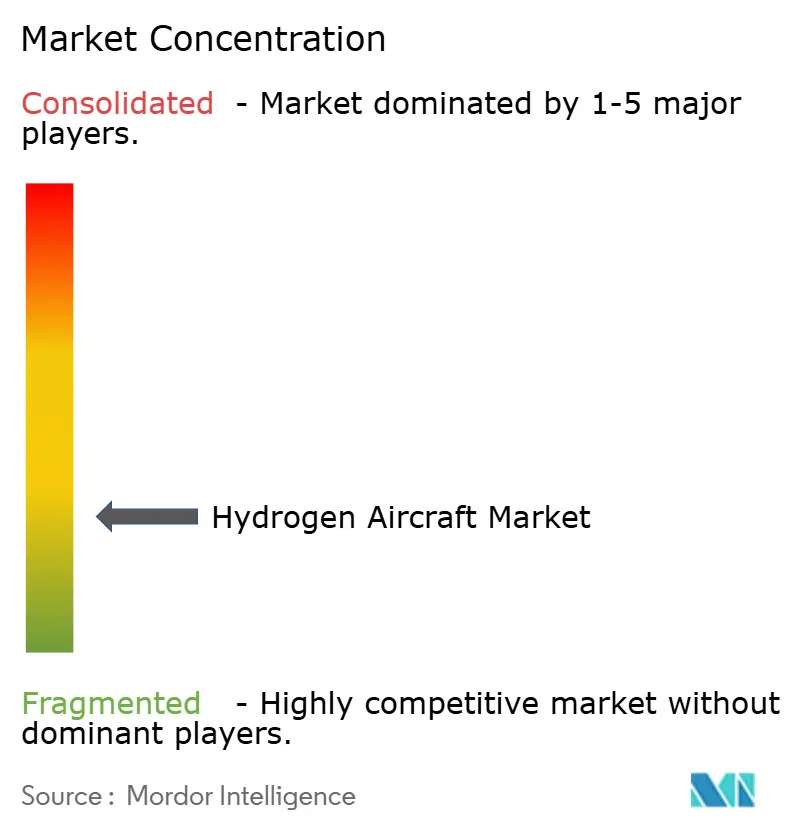
The hydrogen aircraft market is fragmented across airframe manufacturers, propulsion specialists, industrial gas suppliers, cryogenic equipment firms, and energy companies. Competition is strongest in fuel-cell propulsion and UAM because smaller platforms can generate testing and certification experience sooner than large aircraft. Airbus and MTU created a joint venture in July 2026 to develop a fully electric hydrogen fuel-cell engine. The structure combines aircraft program knowledge with engine design, integration, and certification work. Rolls-Royce, Tata Consultancy Services, and easyJet completed a full Pearl 15 hydrogen flight-cycle simulation in 2026, showing a separate path centered on combustion. These different approaches show that no single aircraft propulsion architecture has become the accepted standard.
Strategic partnerships allow companies to share the high costs of testing, certification, and manufacturing scale. ZeroAvia and Safran announced a hydrogen-electric technology partnership in August 2026 that combines powertrain work with production and certification capabilities. ZeroAvia is also using its Norwegian network project to link aircraft conversion with airport infrastructure, rather than treating propulsion as an isolated product. Honeywell’s Project Newborn shows how established systems suppliers are pursuing broader roles in hydrogen powertrains. The medium-haul range remains open because fuel-cell and combustion aircraft have not established a definitive architecture for 500- 2,000 km missions. This leaves room for suppliers that can solve storage, thermal, and power-management needs across the aircraft. The hydrogen aircraft market rewards shared development risk.
Intellectual property and compliance evidence will shape company positions as programs move closer to service. Rolls-Royce’s US Patent 12,618,361 B2 covers a hydrogen gas turbine fuel-management system with an auxiliary combustor arrangement. Airbus and MTU have selected a fuel-cell engine path, while ZeroAvia is advancing certification-intent fuel-cell testing for smaller aircraft. Companies can therefore lead in different technical layers rather than through aircraft deliveries alone. Suppliers with validated tanks, fuel cells, controls, and thermal systems may gain roles across several aircraft programs. Large companies retain certification advantages, while focused developers can establish positions through demonstrators and targeted route networks. The hydrogen aircraft market remains open to specialized suppliers that prove aircraft-ready performance.
Hydrogen Aircraft Industry Leaders
-
ZeroAvia, Inc.
-
Joby Aero, Inc.
-
Beyond Aero SAS
-
Doosan Corporation
-
Airbus SE
- *Disclaimer: Major Players sorted in no particular order
Hydrogen Aircraft Market Companies Covered in this Report
- Airbus SE
- ZeroAvia, Inc.
- Joby Aero, Inc.
- Doosan Corporation
- Beyond Aero SAS
- Embraer S.A.
- AeroDelft
- HES Energy Systems Pte. Ltd.
- Cranfield Aerospace Solutions Ltd.
- FlyH2 Aerospace (Pty) Ltd.
- Fokker Next Gen NV
- Alakai Technologies Corporation
Recent Industry Developments in Hydrogen Aircraft Market
- July 2026: ZeroAvia and Safran announced a partnership on hydrogen-electric technologies, combining ZeroAvia's fuel cell powertrain expertise with Safran's manufacturing scale and certification track record to accelerate commercial readiness for regional aircraft.
- July 2026: Airbus and MTU Aero Engines announced a joint venture to develop and commercialize a fully electric hydrogen fuel cell engine, with operations expected to begin in 2027.
- November 2025: ZeroAvia announced a EUR 21.40 million (USD 23.95 million) EU Innovation Fund grant for Project ODIN to retrofit 15 Cessna Caravans with ZA600 hydrogen-electric engines and establish refueling infrastructure at 15 Norwegian airports. The project targets a commercial hydrogen aircraft network by 2028.
Global Hydrogen Aircraft Market Report Scope
The hydrogen aircraft market comprises aircraft designed to utilize hydrogen as a primary energy source for propulsion across civil, commercial, and unmanned aviation applications. The market covers new aircraft production and hydrogen propulsion integration or conversion programs, including aircraft under development, demonstration, and commercialization, with market sizing focused on commercialized aircraft deliveries and associated aircraft-level revenues.
The hydrogen aircraft market is segmented by power source, platform, range, and geography. By power source, the market is segmented into hydrogen combustion, hydrogen fuel cell, and hybrid hydrogen-electric. By platform, the market is segmented into urban air mobility (UAM), unmanned aerial systems (UAS), business jets, and regional jets. By range, the market is segmented into short-haul, medium-haul, and long-haul aircraft. The report also covers market sizes and forecasts for the hydrogen aircraft market in major countries across different regions. For each segment, the market size is provided in terms of value (USD).
Segmentation Overview
| Hydrogen Combustion |
| Hydrogen Fuel Cell |
| Hybrid Hydrogen-Electric |
| Urban Air Mobility (UAM) |
| Unmanned Aerial Systems (UAS) |
| Business Jets |
| Regional Jets |
| Short-Haul |
| Medium-Haul |
| Long-Haul |
| North America | United States | |
| Canada | ||
| Mexico | ||
| Europe | United Kingdom | |
| France | ||
| Germany | ||
| Netherlands | ||
| Italy | ||
| Rest of Europe | ||
| Asia-Pacific | China | |
| Japan | ||
| India | ||
| South Korea | ||
| Singapore | ||
| Australia | ||
| Rest of Asia-Pacific | ||
| South America | Brazil | |
| Rest of South America | ||
| Middle East and Africa | Middle East | Saudi Arabia |
| United Arab Emirates | ||
| Rest of Middle East | ||
| Africa | South Africa | |
| Rest of Africa | ||
| By Power Source | Hydrogen Combustion | ||
| Hydrogen Fuel Cell | |||
| Hybrid Hydrogen-Electric | |||
| By Platform | Urban Air Mobility (UAM) | ||
| Unmanned Aerial Systems (UAS) | |||
| Business Jets | |||
| Regional Jets | |||
| By Range | Short-Haul | ||
| Medium-Haul | |||
| Long-Haul | |||
| By Geography | North America | United States | |
| Canada | |||
| Mexico | |||
| Europe | United Kingdom | ||
| France | |||
| Germany | |||
| Netherlands | |||
| Italy | |||
| Rest of Europe | |||
| Asia-Pacific | China | ||
| Japan | |||
| India | |||
| South Korea | |||
| Singapore | |||
| Australia | |||
| Rest of Asia-Pacific | |||
| South America | Brazil | ||
| Rest of South America | |||
| Middle East and Africa | Middle East | Saudi Arabia | |
| United Arab Emirates | |||
| Rest of Middle East | |||
| Africa | South Africa | ||
| Rest of Africa | |||
Key Questions Answered in the Report
What is the projected value of hydrogen aircraft by 2032?
The hydrogen aircraft market is projected to reach USD 4.34 billion by 2032, rising from USD 0.76 billion in 2027 at a 41.69% CAGR.
Which hydrogen aircraft propulsion technology has the largest share?
Hydrogen fuel-cell systems held 57.65% of revenue in 2026, supported by their fit with smaller aircraft and electric propulsion.
Why are short-haul hydrogen aircraft developing first?
Short-haul aircraft held 43.23% in 2026 because they need less fuel and can operate from focused hydrogen hubs.
Which region is growing fastest for hydrogen aviation?
Asia-Pacific is forecast to grow at a 45.22% CAGR through 2032, supported by investment and flight demonstration activity.
What is the largest barrier to commercial hydrogen aircraft?
Certification rules and liquid hydrogen storage remain major barriers, since hydrogen-specific airworthiness standards are not yet finalized.
Which companies are developing hydrogen aircraft technologies?
Airbus, MTU, Rolls-Royce, ZeroAvia, Safran, Honeywell, and Conscious Aerospace are active across aircraft, engines, fuel cells, and infrastructure.