
Hybrid Switchgear Market Size and Share
Market Overview
| Study Period | 2022 - 2032 |
|---|---|
| Market Size (2027) | USD 5.44 Billion |
| Market Size (2032) | USD 7.89 Billion |
| Growth Rate (2027 - 2032) | 7.71 % |
| Fastest Growing Market | Asia-Pacific |
| Largest Market | Asia-Pacific |
| Market Concentration | Medium |
Major Players *Disclaimer: Major Players sorted in no particular order Image © Mordor Intelligence. Reuse requires attribution under CC BY 4.0. | |
Hybrid Switchgear Market Analysis by Mordor Intelligence
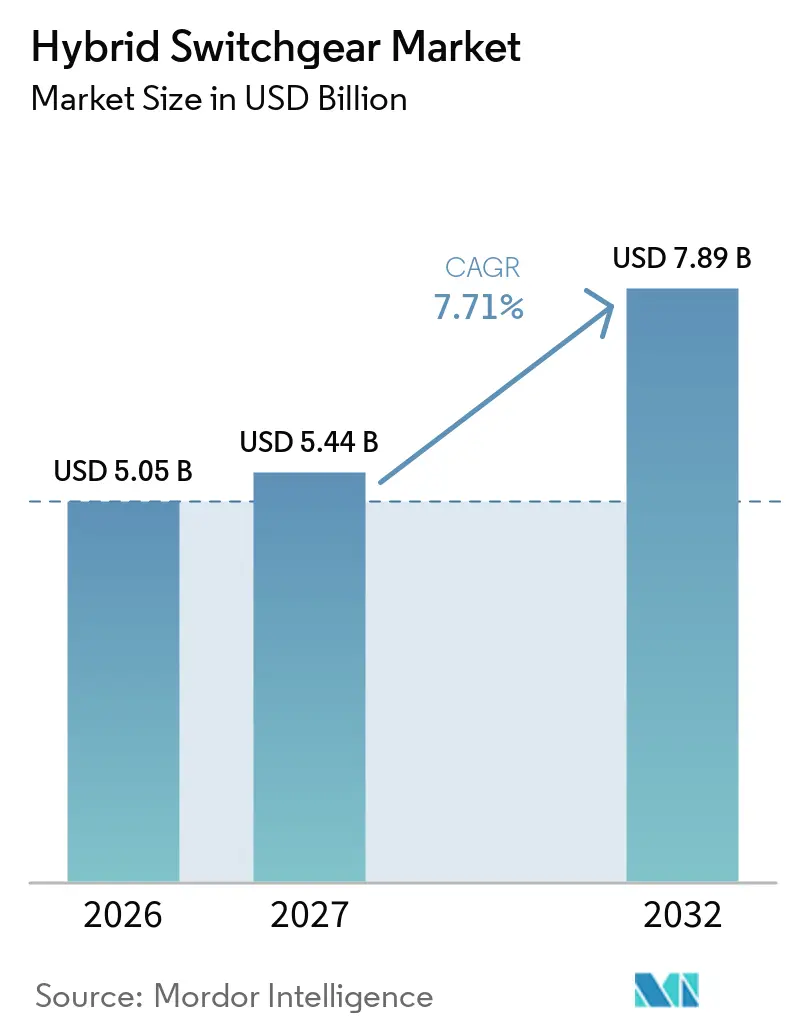
The Hybrid Switchgear Market size is expected to increase from USD 5.05 billion in 2026 to USD 5.44 billion in 2027 and reach USD 7.89 billion by 2032, growing at a CAGR of 7.71% over 2027-2032. Grid expansion, aging asset replacement, and the decarbonization of transmission and sub-transmission networks support demand for compact equipment. Hybrid systems combine the smaller footprint of gas-insulated switchgear with the service access and cost characteristics of air-insulated equipment. Brownfield upgrades benefit where available land prevents a full air-insulated replacement. Utilities are also bundling equipment, digital monitoring, insulating-gas management, and cyber-secure firmware support into lifecycle contracts. This approach favors suppliers that can support installed assets as well as deliver new equipment.
Key Report Takeaways
- By voltage level, 72.5-245 kV held 46.5% of global hybrid switchgear market share in 2026, while 245-550 kV is forecast to grow at an 8.1% CAGR through 2032.
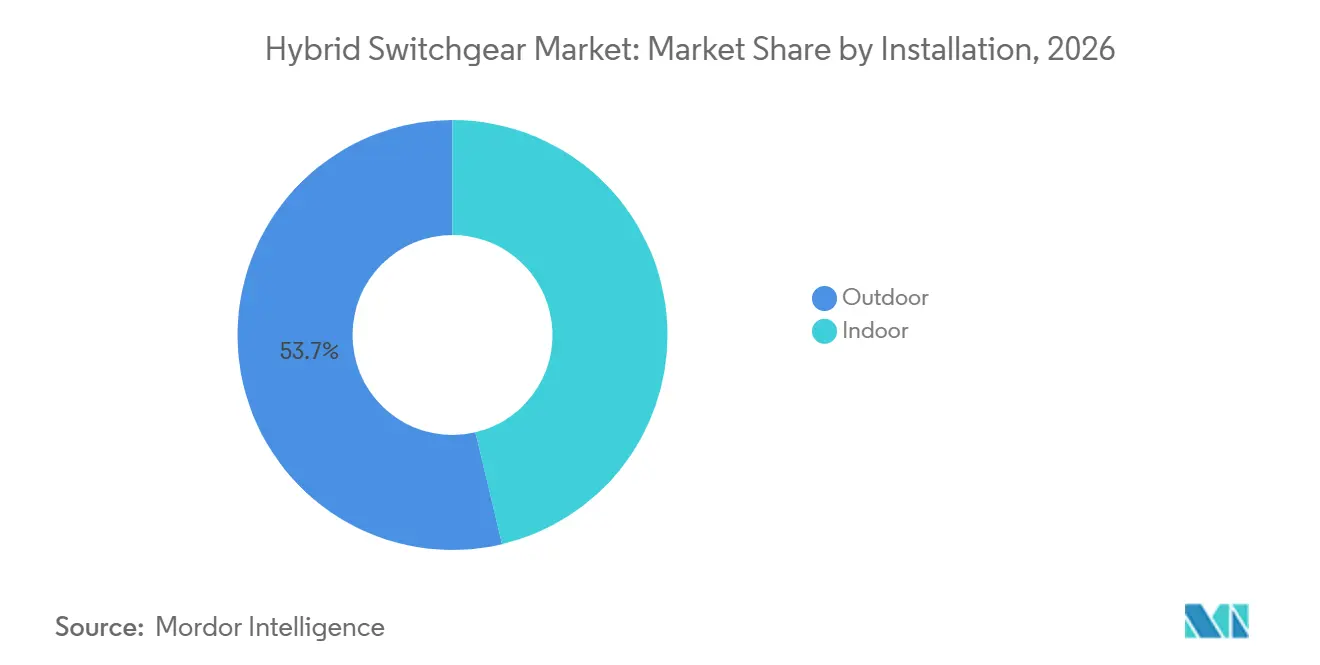
- By installation, outdoor held 53.7% of global hybrid switchgear market share in 2026, while offshore is forecast to grow at an 8.3% CAGR through 2032.
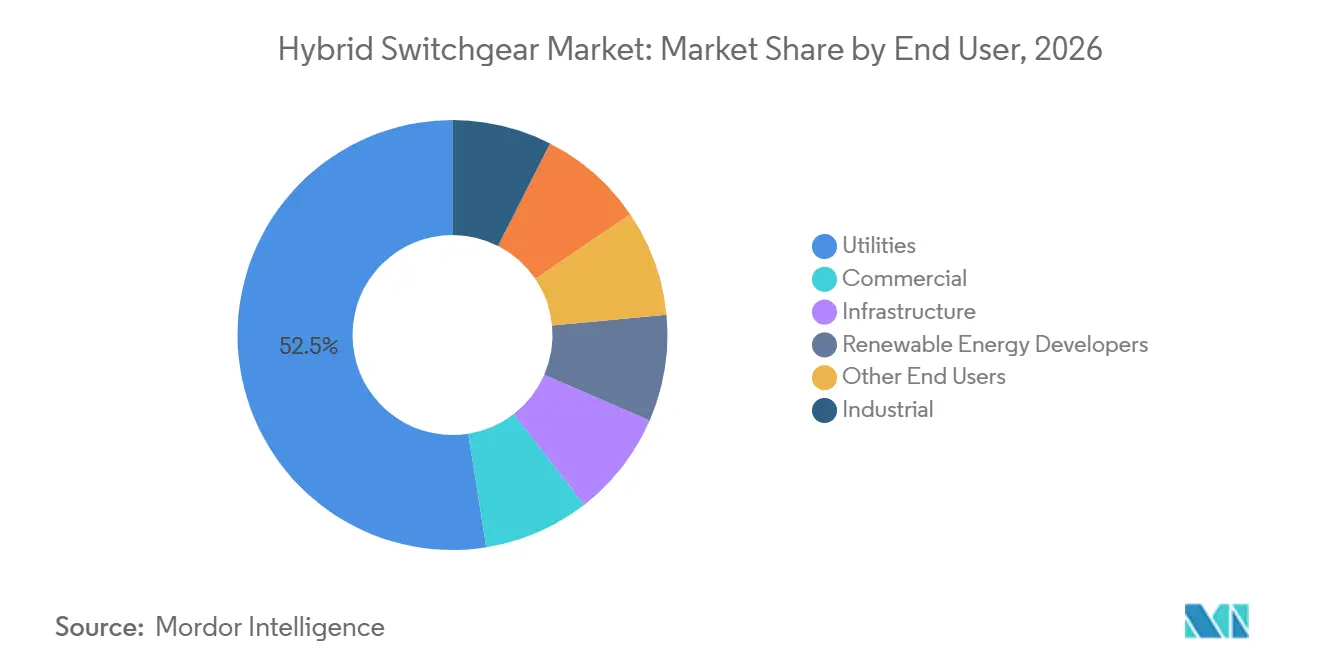
- By end user, utilities held 52.5% of demand in 2026, while renewable energy developers are forecast to grow at a 9.8% CAGR through 2032.
- By geography, Asia-Pacific held 31.5% of revenue in 2026 and is forecast to grow at an 8.4% CAGR through 2032.
Note: Market numbers in this report are based on Mordor Intelligence's proprietary estimation framework, which combines nine months of actuals with Q4 projections for base year 2026.
Market Trends and Insights
Drivers Impact Analysis of Hybrid Switchgear Market*
| Driver | (~) % Impact on CAGR Forecast | Geographic Relevance | Impact Timeline |
|---|---|---|---|
| Renewable-Energy Grid Integration | +1.8% | Global, with intensity in APAC, EU, and North America | Long term (≥ 4 years) |
| Aging Substation Replacement and Grid Modernization | +1.4% | North America and EU core, spillover to Latin America | Medium term (2-4 years) |
| Space-Constrained Urban and Industrial Substations | +0.7% | APAC urban cores, Western Europe | Medium term (2-4 years) |
| Offshore Wind Collection and Export Substations | +1% | EU, China, Vietnam, and South Korea | Long term (≥ 4 years) |
| SF6 Phase-Down and Low-Emission Equipment Procurement | +1.2% | EU mandatory, voluntary adoption in Japan, Australia, and Norway | Short term (≤ 2 years) |
| Digital Monitoring and Predictive Asset Management | +0.6% | Global, with early adoption in EU and APAC | Long term (≥ 4 years) |
| Source: Mordor Intelligence | |||
Renewable-Energy Grid Integration
Renewable capacity is changing transmission design and creating demand in the global hybrid switchgear market. Solar and wind projects are often located far from load centers and require additional switching bays at collection and export substations. These sites can be brownfield locations or offshore platforms with limited space. China’s State Grid is executing a USD 120.1 billion (RMB 800 billion) grid investment plan for 2026-2027 that targets 500 GW of renewable capacity integration.[1] Renewable-heavy systems can also face higher short-circuit currents and more severe fault transients. This raises requirements for internal arc protection, digital interlocking, and higher breaking-current ratings.
SF6 Phase-Down and Low-Emission Equipment Procurement
The EU F-Gas Regulation restricts SF6 in new medium-voltage switchgear up to 24 kV from January 2026. Restrictions will extend to 52-145 kV equipment in January 2028 and to applications above 145 kV in January 2032. Chubu Electric Power Grid ordered a 550 kV fully SF6-free GIS from Hitachi Energy in March 2026. The order shows how utility procurement is moving ahead of formal national mandates in some markets. Suppliers without certified alternatives across the 72.5-550 kV range face a narrower tender opportunity. IEC 62271 testing requirements also favor suppliers with the financial capacity to complete product development and certification.
Aging Substation Replacement and Grid Modernization
Much of the transmission infrastructure in Europe and North America entered service between the 1960s and 1990s. This installed base is creating replacement work for the global hybrid switchgear market. GE Vernova received a July 2025 contract from TransnetBW to replace the existing AIS at the 380 kV Kühmoos grid node with 15 compact GIS bays.[2] The project is designed to double the substation capacity within the existing site while keeping operations live. Compact designs can reduce space needs by as much as 70% compared with AIS, which can limit land acquisition at congested nodes. Replacement contracts can also include digital retrofits, recommissioning, and longer-term service work.
Offshore Wind Collection and Export Substations
Offshore wind projects need switchgear that can operate in corrosive conditions with limited maintenance access. Larger turbines and greater distance from shore are increasing the requirements for collection and export infrastructure. 50Hertz awarded Siemens Energy and NEPTUN SMULDERS Offshore Renewables a USD 2.78 billion (EUR 2.5 billion) contract in June 2026 for the North Sea Connector 2 infrastructure.[3] Commissioning is targeted for the end of 2034. Offshore platforms need equipment that meets IEC 62271-209 cable-termination requirements and provides full internal arc protection. Weight, footprint, vibration, and salinity requirements limit the number of suppliers with qualified marine-grade platforms.
Restraints Impact Analysis of Hybrid Switchgear Market*
| Restraint | (~) % Impact on CAGR Forecast | Geographic Relevance | Impact Timelin |
|---|---|---|---|
| High Upfront Cost of Integrated AIS-GIS Architectures | -0.9% | Global, most acute in South and Southeast Asia and South America | Medium term (2-4 years) |
| Dual Certification and Complex Commissioning Requirements | -0.5% | EU and North America for new insulation systems | Medium term (2-4 years) |
| Shortage of Specialized High-Voltage Service Talent | -0.4% | Global, most acute in MEA and Southeast Asia | Long term (≥ 4 years) |
| Long Lead Times for Interrupters and Alternative Insulation Media | -0.5% | North America, Europe, and import-dependent markets | Short term (≤ 2 years) |
| Source: Mordor Intelligence | |||
High Upfront Cost of Integrated AIS-GIS Architectures
Integrated AIS-GIS systems carry a first-cost premium over conventional AIS. A base 170 kV hybrid bay costs USD 130,000-180,000. Digital monitoring can add USD 25,000-50,000, while alternative insulation can carry a 15-25% premium over conventional SF6 designs. The cost structure concentrates adoption among transmission utilities with diversified capital budgets. The normal 10-15 year lifecycle payback can conflict with public utility capital cycles of 3-5 years. Competing needs for capacity additions and network renewal further delay purchases in emerging markets.
Long Lead Times for Interrupters and Alternative Insulation Media
Hybrid switchgear depends on vacuum interrupters, alternative-gas compartments, and digital protection relays. Manufacturing capacity for these components is concentrated among a limited set of suppliers. High-voltage testing and certification are required before new insulating systems can move into commercial production. This sequence can delay equipment availability even where utilities face grid-stability requirements or SF6-replacement schedules. Vertically integrated suppliers can control interrupter manufacturing and gas-compartment sealing within their operations. More predictable delivery schedules can therefore become an important factor in the global hybrid switchgear market.
*Our forecasts treat driver/restraint impacts as directional, not additive. The impact forecasts reflect baseline growth, mix effects, and variable interactions.
Hybrid Switchgear Market Segment Analysis
By Voltage Level:
Renewable Transmission Supports Higher-Voltage DemandThe 72.5-245 kV range held 46.5% of the hybrid switchgear market size in 2026. This band serves a high volume of grid interconnections, sub-transmission upgrades, and renewable-energy collection projects. Utilities drive a large part of procurement in this range. European and North American brownfield replacement combines with new sub-transmission construction in India and Southeast Asia. Procurement increasingly specifies IEC 61850-compatible communications and Modular Switchgear Monitoring systems.[4] These tools support condition-based and predictive maintenance. They are moving from optional features to core procurement requirements. This shift creates a service opportunity alongside equipment delivery.
The 245-550 kV category is forecast to grow at an 8.1% CAGR through 2032. Long-distance transmission reinforcement links renewable generation zones with major load centers. Higher power-flow density requires greater thermal capability and a compact layout. The global hybrid switchgear industry benefits when these requirements occur at constrained substations. Equipment up to 72.5 kV faces stronger competition from compact AIS and ring main units in distribution work. Above 550 kV remains a small and premium category. Ultra-high-voltage backbone projects in China and Japan shape demand in this range. These countries are also early adopters of SF6-free technology at the highest voltage classes. Product qualification remains important because applications have demanding performance requirements.
By Installation:
Outdoor Networks Lead While Indoor Facilities Address Urban DensityOutdoor installations accounted for 53.7% of 2026 revenue under the outdoor and indoor installation segment. Open-air transmission substations, overhead-line junctions, and renewable-energy collection nodes support this position. The global hybrid switchgear market uses outdoor modules where high-voltage switching points connect to overhead lines and outdoor busbars. Factory-tested, weatherproof modules reduce the need to assemble conventional components individually at the project site. EPC contractors also value rapid field assembly when project-finance schedules are tight. Outdoor deployments are forecast to grow at an 8.3% CAGR through 2032. India, Southeast Asia, and the Middle East are adding transmission capacity that primarily favors open-air substations. This supports the continued use of outdoor configurations in new grid projects.
Indoor installations serve building-integrated substations, urban underground switching stations, and enclosed cable-fed grid nodes. Fire safety requirements, groundwater risk, and municipal planning limits can require sealed and arc-contained equipment. GE Vernova’s July 2026 contracts with Stromnetz Berlin cover SF6-free 110 kV gas-insulated substations in Wittenau and Neukölln. The projects reflect city operators’ need to replace aging overhead infrastructure with enclosed high-voltage stations. Tokyo, Seoul, Singapore, and Mumbai are expanding underground cable networks and restricting above-ground infrastructure. Hyperscale data centers also require compact enclosed switching stations with high reliability and arc-flash containment. These applications extend the global hybrid switchgear market beyond traditional outdoor transmission sites.

By End User:
Utilities Provide Volume While Developers Expand FasterUtilities accounted for 52.5% of demand in 2026, providing the largest hybrid switchgear market size by end user. Multi-year capital programs support this volume. Utility procurement can extend 3-7 years between major capital tranches. These longer cycles can slow individual awards but support steady replacement activity. Large utilities are seeking efficiency and lower-emission equipment at the same time. Schneider Electric was selected by Southern California Edison in June 2026 to deploy SF6-free GMAirSeT equipment at existing substations. The installation is expected to double substation capacity within the existing footprint. This use case aligns compact layouts with utility emission-reduction objectives.
Renewable energy developers are forecast to grow at a 9.8% CAGR through 2032. Utility-scale wind and solar sites need compact grid-connection substations at 72.5 kV and above. EPC contractors commonly specify equipment during a compressed project-finance schedule. Suppliers must therefore engage earlier in the project-development cycle. Delivery certainty can be important to developers meeting construction milestones. Industrial, commercial, and infrastructure customers hold smaller positions in the global hybrid switchgear market. Data centers, airport substations, and metro networks create demand where reliability and limited space coincide. These users select hybrid equipment when its footprint and operating characteristics fit their project requirements. Their demand broadens the set of applications beyond the utility base.
Geography Analysis
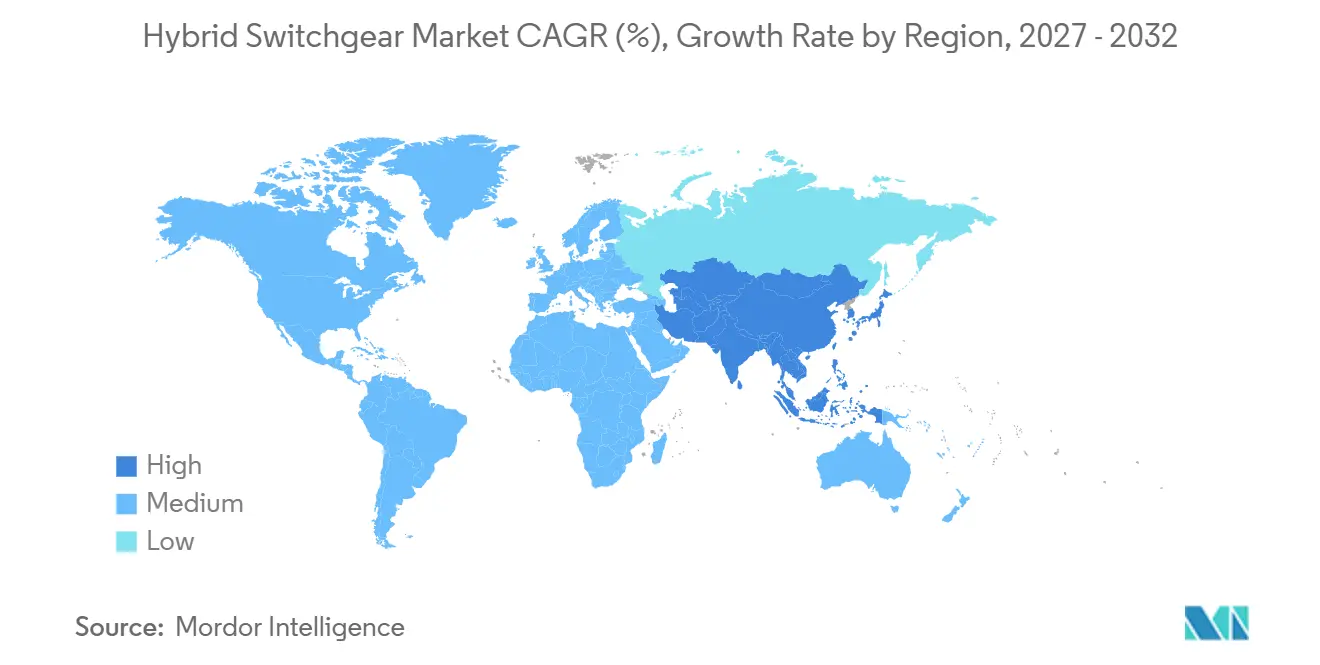
Asia-Pacific held 31.5% of revenue in 2026 and is forecast to grow at an 8.4% CAGR through 2032. The region holds the largest regional revenue share and combines current scale with rapid demand growth. China’s 2026-2027 grid program targets 500 GW of renewable integration. India is expanding 765 kV green energy corridors under its renewable energy zone framework. Deepwater wind expansion along China’s eastern coast and Vietnam’s offshore program adds demand for marine-grade equipment. Japan’s Chubu Electric Power Grid ordered a fully SF6-free 550 kV GIS in March 2026. South Korea, Indonesia, Vietnam, Australia, and Thailand also support demand through grid modernization and renewable integration programs.
Europe and North America are the next-largest regional revenue blocs in the hybrid switchgear market. Both regions combine aging-infrastructure replacement with renewable interconnection work. Europe has large fleets of 380 kV and 220 kV equipment installed in the 1970s and 1980s. SF6 rules require a technology transition during many replacement projects. GE Vernova received July 2026 contracts from Stromnetz Berlin for SF6-free 110 kV gas-insulated substations. 50Hertz also awarded the North Sea Connector 2 contract in June 2026. 50HERTZ Avangrid’s USD 20 billion program through 2030 illustrates the scale of planned grid investment in North America. Hydro One’s 2026 orders for SF6-free 245 kV equipment indicate early voluntary technology adoption.
South America and the Middle East and Africa hold smaller positions in the hybrid switchgear market. Brazil and Chile support procurement through transmission expansion and renewable interconnection. Fiscal limits can slow the adoption of technologies with higher initial costs. Lifecycle economics are nevertheless gaining attention in utility purchasing decisions. Gulf utilities in Saudi Arabia and the UAE are building substations for demand growth and renewable targets. Siemens Energy received a December 2025 service contract from Kuwait’s Ministry of Electricity for high-voltage substations. Morocco, Egypt, and South Africa remain earlier-stage markets supported by grid expansion and cross-border interconnection activity.
Competitive Landscape
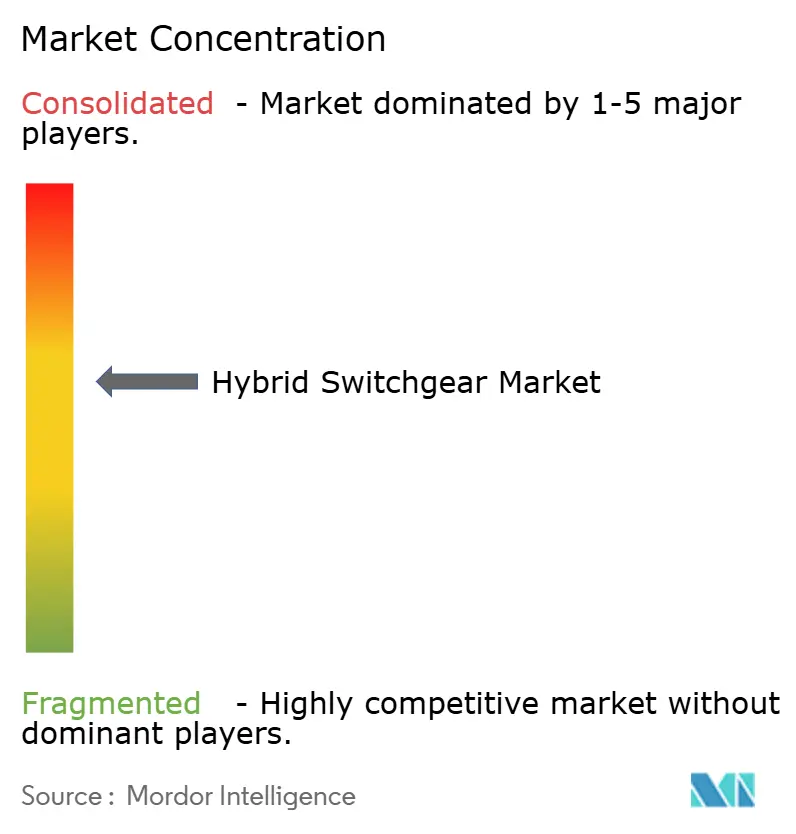
The global hybrid switchgear market is moderately concentrated. Integrated technology leaders hold much of the addressable revenue above 72.5 kV. Chinese and Indian manufacturers compete more actively in sub-transmission and domestic applications. Suppliers differentiate through certified SF6-free coverage across the voltage range. Digital services, IEC 61850-compatible monitoring, predictive analytics, and cybersecurity packages provide a second area of competition. Utility tenders increasingly include longer-term asset-management requirements. Suppliers that combine equipment with lifecycle support are better positioned for these contracts. This changes competition from a product-only comparison to a broader operating proposition.
Hitachi Energy’s PASS platform has more than 9,500 installed bays across more than 40 countries. That installed base supports its position in hybrid applications. TenneT Germany ordered a 420 kV 80 kA live-tank circuit breaker from the company in 2026. GE Vernova completed its SF6-free transmission-range portfolio with the F35g 170 kV GIS launch in August 2026. The launch added a product positioned for transmission applications. Toshiba confirmed laboratory performance for a 300 kV GIS using natural-origin gases in April 2026. Commercialization is targeted for fiscal year 2028.
Pinggao Group, Sieyuan Electric, CHINT Group, and XD Electric are extending domestic scale into international bids. Their presence is notable in price-sensitive segments below 245 kV, especially in the Middle East, Africa, and Southeast Asia. Cost structures are a competitive challenge for global suppliers in these projects. Regional after-sales service remains less developed in many markets. Offshore platforms and extra-high-voltage applications also require type-tested products and specialist support. These areas preserve advantages for global manufacturers with established service networks. In the global hybrid switchgear market, portfolio depth can be as important as an individual equipment offer. Suppliers must demonstrate that their platforms meet the required voltage, footprint, and insulation specifications. The global hybrid switchgear market also rewards local service capacity when utilities seek long-term operating support. This favors companies able to provide maintenance, diagnostics, and firmware support after installation. In the global hybrid switchgear market, regional suppliers can still compete where customers place greater weight on initial equipment cost. Their role is most visible in domestic and sub-transmission applications with less demanding service requirements. Global manufacturers retain an advantage in the global hybrid switchgear market, where offshore conditions require certified designs. They also retain an advantage where extra-high-voltage projects require a proven installed base. The global hybrid switchgear market has room for both large integrated suppliers and regional manufacturers. Their positions differ by voltage level, project complexity, and customer service needs. The global hybrid switchgear market is therefore shaped by the practical needs of each project rather than by a single purchasing criterion. Equipment performance, delivery capability, and access to qualified service personnel are considered together. Across the global hybrid switchgear market, customers balance initial costs with the need for reliable operation, certified technology, and ongoing technical support.
Hybrid Switchgear Industry Leaders
-
ABB Ltd.
-
Siemens Energy AG
-
Hitachi Energy Ltd.
-
GE Vernova Inc.
-
Schneider Electric SE
- *Disclaimer: Major Players sorted in no particular order
Hybrid Switchgear Market Companies Covered in this Report
- ABB Ltd.
- Bharat Heavy Electricals Limited
- CG Power and Industrial Solutions Ltd.
- CHINT Group Corporation
- Eaton Corporation plc
- Fuji Electric Co., Ltd.
- GE Vernova Inc.
- Hitachi Energy Ltd.
- Hyosung Heavy Industries Corporation
- Hyundai Electric & Energy Systems Co., Ltd.
- Larsen & Toubro Limited
- Meidensha Corporation
- Mitsubishi Electric Corporation
- Ningbo Tianan Group Co., Ltd.
- Ormazabal
- Pinggao Group Co., Ltd.
- Schneider Electric SE
- Shanghai Electric Group Co., Ltd.
- Siemens Energy AG
- Sieyuan Electric Co., Ltd.
- Switchgear Company NV
- TGOOD Global Ltd.
- Toshiba Energy Systems & Solutions Corporation
- XD Electric Co., Ltd.
Recent Industry Developments in Hybrid Switchgear Market
- August 2026: Hitachi Energy announced new EconiQ SF6-free wins at CIGRE Paris 2026. Hydro One and Wesco placed orders for the EconiQ 245 kV dead tank circuit breaker for North American transmission infrastructure, and TenneT Germany ordered the EconiQ 420 kV 80 kA live tank circuit breaker. The 80 kA rating addresses higher fault-severity levels in renewable-heavy grids.
- August 2026: GE Vernova launched the F35g 170 kV SF6-free gas-insulated switchgear at CIGRE Paris 2026. The launch completed its SF6-free transmission-range GIS portfolio from 72.5 kV to 420 kV. The product uses g³ insulation technology and is manufactured in Europe.
- June 2026: 50Hertz awarded a consortium of Siemens Energy and NEPTUN SMULDERS Offshore Renewables a EUR 2.5 billion contract for the North Sea Connector 2 offshore converter platform and onshore station. Commissioning is targeted by the end of 2034. Key components will be manufactured in Rostock, Germany.
Global Hybrid Switchgear Market Report Scope
Hybrid switchgear combines components of traditional air-insulated switchgear (AIS) and SF6 gas-insulated switchgear (GIS) technologies. Its compact, modular design integrates multiple functions into a single module.
The global hybrid switchgear market is segmented by voltage level, installation, end user, and geography. By voltage level, the market is segmented into up to 72.5 kV, 72.5–245 kV, 245–550 kV, and above 550 kV. By installation, the market is segmented into indoor and outdoor. By end user, the market is segmented into utilities, industrial, commercial, infrastructure, renewable energy developers, and other end users. The report also covers the market size and forecasts for the global hybrid switchgear market across 26 countries in the key regions. For each segment, market sizing and forecasts are provided in terms of value (USD).
Segmentation Overview
| Up to 72.5 kV |
| 72.5-245 kV |
| 245-550 kV |
| Above 550 kV |
| Onshore |
| Offshore |
| Utilities |
| Industrial |
| Commercial |
| Infrastructure |
| Renewable Energy Developers |
| Other End Users |
| North America | United States |
| Canada | |
| Mexico | |
| Europe | Germany |
| France | |
| Italy | |
| Spain | |
| United Kingdom | |
| Poland | |
| Russia | |
| Rest of Europe | |
| Asia-Pacific | China |
| India | |
| Japan | |
| South Korea | |
| Australia | |
| Indonesia | |
| Vietnam | |
| Thailand | |
| Rest of Asia-Pacific | |
| South America | Brazil |
| Argentina | |
| Chile | |
| Rest of South America | |
| Middle East and Africa | Saudi Arabia |
| United Arab Emirates | |
| Egypt | |
| South Africa | |
| Morocco | |
| Rest of Middle East and Africa |
| By Voltage Level | Up to 72.5 kV | |
| 72.5-245 kV | ||
| 245-550 kV | ||
| Above 550 kV | ||
| By Installation | Onshore | |
| Offshore | ||
| By End User | Utilities | |
| Industrial | ||
| Commercial | ||
| Infrastructure | ||
| Renewable Energy Developers | ||
| Other End Users | ||
| By Geography | North America | United States |
| Canada | ||
| Mexico | ||
| Europe | Germany | |
| France | ||
| Italy | ||
| Spain | ||
| United Kingdom | ||
| Poland | ||
| Russia | ||
| Rest of Europe | ||
| Asia-Pacific | China | |
| India | ||
| Japan | ||
| South Korea | ||
| Australia | ||
| Indonesia | ||
| Vietnam | ||
| Thailand | ||
| Rest of Asia-Pacific | ||
| South America | Brazil | |
| Argentina | ||
| Chile | ||
| Rest of South America | ||
| Middle East and Africa | Saudi Arabia | |
| United Arab Emirates | ||
| Egypt | ||
| South Africa | ||
| Morocco | ||
| Rest of Middle East and Africa | ||
Key Questions Answered in the Report
What is the forecast for global hybrid switchgear demand?
The Hybrid Switchgear Market size is expected to increase from USD 5.05 billion in 2026 to USD 5.44 billion in 2027 and reach USD 7.89 billion by 2032, growing at a CAGR of 7.71% over 2027-2032.
Which voltage range has the largest demand?
The 72.5-245 kV range held 46.5% of revenue in 2026, supported by grid interconnection and sub-transmission projects.
Which installation type is growing fastest?
Outdoor installations are projected to expand at an 8.3% CAGR through 2032 as there is increasing investments in transmission and distribution (T&D) infrastructure, renewable energy integration, and high-voltage substation expansion.
Why are utilities adopting hybrid switchgear?
Utilities use hybrid solutions to expand capacity in constrained substations while adding digital monitoring and lower-emission technology.
Which region is leading hybrid switchgear adoption?
Asia-Pacific held 31.5% of 2026 revenue and is projected to grow at an 8.4% CAGR through 2032.
What is the main constraint on hybrid switchgear adoption?
Higher initial equipment costs and lengthy certification and supply timelines can delay procurement, particularly for budget-constrained buyers.