
Hybrid OTP-PKI Hardware Token Market Size and Share
Market Overview
| Study Period | 2021 - 2032 |
|---|---|
| Market Size (2027) | USD 0.53 Billion |
| Market Size (2032) | USD 0.91 Billion |
| Growth Rate (2027 - 2032) | 11.42 % |
| Fastest Growing Market | Asia-Pacific |
| Largest Market | North America |
| Market Concentration | Medium |
Major Players *Disclaimer: Major Players sorted in no particular order Image © Mordor Intelligence. Reuse requires attribution under CC BY 4.0. | |
Hybrid OTP-PKI Hardware Token Market Analysis by Mordor Intelligence
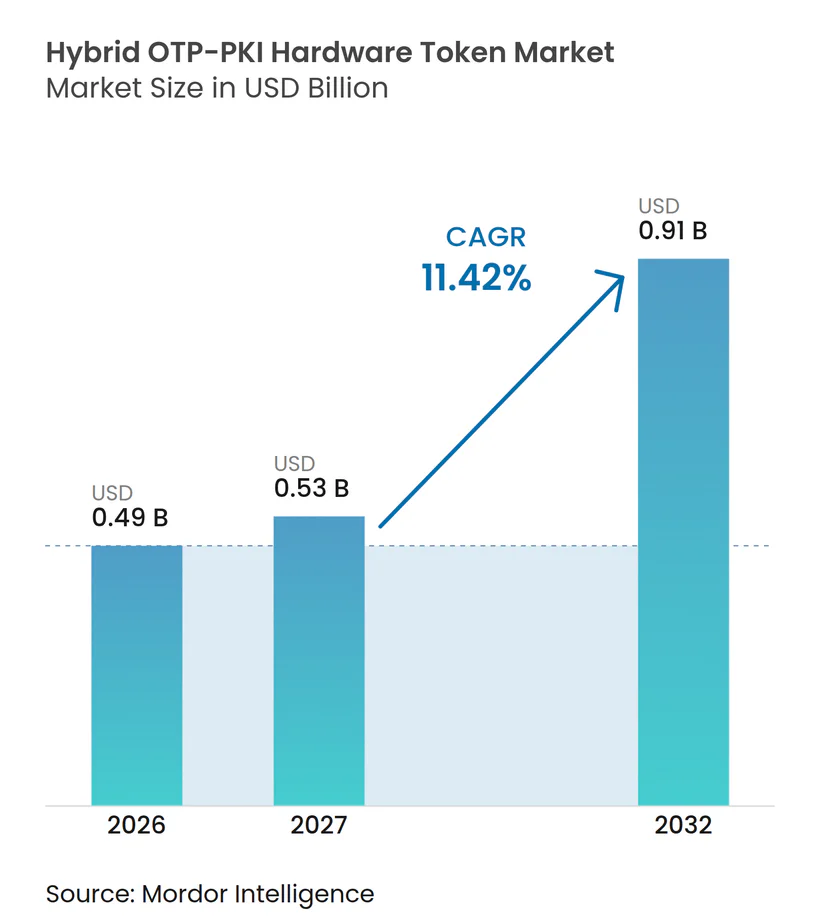
The Hybrid OTP-PKI hardware token market size is expected to increase from USD 0.49 billion in 2026 to USD 0.53 billion in 2027 and reach USD 0.91 billion by 2032, expanding at a CAGR of 11.42% over 2027-2032. Mandatory phishing-resistant authentication requirements are giving the Hybrid OTP-PKI hardware token market a clear compliance-led demand base across finance, government, and critical infrastructure. A single device that combines OTP generation with PKI certificate management helps organizations reduce parallel credential workflows while retaining support for older systems. New payment and authentication requirements are raising procurement standards in several regions, especially where SMS OTP is being retired for high-risk transactions. Vendors with concurrent PKI and FIDO2 capabilities are better placed to serve buyers who cannot replace their established certificate infrastructure at once. Token lifecycle costs, recovery workflows, and interoperability requirements remain important limits on adoption, particularly for organizations with large or distributed workforces.
Key Report Takeaways
- By authentication method, Hybrid OTP-PKI Token held 43.74% share in the hybrid OTP-PKI hardware token market in 2026 and is projected to expand at a 12.22% CAGR through 2032.
- By form factor, USB Token held 44.03% share in 2026, while NFC-Enabled Token is projected to record the highest CAGR of 12.43% through 2032.
- By connectivity, Disconnected held 48.01% share in 2026, while Contactless is projected to advance at a 12.01% CAGR through 2032.
- By deployment mode, On-Premises held 59.26% share in 2026, while Cloud is projected to expand at a 12.06% CAGR through 2032.
- By end-user industry, BFSI held 32.84% share in the 2026 hybrid OTP-PKI hardware token market, while Industrial and Critical Infrastructure is projected to record the highest CAGR of 12.79% through 2032.
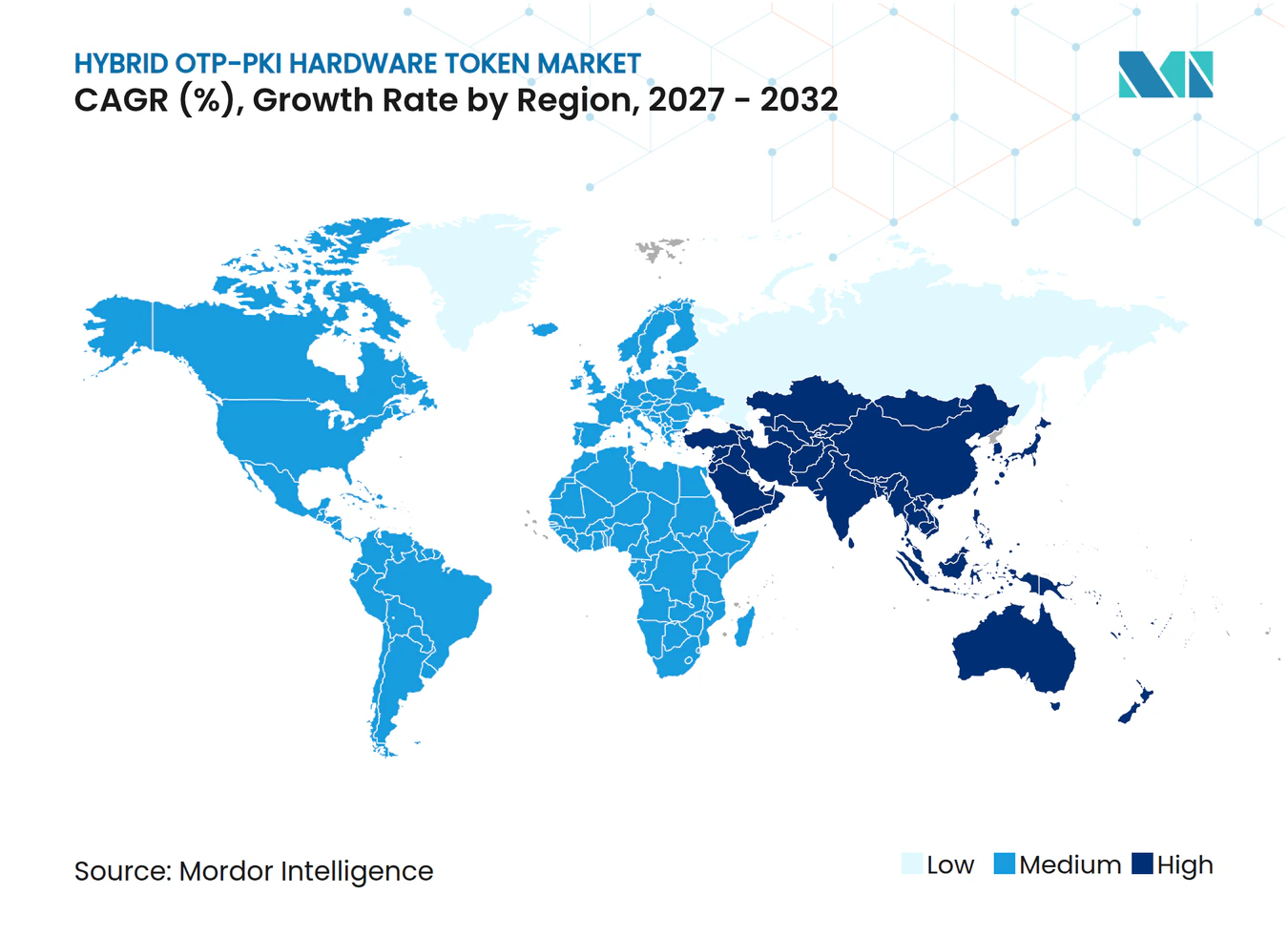
- By geography, North America held 38.01% share in 2026, while Asia-Pacific is projected to expand at a 12.39% CAGR through 2032.
Note: Market size and forecast figures in this report are generated using Mordor Intelligence’s proprietary estimation framework, updated with the latest available data and insights as of January 2026.
Market Trends and Insights
Drivers Impact Analysis of Hybrid OTP-PKI Hardware Token Market*
| Driver | (~) % Impact on CAGR Forecast | Geographic Relevance | Impact Timeline |
|---|---|---|---|
| Mandatory MFA and Strong Customer Authentication Regulation | +2.8% | Global, highest intensity in North America, Europe, and Asia-Pacific | Medium term (2-4 years) |
| Escalating Account Takeover and Phishing Attacks | +2.2% | Global | Short term (≤ 2 years) |
| Expansion of Cloud and Zero-Trust Access | +1.9% | North America, Europe, and Asia-Pacific core markets | Medium term (2-4 years) |
| Digital Banking and High-Value Transaction Growth | +1.5% | Asia-Pacific, Middle East, and South America | Medium term (2-4 years) |
| Legacy-to-Passwordless Migration in Regulated Estates | +0.7% | North America and Europe | Long term (≥ 4 years) |
| Offline and Air-Gapped Authentication Demand in Operational Environments | +0.5% | North America and Europe, with expansion into Asia-Pacific | Long term (≥ 4 years) |
| Source: Mordor Intelligence | |||
Mandatory MFA and Strong Customer Authentication Regulation
Mandatory authentication rules provide the most durable source of demand for the Hybrid OTP-PKI hardware token market. The Reserve Bank of India’s 2025 directions, effective April 1, 2026, require payment system providers to use at least 1 dynamically generated authentication factor.[1] Hardware OTP tokens meet this requirement by design and can also support certificate-based access where institutions retain PKI systems. The International Telecommunication Union identifies secure authentication technologies as a core control for digital financial services, underscoring the operational importance of stronger authentication mechanisms. European rules, including PSD2, NIS2, and DORA, add procurement pressure for financial entities and operators of essential services. The Hybrid OTP-PKI hardware token market benefits when compliance teams need a device that supports modern phishing resistance without disrupting legacy certificate workflows.
Escalating Account Takeover and Phishing Attacks
Rising account takeover and phishing activity give security teams a direct operational reason to adopt hardware-backed authentication. TransUnion reported that the suspected digital fraud rate for account takeover rose 37% from 2024 to 2025. The risk is most acute where a stolen password or intercepted OTP can allow access to payment, administrative, or sensitive data systems. In the Hybrid OTP-PKI hardware token market, hardware keys provide a possession factor that is harder to relay or duplicate than credentials delivered through common messaging channels. This threat profile supports the Hybrid OTP-PKI hardware token market because regulated organizations can use a single device for both transaction authentication and enterprise access. Buyers are also less likely to view a token program as a narrow compliance cost when phishing resistance supports broader fraud and identity-control objectives.
Expansion of Cloud and Zero-Trust Access
Across the Hybrid OTP-PKI hardware token market, cloud migration is moving authentication decisions closer to a central access-control policy. The FIDO Alliance found that 87% of surveyed enterprises were moving toward passkeys, although nearly half had not deployed them at scale because of complexity and cost. Hardware tokens can serve the device-bound passkey role when organizations are unwilling to accept the risk of credential synchronization across personal devices. Identity-centric security also becomes more important when workloads sit across cloud and on-premises environments. The Hybrid OTP-PKI hardware token market benefits from this shift because a hybrid token can authenticate with both legacy applications and cloud services from the same secure element. The approach gives organizations a practical migration path when their identity provider, applications, and endpoint estate do not change at the same pace.
Digital Banking and High-Value Transaction Growth
For the Hybrid OTP-PKI hardware token market, real-time payments and cross-border digital banking raise the authentication standard for high-value transactions. The EU Instant Payments Regulation introduced requirements for real-time fraud monitoring and enhanced controls for instant payment flows in 2025. Stronger transaction controls increase the value of hardware that can bind authentication to a specific action or transaction. Capital One’s work to use x.509 device certificates alongside FIDO2 passkeys across more than 1,000 applications shows the importance of concurrent protocol support in large financial institutions. The Hybrid OTP-PKI hardware token market, therefore, has an opportunity where banks must protect newer payment channels while preserving established access and certificate systems. Flexible protocol support is especially relevant in Asia-Pacific and the Middle East, where digital banking volumes and regulatory expectations are rising together.
Restraints Impact Analysis of Hybrid OTP-PKI Hardware Token Market*
| Restraint | (~) % Impact on CAGR Forecast | Geographic Relevance | Impact Timeline |
|---|---|---|---|
| Token Procurement, Replacement, and Lifecycle Costs | -1.0% | Global | Short term (≤ 2 years) |
| User Friction and Lost-Device Recovery Burden | -0.8% | Global | Short term (≤ 2 years) |
| Interoperability Debt Across Middleware, Readers, and Identity Providers | -0.6% | North America and Europe | Medium term (2-4 years) |
| Secure-Element Component Provenance and Firmware-Supply-Chain Risk | -0.4% | North America, Europe, and Asia-Pacific | Long term (≥ 4 years) |
| Source: Mordor Intelligence | |||
Token Procurement, Replacement, and Lifecycle Costs
In the Hybrid OTP-PKI hardware token market, hardware token economics can delay deployment among mid-sized organizations and public bodies with limited IT budgets. Physical credentials require initial procurement and periodic replacement after damage, loss, employee turnover, or firmware obsolescence. Recovery work can cost more than the token itself when high-assurance policies require identity verification before a replacement credential is issued. Yubico offers YubiKey as a Service, which combines hardware with lifecycle management and shows how vendors are responding to this operational burden. Even so, mobile authenticator applications can appear less expensive where phishing-resistant authentication is not an explicit requirement. Cost concerns may restrain the Hybrid OTP-PKI hardware token market when buyers assess device price without considering the fraud, compliance, and migration benefits of a unified credential.
User Friction and Lost-Device Recovery Burden
Within the Hybrid OTP-PKI hardware token market, enrollment and recovery processes can create friction that becomes visible only after a token program begins. The Association for Computing Machinery notes that adopting passwordless authentication may require changes to legacy systems, user experience, and organizational processes.[2] Large rollouts can be delayed when older applications need custom FIDO2 or WebAuthn integrations. Lost-token procedures also reduce efficiency in healthcare and critical infrastructure, where shared workstations and shift-based access patterns are common. OLOID’s integration with Epic shows that multimodal authentication can improve access in healthcare, but also increases the number of recovery paths IT teams must manage. The Hybrid OTP-PKI hardware token market must therefore pair device sales with enrollment, recovery, and lifecycle services that reduce the burden on users and administrators.
*Our forecasts treat driver/restraint impacts as directional, not additive. The impact forecasts reflect baseline growth, mix effects, and variable interactions.
Hybrid OTP-PKI Hardware Token Market Segment Analysis
By Authentication Method:
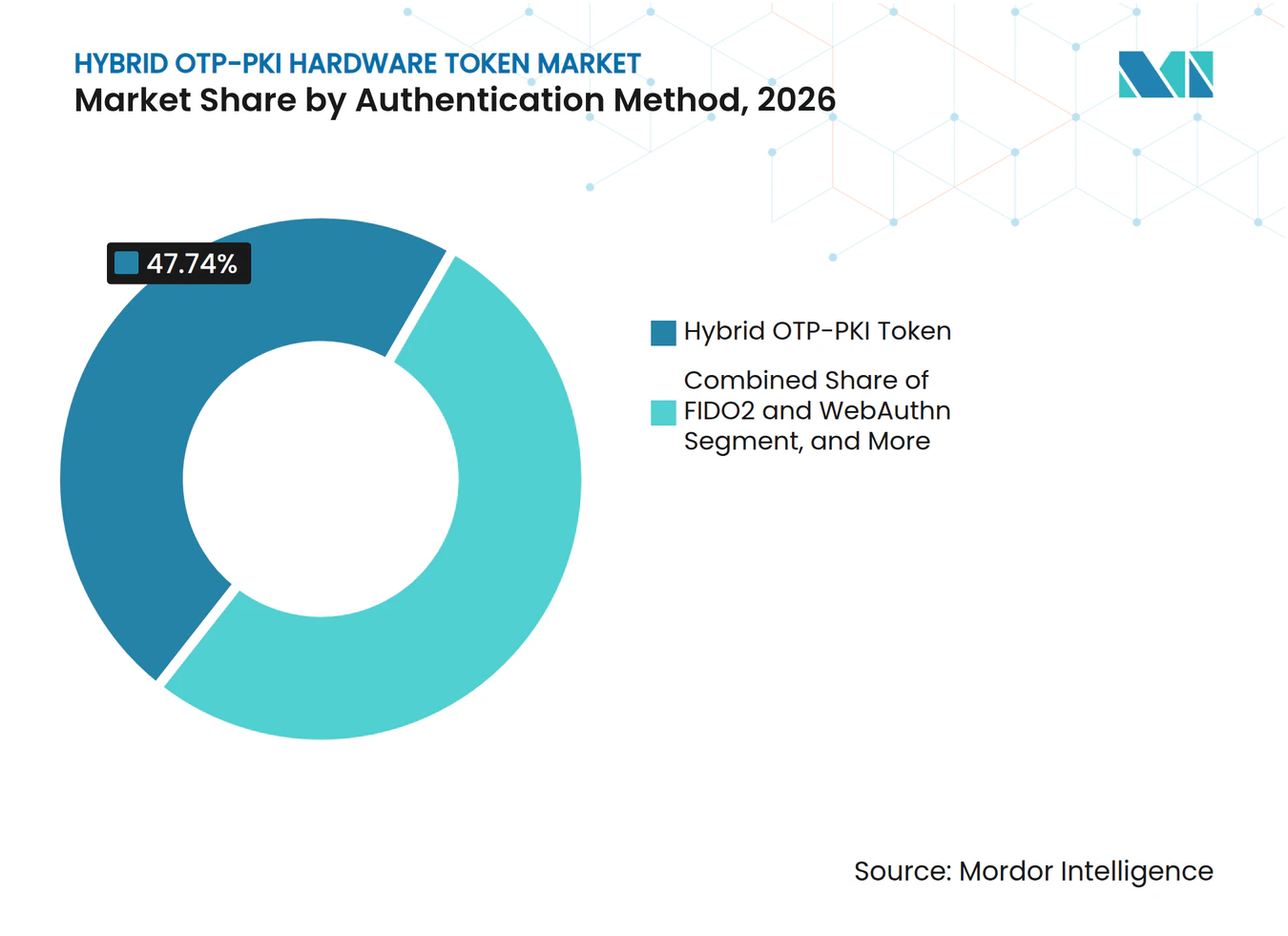
Hybrid Credentials Support Legacy and Modern ProtocolsHybrid OTP-PKI Token held 43.74% share in 2026 and is projected to record a 12.22% CAGR through 2032. This position reflects the need for a credential that works across PKI estates and newer FIDO2 environments. Yubico’s YubiKey 5 FIPS Series received FIPS 140-3 validation in May 2026 and supports DoD PKI credentials, FIDO2 passkeys, OATH OTP, and OpenPGP on a single device. That combination supports high-assurance deployments that cannot abandon certificate-based access immediately. FIDO2 and WebAuthn adoption is increasing as organizations remove SMS OTP from higher-risk workflows.
TOTP retains an installed base in banking and VPN access, where older middleware slows migration. HOTP remains useful in plant-floor settings where reliable time synchronization cannot be assumed. The Hybrid OTP-PKI hardware token industry serves these use cases by enabling a phased transition rather than forcing a single protocol decision. Infineon launched the SECORA ID Key S USB in July 2026, featuring FIDO, PKI, and digital signature applets on a Java Card 3.1 platform. Its design shows that the hybrid requirement is moving into the underlying silicon platform, which can reduce integration work for manufacturers and enterprise buyers.



By Form Factor:
USB Leadership Faces Contactless DemandUSB Token held 44.03% share in 2026, while NFC-Enabled Token is projected to expand at a 12.43% CAGR through 2032. USB-A infrastructure remains common across enterprise and government environments, which supports the established position of USB devices. Contactless designs reduce the need to insert a token and suit mobile-first work patterns. Swissbit launched iShield Key 2 in May 2025 with USB-C, USB-A, NFC, and MIFARE DESFire EV3 support across its model range. This format provides organizations with a single device for logical access, mobile authentication, and selected physical access needs.
Smart cards and USB smart cards continue to matter in government and healthcare settings that combine physical and logical access controls. Display cards remain relevant for legacy banking users who prefer on-card OTP generation. Key fob tokens have a role in industrial operations where permanent workstations are unavailable or one-handed use is useful. HID Global introduced Crescendo Cards in August 2025 to combine physical-access badges with passwordless logical access in dual-interface and contactless formats. The Hybrid OTP-PKI hardware token market is consequently moving toward devices that reduce the separation between access badges and authentication tools.
By Connectivity:
Disconnected Tokens Meet Operational Technology NeedsDisconnected tokens held 48.01% share in 2026, while Contactless is projected to register a 12.01% CAGR through 2032. The leading position reflects the established OTP base and the need for authentication that works without a network call-home. Air-gapped operational technology environments often separate enterprise systems from control networks. This restriction makes offline authentication important for plant-floor operators and other high-consequence users. A 2025 study in the International Journal of Control, Automation and Systems assessed out-of-band OTP-based 2-factor authentication for secure Linux platforms in control and automation settings.
Contactless connectivity is gaining support, with smartphone tap-to-authenticate workflows becoming routine. NFC-capable hardware can offer a more convenient experience without sacrificing a discrete possession factor. Connected tokens also play a role in enterprise IT, as managed workstations can receive firmware updates and credential revocation instructions remotely. eIDAS 2.0 and NIST FIPS 201 standards support structured credential practices in environments that require identity assurance. The Hybrid OTP-PKI hardware token market can address both architectures by offering disconnected OTP use for operational networks and connected credential management for corporate applications.
By Deployment Mode:
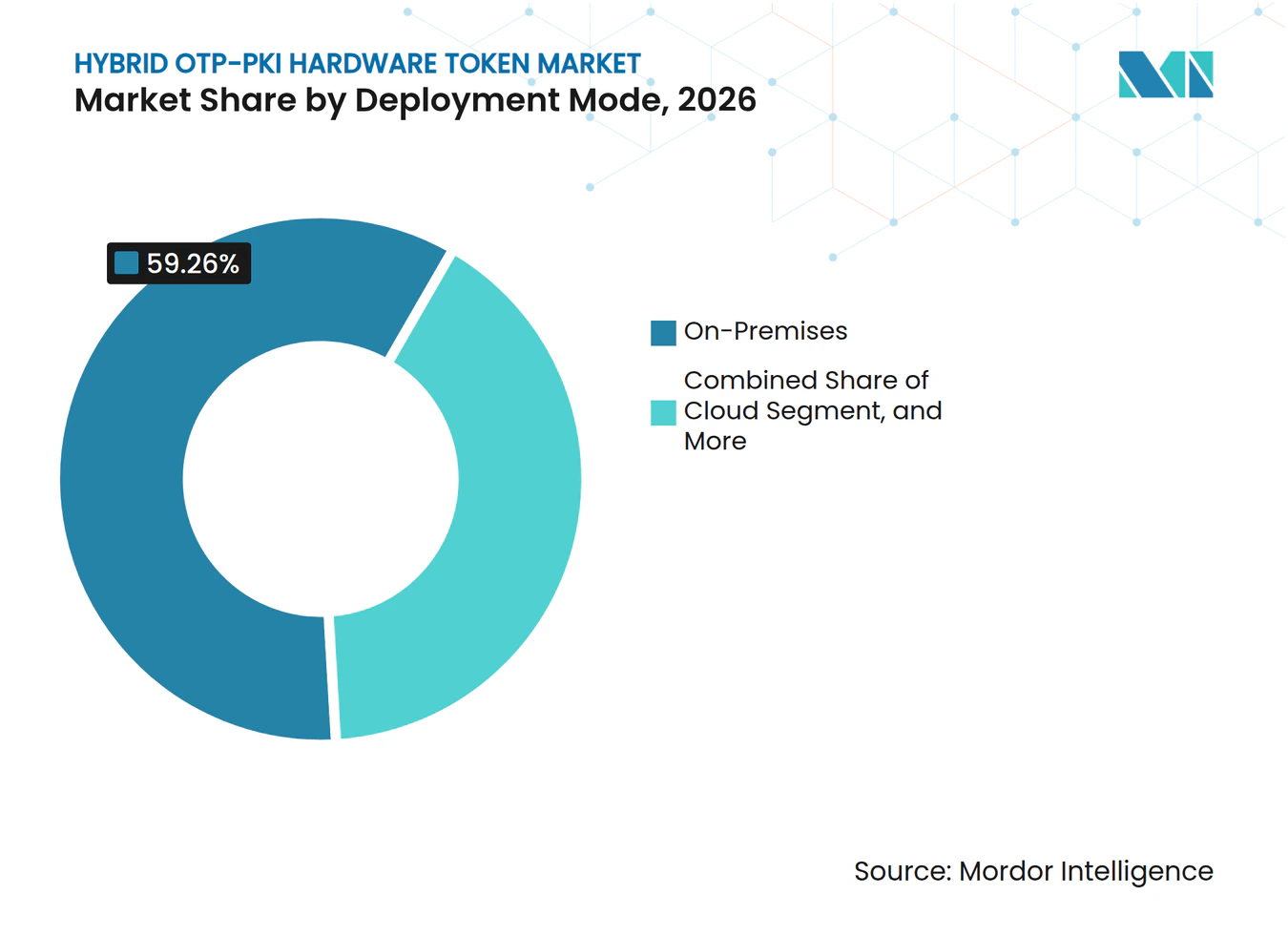
On-Premises Systems Coexist With Cloud MigrationOn-Premises deployment held 59.26% share in 2026, while Cloud is projected to expand at a 12.06% CAGR through 2032. Government and regulated organizations retain authentication infrastructure within their own networks because of isolation requirements and prior investment in PKI. Cloud identity platforms are attracting demand because they can automate token enrollment, revocation, and audit logging. Hybrid deployments allow organizations to retain sensitive authentication workloads locally while federating identity assertions to cloud applications. This structure is useful for BFSI buyers who face data residency obligations and service resilience requirements.
Thales made SafeNet eToken Fusion NFC PIV generally available in April 2025 with support for Microsoft Entra ID and Okta. The product shows how 1 hardware SKU can connect on-premises credential management to cloud identity services. DORA also encourages operational resilience among financial entities, which can strengthen the case for architectures that avoid a single point of authentication failure. The Hybrid OTP-PKI hardware token industry is well-positioned to support these mixed environments, as devices can preserve certificate functions while supporting cloud-ready passkey authentication. Deployment choices will depend on local regulations, existing middleware, and the organization’s approach to identity governance.

By End-User Industry:
BFSI Leads While Industrial Users AccelerateBFSI held 32.84% share in 2026, while Industrial and Critical Infrastructure is projected to advance at a 12.79% CAGR through 2032. Financial institutions have invested in hardware tokens for many years because payment fraud and customer authentication requirements create a clear use case. Industrial adoption is gaining momentum as operators secure programmable logic controllers, SCADA interfaces, and other operational technology assets. Government and defense buyers also need high-assurance credentials that can meet PIV, Common Access Card, and related requirements. Enterprise IT and cloud-security buyers use tokens to extend zero-trust policies to applications across distributed infrastructure.
Healthcare organizations face specific access-control needs because prescribing and protected health information systems require reliable multi-factor authentication. The Hybrid OTP-PKI hardware token market can support environments where cloud connectivity is limited but strong credential assurance remains necessary. BFSI deployments often focus on transaction authentication and identity proofing, while industrial use cases focus on operator access and predictable offline behavior. This difference explains why industrial adoption can accelerate even though BFSI remains the larger segment. Telecommunications and other end users add volume through deployments that protect network operations centers and customer-facing platforms from credential theft.
Geography Analysis
North America Hybrid OTP-PKI Hardware Token Market
North America held 38.01% of the Hybrid OTP-PKI hardware token market share in 2026. Federal procurement, regulated financial institutions, and established FIDO2 adoption support the region’s leading position. Yubico stated that the YubiKey 5 FIPS Series was authorized by the US Department of Defense to hold both DoD PKI credentials and FIDO2 passkeys. Federal requirements can influence demand beyond agencies because contractors often need comparable levels of authentication assurance. Canada’s guidance on multi-factor authentication also supports hardware-bound authenticators for high-privilege functions.
Europe and South America Hybrid OTP-PKI Hardware Token Market
Europe is the second-largest regional market, with Germany, the United Kingdom, and France leading adoption. NIS2 and DORA impose compliance requirements on essential-service operators and financial entities. France’s CNIL recommended multi-factor authentication in March 2025 and listed hardware OTP tokens and USB authentication keys as possession factors. eIDAS 2.0 is also supporting demand for credentials that can work with qualified electronic signatures and stronger user authentication. South America remains smaller, although banking requirements and fintech adoption in Brazil are widening the potential user base.
APAC and MEA Hybrid OTP-PKI Hardware Token Market
Asia-Pacific is projected to record a 12.39% CAGR from 2027 to 2032, the highest regional rate. India’s payment authentication directions create a clear compliance route for dynamically generated factors. The Philippines, Singapore, South Korea, and Japan also present demand as financial institutions raise protections for higher-value digital activity. Sumitomo Mitsui Trust Bank used OneSpan’s cloud-based FIDO authentication in 2025 to address phishing threats in high-value banking use cases.[3] The Middle East is seeing demand after authentication requirements became more stringent for banking transactions. Africa is at an earlier stage, but digital payments and fraud concerns are encouraging investment in MFA infrastructure in Nigeria and South Africa.
Competitive Landscape
Market Concentration
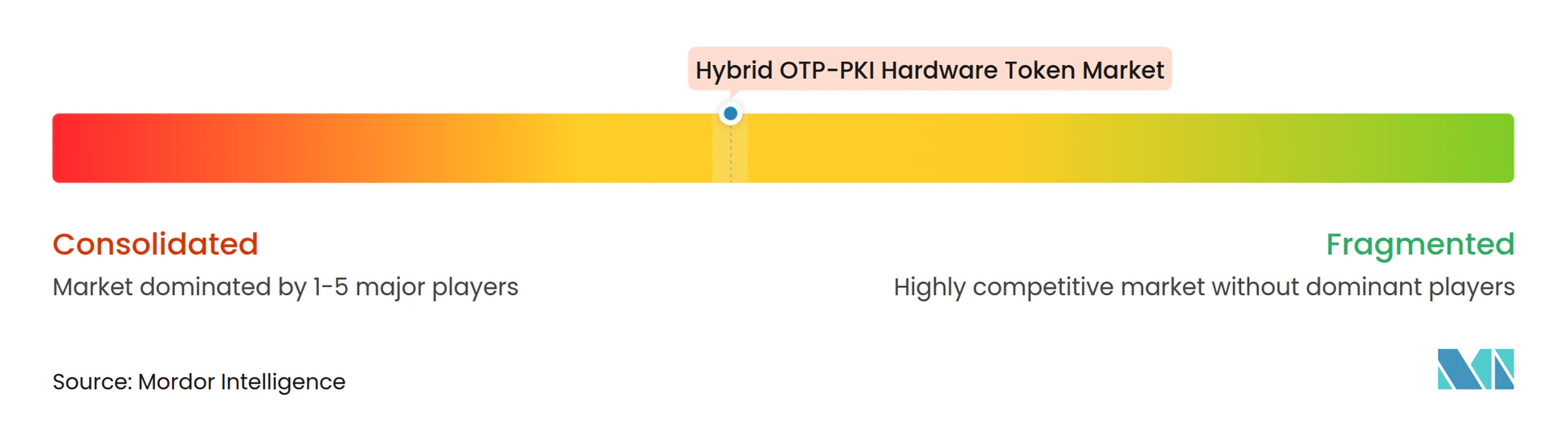
The Hybrid OTP-PKI hardware token market is moderately concentrated, with Yubico, OneSpan, FEITIAN Technologies, Thales Group, and HID Global competing for regulated-sector contracts. Leading suppliers in the Hybrid OTP-PKI hardware token market differentiate themselves through certifications, credential management capabilities, and support for multiple protocols. FIDO Alliance participation and integrations with Microsoft Entra ID, Okta, and Ping Identity can reduce customer switching costs. Vendors that combine PKI and FIDO2 functionality have an advantage when buyers need to retain older certificate systems during a passkey transition. This makes platform compatibility as important as token hardware in many procurement decisions.
HID Global launched an Enterprise Passkey Management platform in August 2025 to centralize FIDO credential provisioning, revocation, and audit logging. This move extends competition from individual devices into lifecycle management services. OneSpan agreed to acquire Build38 in January 2026, combining hardware authentication with mobile application threat protection for financial services customers. Yubico also demonstrated a Role Delegation Token capability for AI agent authorization with Delinea and StrongDM at RSA Conference 2026. These actions show that suppliers are building broader identity and security offerings around the physical credential
For the Hybrid OTP-PKI hardware token market, post-quantum cryptography is opening a new product-development path. Cryptsoft and FEITIAN demonstrated a hybrid post-quantum authentication token proof of concept in April 2026 using ML-DSA-65. Intercede and Swissbit also expanded their partnership in June 2026 to create a post-quantum-ready FIDO2 passkey with iShield Key 2 hardware. FIPS 140-3 certification remains important because failure to obtain it can restrict access to US federal and allied government opportunities. Open-hardware suppliers such as SoloKeys and Nitrokey compete on transparency and price, but regulated buyers often require the lifecycle management and certification depth that larger vendors offer.
Hybrid OTP-PKI Hardware Token Industry Leaders
-
Yubico AB
-
Thales Group
-
OneSpan Inc.
-
FEITIAN Technologies Co., Ltd.
-
Entrust Corporation
- *Disclaimer: Major Players sorted in no particular order
Hybrid OTP-PKI Hardware Token Market Companies Covered in this Report
- Yubico AB
- OneSpan Inc.
- FEITIAN Technologies Co., Ltd.
- GoTrustID Inc.
- Hypersecu Information Systems Inc.
- Deepnet Security Limited
- SecureMetric Technology Sdn. Bhd.
- AuthenTrend Technology Inc.
- Razzo Tech Corporation DBA Thetis.io
- SoloKeys
- Nitrokey GmbH
- Token2 SIA
- TrustKey Solutions Co., Ltd.
- Identiv, Inc.
- Thales Group
- Entrust Corporation
- HID Global Corporation
- RSA Security LLC
- Swissbit AG
- Kensington Computer Products Group
- BIO-key International, Inc.
- SurePassID Corp.
- Nexus Group AB
- ID Control B.V.
- Soliton Systems K.K.
Recent Industry Developments in Hybrid OTP-PKI Hardware Token Market
- July 2026: OneSpan launched DigipassONE, a unified authentication platform enabling financial institutions to consolidate passkeys, hardware tokens, and OTP into a single managed service. The platform targets BFSI customers upgrading security infrastructure while preserving existing authentication investments, repositioning OneSpan as an authentication orchestration vendor beyond device supply.
- July 2026: Infineon Technologies launched the SECORA ID Key S USB, the first FIDO-certified Level 3+ security key built on a Java Card 3.1 platform with USB and NFC connectivity. The device combines preloaded FIDO, PKI, and digital-signature applets on its SLC38 crypto controller, with volume production scheduled for September 2026.
- June 2026: Intercede and Swissbit expanded their partnership to develop an end-to-end FIDO2 passkey implementing post-quantum cryptography, integrating Intercede’s MyID credential management with Swissbit’s iShield Key 2 hardware to deliver a single quantum-safe authentication chain ahead of anticipated government PQC mandates.
- June 2026: Yubico received FIPS 140-3 validation for its YubiHSM 2 FIPS hardware security module at Security Level 3 through the NIST Cryptographic Module Validation Program, strengthening its hardware root-of-trust offering for servers and PKI infrastructure in regulated environments.
Global Hybrid OTP-PKI Hardware Token Market Report Scope
The Hybrid OTP-PKI Hardware Token Market refers to the global market for hardware-based authentication devices that combine One-Time Password (OTP) technology with Public Key Infrastructure (PKI) capabilities to provide secure user authentication, identity verification, and access control for digital systems, networks, applications, and sensitive information. These tokens integrate OTP mechanisms, such as Time-Based One-Time Password (TOTP) and Event-Based One-Time Password (HOTP), with cryptographic key storage, digital certificate-based authentication, and public-key cryptography to strengthen security and reduce the risk of unauthorized access, credential theft, phishing, and identity fraud.
The Hybrid OTP-PKI Hardware Token Market Report is Segmented by Authentication Method (Time-Based One-Time Password (TOTP), Event-Based One-Time Password (HOTP), FIDO2 and WebAuthn, and Hybrid OTP-PKI Token), Form Factor (USB Token, Smart Card and USB Smart Card, Display Card, Key Fob Token, and NFC-Enabled Token), Connectivity (Connected, Disconnected, and Contactless), Deployment Mode (On-Premises, Cloud, and Hybrid), End-User Industry (BFSI, Government and Defense, Enterprise IT and Cloud Security, Healthcare and Life Sciences, Telecommunications, Industrial and Critical Infrastructure, and Other End-User Industries), and Geography (North America, South America, Europe, Asia-Pacific, Middle East, and Africa). The Market Forecasts are Provided in Terms of Value (USD).
Segmentation Overview
| Time-Based One-Time Password (TOTP) |
| Event-Based One-Time Password (HOTP) |
| FIDO2 and WebAuthn |
| Hybrid OTP-PKI Token |
| USB Token |
| Smart Card and USB Smart Card |
| Display Card |
| Key Fob Token |
| NFC-Enabled Token |
| Connected |
| Disconnected |
| Contactless |
| On-Premises |
| Cloud |
| Hybrid |
| BFSI |
| Government and Defense |
| Enterprise IT and Cloud Security |
| Healthcare and Life Sciences |
| Telecommunications |
| Industrial and Critical Infrastructure |
| Other End-User Industries |
| North America | United States |
| Canada | |
| Mexico | |
| South America | Brazil |
| Argentina | |
| Rest of South America | |
| Europe | Germany |
| United Kingdom | |
| France | |
| Italy | |
| Spain | |
| Rest of Europe | |
| Asia-Pacific | China |
| Japan | |
| India | |
| South Korea | |
| Australia | |
| Rest of Asia-Pacific | |
| Middle East | Saudi Arabia |
| United Arab Emirates | |
| Turkey | |
| Rest of Middle East | |
| Africa | South Africa |
| Nigeria | |
| Egypt | |
| Rest of Africa |
| By Authentication Method | Time-Based One-Time Password (TOTP) | |
| Event-Based One-Time Password (HOTP) | ||
| FIDO2 and WebAuthn | ||
| Hybrid OTP-PKI Token | ||
| By Form Factor | USB Token | |
| Smart Card and USB Smart Card | ||
| Display Card | ||
| Key Fob Token | ||
| NFC-Enabled Token | ||
| By Connectivity | Connected | |
| Disconnected | ||
| Contactless | ||
| By Deployment Mode | On-Premises | |
| Cloud | ||
| Hybrid | ||
| By End-User Industry | BFSI | |
| Government and Defense | ||
| Enterprise IT and Cloud Security | ||
| Healthcare and Life Sciences | ||
| Telecommunications | ||
| Industrial and Critical Infrastructure | ||
| Other End-User Industries | ||
| By Geography | North America | United States |
| Canada | ||
| Mexico | ||
| South America | Brazil | |
| Argentina | ||
| Rest of South America | ||
| Europe | Germany | |
| United Kingdom | ||
| France | ||
| Italy | ||
| Spain | ||
| Rest of Europe | ||
| Asia-Pacific | China | |
| Japan | ||
| India | ||
| South Korea | ||
| Australia | ||
| Rest of Asia-Pacific | ||
| Middle East | Saudi Arabia | |
| United Arab Emirates | ||
| Turkey | ||
| Rest of Middle East | ||
| Africa | South Africa | |
| Nigeria | ||
| Egypt | ||
| Rest of Africa | ||
Key Questions Answered in the Report
What is the size of the Hybrid OTP-PKI hardware token market?
The Hybrid OTP-PKI hardware token market is expected to increase from USD 0.49 billion in 2026 to USD 0.91 billion by 2032, at an 11.42% CAGR from 2027 to 2032.
What is driving demand for hybrid OTP-PKI hardware tokens?
Mandatory phishing-resistant authentication, digital-payment security requirements, zero-trust access, and the need to support both PKI and FIDO2 are key demand factors.
Which authentication method leads adoption?
Hybrid OTP-PKI Token held 43.74% share in 2026 and is projected to expand at a 12.22% CAGR through 2032.
Which end-user group is expanding fastest?
Industrial and Critical Infrastructure is projected to record a 12.79% CAGR through 2032 as operators strengthen access controls for operational technology.
Which region has the highest projected growth rate?
Asia-Pacific is projected to expand at a 12.39% CAGR from 2027 to 2032, supported by banking and payment-authentication requirements.
What is the main challenge for hardware token deployment?
Upfront procurement, token replacement, enrollment, and lost-device recovery can increase operating costs and slow broad deployment.