
HVAC Linesets Market Size and Share
Market Overview
| Study Period | 2022 - 2032 |
|---|---|
| Market Size (2027) | USD 12.62 Billion |
| Market Size (2032) | USD 17.99 Billion |
| Growth Rate (2027 - 2032) | 7.35 % |
| Fastest Growing Market | Asia-Pacific |
| Largest Market | Asia-Pacific |
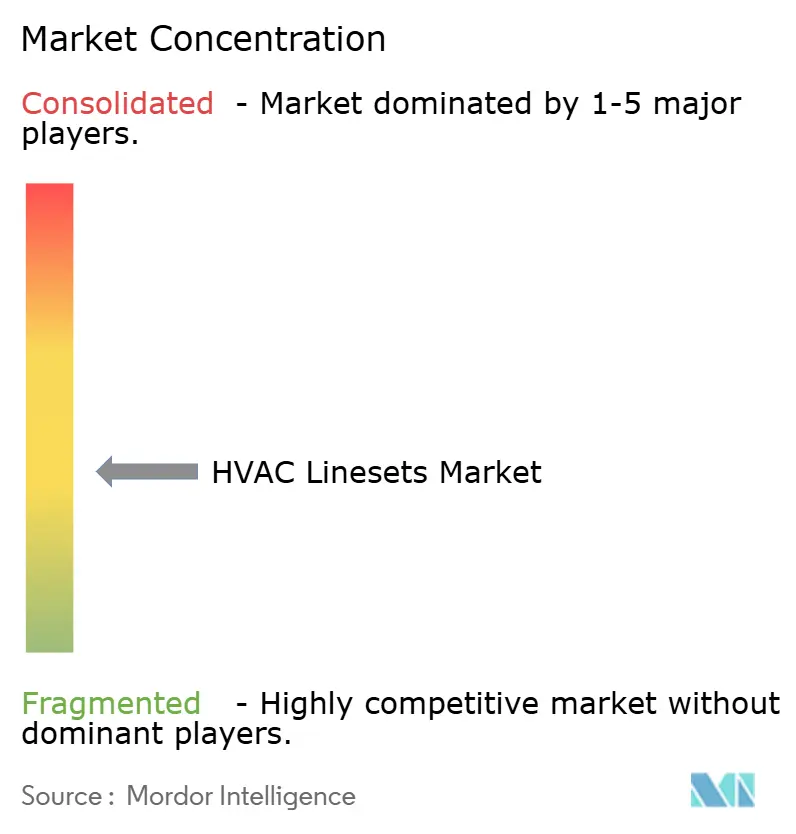
| Market Concentration | Medium |
Major Players *Disclaimer: Major Players sorted in no particular order Image © Mordor Intelligence. Reuse requires attribution under CC BY 4.0. | |
HVAC Linesets Market Analysis by Mordor Intelligence
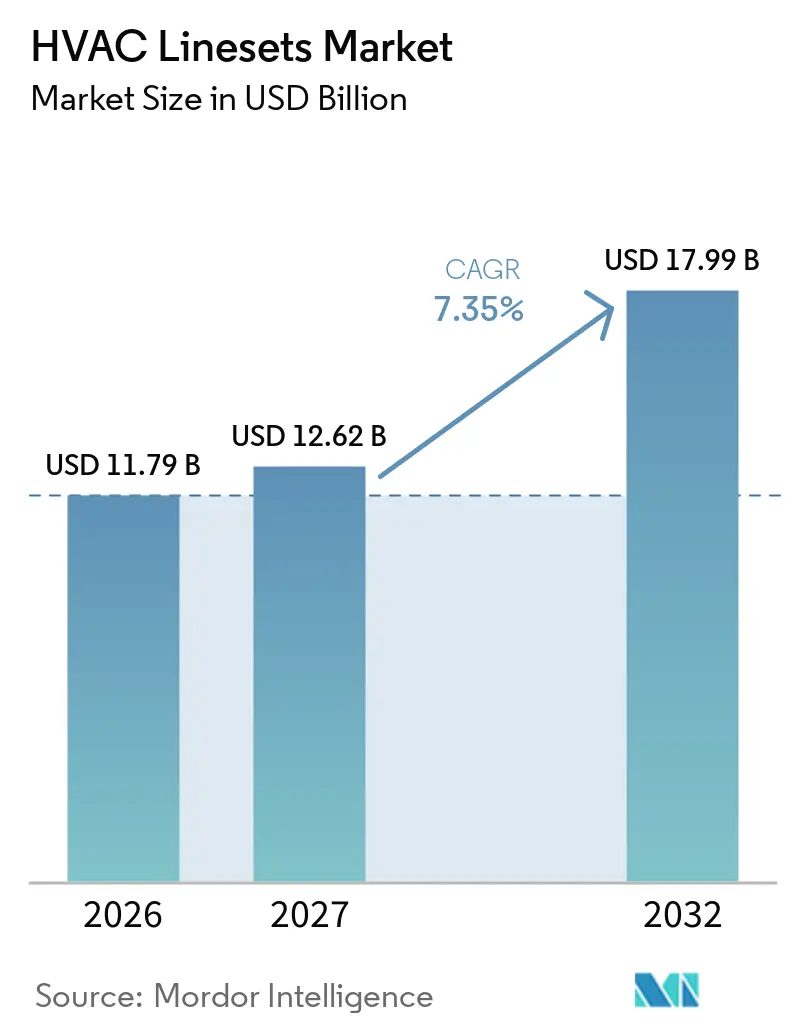
The HVAC Linesets Market size was valued at USD 11.79 billion in 2026 and is estimated to grow from USD 12.62 billion in 2027 to reach USD 17.99 billion by 2032, at a CAGR of 7.35% during the forecast period (2027-2032). Heating, Ventilation, and Air Conditioning (HVAC) linesets connect indoor evaporator coils with outdoor condensing units in split-system installations. Heat pump adoption is increasing the need for assemblies that can operate under heating-mode pressures and support larger suction-line requirements. The shift toward lower Global Warming Potential (GWP) refrigerants is also changing product specifications, installation practices, and replacement decisions. These developments create demand in new construction and retrofit work, while bringing more attention to certified factory-insulated and pressure-tested products. The HVAC linesets market is, therefore, shaped by equipment electrification, refrigerant compliance, copper supply conditions, and the availability of qualified installers.
Key Report Takeaways
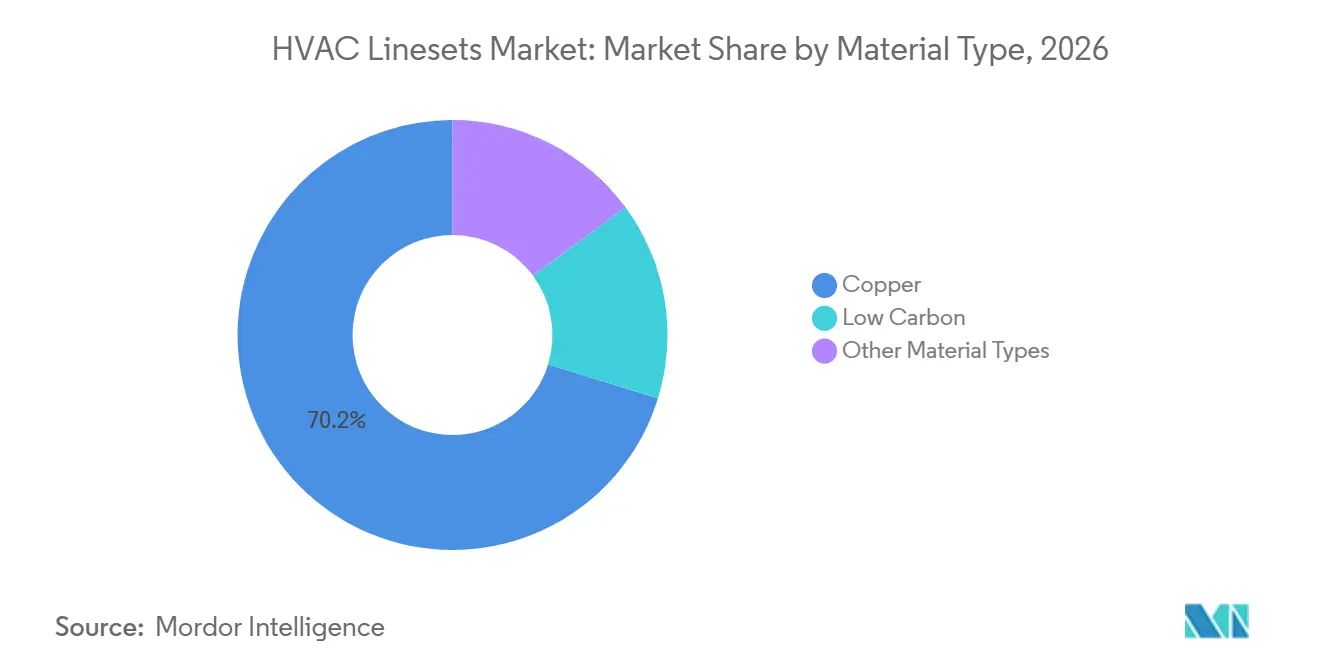
- By material type, copper held 70.24% of the HVAC linesets market share in 2026, while low carbon is forecast to advance at a 7.92% CAGR through 2032.
- By implementation, new construction held 55.78% of the HVAC linesets market share in 2026, while retrofit is forecast to advance at an 8.17% CAGR through 2032.
- By application, air conditioning held 45.67% of the HVAC linesets market share in 2026, while heat pumps are forecast to advance at an 8.58% CAGR through 2032.
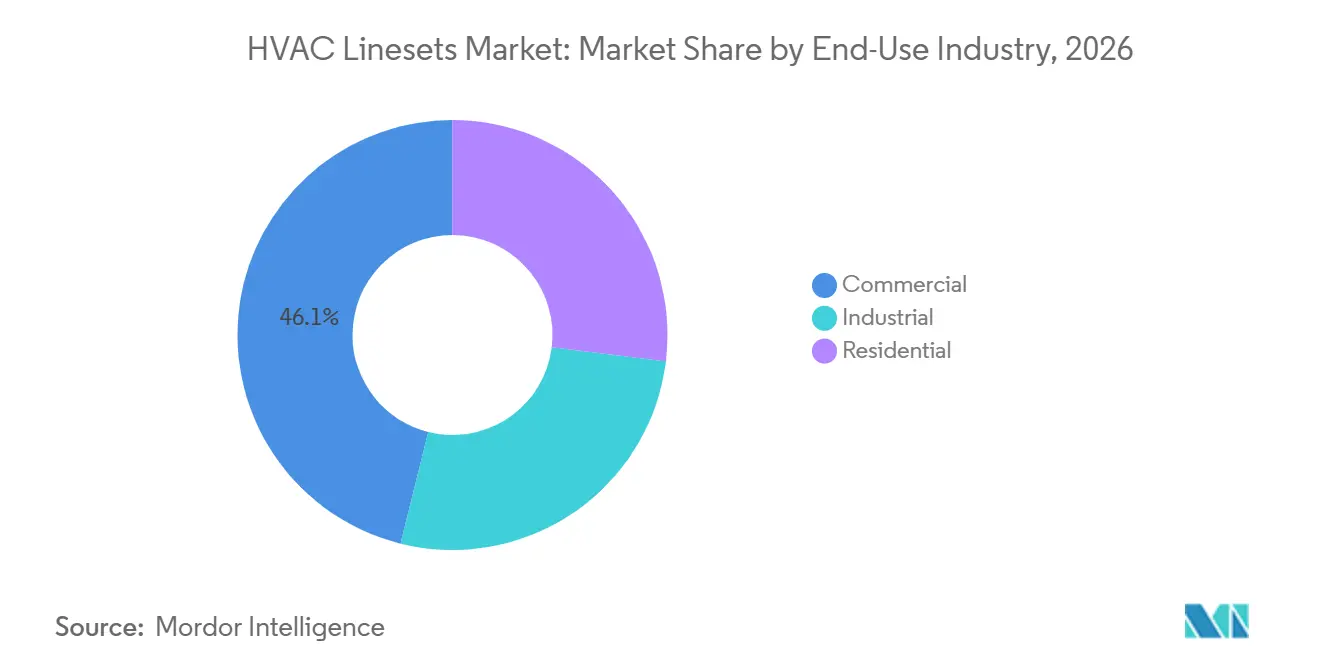
- By end-use industry, commercial held 46.12% of the HVAC linesets market share in 2026, while residential is forecast to advance at an 8.63% CAGR through 2032.
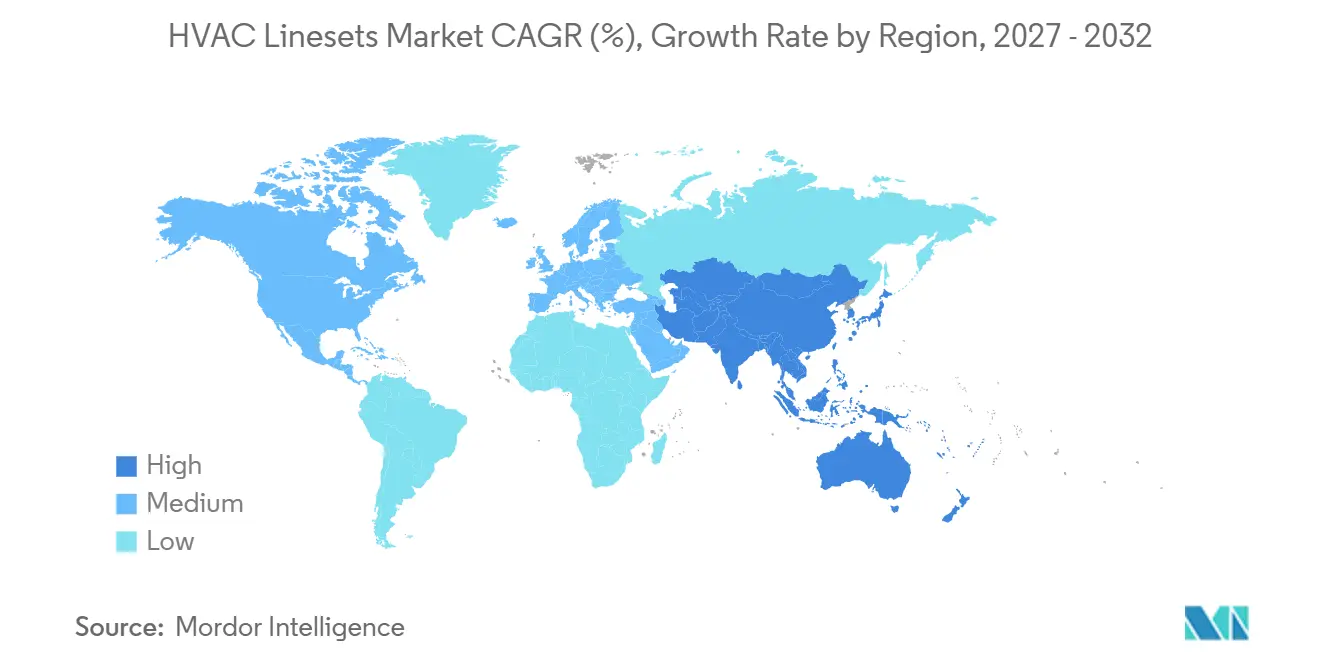
- By geography, Asia-Pacific held 38.39% of the HVAC linesets market share in 2026 and is forecast to advance at an 8.24% CAGR through 2032.
Note: Market numbers in this report are based on Mordor Intelligence's proprietary estimation framework, which combines nine months of actuals with Q4 projections for base year 2026.
Global HVAC Linesets Market Trends and Insights
Drivers Impact Analysis*
| Driver | (~) % Impact on CAGR Forecast | Geographic Relevance | Impact Timeline |
|---|---|---|---|
| Energy-Efficient HVAC and Heat-Pump Adoption | +2.3% | Global, led by North America, Europe, APAC | Short term (≤ 2 years) |
| Low-GWP Refrigerant Transition and A2L-Ready Replacements | +1.9% | North America & Europe; spillover to APAC | Short term (≤ 2 years) |
| Commercial Retrofit and Aging HVAC Replacement Cycles | +1.4% | North America & Europe; APAC secondary | Medium term (2–4 years) |
| Urbanization, Data Centers, and High-Density Cooling Infrastructure | +1.1% | APAC core, spillover to North America and MEA | Medium term (2–4 years) |
| Factory-Insulated Products Addressing Skilled-Labor Constraints | +0.7% | Global | Short term (≤ 2 years) |
| Source: Mordor Intelligence | |||
Energy-Efficient HVAC and Heat-Pump Adoption
Heat pump installations are creating direct demand for linesets because each system requires a refrigerant circuit between indoor and outdoor equipment. The Building Decarbonization Coalition reported that 2.4 million heat pumps were sold in the United States through July 2025, compared with 1.9 million fossil-fuel furnaces. That represented a 26% lead for heat pumps during the period. The European Commission Joint Research Centre recorded 2.3 million heat pump installations in the European Union during 2024[1]. Heating-mode refrigerant pressures require appropriately rated tubing and insulation, particularly in cold-climate applications. Wider suction lines and longer runs in retrofit projects can increase the material content per installation. This supports the HVAC linesets market beyond the increase in equipment unit shipments alone.
Low-GWP Refrigerant Transition and A2L-Ready Replacements
The transition to lower-GWP refrigerants is creating a compliance-related replacement cycle for refrigerant tubing assemblies. The United States Environmental Protection Agency Technology Transitions Program restricted the manufacture of certain new HVAC system components using refrigerants with a GWP above 700 from January 1, 2025. It also restricted the installation of covered systems from January 1, 2026. Refrigerants such as R-32, with a GWP of 675, and R-454B, with a GWP of 466, are part of the transition toward A2L lower-flammability refrigerants. The HVAC linesets market gains when legacy assemblies need verification or replacement during the refrigerant changeover.
Commercial Retrofit and Aging HVAC Replacement Cycles
Commercial HVAC systems commonly remain in service for 15 to 20 years, placing systems commissioned during the 2000-2010 construction period within an active replacement window[2]. These projects often involve operating buildings where owners seek to limit disruption. Component replacements can therefore be preferred when a complete system redesign would create extended downtime. Data centers, healthcare facilities, hospitality sites, and offices need dependable cooling while equipment is upgraded. A refrigerant transition can add a lineset verification or replacement requirement to an equipment change. This creates demand that is not captured by equipment shipment counts alone.
Urbanization, Data Centers, and High-Density Cooling Infrastructure
Urban development is supporting HVAC installation activity in the Asia-Pacific, the Middle East, and other regions with rising building density. New offices, hotels, retail space, and multifamily buildings require cooling and, in some settings, heat pump systems. Data centers add another source of demand because their cooling equipment must manage higher thermal loads than standard commercial facilities. Data showed growth in data center physical infrastructure during 2025, with thermal management increasing faster than the wider category. Data center operators commonly require nitrogen-charged and pressure-tested assemblies with material traceability. These requirements support higher-value lineset sales in the HVAC linesets market when compared with standard residential kits.
Restraints Impact Analysis*
| Restraint | (~) % Impact on CAGR Forecast | Geographic Relevance | Impact Timeline |
|---|---|---|---|
| Copper Price Volatility and Working-Capital Exposure | -1.5% | Global | Short term (≤ 2 years) |
| High Installation Cost and Limited Skilled Technicians | -0.9% | North America & Europe | Medium term (2–4 years) |
| Aluminum Substitution and Re-Engineering Barriers | -0.5% | APAC core, spillover to Europe & North America | Long term (≥ 4 years) |
| Source: Mordor Intelligence | |||
Copper Price Volatility and Working-Capital Exposure
Copper is the main input for conventional refrigerant tubing, so price movements affect material costs, inventories, and supplier margins. In 2025, copper prices moved from below USD 4.60 per pound to above USD 5.70 per pound within months. Copper prices also exceeded USD 12,000 per metric ton in late December 2025. The United States Section 232 tariff on specified copper semi-finished products took effect in 2025, while refined copper metal was excluded. The change affected the value of inventory accumulated ahead of the tariff decision. Companies with limited hedging capacity face greater working-capital pressure when prices change rapidly.
High Installation Cost and Limited Skilled Technicians
A limited technician base can slow the conversion of equipment demand into completed HVAC installations. The United States Bureau of Labor Statistics projects 11% employment growth for HVAC mechanics and installers from 2025 to 2035. It also projects 40,600 openings each year over that period. Installation costs rise when contractors must compete for skilled labor or schedule work over a longer period. This can defer projects even when building owners have already selected the equipment. The effect is most visible in North America and Europe, where labor availability is a continuing constraint.
*Our forecasts treat driver/restraint impacts as directional, not additive. The impact forecasts reflect baseline growth, mix effects, and variable interactions.
Segment Analysis
By Material Type: Copper Anchors the Market While Low Carbon Gains Momentum
Copper held 70.24% of the market share in 2026. Its position reflects thermal conductivity, established Air Conditioning and Refrigeration (ACR)-grade processing, and compatibility with major refrigerant families, including A2L (mildly flammable refrigerant classification) products. Copper tubing also benefits from long-standing technician familiarity and widely used tooling. Many active specifications and codes were developed around copper refrigerant lines. These factors support continued demand for conventional copper assemblies. They also make a rapid material change more difficult for installers, equipment makers, and building owners.
Low carbon is projected to advance at a 7.92% CAGR through 2032. The segment is supported by building projects that seek lower lifecycle emissions and refrigerant systems with lower charge requirements. A 2025 Journal of Cleaner Production study found that copper-saving aluminum approaches can reduce lifecycle greenhouse gas emissions when design and performance requirements are met. Small-diameter copper designs can also lower internal refrigerant volume without leaving the copper product family. Composite, nickel-coated steel, and hybrid configurations remain niche options, but they are being considered where manufacturers seek to manage copper exposure. The HVAC linesets industry continues to rely on copper because the material has an established role in manufacturing, installation, and code compliance.

By Implementation: New Construction Leads as Retrofit Accelerates Structurally
New construction held 55.78% of the market share in 2026. Residential building activity in Asia-Pacific and commercial development in North America and the Middle East supported this position. New projects allow designers to specify line sizes, insulation, and routing before equipment installation begins. This can simplify procurement for standard residential systems and larger commercial applications. New construction also supports the use of factory-insulated kits when builders seek faster installation. The segment remains closely connected to construction starts, project financing, and equipment delivery schedules.
Retrofit is projected to advance at an 8.17% CAGR through 2032. Aging equipment, A2L refrigerant changeovers, and energy-efficiency requirements are working together to support this growth. A refrigeration circuit may need to be inspected, verified, or replaced when the refrigerant type changes. The decision depends on compatibility, physical condition, cleanliness, and the documentation required for the project. This converts a portion of equipment replacement and service activity into demand for new tubing assemblies. The HVAC linesets market size for retrofit work is also supported by custom lengths, expedited fulfillment, and pressure testing requirements.
By Application: Air Conditioning Anchors Revenue as Heat Pumps Reshape Specification
Air conditioning held 45.67% of the market share in 2026. Cooling demand remains broad across tropical and subtropical regions, as well as commercial buildings in temperate markets. Split air conditioning systems require a refrigerant connection between the indoor and outdoor equipment. This makes linesets a required component in many new installations and replacements. The segment includes residential systems, commercial cooling, and other applications that rely on distributed refrigerant circuits. Its large installed base supports ongoing replacement demand.
Heat pumps are projected to advance at an 8.58% CAGR through 2032. Electrification policies in Europe and North America are redirecting some space-heating demand toward air-source systems. Heat pump operation can require wider suction lines because refrigerant mass flows differ during heating mode. The HVAC linesets market benefits when heat pump installations require a new assembly instead of relying on an existing cooling-only line. Variable Refrigerant Flow and Variable Refrigerant Volume (VRF/VRV) systems and multi-split systems require several circuits and equipment-specific line diameters.
By End-Use Industry: Commercial Dominates Revenue as Residential Catches Up
Commercial held 46.12% of the market share in 2026. Offices, retail centers, hospitals, hotels, and data centers use multiple HVAC circuits and may require larger or more complex assemblies. These projects often have higher standards for pressure testing, product documentation, and delivery timing. Commercial installations can include long routes, custom lengths, and several indoor-outdoor equipment connections. This raises the value of each project compared with a basic residential installation. The share held by commercial users reflects these higher-complexity requirements.
Residential is projected to advance at an 8.63% CAGR through 2032. Heat pump programs, higher cooling penetration, and urban heat conditions are supporting installation activity. Factory-insulated and pre-flared kits are becoming more relevant because contractors face labor constraints. Industrial users have specialized requirements for pressure ratings, cleanliness, material traceability, and compliance documentation. Their projects can command higher prices because the operating environment and verification requirements are more demanding. Standards such as American Society of Heating, Refrigerating and Air-Conditioning Engineers (ASHRAE) 15 and International Organization for Standardization (ISO) 5149 influence how refrigerant systems are designed and managed.
Geography Analysis
Asia-Pacific held 38.39% of the market share in 2026 and is projected to advance at an 8.24% CAGR through 2032. China supports regional demand through large residential air conditioner production and consumption. Zhejiang Hailiang Co., Ltd. reported that its refrigeration-segment copper tube orders in the first quarter of 2025 were 20% above the prior-year level. The company linked the growth to appliance trade-in subsidies and export expansion. India is a high-growth market because temperatures frequently exceed 45 °C in northern urban areas, while data center pipelines and commercial construction continue to expand. Association of Southeast Asian Nations (ASEAN) markets are also receiving manufacturing investment from Chinese original equipment manufacturers that are seeking to manage trade exposure.
Japan and South Korea support demand for premium-grade linesets through high penetration of VRF systems and strict building-energy requirements. INABA DENKI SANGYO CO., LTD. has established a position in factory-pre-insulated, A2L-compatible Paircoil products in Japan. China, India, and ASEAN have different demand drivers, but all support more HVAC equipment installations and related refrigerant circuits. New residential construction is important in some parts of the region, while commercial projects and manufacturing activity are important in others. Product suppliers must address a wide range of climate conditions, equipment specifications, and distribution systems. This diversity supports both high-volume standard products and specialized assemblies in the HVAC linesets market.
North America is transitioning toward A2L refrigerant systems under the United States Environmental Protection Agency requirements. The regional HVAC linesets market is also influenced by domestic manufacturing investment and copper tariff conditions. PDM Corporation has expanded its Rock Hill, South Carolina, facility, while Cambridge-Lee Industries LLC committed USD 30 million for fabrication capacity expansion in Texas during April 2025. Heat pumps outsold furnaces by 26% through July 2025 in the United States, adding demand for associated refrigerant tubing. Europe is affected by the European Union F-Gas Regulation and the Energy Performance of Buildings Directive, which support lower-GWP specifications and building renovation activity.
South America is supported by urbanization and construction activity in Brazil and Argentina. Chile had the region's first commercial refrigeration system using R-454C operational by 2025, indicating an early transition toward lower-GWP refrigerants. The Middle East and Africa region is supported by Gulf Cooperation Council construction, including Saudi Arabia's Vision 2030 programs. Extreme temperatures make high-performance HVAC equipment and refrigerant lines necessary in Gulf projects. Halcor supplies the region from its 85,000-metric-ton annual-capacity production facility in Greece. Demand in Sub-Saharan Africa remains concentrated in South Africa's commercial segment and early industrial applications.
Competitive Landscape
The HVAC linesets market is moderately concentrated, with the top five players including Mueller Industries, Cerro Flow Products LLC, DiversiTech Corporation, Halcor, and Norsk Hydro ASA. In September 2025, Mueller Streamline launched HP90 copper tube, rated to 90 bar or 1,305 psi under Underwriters Laboratories 207 protocols, for high-pressure carbon dioxide and A2L refrigerant applications. The launch shows how pressure capability can be used to differentiate premium tubing products. Scale, product certification, and regional supply availability remain important competitive factors.
Zhejiang Hailiang Co., Ltd. has focused on nearshore manufacturing in the United States. Its Texas facility exceeded 2,000 metric tons of monthly production in September 2025. This approach is intended to reduce exposure to import tariffs and supply domestic HVAC demand. PDM Corporation differentiates itself through integrated production from copper casting to finished lineset assembly. Cambridge-Lee Industries LLC, Cerro Flow Products LLC, HMAX, JMF Company, PTubes, Inc., and Thermaduct also participate in the supply base through tubing, fabrication, components, and related HVAC products. Competition, therefore, includes broad copper producers, focused lineset manufacturers, and accessory providers.
Halcor has moved toward higher-value thermal applications through its joint venture with Suzhou New-Taitong FIN-Tube Company and its TALOS FIN NTT Tube platform. INABA DENKI SANGYO CO.,LTD. supplies pre-insulated Paircoil products that address A2L compatibility and installation needs in Asia-Pacific. DiversiTech Corporation, RectorSeal, and other accessory suppliers add products that support installation, protection, drainage, and ductless system applications. These companies compete through distribution reach, contractor relationships, product breadth, and practical installation features. The HVAC linesets market remains differentiated by region and application rather than being dominated by a single supplier.
Strategic activity centers on local manufacturing, refrigerant-ready product development, and labor-saving designs. Factory-insulated and pre-flared kits can reduce field work and improve product consistency. Zhejiang Hailiang Co., Ltd.'s Texas capacity expansion is a direct response to regional supply and tariff considerations. Mueller Streamline's HP90 launch addresses the need for tubing suited to high-pressure refrigeration applications. Halcor's February 2025 joint venture expanded its focus on heat-exchange components for HVAC and refrigeration. These actions show that suppliers are responding to regulatory change, installation constraints, and higher technical requirements.
Aluminum is a continuing consideration for copper-focused suppliers. Norsk Hydro ASA stated in September 2025 that aluminum represented 40% of global HVAC and refrigeration unit content, having doubled over 5-6 years. Norsk Hydro ASA identified the United States as the fastest-moving market for this substitution. Aluminum adoption can reduce copper exposure, but it often requires system redesign and new manufacturing approaches. Copper tube suppliers retain an advantage where replacement work uses existing system designs and established installer practices. The competition between materials is therefore expected to develop gradually rather than displace conventional copper assemblies immediately.
HVAC Linesets Industry Leaders
-
Mueller Industries
-
Cerro Flow Products LLC
-
DiversiTech Corporation
-
Halcor
-
Norsk Hydro ASA
- *Disclaimer: Major Players sorted in no particular order
Recent Industry Developments
- June 2026: Halcor presented a newly developed high-performance copper alloy tube for heat exchangers at the International Wrought Copper Council Technical Seminar 2026. The innovation supports the HVAC linesets market indirectly by advancing copper-tube technologies used across heating, ventilation, air-conditioning, and refrigeration systems.
- October 2025: Mueller Industries launched the HP90 copper tube, rated to 90 bar (1,305 psi) under Underwriters Laboratories 207 protocols, for subcritical carbon dioxide refrigeration systems. The product supports the HVAC linesets market by expanding high-pressure copper tubing options for refrigeration and HVAC applications requiring reliable performance under demanding operating conditions.
Global HVAC Linesets Market Report Scope
HVAC linesets are insulated tubing assemblies that connect indoor and outdoor units in heating, ventilation, air conditioning, and refrigeration systems. They carry refrigerant between system components and support efficient heat transfer, reliable operation, and proper system performance.
The HVAC Linesets Market is segmented by material type, implementation, application, end-use industry, and geography. By material type, the market is segmented into copper, low carbon, and other material types. By implementation, the market is segmented into new construction and retrofit. By application, the market is segmented into air conditioning, heat pumps, refrigeration, and VRF/VRV and multi-split systems. By end-use industry, the market is segmented into commercial, industrial, and residential. The report also covers the market size and forecasts for HVAC linesets across 15 countries. For each segment, the market sizing and forecasts have been done on the basis of value (USD).
| Copper |
| Low Carbon |
| Other Material Types |
| New Construction |
| Retrofit |
| Air Conditioning |
| Heat Pumps |
| Refrigeration |
| VRF/VRV and Multi-Split Systems |
| Commercial |
| Industrial |
| Residential |
| Asia-Pacific | China |
| India | |
| Japan | |
| South Korea | |
| ASEAN Countries | |
| Rest of Asia-Pacific | |
| North America | United States |
| Canada | |
| Mexico | |
| Europe | Germany |
| United Kingdom | |
| France | |
| Italy | |
| NORDIC Countries | |
| Rest of Europe | |
| South America | Brazil |
| Argentina | |
| Rest of South America | |
| Middle East and Africa | Saudi Arabia |
| South Africa | |
| Rest of Middle East and Africa |
| By Material Type | Copper | |
| Low Carbon | ||
| Other Material Types | ||
| By Implementation | New Construction | |
| Retrofit | ||
| By Application | Air Conditioning | |
| Heat Pumps | ||
| Refrigeration | ||
| VRF/VRV and Multi-Split Systems | ||
| By End-Use Industry | Commercial | |
| Industrial | ||
| Residential | ||
| By Geography | Asia-Pacific | China |
| India | ||
| Japan | ||
| South Korea | ||
| ASEAN Countries | ||
| Rest of Asia-Pacific | ||
| North America | United States | |
| Canada | ||
| Mexico | ||
| Europe | Germany | |
| United Kingdom | ||
| France | ||
| Italy | ||
| NORDIC Countries | ||
| Rest of Europe | ||
| South America | Brazil | |
| Argentina | ||
| Rest of South America | ||
| Middle East and Africa | Saudi Arabia | |
| South Africa | ||
| Rest of Middle East and Africa | ||
Key Questions Answered in the Report
What is the size of the HVAC linesets market?
The HVAC linesets market size was valued at USD 11.79 billion in 2026 and is estimated to grow from USD 12.62 billion in 2027 to reach USD 17.99 billion by 2032, at a CAGR of 7.35% during the forecast period (2027-2032).
What is driving demand for HVAC linesets?
Heat pump adoption, the transition to lower-GWP refrigerants, commercial retrofit activity, urban construction, and data center cooling needs are supporting demand.
Which material type held the largest share in 2026?
Copper led with 70.24% share in 2026 because it offers thermal conductivity, established tooling, and compatibility with major refrigerant families.
Which application is projected to advance fastest through 2032?
Heat pumps are projected to advance at an 8.58% CAGR through 2032 as building electrification supports air-source heating installations.