
HVAC Air Filter Market Size and Share
Market Overview
| Study Period | 2022 - 2032 |
|---|---|
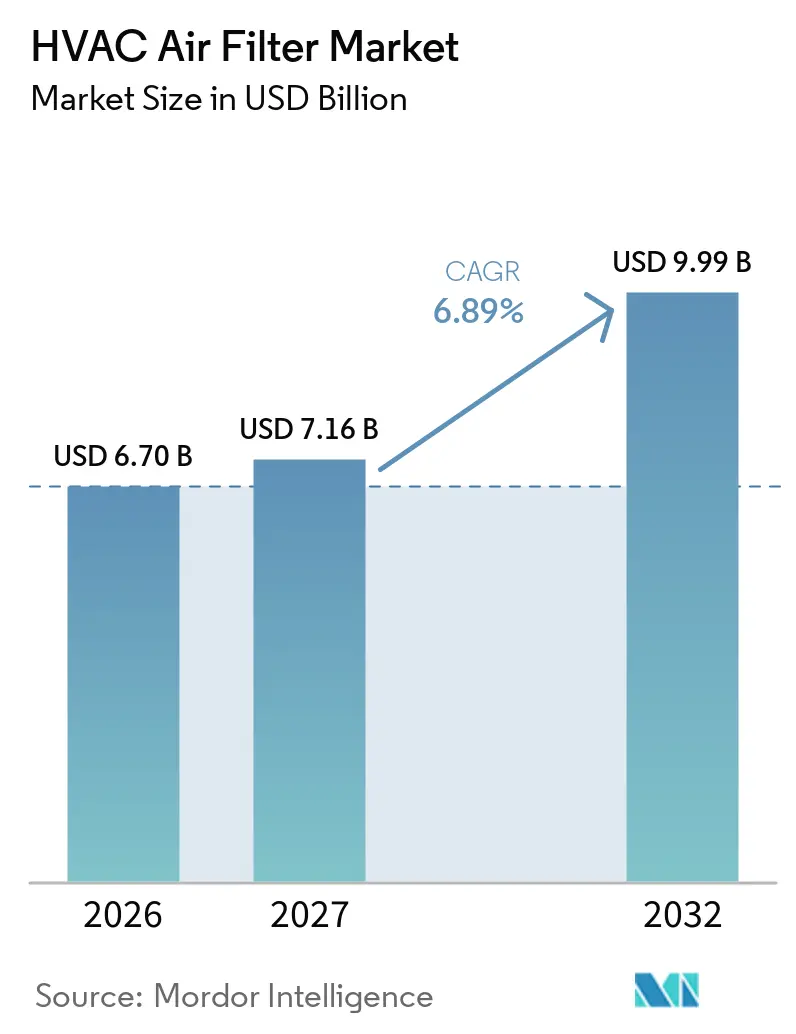
| Market Size (2027) | USD 7.16 Billion |
| Market Size (2032) | USD 9.99 Billion |
| Growth Rate (2027 - 2032) | 6.89 % |
| Fastest Growing Market | Asia-Pacific |
| Largest Market | Asia-Pacific |
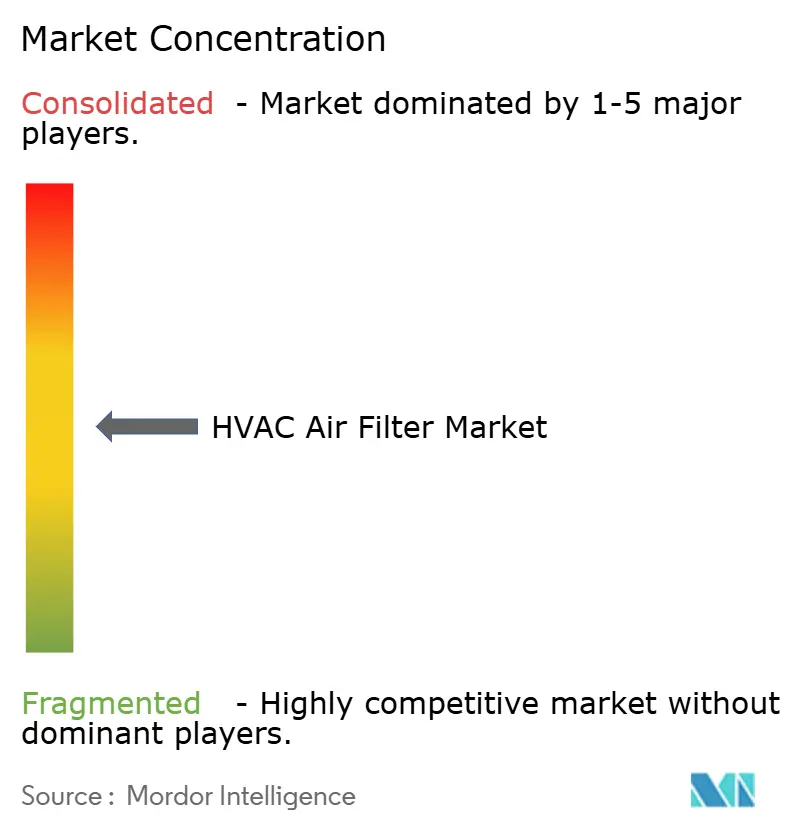
| Market Concentration | Medium |
Major Players *Disclaimer: Major Players sorted in no particular order Image © Mordor Intelligence. Reuse requires attribution under CC BY 4.0. | |
HVAC Air Filter Market Analysis by Mordor Intelligence
The HVAC Air Filter Market size is projected to expand from USD 6.70 billion in 2026 and USD 7.16 billion in 2027 to USD 9.99 billion by 2032, a CAGR of 6.89% between 2027 and 2032. The global HVAC air filter market is benefiting from a stronger focus on indoor air quality as a building design and compliance requirement. Higher filtration specifications are moving demand from fiberglass and panel media toward pleated, HEPA, and multi-stage products. California's 2025 Energy Code requires MERV 13 filtration in applicable new construction, while ANSI/ASHRAE/ASHE Standard 170-2025 sets hospital filtration requirements, supporting compliance-led purchases. The global HVAC air filter market also has opportunities in healthcare, semiconductor production, and data centers, where equipment protection and operational reliability shape filter selection. Competition remains strongest in certified premium products, while regional suppliers and private-label producers compete on price in standard efficiency ranges.
Key Report Takeaways
- By filter type, Pleated Filters held 37.3% of global HVAC air filter market share in 2026, while HEPA Filters are forecast to grow at a 7.5% CAGR through 2032.
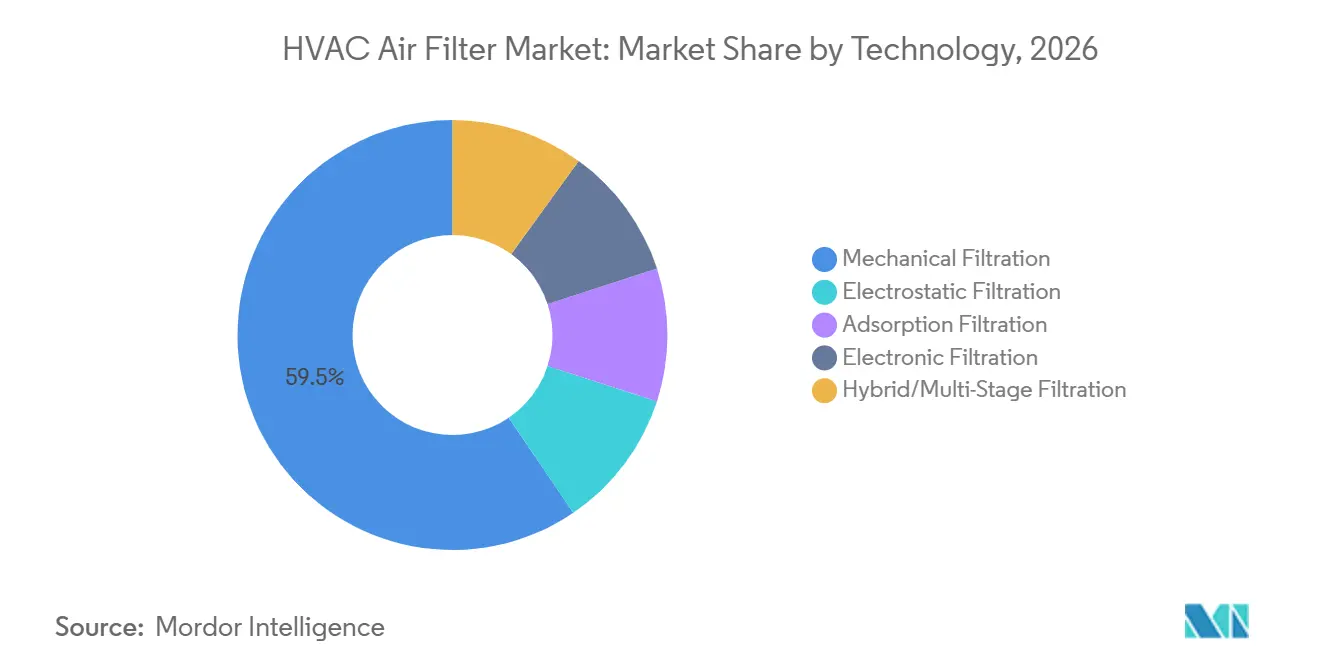
- By technology, Mechanical Filtration held 59.5% of global HVAC air filter market share in 2026, while Hybrid/Multi-Stage Filtration is forecast to grow at a 7.1% CAGR through 2032.
- By application, Residential held 41.3% of revenue in 2026, while Data Centers are forecast to grow at an 8.2% CAGR through 2032.
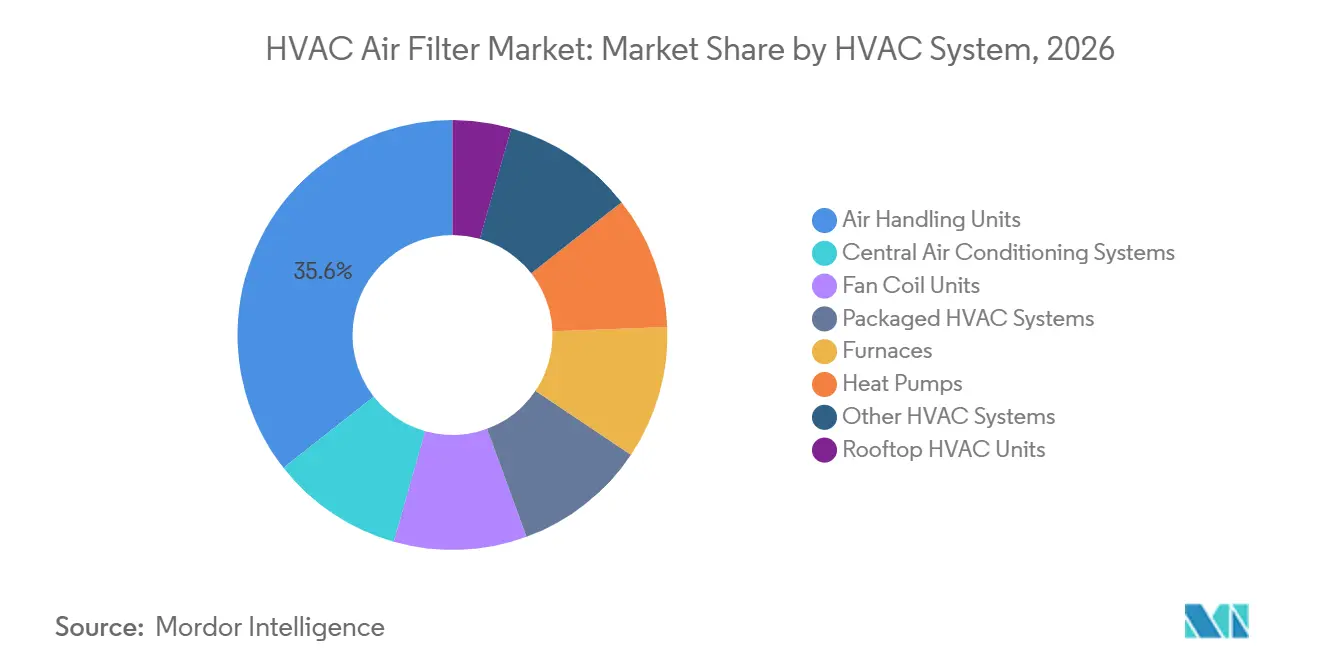
- By HVAC system, Air Handling Units held 35.6% of revenue in 2026, while Heat Pumps are forecast to grow at a 7.3% CAGR through 2032.
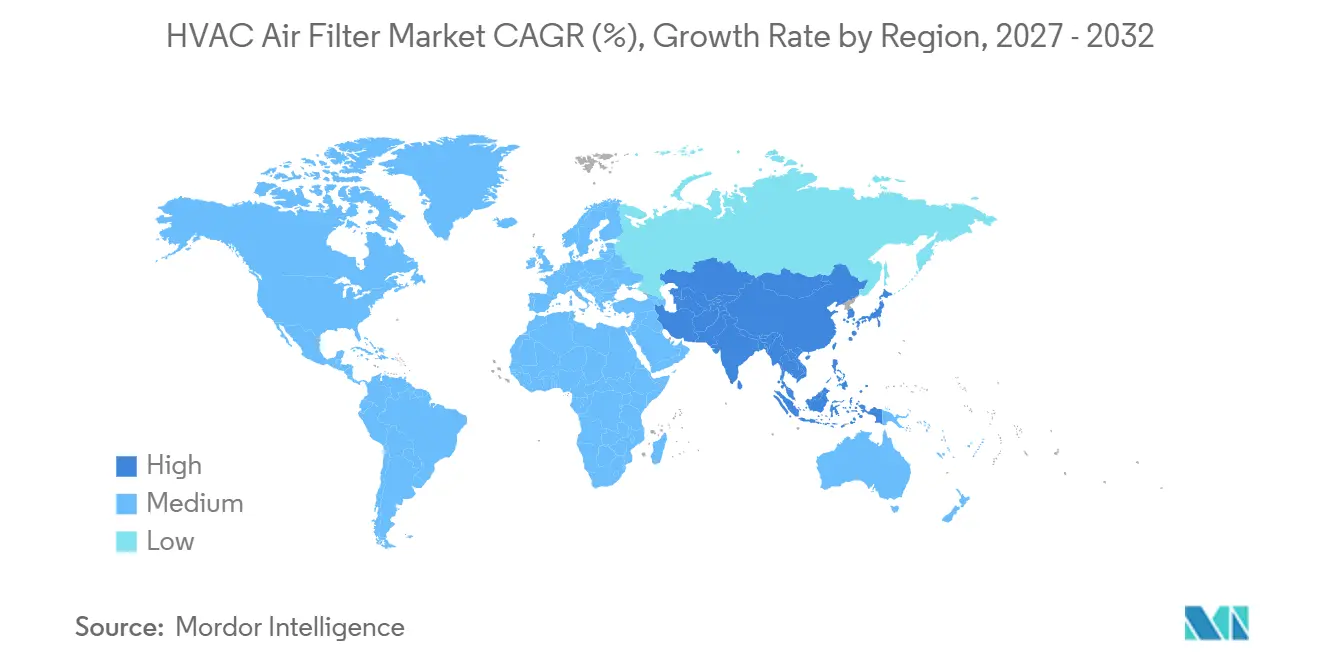
- By geography, Asia-Pacific held 37.9% of revenue in 2026 and is forecast to grow at a 7.7% CAGR through 2032.
Note: Market numbers in this report are based on Mordor Intelligence's proprietary estimation framework, which combines nine months of actuals with Q4 projections for base year 2026.
Market Trends and Insights
Drivers Impact Analysis of HVAC Air Filter Market*
| Driver | (~) % Impact on CAGR Forecast | Geographic Relevance | Impact Timeline |
|---|---|---|---|
| Indoor Air Quality Regulations and Health Awareness | +1.6% | Global, with intensity concentrated in North America, EU, China, India | Medium term (2-4 years) |
| Commercial, Healthcare and Industrial HVAC Expansion | +1.2% | APAC core, secondary in MEA and South America | Long term (≥ 4 years) |
| Energy-Efficient Filtration and Building Decarbonization | +0.9% | North America and EU, spillover to APAC | Medium term (2-4 years) |
| High-Density Data Center and Semiconductor Contamination Control | +1.0% | North America, APAC, and EU | Short term (≤ 2 years) |
| Certified Performance, Filter Monitoring and Replacement Optimization | +0.6% | North America and EU, with early gains in Singapore, Japan, and South Korea | Medium term (2-4 years) |
| Source: Mordor Intelligence | |||
Indoor Air Quality Regulations and Health Awareness
The global HVAC air filter market is supported by standards that require measurable filtration performance. EPA guidance identifies improved filtration and ventilation as ways to improve indoor air quality in occupied buildings.[1] ISO 16890 rates filters against particle sizes found in ambient air, which connects product selection more closely to particulate control needs. ASHRAE 241 established equivalent clean-air delivery requirements for occupied spaces to reduce infectious aerosol exposure. California's code requirements are narrowing the role of lower-efficiency products in new construction.[2] This change supports replacement demand for pleated and higher-efficiency media across the global HVAC air filter market.
Commercial, Healthcare and Industrial HVAC Expansion
Healthcare facilities require filtration practices that align with ANSI/ASHRAE/ASHE Standard 170-2025. This requirement makes hospital purchasing more dependent on documented product performance and scheduled replacement. Commercial buildings also support recurring demand because their air handling systems use filters throughout the year. Pharmaceutical manufacturing and semiconductor fabrication require tightly managed air quality conditions, which support demand for premium filtration. The global HVAC air filter market, therefore, receives demand from projects that are less dependent on ordinary office construction cycles. These facilities can require more frequent filter changes because higher particle loads and stricter operating conditions reduce usable filter life.
Energy-Efficient Filtration and Building Decarbonization
Energy use has become an important consideration in filter selection because pressure drop affects fan power consumption. VDMA states that energy consumption represents 80% of a filter's lifecycle cost, and filters can account for 8% of commercial building energy use. This relationship favors media that can maintain the required efficiency with lower resistance. Ahlstrom launched PFAS-free glass microfiber media in May 2026 with up to 20% lower initial pressure drop and ePM1 65% to ePM1 80% performance under ISO 16890. The global HVAC air filter market is also affected by building certification programs that make filtration efficiency part of a wider energy-performance decision. Energy savings can reduce the focus on unit price in commercial projects where lifecycle cost is assessed.
High-Density Data Center and Semiconductor Contamination Control
Data centers require high-efficiency filtration to reduce particulate deposition on sensitive electronic equipment. AAF International notes that data center operators are focusing on indoor air quality, reliability, and uptime as their facilities increase in density. Air-side economization can increase exposure to outdoor particles and molecular contaminants when facilities use outside air for cooling. This operating model raises the need for effective pre-filtration and molecular filtration. Semiconductor plants also require carefully controlled cleanroom conditions, supporting demand for HEPA and ULPA systems. The global HVAC air filter market benefits because these facilities purchase products based on performance specifications rather than simple replacement cost.
Restraints Impact Analysis of HVAC Air Filter Market*
| Restraint | (~) % Impact on CAGR Forecast | Geographic Relevance | Impact Timeline |
|---|---|---|---|
| Premium Filter Cost and Total Cost of Ownership | -1.0% | South America, MEA, Southeast Asia, moderate in India and Eastern Europe | Long term (≥ 4 years) |
| Counterfeit Products and Inconsistent Certification | -0.6% | Global, concentrated in online retail channels across North America and APAC | Short term (≤ 2 years) |
| Pressure Drop and HVAC Energy Penalty | -0.8% | Global, particularly North America, Europe, and Asia-Pacific | |
| Source: Mordor Intelligence | |||
Premium Filter Cost and Total Cost of Ownership
Higher-efficiency filters remain more expensive than basic panel products, which can delay upgrades in cost-sensitive settings. The price difference is compounded when operators do not account for the energy effect of pressure drop. VDMA identifies energy consumption as the main component of filter lifecycle cost. Fragmented distribution in South America and Southeast Asia can prioritize purchase price over operating cost. Smaller buildings often lack monitoring systems, so filters may remain in service beyond their effective replacement point. This can increase loading and energy use without a clear signal to the operator, slowing upgrades across the global HVAC air filter market.
Counterfeit Products and Inconsistent Certification
Counterfeit products can weaken confidence in stated filtration ratings and create risk for legitimate suppliers. A September 2025 NIOSH investigation found that 91.67% of tested counterfeit P100 respiratory filter products failed minimum performance thresholds. Although the investigation concerned respiratory products, it highlights the importance of traceable certification in filtration purchasing. Differences among MERV, ISO 16890, and national testing systems can make it harder for buyers to assess equivalent performance across regions. Product verification is therefore a commercial and quality-control concern for the global HVAC air filter market. Clearer documentation and trusted channels can limit the risk of noncompliant products entering specification-led applications.
*Our forecasts treat driver/restraint impacts as directional, not additive. The impact forecasts reflect baseline growth, mix effects, and variable interactions.
HVAC Air Filter Market Segment Analysis
By Filter Type:
Pleated Filters Lead While HEPA Supports Premium GrowthPleated Filters held 37.3% of revenue in 2026, the largest share within the global HVAC air filter market size for filter types. Their established base covers residential, light commercial, and office equipment, where standard frames and familiar 1-to-4-inch formats support routine replacement. Private-label alternatives are applying price pressure to mid-MERV products, even as Bag and Pocket Filters remain useful in commercial air handling units with higher dust loads. Panel Filters increasingly serve lower-cost or pre-filtration duties, while Fiberglass Filters lose ground where higher MERV requirements replace basic specifications. Rigid Cell and Box Filters retain a stable role in high-airflow hospital and pharmaceutical systems that require dependable final-stage filtration.
HEPA Filters are forecast to grow at a 7.5% CAGR through 2032, making them the fastest-growing type in the global HVAC air filter market. Healthcare upgrades, cleanroom construction, and data center operating requirements support this demand, while established testing requirements favor certified suppliers in premium applications. ULPA Filters serve narrower needs in semiconductor plants and hospital isolation settings, where very small particle control is essential. Activated Carbon Filters add molecular contaminant and odor control in urban commercial buildings and data centers, which particulate media alone cannot provide. The global HVAC air filter industry therefore depends on combinations of pre-filtration, final filtration, and molecular control rather than a single product stage.
By Technology:
Mechanical Filtration Has Scale While Hybrid Systems AdvanceMechanical Filtration held 59.5% of revenue in 2026, making it the largest technology category in the global HVAC air filter market. Most HVAC systems use fiber media, including fiberglass, polypropylene, and glass microfiber, to remove airborne particles through a modular replacement model. This broad installed base keeps mechanical products relevant across building types, although Electrostatic Filtration remains attractive in residences because washable and self-charging formats can reduce replacement needs. Its efficiency can decline when the electret charge dissipates, an issue ISO 16890 considers through IPA-discharge testing that evaluates real-world efficiency loss. Electronic Filtration remains limited in HVAC applications because ozone concerns have constrained broader adoption.
Hybrid/Multi-Stage Filtration is forecast to grow at a 7.1% CAGR through 2032, driven by data centers, pharmaceutical facilities, and semiconductor plants. These systems combine high-MERV or HEPA particulate media with activated carbon or chemically treated media to control particles and molecular contaminants together. Camfil introduced its CC X-Series in March 2026, combining PM1 particulate and molecular filtration with BACnet and Modbus connectivity. Standalone adsorption products continue to serve food facilities and urban commercial buildings where odor and VOC control is the principal need. The global HVAC air filter market uses hybrid systems where a single mechanical stage cannot meet the full contaminant-control requirement.

By Application:
Residential Replacement Volume Coexists With Data Center DemandResidential applications held 41.3% of revenue in 2026, the largest application share in the global HVAC air filter market. The installed volume of household HVAC units creates recurring replacement demand in North America and Europe, while wider air conditioning use supports growth in the Asia-Pacific. Premium products can support shorter replacement cycles and clearer maintenance routines for households that prioritize indoor air quality. In April 2025, 3M introduced its Filtrete Refillable Air Filter Kit, with a reusable frame rated for up to 20 years and inserts rated for up to 12 months 3M. The company stated that the kit reduces storage space by 75% and disposable waste by 20%, while commercial and industrial facilities continue to support scheduled replacement contracts.
Data Centers are forecast to grow at an 8.2% CAGR through 2032, the highest application growth rate in the global HVAC air filter market. Their purchasing decisions prioritize equipment reliability, operating continuity, and control of particle deposition and corrosive gases in dense computing environments. Healthcare and pharmaceutical sites also require certified filtration because ventilation conditions are closely managed, while cleanrooms need controlled air for production. Food and beverage facilities provide a stable niche where hygiene and contamination control guide product selection rather than general wellness requirements. The global HVAC air filter industry gains from these settings because buyers frequently value documented performance and service support over simple unit price.
By HVAC System:
Air Handling Units Lead While Heat Pumps Add Demand PointsAir Handling Units held 35.6% of revenue in 2026, the largest system category in the global HVAC air filter market. These units often use pre-filters, intermediate bag filters, and final HEPA stages, creating recurring demand for several product types in a single installation. Central air conditioning systems provide a substantial secondary base, while Rooftop HVAC Units commonly receive scheduled service through U.S. commercial maintenance contracts. Fan Coil Units and Packaged HVAC Systems serve small and midsized commercial sites, often with single-stage filtration at MERV 8 to MERV 11 levels. Furnaces face lower long-term relevance in developed markets as electrification incentives support alternative heating systems.
Heat Pumps are forecast to grow at a 7.3% CAGR through 2032, creating a faster-growing system demand source for the global HVAC air filter market. The IEA reported that global building heat pump sales reached 108 GW in 2025 and that heat pumps outsold natural gas boilers in France, Germany, and the United States. Each ducted, or cassette installation, can create a filter service point that did not exist in heating systems without a comparable air-handling component. Seasonal reversal can load filters differently from cooling-only equipment, which can influence service requirements throughout the year. This makes electrification relevant to filter demand alongside the established replacement cycle for existing HVAC equipment.
Geography Analysis
Asia-Pacific held 37.9% of revenue in 2026 and is forecast to grow at a 7.7% CAGR through 2032, leading the global HVAC air filter market on both measures. China has a major manufacturing role and is raising quality requirements through its GB/T 14295-2025 revision, which took effect in 2026. India supports demand through pharmaceutical manufacturing, especially in the Pune-Hyderabad corridor, while Japan remains stable through renovation activity and widespread reversible air conditioner use. Vietnam, Thailand, and Indonesia are gaining demand from electronics manufacturing clusters and data center development. These conditions make the region important for both product supply and high-specification consumption.
North America is a mature region where infrastructure replacement, heat pump adoption, and hyperscale data centers support demand. EPA guidance supports improved filtration and ventilation in schools and other occupied buildings. California's building requirements support MERV 13 use in applicable new construction. Data center purchasing is specification-led and often connected to multiyear service arrangements, while Canada gains from commercial retrofits and Mexico from automotive and electronics manufacturing. The global HVAC air filter market has a stable premium demand base in the region because compliance and asset reliability affect purchasing choices.
Europe is shaped by quality requirements and commercial building renovation activity. The EU Energy Performance of Buildings Directive supports HVAC upgrades that can require updated filter specifications, and Eurovent provides third-party certification for filters rated under ISO ePM1, ePM2.5, and ePM10. Germany leads regional demand, followed by France, the United Kingdom, Italy, and Poland, while semiconductor, pharmaceutical, and healthcare investment supports HEPA and ULPA needs. South America and the Middle East and Africa remain smaller pools, although Gulf data center projects and industrial, pharmaceutical, and commercial needs in Brazil, Argentina, Chile, and Colombia sustain demand.
Competitive Landscape
The global HVAC air filter market has moderate concentration in certified premium products, with Camfil AB, 3M, MANN+HUMMEL, AAF International, Freudenberg Filtration Technologies, and Parker Hannifin competing across selected categories. Regional suppliers and private-label producers remain active in standard MERV ranges, so premium certification does not translate to control of all product volumes. Parker Hannifin completed its USD 9.25 billion acquisition of Filtration Group Corporation in August 2026, expanding its portfolio across HVAC/R, life sciences, and industrial filtration. The transaction increased the relevance of recurring aftermarket revenue in Parker's filtration operations. Premium suppliers compete through certification, product engineering, and service capability, while standard ranges remain more exposed to price competition.
MANN+HUMMEL reported that its EF Series covered panel, bag, compact, high-performance, and molecular filters across filtration stages. Ahlstrom introduced PFAS-free glass microfiber media in May 2026, offering a materials-based response to energy and product-safety requirements. Camfil's March 2026 CC X-Series added connected industrial air-cleaning equipment with combined particulate and molecular filtration. Suppliers are therefore pursuing efficiency, monitoring, and high-value applications, while production investment in Asia can reduce lead times for bulky products used in cleanroom projects. The global HVAC air filter market remains competitive because standard products have lower entry barriers than premium certified segments.
Sustainability, connected monitoring, and specialized filtration are central competitive areas. Recyclable frames and PFAS-free media address material and waste concerns, while sensor-based replacement programs can build ongoing commercial customer relationships. Data center, pharmaceutical, and semiconductor applications are attractive because buyers emphasize documented performance, and advanced media patents can protect lower-pressure-drop designs. Smaller commercial buildings remain less served by connected replacement programs, which leaves room for sensor-linked inventory management and subscription-style service models.
HVAC Air Filter Industry Leaders
-
Camfil AB
-
American Air Filter Company, Inc. (AAF International)
-
MANN+HUMMEL Gruppe
-
Freudenberg Filtration Technologies SE & Co. KG
-
Donaldson Company, Inc.
- *Disclaimer: Major Players sorted in no particular order
HVAC Air Filter Market Companies Covered in this Report
- 3M Company
- AFPRO Filters
- Ahlstrom Oyj
- American Air Filter Company, Inc. (AAF International)
- Camfil AB
- Carrier Global Corporation
- Daikin Industries, Ltd.
- Donaldson Company, Inc.
- Dynamic Filtration Ltd.
- Emirates Industrial Filters LLC
- Filtration Group Corporation
- Freudenberg Filtration Technologies SE & Co. KG
- Hengst SE
- Honeywell International Inc.
- Johnson Controls International plc
- Koch Filter Corporation
- MANN+HUMMEL Gruppe
- Parker Hannifin Corporation
- Trane Technologies plc
- Volz Luftfilter
Recent Industry Developments in HVAC Air Filter Market
- September 2026: AAF International introduced the AstroCel III Aero, a lightweight V-bank HEPA filter with 99.99% efficiency at 0.3 microns, manufactured in the United States for the North American market. The polymer-frame design is 40% lighter than traditional metal-frame HEPA units, reduces installation and changeout labor cost, and meets UL 900 fire-safety classification for NFPA 90A compliance.
- August 2026: Parker Hannifin completed its USD 9.25 billion acquisition of Filtration Group Corporation, consolidating filtration portfolios across HVAC/R, life sciences, and industrial applications. The transaction was structured on a cash-free, debt-free basis at 19.6x Filtration Group's 2025 estimated adjusted EBITDA.
- May 2026: Ahlstrom launched PFAS-free glass microfiber HVAC filter media in Turin, Italy. The platform delivers up to 20% lower initial pressure drop, spans ePM1 65% to ePM1 80% efficiency under ISO 16890, and supports manufacturers transitioning to safer filter materials.
Global HVAC Air Filter Market Report Scope
An HVAC air filter is a removable device made from porous or fibrous materials that captures dust, pollen, pet dander, and other airborne pollutants before they enter and circulate through a heating, ventilation, and air conditioning system.
The global HVAC air filter market is segmented by filter type, technology, application, HVAC system, and geography. By filter type, the market is segmented into panel filters, pleated filters, bag/pocket filters, HEPA filters, ULPA filters, electrostatic filters, activated carbon filters, fiberglass filters, rigid cell/box filters, and other HVAC air filters. By technology, the market is segmented into mechanical filtration, electrostatic filtration, adsorption filtration, electronic filtration, and hybrid/multi-stage filtration. By application, the market is segmented into residential, commercial, industrial, healthcare, data centers, cleanrooms, pharmaceutical facilities, food & beverage facilities, and other applications. By HVAC system, the market is segmented into air handling units, rooftop HVAC units, central air conditioning systems, fan coil units, packaged HVAC systems, furnaces, heat pumps, and other HVAC systems. The report also covers the market size and forecasts for the global HVAC air filter market across 26 countries in the key regions. For each segment, market sizing and forecasts are provided in terms of value (USD).
Segmentation Overview
| Panel Filters |
| Pleated Filters |
| Bag/Pocket Filters |
| HEPA Filters |
| ULPA Filters |
| Electrostatic Filters |
| Activated Carbon Filters |
| Fiberglass Filters |
| Rigid Cell/Box Filters |
| Other HVAC Air Filters |
| Mechanical Filtration |
| Electrostatic Filtration |
| Adsorption Filtration |
| Electronic Filtration |
| Hybrid/Multi-Stage Filtration |
| Residential |
| Commercial |
| Industrial |
| Healthcare |
| Data Centers |
| Cleanrooms |
| Pharmaceutical Facilities |
| Food & Beverage Facilities |
| Other Applications |
| Air Handling Units |
| Rooftop HVAC Units |
| Central Air Conditioning Systems |
| Fan Coil Units |
| Packaged HVAC Systems |
| Furnaces |
| Heat Pumps |
| Other HVAC Systems |
| North America | United States |
| Canada | |
| Mexico | |
| Europe | Germany |
| France | |
| Italy | |
| Spain | |
| United Kingdom | |
| Poland | |
| Russia | |
| Rest of Europe | |
| Asia-Pacific | China |
| India | |
| Japan | |
| South Korea | |
| Australia | |
| Indonesia | |
| Vietnam | |
| Thailand | |
| Rest of Asia-Pacific | |
| South America | Brazil |
| Argentina | |
| Chile | |
| Rest of South America | |
| Middle East and Africa | Saudi Arabia |
| United Arab Emirates | |
| Egypt | |
| South Africa | |
| Morocco | |
| Rest of Middle East and Africa |
| By Filter Type | Panel Filters | |
| Pleated Filters | ||
| Bag/Pocket Filters | ||
| HEPA Filters | ||
| ULPA Filters | ||
| Electrostatic Filters | ||
| Activated Carbon Filters | ||
| Fiberglass Filters | ||
| Rigid Cell/Box Filters | ||
| Other HVAC Air Filters | ||
| By Technology | Mechanical Filtration | |
| Electrostatic Filtration | ||
| Adsorption Filtration | ||
| Electronic Filtration | ||
| Hybrid/Multi-Stage Filtration | ||
| By Application | Residential | |
| Commercial | ||
| Industrial | ||
| Healthcare | ||
| Data Centers | ||
| Cleanrooms | ||
| Pharmaceutical Facilities | ||
| Food & Beverage Facilities | ||
| Other Applications | ||
| By HVAC System | Air Handling Units | |
| Rooftop HVAC Units | ||
| Central Air Conditioning Systems | ||
| Fan Coil Units | ||
| Packaged HVAC Systems | ||
| Furnaces | ||
| Heat Pumps | ||
| Other HVAC Systems | ||
| Geography | North America | United States |
| Canada | ||
| Mexico | ||
| Europe | Germany | |
| France | ||
| Italy | ||
| Spain | ||
| United Kingdom | ||
| Poland | ||
| Russia | ||
| Rest of Europe | ||
| Asia-Pacific | China | |
| India | ||
| Japan | ||
| South Korea | ||
| Australia | ||
| Indonesia | ||
| Vietnam | ||
| Thailand | ||
| Rest of Asia-Pacific | ||
| South America | Brazil | |
| Argentina | ||
| Chile | ||
| Rest of South America | ||
| Middle East and Africa | Saudi Arabia | |
| United Arab Emirates | ||
| Egypt | ||
| South Africa | ||
| Morocco | ||
| Rest of Middle East and Africa | ||
Key Questions Answered in the Report
What is the 2027 value of the global HVAC air filter market?
The HVAC Air Filter Market size is projected to expand from USD 6.70 billion in 2026 and USD 7.16 billion in 2027 to USD 9.99 billion by 2032, registering a CAGR of 6.89% between 2027 and 2032.
What is driving demand for HVAC air filters?
Indoor air quality requirements, building energy performance, healthcare needs, data center expansion, and heat pump adoption are supporting demand. Compliance-led purchases are particularly important in premium filtration categories.
Which filter type is growing fastest?
HEPA Filters are forecast to grow at a 7.5% CAGR through 2032, supported by cleanrooms, healthcare facilities, and data centers.
Which application is growing fastest for HVAC air filters?
Data Centers are forecast to grow at an 8.2% CAGR through 2032 because their operators require reliable particulate and molecular contaminant control. This supports specification-led purchase decisions and service requirements. It also favors higher-efficiency, multi-stage filtration solutions in facilities with sensitive equipment. Healthcare and pharmaceutical operations display similar preference for certified performance.
Which region leads HVAC air filter demand?
Asia-Pacific held 37.9% of revenue in 2026 and is forecast to grow at a 7.7% CAGR through 2032.
How do heat pumps affect HVAC air filter demand?
Heat Pumps are forecast to grow at a 7.3% CAGR through 2032, and new ducted or cassette installations can create additional filter service points.