
HV Bushing Market Size and Share
Market Overview
| Study Period | 2022 - 2032 |
|---|---|
| Market Size (2027) | USD 1.51 Billion |
| Market Size (2032) | USD 1.82 Billion |
| Growth Rate (2027 - 2032) | 3.83 % |
| Fastest Growing Market | Asia-Pacific |
| Largest Market | Asia-Pacific |
| Market Concentration | Medium |
Major Players *Disclaimer: Major Players sorted in no particular order Image © Mordor Intelligence. Reuse requires attribution under CC BY 4.0. | |
HV Bushing Market Analysis by Mordor Intelligence
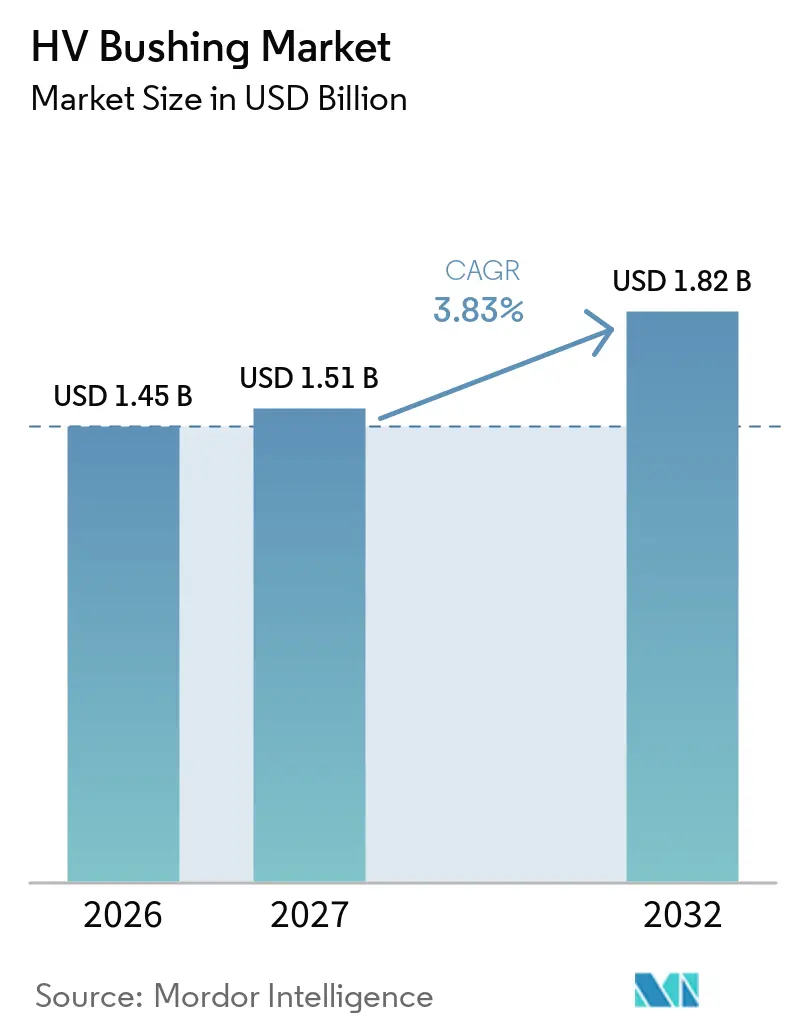
The HV Bushing Market size was valued at USD 1.45 billion in 2026 and is estimated to grow from USD 1.51 billion in 2027 to reach USD 1.82 billion by 2032, at a CAGR of 3.83% during the forecast period (2027-2032). The HV bushing market is supported by grid investment, replacement of aging substation equipment, and the connection needs of renewable power projects. The International Energy Agency reported that annual grid investment was USD 400 billion and that more than 2,500 GW of projects were waiting for grid connections, showing why transmission and substation capacity remain important. Many grids built from the 1950s to the 1980s now need replacement or modernization, while renewable generation needs more connection points and longer transmission links. Equipment suppliers are responding with dry insulation, digital monitoring capability, and designs that can support SF6-free switchgear. The HV bushing market also faces delivery pressure because high-voltage projects need tested equipment, specialized commissioning skills, and qualified suppliers.
Key Report Takeaways
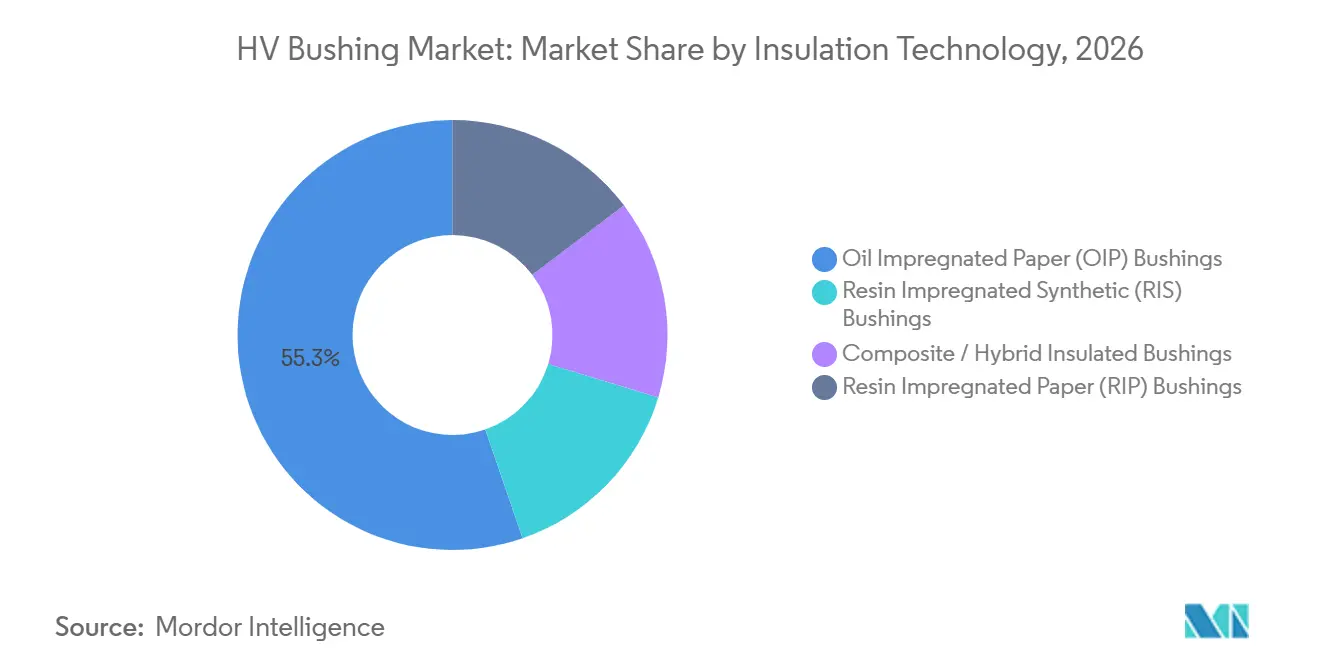
- By insulation technology, Oil Impregnated Paper held 55.3% of the HV bushing market share in 2026, while Resin Impregnated Paper is projected to grow at a 4.3% CAGR through 2032.
- By bushing type, condenser bushings accounted for 72.4% of the HV bushing market size in 2026, while the same type is forecast to grow at a 4.6% CAGR through 2032.
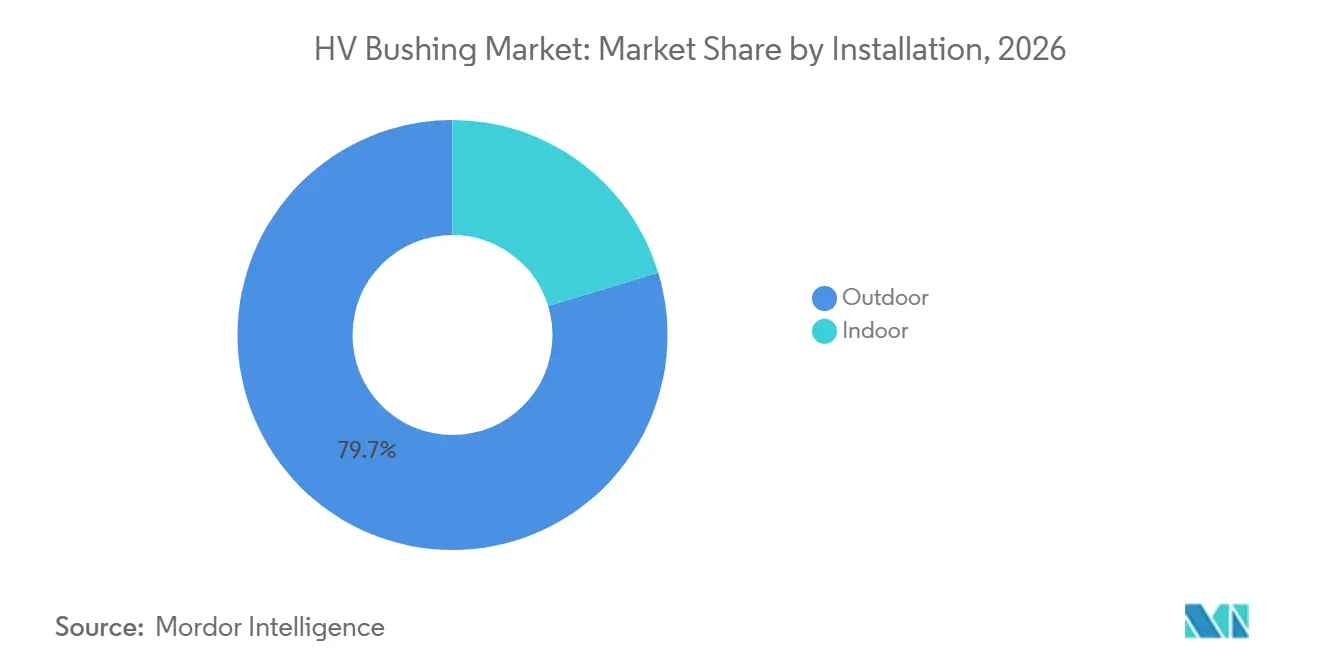
- By installation, outdoor bushings held 79.7% revenue share in 2026, while outdoor installations are projected to expand at a 4.2% CAGR through 2032.
- By voltage class, the 15 kV to 170 kV category held 51.3% revenue share in 2026, while the above 550 kV category is forecast to advance at a 4.9% CAGR through 2032.
- By end user, utilities held 55.1% revenue share in 2026, while renewable energy developers are projected to grow at a 5.5% CAGR through 2032.
- By geography, Asia-Pacific held 44.8% revenue share in 2026 and is forecast to grow at a 5.2% CAGR through 2032.
Note: Market numbers in this report are based on Mordor Intelligence's proprietary estimation framework, which combines nine months of actuals with Q4 projections for base year 2026.
Market Trends and Insights
Drivers Impact Analysis of HV Bushing Market*
| Driver | (~) % Impact on CAGR Forecast | Geographic Relevance | Impact Timeline |
|---|---|---|---|
| Renewable Energy Grid Integration | +1.2% | Global, concentrated in Asia-Pacific, Europe, and North America | Short term (≤ 2 years) |
| Aging Substation Replacement and Grid Modernization | +1.0% | North America and Europe, with spillover to Japan and Australia | Medium term (2-4 years) |
| Space-Constrained Urban and Industrial Substations | +0.6% | Europe, East Asia, and dense urban corridors in Southeast Asia | Medium term (2-4 years) |
| Offshore Wind Collection and Export Substations | +0.8% | North Sea, Baltic Sea, Taiwan, South Korea, and Japan | Medium term (2-4 years) |
| SF6 Phase-Down and Low-Emission Equipment Procurement | +0.7% | European Union and United Kingdom, with spillover to Norway and Switzerland | Short term (≤ 2 years) |
| Digital Monitoring and Predictive Asset Management | +0.4% | Global, with early adoption in Germany, the United Kingdom, and Scandinavia | Long term (≥ 4 years) |
| Source: Mordor Intelligence | |||
Renewable Energy Grid Integration
The HV bushing market gains from renewable projects because each project requires transformer connections, collector substations, switching stations, and transmission links. Wind and solar projects use step-up transformers that need bushings at several voltage interfaces. The International Energy Agency stated that more than 2,500 GW of projects were waiting in grid connection queues worldwide in 2026.[1] Clearing this queue requires additional substation and transmission equipment, which supports demand for high-voltage components. India approved Green Energy Corridor Phase III with an INR 1.86 lakh crore outlay, including 51,126 circuit kilometers of lines and 228,903 MVA of transformation capacity through 2033. These programs increase demand for equipment suitable for 400 kV and 765 kV substations.
Aging Substation Replacement and Grid Modernization
Replacement demand remains important for the HV bushing market because much of the North American and European grid was installed several decades ago. Aging transformers and substations require reliable replacement equipment, even where electricity demand grows slowly. The American Society of Civil Engineers projected that United States investor-owned utilities would spend USD 32.1 billion on transmission in 2026. Utilities often use replacement projects to select equipment with stronger monitoring and insulation features. This approach favors dry-type and composite alternatives where maintenance exposure, fire risk, or site access matter. It also raises the value of suppliers that can support existing transformer fleets and new equipment designs.
Offshore Wind Collection and Export Substations
Offshore wind projects need high-voltage equipment that can operate in salt air, restricted spaces, and difficult maintenance conditions. These requirements favor insulation systems with strong dielectric performance and corrosion resistance. The HV bushing market can benefit where offshore developers build collection substations and export connections. PFISTERER supplied cable accessories for the BorWin4 and DolWin4 offshore projects, which shows the importance of qualified high-voltage accessory suppliers in this application. Composite and RIP designs are relevant for offshore applications because they can reduce maintenance needs and support compact equipment layouts. Qualification and proven operating performance remain more important than initial equipment price in these projects.
SF6 Phase-Down and Low-Emission Equipment Procurement
The European Union regulation on fluorinated greenhouse gases is changing procurement requirements for high-voltage switchgear and connected components. Regulation EU 2024/573 restricts SF6 in new high-voltage switchgear above 52 kV from January 1, 2028, and above 145 kV from January 1, 2032.[2] The policy encourages buyers to assess compatible dry and SF6-free designs before the compliance dates arrive. GE Vernova announced two 420 kV SF6-free GIS substations for Statnett and Equinor in Norway during 2025. Hitachi Energy also introduced its GARIP Eco SF6-free transformer-GIS bushing in 2025. The HV bushing market is therefore moving toward new interface and insulation requirements, particularly in premium European projects.
Restraints Impact Analysis of HV Bushing Market*
| Restraint | (~) % Impact on CAGR Forecast | Geographic Relevance | Impact Timeline |
|---|---|---|---|
| High Upfront Cost of Integrated AIS-GIS Architectures | -0.9% | Global, most acute in cost-sensitive emerging markets | Medium term (2-4 years) |
| Dual Certification and Complex Commissioning Requirements | -0.5% | Global | Medium term (2-4 years) |
| Shortage of Specialized High-Voltage Service Talent | -0.4% | North America, Europe, and Australia | Long term (≥ 4 years) |
| Long Lead Times for Interrupters and Alternative Insulation Media | -0.6% | Global | Short term (≤ 2 years) |
| Source: Mordor Intelligence | |||
High Upfront Cost of Integrated AIS-GIS Architectures
High initial cost can slow the HV bushing market in regions where utility capital budgets are constrained. GIS systems and low-emission insulation arrangements require a greater upfront commitment than conventional solutions. This issue is especially relevant in South and Southeast Asia, Latin America, and Sub-Saharan Africa. Subsidized electricity tariffs can limit the funding available for higher-cost substation upgrades. Concessional financing can support projects, but approval, disbursement, and local procurement processes may delay implementation. The result is uneven adoption of advanced bushing designs across regions with otherwise strong long-term power demand.
Long Lead Times for Interrupters and Alternative Insulation Media
Long delivery cycles can limit near-term growth in the HV bushing market when new grid projects move from tendering into construction. EHV and UHV equipment requires validated testing, manufacturing capacity, and specialized engineering support. Project schedules can extend further when both IEC and IEEE certifications are required. IEC 60270:2025 added current requirements for charge-based partial discharge measurement in high-voltage testing. Digital monitoring systems can add further acceptance work during commissioning. The shortage of experienced high-voltage technicians can therefore delay handover even after equipment reaches the project site.
*Our forecasts treat driver/restraint impacts as directional, not additive. The impact forecasts reflect baseline growth, mix effects, and variable interactions.
HV Bushing Market Segment Analysis
By Insulation Technology:
OIP Holds Scale While Dry Alternatives Gain Specification ShareOil-impregnated paper held 55.3% of the HV bushing market share in 2026 because of its long use in utility transformers and established supply economics. It remains common in brownfield replacement programs where existing transformer configurations favor familiar designs. OIP is also relevant in cost-focused grid expansion projects across Asia-Pacific and the Middle East. The technology is widely used within the 170 kV to 245 kV range. Its installed base gives manufacturers recurring replacement demand and familiar service requirements.
RIP is the fastest-growing insulation technology, with a projected 4.3% CAGR through 2032. The HV bushing industry is using RIP more often in GIS, offshore, and urban applications where dry insulation and reduced maintenance are valued. Hitachi Energy launched the AirRIP Flex AF 800 kV at CWIEME Berlin in May 2026, describing it as a dry RIP bushing tested on a 765 kV natural-ester transformer. Composite and hybrid designs have a smaller combined position but are useful in exposed environments. RIS systems provide another dry insulation option for projects that need compact, oil-free configurations.

By Bushing Type:
Condenser Architecture Anchors High-Voltage Grid ReliabilityCondenser bushings accounted for 72.4% of the HV bushing market size in 2026 and are projected to grow at a 4.6% CAGR through 2032. Their capacitive grading layers distribute electrical stress along the insulation structure. This capability makes condenser architecture important at higher voltage ratings. The HV bushing market uses these products in large transformers and transmission applications where reliability requirements are strict. Their construction also supports monitoring at the condenser tap point.
CIGRÉ Working Group A2.37 identified bushings and lead exits as material locations for high-voltage transformer failures, reinforcing the value of sound design and condition monitoring. Partial discharge sensors can use the condenser tap as an interface for asset monitoring. This supports maintenance strategies that identify developing insulation issues before failure. Non-condenser bushings remain relevant in the 15 kV to 36 kV range. At these lower ratings, the additional cost of capacitive grading is less often justified by the electrical stress profile.
By Installation:
Outdoor Arrays Support Grid Expansion EconomicsOutdoor bushings held 79.7% revenue share in 2026 and are forecast to grow at a 4.2% CAGR through 2032. They support open-air substations, which remain economical where land is available and environmental conditions are manageable. This installation format is common in Asia-Pacific, the Middle East, and Africa at 220 kV and above. Outdoor systems suit greenfield transmission projects that need large clearances and accessible equipment. The segment benefits from continuing investment in conventional air-insulated substations.
PFISTERER reported 69.1% revenue growth in its Overhead Lines segment during the first months of 2026, citing Saudi Arabia and India as demand drivers. The result reflects demand for outdoor high-voltage equipment and related insulation systems in these countries. Indoor bushings serve a smaller but growing set of urban, offshore, and enclosed traction projects. These locations need compact equipment and stronger containment features. The contrast between indoor and outdoor requirements supports specialized products and pricing across the HV bushing industry.
By Voltage Class:
Mid-Range Installed Base Dominates, EHV Tier Grows FastestThe 15 kV to 170 kV class held 51.3% revenue share in 2026, supported by the large installed base of power transformers worldwide. This range is active in brownfield replacement work across utility and industrial networks. The 170 kV to 245 kV range serves many high-voltage transmission systems. The 245 kV to 550 kV range is important for new renewable integration substations. Together, these ranges provide broad demand across mature and developing electricity systems.
The above 550 kV category is projected to grow at a 4.9% CAGR through 2032. China placed the Ningxia-Hunan plus or minus 800 kV UHV DC project into operation in October 2025, and the project is designed to transmit more than 36 billion kWh annually, with at least 50% from renewable sources. UHV projects need equipment with demanding design, type-test, and operating credentials. This makes the segment commercially significant for manufacturers with validated 800 kV products. It also creates high entry barriers because supplier qualification cycles are long.
By End User:
Utilities Lead, Renewable Developers Reshape Demand SpecificationsUtilities accounted for 55.1% of demand in 2026 because they operate the largest installed base of high-voltage transformers. They are also the primary buyers in national transmission and substation modernization programs. Power generation companies form the next major customer group. Their purchases include step-up transformer equipment for conventional and renewable plants. Utilities commonly focus on reliability, fleet compatibility, and life-cycle service support.
Renewable energy developers are projected to be the fastest-growing end-user segment at a 5.5% CAGR through 2032. Their procurement is often integrated into engineering, procurement, and construction contracts. Delivery speed and lower equipment weight can favor composite and RIP designs over OIP alternatives. Rail and transport systems need compact dry-type bushings with strong short-circuit performance for enclosed traction transformers. Petrochemical, mining, and data center operators also require direct connections at transmission voltage, which adds to grid connection pressure.
Geography Analysis
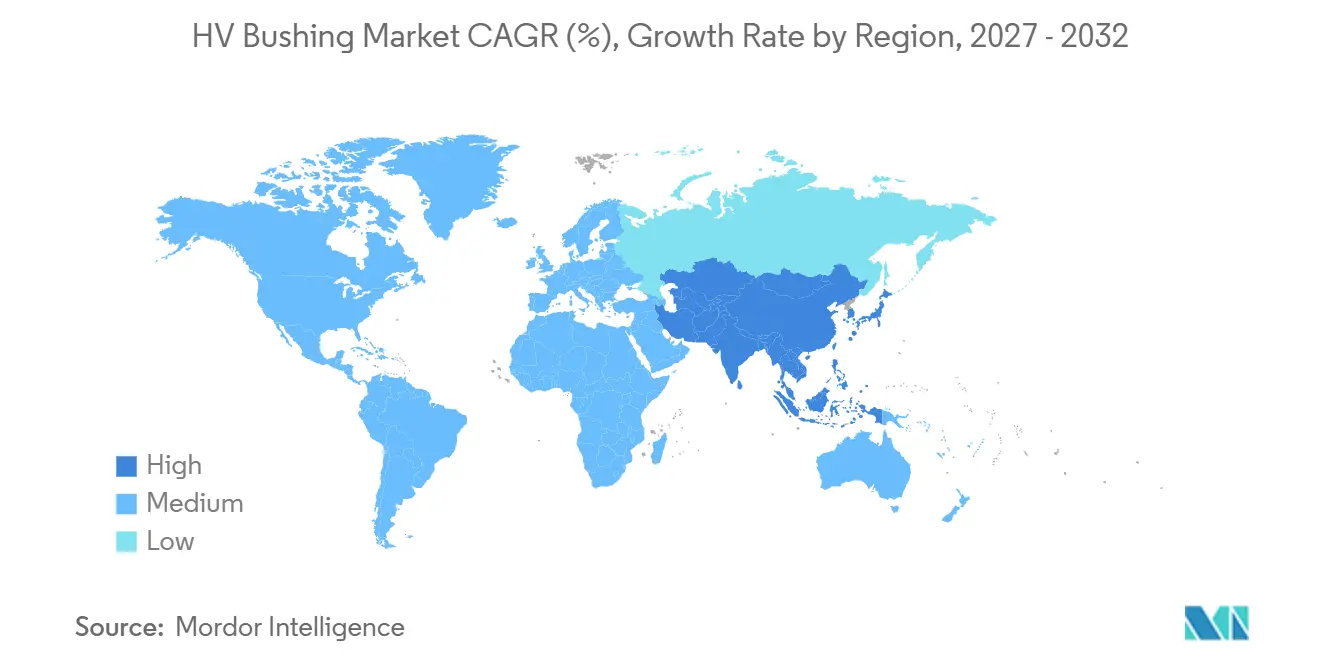
Asia-Pacific held 44.8% revenue share in 2026 and is expected to grow at a 5.2% CAGR through 2032. China remains central to the HV bushing market because its transmission plan includes UHV corridor expansion. State Grid Corporation announced CNY 4 trillion in fixed-asset investment for the 2026 to 2030 period. The plan targets a 30% increase in cross-regional transmission capacity. India adds a large demand base through transmission expansion, renewable evacuation projects, and procurement of high and extra-high-voltage substation equipment.
North America and Europe form the second major demand cluster for the HV bushing market, where the replacement of aging assets remains important. European buyers also face new equipment requirements under the EU fluorinated greenhouse gas regulation. The United States investor-owned utility transmission forecast for 2026 was USD 32.1 billion, according to the American Society of Civil Engineers. PFISTERER reported 23.4% growth in its HVA segment in the first months of 2026, supported by European high-voltage demand. Offshore wind, GIS upgrades, and SF6-free procurement create demand for technically qualified bushing systems.
South America, the Middle East, and Africa represented smaller but expanding demand pools within the HV bushing market. Brazil has a large transmission system, while Saudi Arabia, the United Arab Emirates, and Egypt are advancing grid and renewable programs requiring outdoor-rated high-voltage equipment. PFISTERER identified Saudi Arabia as a driver of its Overhead Lines revenue growth in 2026. Morocco, South Africa, Argentina, and Chile add project-led demand linked to renewable power, network rehabilitation, mining, hydropower, and industrial loads.
Competitive Landscape
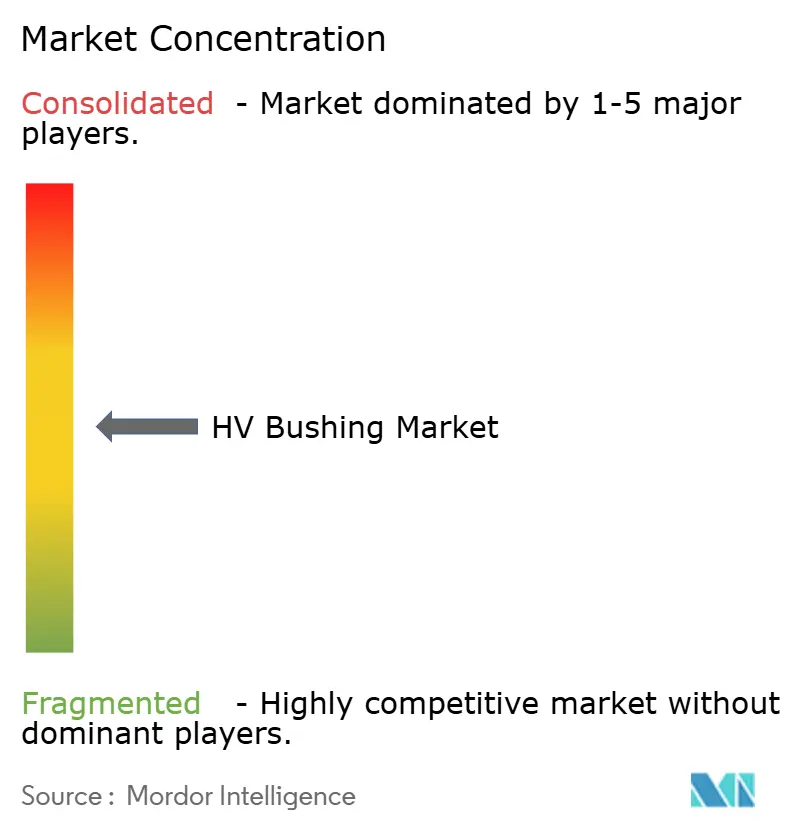
The HV bushing market is moderately concentrated because a limited group of integrated suppliers holds capabilities in design, testing, manufacturing, and field service. ABB, Siemens Energy, Hitachi Energy, and GE Vernova have broad positions through relationships with transformer and grid equipment customers. Hitachi Energy states that it has supplied more than 2.5 million bushings across over 30 countries and can produce 5,000 units per month. This installed base supports warranty coverage, replacement demand, and remote diagnostic services. Suppliers with broad transformer portfolios can embed bushing requirements at an early stage of equipment design.
Specialist suppliers, including PFISTERER, Trench Group, and NGK Insulators, compete through application-specific products and supply flexibility. PFISTERER received certification from Siemens Energy for its CONNEX pluggable connection system in 420 kV Clean Air switchgear in 2024. The certification supports its position in the SF6-free high-voltage application segment. GE Vernova announced SF6-free 420 kV GIS substation deployments for Statnett and Equinor in 2025. Hitachi Energy introduced its AirRIP Flex AF 800 kV product in 2026, strengthening its position in dry bushing technology for alternative-fluid transformers.
Chinese manufacturers such as Jiangsu Shengda Electric, Nanjing Rainbow Electric, and Xi'an XD Transformer are extending their reach in Southeast Asia and the Middle East. Their offer is supported by competitive pricing and growing EHV type-test credentials. The main technology competition centers on dry insulation at 800 kV and above, integrated digital sensing, and SF6-free GIS interfaces. IEC 60270:2025 provides a current technical reference for charge-based partial discharge measurement, while service capability and monitoring support strengthen supplier roles in asset management
HV Bushing Industry Leaders
-
ABB Ltd.
-
Siemens Energy AG
-
Hitachi Energy Ltd.
-
GE Vernova Inc.
-
Trench Group GmbH
- *Disclaimer: Major Players sorted in no particular order
HV Bushing Market Companies Covered in this Report
- ABB Ltd.
- CG Power and Industrial Solutions Ltd.
- Eaton Corporation plc
- GE Vernova Inc.
- GIPRO GmbH
- Hitachi Energy Ltd.
- HSP Hochspannungsgerate GmbH
- Hubbell Incorporated
- Jiangsu Shengda Electric Co., Ltd.
- LAPP Insulators GmbH
- Maschinenfabrik Reinhausen GmbH (MR)
- Nanjing Rainbow Electric Co., Ltd.
- NGK Insulators, Ltd.
- PFISTERER Holding SE
- RHM International
- Sediver Group
- Siemens Energy AG
- Trench Group GmbH
- Xi'an XD Transformer Co., Ltd.
- Yash Highvoltage Insulators Pvt. Ltd.
Recent Industry Developments in HV Bushing Market
- May 2026: Hitachi Energy launched two transformer-bushing innovations at CWIEME Berlin, the AirRIP Flex Cable Termination Bushing and the AirRIP Flex AF 800 kV. The company described the latter as a dry-type UHV AC bushing for alternative-fluid transformers, tested on a 765 kV natural-ester unit.
- January 2026: State Grid Corporation announced CNY 4 trillion in fixed-asset investment for 2026 to 2030. The plan targets UHV corridor expansion and a 30% rise in cross-regional transmission capacity.
- June 2025: Hitachi Energy introduced the GARIP Eco SF6-free transformer-GIS bushing at CWIEME Berlin for the GIS segment transitioning away from SF6 insulation.
Global HV Bushing Market Report Scope
A high-voltage (HV) bushing is a hollow insulating device that allows a live high-voltage conductor to pass safely through a grounded metal enclosure, such as a transformer tank or circuit breaker.
The global HV bushing market is segmented by insulation technology, bushing type, installation, voltage class, end user, and geography. By insulation technology, the market is segmented into oil-impregnated paper (OIP) bushings, resin-impregnated paper (RIP) bushings, resin-impregnated synthetic (RIS) bushings, and composite/hybrid insulated bushings. By bushing type, the market is segmented into condenser-type bushings and non-condenser-type bushings. By installation, the market is segmented into indoor and outdoor. By voltage class, the market is segmented into 15 kV - 170 kV, 170 kV - 245 kV, 245 kV - 550 kV, and above 550 kV (EHV/UHV). By end user, the market is segmented into utilities, power generation companies, renewable energy developers, rail & transportation, and others. The report also covers the market size and forecasts for the global HV bushing market across 26 countries in the key regions. For each segment, market sizing and forecasts are provided in terms of value (USD).
Segmentation Overview
| Oil Impregnated Paper (OIP) Bushings |
| Resin Impregnated Paper (RIP) Bushings |
| Resin Impregnated Synthetic (RIS) Bushings |
| Composite / Hybrid Insulated Bushings |
| Condenser Type Bushings |
| Non-Condenser Type Bushings |
| Indoor |
| Outdoor |
| 15 kV - 170 kV |
| 170 kV - 245 kV |
| 245 kV - 550 kV |
| Above 550 kV (EHV/UHV) |
| Utilities |
| Power Generation Companies |
| Renewable Energy Developers |
| Rail & Transportation |
| Others |
| North America | United States |
| Canada | |
| Mexico | |
| Europe | Germany |
| France | |
| Italy | |
| Spain | |
| United Kingdom | |
| Poland | |
| Russia | |
| Rest of Europe | |
| Asia-Pacific | China |
| India | |
| Japan | |
| South Korea | |
| Australia | |
| Indonesia | |
| Vietnam | |
| Thailand | |
| Rest of Asia-Pacific | |
| South America | Brazil |
| Argentina | |
| Chile | |
| Rest of South America | |
| Middle East and Africa | Saudi Arabia |
| United Arab Emirates | |
| Egypt | |
| South Africa | |
| Morocco | |
| Rest of Middle East and Africa |
| By Insulation Technology | Oil Impregnated Paper (OIP) Bushings | |
| Resin Impregnated Paper (RIP) Bushings | ||
| Resin Impregnated Synthetic (RIS) Bushings | ||
| Composite / Hybrid Insulated Bushings | ||
| By Bushing Type | Condenser Type Bushings | |
| Non-Condenser Type Bushings | ||
| By Installation | Indoor | |
| Outdoor | ||
| By Voltage Class | 15 kV - 170 kV | |
| 170 kV - 245 kV | ||
| 245 kV - 550 kV | ||
| Above 550 kV (EHV/UHV) | ||
| By End User | Utilities | |
| Power Generation Companies | ||
| Renewable Energy Developers | ||
| Rail & Transportation | ||
| Others | ||
| By Geography | North America | United States |
| Canada | ||
| Mexico | ||
| Europe | Germany | |
| France | ||
| Italy | ||
| Spain | ||
| United Kingdom | ||
| Poland | ||
| Russia | ||
| Rest of Europe | ||
| Asia-Pacific | China | |
| India | ||
| Japan | ||
| South Korea | ||
| Australia | ||
| Indonesia | ||
| Vietnam | ||
| Thailand | ||
| Rest of Asia-Pacific | ||
| South America | Brazil | |
| Argentina | ||
| Chile | ||
| Rest of South America | ||
| Middle East and Africa | Saudi Arabia | |
| United Arab Emirates | ||
| Egypt | ||
| South Africa | ||
| Morocco | ||
| Rest of Middle East and Africa | ||
Key Questions Answered in the Report
What is driving demand for HV bushings?
Grid modernization, renewable power connections, and replacement of aging substation equipment support demand. More than 2,500 GW of projects were waiting in grid connection queues in 2026. The HV bushing market benefits when these connections require step-up transformers, collector substations, switching stations, and long-distance transmission links, with each interface requiring equipment that manages high electrical stress safely.
What is the projected growth rate for HV bushings?
The HV Bushing Market size was valued at USD 1.45 billion in 2026 and is estimated to grow from USD 1.51 billion in 2027 to reach USD 1.82 billion by 2032, at a CAGR of 3.83% during the forecast period (2027-2032).
Which insulation technology is growing the fastest?
RIP is projected to grow at a 4.3% CAGR through 2032, supported by dry insulation needs in GIS, offshore, and compact applications. In the HV bushing market, dry designs can reduce oil maintenance requirements and provide a suitable option for SF6-free equipment interfaces, especially where equipment access is difficult or space is limited.
Which voltage class is expanding most quickly?
The above 550 kV category is projected to grow at a 4.9% CAGR through 2032, supported by EHV and UHV transmission projects. The HV bushing market requires specialized product validation at these voltages, so supplier qualification, type-test performance, insulation design, and field-service capability remain important procurement considerations.
Which region has the largest demand base?
Asia-Pacific held 44.8% revenue share in 2026 and is projected to grow at a 5.2% CAGR through 2032. The regional HV bushing market is supported by Chinese UHV investments and Indian transmission expansion for renewable power evacuation, including new transformers and large-capacity substation infrastructure.
How does SF6 regulation affect bushing selection?
EU Regulation 2024/573 restricts SF6 in specified new high-voltage switchgear from 2028 and 2032, increasing attention on compatible dry and SF6-free equipment. This changes equipment specifications in the HV bushing market, particularly where GIS projects require compatible connection systems, dry insulation, validated product interfaces, and long-term operating reliability.