
Huber Needles Market Size and Share
Market Overview
| Study Period | 2021 - 2032 |
|---|---|
| Market Size (2027) | USD 55.87 Million |
| Market Size (2032) | USD 75.17 Million |
| Growth Rate (2027 - 2032) | 6.11 % |
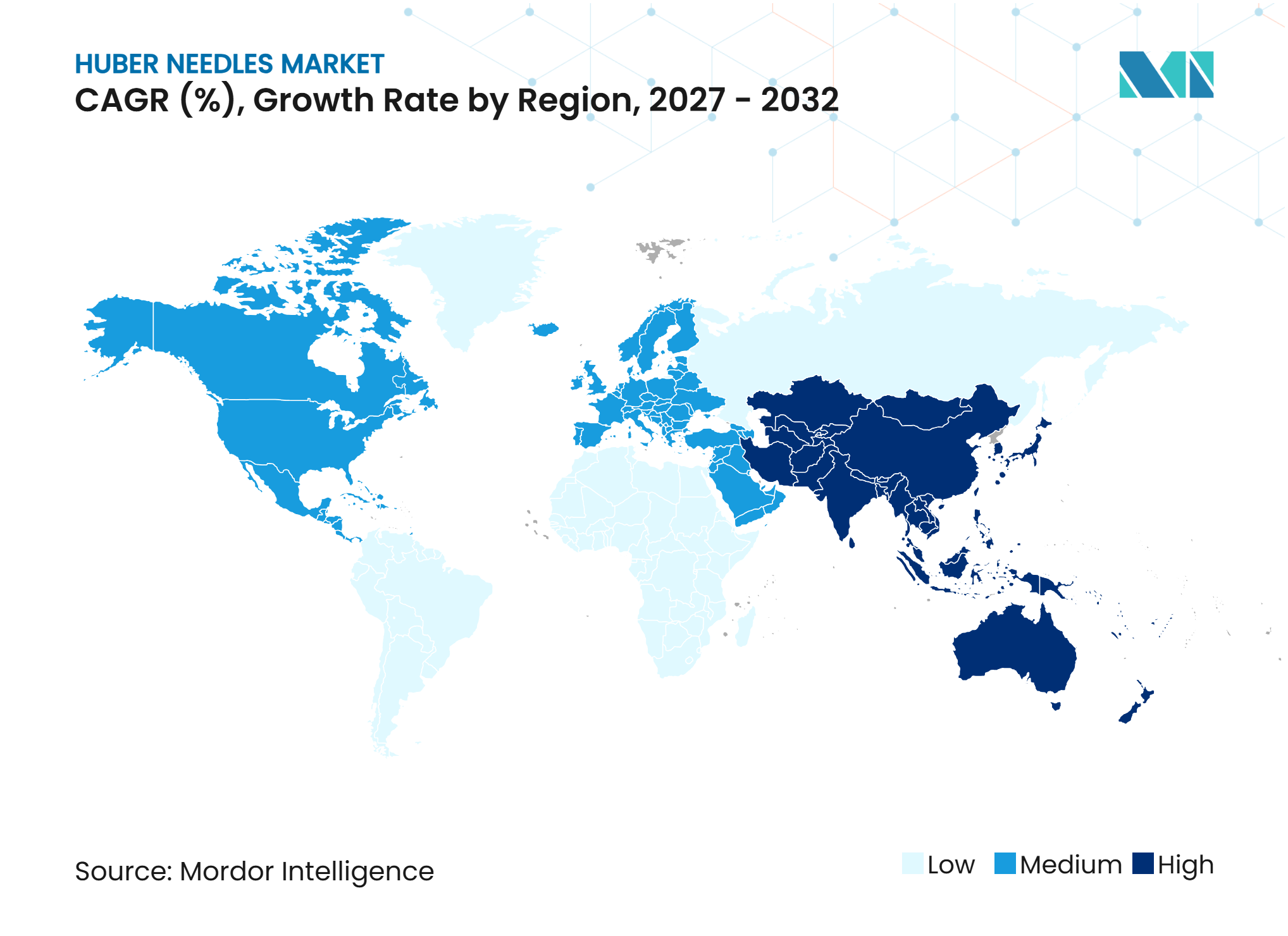
| Fastest Growing Market | Asia-Pacific |
| Largest Market | North America |
| Market Concentration | Medium |
Major Players *Disclaimer: Major Players sorted in no particular order Image © Mordor Intelligence. Reuse requires attribution under CC BY 4.0. | |
Huber Needles Market Analysis by Mordor Intelligence
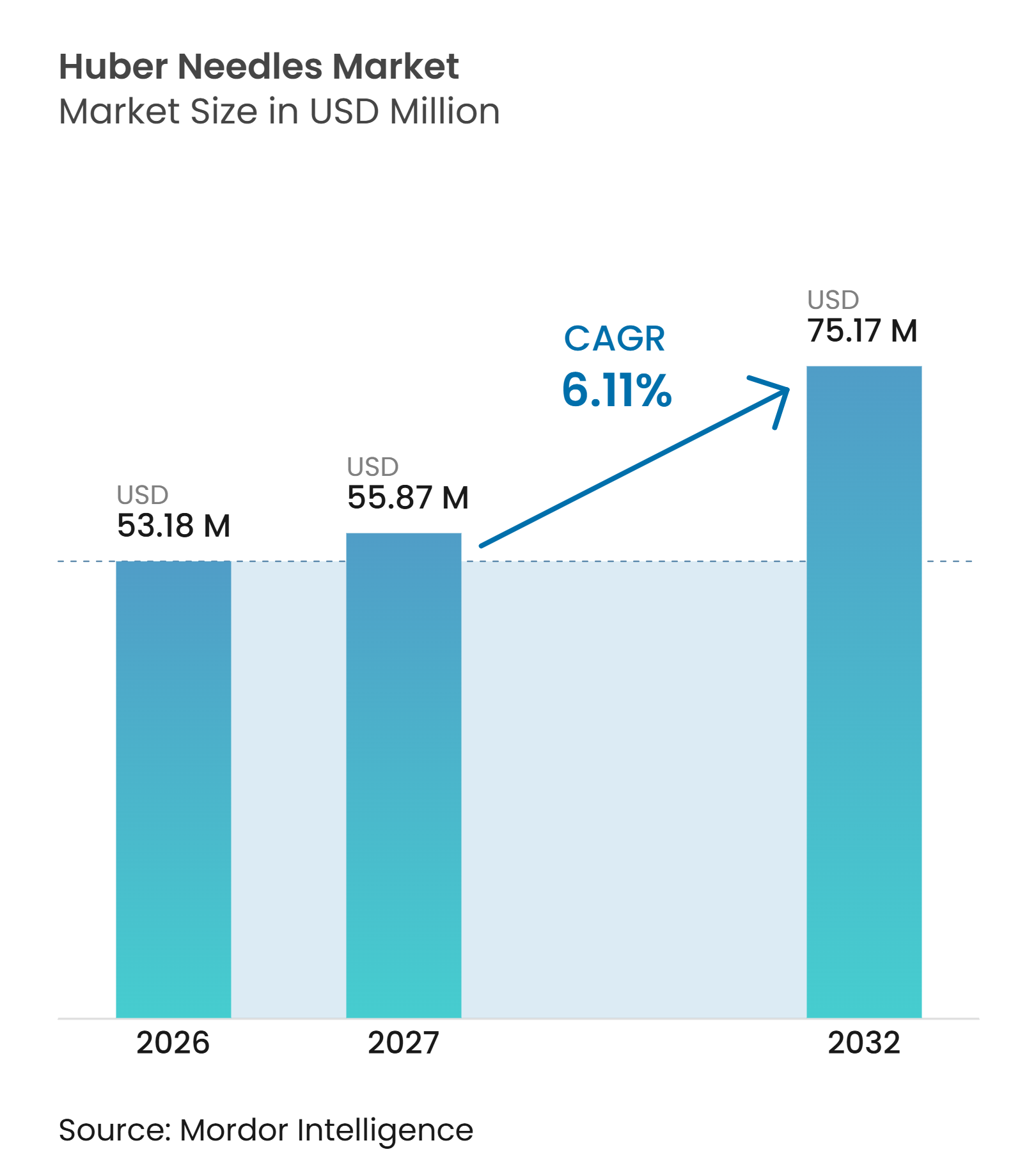
The Huber Needles Market size is expected to grow from USD 53.18 million in 2026 to USD 55.87 million in 2027 and is forecast to reach USD 75.17 million by 2032 at 6.11% CAGR over 2027-2032.
The Huber needles market benefits from recurring use because each implanted vascular port requires repeated access during treatment, maintenance, and assessment throughout the period that the device remains in use. Cancer care remains the central source of demand, as global cancer diagnoses reached 20.6 million in 2024 and are expected to reach 35 million annually by 2050. Growth in dialysis, long-term intravenous treatment, home infusion, and outpatient oncology care broadens demand beyond hospital-based chemotherapy and exposes suppliers to several distinct procurement channels. Suppliers are responding with safety mechanisms, simplified activation, and power-injection compatibility that fit evolving clinical workflows and address differences between hospital and alternate-site care. Competition increasingly depends on integrated access kits, clinical support, and regulatory credentials rather than needle pricing alone, especially where providers seek consistency across port-access procedures.
Key Report Takeaways
- By product type, curved Huber needles held 52.15% of the Huber needles market share in 2026, while straight Huber needles are projected to grow at a 7.22% CAGR through 2032.
- By application, IV cancer treatment accounted for 39.63% of the Huber needles market in 2026, while dialysis is expected to grow at a 7.86% CAGR through 2032.
- By end-user, hospitals and clinics held 43.22% of the Huber needles market share in 2026, while ambulatory surgery centers are forecast to expand at a 6.72% CAGR through 2032.
- By geography, North America accounted for 45.28% of the Huber needles market in 2026, while Asia-Pacific is projected to grow at a 9.36% CAGR through 2032.
Note: Market numbers in this report are based on Mordor Intelligence's proprietary estimation framework, which combines nine months of actuals with Q4 projections for base year 2026.
Market Trends and Insights
Drivers Impact Analysis of Huber Needles Market*
| Driver | (~) % Impact on CAGR Forecast | Geographic Relevance | Impact Timeline |
|---|---|---|---|
| Rising Cancer Treatment and Repeated Port-Access Procedures | +1.8% | Global, concentrated in North America, Western Europe, and East Asia | Long term (≥ 4 years) |
| Expansion of Dialysis and Long-Term Intravenous Therapies | +1.4% | Global, with the highest growth in APAC and North America | Long term (≥ 4 years) |
| Growth of Home Infusion and Outpatient Oncology Care | +1.0% | North America and Western Europe are primary, and APAC is emerging | Medium term (2-4 years) |
| Stricter Needlestick-Injury Prevention Requirements | +0.9% | North America and the EU, with spillovers to APAC and Latin America | Short term (≤ 2 years) |
| Port-Septum Preservation Through Non-Coring Designs | +0.7% | Global | Medium term (2-4 years) |
| Increasing Pressure-Injection and Imaging Compatibility Requirements | +0.5% | North America and the EU, especially CT-intensive settings | Medium term (2-4 years) |
| Source: Mordor Intelligence | |||
Rising Cancer Treatment and Repeated Port-Access Procedures
Cancer treatment supports sustained use of Huber needles because many patients receive several treatment cycles through implantable venous access ports. The World Health Organization stated that new global cancer cases could approach 35 million annually by 2050, following 20.6 million new cases recorded in 2024.[1] The relevant demand base is patients whose chemotherapy or biologic treatment requires repeated port access over an extended period, rather than the full population with a cancer diagnosis. This distinction matters because port placement is tied to regimen duration, the need for reliable venous access, and the clinical decision to avoid repeated peripheral access. A 2025 study of 149 oncology patients found that 91.4% of totally implantable venous access port procedures were free of complications, supporting continued clinician confidence in port-based administration.[2] This repeat-use pattern gives the Huber needles market a steadier purchasing base than a one-time capital device category.
Expansion of Dialysis and Long-Term Intravenous Therapies
Dialysis and other long-term therapies extend the Huber needles market into patient groups that need recurring vascular access. Patients with complex vascular access needs may require implantable ports when conventional fistula options are not suitable, particularly when treatment plans require reliable access over time. The clinical connection is not limited to treatment in a dialysis center because some patients also receive related intravenous therapies through implanted access devices. A 2025 National Institutes of Health study found that the number of peritoneal dialysis programs in CMS-registered facilities rose from 2,157 in 2010 to 3,522 in 2021.[3]Larger programs with more than 50 patients also increased disproportionately, showing deeper institutional commitment to peritoneal dialysis delivery. Long-term antibiotic treatment, parenteral nutrition, and biologic infusions add further recurring use cases for port access. These clinical needs support a broader demand base for the Huber needles market and reduce reliance on oncology treatment alone.
Growth of Home Infusion and Outpatient Oncology Care
Home infusion and outpatient care shift Huber needle purchasing toward providers outside traditional hospital formularies. The National Home Infusion Association estimated that more than 3.2 million patients receive home infusion therapy each year in the United States. This setting can change the selection process because procurement is not always directed by a large hospital value-analysis committee or linked to a systemwide inpatient contract. Independent home health agencies and ambulatory infusion centers often emphasize straightforward activation, extended dwell time, clear visual confirmation, and a compact device profile that staff can manage consistently. Site-neutral payment policies are also moving some infusion activity to lower-cost outpatient settings. This shift creates additional access points for suppliers in the Huber needles market, although purchasing requirements vary by care setting and provider capability.
Stricter Needlestick-Injury Prevention Requirements
Needlestick-injury prevention requirements support the adoption of safety-engineered Huber needles in regulated care settings. The Centers for Disease Control and Prevention estimated that hospital-based personnel in the United States experience 385,000 needlestick injuries annually and stated that 62% to 88% are preventable through safety-engineered devices. OSHA requires employers to identify, evaluate, and use safer medical devices under its Bloodborne Pathogens Standard. These requirements make safety features part of the procurement baseline for many hospitals, rather than an optional premium feature that can be removed when budgets are constrained. Compliance is stronger in hospital environments than in some home care settings, where device cost can carry greater weight and formal monitoring can be less consistent. The result is a divided purchasing environment in which established safety suppliers remain strongest in institutional channels while lower-cost alternatives have room in alternate sites.
Restraints Impact Analysis of Huber Needles Market*
| Restraint | (~) % Impact on CAGR Forecast | Geographic Relevance | Impact Timeline |
|---|---|---|---|
| Infection, Extravasation, and Port-Related Complication Risks | -1.5% | Global | Long term (≥ 4 years) |
| Premium Pricing of Safety-Engineered Devices | -1.2% | Emerging markets in APAC excluding Japan, Latin America, and MEA | Medium term (2-4 years) |
| Technique Sensitivity and Uneven Clinician Training | -0.8% | Global, concentrated in emerging markets and home care settings | Medium term (2-4 years) |
| Limited Standardization of Port, Needle, and Pressure Compatibility | -0.6% | Global | Long term (≥ 4 years) |
| Source: Mordor Intelligence | |||
Infection, Extravasation, and Port-Related Complication Risks
Complications linked to implantable ports can slow the use of port-based therapy and limit Huber needle volumes. A 2025 study of 471 breast cancer patients found that 23.9% experienced at least 1 complication with a totally implantable access port. Infection, thrombosis, extravasation, and catheter malposition require clinical review and can affect confidence in port access protocols. These outcomes may also lead institutions to examine access techniques, staff training, dwell management, and the design of the needle system used. Extravasation is particularly sensitive because it may be associated with needle dislodgement or improper access. Guidance on dwell time, technique, and site assessment is available, but variation in clinical adherence leaves complication management important for suppliers and care providers. This keeps device design and clinical education closely linked to continued adoption in the Huber needles market.
Premium Pricing of Safety-Engineered Devices
Safety-engineered Huber needles cost more per unit than conventional non-coring products, which restricts adoption in cost-sensitive settings. The price difference is most visible when a healthcare provider compares the cost of a safety mechanism with a conventional product in a high-volume procurement decision. Public tenders in emerging regions can place strong emphasis on unit prices and high-volume purchasing. This pressure is most relevant where healthcare systems buy commodity medical devices through centralized procurement and have limited flexibility to pay for added features. Incumbents, therefore, depend more on kit integration, workflow support, and established formulary relationships than on defending a premium price for the needle alone. This leaves suppliers to show value through the wider clinical workflow rather than through a single-device price comparison.
*Our forecasts treat driver/restraint impacts as directional, not additive. The impact forecasts reflect baseline growth, mix effects, and variable interactions.
Huber Needles Market Segment Analysis
By Product Type:
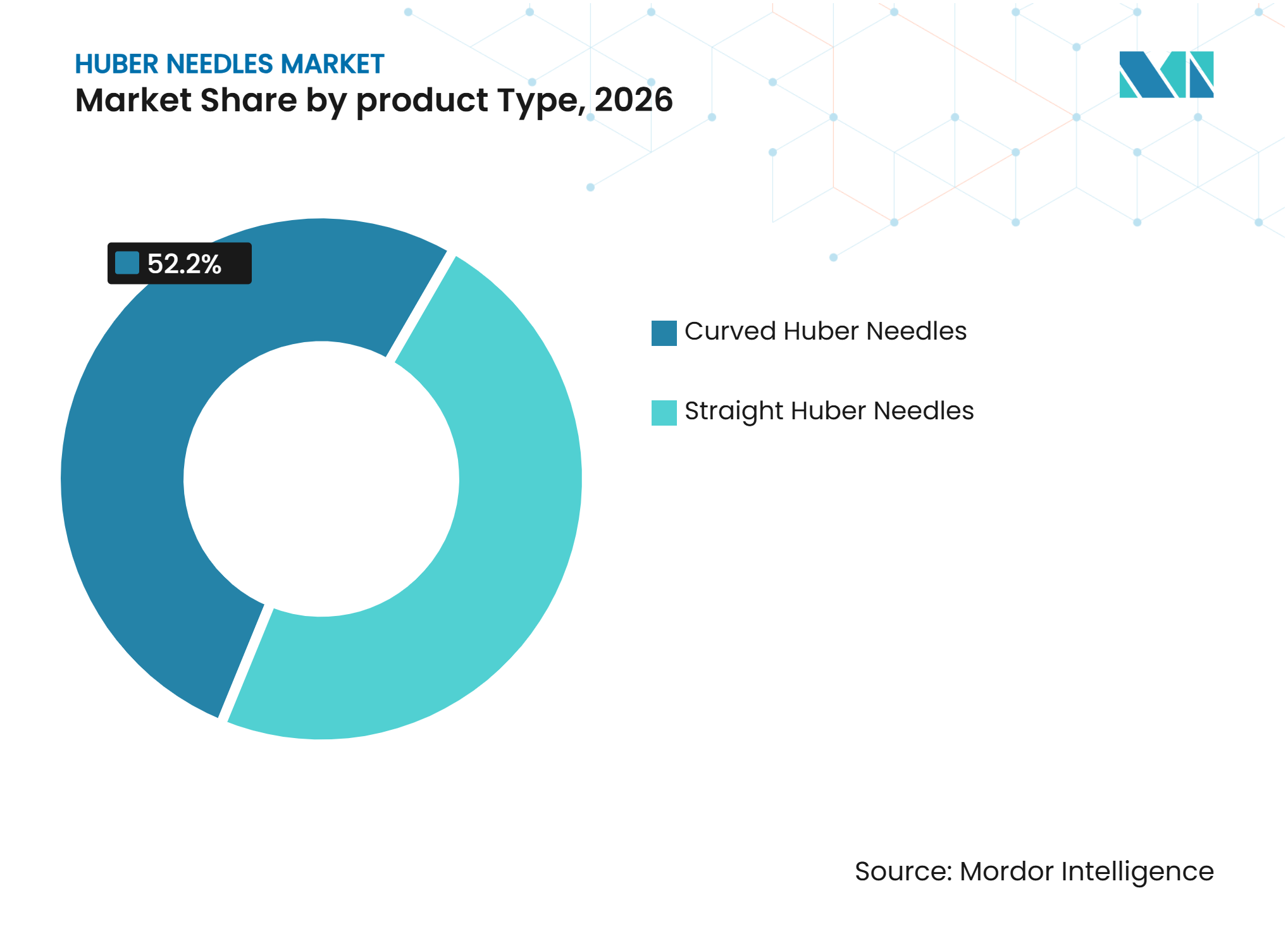
Curved Designs Hold the Lead While Straight Needles Gain Through Technical CompatibilityCurved Huber needles held 52.15% of product demand in 2026, giving them the leading position in the Huber needles market size by product type. Their 90-degree geometry supports stable placement against the chest wall during oncology port access and can help maintain the intended position while a patient moves during treatment. Curved products remain established in chemotherapy settings where secure placement during dwell time is important. Their continued share reflects the value of a format that supports established port-access practice across repeated treatment visits.
Straight Huber needles are forecasted to grow at a 7.22% CAGR through 2032, which is faster than the overall category. Their lower profile suits outpatient settings and can support CT power-injection workflows, where compatibility between the port, needle set, tubing, and imaging procedure matters. A 2025 assessment of 4 commercial safety systems identified differences in activation time, single-handed use, and correct activation, showing that design execution continues to matter. These developments show that technical compatibility remains a central point of differentiation within the Huber needles industry.


By Application:
IV Cancer Treatment Leads While Dialysis Expands the Demand BaseIV cancer treatment accounted for 39.63% of application demand in 2026, representing the largest share of the Huber needles market size by application. Multi-cycle chemotherapy creates repeated port-access events over the course of treatment and makes reliable access important at every scheduled administration. Treatment continuity establishes oncology workflows and broad access to infusion services, therefore, helping keep cancer therapy at the center of application demand.
Dialysis is expected to grow at a 7.86% CAGR through 2032, making it the fastest-growing application. Peritoneal dialysis program expansion and difficult vascular access support this demand, while long-term care requirements can extend the period in which access supplies are needed. These uses rely on different provider settings and patient pathways, which makes the category less closely tied to a single hospital department.
By End-User:
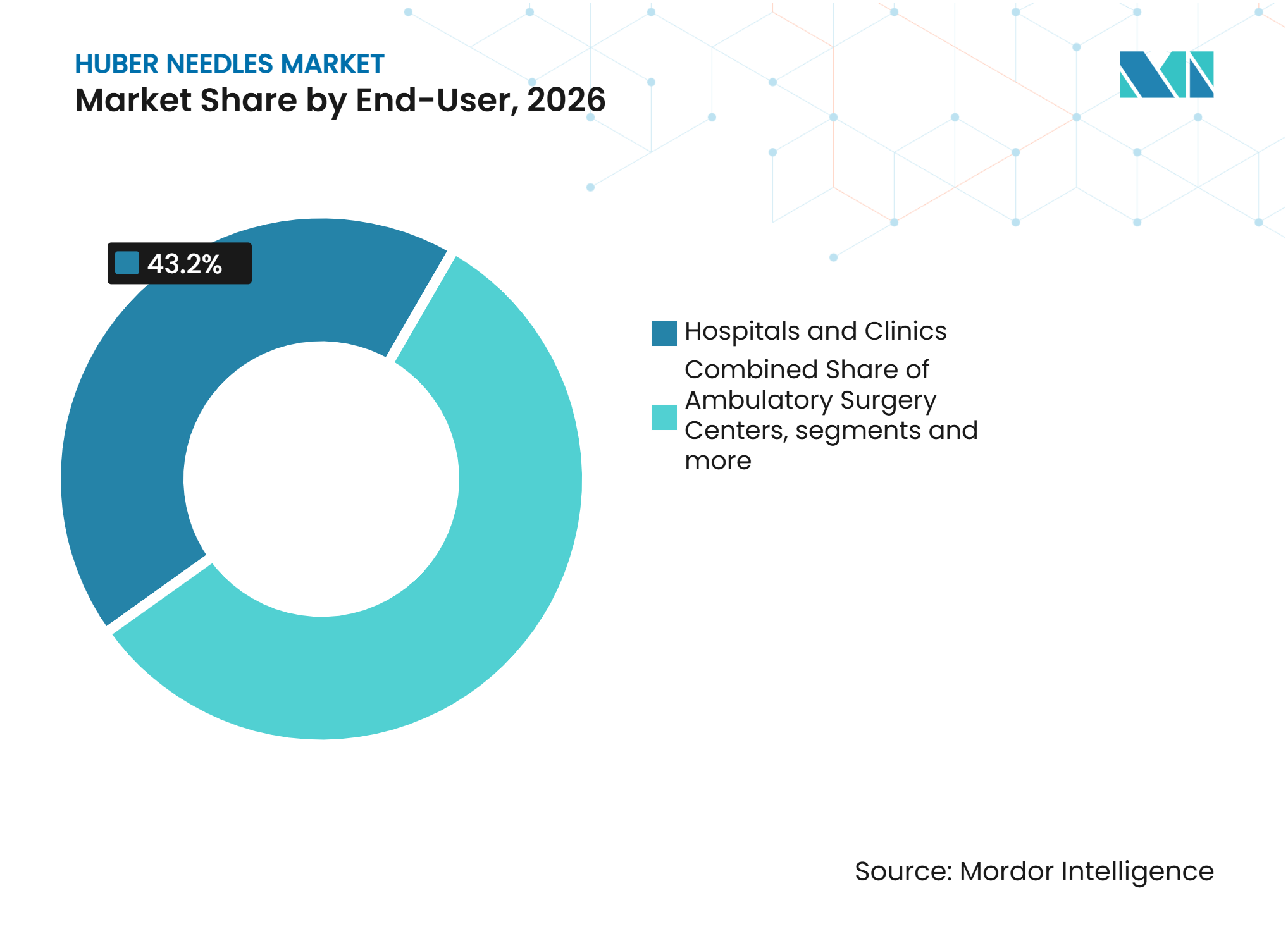
Hospitals and Clinics Lead While Ambulatory Care Grows FasterHospitals and clinics held 43.22% of end-user demand in 2026, the highest Huber needles market share among care settings. These facilities manage a large share of chemotherapy administration, dialysis access, and clinical trial infusion protocols, which concentrate ordering volume in established institutional channels. Value-analysis committees assess safety features, kit integration, compliance documentation, pricing, and the practical fit with current nursing routines before setting formularies. This setting gives suppliers with broad port-access portfolios a clear advantage when hospitals want consistent products across multiple treatment areas.
Ambulatory surgery centers are projected to grow at a 6.72% CAGR through 2032. Their expansion follows continuing movement of infusion activity to freestanding outpatient sites, where lower overhead can affect care delivery and procurement decisions. Home care also contributes to a growing demand through parenteral nutrition, outpatient chemotherapy, and long-term antibiotic treatment. Providers may therefore place greater value on products that are easy to use consistently outside the staffing and support structure of a hospital.


Geography Analysis
North America
North America held 45.28% of the Huber needles market share in 2026, supported by established oncology treatment networks, extensive use of implantable ports, and mature procurement systems for safety-engineered devices. OSHA safety requirements reinforce procurement of safety-engineered products in United States healthcare facilities because employers must assess and implement safer medical devices. The region also has a large Medicare-covered end-stage renal disease population, supporting ongoing vascular-access needs when conventional access options are limited and creating another clinical pathway for repeated device use. Canada’s formulary systems support standardized safety-device purchasing, while Mexico’s divided public and private system can make public procurement more price-sensitive. These factors sustain the region’s leadership while creating distinct purchasing conditions across its national healthcare systems and care-delivery models.
Asia-Pacific
Asia-Pacific is projected to grow at a 9.36% CAGR through 2032, the highest regional rate in the Huber needles market. China, India, and South Korea are expanding dialysis and oncology treatment capacity, and these changes support more recurring port-access activity as patients move through long treatment schedules. Japan, South Korea, and Australia have regulatory systems aligned with FDA and CE requirements, while India and Southeast Asia require price-competitive offers and offer growing opportunities for regional suppliers. China-based manufacturers that have secured FDA clearances can also serve domestic demand with products that put pressure on premium pricing and make price positioning more difficult for foreign suppliers.
Europe, South America, and the Middle East, and Africa
Europe benefits from sharps-safety requirements that create a baseline need for safety-engineered access devices, supported by established oncology and renal care networks in Germany, France, and the United Kingdom. Formulary-based purchasing in these systems can favor standardized products that support common nursing practices across hospital sites and simplify the management of recurring port-access supplies. Vygon has promoted its Huber needle with Positive Pressure System technology in European hospitals, citing prevention of blood reflux in up to 82.8% of cases. South America, the Middle East, and Africa remain emerging opportunities because port implantation remains lower and procurement is price-led. However, Brazil’s increase in long-term central venous catheter procedures points to a developing need for repeated port access.
Competitive Landscape
Market Concentration
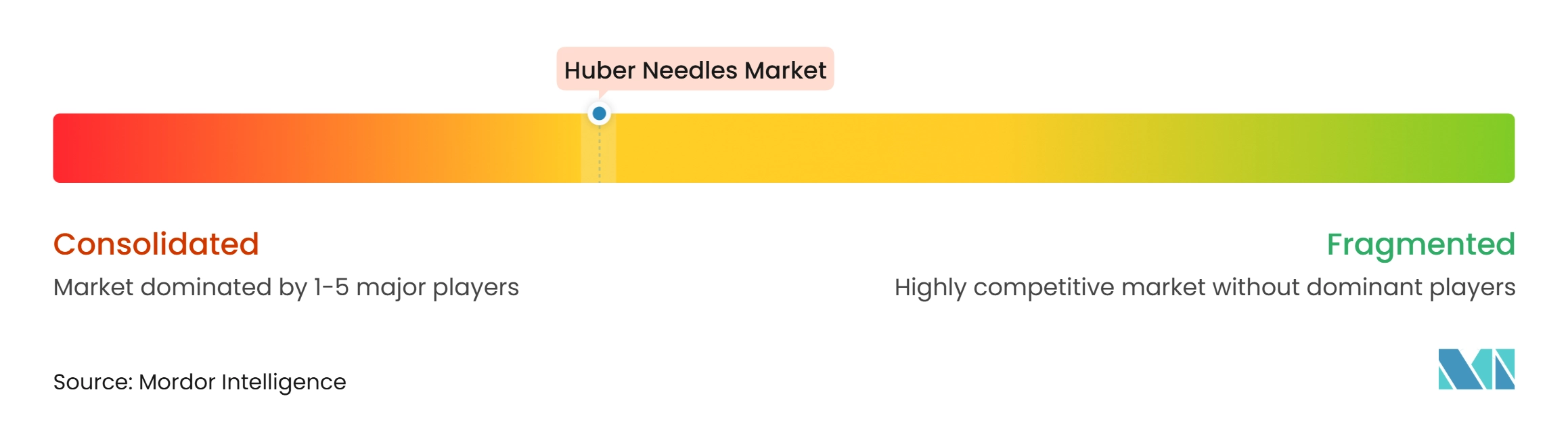
The Huber needles market is moderately consolidated, with BD through Bard Access Systems, B. Braun, Teleflex, ICU Medical, and Vygon holding strong positions in hospital-specified safety needle volumes. These suppliers compete through port-access systems rather than through needle pricing alone, which reflects how hospitals evaluate a complete clinical workflow instead of a single disposable item. Their offerings can combine the needle with sterile preparation materials, dressings, extension sets, and clinical training, creating a common protocol for clinicians who manage implanted ports. This approach increases switching costs for hospitals that have standardized their procedures around a single workflow, and it can make product changes harder to implement across several departments. It also makes service quality, supply reliability, and formulary compliance central purchasing considerations for the Huber needles market.
BD’s AllPoints Port Access System illustrates the integrated approach, combining the SafeStep Huber Needle Set with GuardIVa antimicrobial dressings, NAC needleless access Y-sites, and sterile field drapes in a single procurement configuration. PFM Medical received clearance for the JetCan Pro Safety Huber Needle in May 2025, adding another passively activated device rated for power injection up to 325 psi. These actions show that the capability in vascular access, safety, and imaging-compatible therapy remains important to leading suppliers.
Promisemed Hangzhou Meditech, Jiangsu Caina Medical, and Anhui Tiankang Medical are expanding their regulatory standing and distribution reach, particularly in regions where tenders put strong weight on both price and compliance. Promisemed received 2 FDA clearances during 2024 and 2025, which support participation in higher-specification port-access tenders and demonstrate a deliberate move toward regulated product categories. Regional suppliers are most competitive where tenders place greater weight on price and regulatory parity, while established suppliers can rely on deeper formulary integration in North America and Europe. Competitive pressure is therefore strongest in Southeast Asia and the Middle East, where volume and price trade-offs can favor newer entrants.
Huber Needles Industry Leaders
-
Becton, Dickinson and Company
-
B. Braun Melsungen AG
-
ICU Medical, Inc.
-
Vygon SAS
-
AngioDynamics, Inc.
- *Disclaimer: Major Players sorted in no particular order
Huber Needles Market Companies Covered in this Report
- Amecath Medical Technologies
- AngioDynamics
- Anhui Tiankang Medical Technology Co., Ltd.
- Argon Medical Devices
- B. Braun
- Baxter
- Beckton Dickinson
- Cook Group
- EXELINT International, Co.
- ICU Medical
- Jiangsu Caina Medical Co., Ltd.
- Medtronic
- Ningbo Jumbo Medical Instrument Co., Ltd.
- Nipro
- Polymedicure Limited
- Promisemed Hangzhou Meditech Co., Ltd.
- Smiths Group
- Teleflex
- Terumo
- Vygon
Recent Industry Developments in Huber Needles Market
- July 2026: Portal Access Inc. received FDA 510(k) clearance K260916 for the FLEXI-PORT Power Injectable Implantable Port, a titanium-stem, PEEK-lock port compatible with non-coring Huber needle access and supporting power injection at 5 mL/s. The growing installed base of power-injectable ports directly expands the addressable volume for high-pressure Huber needles across CT-integrated infusion centers.
- November 2025: Sb-Kawasumi Laboratories, Inc. received FDA 510(k) clearance K252355 for the K-SHIELD Advantage PORT ACCESS INFUSION SET with High Pressure Tubing, adding a new safety-engineered competitor into the United States hospital market for port access and reinforcing the trend toward high-pressure-rated infusion needle sets.
- May 2025: Pfm Medical, Inc. received FDA 510(k) clearance K242763 for the JetCan Pro Safety Huber Needle, a passively activated safety device compatible with power injection up to 325 psi in pediatric and adult patients, marking a significant expansion of PFM Medical’s United States regulatory footprint and broadening the competitive field in high-pressure safety Huber needles.
Global Huber Needles Market Report Scope
According to the report’s scope, the Huber needles market refers to specialized medical needles designed with a non‑coring tip that prevents damage to implanted ports during repeated access. These needles are widely used in chemotherapy, parenteral nutrition, and long‑term medication delivery, ensuring safe infusion while minimizing port degradation and patient discomfort.
The Huber needles market is segmented into product type, application, end-user, and geography. By product type, the market is segmented into curved Huber needles and straight Huber needles. By application, the market is segmented into IV cancer treatment, dialysis, blood transfusion, home parenteral nutrition, and other applications. By end-user, the market is segmented into hospitals and clinics, ambulatory surgery centers, home care settings, and other end-users. By geography, the market is segmented into North America, Europe, Asia-Pacific, and the Rest of the World. The report offers values (USD) for all the above segments.
Segmentation Overview
| Curved Huber Needles |
| Straight Huber Needles |
| IV Cancer Treatment |
| Dialysis |
| Blood Transfusion |
| Home Parenteral Nutrition |
| Other Applications |
| Hospitals and Clinics |
| Ambulatory Surgery Centers |
| Home Care Settings |
| Other End-Users |
| North America | United States |
| Canada | |
| Mexico | |
| Europe | Germany |
| United Kingdom | |
| France | |
| Italy | |
| Spain | |
| Rest of Europe | |
| Asia-Pacific | China |
| Japan | |
| India | |
| Australia | |
| South Korea | |
| Rest of Asia-Pacific | |
| Rest of the World |
| By Product Type | Curved Huber Needles | |
| Straight Huber Needles | ||
| By Application | IV Cancer Treatment | |
| Dialysis | ||
| Blood Transfusion | ||
| Home Parenteral Nutrition | ||
| Other Applications | ||
| By End-User | Hospitals and Clinics | |
| Ambulatory Surgery Centers | ||
| Home Care Settings | ||
| Other End-Users | ||
| By Geography | North America | United States |
| Canada | ||
| Mexico | ||
| Europe | Germany | |
| United Kingdom | ||
| France | ||
| Italy | ||
| Spain | ||
| Rest of Europe | ||
| Asia-Pacific | China | |
| Japan | ||
| India | ||
| Australia | ||
| South Korea | ||
| Rest of Asia-Pacific | ||
| Rest of the World | ||
Key Questions Answered in the Report
What is driving demand for Huber needles?
The market is expected to grow from USD 53.18 million in 2026 to USD 55.87 million in 2027, and to reach USD 75.17 million by 2032, at 6.11% CAGR, due to repeated port access in cancer treatment, which drives demand, with additional use in dialysis, long-term IV therapy, home infusion, and outpatient care.
Which Huber needle type is growing fastest?
Straight Huber needles are forecasted to grow at a 7.22% CAGR through 2032, supported by their compact profile and compatibility with imaging-related workflows.
Which application uses the most Huber needles?
IV cancer treatment led application demand with a 39.63% share in 2026 because chemotherapy often requires repeated port access over extended treatment periods.
Which region is expanding fastest for Huber needle demand?
Asia-Pacific is projected to grow at a 9.36% CAGR through 2032 as oncology treatment and dialysis capacity expand across major countries.