
Market Overview
| Study Period | 2020 - 2031 |
|---|---|
| Forecast Data Period | 2026 - 2031 |
| Base Year Market Size (2025) | USD 11.49 Billion |
| Market Size (2026) | USD 12.19 Billion |
| Market Size (2031) | USD 16.34 Billion |
| Growth Rate (2026 - 2031) | 6.05 % |
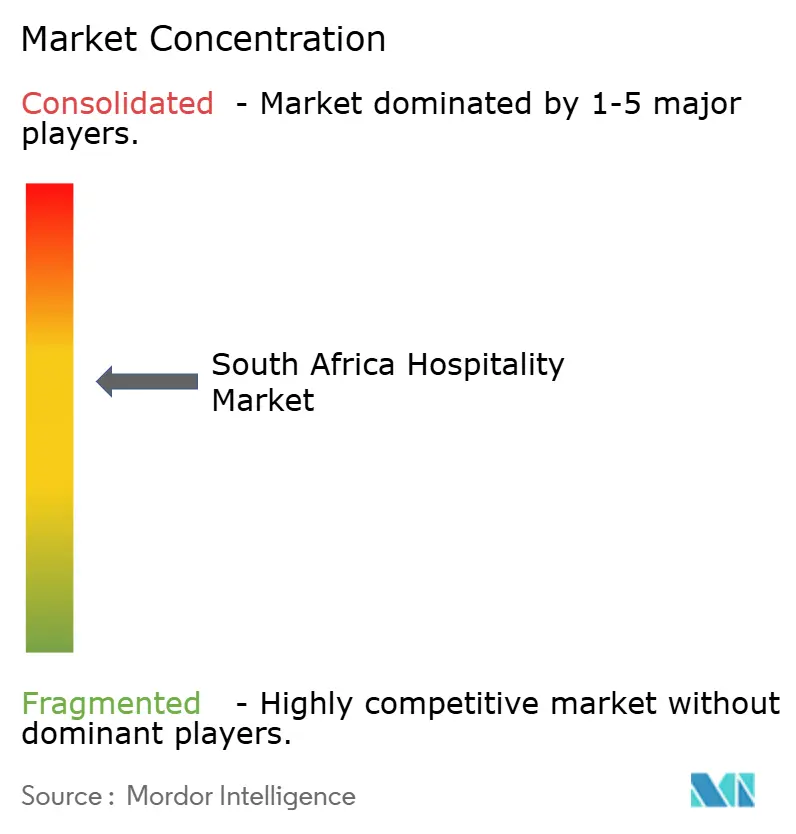
| Market Concentration | Medium |
Major Players *Disclaimer: Major Players sorted in no particular order Image © Mordor Intelligence. Reuse requires attribution under CC BY 4.0. | |
South Africa Hospitality Market Analysis by Mordor Intelligence
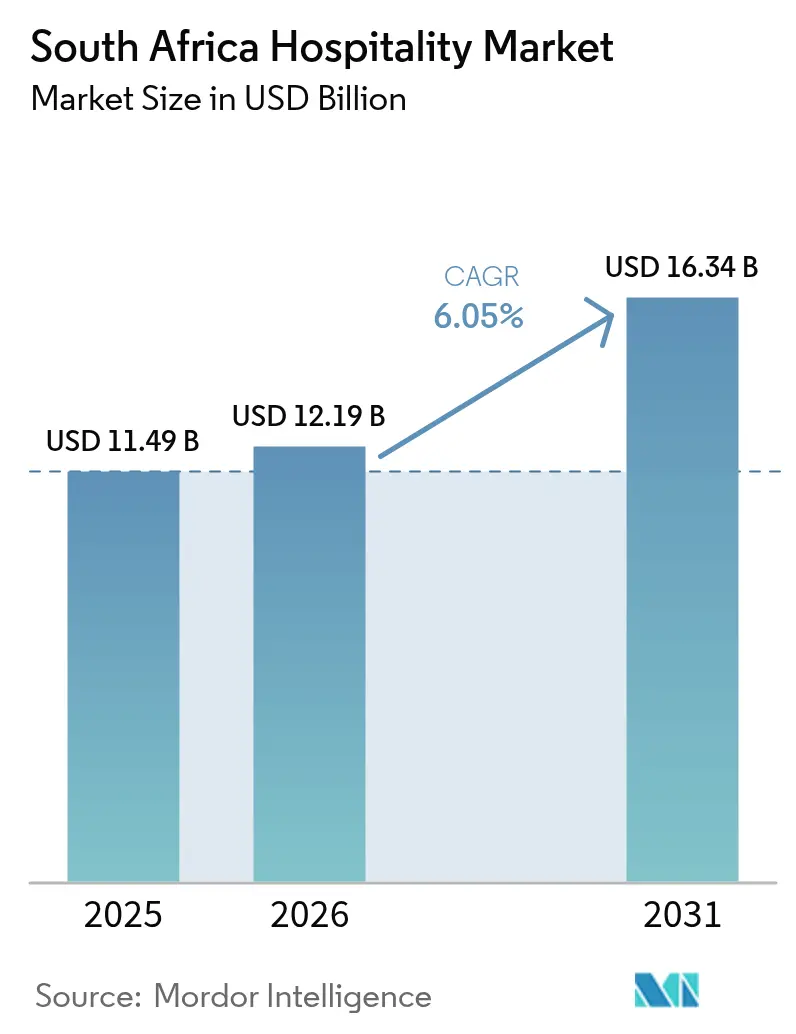
The South Africa Hospitality market size is expected to grow from USD 11.49 billion in 2025 to USD 12.19 billion in 2026 and is forecast to reach USD 16.34 billion by 2031 at 6.05% CAGR over 2026-2031.
The post-pandemic rebound in international arrivals, the recovery of meetings and events, and supportive government incentives position the sector for sustained growth. Business travel holds a larger-than-average revenue contribution because corporate visitors extend stays for leisure activities, while digital-nomad demand is building on the back of the new Remote Work Visitor Visa. Chain-hotel dominance, rising use of direct booking channels, and a shift toward extended-stay formats are reshaping competitive strategies. Growth opportunities cluster around Western Cape’s premium leisure corridor, township-based cultural tourism, and green retrofits that hedge against South Africa’s power and water constraints.
Key Report Takeaways
- By type, chain hotels led with 60.12% of South Africa hospitality market share in 2025, while independent hotels are advancing at a 7.52% CAGR through 2031.
- By accommodation class, mid and upper-mid-scale properties accounted for 50.85% of South Africa hospitality market share in 2025; service apartments are forecast to expand at an 11.1% CAGR to 2031.
- By booking channel, online travel agencies captured 45.70% of South Africa hospitality industry share in 2025, whereas direct digital reservations are growing fastest at 12.05% CAGR through 2031.
- By geography, Gauteng held 29.95% of South Africa hospitality market share in 2025; Western Cape is the fastest-growing region with a 7.05% CAGR forecast to 2031.
Note: Market size and forecast figures in this report are generated using Mordor Intelligence’s proprietary estimation framework, updated with the latest available data and insights as of 2026.
South Africa Hospitality Market Trends and Insights
Drivers Impact Analysis*
| Driver | (~) % Impact on CAGR Forecast | Geographic Relevance | Timeline |
|---|---|---|---|
| Safari Economy Supporting High-Value International Tourism | 1.10% | Kruger and major private game reserves | Short term (≤ 2 years) |
| Wine Tourism Corridors Creating Premium Regional Hospitality Demand | 0.70% | Western Cape wine estate regions | Medium term (2–4 years) |
| Cape Town's Global Leisure Position Supporting Urban Tourism Growth | 0.90% | Cape Town premium leisure districts | Short term (≤ 2 years) |
| African Regional Gateway Role Supporting Business Mobility | 0.70% | Johannesburg and Cape Town MICE hubs | Medium term (2–4 years) |
| Adventure Tourism Assets Expanding Non-Urban Hospitality Markets | 0.60% | Drakensberg, Garden Route, Wild Coast | Long term (≥ 4 years) |
| Private Conservation Reserves Creating Luxury Lodge Opportunities | 0.80% | Greater Kruger and Eastern Cape reserves | Long term (≥ 4 years) |
| Source: Mordor Intelligence | |||
Safari Economy Supporting High-Value International Tourism
South Africa's safari economy is a key driver of the hospitality market, attracting high-spending international tourists through luxury wildlife experiences. Private reserves near Kruger National Park command premium room rates with exclusive accommodations and personalized safaris. The country welcomed 10.5 million international visitors in 2025, with tourism contributing nearly 9% of GDP. South Africa also accounts for around 25.4% of Africa's travel revenue, reflecting its premium tourism positioning[1]. Continued investments in luxury safari lodges and conservation-based developments are further strengthening long-term hospitality growth.
Wine Tourism Corridors Creating Premium Regional Hospitality Demand
South Africa's wine regions, including Stellenbosch and Franschhoek, are established hospitality destinations combining luxury accommodation, gastronomy, wellness, and cultural experiences. The country has 522 wine cellars across 23 wine routes, supporting year-round tourism demand. Wine tourism contributes significantly to cellar revenues, while strong domestic visitation ensures resilience beyond the cycles of international travel. High Airbnb occupancy and RevPAR growth in the Western Cape further reflect the segment's strength. Expanding culinary, wellness, and entertainment offerings continue to broaden visitor appeal.
Cape Town's Global Leisure Position Supporting Urban Tourism Growth
Cape Town's global recognition has strengthened hospitality demand, premium hotel occupancy, and investor confidence. The city received multiple international awards in 2025, attracting high-spending visitors from the United Kingdom, the United States, Germany, and other key markets. It also hosted 58 international association meetings, supporting year-round business and leisure travel[2]. New luxury hotel developments and boutique brands continue entering the market. Infrastructure investments in water security and public transport further enhance Cape Town's long-term hospitality attractiveness.
African Regional Gateway Role Supporting Business Mobility
South Africa serves as Africa's leading business travel and MICE destination, generating stable year-round hospitality demand beyond leisure tourism. The country's MICE industry was valued at USD 6.6 billion in 2023, and it hosted 98 international association meetings in 2024, the highest in Africa. By early 2025, 53 international business events had been secured, expected to contribute ZAR 617 million (USD 37.5 million) to the economy. The G20 Summit 2025 and ongoing visa reforms further strengthen South Africa's appeal to global business travelers. These factors continue to support occupancy and revenue growth for urban hotels[3].
Restraints Impact Analysis*
| Restraint | (~) % Impact on CAGR Forecast | Geographic Relevance | Impact Timeline |
|---|---|---|---|
| Safety and Security Perceptions Affect Destination Selection and Investor Confidence | −0.9% | Johannesburg, Cape Town, Durban urban areas | Short term (≤ 2 years) |
| Currency Volatility Affecting International Investment Decisions | −0.7% | Cape Town and Greater Kruger investments | Medium term (2–4 years) |
| Uneven Tourism Development Creates Regional Market Imbalances | −0.6% | Western Cape versus rural provinces | Long term (≥ 4 years) |
| Skilled Workforce Gaps Challenge Premium Hospitality Service Delivery | −0.5% | Kruger, Cape Town, Sandton hospitality hubs | Medium term (2–4 years) |
| Source: Mordor Intelligence | |||
Safety and Security Perceptions Affect Destination Selection and Investor Confidence
Safety and crime perceptions remain a major challenge for South Africa's hospitality market, reducing international visitor confidence and investment. Overseas arrivals remained below pre-pandemic levels, resulting in billions of rand in lost tourism expenditure. Rising incidents of kidnappings, vehicle hijackings, and robberies have prompted stricter travel advisories from several countries. Hospitality operators are increasingly investing in enhanced security and risk management measures. Persistent safety concerns continue to constrain long-term tourism growth and foreign investment[4].
Currency Volatility Affecting International Investment Decisions
Volatility in the South African rand creates uncertainty for hospitality investors despite improving affordability for international travelers. Exchange rate fluctuations complicate investment planning, increase imported operating costs, and reduce profit predictability. Luxury operators increasingly price offerings in foreign currencies to protect revenues, limiting affordability for domestic travelers. Currency movements also create pricing challenges for bookings, particularly in safari tourism. These factors continue to pressure profitability and investment confidence across the hospitality sector.
*Our forecasts treat driver/restraint impacts as directional, not additive. The impact forecasts reflect baseline growth, mix effects, and variable interactions.
Segment Analysis
By Type: Independent Hotels Capture Experience-Driven Demand
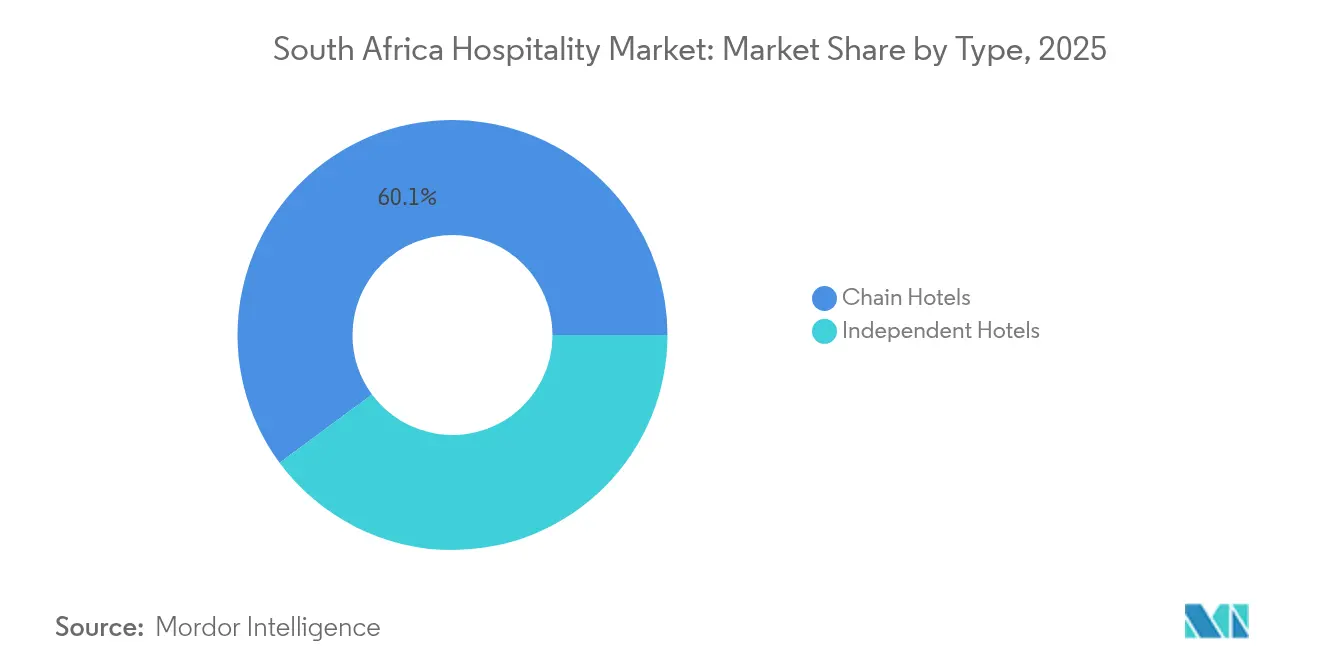
Independent properties grew revenue at 7.52% CAGR between 2026 and 2031 as travelers favored localized design and personalized service. Chain hotels still command 60.12% of the South Africa hospitality market share because loyalty programs and standardized quality appeal to corporate travelers. Independent operators deploy asset-light digital marketing, social-media storytelling, and partnerships with local artisans, which resonate with visitors seeking cultural immersion. Investors view boutiques favorably for above-average RevPAR potential, but procurement and distribution efficiencies remain challenges. Chain brands counter by launching soft-brand collections that promise uniqueness with back-office scale, intensifying competition for experiential demand.
Second-tier cities with heritage landmarks have become testing grounds where independents match hotel conversions to historic buildings, adding authenticity without brand constraints. Luxury chains rely on global reservation systems, yet their uniform standards can alienate guests craving local flavor. The South Africa hospitality market benefits from this diversity because mid-priced, culturally embedded independents fill the gap between economy chains and high-end resorts.

By Accommodation Class: Service Apartments Lead Extended-Stay Upswing
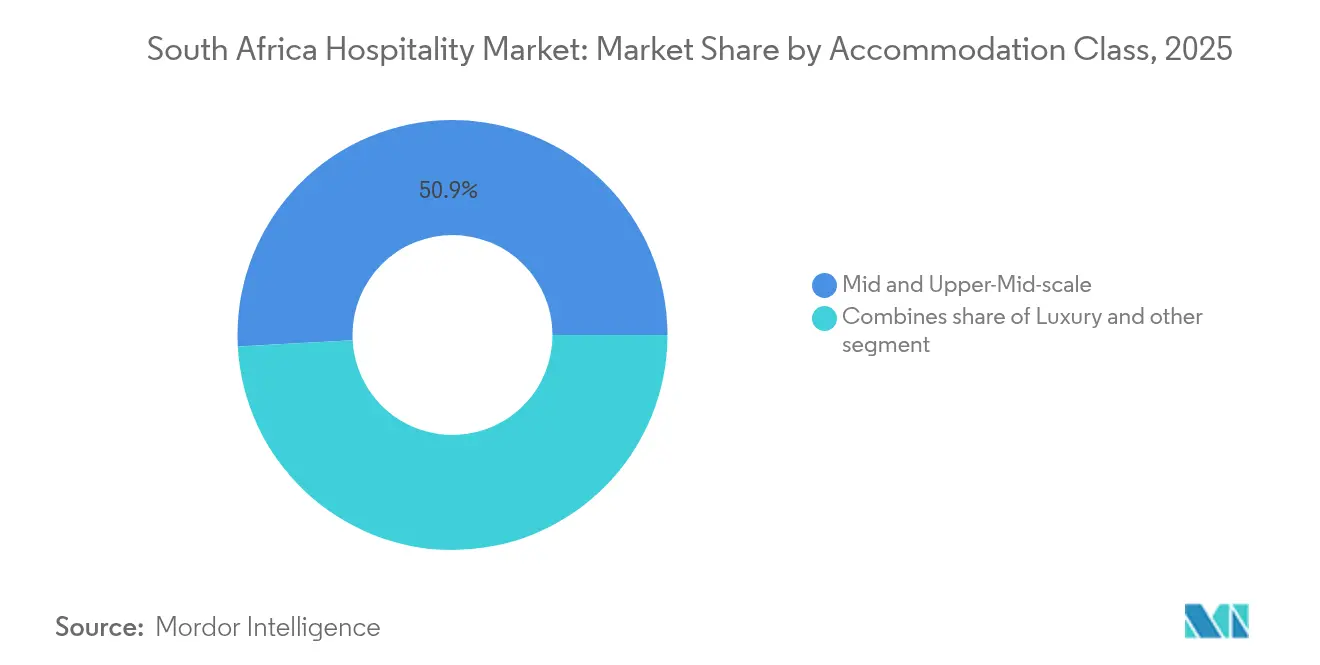
Mid and upper-mid-scale properties provided 50.85% of South Africa hospitality market size in 2025, reflecting balanced value and comfort. Service apartments, however, are expanding at 11.1% CAGR through 2031 as corporate relocations, digital nomads, and long-stay families seek kitchens, workspace, and laundry facilities. Spier Hotel’s 50 luxury serviced units and Steyn City’s 50 extended-stay apartments highlight premium positioning opportunities.
Service-apartment operators bundle housekeeping with flexible lease terms, blurring lines with traditional hotels. Luxury suites retain higher daily rates buoyed by international tourism rebound, while budget hotels contend with Airbnb’s cost-advantage. Green building certifications and energy-efficient appliances tilt preference toward newly built extended-stay assets that promise lower utility bills amid power constraints.
By Booking Channel: Direct Digital Gains Momentum
Online travel agencies controlled 45.70% of South Africa's hospitality market size in 2025, yet direct digital bookings are rising at a 12.05% CAGR. Mobile-first websites, metasearch advertising, and member-only rate guarantees encourage guests to bypass OTAs. Policy changes in large online marketplaces now permit hotels to undercut OTA prices, boosting conversion on brand channels.
Corporate travel managers adopt API-enabled direct contracts that reduce transaction fees, particularly for high-volume MICE itineraries. Independent properties gain pricing control but must invest in search-engine optimization and payment-gateway security to match OTA reach. Wholesale and traditional agents continue to serve group-tour markets, though their share is shrinking as digital adoption deepens.
Geography Analysis
In the South African hospitality market, Gauteng is the largest geographic sub-segment in 2025, accounting for 29.95% of the market share, while the Western Cape is projected to be the fastest-growing sub-segment from 2026 to 2031, with a CAGR of 7.05%. Gauteng maintains leadership in value terms because Johannesburg supplies steady corporate traffic from finance, mining, and ICT sectors, and international conferences cluster around the Sandton Convention Centre. In 2025 the province will host 18 world-class exhibitions, raising mid-week occupancy and average daily rates. Power-grid instability, however, raises generator expenses and pressures operating margins.
Western Cape’s 71% Airbnb occupancy and 20.12% RevPAR jump showcase varied demand streams ranging from wine tourism to adventure sports. Consistent international airlift into Cape Town International Airport and municipal investment in public-transport safety underpin sustained visibility. The province’s adoption of desalination and recycled-water schemes eases drought risk, though tariffs are creeping upward. KwaZulu-Natal’s USD 108.1 million (ZAR2 billion) Club Med Tinley resort illustrates the scale of coastal resort potential outside primary gateways. Eastern Cape’s Big-Seven wildlife reserves and cultural heritage routes offer differentiation but require road upgrades and safety marketing. Northern Cape’s dark-sky reserves anchor niche astro-tourism, yet accommodation density remains thin, presenting ground-floor opportunities for eco-lodges.
Competitive Landscape
South Africa’s hotel industry is characterized by moderate market concentration, with the five largest groups providing the majority of available rooms. Leading brands benefit from extensive footprints and strong local networks, giving them considerable influence over pricing, distribution, and operational standards. Despite this consolidation, there remains room for independent and niche operators to thrive by offering personalized services, unique experiences, or strategic locations. International hotel groups expand primarily through franchise and management agreements, reducing capital risk while accelerating growth. Ambitious expansion targets include plans for significant increases in hotel numbers and room capacity by 2030.
Domestic players capitalize on local market knowledge and vertically integrated food-and-beverage supply chains to maintain cost advantages. Strong financial results, such as one major operator’s USD 83.5 million profit after tax in 2024, demonstrate resilient demand even amid rising utility costs. Alternative accommodation platforms are gaining popularity, particularly among budget travelers, though regulatory and safety considerations temper their rapid growth. Technology investment is a key differentiator, with AI-driven revenue management and guest experience applications helping to improve bookings and customer loyalty. Properties ensuring consistent power and water supply command higher average daily rates, driving increased investment in sustainable infrastructure like solar microgrids and water treatment systems.
The extended-stay segment shows significant growth potential, currently undersupplied despite a robust compound annual growth rate of over 11%. This signals opportunities for specialized operators to enter and expand within the market. Overall, the South African hospitality landscape balances consolidation among major groups with evolving niches and technological innovation. Sustainable and reliable infrastructure investments are becoming critical factors in competitive positioning. As demand continues to recover and evolve, both international and local players are adapting strategies to capture emerging opportunities across market segments.
South Africa Hospitality Industry Leaders
-
Marriott International (Protea Hotels)
-
Tsogo Sun Hotels
-
Southern Sun
-
City Lodge Hotel Group
-
Sun International
- *Disclaimer: Major Players sorted in no particular order
Recent Industry Developments
- March 2025: Marriott International confirmed openings of Morea House Autograph Collection (Camps Bay) and Lord Charles Hotel Tribute Portfolio (Somerset West), strengthening its luxury footprint.
- February 2025: Hyatt scheduled Park Hyatt Johannesburg for Q2 2025, marking brand re-entry to South Africa.
- December 2024: Radisson Collection Hotel Waterfront Cape Town opened with 175 ocean-view rooms.
- October 2024: Steyn City launched a 50-unit luxury serviced-apartment hotel operated by Saxon Hotel.
South Africa Hospitality Market Report Scope
South Africa is geopolitically unique, with natural and cultural diversity that supports a globally compelling tourism proposition. The country has a sizable tourism industry and is one of the world's most popular long-distance destinations. The market is segmented by Type (Chain Hotels and Independent Hotels) and Segment (Service Apartments, Budget and Economy Hotels, Mid and Upper Mid Scale Hotels, and Luxury Hotels). The report also covers a complete background analysis of the hospitality industry in the South African market, including the assessment of the economy and the contribution of the sectors in the economy, a market overview of key segments and emerging trends in the market segments, market dynamics, insights, and key statistics. The report offers market size and forecasts for Hospitality Industry in South Africa in value (USD million) for all the above segments.
By Type
| Chain Hotels |
| Independent Hotels |
By Accommodation Class
| Luxury |
| Mid & Upper-Mid-scale |
| Budget & Economy |
| Service Apartments |
By Booking Channel
| Direct Digital |
| OTAs |
| Corporate / MICE |
| Wholesale & Traditional Agents |
By Geographic Region
| Gauteng |
| Western Cape |
| KwaZulu-Natal |
| Eastern Cape |
| Free State |
| North West |
| Limpopo |
| Mpumalanga |
| Northern Cape |
| By Type | Chain Hotels |
| Independent Hotels | |
| By Accommodation Class | Luxury |
| Mid & Upper-Mid-scale | |
| Budget & Economy | |
| Service Apartments | |
| By Booking Channel | Direct Digital |
| OTAs | |
| Corporate / MICE | |
| Wholesale & Traditional Agents | |
| By Geographic Region | Gauteng |
| Western Cape | |
| KwaZulu-Natal | |
| Eastern Cape | |
| Free State | |
| North West | |
| Limpopo | |
| Mpumalanga | |
| Northern Cape |
Key Questions Answered in the Report
What is the current value of South Africa’s hospitality sector?
The South Africa hospitality industry market size is USD 12.19 billion in 2026.
How fast is the sector expected to grow?
The sector is forecast to expand at a 6.05% CAGR, reaching USD 16.34 billion by 2031.
Which province is growing quickest for hotel revenues?
Western Cape leads regional growth with a projected 7.05% CAGR through 2031.
Which accommodation class shows the strongest upside?
Service apartments are the fastest-growing segment, advancing at 11.1% CAGR.
How serious is load-shedding for hotel operators?
Stage-6 power cuts add fuel costs exceeding ZAR 100 million monthly for large chains, reducing margins and accelerating green retrofits.
What government policy most supports future demand?
The Remote Work Visitor Visa aims to inject ZAR 70 billion into local economies by attracting long-stay digital nomads.