
Market Overview
| Study Period | 2020 - 2031 |
|---|---|
| Forecast Data Period | 2026 - 2031 |
| Base Year Market Size (2025) | USD 87.79 Billion |
| Market Size (2026) | USD 91.49 Billion |
| Market Size (2031) | USD 112.44 Billion |
| Growth Rate (2026 - 2031) | 4.21 % |
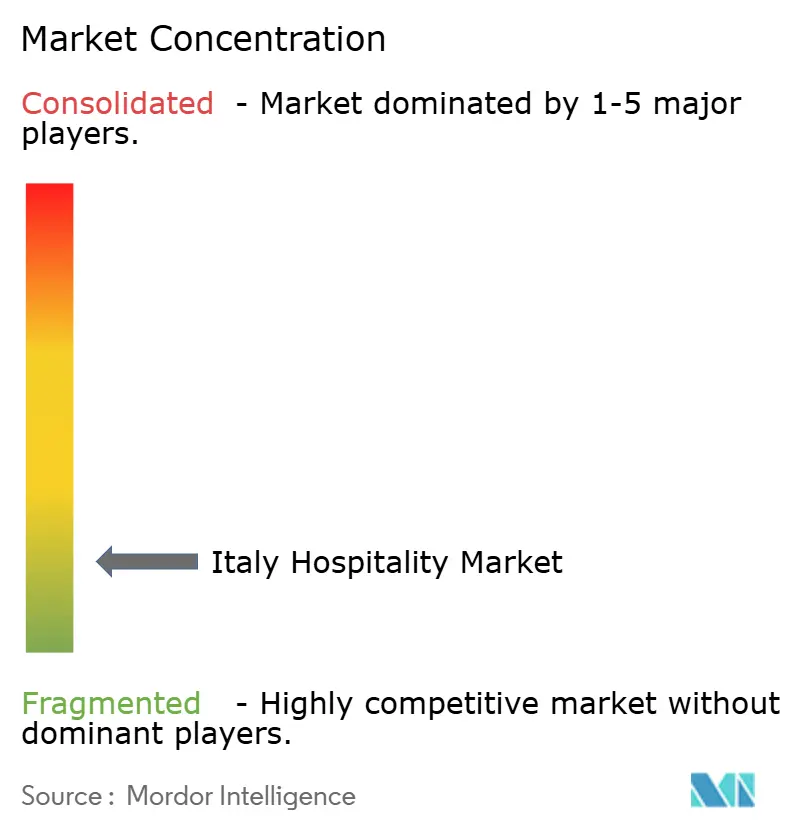
| Market Concentration | Low |
Major Players *Disclaimer: Major Players sorted in no particular order Image © Mordor Intelligence. Reuse requires attribution under CC BY 4.0. | |
Italy Hospitality Market Analysis by Mordor Intelligence
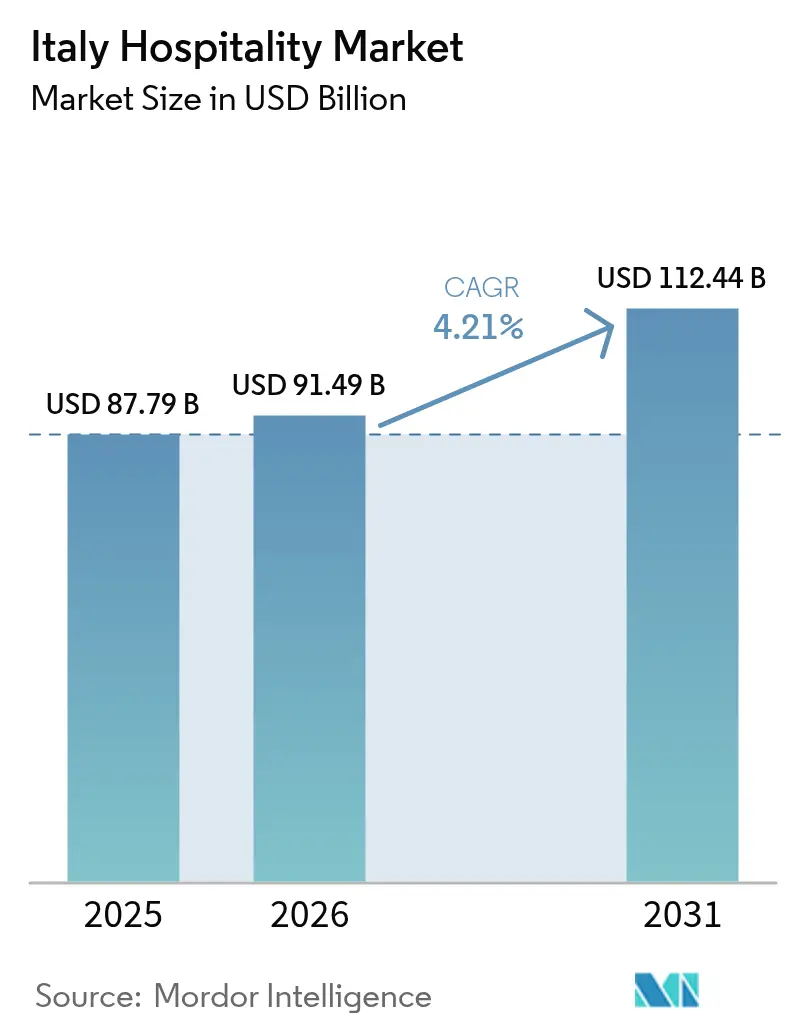
Italy Hospitality Market size in 2026 is estimated at USD 91.49 billion, growing from 2025 value of USD 87.79 billion with 2031 projections showing USD 112.44 billion, growing at 4.21% CAGR over 2026-2031.
Demand momentum flows from three intertwined factors: heritage tourism tied to Rome’s Jubilee 2025, visitor inflows projected for the Milan–Cortina Winter Olympics 2026, and the steady expansion of branded hotel supply that professionalizes a highly fragmented landscape. Large-scale tax credits under the Superbonus Turismo scheme accelerate asset refurbishment, giving independent operators a path to energy-efficient upgrades that hedge against volatile utility costs[1]. Meanwhile, digital distribution reshapes customer acquisition; direct channels still generate half of all room revenue, yet online travel agencies (OTAs) are expanding at 9.81% CAGR as travelers favor mobile search, instant price comparison, and frictionless booking[2]. Labor shortages remain a pressing concern: unfilled hospitality positions tripled between 2019 and 2024, pushing payroll above 33% of revenue in many city-center properties. Finally, mandatory ESG reporting under Legislative Decree 125/2024 forces hotels, especially heritage buildings, to invest in metering, renewable energy, and transparent disclosures that add short-term cost but unlock green-finance opportunities.
Key Report Takeaways
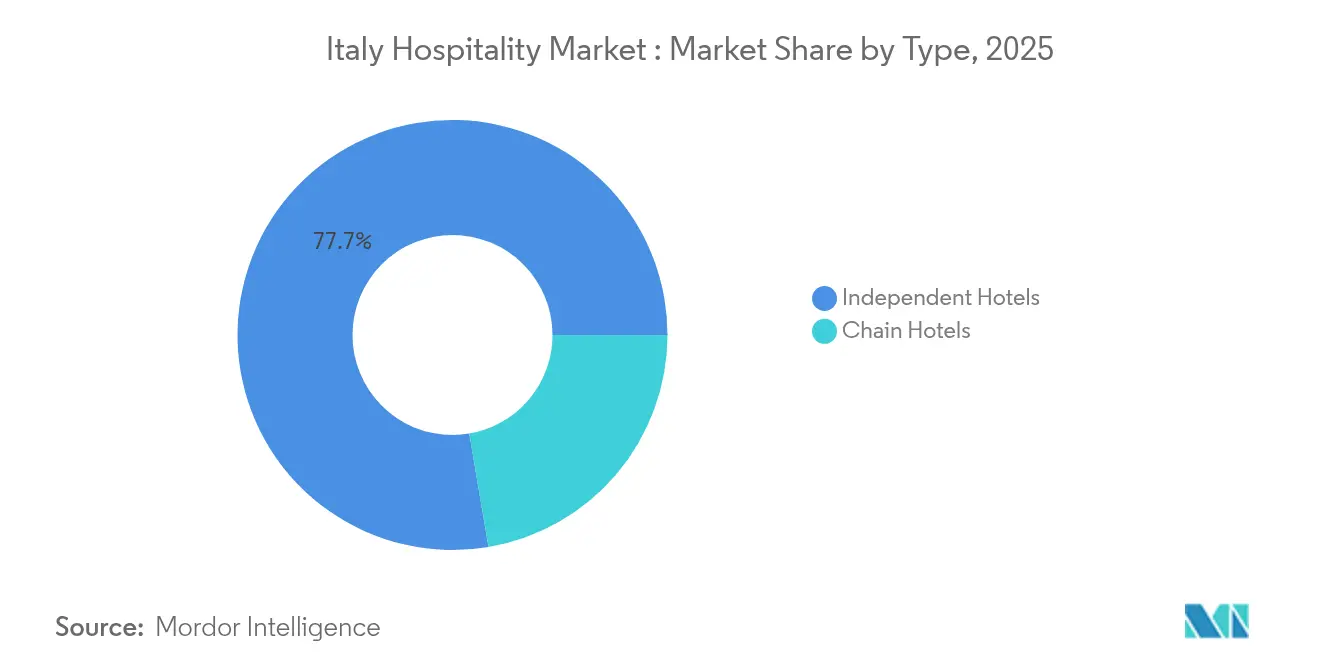
- By type, independent hotels held 77.68% of Italy hospitality market share in 2025, while chain hotels are advancing at a 7.14% CAGR through 2031.
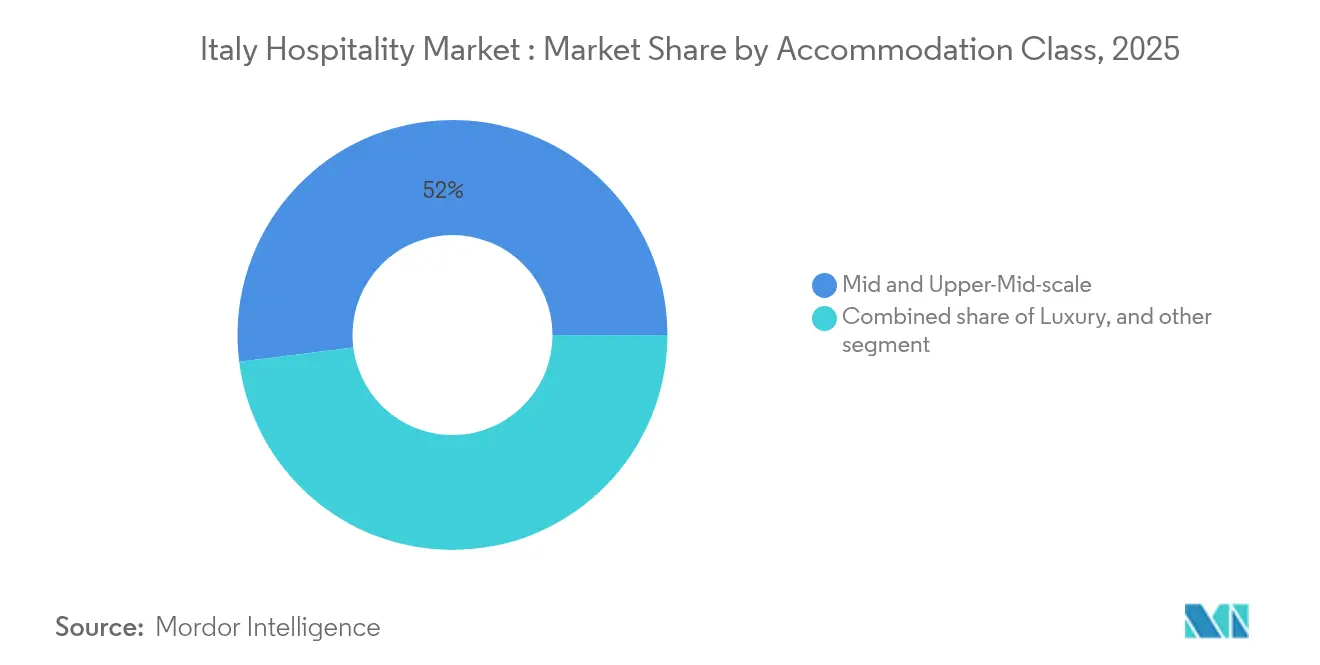
- By accommodation class, the mid & upper-mid segment led with 51.98% of Italy hospitality market share in 2025; luxury properties are set to expand at a 8.98% CAGR to 2031.
- By booking channel, direct bookings captured 49.88% of Italy hospitality market share in 2025, whereas digital OTAs are growing at a 9.73% CAGR to 2031.
- By geography, Northwest Italy commanded 26.14% of Italy hospitality industry share in 2025; the Islands region is projected to grow at a 6.90% CAGR through 2031.
Note: Market size and forecast figures in this report are generated using Mordor Intelligence’s proprietary estimation framework, updated with the latest available data and insights as of 2026.
Market Trends and Insights
Drivers Impact Analysis of Italy Hospitality Market*
| Driver | (~) % Impact on CAGR Forecast | Geographic Relevance | Impact Timeline |
|---|---|---|---|
| Fashion Capital Tourism Supporting Milan Hospitality Demand | 0.90% | Milan Luxury Hotel Districts | Short term (≤ 2 years) |
| Wine Region Tourism Creating Rural Accommodation Opportunities | 0.70% | Wine & Agritourism Regions | Medium term (2–4 years) |
| Cruise Gateway Cities Supporting Coastal Hotel Demand | 0.80% | Cruise Port Hospitality Hubs | Short term (≤ 2 years) |
| Historic Property Conversion Driving Boutique Hotel Growth | 0.60% | Historic Property Conversions | Long term (≥ 4 years) |
| Agritourism Expansion Across Rural Italy | 0.50% | Rural Farm Stay Corridors | Medium term (2–4 years) |
| Art and Festival Tourism Supporting Seasonal Demand | 0.60% | Cultural Event Tourism Destinations | Medium term (2–4 years) |
| Source: Mordor Intelligence | |||
Fashion Capital Tourism Supporting Milan Hospitality Demand
Milan’s status as a global fashion capital continues to drive strong hotel demand, with September 2025 Fashion Week expected to deliver 91.4% occupancy, ADR of EUR 394.60 (USD 464.18), and RevPAR of EUR 360.68 (USD 424.30) on its peak day. The event is projected to generate EUR 238.9 million (USD 281.02 million) in tourism revenue from over 149,300 visitors, with 39% (EUR 93 million (USD 109.40 million)) spent on accommodation and catering. Across both 2025 Fashion Weeks, visitor spending is expected to reach EUR 423.6 million (USD 498.29 million), driven by nearly 262,000 visitors. Momentum is set to continue in 2026, with the February Fashion Week expected to attract 132,200+ visitors and generate EUR 217.4 million (USD 255.73 million) in spending, including EUR 84.8 million (USD 99.77 million) on accommodation and catering, supporting premium hotel occupancy, higher room rates, and continued investment in Milan’s luxury hospitality sector.
Wine Region Tourism Creating Rural Accommodation Opportunities
Italy's wine tourism sector is becoming a major driver of demand for rural and peri-urban hospitality. In 2025, it is projected to generate EUR 3.1 billion (USD 3.65 billion) in winery turnover, contributing 21% of average winery revenue and up to 35% for smaller wineries. Structured wineries are expected to see 16.8% annual visitor growth and 21.4% higher direct sales, while the average wine tourism booking value will reach EUR 39.40 (USD 46.36) per adult, growing at an 11% CAGR over the past four years. Visitor growth between 2019 and 2024 reached 39% in Brunello di Montalcino, 33% in Vino Nobile di Montepulciano, 27.9% in Collio, 26.5% in Conegliano Valdobbiadene, and 17.45% in Etna DOC. By 2026, around 18 million Italians are expected to participate in wine tourism, up 4.5 million from 2024, while winery visitation among Italian tourists is projected to increase from 60% (2021) to 77% (2025). The expansion of wine tourism is directly boosting accommodation demand, with visitors spending an average of EUR 145 (USD 170.56) per trip on accommodation, the largest expense category, ahead of wine purchases (EUR 123), harvest experiences (EUR 54 (USD 63.52)), and tastings (EUR 41 (USD 48.23)). International tourists from Germany, the United States, the Netherlands, Switzerland, and the United Kingdom account for 42% of wine tourists, with American visitors spending up to EUR 300 (USD 352.89) per overnight stay. As a result, rural hotels, agriturismo properties, boutique relais, and B&Bs in wine regions are key beneficiaries, with wine and food tourism already generating around 6 million overnight stays in areas near production.
Cruise Gateway Cities Supporting Coastal Hotel Demand
Italy's position as Europe's leading cruise destination is driving strong hotel demand in coastal gateway cities, particularly for pre- and post-cruise stays. In 2025, Italian ports are expected to handle a record 14.74 million passengers across 5,690+ cruise calls, with 4.8 million homeport passengers generating sustained overnight hotel demand. Civitavecchia alone is projected to welcome 3.56 million passengers, while eight Italian ports account for over 11 million passengers and 38% of Mediterranean cruise traffic. Growth is expected to continue in 2026, with 15.31 million passengers and nearly 5,970 cruise calls, supported by EUR 190 million (USD 223.50 million) in investments across eight new cruise terminals by 2028[3]. The expanding luxury cruise segment is further boosting demand for premium hotels and hospitality services in cruise-adjacent markets.
Historic Property Conversion Driving Boutique Hotel Growth
The adaptive reuse of Italy’s historic buildings is emerging as a major supply-side growth driver for the boutique and luxury hotel market. In H1 2026, hotel acquisitions reached EUR 370 million (USD 435.23 million), with approximately two-thirds (EUR 200 million (USD 235.26 million)) allocated to redevelopment and conversion projects, reflecting strong investor interest in heritage assets[4]. International capital is increasingly targeting destinations beyond major cities, including Lake Como, Sicily, Puglia, and Piedmont. At the same time, notable projects such as Orient Express Venezia (47 rooms), Vista Ostuni (28 suites), and Borgo Monchiero (25 rooms) demonstrate the scale of conversions from historic palazzos, convents, and monasteries into luxury hotels. Backed by heritage restoration incentives and rising demand for authentic, experience-led stays, these projects are expanding premium hotel supply, supporting higher ADRs, and driving investment across Italy’s upper-upscale and luxury hospitality segments.
Restraints Impact Analysis of Italy Hospitality Market*
| Restraint | (~) % Impact on CAGR Forecast | Geographic Relevance | Impact Timeline |
|---|---|---|---|
| High Tourism Concentration in Iconic Cities Creates Capacity and Sustainability Challenges | −0.8% | Overtourism in Iconic Destinations | Short term (≤ 2 years) |
| Fragmented Ownership Structure Limits Operational Scalability | −0.6% | Fragmented Family-Owned Hotel Markets | Long term (≥ 4 years) |
| Limited Digital Adoption Among Independent Hospitality Operators | −0.5% | Limited Digital Adoption in Rural Areas | Medium term (2–4 years) |
| Labor Availability and Seasonal Workforce Challenges Affect Service Quality | −0.6% | Seasonal Workforce Shortages | Medium term (2–4 years) |
| Source: Mordor Intelligence | |||
High Tourism Concentration in Iconic Cities Creates Capacity and Sustainability Challenges
Italy's tourism demand remains highly concentrated, with 70% of visitors concentrated in just 1% of destinations, including Rome, Venice, Florence, Capri, Positano, and Cinque Terre. Tourist arrivals grew 13.14% in 2025 over 2024, intensifying pressure on infrastructure and prompting stricter overtourism measures such as Venice's EUR 5–10 (USD 5.88–11.76) entry fee, with proposals of up to EUR 50 (USD 58.82) on peak days. Regulations also include QR-based crowd monitoring, timed-entry systems, and fines of up to EUR 500 (USD 588.16). These regulations, along with limits on new hotel development and stricter short-term rental rules, increase compliance costs, constrain accommodation supply, and limit the hospitality sector's ability to capitalize on peak tourism demand fully.
Fragmented Ownership Structure Limits Operational Scalability
Italy's hotel sector remains highly fragmented, with over 60% of 3- and 4-star hotels independently or family-owned and around 80% of tourism businesses operating as single-unit enterprises, limiting access to capital, technology, and operational efficiencies. This fragmentation weakens investment capacity, revenue management, and brand competitiveness while creating succession challenges as owners retire. Although hotel investment reached EUR 1.7 billion (USD 2.00 billion) in H1 2025 (+102% YoY), much of the capital has come from foreign investors acquiring undercapitalized independent hotels. As international operators such as Minor Hotels target expansion from 60 to 100 Italian properties by 2030, the competitive gap between branded chains and independent operators continues to widen.
*Our forecasts treat driver/restraint impacts as directional, not additive. The impact forecasts reflect baseline growth, mix effects, and variable interactions.
Italy Hospitality Market Segment Analysis
By Type:
Independent properties maintain scale advantage while chains professionalize operationsIndependent hotels held 77.68% of Italy hospitality market share in 2025, preserving numerical dominance despite steady chain expansion at 7.14% CAGR. Family-run assets thrive on local storytelling, culinary authenticity, and flexible guest interaction that repeat visitors prize. Yet, the fragmented owner base confronts rising guest expectations for omnichannel service and unified loyalty benefits. Conversion pipelines reveal that 67% of upcoming branded openings involve taking over existing independent structures, signaling owner appetite for franchise or soft-brand agreements that retain architectural character. Chains leverage centralized purchasing, robust digital-marketing budgets, and advanced revenue-management software, securing RevPAR premiums of 10-12% over comparable unbranded peers. While independent ethos will remain a hallmark of the Italy hospitality market, it is increasingly augmented by selective brand alliances that marry authenticity with global reach.

By Accommodation Class:
Mid-scale leads revenue, luxury accelerates value creationMid and upper-mid establishments represented 51.98% of aggregate revenue in 2025, capitalizing on leisure travelers who seek comfort yet remain price sensitive. These properties often operate in renovated historic structures that balance charm and modern amenities, attracting both domestic families and international tour groups. Luxury, though smaller in absolute volume, is the fastest-growing tier at 8.98% CAGR, fueled by ultra-high-net-worth demand for suite-only floors, private villa annexes, and curated cultural itineraries. Italy's hospitality market size for luxury properties exceeded EUR 9 billion (USD 9.9 billion) last year, and transaction data show investors allocating 45% of deal volume to five-star assets due to their resilient margins. Budget & economy hotels retain relevance for price-driven segments, but rising operating costs challenge profitability unless offset by ancillary revenue streams such as coworking spaces or self-service F&B kiosks. Serviced apartments, bolstered by tighter regulation of informal rentals, post double-digit growth and appeal to long-stay corporate travelers who require kitchenettes and flexible check-in.
By Booking Channel:
Direct dominance erodes as OTAs consolidate powerDirect booking channels captured 49.88% of Italy hospitality market share in 2025, a testament to repeat visitation patterns in art-city destinations. Still, OTAs’ 9.73% CAGR trajectory indicates a power shift that compresses net rates for operators unable to pivot to dynamic pricing. The Italy hospitality market size attributable to OTA sales is forecast to exceed USD 50 billion by 2030 as consumer trust in user-generated reviews, bundled itineraries, and “pay later” options deepens. Corporate/MICE channels underpin occupancy during shoulder seasons, especially in Milan’s convention district, where large-room blocks are still contracted through global travel-management companies. Wholesale and traditional agents retain niche relevance for complex multi-city tours that package rail passes and museum tickets. Hotels that deploy customer-data platforms and loyalty apps steer guests back to owned channels, saving commission expenses that can otherwise top EUR 30 (USD 33) per night.
Geography Analysis
Northwest Italy leads the country’s hospitality market in 2025 with a 26.14% share, supported by strong demand for Alpine resorts and urban gateways such as Milan and Turin. Preparations for the Winter Olympics are channeling EUR 30 million (USD 32.79 million) into modernizing lodging and enhancing smart-mobility systems to accommodate international visitors. Central Italy follows with a 25.00% share, anchored by the timeless appeal of Rome’s cultural landmarks and Tuscany’s premium wine tourism. Together, these regions create a balanced mix of business, leisure, and heritage-driven demand that keeps occupancy levels high. Investment in transport infrastructure further reinforces their competitive advantage across both domestic and foreign visitor segments.
Northeast Italy, with Venice as its flagship destination, benefits from cruise-ship traffic regulations that have shifted demand toward overnight hotel stays. The average length of stay has increased above 2.4 nights, supporting steady revenue growth for hoteliers. Secondary cities such as Verona and Trieste are also seeing rising inbound traffic due to cultural festivals and cross-border tourism flows. South Italy, while still underpenetrated, is gaining momentum from the expansion of high-speed rail links. Travel time between Bari and Naples has been reduced to under two hours, improving accessibility and stimulating short-break tourism.
The Islands of Sicily and Sardinia represent the fastest-growing sub-segment, projected to expand at a CAGR of 6.90% between 2026 and 2031. Limited upscale room supply and the arrival of marquee international brands, including a forthcoming W Hotels resort in Poltu Quatu, are expected to drive rate premiums. Enhanced air connectivity, such as the upgrade of the Salerno-Costa d’Amalfi airport, is opening new Mediterranean routes for both regional and long-haul travelers. These improvements enable more seamless itineraries combining coastal retreats, cultural exploration, and rural experiences. As a result, the Islands are positioned to capture outsized share growth and elevate Italy’s hospitality market outlook.
Competitive Landscape
Italy’s hospitality market is characterized by high fragmentation, with leading international hotel chains holding only a modest share of the total room inventory. This results in a low market concentration, signaling ample opportunities for consolidation and strategic partnerships. A growing number of family-run and independent hotels are now exploring collaborations with professional management companies to improve competitiveness. While the fragmented landscape has traditionally favored local operators, it increasingly exposes them to disadvantages in areas such as global distribution reach, advanced revenue management, and operational efficiency. To capitalize on this dynamic, global hotel chains are prioritizing conversions of existing independent properties, offering the benefits of international branding while preserving local character.
Strategically, international operators are concentrating their efforts on the luxury and upscale segments, where strong brand equity supports higher management fees and capital investment. In contrast, domestic chains leverage their deep understanding of local markets and heritage-driven positioning to compete in boutique and resort categories. The role of technology is becoming central to competition, with independents investing in tools like revenue optimization systems, CRM platforms, and digital marketing to narrow the performance gap with larger chains. These innovations are critical in enhancing guest experience, driving direct bookings, and maintaining rate integrity. The push toward digital transformation is reshaping how hotels operate and engage with both domestic and international travelers.
White-space growth opportunities are emerging in secondary cities and underdeveloped luxury destinations where international brands remain underrepresented. Additionally, the serviced apartment segment is seeing increased demand due to tighter regulations on short-term rentals, pushing travelers toward professionally managed accommodations. Italy's evolving regulatory landscape, including the implementation of the Digital Markets Act and Corporate Sustainability Reporting Directive, is helping to level the playing field for independent operators. These changes encourage greater transparency, sustainability, and competitive fairness across the industry. As consolidation accelerates and technology adoption rises, Italy’s hospitality market is entering a new phase marked by modernization, strategic alignment, and cross-segment innovation.
Italy Hospitality Industry Leaders
-
Marriott International
-
Accor SA
-
Best Western Hotels & Resorts
-
NH Hotel Group
-
Hilton Worldwide
- *Disclaimer: Major Players sorted in no particular order
Italy Hospitality Market Companies Covered in this Report
- Marriott International
- Accor SA
- Best Western Hotels & Resorts
- NH Hotel Group
- Hilton Worldwide
- B&B Hotels
- Starhotels SpA
- Gruppo UNA
- TH Resorts
- VOIhotels
- ITI Hotels Group
- Meliá Hotels International
- Radisson Hotel Group
- IHG Hotels & Resorts
- Minor Hotels
- Four Seasons Hotels & Resorts
- Rocco Forte Hotels
- Baglioni Hotels & Resorts
- Belmond Ltd.
- Rosewood Hotels & Resorts
- JdV by Hyatt
- CitizenM Hotels
Recent Industry Developments in Italy Hospitality Market
- May 2025: Una Group unveiled a 176-room high-rise project near Milan’s convention center slated for mid-2026 opening.
- April 2025: Starhotels purchased the Hermitage Hotel & Resort in Forte dei Marmi, marking its inaugural resort entry with 59 rooms and expansive parkland.
- March 2025: Castello SGR acquired Sardinia’s Grand Hotel Poltu Quatu for EUR 70 million (USD 76.5 million), planning redevelopment under Marriott’s W Hotels label.
- January 2025: EY Italy reported that hotel transactions reached EUR 2.1 billion (USD 2.31 billion), a 30% annual jump, with five-star assets capturing 45% of volume.
Italy Hospitality Market Report Scope
The hospitality industry encompasses various services, including lodging, food and beverages, event management, theme parks, and travel. It also includes multiple establishments, such as hotels, tourism agencies, restaurants, and bars. A complete background analysis of the hospitality industry in Italy includes an assessment of industry associations, the overall economy, and emerging market trends by segment. Significant changes in the market dynamics and market overview are also covered in the report.
The hospitality industry in Italy is segmented by type and segment. By type, the market is segmented into chain hotels and independent hotels. By segment, the market is divided into service apartments, budget and economy hotels, mid- and upper-middle-scale hotels, and luxury hotels. The report offers market sizes and forecasts in value (USD) for all the above segments.
Segmentation Overview
By Type
| Chain Hotels |
| Independent Hotels |
By Accommodation Class
| Luxury |
| Mid & Upper-Mid-scale |
| Budget & Economy |
| Service Apartments |
By Booking Channel
| Direct |
| Digital OTAs |
| Corporate / MICE |
| Wholesale & Traditional Agents |
By Geographic Region
| Northwest Italy |
| Northeast Italy |
| Central Italy |
| South Italy |
| Islands |
| By Type | Chain Hotels |
| Independent Hotels | |
| By Accommodation Class | Luxury |
| Mid & Upper-Mid-scale | |
| Budget & Economy | |
| Service Apartments | |
| By Booking Channel | Direct |
| Digital OTAs | |
| Corporate / MICE | |
| Wholesale & Traditional Agents | |
| By Geographic Region | Northwest Italy |
| Northeast Italy | |
| Central Italy | |
| South Italy | |
| Islands |
Key Questions Answered in the Report
How large is the Italy hospitality market in 2026?
The Italy hospitality market size stands at USD 91.49 billion in 2026 and is forecast to grow at a 4.21% CAGR through 2031.
Which region currently leads revenue?
Northwest Italy captures 26.14% of national revenue in 2025, supported by Milan’s corporate demand and Lake Como’s luxury appeal.
What segment is expanding fastest?
Luxury hotels exhibit the highest growth with a 8.98% CAGR, buoyed by Jubilee 2025 and Winter Olympics-linked premium demand.
How are booking habits changing?
Digital OTAs are growing at 9.73% CAGR and are on track to control 84.00% of hotel revenue by 2030 as travelers favor mobile, comparison-rich platforms.
Why are international hotel chains accelerating in Italy?
Owners pursue brand affiliation for global distribution and professional management, driving chain penetration toward 22.00% of rooms by 2029.
What policy helps hotels finance renovations?
The Superbonus Turismo program offers up to 80% tax credits and supplemental grants for energy efficiency, seismic safety, and digital upgrades.