
Hospital Privacy Screens Market Size and Share
Market Overview
| Study Period | 2021 - 2032 |
|---|---|
| Market Size (2027) | USD 20.59 Billion |
| Market Size (2032) | USD 33.70 Billion |
| Growth Rate (2026 - 2032) | 10.36 % |
| Fastest Growing Market | Asia-Pacific |
| Largest Market | North America |
| Market Concentration | Low |
Major Players *Disclaimer: Major Players sorted in no particular order Image © Mordor Intelligence. Reuse requires attribution under CC BY 4.0. | |
Hospital Privacy Screens Market Analysis by Mordor Intelligence
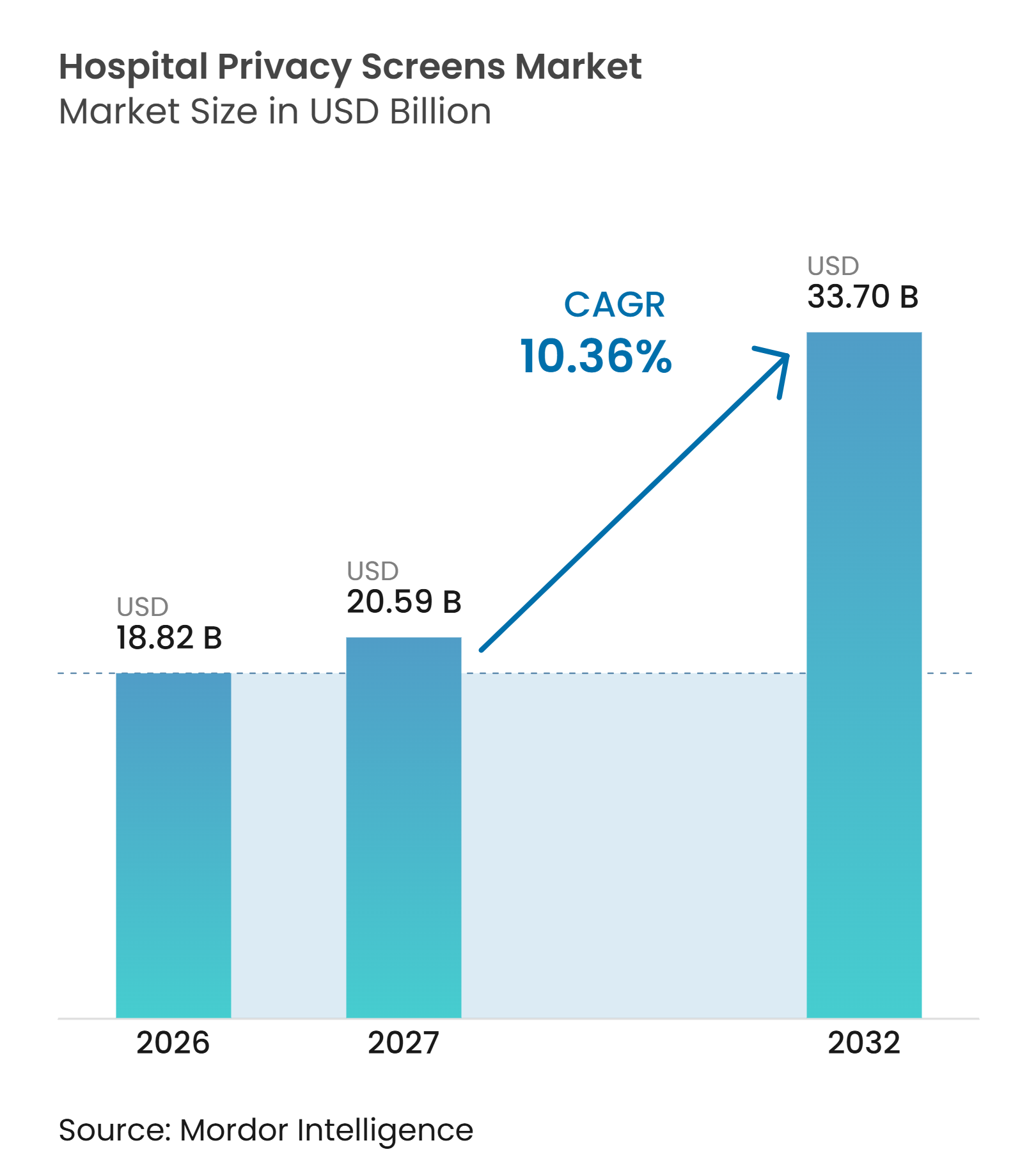
The Hospital Privacy Screens Market size was valued at USD 18.82 billion in 2026 and is estimated to grow from USD 20.59 billion in 2027 to reach USD 33.70 billion by 2032, at a CAGR of 10.36% during the forecast period (2027-2032).
Tighter expectations for patient privacy, new hospital capacity, and greater attention to infection prevention in shared care environments support growth. Hospitals are replacing some textile curtains with wipeable panels that can be moved, cleaned, and reused across changing care spaces. This shift gives suppliers an opportunity to compete on lifecycle value, infection-control performance, and installation flexibility rather than purchase price alone. Demand also rises when providers prepare overflow areas and outpatient facilities for higher patient volumes. The hospital privacy screens market is therefore moving toward products that support both routine care and surge operations.
Key Report Takeaways
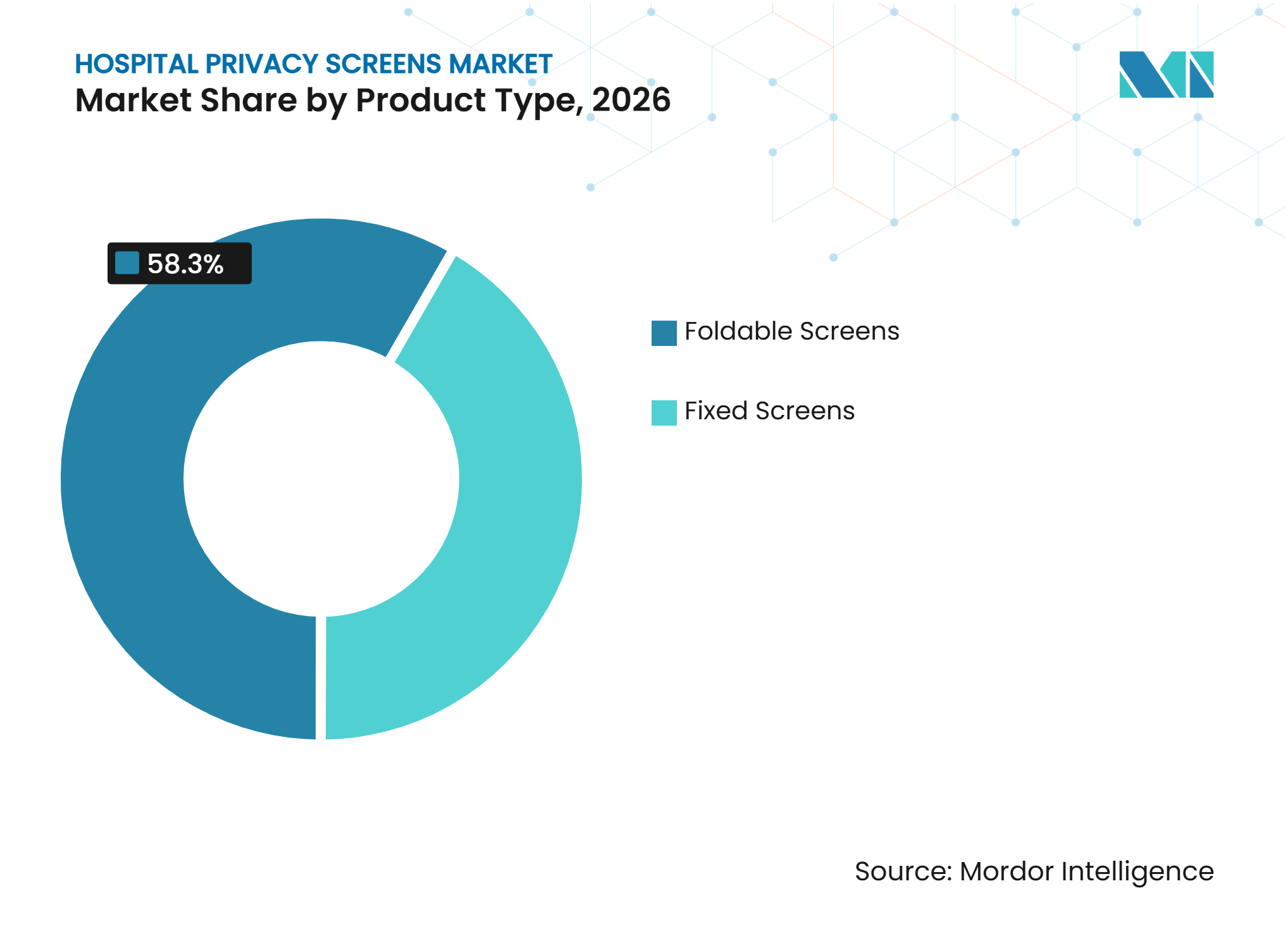
- By product type, foldable screens held 58.34% of hospital privacy screens market share in 2026 and are forecast to grow at a 10.92% CAGR through 2032.
- By form factor, solid-panel screens held 28.76% share in 2026, while hybrid screen-curtain systems are forecast to grow at a 13.24% CAGR through 2032.
- By mobility, mobile screens held a 46.83% share in 2026 and are forecast to grow at an 11.86% CAGR through 2032.
- By mounting, freestanding screens held a 34.91% share in 2026, while ceiling- or track-mounted systems are forecast to grow at a 12.58% CAGR through 2032.
- By material, polyester and fabric held a 31.48% share in 2026, while polycarbonate and transparent polymers are forecast to grow at a 13.05% CAGR through 2032.
- By application, inpatient wards and patient bays held a 24.67% share in 2026, while overflow, vaccination, and temporary care areas are forecast to grow at a 14.22% CAGR through 2032.
- By end user, hospitals held a 57.12% share in 2026, while ambulatory surgical centers are forecast to grow at a 12.37% CAGR through 2032.
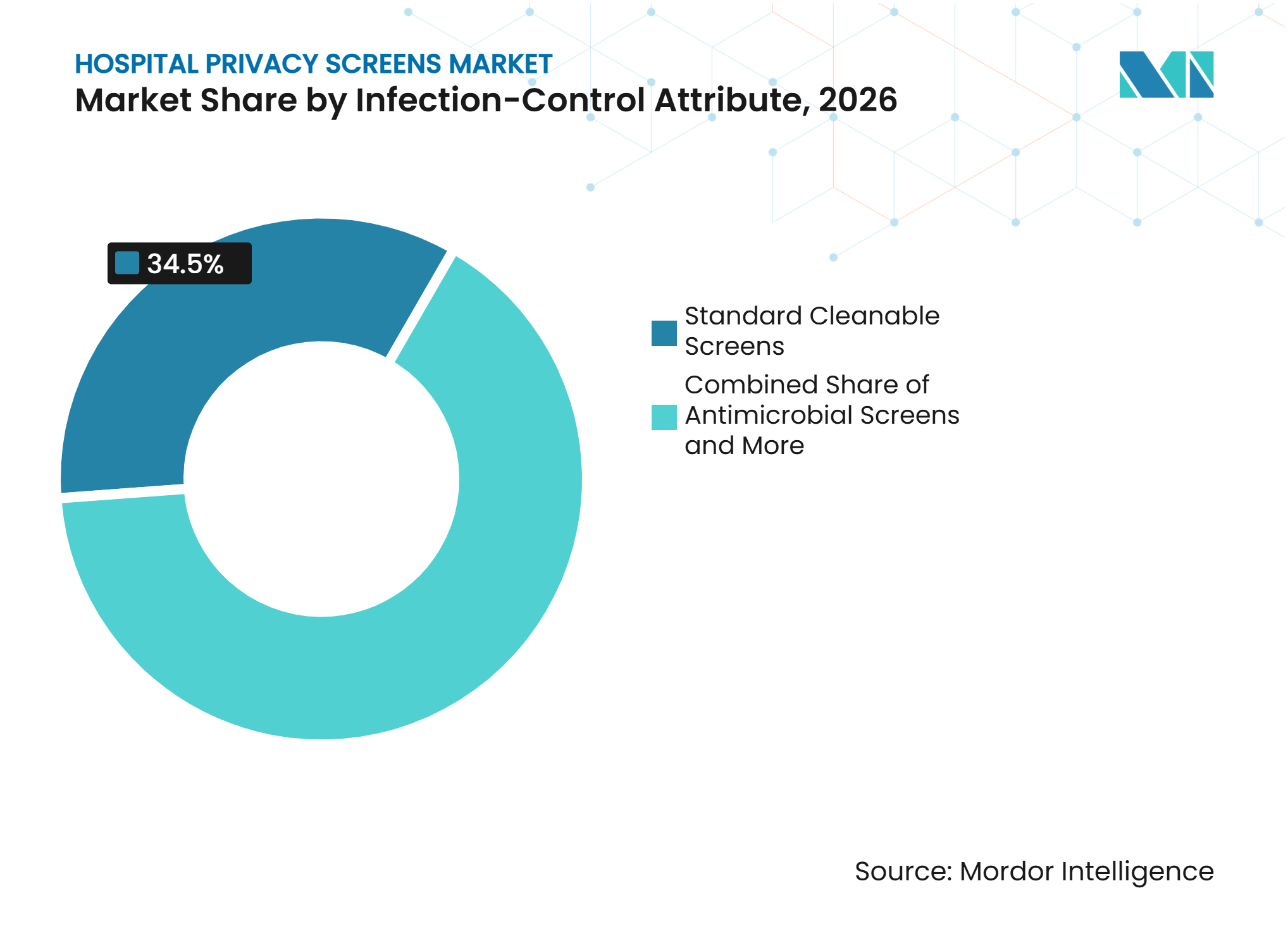
- By infection-control attribute, standard cleanable screens held a 34.53% share in 2026, while antimicrobial screens are forecast to grow at a 14.48% CAGR through 2032.
- By distribution channel, direct sales and contract procurement held a 45.72% share in 2026, while online medical-supply stores are forecast to grow at a 15.36% CAGR through 2032.
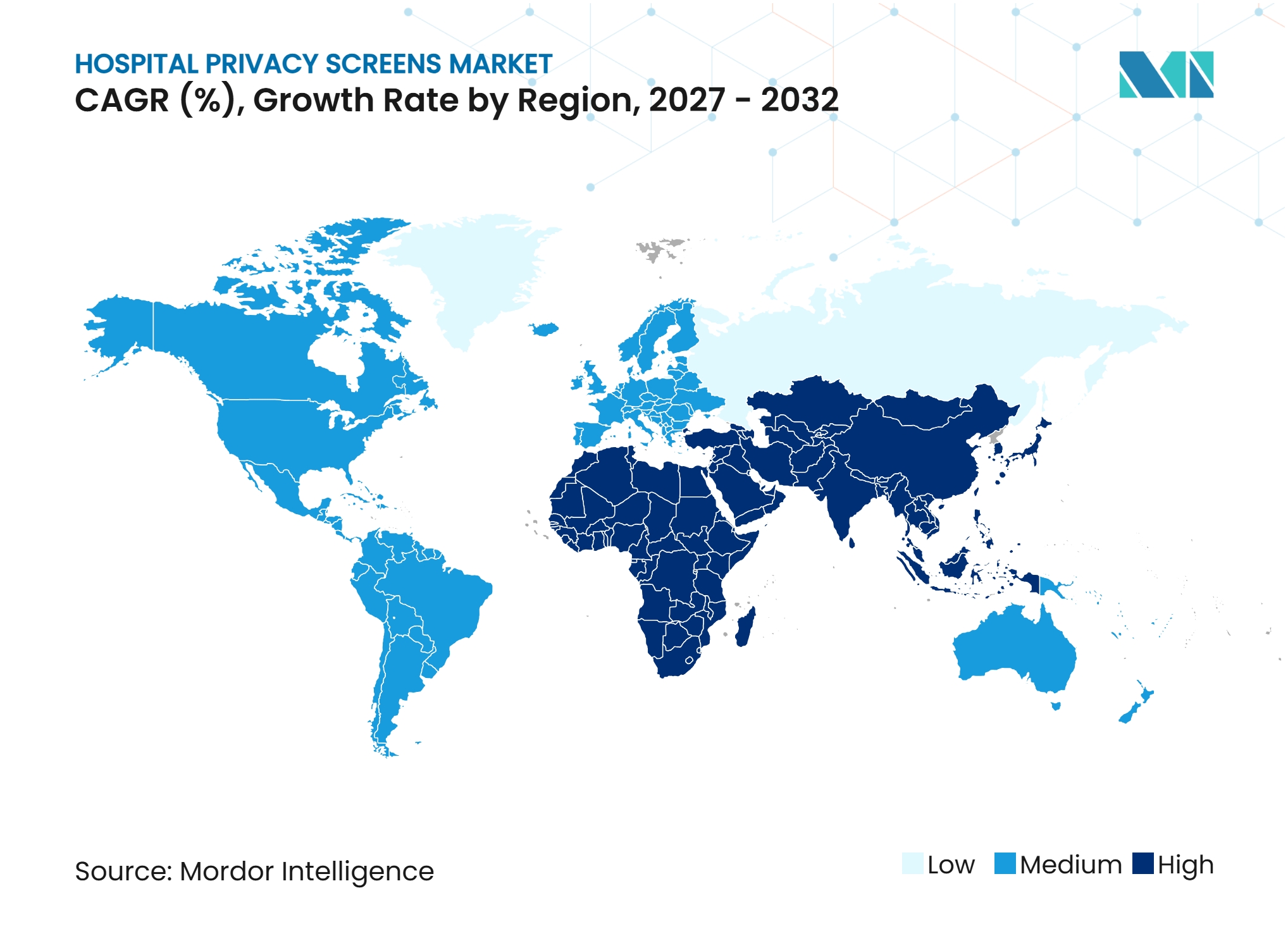
- By region, North America held a 37.84% share in 2026, and the Asia-Pacific region is expected to grow at a CAGR of 13.18% during the forecast period.
Note: Market numbers in this report are based on Mordor Intelligence's proprietary estimation framework, which combines nine months of actuals with Q4 projections for base year 2026.
Market Trends and Insights
Drivers Impact Analysis of Hospital Privacy Screens Market of Hospital Privacy Screens Market*
| Driver | (~) % Impact on CAGR Forecast | Geographic Relevance | Impact Timeline |
|---|---|---|---|
| Patient Privacy and Dignity Requirements | +2.5% | Global | Short term (≤ 2 years) |
| Hospital Capacity Expansion and Shared-Ward Use | +2.8% | APAC core, spillover to MEA and South America | Medium term (2-4 years) |
| Infection-Control Demand for Cleanable Non-Porous Screens | +2.2% | Global | Short term (≤ 2 years) |
| Rapid Deployment in Emergency and Overflow Care | +1.4% | North America and Europe | Short term (≤ 2 years) |
| Modular Space Conversion for Flexible Care | +1.0% | North America and Europe | Medium term (2-4 years) |
| Sustainability-Led Replacement of Laundering-Intensive Curtains | +0.9% | Europe and North America | Long term (≥ 4 years) |
| Source: Mordor Intelligence | |||
Patient Privacy and Dignity Requirements
Patient privacy has become a design and compliance consideration in clinical facilities. The U.S. Department of Veterans Affairs requires privacy curtains or screens in examination, procedure, and inpatient rooms where patients may be physically examined. The same design alert calls for disposable screens and portable alternatives in intensive care and airborne infection isolation rooms. Defined sightline boundaries give facilities a practical way to demonstrate privacy provisions during inspections and internal audits. This moves purchasing discussions beyond clinical preference and toward facilities, risk, and compliance teams. The hospital privacy screens market benefits when providers treat these products as part of the built environment needed for dignified care.
Hospital Capacity Expansion and Shared-Ward Utilization
New beds create a direct need for patient partitions, especially where rooms serve several patients. Apollo Hospitals stated in May 2025 that it planned to add 4,300 beds over 3 to 4 years, with 2,000 beds already in progress. ICRA reported that private hospital operators in India were deploying more than INR 400 billion, equivalent to USD 4.8 billion, for capacity additions between FY2025 and FY2029[1]. Singapore also plans to add 2,800 public acute and community beds by 2030 within a wider 13,600-bed expansion. IHH Healthcare added more than 1,400 beds in FY2025 across its markets. Shared wards require privacy at each bed, which makes the hospital privacy screens market sensitive to the layout of new capacity as well as the number of beds.
Infection-Control Demand for Cleanable Non-Porous Screens
Infection prevention is strengthening the case for wipeable and antimicrobial screen designs. A 2025 intensive care study found that antimicrobial disposable curtains maintained bacterial contamination below 0.2 CFU/cm² during 120 days, while standard polyester curtains reached 2.1 CFU/cm². The study also reported a 59.42% reduction in cumulative curtain-related expenditure. A randomized trial of MAP-1 coated privacy curtains reported a 96.8% reduction in total viable bacteria and a 99.3% reduction in MRSA compared with standard laundered curtains. A 2025 scoping review of 20 clinical studies found that textile-management measures can reduce surface contamination and may lower healthcare-associated infection risk. These findings help the hospital privacy screens market compete for infection-prevention budgets rather than only facilities budgets.
Rapid Deployment Needs in Emergency and Overflow Care
Overcrowded emergency departments need partitions that can be placed in corridors, temporary zones, and other nontraditional care areas. A 2025 clinical report found that more than 95% of ward curtains became contaminated within 3 weeks, while 55.6% had not been changed for more than a month. This concern becomes more acute when care spaces are assembled quickly, and regular curtain-maintenance schedules are harder to maintain. Portable screens can separate treatment spaces without construction work or track installation. This makes them relevant to planned winter capacity and to sudden surges in patient volume. The hospital privacy screens market gains a separate source of demand when health systems treat overflow care as a recurring operating condition.
Restraints Impact Analysis of Hospital Privacy Screens Market of Hospital Privacy Screens Market*
| Restraint | (~) % Impact on CAGR Forecast | Geographic Relevance | Impact Timeline |
|---|---|---|---|
| Budget Competition from Low-Cost Curtains and Fixed Construction | -1.8% | Global, with greater intensity in MEA and South America | Medium term (2-4 years) |
| Retrofit and Installation Constraints in Legacy Facilities | -1.3% | Europe and North America | Medium term (2-4 years) |
| Cleaning-Chemical, Fire-Safety, and Material-Certification Requirements | -0.9% | Europe, North America, and APAC | Long term (≥ 4 years) |
| Procurement Fragmentation and Long Clinical Validation Cycles | -0.7% | Global | Medium term (2-4 years) |
| Source: Mordor Intelligence | |||
Budget Competition from Low-Cost Curtains and Fixed Construction
Fabric curtains retain an advantage where procurement decisions focus on the initial unit cost. They are often purchased under volume contracts that support established supplier relationships. Screen systems can also compete with permanent construction projects when facilities consider room upgrades. The challenge is that clinical supply, facilities, laundering, and replacement costs are frequently managed through separate budgets. That separation can make a low-cost curtain appear less expensive even when its operating requirements are greater. This slows hospital privacy screens market adoption where buyers do not assess the full cost of ownership across departments.
Retrofit and Installation Constraints in Legacy Facilities
Many older hospitals were not designed for ceiling tracks or modern screen mounting systems. Ceiling-mounted designs may require structural support that legacy facilities cannot provide without additional capital work. Fixed headwall systems can also conflict with brackets and require custom engineering. A 2026 study of nurse-informed flexibility strategies found that approaches requiring major infrastructure changes or relicensing were consistently considered less feasible. New builds can specify screens at the planning stage, but retrofits may face disruption, approval processes, and installation expense. This difference leaves hospital privacy screens market penetration stronger in greenfield and modular projects than in some mature hospital estates.
*Our forecasts treat driver/restraint impacts as directional, not additive. The impact forecasts reflect baseline growth, mix effects, and variable interactions.
Hospital Privacy Screens Market Segment Analysis
By Product Type:
Foldable Screens Combine Scale and FlexibilityFoldable screens held 58.34% of the hospital privacy screens market share in 2026 and are projected to expand at a 10.92% CAGR through 2032. Their position reflects the need to change room layouts without adding permanent structures. Folding panels can be moved between bays and stored flat when demand falls. They also avoid the structural work associated with fixed ceiling or wall systems. This makes them useful in both new clinical areas and curtain-replacement projects.
Silentia documented 10 hospital installations during 2025 across the United States, Canada, Denmark, Finland, Belgium, and Sweden, all using folding screen configurations[2]. These deployments show that folding formats can serve varied clinical settings and national systems. Fixed screens remain relevant in intensive care units, headwall locations, and examination alcoves with stable layouts. Those environments place a higher value on permanent delineation than redeployment. The hospital privacy screens industry therefore retains a role for fixed products, but flexible formats align more directly with changing care delivery patterns.



By Form Factor:
Hybrid Systems Extend the Design ChoiceSolid-panel screens held a 28.76% share in 2026. Solid panels are valued because smooth, nonporous surfaces can be wiped with quaternary ammonium compounds, hydrogen peroxide wipes, and sodium hypochlorite. These disinfectants are widely used in clinical cleaning protocols. Their cleanability makes solid products suitable for patient spaces with frequent turnover. They also offer a defined physical barrier without relying on a fabric surface.
Hybrid screen-curtain systems are forecast to grow at a 13.24% CAGR through 2032. Hybrid systems combine wipeable frames with fabric valances or decorative panels. This allows a facility to retain a softer visual setting while reducing the amount of fabric in critical contact areas. Transparent panels have an additional role in intensive care, where staff need sightlines for patient observation. Silentia positions its ClearPanels product as a transparent mobile screen for this use. Mesh, fabric-panel, and accordion designs continue to serve outpatient and rehabilitation settings where full opacity is less important. The hospital privacy screens market can therefore accommodate different privacy, observation, and environmental-cleaning needs.
By Mobility:
Mobile Screens Support Flexible OperationsMobile screens accounted for a 46.83% share in 2026 and are expected to grow at an 11.86% CAGR through 2032. Their leading position is tied to flexible bay design, surge response, and cleaning routines. Staff can move a mobile screen without disconnecting a ceiling track. This reduces the time needed to prepare a temporary care zone. It also supports terminal cleaning between patients.
Stationary screens remain appropriate where bay layouts seldom change, including dialysis centers and chemotherapy infusion suites. Convertible fixed-to-mobile designs offer a middle option for facilities that need routine stability and occasional surge capacity. Perkins&Will identifies portable equipment and modular furniture as feasible healthcare flexibility strategies because they do not require structural changes or relicensing. This supports interest in screens that can be repositioned with minimal disruption. The hospital privacy screens market is shaped by operational choices as much as by the physical characteristics of each product.
By Mounting:
Freestanding Products Remain AccessibleFreestanding screens held a 34.91% share in 2026. Freestanding products require no wall anchors, ceiling modifications, or structural verification. That lower installation burden makes them practical for many existing facilities. They can also be deployed quickly in temporary or overflow spaces. Their accessibility supports use across different budget levels.
Ceiling- or track-mounted screens are projected to grow at a 12.58% CAGR through 2032. Ceiling- and track-mounted systems are more likely to be specified in new hospitals where their requirements are included during design. This removes much of the retrofit burden that older buildings face. Wall-mounted systems provide another option for examination rooms and recovery bays with predictable layouts. Floor-pole designs meet a narrower need where ceiling and wall mounting cannot be used. The hospital privacy screens market size for mounting solutions will depend on both hospital construction activity and the condition of installed facilities.
By Material:
Transparent Polymers Gain Clinical RelevancePolyester and fabric held a 31.48% share in 2026. Fabric remains relevant in long-term care and rehabilitation settings that value acoustic dampening and patient comfort. These settings may not require continuous visual observation. Fabric also remains part of hybrid screen designs. Its installed base continues to support demand despite cleaning concerns.
Polycarbonate and transparent polymers are forecast to grow at a 13.05% CAGR through 2032. Polycarbonate supports patient observation in intensive care units because it preserves sightlines. Its nonshattering properties also make it relevant to mental health inpatient environments where glass substitutes are required. PVC is widely used in mid-tier foldable screens because it balances cost, cleanability, and flame-retardant requirements. Polypropylene is used more often in entry-level freestanding designs. Metal frames and composite panels are associated with wall-mounted and ceiling-track installations. These material choices allow the hospital privacy screens market to address different clinical risks and capital budgets.
By Application:
Temporary Care Areas Outpace Established WardsInpatient wards and patient bays held a 24.67% share in 2026. Multi-occupancy wards require a partition for each bed, which keeps them central to unit demand. Patient turnover also sustains replacement needs. Wards remain the most consistent application across hospital systems. Their purchase decisions often combine privacy, cleanability, and durability requirements.
Overflow, vaccination, and temporary care areas are forecast to grow at a 14.22% CAGR through 2032. Temporary applications have grown beyond the emergency arrangements used during the COVID-19 period. Health systems now use screens in corridors, gyms, car parks, and other spaces when care demand rises. Emergency departments, triage areas, intensive care units, and examination rooms add further demand through infection-control upgrades. Operating and perioperative spaces require products that meet fire-retardant and fluid-resistance needs. Dialysis, infusion, long-term care, and rehabilitation sites often place greater weight on comfort. The hospital privacy screens market is thus extending from standard patient bays into a wider set of flexible care environments.
By End User:
Hospitals Retain the Largest Procurement BaseHospitals accounted for 57.12% of 2026 demand. Hospitals purchase at scale because their bed counts exceed those of most other care sites. Their formal procurement processes also create recurring contract cycles. Group purchasing arrangements can simplify purchases for large systems. These factors give hospitals the largest established demand base.
Ambulatory surgical centers are expected to grow at a 12.37% CAGR through 2032. Ambulatory surgical centers are expanding as surgical activity shifts toward outpatient settings. The user-supplied data identifies 6,566 Medicare-certified centers and a USD 45.6 billion U.S. sector value in 2025. Their growth creates fresh needs for privacy infrastructure in preoperative, procedure, recovery, and consultation spaces. Clinics, physician offices, long-term care facilities, and government or veterans facilities follow different purchasing routes. Suppliers need product configurations and sales models that match those settings. This broadens the hospital privacy screens market beyond traditional inpatient systems.
By Infection-Control Attribute:
Antimicrobial Products Gain SupportStandard cleanable screens held a 34.53% share in 2026. Standard wipeable products meet baseline cleaning needs without using active antimicrobial chemistry. This makes them a practical option for a large part of the installed base. Their smooth surfaces are easy to include in routine cleaning protocols. They also provide a clear upgrade path from conventional curtains.
Antimicrobial screens are projected to grow at a 14.48% CAGR through 2032. Antimicrobial products are supported by evidence on coated privacy surfaces. The 2025 MAP-1 trial reported bacterial and MRSA reductions above 95% across the study assessment periods. Fluid-resistant products are increasingly relevant near operating rooms and in dialysis areas. Flame-retardant screens are important in hospital procurement, where UL 94 ratings can be a minimum requirement for plastic materials. Low-joint and seamless designs seek to remove places where microbes can accumulate. The hospital privacy screens industry is responding with products that combine screening functions with specified infection-control characteristics.

By Distribution Channel:
Direct Procurement Leads While Digital Sales GrowDirect sales and contract procurement represented a 45.72% share in 2026. Large health systems often prefer direct relationships when products need customization, installation support, and service agreements. Integrated delivery networks also use contracts to align products across multiple sites. These relationships favor suppliers that can provide clinical and facilities support. Direct sales therefore remain important for complex institutional orders.
Online medical-supply stores are forecast to grow at a 15.36% CAGR through 2032. Online suppliers are more relevant to ambulatory surgery centers, outpatient clinics, and smaller facilities without centralized procurement teams. Digital channels can simplify purchasing when requirements are standard, and products do not require extensive installation. Medical-equipment distributors remain important for regional hospitals and long-term care providers that need logistics and product advice. Group purchasing organizations retain influence through member contracts and established listings. Price transparency may pressure margins, but it can also bring specialist products to a wider group of buyers. This channel shift gives the hospital privacy screens market more routes to smaller care sites.
Geography Analysis
North America
North America held 37.84% of the hospital privacy screens market size in 2026. Veterans Affairs guidance requires screens or curtains in several patient care areas. Outpatient care expansion creates fresh procurement events for privacy infrastructure. The supplied data identifies 6,566 Medicare-certified ambulatory surgical centers at the end of 2025.
Asia-Pacific
Asia-Pacific is forecast to grow at a 13.18% CAGR through 2032. ICRA expects 34,000 private hospital beds to be added in India between FY2025 and FY2029. New shared wards require privacy at each bed, giving the regional hospital privacy screens market a higher demand multiplier than the bed count alone suggests.
Europe, Middle East and Africa, and South America
Europe is a mature hospital privacy screens market with early adoption of rigid systems in Scandinavian facilities. Silentia reported that Bispebjerg Hospital in Copenhagen replaced 260 disposable curtains with folding screens in 2025. Saudi Arabia’s Ministry of Health reported USD 33 billion in strategic healthcare investments in 2025, including USD 8.4 billion in hospital and infrastructure projects. Aster DM Healthcare announced AED 1 billion, equivalent to USD 272 million, in planned UAE investments that include 2 hospitals and an expansion adding more than 250 beds. Across these geographies, new construction supports mounted screens, while budget limits and older estates preserve demand for mobile and freestanding designs.
Competitive Landscape
Market Concentration
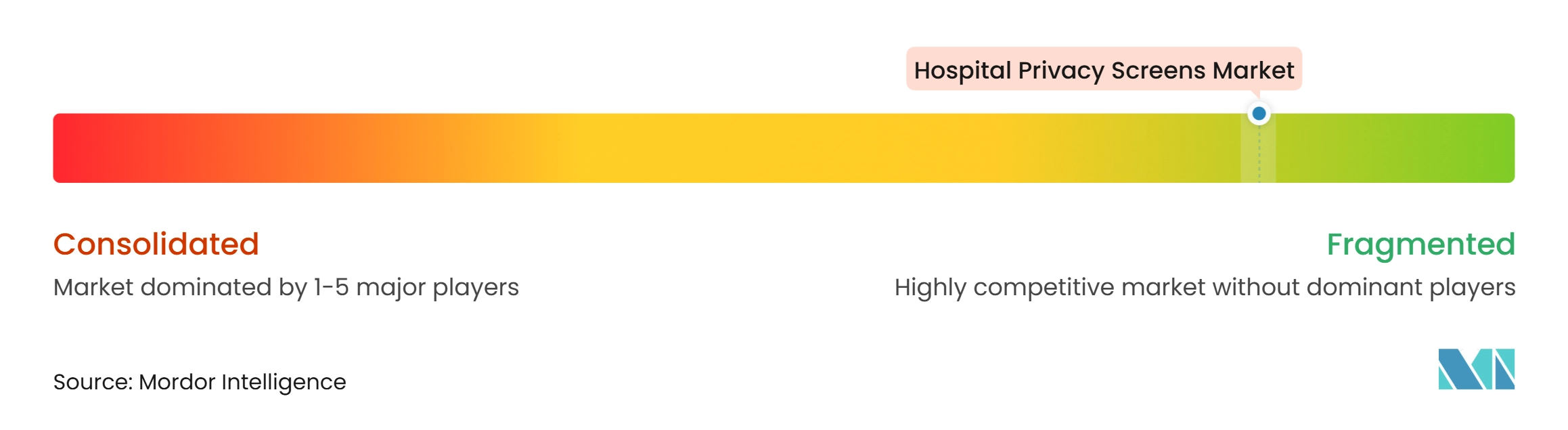
The hospital privacy screens market includes broad-line North American distributors, European design specialists, and regional manufacturers. Medline Industries and GF Health Products participate through wider healthcare catalogs and established supply relationships. Silentia AB, KwickScreen, and NoJerm focus more directly on specialized screen design and infection-control positioning. This produces moderate fragmentation across the overall category.
Silentia has built its position through folding systems, hospital partnerships, and geographic reach. The company states that its screens are installed in hospitals in more than 50 countries and documented 10 installations in 2025. KwickScreen differentiates through its retractable C-tube approach and product engineering. NoJerm uses a seamless polyethylene panel with a permanent antimicrobial additive to address cleaning and infection-control concerns. These approaches show how clinical usability and material design separate specialist suppliers from catalog-based competitors.
Silentia also installed custom-printed screens at Halland Hospital Halmstad’s maternity ward in 2025. Larger distributors can bundle screens with infection-control supplies and use group purchasing relationships. Specialists are expanding through direct sales and clinical co-development agreements, particularly in North America and the Middle East. Regional manufacturers can enter emerging markets through government tender channels. The available evidence indicates a broad field of distributors, specialists, and regional suppliers.
Hospital Privacy Screens Industry Leaders
-
Silentia AB
-
Medline Industries, Inc.
-
GF Health Products, Inc.
-
KwickScreen
-
R&B Wire Products, Inc.
- *Disclaimer: Major Players sorted in no particular order
Hospital Privacy Screens Market Companies Covered in this Report
- AGA Sanitätsartikel GmbH
- AliMed, Inc.
- Bextera Health
- Construction Specialties, Inc.
- Cube Care Company, Inc.
- Drive DeVilbiss Healthcare
- Elers Medical Ltd.
- Fabrication Enterprises, Inc.
- GF Health Products, Inc.
- KwickScreen
- Medline Industries
- NoJerm
- Ocelco, Inc.
- Omnimed
- R&B Wire Products, Inc.
- Rolascreen
- Silentia AB
- Versare Products LLC
- Winco Mfg. LLC
- Yewdale Corporation Ltd
Recent Industry Developments in Hospital Privacy Screens Market
- February 2026: Aster DM Healthcare announced AED 1 billion in planned investments, including 2 new multi-specialty hospitals in Dubai and an expansion of Aster Hospital Al Qusais, adding over 250 beds to its UAE network. The projects are financed partly through AED 265 million in Emirates Development Bank financing and are expected to begin construction in 2026.
- October 2025: Saudi Arabia’s Global Health Exhibition 2025 unveiled USD 33 billion in strategic healthcare investments, including USD 8.4 billion in new hospital and infrastructure projects announced at the event. Major commitments include Al Hayat National Hospitals with USD 1.86 billion for 4,000 beds across 15 facilities and Akdital Group’s Saudi entry at USD 1.41 billion.
- October 2025: Dubai Healthcare City Authority announced an AED 1.3 billion development plan for DHCC Phase 1, including a purpose-built medical complex with 5,800 square meters of adaptable surgical, diagnostic, and outpatient space. Construction is scheduled to begin in December 2025, with completion targeted for November 2027.
Global Hospital Privacy Screens Market Report Scope
As per the report's scope, a hospital privacy screen is a mobile, portable, or fixed physical barrier used in healthcare settings to block sightlines and establish temporary, private spaces around patient beds, examination tables, or treatment areas.
The hospital privacy screens market is segmented by product type, form factor, mobility, mounting, material, application, end user, infection-control attribute, distribution channel, and geography. By product type, the market is segmented into fixed screens and foldable screens. By form factor, the market is segmented into solid-panel screens, transparent or daylight screens, mesh and fabric-panel screens, accordion-style screens, and hybrid screen-curtain systems. By mobility, the market is segmented into convertible fixed-to-mobile screens, stationary screens, and mobile screens. By mounting, the market is segmented into wall-mounted screens, ceiling- or track-mounted screens, floor-pole-mounted screens, and freestanding screens.
By material, the market is segmented into polyester and fabric, polyvinyl chloride, polypropylene, polycarbonate and transparent polymers, and metal frames and composite panels. By application, the market is segmented into emergency departments and triage areas, intensive care units and isolation areas, examination and treatment rooms, operating, preoperative, and postoperative areas, inpatient wards and patient bays, dialysis and infusion clinics, long-term care and rehabilitation, and overflow, vaccination, and temporary care areas. By end user, the market is segmented into hospitals, clinics and physician offices, ambulatory surgical centers, long-term care facilities, and government and veterans affairs facilities. By infection-control attribute, the market is segmented into standard cleanable screens, antimicrobial screens, fluid-resistant screens, flame-retardant screens, and low-joint and seamless screens.
By distribution channel, the market is segmented into direct sales and contract procurement, medical-equipment distributors, group purchasing organizations, and online medical-supply stores. By geography, the market is segmented into North America, Europe, Asia-Pacific, the Middle East and Africa, and South America. The market report also covers estimated market sizes and trends for 17 countries across major regions worldwide. The report offers market size and forecasts in value (USD) for the above segments.
Segmentation Overview
| Fixed Screens |
| Foldable Screens |
| Solid-Panel Screens |
| Transparent or Daylight Screens |
| Mesh and Fabric-Panel Screens |
| Accordion-Style Screens |
| Hybrid Screen-Curtain Systems |
| Convertible Fixed-to-Mobile Screens |
| Stationary Screens |
| Mobile Screens |
| Wall-Mounted Screens |
| Ceiling- or Track-Mounted Screens |
| Floor-Pole-Mounted Screens |
| Freestanding Screens |
| Polyester and Fabric |
| Polyvinyl Chloride |
| Polypropylene |
| Polycarbonate and Transparent Polymers |
| Metal Frames and Composite Panels |
| Emergency Departments and Triage Areas |
| Intensive Care Units and Isolation Areas |
| Examination and Treatment Rooms |
| Operating, Preoperative, and Postoperative Areas |
| Inpatient Wards and Patient Bays |
| Dialysis and Infusion Clinics |
| Long-Term Care and Rehabilitation |
| Overflow, Vaccination, and Temporary Care Areas |
| Hospitals |
| Clinics and Physician Offices |
| Ambulatory Surgical Centers |
| Long-Term Care Facilities |
| Government and Veterans Affairs Facilities |
| Standard Cleanable Screens |
| Antimicrobial Screens |
| Fluid-Resistant Screens |
| Flame-Retardant Screens |
| Low-Joint and Seamless Screens |
| Direct Sales and Contract Procurement |
| Medical-Equipment Distributors |
| Group Purchasing Organizations |
| Online Medical-Supply Stores |
| North America | United States |
| Canada | |
| Mexico | |
| Europe | Germany |
| United Kingdom | |
| France | |
| Italy | |
| Spain | |
| Rest of Europe | |
| Spain | |
| Rest of Europe | |
| Asia-Pacific | China |
| Japan | |
| India | |
| Australia | |
| South Korea | |
| Rest of Asia-Pacific | |
| Middle East and Africa | GCC |
| South Africa | |
| Rest of Middle East and Africa | |
| South America | Brazil |
| Argentina | |
| Rest of South America |
| By Product Type | Fixed Screens | |
| Foldable Screens | ||
| By Form Factor | Solid-Panel Screens | |
| Transparent or Daylight Screens | ||
| Mesh and Fabric-Panel Screens | ||
| Accordion-Style Screens | ||
| Hybrid Screen-Curtain Systems | ||
| By Mobility | Convertible Fixed-to-Mobile Screens | |
| Stationary Screens | ||
| Mobile Screens | ||
| By Mounting | Wall-Mounted Screens | |
| Ceiling- or Track-Mounted Screens | ||
| Floor-Pole-Mounted Screens | ||
| Freestanding Screens | ||
| By Material | Polyester and Fabric | |
| Polyvinyl Chloride | ||
| Polypropylene | ||
| Polycarbonate and Transparent Polymers | ||
| Metal Frames and Composite Panels | ||
| By Application | Emergency Departments and Triage Areas | |
| Intensive Care Units and Isolation Areas | ||
| Examination and Treatment Rooms | ||
| Operating, Preoperative, and Postoperative Areas | ||
| Inpatient Wards and Patient Bays | ||
| Dialysis and Infusion Clinics | ||
| Long-Term Care and Rehabilitation | ||
| Overflow, Vaccination, and Temporary Care Areas | ||
| By End User | Hospitals | |
| Clinics and Physician Offices | ||
| Ambulatory Surgical Centers | ||
| Long-Term Care Facilities | ||
| Government and Veterans Affairs Facilities | ||
| By Infection-Control Attribute | Standard Cleanable Screens | |
| Antimicrobial Screens | ||
| Fluid-Resistant Screens | ||
| Flame-Retardant Screens | ||
| Low-Joint and Seamless Screens | ||
| By Distribution Channel | Direct Sales and Contract Procurement | |
| Medical-Equipment Distributors | ||
| Group Purchasing Organizations | ||
| Online Medical-Supply Stores | ||
| By Geography | North America | United States |
| Canada | ||
| Mexico | ||
| Europe | Germany | |
| United Kingdom | ||
| France | ||
| Italy | ||
| Spain | ||
| Rest of Europe | ||
| Spain | ||
| Rest of Europe | ||
| Asia-Pacific | China | |
| Japan | ||
| India | ||
| Australia | ||
| South Korea | ||
| Rest of Asia-Pacific | ||
| Middle East and Africa | GCC | |
| South Africa | ||
| Rest of Middle East and Africa | ||
| South America | Brazil | |
| Argentina | ||
| Rest of South America | ||
Key Questions Answered in the Report
What is driving demand for hospital privacy screens?
Privacy requirements, hospital bed additions, flexible care layouts, and infection-control needs are increasing demand for cleanable and movable partitions. Shared wards and planned overflow areas add demand because each patient space requires a practical privacy barrier.
How large is the hospital privacy screens market?
It is projected to grow from USD 18.82 billion in 2026 to USD 33.70 billion by 2032 at a 10.36% CAGR. Growth reflects demand for privacy, flexible care space, and surfaces that fit clinical cleaning practices.
Which product type leads hospital privacy screen demand?
Foldable screens lead with a 58.34% share in 2026 and are projected to grow at a 10.92% CAGR through 2032. They can be repositioned across bays and stored flat when they are not needed.
Why are antimicrobial privacy screens growing quickly?
Clinical studies found substantial reductions in bacterial contamination compared with standard laundered curtains. These results help providers assess antimicrobial products as part of infection-prevention planning rather than as a basic furnishing.
Which region is growing fastest for hospital privacy screens?
Asia-Pacific is forecast to grow at a 13.18% CAGR through 2032, supported by large hospital bed expansion programs. India, Singapore, and IHH Healthcare’s operating markets are adding capacity that requires privacy infrastructure.
Why are ambulatory surgical centers important to suppliers?
Ambulatory surgical centers are the fastest-growing end-user segment, with a projected 12.37% CAGR through 2032. They create new procurement needs in preparation, procedure, recovery, and consultation spaces.