
Home Mortgage Finance Market Size and Share
Market Overview
| Study Period | 2020 - 2031 |
|---|---|
| Market Size (2026) | USD 54.40 Trillion |
| Market Size (2031) | USD 70.10 Trillion |
| Growth Rate (2026 - 2031) | 5.20 % |
| Fastest Growing Market | Asia-Pacific |
| Largest Market | North America |
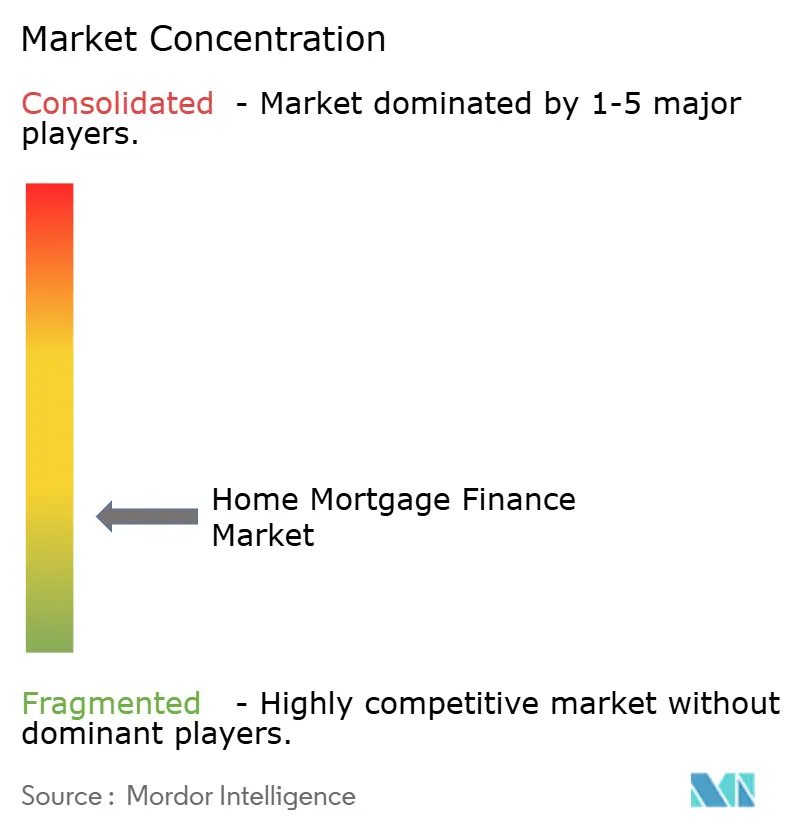
| Market Concentration | Low |
Major Players *Disclaimer: Major Players sorted in no particular order Image © Mordor Intelligence. Reuse requires attribution under CC BY 4.0. | |
Home Mortgage Finance Market Analysis by Mordor Intelligence
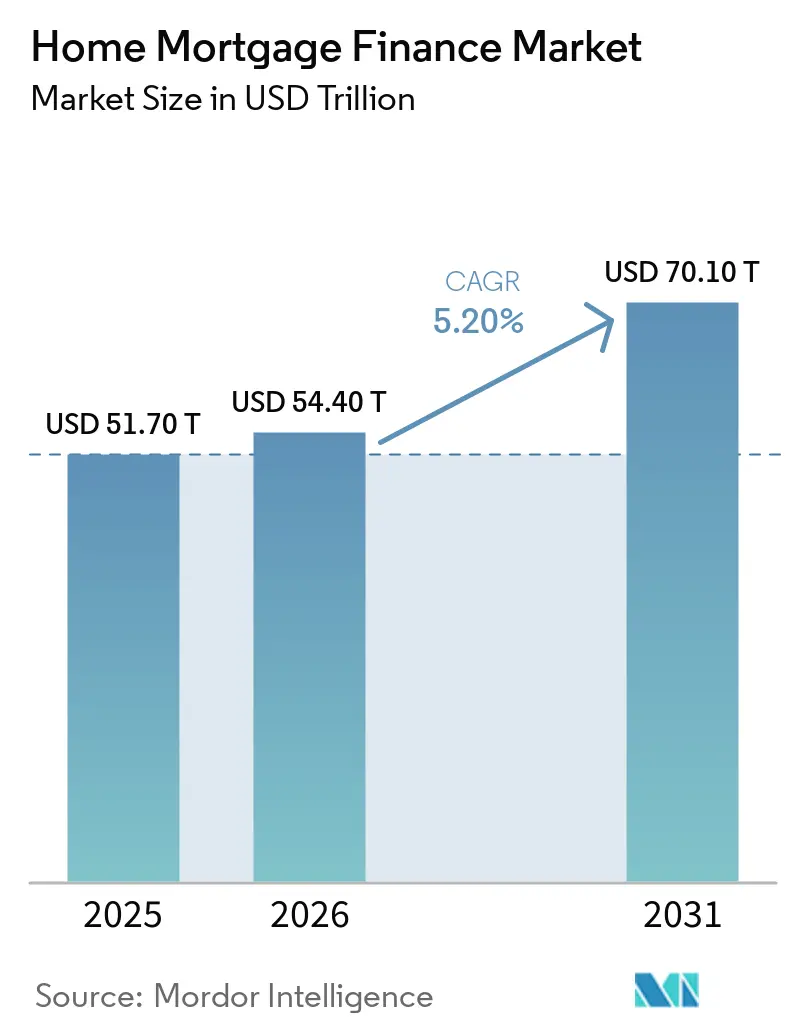
The Home Mortgage Finance Market size is projected to expand from USD 51.70 trillion in 2025 and USD 54.40 trillion in 2026 to USD 70.10 trillion by 2031, registering a CAGR of 5.20% between 2026 and 2031.
The market covers the origination, servicing, refinancing, and securitization of loans for owner-occupied and investor-owned homes, while excluding commercial real estate lending. Residential mortgage debt remains the largest global asset class, but lending depth differs widely by region. Lower mortgage penetration in developing economies supports lending expansion as formal employment and household incomes grow. Digital loan processing, public housing support, and broader capital-market funding are improving lenders’ ability to serve borrowers. Higher rates, limited housing supply, and high down payments continue to limit affordability and keep competitive pressure focused on cost control.
Key Report Takeaways
- By loan purpose, purchase mortgages captured 63.2% of the home mortgage finance market share in 2025, while home improvement and renovation loans are projected to grow at a 6.2% CAGR through 2031.
- By provider, banks captured 73.5% of the home mortgage finance market share in 2025, while Housing Finance Companies and specialized mortgage lenders are projected to grow at a 6.5% CAGR through 2031.
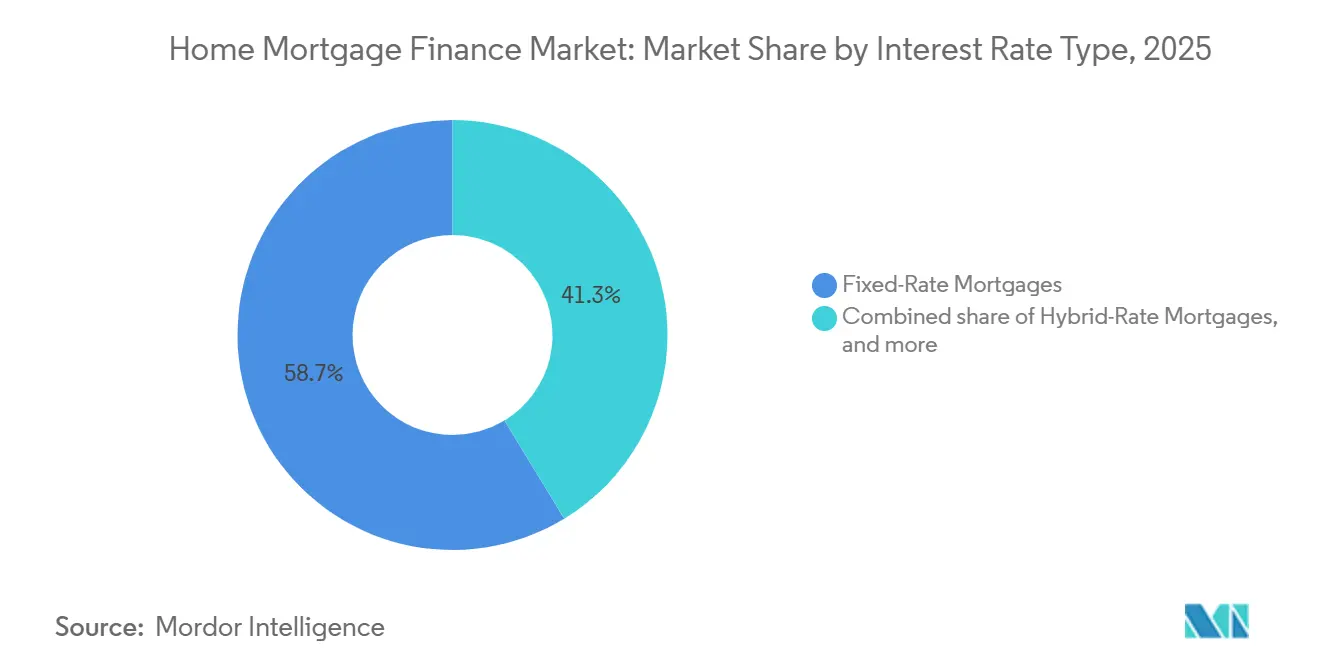
- By interest rate type, fixed-rate mortgages captured 58.7% of the home mortgage finance market share in 2025, while hybrid-rate mortgages are projected to grow at a 6.0% CAGR through 2031.
- By loan tenure, loans with terms of more than 20 years captured 61.6% of the home mortgage finance market share in 2025 and are projected to grow at a 5.6% CAGR through 2031.
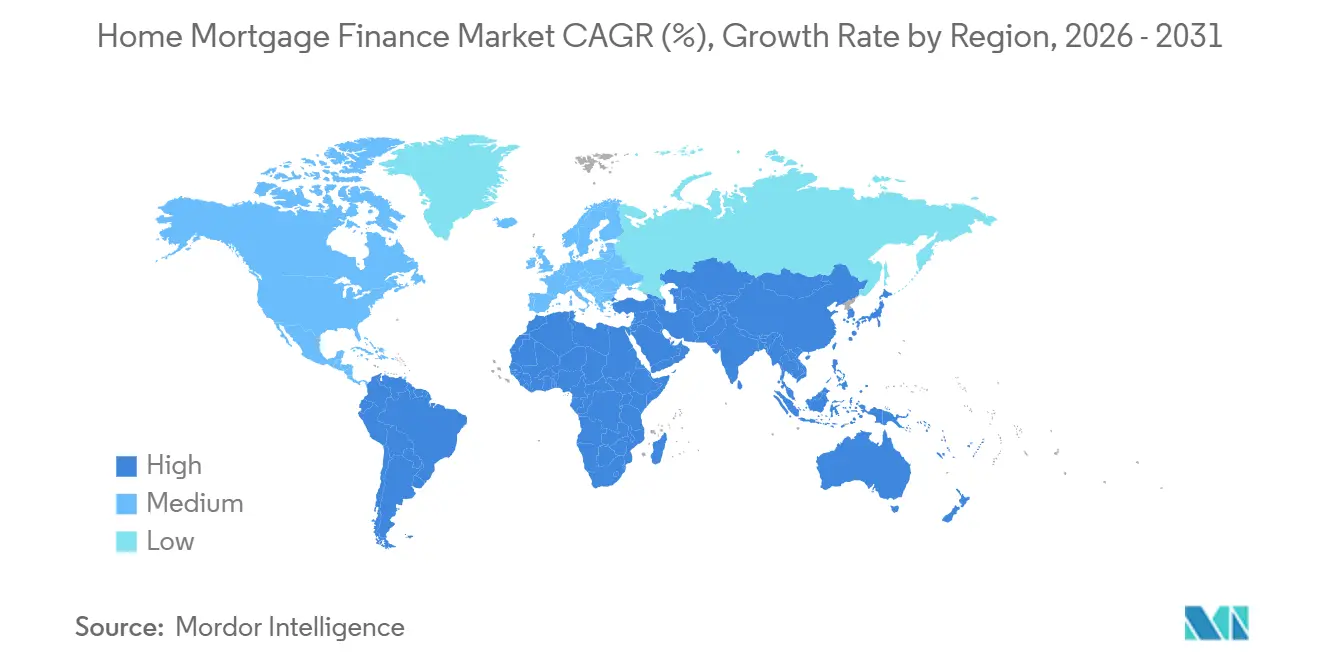
- By geography, North America captured 28.8% of the home mortgage finance market share in 2025, while Asia-Pacific is projected to grow at a 6.8% CAGR through 2031.
Note: Market size and forecast figures in this report are generated using Mordor Intelligence’s proprietary estimation framework, updated with the latest available data and insights as of January 2026.
Global Home Mortgage Finance Market Trends and Insights
Drivers Impact Analysis*
| Driver | (~) % Impact on CAGR Forecast | Geographic Relevance | Impact Timeline |
|---|---|---|---|
| Rising Homeownership Demand and Household Formation | +1.2% | Global, concentrated in Asia-Pacific, the Middle East and Africa, and Latin America | Long term (≥ 4 years) |
| Digital-First Mortgage Origination and Servicing | +1.0% | Global, with early gains in North America and Europe, and expansion into the Asia-Pacific | Medium term (2-4 years) |
| Government-Backed Affordable Housing Programs | +0.9% | National programs in India, Saudi Arabia, Brazil, and European Union member states | Medium term (2-4 years) |
| Private-Label Securitization and Alternative Lender Liquidity | +0.5% | North America, with spillover into the European Union and Australia | Short term (≤ 2 years) |
| Green Mortgage Incentives and Energy-Efficient Home Finance | +0.4% | Europe and North America, with early activity in Asia-Pacific, the Middle East, and Africa | Long term (≥ 4 years) |
| Embedded Mortgage Distribution Through Property Platforms and Homebuilders | +0.3% | North America, the United Kingdom, Germany, and Australia | Medium term (2-4 years) |
| Source: Mordor Intelligence | |||
Rising Homeownership Demand and Household Formation
Demand for homeownership in less-penetrated lending markets provides a durable base for the home mortgage finance market. In the United States, the housing supply shortfall reached 4.03 million homes in 2025, while 1.41 million households formed and 1.36 million homes were started[1]. The median age of first-time buyers reached 40 in 2025, which indicates that many households delayed purchases rather than exited the housing market. The number of households led by people aged 80 or older is set to increase nearly 60% over the next decade. This demographic shift supports demand for equity release and home renovation finance in more mature markets. The home mortgage finance market, therefore, has growth opportunities in both first-purchase lending and products for aging homeowners.
Digital-First Mortgage Origination and Servicing
Digital origination is reshaping the cost and timing of mortgage lending. Freddie Mac’s 2025 cost-to-originate study found that lenders using artificial intelligence-assisted automated underwriting could save USD 1,700 per loan and reduce timelines by 5 days. Mortgage lenders are using automation to review income, assets, and credit records that were previously handled through manual processes. The underwriter continues to make the final decision for agency-eligible loans, which limits the use of fully automated decisions. Clear documentation and explainability requirements make governance an important part of deployment. These conditions encourage lenders in the home mortgage finance market to use technology to support decisions rather than replace accountable lending controls.
Government-Backed Affordable Housing Programs
Public housing programs can increase lending capacity where private finance has not kept pace with housing demand. Saudi Arabia’s Real Estate Development Fund launched its Alternative Financing Program in July 2026 to channel funding to banks for immediate mortgage approvals[2]. The program targets households that do not meet conventional credit thresholds and began with Saudi National Bank as its banking partner. Government-backed funding can sustain originations when high interest rates restrict private lenders’ balance-sheet capacity. It can also concentrate exposure in sovereign-linked institutions when private-label funding remains limited. Lenders in the home mortgage finance market need diverse funding sources to strengthen resilience as public support expands.
Green Mortgage Incentives and Energy-Efficient Home Finance
Green mortgage products are becoming more specific to individual programs and lender economics. The United States Sections 25C and 25D home energy tax credits expired on December 31, 2025[3]. Internal Revenue Service Mortgage products that include qualified energy improvement costs can still support renovation financing. Fannie Mae HomeStyle Energy, Freddie Mac GreenCHOICE, and Federal Housing Administration and Department of Veterans Affairs Energy Efficient Mortgages remain important financing approaches. European energy-performance disclosure requirements continue to bring energy considerations into mortgage underwriting. The differing policy frameworks in the United States and Europe create separate product and compliance priorities for lenders.
Restraints Impact Analysis*
| Restraint | ~% Impact on CAGR Forecast | Geographic Relevance | Impact Timeline |
|---|---|---|---|
| Elevated Interest Rates and Refinancing Disincentives | -0.8% | North America and Europe, with moderating pressure in Asia-Pacific, as policy rates diverge | Medium term (2–4 years) |
| Home-Price Inflation and Down-Payment Affordability Gaps | -0.6% | Global, particularly in North America, the United Kingdom, Australia, and urban Southeast Asia | Long term (≥4 years) |
| Macro-Prudential Rules and Financial-Crime Compliance Costs | -0.4% | Europe, North America, Australia, and major Asian financial centers with tighter mortgage underwriting and AML requirements | Medium to long term (2–5 years) |
| Climate-Risk Exposure and Property-Insurance Affordability | -0.3% | North America, Australia, and parts of Europe are facing higher catastrophe and property-insurance costs | Long term (≥4 years) |
| Legacy-System and Digital-Integration Friction | -0.2% | Global, particularly mature mortgage markets with fragmented legacy lending, servicing, and property-data systems | Medium term (2–4 years) |
| Source: Mordor Intelligence | |||
Elevated Interest Rates and Refinancing Disincentives
High mortgage rates continue to reduce refinancing activity and limit borrowers’ ability to move. The 30-year fixed mortgage rate reached 6.85% in the first week of September 2026, its highest level since June 2025. Adjustable-rate mortgages accounted for 8.5% of applications as borrowers sought lower entry rates. A 5-year hybrid adjustable-rate mortgage was priced between 5.82% and 5.98%, while fixed rates remained above 6.7%. The rate lock-in effect keeps many homeowners with 2020 and 2021 loans at 3% or below from selling or refinancing. The National Association of Home Builders reported that a median-income family needed 34% of its income to pay the mortgage on a median-priced new home in the second quarter of 2026.
Home-Price Inflation and Down-Payment Affordability Gaps
Home prices have risen faster than incomes, making affordability a direct limit on originations. Existing home prices were 54% higher nationwide than in 2020 and stood at nearly 5 times median incomes. The monthly payment on a median-priced home reached USD 3,100 in the fourth quarter of 2025, compared with USD 1,700 in early 2020. In June 2026, the qualifying income for a median-priced home was USD 109,152, compared with the median household income of USD 87,599. Home prices increased in 80% of metropolitan areas in the second quarter of 2026, and 5% of markets recorded double-digit growth. Higher income thresholds lead more first-time borrowers to seek longer terms and higher loan-to-value products.
*Our forecasts treat driver/restraint impacts as directional, not additive. The impact forecasts reflect baseline growth, mix effects, and variable interactions.
Segment Analysis
By Loan Purpose: Purchase Lending Remains the Largest Activity
Purchase mortgages held 63.2% of the global home mortgage finance market in 2025. New household formation in developing economies and delayed buying activity in mature economies support this position. The current rate environment has shifted lender investment toward purchase workflows instead of refinancing pipelines. Fewer than 3% of outstanding borrowers can refinance economically at prevailing rates. Home improvement and renovation loans are forecast to grow at a 6.2% CAGR through 2031. Equity-rich homeowners are using accumulated value for energy upgrades, accessibility improvements, and additional living space.
Refinancing mortgages are recovering from their 2023 and 2024 lows but remain constrained while fixed rates stay above 6.5%. Construction-to-permanent and self-build loans are gaining attention in supply-constrained locations, including mid-tier United States cities and India’s tier-2 urban corridors. Equity release loans, including home equity loans and home equity lines of credit, give borrowers access to funds without changing low-rate first mortgages. This product mix favors institutions with strong servicing capabilities. Renovation and equity-release demand also support hybrid loan structures. These products remain a relatively open area for lenders in the home mortgage finance market.
By Provider: Banks Lead Globally While Specialized Lenders Expand
Banks held 73.5% of the global home mortgage finance market size in 2025. Their position reflects deposit-funded origination in Asia-Pacific and Europe, where savings systems direct household funds through banks. The United States follows a different pattern, where independent mortgage banks and non-bank lenders originated 84.1% of single-family mortgages in 2025. Non-bank lenders accounted for 64.2% of United States home purchase loans in 2025. Housing finance companies and specialized mortgage lenders are projected to grow at a 6.5% CAGR through 2031. Their specialized technology and lower capital requirements can support faster decisions and competitive pricing.
Credit unions, mutuals, and cooperatives retain a stable role in member-based lending in Canada, Australia, and Germany. Public housing finance institutions remain important liquidity providers in Saudi Arabia, Brazil, and India. The non-bank servicing share of agency mortgage-backed securities rose from 27% in 2014 to 66% in 2024. Banks operate under layered federal banking rules, while non-banks work under the Consumer Financial Protection Bureau and state oversight. This difference creates a compliance gap during periods of financial stress. Providers that can combine sound governance with efficient origination can strengthen their position in the home mortgage finance industry.
By Interest Rate Type: Fixed Rates Provide Payment Stability
Fixed-rate mortgages held 58.7% of the global home mortgage finance market in 2025. Borrowers value payment certainty during a period of elevated interest-rate uncertainty. France illustrates the strength of this preference, with 97% of new mortgage originations issued at fixed rates in 2026. Fixed-rate demand varies by country, as variable and hybrid loans hold larger roles in Spain, Germany, and Italy. The European Mortgage Federation reported a move toward fixed-rate products in Italy, Germany, Spain, the Netherlands, and Poland as rate volatility increased. Adjustable-rate loans remain significant in developing markets where shorter pricing terms align with lender funding structures.
Hybrid-rate mortgages are projected to grow at a 6.0% CAGR through 2031. In September 2026, 5-year hybrid adjustable-rate mortgages were priced between 5.82% and 5.98%, compared with 30-year fixed rates between 6.74% and 6.85%. Agency adjustable-rate mortgage originations in the United States reached 3.34% of agency loans through May 2026, compared with 0.31% during the same period in 2021. The shift from LIBOR to SOFR has given the United States adjustable-rate loans clearer reset mechanics. These products can reduce the initial payment burden for borrowers facing high home prices. The home mortgage finance market is therefore seeing hybrid products become a more visible affordability option.
By Loan Tenure: Long-Term Loans Address Affordability Pressures
Loans with terms of more than 20 years accounted for 61.6% of the global home mortgage finance market size in 2025. This tenure group is also the fastest-growing, with a projected 5.6% CAGR through 2031. Higher home prices and monthly payments encourage borrowers to extend terms to lower monthly obligations. The payment on a median-priced United States home reached USD 3,100 in the fourth quarter of 2025. Longer terms can also make energy-efficiency improvements more affordable when those costs are included in a mortgage. The United Kingdom recorded GBP 1,760.6 billion (USD 2,363.2 billion) in outstanding residential mortgage loans in the second quarter of 2026, while higher loan-to-value mortgages reached their largest share of new lending in almost 2 decades.
Loans with terms of up to 10 years and from 10 to 20 years mainly serve borrowers with substantial equity or near-payoff properties. These segments are more responsive to interest-rate changes. Lower rates could make refinancing from 30-year to 15-year structures more attractive in later forecast years. Long loan terms also slow equity buildup, particularly for borrowers entering with 95% loan-to-value ratios. Borrowers who bought at high prices with 30-year terms have less protection against a housing price decline. This exposure remains relevant to prudential monitoring in the United Kingdom and the United States.
Geography Analysis
North America held 28.8% of the global home mortgage finance market share in 2025. The region benefits from the world’s deepest secondary mortgage market. The Mortgage Bankers Association expects United States single-family mortgage originations to reach USD 2.2 trillion in 2026, including USD 1.46 trillion in purchase originations. United States mortgage-backed securities issuance reached USD 1,432.5 billion through August 2026. A housing shortage of more than 4 million homes supports home prices and average loan amounts despite lower transaction volumes. Mexico continues to receive structural support from Infonavit, although private lending beyond formal salaried workers remains limited by credit infrastructure.
Asia-Pacific is expected to grow at a 6.8% CAGR through 2031. India and Southeast Asia drive this outlook more than the mature markets of China and Japan. India’s mortgage lending base was projected to increase from USD 480 billion in 2025 to USD 539.7 billion in 2026, with a 12.4% CAGR through 2031. Vietnam, Indonesia, and Malaysia have rising middle-class incomes, urbanization, and low mortgage-to-gross-domestic-product ratios. China’s mortgage market was valued at USD 1,194 billion in 2026, while the 5-year Loan Prime Rate remained at 3.5% through midyear. Australia’s prudential settings and monetary policy continue to affect the Commonwealth Bank of Australia and ANZ in the Australia and New Zealand housing-finance corridor.
Europe’s regional mortgage position reflects significant differences between national markets. European Union residential mortgage credit reached EUR 5,404 billion (USD 5,831.2 billion) at the end of March 2026, and Germany and France represented 30% and 24% of the total. France recorded a 3.18% average new mortgage rate in July 2026, and 97% of new contracts carried fixed rates. The United Kingdom recorded GBP 77.4 billion (USD 104 billion) in gross advances in the second quarter of 2026, with higher loan-to-value mortgages taking their largest share of new lending since 2008. Saudi Arabia recorded SAR 951.3 billion in outstanding real-estate loans at the end of 2025, equivalent to USD 253.5 billion, while homeownership reached 65.4% against its 70% 2030 target. Brazil projected BRL 411 billion (USD 72.7 billion) in home credit grants for 2026, while Argentina’s mortgage originations fell 42% in the first half of 2026.
Competitive Landscape
The home mortgage finance market combines a small group of major originators with many smaller lenders. Competition increasingly depends on processing efficiency, technology, and access to capital markets rather than branch networks alone. Rocket Companies completed its USD 14.2 billion acquisition of Mr. Cooper Group in October 2025. The combined platform serviced one in every 6 United States mortgages and had a USD 2.1 trillion unpaid principal balance. Rocket reported an annual client retention rate of 97%. United Wholesale Mortgage led the United States origination volume in 2025 with USD 164.3 billion, while Rocket led loan counts with 429,332 originations.
Deposit-funded relationship lenders, including BNP Paribas, HSBC, and Santander Bank, shape European competition. These banks distribute mortgages within broader household financial relationships. The approach supports cross-selling but can make system upgrades slower than at specialized digital originators. Better Home & Finance uses its Tinman engine to offer artificial-intelligence-supported underwriting to banks and brokers. United Wholesale Mortgage deployed its Mia assistant for broker calls, outreach, and loan-estimate optimization in 2025. These investments show how lenders are using technology to improve service and preserve channel relationships within the home mortgage finance market.
Regulatory governance can become a barrier for smaller lenders that cannot fund model documentation and explainability capabilities. The Consumer Financial Protection Bureau’s Regulation B rule on adverse-action explainability established a federal framework for communicating artificial-intelligence-driven credit decisions in April 2026. Fannie Mae’s Lender Letter LL-2026-04 also set artificial intelligence and machine-learning governance expectations for lenders. Alternative-income underwriting, finance for migrant borrowers, and digital infrastructure in Vietnam, Indonesia, Egypt, and Nigeria remain underserved areas. These markets need stronger housing-credit infrastructure to support reliable lending growth. The competitive landscape remains fragmented despite consolidation among larger technology-enabled firms.
Home Mortgage Finance Industry Leaders
-
United Wholesale Mortgage LLC
-
Rocket Mortgage LLC
-
JPMorgan Chase Bank, N.A.
-
Wells Fargo Bank, N.A.
-
Bank of America, N.A.
- *Disclaimer: Major Players sorted in no particular order
Recent Industry Developments
- July 2026: Saudi Arabia’s Real Estate Development Fund launched an Alternative Financing Program that channels capital directly to banks for immediate mortgage approvals. The program targets first-time Saudi buyers in Riyadh, Jeddah, and Dammam, with the Saudi National Bank named as the first banking partner. Mortgages under the program start from SAR 699 (USD 186) per month.
- May 2026: PennyMac Mortgage Investment Trust completed 8 private-label securitization transactions totaling USD 2.8 billion in unpaid principal balance. The company retained more than USD 200 million of new investments. It remained on pace for 30 securitizations in 2026.
- March 2026: The Mortgage Bankers Association published a white paper on the persistent housing demand slowdown. The paper stated that slower household formation, reduced immigration, and aging-related housing transitions could constrain the United States ' origin growth over the next decade.
- October 2025: Rocket Companies completed its USD 14.2 billion all-stock acquisition of Mr. Cooper Group, combining the largest United States mortgage originator with the largest servicer to create a platform with a servicing portfolio of 10 million homeowners, or 1 in 6 United States mortgages. The transaction closed at a 51% premium to its March 2025 announcement valuation of USD 9.4 billion. Jay Bray, former Mr. Cooper chief executive officer, became president and chief executive officer of Rocket Mortgage as a subsidiary of the combined company.
Global Home Mortgage Finance Market Report Scope
| Purchase Mortgages |
| Refinancing Mortgages |
| Home Improvement / Renovation Loans |
| Construction / Self-Build / Construction-to-Permanent Loans |
| Equity Release Loans (Home Equity Loans / HELOCs) |
| Banks |
| Housing Finance Companies / Specialized Mortgage Lenders |
| Non-Bank Mortgage Lenders |
| Credit Unions / Mutuals / Cooperatives |
| Government / Public Housing Finance Institutions |
| Fixed-Rate Mortgages |
| Adjustable / Floating-Rate Mortgages |
| Hybrid-Rate Mortgages |
| Up to 10 Years |
| More than 10 Years to 20 Years |
| More than 20 Years |
| North America | United States |
| Canada | |
| Mexico | |
| South America | Brazil |
| Argentina | |
| Rest of South America | |
| Europe | United Kingdom |
| Germany | |
| France | |
| Italy | |
| Spain | |
| Rest of Europe | |
| Asia-Pacific | China |
| Japan | |
| India | |
| South Korea | |
| Australia | |
| Indonesia | |
| Thailand | |
| Malaysia | |
| Singapore | |
| Vietnam | |
| Rest of Asia-Pacific | |
| Middle East and Africa | Saudi Arabia |
| United Arab Emirates | |
| Turkey | |
| South Africa | |
| Egypt | |
| Rest of Middle East and Africa |
| By Loan Purpose | Purchase Mortgages | |
| Refinancing Mortgages | ||
| Home Improvement / Renovation Loans | ||
| Construction / Self-Build / Construction-to-Permanent Loans | ||
| Equity Release Loans (Home Equity Loans / HELOCs) | ||
| By Provider | Banks | |
| Housing Finance Companies / Specialized Mortgage Lenders | ||
| Non-Bank Mortgage Lenders | ||
| Credit Unions / Mutuals / Cooperatives | ||
| Government / Public Housing Finance Institutions | ||
| By Interest Rate Type | Fixed-Rate Mortgages | |
| Adjustable / Floating-Rate Mortgages | ||
| Hybrid-Rate Mortgages | ||
| By Loan Tenure | Up to 10 Years | |
| More than 10 Years to 20 Years | ||
| More than 20 Years | ||
| By Geography | North America | United States |
| Canada | ||
| Mexico | ||
| South America | Brazil | |
| Argentina | ||
| Rest of South America | ||
| Europe | United Kingdom | |
| Germany | ||
| France | ||
| Italy | ||
| Spain | ||
| Rest of Europe | ||
| Asia-Pacific | China | |
| Japan | ||
| India | ||
| South Korea | ||
| Australia | ||
| Indonesia | ||
| Thailand | ||
| Malaysia | ||
| Singapore | ||
| Vietnam | ||
| Rest of Asia-Pacific | ||
| Middle East and Africa | Saudi Arabia | |
| United Arab Emirates | ||
| Turkey | ||
| South Africa | ||
| Egypt | ||
| Rest of Middle East and Africa | ||
Key Questions Answered in the Report
What is the projected value of the global home mortgage finance market by 2031?
The global home mortgage finance market is projected to reach USD 70.1 trillion by 2031, growing at a 5.2% CAGR from 2026.
Which loan purpose holds the largest share of global home mortgage finance?
Purchase mortgages held 63.2% of the global total in 2025, making them the largest loan-purpose category.
Which provider segment is growing fastest in residential mortgage lending?
Housing Finance Companies and specialized mortgage lenders are projected to grow at a 6.5% CAGR through 2031.
Why are long mortgage terms becoming more common?
Higher home prices and monthly payments are leading borrowers to select terms longer than 20 years to reduce monthly obligations.
Which region is growing fastest for home mortgage lending?
Asia-Pacific is projected to grow at a 6.8% CAGR through 2031, supported by India and Southeast Asian economies.
What are the main constraints on mortgage origination growth?
Elevated interest rates, high home prices, limited housing supply, and down-payment gaps continue to limit borrower affordability.