
Hispanic Foods Market Size and Share
Market Overview
| Study Period | 2022 - 2032 |
|---|---|
| Market Size (2027) | USD 55.88 Billion |
| Market Size (2032) | USD 75.29 Billion |
| Growth Rate (2027 - 2032) | 6.14 % |
| Fastest Growing Market | Asia-Pacific |
| Largest Market | North America |
| Market Concentration | Medium |
Major Players *Disclaimer: Major Players sorted in no particular order Image © Mordor Intelligence. Reuse requires attribution under CC BY 4.0. | |
Hispanic Foods Market Analysis by Mordor Intelligence
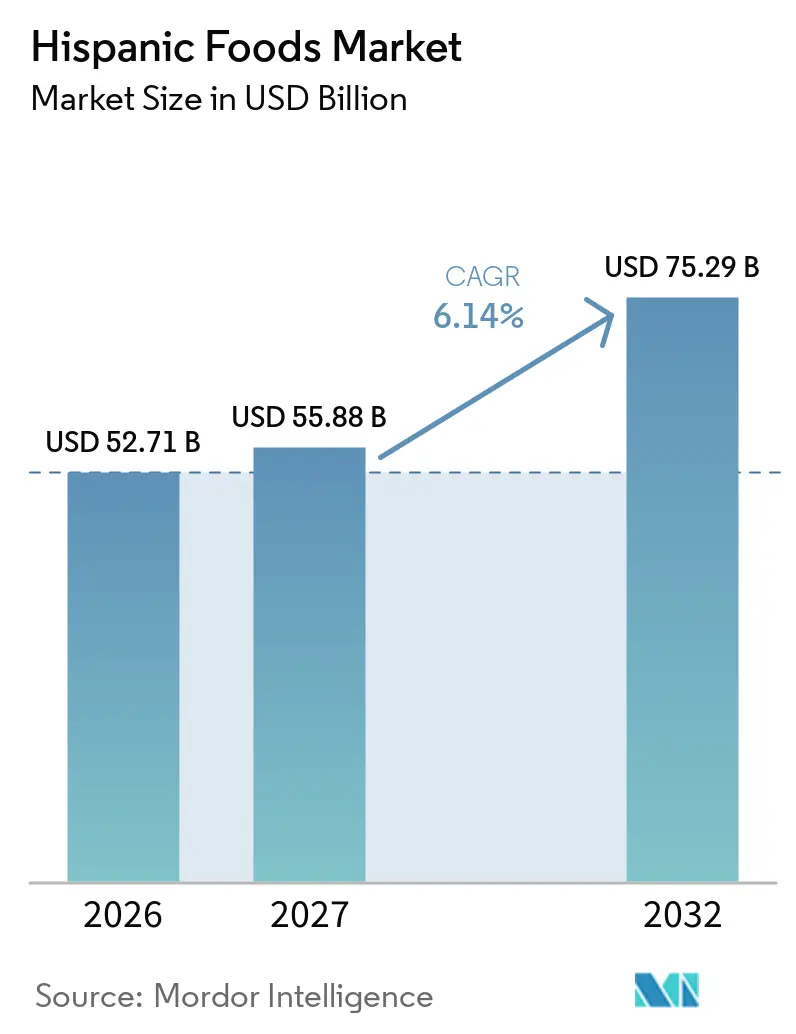
The Hispanic foods market size is expected to grow from USD 52.71 billion in 2026 to USD 55.88 billion in 2027 and is forecast to reach USD 75.29 billion by 2032 at a 6.14% CAGR over 2027-2032. The Hispanic foods market is expanding beyond traditional ethnic-food categories as more consumers embrace a wider variety of products. A strong Hispanic population in the United States supports sustained demand, while broader retail distribution improves product accessibility. Manufacturers are introducing convenient formats, healthier recipes, and diverse flavors to meet evolving consumer preferences. Efficient sourcing and competitive pricing help brands serve different consumer groups, while acquisitions and established distribution networks enable major food companies to strengthen their market presence and expand their product offerings.
Key Report Takeaways
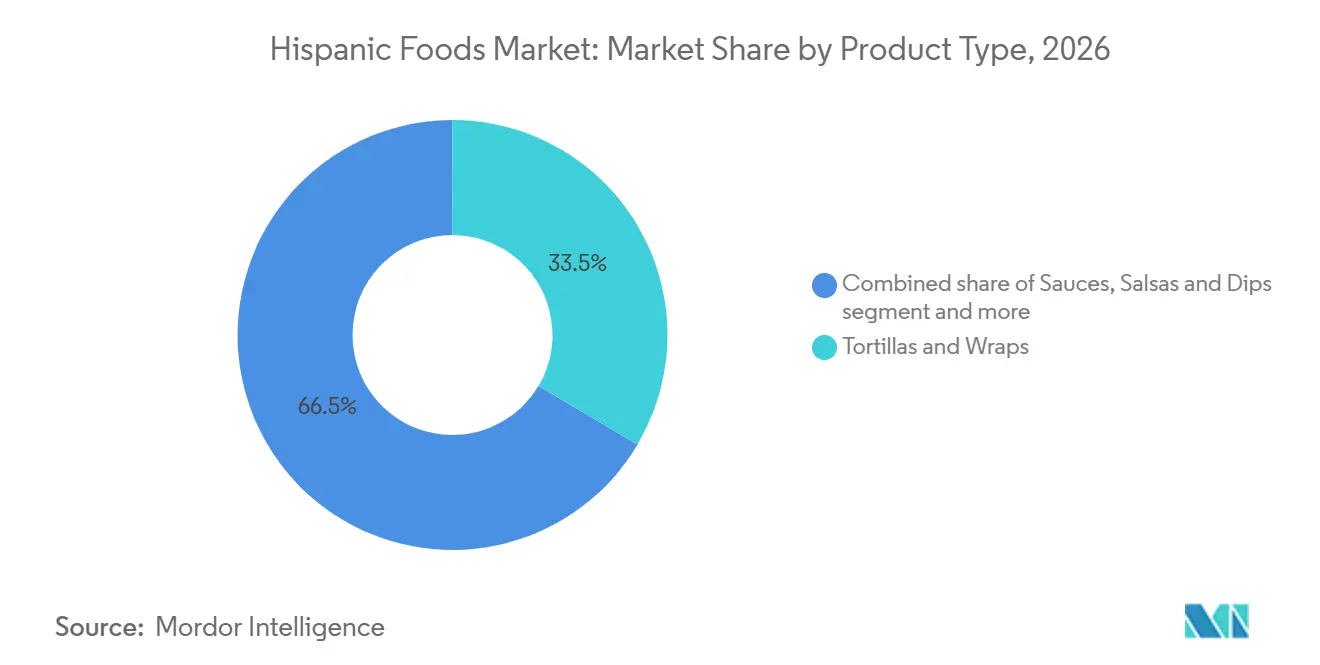
- By product type, tortillas and wraps held 33.51% of the Hispanic foods market share in 2026, while sauces, salsas, and dips are projected to expand at a 7.21% CAGR through 2032.
- By cuisine type, Mexican accounted for 58.21% of the Hispanic foods market share in 2026, while other cuisine types are forecast to expand at a 7.52% CAGR through 2032.
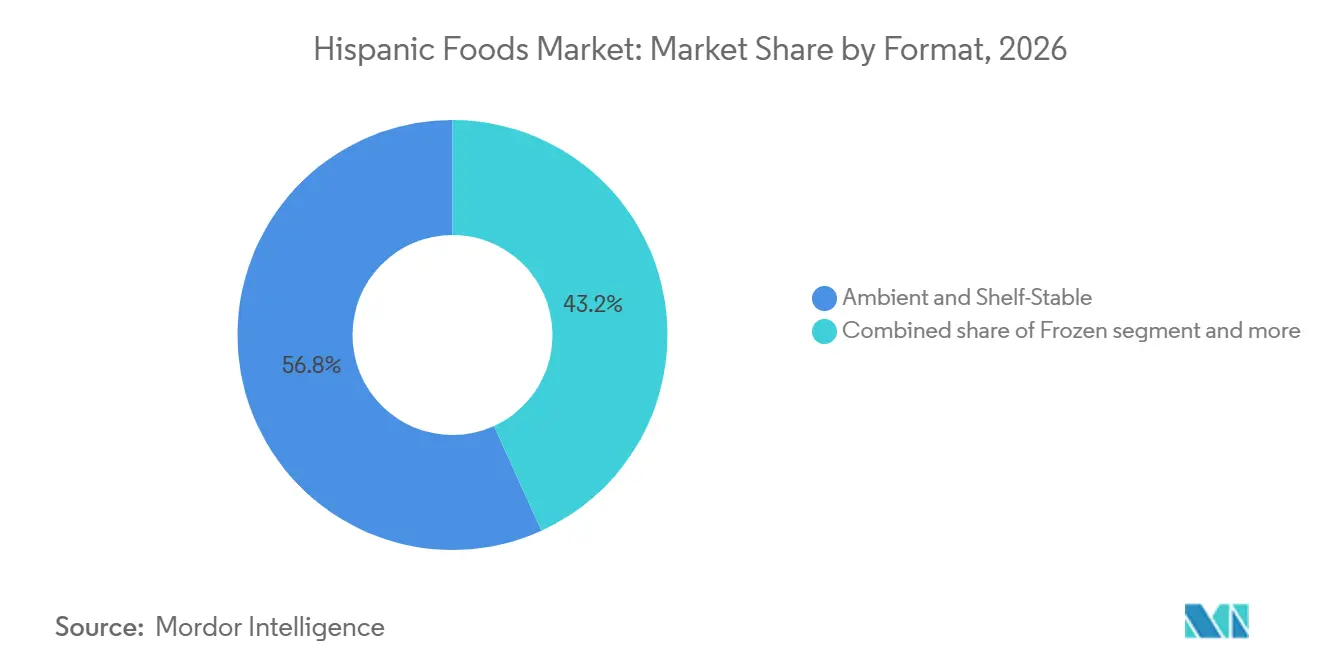
- By format, ambient and shelf-stable held 56.88% of the Hispanic foods market share in 2026, while frozen is forecast to expand at a 7.15% CAGR through 2032.
- By distribution channel, offline accounted for 88.12% of the Hispanic foods market share in 2026, while online is projected to expand at a 9.12% CAGR through 2032.
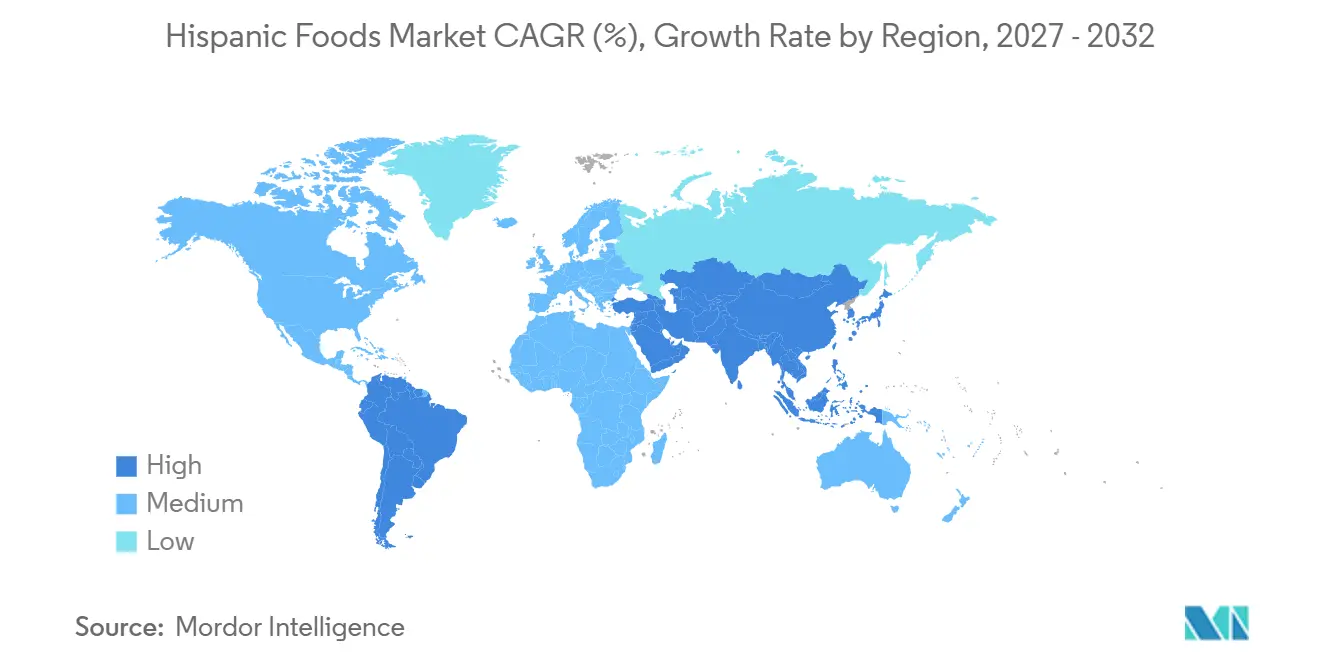
- By geography, North America held 63.33% of the Hispanic foods market share in 2026, while Asia-Pacific is projected to expand at a 7.55% CAGR through 2032.
Note: Market numbers in this report are based on Mordor Intelligence's proprietary estimation framework, which combines nine months of actuals with Q4 projections for base year 2026.
Market Trends and Insights
Drivers Impact Analysis of Hispanic Foods Market*
| Driver | (~) % Impact on CAGR Forecast | Geographic Relevance | Impact Timeline |
|---|---|---|---|
| Growing Hispanic population and demand for traditional foods | +1.5% | North America, with spillover to South America and Middle East and Africa | Long term (≥ 4 years) |
| Increasing mainstream adoption of Hispanic foods | +1.8% | North America and Western Europe | Medium term (2-4 years) |
| Growing preference for healthier and clean-label Hispanic food products | +1.3% | Global, with early gains in North America and Asia-Pacific urban markets | Medium term (2-4 years) |
| Rising demand for convenient and ready-to-eat Hispanic foods | +0.9% | North America and Western Europe | Medium term (2-4 years) |
| Hispanic-inspired flavors in packaged foods | +0.7% | North America, with early-stage adoption in Asia-Pacific and Middle East | Short term (≤ 2 years) |
| Increasing consumer interest in regional Hispanic cuisines | +0.5% | North America, expanding to the United Kingdom, Netherlands, and Australia | Long term (≥ 4 years) |
| Source: Mordor Intelligence | |||
Growing Hispanic Population and Demand for Traditional Foods
The Hispanic foods market benefits from the expanding Hispanic population in the United States, which supports the consumer base for traditional food products. For instance, in August 2026, according to the United States Census Bureau, the Hispanic population reached 70.1 million in July, accounting for 21% of the total United States population [1]. This demographic presence creates opportunities for food manufacturers to offer familiar products such as tortillas, sauces, beans, rice, and prepared meals. Established food traditions and household preferences further contribute to demand for these products, creating a strong foundation for the Hispanic foods market.
Increasing Mainstream Adoption of Hispanic Foods
Hispanic foods are gaining opportunities for broader retail adoption as grocery retailers respond to changing consumer demand and the growing influence of Hispanic shoppers. For instance, in 2026, according to the Food Industry Association's Hispanic grocery Shopper report, Hispanic consumers account for approximately one in five of the United States residents, while Hispanic household consumption has reached US$2.8 trillion and is growing nearly 3 times faster than non-Hispanic consumption [2]. These trends highlight the growing importance of Hispanic consumers to the grocery industry and create opportunities for retailers to expand relevant product assortments.
Growing Preference for Healthier and Clean-Label Hispanic Food Products
Consumers are increasingly prioritizing nutritional value and ingredient transparency, creating opportunities for Hispanic food manufacturers to expand their healthier product offerings. For instance, in 2025, according to the International Food Information Council’s food and health survey, 28% of Americans considered minimal or no processing a characteristic of healthy food, while 25% valued products with limited or no artificial ingredients or preservatives [3]. These preferences encourage manufacturers to offer lower-carbohydrate tortillas, reduced-sodium sauces, and Hispanic food products with simpler ingredient lists, helping brands align traditional flavors with evolving health and wellness preferences.
Rising Demand for Convenient and Ready-to-Eat Hispanic Foods
Busy lifestyles and changing eating habits are increasing the demand for Hispanic food products that require minimal preparation and fit easily into daily routines. Consumers are seeking convenient meal and snack options that offer quick preparation without compromising on taste, quality, and familiar flavors. This is encouraging manufacturers to expand convenient product formats across the Hispanic foods market and cater to different eating occasions, including quick meals and at-home consumption. Improved packaging, easy storage, and simple preparation methods also help make these products more accessible to a wider range of consumers.
Restraints Impact Analysis of Hispanic Foods Market*
| Restraint | (~) % Impact on CAGR Forecast | Geographic Relevance | Impact Timeline |
|---|---|---|---|
| Dependence on imported ingredients and supply chain disruptions | -0.8% | North America, with spillover to Europe and Asia-Pacific | Short term (≤ 2 years) |
| Price sensitivity among core Hispanic consumer segments | -0.5% | North America | Medium term (2-4 years) |
| Diverse regional preferences and challenges in maintaining authenticity | -0.2% | Global | Long term (≥ 4 years) |
| Cold-chain limitations for refrigerated and frozen Hispanic foods outside North America | -0.3% | Asia-Pacific, Middle East and Africa, and South America outside core cities | Medium term (2-4 years) |
| Source: Mordor Intelligence | |||
Dependence on Imported Ingredients and Supply Chain Disruptions
The Hispanic foods market relies on cross-border trade for several ingredients used in sauces, salsas, and prepared foods. Changes in trade policies, import duties, and agricultural production can affect ingredient availability and purchasing costs for manufacturers. These conditions encourage companies to diversify sourcing strategies, strengthen supplier relationships, and improve supply chain planning. Managing ingredient costs is particularly important for products that depend on agricultural inputs, as manufacturers must balance production expenses with competitive retail pricing.
Price Sensitivity Among Core Hispanic Consumer Segments
Price sensitivity remains a challenge in the Hispanic foods market, particularly for everyday products such as tortillas, beans, rice, and basic sauces. When household budgets are under pressure, consumers may switch to lower-priced store brands or choose smaller pack sizes to manage spending. This creates competition between established brands and private-label products, especially in staple food categories where prices are easy to compare. Manufacturers must balance affordability with product quality and the brand value expected by consumers. Offering different pack sizes and price points can help brands serve both budget-conscious shoppers and consumers willing to pay more for premium products.
*Our forecasts treat driver/restraint impacts as directional, not additive. The impact forecasts reflect baseline growth, mix effects, and variable interactions.
Hispanic Foods Market Segment Analysis
By Product Type:
Tortillas Lead While Sauces, Salsas and Dips Expand FastestTortillas and wraps accounted for 33.51% of the Hispanic foods market in 2026 and remain the largest product category. Their use as a flexible alternative to conventional bread also broadens their appeal beyond traditional Mexican cuisine. Manufacturers are catering to diverse consumer preferences through a wide range of offerings, including traditional tortillas, better-for-you varieties, and products focused on freshness and convenience. Continued product development around ingredients, texture, taste, and nutritional benefits allows brands to reach different consumer groups and create distinctive product offerings.
Sauces, salsas, and dips are projected to register at a CAGR of 7.21% through 2032. Sauces, salsas, and dips support growth in the Hispanic foods market by adding distinctive flavors to snacks, home cooking, and everyday meals. These products allow consumers to explore regional Hispanic flavors in familiar, easy-to-use formats. Varieties such as birria sauce, chamoy, salsa macha, and hot sauce offer brands opportunities to differentiate their products through unique flavor profiles and specific culinary uses. Their versatility across sandwiches, eggs, grilled foods, and snacks further broadens their appeal across different eating occasions.

By Cuisine Type:
Mexican Cuisine Provides Scale While Other Cuisines Build DemandMexican cuisine accounted for 58.21% of the Hispanic foods market share in 2026 and remains the largest cuisine category. Mexican cuisine holds a leading position in the Hispanic foods market, supported by widespread consumer familiarity with tacos, tortillas, salsa, beans, and Mexican-style prepared meals. Its established presence in United States restaurants and retail stores supports broad product availability and strong consumer recognition. This creates opportunities for manufacturers to introduce products across multiple categories, including sauces, meal kits, snacks, and refrigerated foods. Retailers can offer a diverse range of Mexican food products to meet demand across different meal occasions and consumer preferences.
Other cuisine types are projected to register at a CAGR of 7.52% through 2032. Sauces, salsas, and dips support growth in the Hispanic foods market. Regional Hispanic cuisines, including Central American, South American, and Caribbean food traditions, are broadening the variety of offerings in the Hispanic foods market. Growing visibility of Cuban, Peruvian, and Colombian flavors in foodservice creates opportunities to introduce related packaged products to consumers. These regional options allow shoppers to explore new tastes while continuing to purchase familiar Mexican food products. Wider availability across mainstream retailers and specialty stores can further improve product accessibility and consumer awareness.
By Format:
Shelf-Stable Products Retain Scale While Frozen Products Gain MomentumAmbient and shelf-stable accounted for 56.88% of the Hispanic foods market share in 2026. Ambient and shelf-stable products play an important role in the Hispanic foods market due to their long shelf life, convenient storage, and wide distribution potential. Products such as beans, sauces, chips, dry grocery items, and seasonings are well-suited to routine household purchases and everyday cooking needs. Their storage flexibility allows retailers to maintain a broad product assortment across different locations, including areas with limited refrigerated infrastructure. These products also appeal to value-conscious consumers by offering pack sizes suitable for different household needs and allowing purchases to be stored for future use.
Frozen is projected to register at a CAGR of 7.15% through 2032. Frozen Hispanic food products are gaining relevance as consumers seek convenient meal options that deliver restaurant-style flavors at home. Products such as tacos, enchiladas, burritos, and pupusas cater to both family meals and individual eating occasions, offering flexibility and ease of preparation. Frozen formats also allow manufacturers to provide a wider variety of Hispanic food products while supporting convenient storage and consumption. Reliable cold-chain infrastructure, including temperature-controlled warehouses, refrigerated transportation, and supermarket freezer facilities, helps maintain product quality and expand distribution.
By Distribution Channel:
Offline Sales Remain Dominant While Online Sales AdvanceOffline accounted for 88.12% of the Hispanic foods market share in 2026. Offline remains important to the Hispanic foods market by providing consumers with convenient access to a wide range of products in one location. Supermarkets, hypermarkets, warehouse clubs, specialty stores, and convenience stores support regular purchases of staple foods and larger household shopping trips. Warehouse clubs offer opportunities for multipack tortillas, sauces, frozen foods, and pantry products, while physical store displays help consumers discover new brands and product varieties. Wider placement across fresh, dairy, refrigerated, and snack sections also allows Hispanic food products to reach consumers beyond traditional ethnic-food aisles.
Online is projected to register at a CAGR of 9.12% through 2032. Online platforms are creating new opportunities for the Hispanic foods market by helping consumers discover regional brands, specialized ingredients, and distinctive flavors that may not be readily available in local stores. Digital platforms also provide smaller manufacturers with an accessible route to reach customers and build brand recognition before expanding into wider retail distribution. Online grocery shopping and product discovery tools allow consumers to explore a broader range of Hispanic food products and find options suited to their preferences. Direct-to-consumer channels can also help manufacturers understand customer feedback and identify demand for specific products and regional cuisines.
Geography Analysis
North America Hispanic Foods Market
North America accounted for 63.33% of the Hispanic Foods market share in 2026. The United States is the primary market, with California, Texas, and Florida as major centers of Hispanic population and demand. Canada offers further growth opportunities, as established Hispanic communities drive demand for traditional food products and encourage broader consumer adoption. Mexico also plays an important role through its domestic packaged-food market and established food production capabilities. Strong retail networks allow manufacturers to distribute Hispanic food products across supermarkets, specialty stores, convenience stores, and other channels.
APAC Hispanic Foods Market
Asia-Pacific is projected to register a CAGR of 7.55% through 2032. Asia-Pacific offers growth opportunities for the Hispanic foods market as restaurants and modern retail introduce consumers to a wider range of international flavors. Markets such as Japan, Australia, South Korea, China, Indonesia, and India offer consumers opportunities to discover products like tacos, hot sauces, and salsas through dining experiences and global food content. This growing awareness can encourage consumers to incorporate packaged Hispanic food products into their regular shopping. Modern retail expansion and interest in diverse flavors further support the region's development.
EMEA and South America Hispanic Foods Market
Shelf-stable products, including sauces, seasonings, and snacks, provide manufacturers with accessible options for entering new markets and adapting to local storage conditions. Europe is expanding its presence in the Hispanic foods market, supported by established consumer communities and growing interest in bold, international flavors across Spain, the United Kingdom, Germany, the Netherlands, and France. Spain benefits from established trade relationships with Mexico, supporting product availability and commercial connections. Growing retail access and consumer interest in diverse food options create opportunities for manufacturers to expand their product offerings across the region. South America also provides opportunities in markets such as Brazil, Argentina, and Colombia, while the Middle East and Africa can benefit from expatriate communities and the development of modern retail networks.
Competitive Landscape
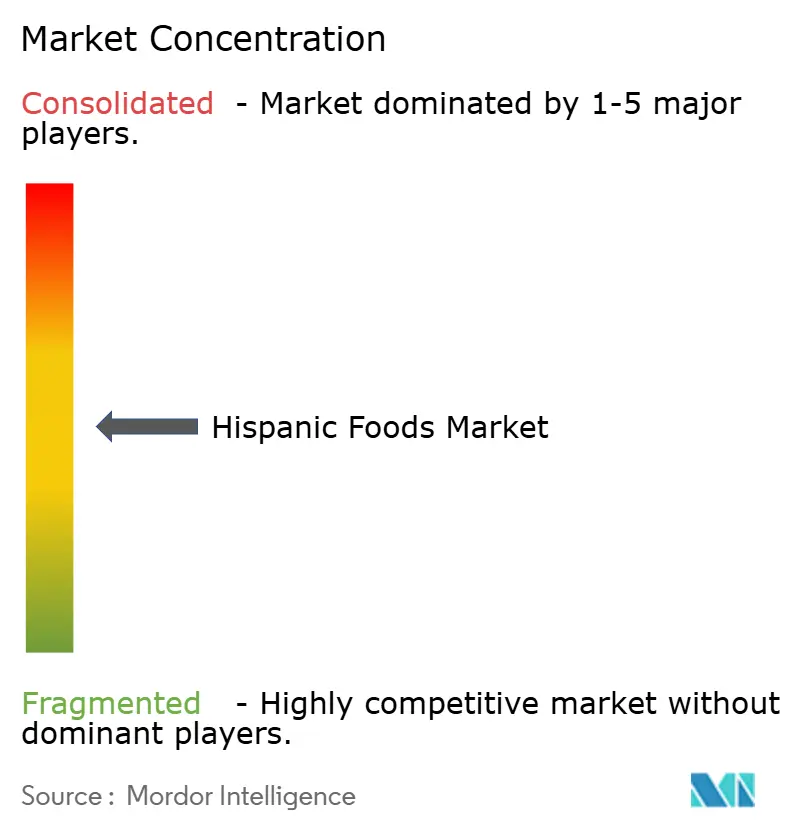
The Hispanic foods market is moderately fragmented, with established companies such as GRUMA, Goya Foods, General Mills, PepsiCo, and Grupo Herdez competing alongside numerous regional and specialty producers. While larger companies benefit from established distribution networks, procurement capabilities, and relationships with retailers, smaller players contribute through authentic regional flavors, specialized product offerings, and niche-market expertise. Competition spans categories such as tortillas, sauces, snacks, and frozen foods, with brands differentiating themselves through product quality, flavor variety, and consumer recognition.
Leading companies in the Hispanic foods market are strengthening their positions through acquisitions, product innovation, and distribution expansion. PepsiCo’s acquisition of Siete Foods expanded its portfolio with grain-free tortillas, enchilada sauces, taco seasonings, and salsas, while providing opportunities to increase product reach through its extensive distribution network. McCormick is also strengthening its presence in Mexican flavors and condiments by increasing its ownership of McCormick de Mexico. GRUMA continues to focus on product innovation and distribution capabilities to support its tortilla business.
These developments highlight how established companies are expanding their product portfolios, improving market reach, and responding to evolving consumer preferences. Acquisition activity in the Hispanic foods market reflects growing interest in brands that combine authentic flavors with opportunities for wider distribution. Nuevo Garcia Foods’ acquisition of Texas Tamale Company expanded its portfolio with premium tamales while connecting the brand with broader manufacturing capabilities. Similarly, Vilore Foods’ acquisition of Tia Lupita Foods added better-for-you hot sauces, grain-free cactus tortilla chips, and Mexican chili crunch to its product range. These developments highlight opportunities for companies to strengthen their portfolios and expand access to distinctive Hispanic food products.
Hispanic Foods Industry Leaders
-
Goya Foods, Inc.
-
GRUMA, S.A.B. de C.V.
-
PepsiCo, Inc. (Siete Foods)
-
Grupo Bimbo, S.A.B. de C.V.
-
General Mills, Inc. (Old El Paso)
- *Disclaimer: Major Players sorted in no particular order
Hispanic Foods Market Companies Covered in this Report
- Goya Foods, Inc.
- GRUMA, S.A.B. de C.V.
- PepsiCo, Inc. (Siete Foods)
- Grupo Bimbo, S.A.B. de C.V.
- General Mills, Inc. (Old El Paso)
- Grupo Herdez, S.A.B. de C.V.
- Corporación Multi Inversiones (CMI) (Del Real Foods)
- Hormel Foods Corporation (MegaMex Foods, LLC)
- B&G Foods, Inc. (Ortega)
- Conservas La Costeña, S.A. de C.V.
- McCormick & Company, Incorporated (Cholula)
- The Campbell's Company (Pace)
- Conagra Brands, Inc. (Frontera)
- Olé Mexican Foods, Inc.
- La Tortilla Factory
- El Milagro Company
- Sigma Alimentos, S.A.B. de C.V.
- Ruiz Food Products, Inc. (Ruiz Foods)
- Reynaldo's Mexican Food Company, LLC
- Cacique Foods, LLC
Recent Industry Developments in Hispanic Foods Market
- October 2026: 7-Eleven launched Selección 7, a Hispanic-inspired private-label product line featuring packaged baked goods, salty snacks, and candy. Products include conchas, mantecadas, and pecan pound cake, available at participating 7-Eleven, Stripes, and Speedway stores across the United States.
- February 2026: Dawn Foods expanded its Hispanic bakery offerings to include frozen conchas and mantecadas for bakeries across the United States. The products help bakery operators simplify preparation, improve production consistency, and offer traditional Hispanic bakery items.
- August 2025: Tyson Foods introduced Buena Mesa, a Hispanic-inspired brand featuring 22 products, including marinated, pre-seasoned proteins such as fajitas, carnitas, barbacoa, al pastor, and pollo asado, as well as ready-to-heat appetizers. The products were launched in more than 450 Walmart stores across Texas.
Global Hispanic Foods Market Report Scope
The Hispanic foods market includes traditional and modern food products inspired by Hispanic cuisines. The market is segmented by Product Type, Cuisine Type, Format, Distribution Channel, and Geography. Product types include tortillas and wraps, sauces, salsas and dips, beans, rice and dry grocery, and other Hispanic food. Cuisine types include Mexican, Hispanic Caribbean, Central American, South American, and other cuisine types. Formats include ambient and shelf-stable, frozen, fresh and prepared, and other formats. Distribution channels include online and offline. Geographically, the market covers North America, Europe, Asia-Pacific, South America, and the Middle East and Africa. Market forecasts are provided in value (USD).
Segmentation Overview
| Tortillas and Wraps |
| Sauces, Salsas and Dips |
| Beans, Rice and Dry Grocery |
| Other Hispanic Food |
| Mexican |
| Hispanic Caribbean |
| Central American |
| South American |
| Other Cuisine Types |
| Ambient and Shelf-Stable |
| Frozen |
| Fresh and Prepared |
| Other Format |
| Online | |
| Offline | Supermarkets/Hypermarkets |
| Hispanic Specialty Stores | |
| Convenience Stores | |
| Ethnic Food Stores | |
| Other Distribution Channel |
| North America | United States |
| Canada | |
| Mexico | |
| Rest of North America | |
| Europe | Germany |
| United Kingdom | |
| Italy | |
| France | |
| Spain | |
| Netherlands | |
| Rest of Europe | |
| Asia-Pacific | India |
| Japan | |
| Australia | |
| China | |
| Indonesia | |
| South Korea | |
| Rest of Asia-Pacific | |
| South America | Brazil |
| Argentina | |
| Colombia | |
| Rest of South America | |
| Middle East and Africa | South Africa |
| Saudi Arabia | |
| United Arab Emirates | |
| Nigeria | |
| Egypt | |
| Turkey | |
| Rest of Middle East and Africa |
| By Product Type | Tortillas and Wraps | |
| Sauces, Salsas and Dips | ||
| Beans, Rice and Dry Grocery | ||
| Other Hispanic Food | ||
| By Cuisine Type | Mexican | |
| Hispanic Caribbean | ||
| Central American | ||
| South American | ||
| Other Cuisine Types | ||
| By Format | Ambient and Shelf-Stable | |
| Frozen | ||
| Fresh and Prepared | ||
| Other Format | ||
| By Distribution Channel | Online | |
| Offline | Supermarkets/Hypermarkets | |
| Hispanic Specialty Stores | ||
| Convenience Stores | ||
| Ethnic Food Stores | ||
| Other Distribution Channel | ||
| By Geography | North America | United States |
| Canada | ||
| Mexico | ||
| Rest of North America | ||
| Europe | Germany | |
| United Kingdom | ||
| Italy | ||
| France | ||
| Spain | ||
| Netherlands | ||
| Rest of Europe | ||
| Asia-Pacific | India | |
| Japan | ||
| Australia | ||
| China | ||
| Indonesia | ||
| South Korea | ||
| Rest of Asia-Pacific | ||
| South America | Brazil | |
| Argentina | ||
| Colombia | ||
| Rest of South America | ||
| Middle East and Africa | South Africa | |
| Saudi Arabia | ||
| United Arab Emirates | ||
| Nigeria | ||
| Egypt | ||
| Turkey | ||
| Rest of Middle East and Africa | ||
Key Questions Answered in the Report
How large is the Hispanic foods market?
The market was valued at USD 52.71 billion in 2026 and is expected to reach USD 75.29 billion by 2032 at a 6.14% CAGR.
What is driving growth in Hispanic foods?
Growth is supported by the expanding United States Hispanic population, broader mainstream adoption, convenient meal formats, and better-for-you product development.
Which region offers the fastest growth?
Asia-Pacific is expected to grow at a 7.55% CAGR through 2032, helped by modern retail, foodservice exposure, and interest in global flavors.
What are the main risks for Hispanic food producers?
Imported ingredient exposure, trade disruption, consumer price sensitivity, and cold-chain gaps for frozen and refrigerated products remain the key risks.