
High Speed Motors Market Size and Share
Market Overview
| Study Period | 2022 - 2032 |
|---|---|
| Market Size (2027) | USD 13.88 Billion |
| Market Size (2032) | USD 21.42 Billion |
| Growth Rate (2027 - 2032) | 9.07 % |
| Fastest Growing Market | Asia-Pacific |
| Largest Market | Asia-Pacific |
| Market Concentration | Medium |
Major Players *Disclaimer: Major Players sorted in no particular order Image © Mordor Intelligence. Reuse requires attribution under CC BY 4.0. | |
High Speed Motors Market Analysis by Mordor Intelligence
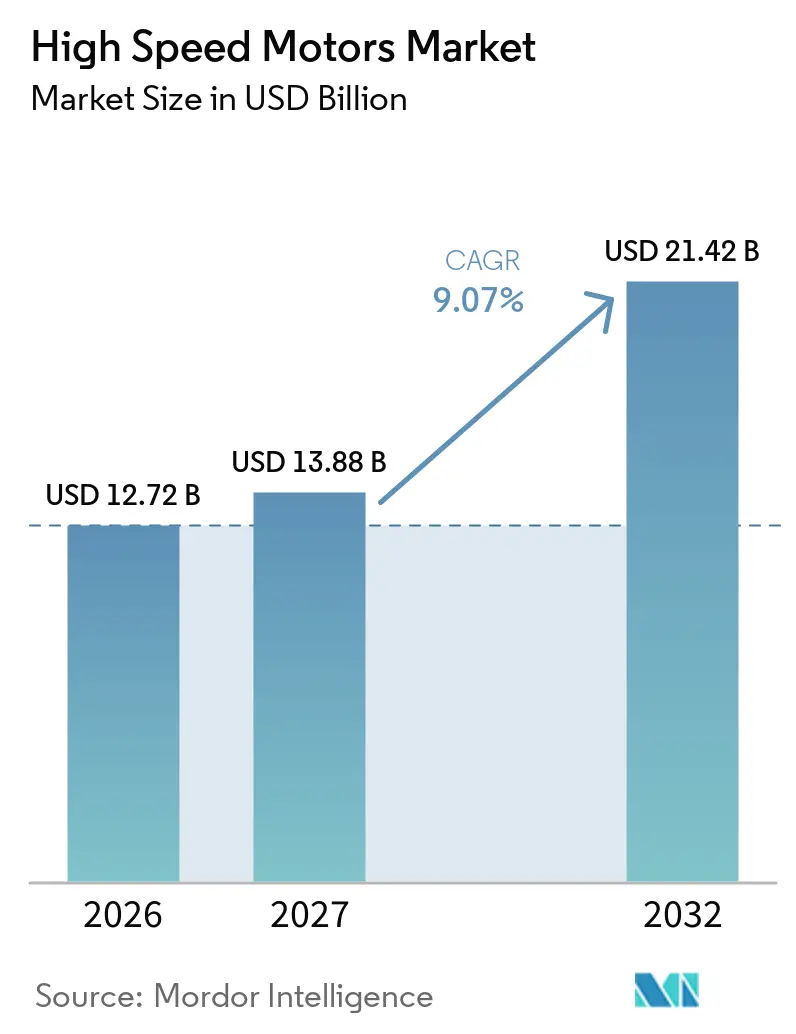
The High Speed Motors Market size is expected to grow from USD 12.72 billion in 2026 to USD 13.88 billion in 2027 and is forecast to reach USD 21.42 billion by 2032 at 9.07% CAGR over 2027-2032. The global high speed motors market is moving toward direct-drive equipment, which places more performance responsibility on the motor and reduces reliance on geared assemblies. Industrial automation, vehicle electrification, and more capable inverter electronics are supporting demand for motors that can sustain high rotational speeds. These forces also favor suppliers that can combine motors, drives, thermal protection, and monitoring functions into one validated package. Product development is increasingly tied to rotor containment, bearing reliability, insulation durability, and cooling performance. The global high speed motors market therefore offers opportunities for established suppliers with system capabilities and for specialists that solve specific mechanical or electrical constraints.
Key Report Takeaways
- By motor type, AC motors held 74.2% of the global high speed motors market share in 2026 and are forecast to grow at a 9.4% CAGR through 2032.
- By voltage range, low-voltage motors accounted for 95.4% of the global high speed motors market share in 2026 and are forecast to grow at a 9.7% CAGR through 2032.
- By end-user industry, industrial users held 65.2% of the global high speed motors market share in 2026 and are forecast to expand at a 9.5% CAGR through 2032.
- By geography, Asia-Pacific held 44.2% of the global high speed motors market share in 2026 and is projected to grow at a 10.7% CAGR through 2032.
Note: Market numbers in this report are based on Mordor Intelligence's proprietary estimation framework, which combines nine months of actuals with Q4 projections for base year 2026.
Market Trends and Insights
Drivers Impact Analysis of High Speed Motors Market*
| Driver | (~) % Impact on CAGR Forecast | Geographic Relevance | Impact Timeline |
|---|---|---|---|
| Industrial Automation and Precision Manufacturing Expansion | +2.1% | Global, led by Asia-Pacific and North America | Medium term (2-4 years) |
| Electrification of Vehicles, Aerospace Systems, and Auxiliary Power Units | +1.8% | Asia-Pacific for EV platforms, North America and Europe for aerospace | Long term (≥ 4 years) |
| Energy Efficiency Demand and Gearbox Elimination | +1.4% | Global | Medium term (2-4 years) |
| High-Speed Compressor and Turbomachinery Deployment | +1.2% | Global, concentrated in Middle East and Africa, Europe, and Asia-Pacific | Long term (≥ 4 years) |
| Integrated Motor-Drive Packages for Space-Constrained Equipment | +0.8% | Asia-Pacific and North America | Short term (≤ 2 years) |
| Wide-Bandgap Power Electronics Enabling Higher Operating Speeds | +1% | Global | Medium term (2-4 years) |
| Source: Mordor Intelligence | |||
Industrial Automation and Precision Manufacturing Expansion
Capital spending on semiconductor fabrication, battery-cell production, and logistics automation is giving the global high speed motors market a durable demand base. Wafer-handling systems, electrode coating lines, and high-speed sortation conveyors need motors that operate continuously with controlled heat and vibration. Minor deviations can stop a production line, which raises the value of active bearing monitoring and integrated thermal protection. China’s general-purpose AC servo market grew 7.4% year over year in the first half of 2025, while linear motor demand rose 8%, reflecting continued investment in semiconductor, electronics, and advanced battery capacity. Connected controls, encoder data, and predictive maintenance systems help operators improve availability and assess lifecycle cost more clearly. This environment supports suppliers that can document precision, uptime, and service performance rather than compete only on initial price.
Electrification of Vehicles, Aerospace Systems, and Auxiliary Power Units
Vehicle electrification is shifting high-speed motor development into a range previously associated with aerospace equipment. BYD, Xiaomi, and GAC announced traction motor platforms exceeding 30,000 rpm in 2025, increasing the need for rotor containment and advanced inverter control. GE Aerospace is progressing megawatt-class hybrid-electric powertrain demonstrators that integrate motor-generators into turbofan-related architectures with NASA and Boeing. Research on electric aircraft propulsion identifies superconducting motors and permanent magnet synchronous motors as important technologies, with silicon carbide and gallium nitride electronics supporting their operation.[1] Auxiliary power unit electrification also replaces pneumatic starters with high-speed motor-generators in commercial and military aircraft. These requirements extend the global high speed motors market into applications where qualification, safety, and power density carry substantial weight.
Energy Efficiency Demand and Gearbox Elimination
Direct-drive motor configurations reduce drivetrain losses and remove gearbox maintenance requirements in appropriate applications. This matters most in continuous-process sites where unplanned downtime can be costly and where equipment availability influences plant economics. Efficiency rules are supporting replacement cycles, including China introduced its GB 30253-2024 standard for permanent magnet synchronous motors, which took effect in October 2025. ABB expanded its IE5 synchronous reluctance motor portfolio in September 2025, adding smaller frame sizes and extending ultra-premium efficiency across a 0.75 kW to 450 kW range.[2] The magnet-free design also reduces exposure to rare-earth material constraints. In the global high speed motors market, energy savings and simpler mechanical layouts strengthen the case for qualified direct-drive equipment.
High-Speed Compressor and Turbomachinery Deployment
High-speed direct-drive motors are used in air separation, fuel-cell compressors, and industrial process compression. Their appeal comes from lower drivetrain losses, fewer gearbox-related maintenance needs, and a smaller equipment footprint. Research on hydrogen fuel-cell aircraft presented an ultra-high-speed centrifugal air compressor operating at 150,000 rpm, showing the demanding operating conditions under development.[3] Shanghai Electric introduced a domestically produced 40 MW-class air separation electric drive and a 9,540 rpm direct-drive motor for a nitric acid compressor train in September 2025.[4] API 546 and IEC 60034-1 requirements raise qualification expectations for suppliers serving these uses. The global high speed motors market benefits where compressor projects value reliability, plant availability, and certified mechanical performance.
Restraints Impact Analysis of High Speed Motors Market*
| Restraint | (~) % Impact on CAGR Forecast | Geographic Relevance | Impact Timeline |
|---|---|---|---|
| High Initial Cost and Engineering Complexity | -1.2% | Global, most acute in emerging markets and mid-tier industrial users | Long term (≥ 4 years) |
| Rotor Integrity, Overspeed Qualification, and Containment Requirements | -0.6% | Global | Medium term (2-4 years) |
| Thermal Management and High-Frequency Losses | -0.5% | Global | Short term (≤ 2 years) |
| Rare-Earth Magnet, Copper, and Precision-Bearing Supply Exposure | -0.8% | Global, with the highest impact outside China | Medium term (2-4 years) |
| Source: Mordor Intelligence | |||
High Initial Cost and Engineering Complexity
High-speed systems require more engineering than standard induction motor installations. Their cost includes rotor-dynamic analysis, precision bearings, custom enclosures, and matched variable-frequency drives. Projects often need specialized overspeed testing, electromagnetic and mechanical design iterations, and extended factory acceptance procedures. These requirements can limit adoption among smaller operators that assess investments against a 36-month payback period. At speeds of 20,000 revolutions per minute (rpm) to 30,000 rpm, insulation qualification and retaining-sleeve stress analysis add further cost and lead time. Pre-engineered packages with validated drive matching and qualification documents can reduce this barrier, but they do not remove the need for careful application engineering.
Rare-Earth Magnet, Copper, and Precision-Bearing Supply Exposure
Supply exposure remains a material constraint for manufacturers using permanent magnets and specialized bearing systems. China’s 2025 export licensing controls caused a sharp reduction in rare-earth magnet shipments at the peak of disruption, prompting manufacturers to qualify other supply channels. ABB’s SynRM (synchronous reluctance motor) range provides an ultra-premium-efficiency alternative without rare-earth magnets. Nidec Motor Corporation signed a five-year agreement for more than 1,000 tons of U.S.-manufactured sintered neodymium-iron-boron magnets, with deliveries beginning in 2025. Copper price changes and lead times for ceramic or hybrid bearings rated above 15,000 rpm add to procurement risk. These conditions encourage long-term supply agreements, dual sourcing, and motor designs that use less constrained materials.
*Our forecasts treat driver/restraint impacts as directional, not additive. The impact forecasts reflect baseline growth, mix effects, and variable interactions.
High Speed Motors Market Segment Analysis
By Motor Type:
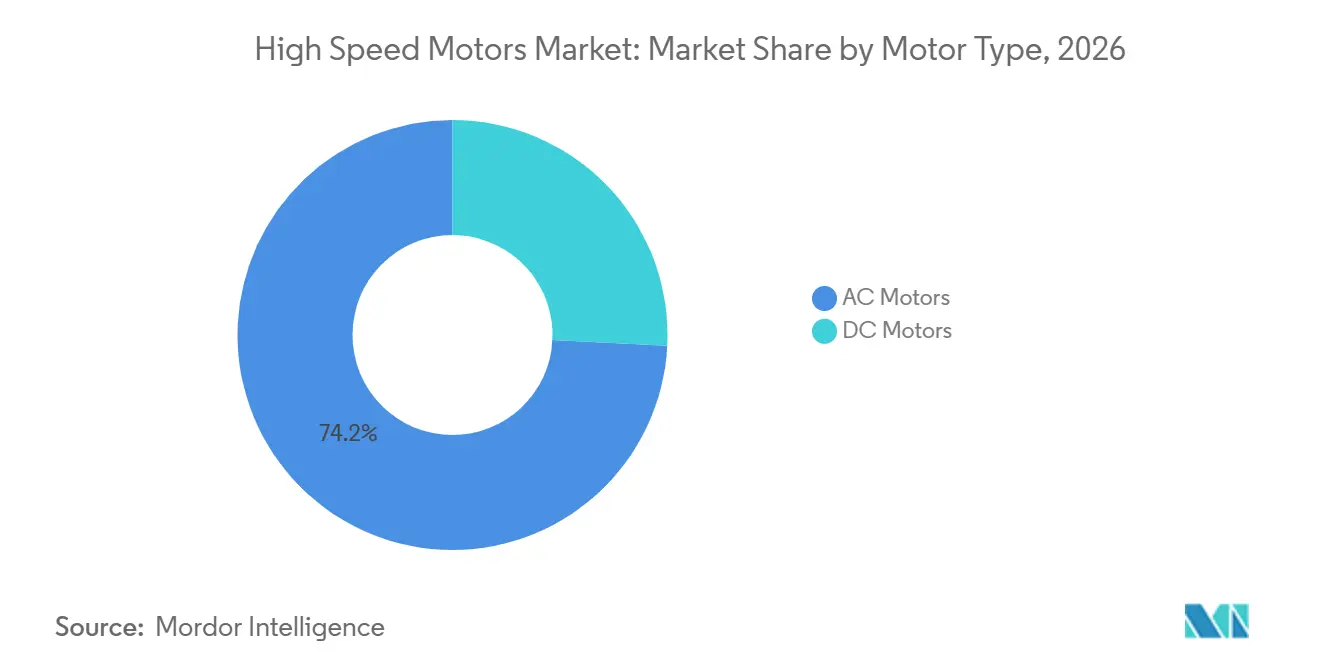
AC Architecture Anchors Both Scale and Speed LeadershipAC motors held 74.2% of the global high speed motors market share in 2026 and were also the fastest-growing motor type. This position keeps competition focused on efficiency, thermal performance, and control integration within a single technology family. Permanent magnet synchronous motors and synchronous reluctance motors are replacing older induction motors in many applications above 5,000 rpm. Their torque-to-volume performance and partial-load efficiency are relevant in compact equipment and continuous-duty systems. ABB broadened its IE5 synchronous reluctance range to 0.75 kW to 450 kW in September 2025, including 3 smaller frame sizes. The product line is magnet-free, which links efficiency improvements with lower rare-earth material exposure.
China’s GB 30253-2024 efficiency standard is renewing attention on the premium tier of permanent magnet synchronous motors. The standard became effective in October 2025 and supports fleet replacement where older motors no longer meet expected efficiency levels. Mitsubishi Electric’s MELSERVO-JET platform reaches a 3.2 kHz speed frequency response and a 6,700 rpm maximum speed, while incorporating safety functions and 24-bit battery-less encoders. Such capabilities are relevant for precision manufacturing and collaborative robotics. DC motors retain roles in battery-powered mobile equipment and precision positioning. However, inverter cost reductions and more capable controls continue to support AC designs across the global high speed motors market.

By Voltage Range:
Low-Voltage Ecosystem Drives Universal PenetrationLow-voltage products represented 95.4% of the global high speed motors market size in 2026 and are expected to remain the fastest-growing voltage category through 2032. Standard three-phase grids support their use across EV auxiliary drives, robotic joints, HVAC compressors, and industrial spindles. ABB launched its Low Voltage (LV) Titanium Variable Speed Motor in June 2025 as an integrated IE5 motor-drive platform covering 1.5 kW to 30 kW and speeds from 1,500 rpm to 4,500 rpm. The package is intended to simplify installation and extend motor-drive integration into common industrial uses. Its design illustrates why low-voltage products reach a broad group of customers. It also shows how suppliers can capture more system value through integrated offerings.
Medium-voltage motors remain important in large compressors and turbomachinery for petrochemical, mining, and power generation facilities. Their applications are narrower and tend to follow longer project cycles, which limits their share relative to low-voltage equipment. High-voltage motors serve grid-connected generators and large utility machinery where voltages above 6 kV meet transmission and site requirements. International Electrotechnical Commission (IEC) 60034-1 and national grid codes define insulation and protection requirements in these installations. Siemens completed the acquisition of ebm-papst’s industrial drive technology business in July 2025 and incorporated the 24 V and 48 V brushless systems into its Simotics E portfolio. The move shows that high-speed applications also extend into lower-voltage automated guided vehicles and intralogistics equipment.
By End-User Industry:
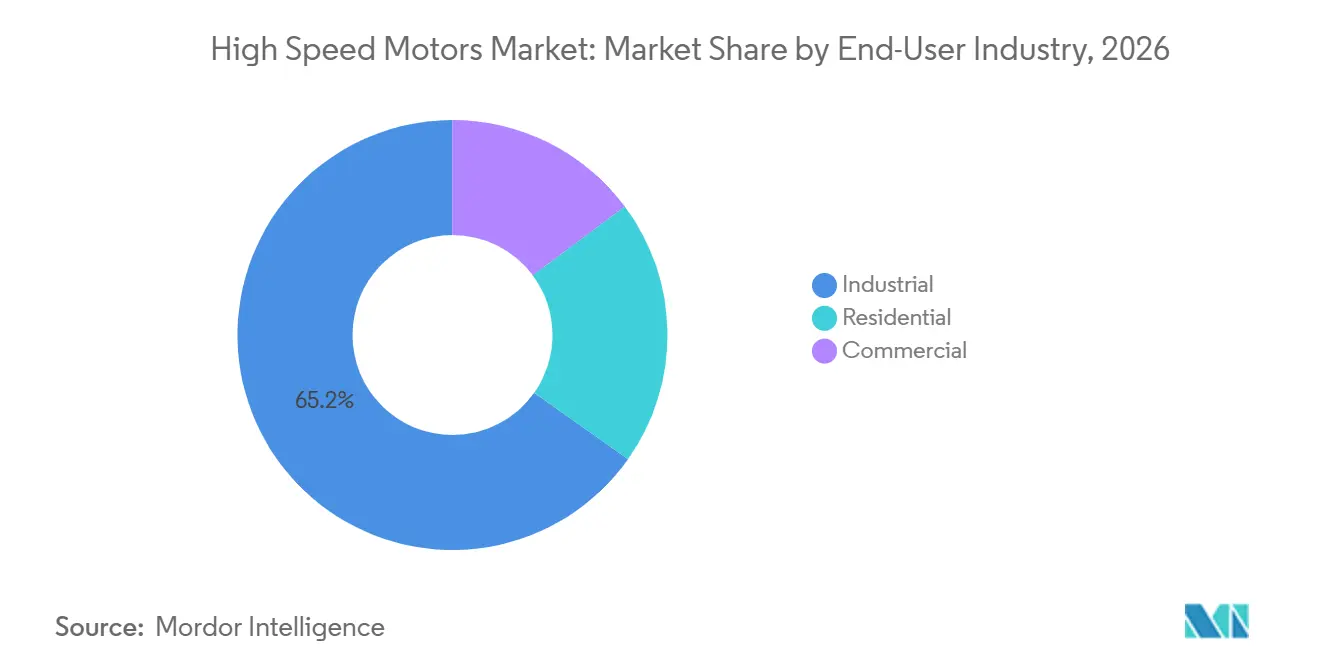
Industrial Demand Sets the Ceiling and the PaceIndustrial users held 65.2% of the global high speed motors market size in 2026 and are projected to be the fastest-growing end-user group through 2032. This group includes CNC machine tools, centrifugal compressors, turboblowers, industrial robots, and semiconductor process equipment. These applications require continuous operation, accuracy, and long service intervals. Gearbox removal in compressor and blower systems reduces maintenance work, installation footprint, and mechanical vibration. A fuel-cell air-compressor platform described in SAE Technical Paper 2025-01-8547 reported 99% silicon carbide controller efficiency and 95% system efficiency. Advanced manufacturing investment is supporting both replacement of installed equipment and new application requirements in the global high speed motors market.
Commercial users form the next important demand pool, particularly in Heating, ventilation, and air conditioning (HVAC) equipment, data-center cooling, medical systems, and precision instruments. Smaller equipment size, lower noise, and efficiency shape purchase decisions in these settings. Healthcare and semiconductor equipment are growing faster than the overall market, as their equipment needs favor compact and precise motor systems. Residential applications remain smaller and are concentrated in efficient appliance compressors and ventilation fans. Energy-labeling programs are moving some cost-sensitive buyers toward premium motor-equipped products as energy costs affect payback periods. The different operating needs of industrial, commercial, and residential users require suppliers to balance high-performance engineering with simpler, scalable product designs.
Geography Analysis
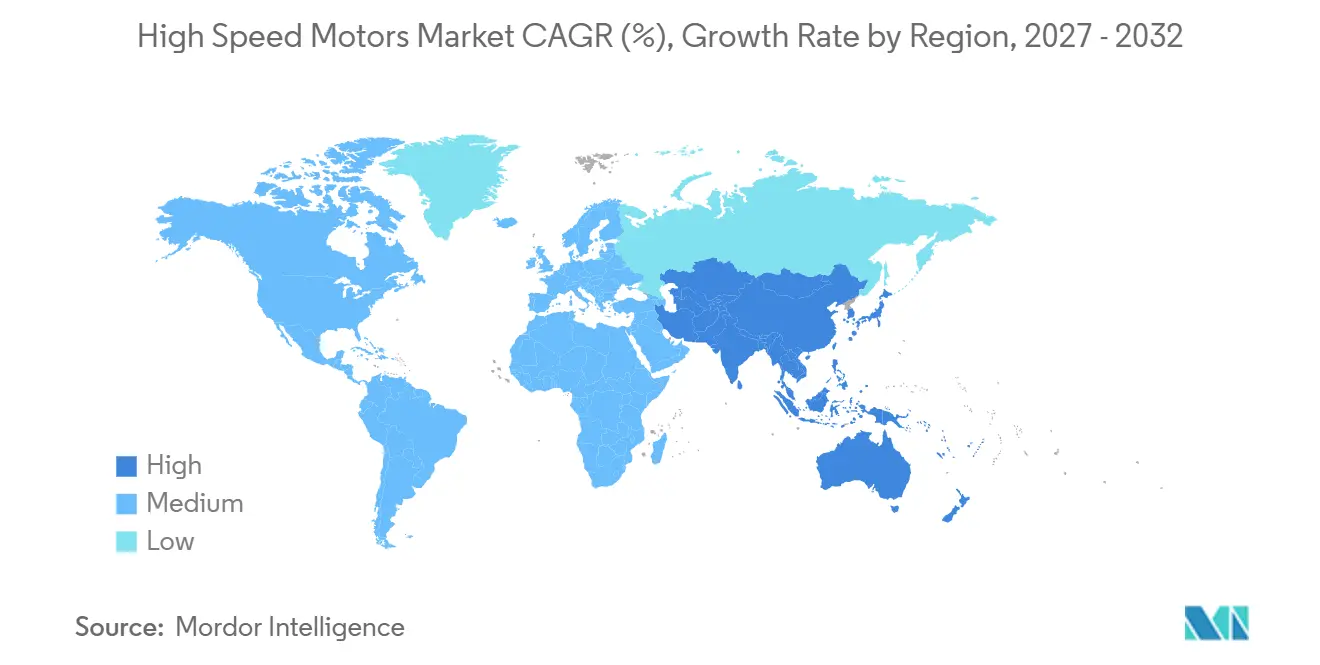
Asia-Pacific held 44.2% of the global high speed motors market share in 2026 and is projected to grow at a 10.7% CAGR through 2032. The region combines EV production, industrial robot deployment, and semiconductor fabrication at a scale that supports both demand and local product development. Xiangdian Group opened a high-speed motor manufacturing base in Hunan in 2025 for traction, aviation, and magnetic-levitation motor work with Huazhong University of Science and Technology. Japan and South Korea contribute demand through precision machine tools and advanced robotics. Yaskawa Electric and Mitsubishi Electric remain active in servo systems at the upper end of Alternating current (AC) motor speed capability. India is emerging as a secondary growth area through manufacturing, defense, and EV activity.
North America and Europe are the next largest regional areas for the global high speed motors market. North American demand is linked to energy-transition investment, industrial upgrades, and aerospace programs. GE Aerospace is developing megawatt-class hybrid-electric powertrain demonstrators that integrate motor-generators with CT7 turboshaft engines. Domestic manufacturing incentives add to the case for high-efficiency motors in the North American industrial base. European demand is concentrated in Germany, France, and the United Kingdom, where energy-efficiency and decarbonization requirements support direct-drive solutions. ABB completed its acquisition of Gamesa Electric’s power electronics business in December 2025, expanding its renewable power-conversion service reach.
South America and the Middle East and Africa have smaller positions but remain relevant to specific applications. Brazil’s mining, agri-processing, and oil and gas activities support demand for compressor and pump drives. The Middle East has a strong base in oil and gas compression, especially in Saudi Arabia and the United Arab Emirates. Morocco and South Africa offer developing precision-manufacturing opportunities that could broaden regional demand. High-speed motor deployment in these locations depends on project investment, local service access, and the need for reliable equipment in demanding operating conditions. The geographic pattern shows that large industrial programs and application-specific needs matter more than uniform regional adoption.
Competitive Landscape
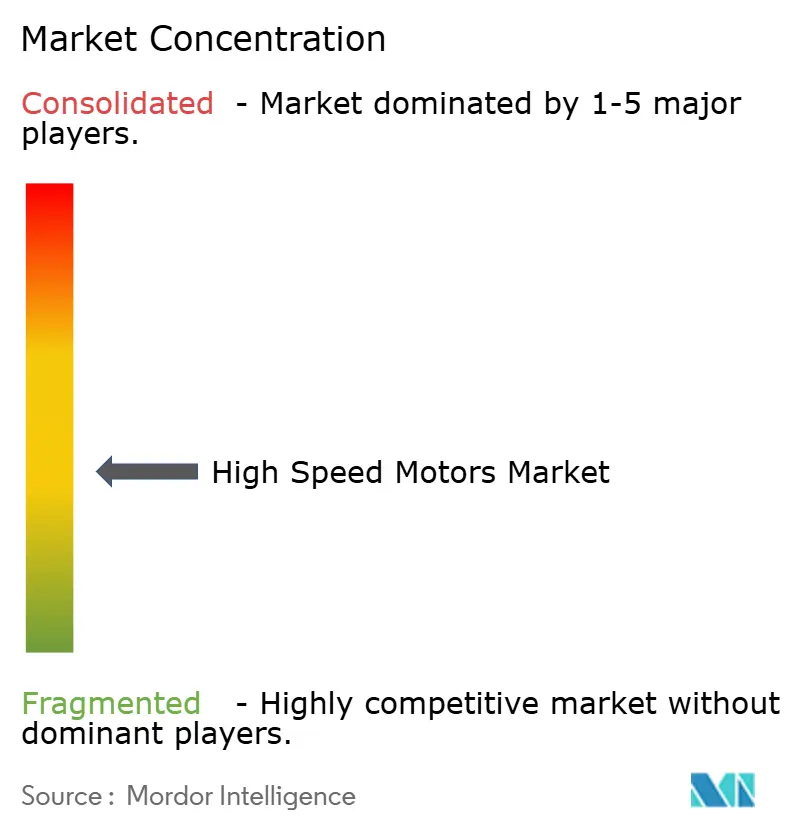
The global high speed motors market is moderately consolidated at the system-integration level. ABB, Siemens, Nidec, Yaskawa, and Mitsubishi Electric hold leading positions through broad portfolios, service networks, and certified motor-drive combinations. These capabilities matter because high-speed applications require coordination between the motor, inverter, bearings, cooling, and safety functions. ABB is combining efficiency and system integration through its Low Voltage (LV) Titanium Variable Speed Motor and its magnet-free high-efficiency synchronous reluctance products. Its 2025 portfolio expansion brought smaller frame sizes into the IE5 SynRM range. This approach addresses both energy use and material-supply concerns.
Siemens expanded its industrial drive technology scope when it completed the ebm-papst industrial drive technology acquisition in July 2025. The business was integrated as Simotics E and includes 24 V and 48 V brushless motor systems for automated guided vehicles and intralogistics. The move strengthens Siemens’ connection between automation systems and mobile robotics drives. Nidec is also addressing supply-chain resilience through its long-term agreement for U.S.-manufactured rare-earth magnets. Smaller suppliers with magnetic-levitation bearing capabilities can compete in compressor and blower uses where maintenance-free operation supports a higher purchase cost. The global high speed motors market therefore has room for specialists, although qualification requirements remain a barrier.
Hydrogen applications, including fuel-cell air compressors, electrolysis blowers, and pipeline compressors, remain less developed than their projected demand suggests. Many existing designs were adapted from nearby applications instead of being designed solely for hydrogen service. The electric vertical take-off and landing (eVTOL) propulsion field is attracting companies with structural certification and overspeed qualification experience. Rotor retention above 50,000 r/min and active magnetic-bearing control are important technical areas for new entrants. Research presented through IEEE forums in 2025 also points to the role of multiphysics simulation in shortening motor qualification work.
High Speed Motors Industry Leaders
-
Siemens AG
-
ABB Ltd.
-
Nidec Corporation
-
Mitsubishi Electric Corporation
-
Regal Rexnord Corporation
- *Disclaimer: Major Players sorted in no particular order
High Speed Motors Market Companies Covered in this Report
- ABB Ltd.
- Allied Motion Technologies Inc.
- Delta Electronics, Inc.
- Fuji Electric Co., Ltd.
- Hitachi, Ltd.
- Johnson Electric Holdings Limited
- Kollmorgen Corporation
- Maxon International AG
- Mitsubishi Electric Corporation
- Moog Inc.
- Nidec Corporation
- Oriental Motor Co., Ltd.
- Parker-Hannifin Corporation
- Regal Rexnord Corporation
- Robert Bosch GmbH
- Schneider Electric SE
- Siemens AG
- Toshiba Corporation
- WEG S.A.
- Yaskawa Electric Corporation
Recent Industry Developments in High Speed Motors Market
- December 2025: ABB completes acquisition of Gamesa Electric's power electronics business (Siemens Gamesa, Spain): The portfolio, covering wind converters, battery energy storage inverters, and solar inverters, reported annual revenues of EUR 145 million. The deal increases ABB's serviceable installed base of wind converters by 46 GW and extends its motor-drive integration reach into renewable power conversion globally.
- December 2025: Siemens Limited (India) Board approves INR 2,200 crore (USD 262 million) sale of Low Voltage Motors and Geared Motors business to Innomotics India: Subject to Competition Commission of India clearance, the transaction consolidates Siemens' India motor manufacturing operations under the dedicated Innomotics entity carved out from the global motor’s separation, closing was expected by June 2026.
- September 2025: Shanghai Electric debuts China's first domestically produced large-scale air separation electric drive and ultra-high-speed direct-drive motor series: The 40 MW-class air separation drive is China's first demonstration at that power scale in coal chemical applications, and the companion ultra-high-speed direct-drive motor at 9,540 rpm for a nitric acid four-in-one compressor train replaced previously imported units, marking full domestic localization of that segment.
- August 2025: Regal Rexnord and ABB Robotics certify first collaborative robot seventh-axis integration: The Thomson Movotrak Cobot Transfer Unit became the first seventh-axis technology certified within the ABB Robotics partner ecosystem, integrating Kollmorgen motors, Boston Gear gearheads, and Huco couplings in a pre-configured, single-part-number assembly for multi-workstation cobot deployment.
Global High Speed Motors Market Report Scope
A high-speed motor is an electric motor that typically operates at a rotational speed exceeding 10,000 revolutions per minute (RPM), with many advanced or specialized industrial models running at 20,000 RPM to over 100,000 RPM.
The high-speed motors market is segmented into motor type, voltage range, end-user industry, and geography. By motor type, the market is segmented into AC Motors and DC Motors. By voltage range, the market is divided into low voltage, medium voltage, and high voltage. By end-user industry, the market is segmented into residential, commercial, and industrial. The report also covers the market size and forecasts for the global high-speed motors market across 26 countries in key regions. For each segment, the market sizing and forecasts have been provided on the basis of value (USD).
Segmentation Overview
| AC Motors |
| DC Motors |
| Low Voltage |
| Medium Voltage |
| High Voltage |
| Residential |
| Commercial |
| Industrial |
| North America | United States |
| Canada | |
| Mexico | |
| Europe | Germany |
| France | |
| Italy | |
| Spain | |
| United Kingdom | |
| Poland | |
| Russia | |
| Rest of Europe | |
| Asia-Pacific | China |
| India | |
| Japan | |
| South Korea | |
| Australia | |
| Indonesia | |
| Vietnam | |
| Thailand | |
| Rest of Asia-Pacific | |
| South America | Brazil |
| Argentina | |
| Chile | |
| Rest of South America | |
| Middle East and Africa | Saudi Arabia |
| United Arab Emirates | |
| Egypt | |
| South Africa | |
| Morocco | |
| Rest of Middle East and Africa |
| By Motor Type | AC Motors | |
| DC Motors | ||
| By Voltage Range | Low Voltage | |
| Medium Voltage | ||
| High Voltage | ||
| By End-User Industry | Residential | |
| Commercial | ||
| Industrial | ||
| By Geography | North America | United States |
| Canada | ||
| Mexico | ||
| Europe | Germany | |
| France | ||
| Italy | ||
| Spain | ||
| United Kingdom | ||
| Poland | ||
| Russia | ||
| Rest of Europe | ||
| Asia-Pacific | China | |
| India | ||
| Japan | ||
| South Korea | ||
| Australia | ||
| Indonesia | ||
| Vietnam | ||
| Thailand | ||
| Rest of Asia-Pacific | ||
| South America | Brazil | |
| Argentina | ||
| Chile | ||
| Rest of South America | ||
| Middle East and Africa | Saudi Arabia | |
| United Arab Emirates | ||
| Egypt | ||
| South Africa | ||
| Morocco | ||
| Rest of Middle East and Africa | ||
Key Questions Answered in the Report
What is the projected value of the global high speed motors market by 2032?
The global high speed motors market is projected to reach USD 21.42 billion by 2032, from USD 12.72 billion in 2026, at a 9.07% CAGR from 2027 to 2032.
Which motor type leads high-speed applications?
AC motors led with 74.2% share in 2026 and are also the fastest-growing motor type through 2032. Permanent magnet synchronous and synchronous reluctance designs are becoming more important above 5,000 rpm.
Why are direct-drive motors gaining adoption?
Direct-drive systems can reduce drivetrain losses, remove gearbox maintenance needs, lower vibration, and support more compact equipment designs. These benefits are important for compressors, blowers, and other continuous-duty equipment.
Which voltage range has the broadest demand?
Low-voltage motors accounted for 95.4% of 2026 demand and are forecast to remain the fastest-growing voltage category. Their broad use reflects deployment from standard three-phase grids in many industrial and commercial applications.
Which end users create the largest demand for high-speed motors?
Industrial users held 65.2% of 2026 demand, supported by semiconductor equipment, compressors, robots, and other continuous-duty systems. This equipment needs precision, reliable temperature control, and extended service intervals.
Which region is growing fastest for high-speed motors?
Asia-Pacific held 44.2% of 2026 demand and is projected to grow at a 10.7% CAGR through 2032. Regional growth is supported by EV production, industrial robots, and semiconductor fabrication.