
High-Speed Industrial Imaging Systems Market Size and Share
Market Overview
| Study Period | 2020 - 2031 |
|---|---|
| Market Size (2026) | USD 517.84 Million |
| Market Size (2031) | USD 886.05 Million |
| Growth Rate (2026 - 2031) | 11.34 % |
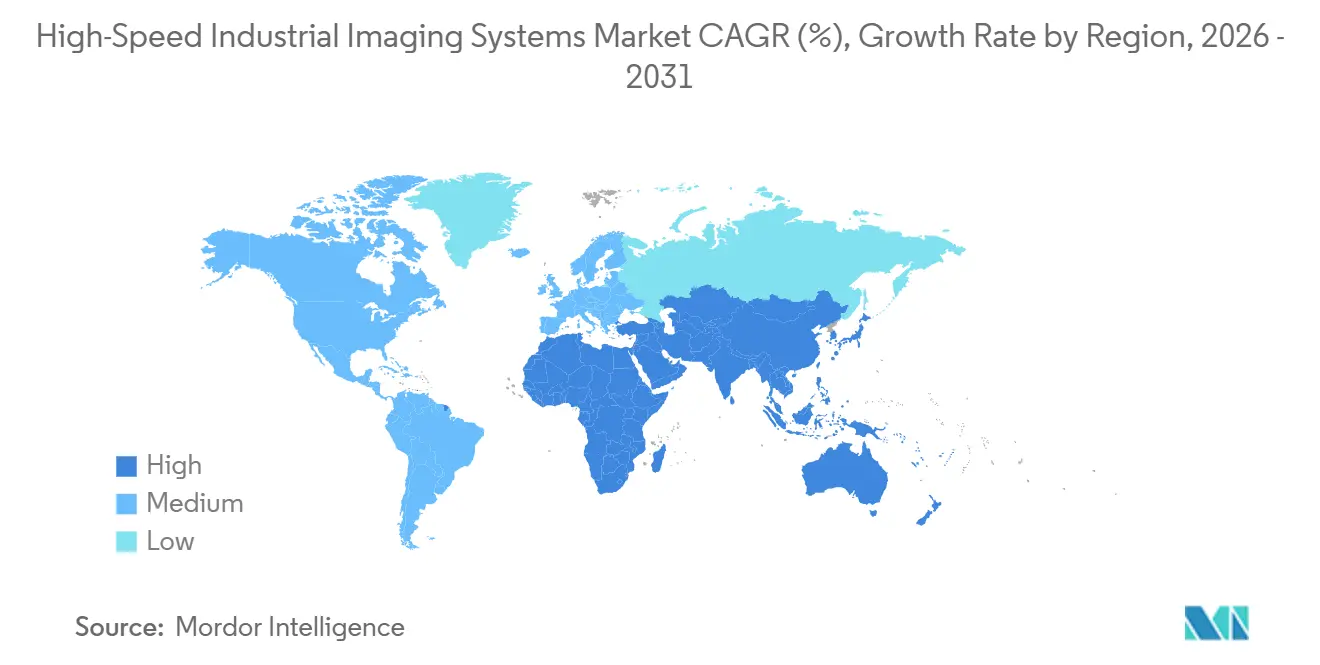
| Fastest Growing Market | Asia-Pacific |
| Largest Market | North America |
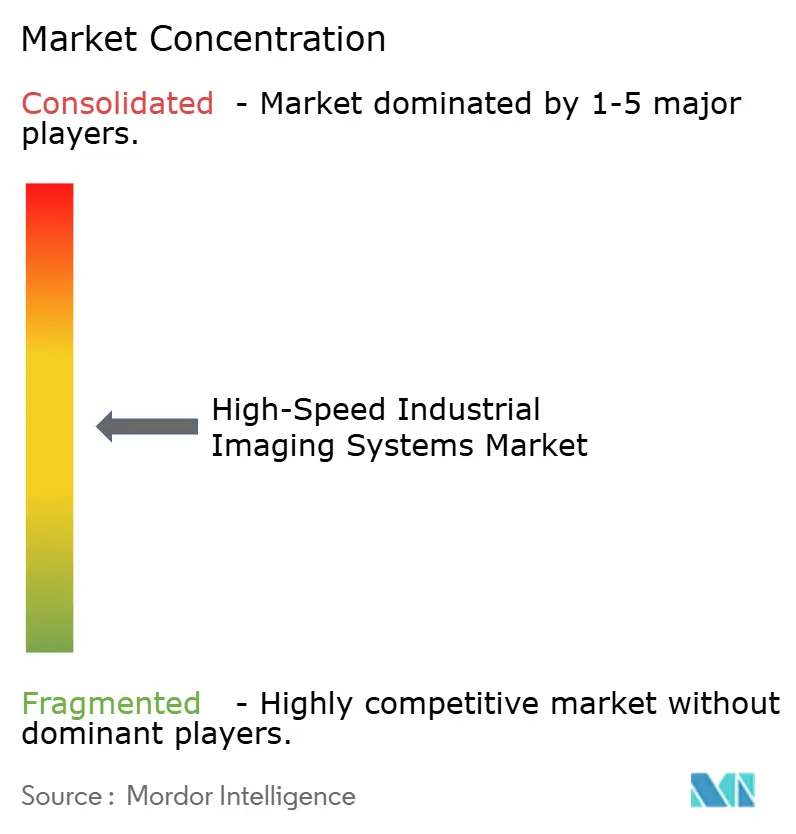
| Market Concentration | Medium |
Major Players
*Disclaimer: Major Players sorted in no particular order Image © Mordor Intelligence. Reuse requires attribution under CC BY 4.0. |
|
High-Speed Industrial Imaging Systems Market Analysis by Mordor Intelligence
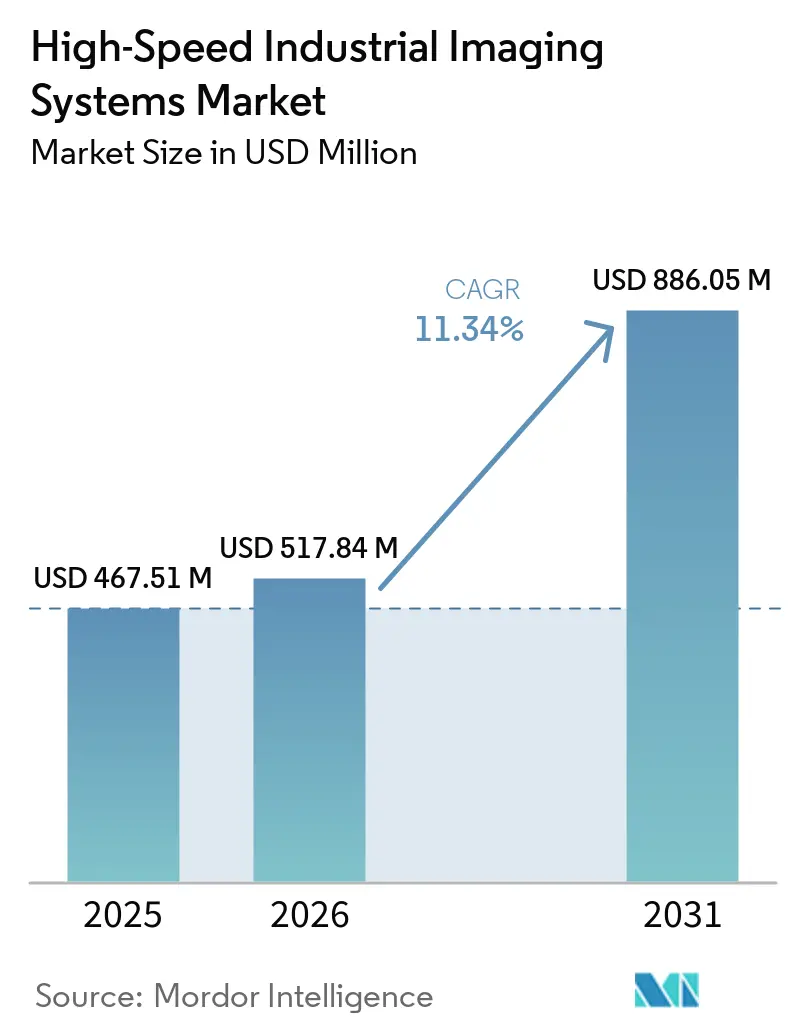
The high-speed industrial imaging systems market size is expected to increase from USD 467.51 million in 2025 to USD 517.84 million in 2026 and reach USD 886.05 million by 2031, growing at a CAGR of 11.34% over 2026-2031. Demand is being supported by zero-defect requirements in electronics, automotive, and pharmaceutical production, where inspection data forms part of line qualification. Industry 4.0 investments are also raising demand for visual data that can support automated process control. Suppliers are increasingly combining cameras, interfaces, software, and embedded AI capabilities to reduce integration effort and improve real-time decisions. North America remains the largest regional base, while Asia-Pacific is set to grow faster as semiconductor, display, and electronics capacity expands. The high-speed industrial imaging systems market also faces deployment constraints from data infrastructure costs, limited specialist availability, interface fragmentation, and sensor supply restrictions.
Key Report Takeaways
- By camera architecture, area scan cameras accounted for 73.45% of the High-Speed Industrial Imaging Systems Market in 2025, while line scan cameras are projected to expand at a 12.35% CAGR through 2031.
- By resolution, the 2-5 MP band accounted for 42.78% of revenue in 2025, while the 5-12 MP segment is projected to grow at a 13.21% CAGR through 2031.
- By frame rate, the 1,001-5,000 FPS range captured 39.87% of revenue in 2025, while cameras above 100,000 FPS are projected to grow at a 12.91% CAGR through 2031.
- By imaging spectrum, visible-light cameras held 73.46% of revenue in 2025, while NIR and SWIR cameras are projected to expand at a 13.19% CAGR through 2031.
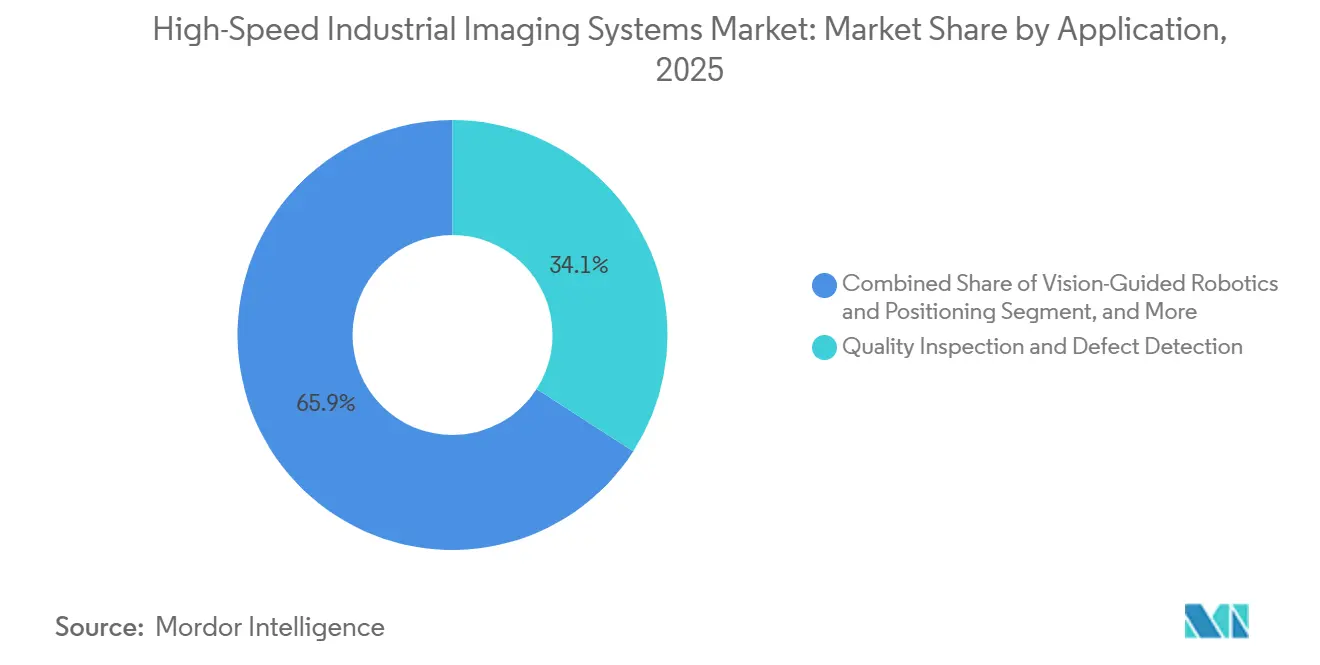
- By application, quality inspection and defect detection accounted for 34.10% of revenue in 2025, while vision-guided robotics and positioning are projected to advance at a 12.55% CAGR through 2031.
- By end-user industry, electronics and semiconductor accounted for 25.32% of revenue in 2025, while electronics and semiconductor is projected to grow at a CAGR of 13.78% through 2031.
- By geography, North America held 31.23% of market value in 2025, while Asia-Pacific is projected to expand at a CAGR of 12.95% through 2031.
Note: Market size and forecast figures in this report are generated using Mordor Intelligence’s proprietary estimation framework, updated with the latest available data and insights as of January 2026.
Global High-Speed Industrial Imaging Systems Market Trends and Insights
Drivers Impact Analysis*
| Driver | (~) % Impact on CAGR Forecast | Geographic Relevance | Impact Timeline |
|---|---|---|---|
| Factory Automation and Zero-Defect Inspection | +3.2% | Global | Short term (≤ 2 years) |
| Edge AI Reduces High-Speed Image Data Bottlenecks | +2.5% | Global, with early gains in North America and East Asia | Medium term (2-4 years) |
| Semiconductor and EV Battery Inspection Intensity | +2.0% | Asia-Pacific core, with spillover to North America and Europe | Short term (≤ 2 years) |
| High-Bandwidth Interfaces Enable Higher Resolution at Line Speed | +1.5% | Global | Medium term (2-4 years) |
| Vision-Guided Robotics and Closed-Loop Process Control | +1.2% | Global, strongest in Asia-Pacific and Europe | Medium term (2-4 years) |
| Demand for High-Speed Imaging in Production-Line Digital Twins | +0.8% | North America and Europe | Long term (≥ 4 years) |
| Source: Mordor Intelligence | |||
Factory Automation and Zero-Defect Inspection
Zero-defect programs have made high-speed inspection systems a core part of production-line qualification in the automotive, electronics, and food processing industries. The high-speed industrial imaging systems market benefits because manufacturers use these systems to identify faults before products move to later stages of production. ISO 26262 and FDA 21 CFR Part 820 treat in-process inspection records as evidence of compliance with functional safety and device quality requirements. A 2026 Scientific Reports study found that a magnet-roller image acquisition method raised battery-can inspection throughput from 140 to 240 units per minute while achieving 99.6% accuracy.[1]W. Yang, C. Huang, and P. Ji, “A Rapid Image Acquisition Method for External Defect Inspection of Battery Can,” Scientific Reports, nature.com The result shows why equipment suppliers are focusing on systems that improve both throughput and traceability. Once a line is qualified with a particular imaging configuration, operators often favor upgrades within that installed system rather than a lower-specification replacement.
Edge AI Reduces High-Speed Image Data Bottlenecks
The high-speed industrial imaging systems market is moving toward edge processing because sensor output can overwhelm conventional storage and network infrastructure. An 8-kilopixel TDI line-scan camera operating at 1 MHz can generate data streams exceeding 8 TB per hour. Edge AI runs inspection models in the camera or an adjacent FPGA and filters irrelevant frames before transmission. Cognex introduced the In-Sight 3900 in May 2026, featuring Qualcomm DragonWing processing for real-time AI inspection without a separate PC host. This design can reduce latency and keep sensitive images inside the plant network. Software deployment tools and trained inspection models are becoming as important as camera specifications.
Semiconductor and EV Battery Inspection Intensity
Advanced semiconductor production requires inspection systems that can process many frames per second, as small defects can reduce wafer yield. Wafer inspection, interconnect verification, and high-density packaging all require stable image capture at production speed. Teledyne DALSA launched the Linea HS2 8k TDI camera in June 2026 with a 1 MHz line rate and a backside-illuminated CMOS TDI sensor for low-light inspection applications. EV battery production also requires inspection of pouch, prismatic, and cylindrical cells before assembly. A 2026 European Conference on Non-Destructive Testing paper described complete cylindrical-cell scans within seconds using a microfocus X-ray source and a high-frame-rate photon-counting detector. This need supports the high-speed industrial imaging systems market because the cost of battery recalls can outweigh the capital cost of inline defect detection.
High-Bandwidth Interfaces Enable Higher Resolution at Line Speed
New interfaces are easing the long-standing tradeoff between inspection resolution and line speed. CoaXPress 2.0 supports up to 12.5 Gbps per cable and up to 50 Gbps across 4 lanes under the G3 global vision standardization initiative. Allied Vision launched the fxo925 and fxo926 100 Gigabit Ethernet cameras in July 2026 with RDMA streaming. The cameras delivered 24.6 MP imaging at up to 192 FPS and 12.4 MP imaging at up to 339 FPS, respectively. CoaXPress v3.0 is expected to extend this direction with a 25 Gbps per-lane target and fiber-optic integration. These changes can support the high-speed industrial imaging systems market by allowing integrators to replace several narrower-bandwidth cameras with fewer higher-bandwidth devices.
Restraints Impact Analysis*
| Restraint | (~) % Impact on CAGR Forecast | Geographic Relevance | Impact Timeline |
|---|---|---|---|
| Shortage of Machine Vision Integration Specialists | -1.5% | Global | Short term (≤ 2 years) |
| High Data Handling, Storage, and Cooling Costs | -1.2% | Global | Medium term (2-4 years) |
| Interface Fragmentation and Legacy Network Compatibility | -0.8% | Global | Medium term (2-4 years) |
| Sensor Export Controls and Supply Chain Qualification Delays | -0.6% | Asia-Pacific, with spillover to North America | Long term (≥ 4 years) |
| Source: Mordor Intelligence | |||
Shortage of Machine Vision Integration Specialists
Installing high-speed imaging requires knowledge of optics, embedded programming, machine vision software, and manufacturing processes. The combined skill set takes time to develop and is not widely available. VDMA identified skilled labor shortages as one of the leading constraints on European automation investment in 2025. High-speed deployments require precise settings for triggers, synchronization, regions of interest, and edge AI models. The available specialist base is concentrated in North America, Japan, and Germany. The shortage can leave manufacturers with capable hardware that is not configured to achieve its intended throughput, delaying purchases of high-speed industrial imaging systems.
High Data Handling, Storage, and Cooling Costs
High-resolution imaging at high frame rates increases the requirements for computing, networking, storage, and heat management. These costs can rise faster than the camera purchase price as frame rates increase. Teledyne DALSA identifies Camera Link HS CX4 active optical cable infrastructure as part of the system requirements for its advanced line-scan products. On-camera buffers can support post-event capture but limit continuous recording periods. Onboard SSDs and associated cooling add power and enclosure design requirements. These costs can slow the adoption of high-speed industrial imaging systems when premium capabilities are not needed.
*Our forecasts treat driver/restraint impacts as directional, not additive. The impact forecasts reflect baseline growth, mix effects, and variable interactions.
Segment Analysis
By Camera Architecture: Line Scan Adoption Rises with Continuous-Web Inspection
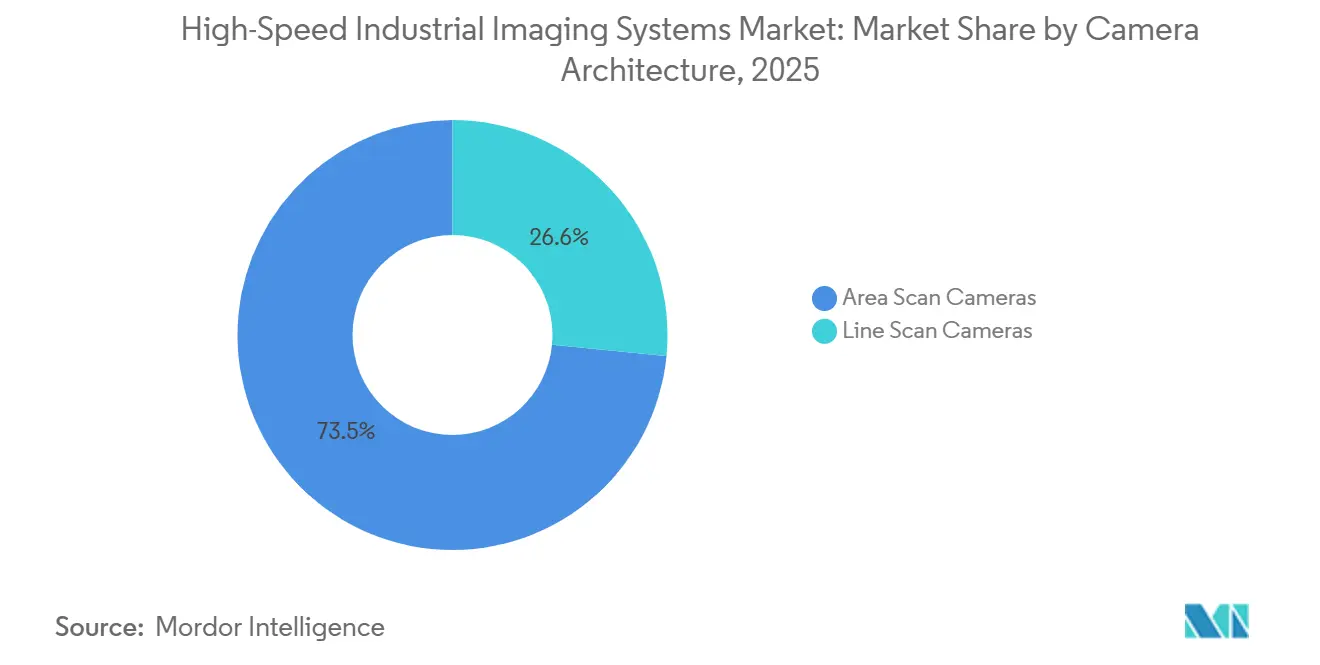
Area scan cameras accounted for 73.45% of the high-speed industrial imaging systems market share in 2025. Their broad use in wafer verification, automated optical inspection of PCBs, and blister-pack inspection supports their installed base. Area scan systems work with established CoaXPress 2.0 and GigE Vision frame-grabber configurations. Existing calibration routines, training data, and operator experience can raise the cost of changing camera architecture. These factors keep area scan systems important in discrete-object inspection.
Line scan cameras are projected to grow at a 12.35% CAGR through 2031. They are suited to continuous-web production such as lithium-ion electrode coating, flexible display films, and carbon-fiber composite inspection. These applications require push-broom imaging that area-scan designs cannot deliver at equivalent throughput. Allied Vision launched the FXO CXP-12 series in May 2026 in a 50×50 mm format with 4 CoaXPress-12 channels, Power-over-CXP, and fanless cooling. As continuous substrate production expands, the high-speed industrial imaging systems market is likely to see line-scan systems used beyond their traditional roles in printing and paper.


By Resolution: The 5-12 MP Range Supports Inline AI Deployment
The 2-5 MP range held 42.78% of revenue in 2025. The range has balanced image size and frame rate across established CoaXPress and Camera Link configurations. It remains appropriate for many systems that need reliable inspection without an extensive data infrastructure. Demand below 2 MP remains focused on legacy line monitoring and barcode verification. High-resolution systems above 12 MP remain focused on full-wafer inspection and demanding semiconductor metrology.
The 5-12 MP segment is projected to advance at a 13.21% CAGR through 2031. Sony's Pregius S backside-illuminated global-shutter platform supported 12-plus MP imaging at 192 FPS or more over 100 Gigabit Ethernet across camera vendors. This performance supports greater image detail while maintaining line speed. At this resolution, onboard AI can identify surface features without the bandwidth load associated with much larger image files. The high-speed industrial imaging systems market size for mid-range-resolution systems benefits from this balance among data load, cost, and detection capability.
By Frame Rate: Ultra-High-Speed Cameras Move into Production Use
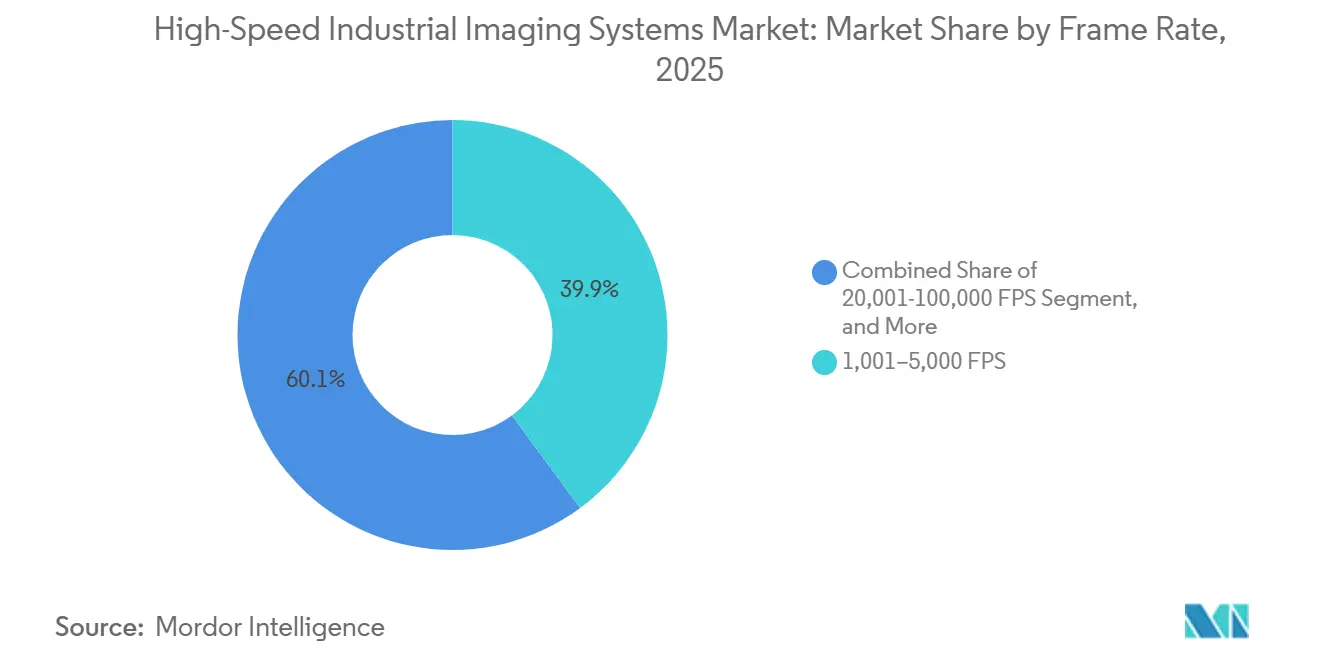
Cameras operating at 1,001-5,000 FPS captured 39.87% of revenue in 2025. This tier supports electronics inspection, pharmaceutical blister inspection, and metal-forming monitoring. It provides the speed required for many volume production applications without creating the most demanding storage and cooling loads. The range is well aligned with production lines built around the current CoaXPress 2.0 infrastructure. The 250-1,000 FPS tier continues to support food, beverage, and label-inspection work in the high-speed industrial imaging systems market.
Cameras above 100,000 FPS are projected to expand at a 12.91% CAGR through 2031. The increase reflects wider industrial use of a capability that was formerly concentrated in laboratories and crash-test settings. Photron's FASTCAM NOVA R5-4K, released in December 2025, achieved 200,000 FPS at reduced resolution and 4K UHD imaging at 1,250 FPS.[2]Photron "FASTCAM NOVA R3-4K and R5-4K,” photron.com The 5,001-20,000 FPS range addresses automotive component testing, while the 20,001-100,000 FPS range serves rapid materials characterization. This expansion widens the high-speed industrial imaging systems market across production and test environments.

By Imaging Spectrum: NIR and SWIR Support Subsurface Inspection
Visible-light cameras accounted for 73.46% of spectral revenue in 2025. They benefit from widely available high-resolution CMOS sensors optimized for the 400-700 nm wavelength range. Silicon-based sensors also carry lower fabrication costs than III-V compound semiconductor materials used for NIR and SWIR detectors. Visible light remains sufficient for many surface inspection tasks. UV, multispectral, hyperspectral, and X-ray systems serve specialized needs where visible imaging cannot identify the relevant condition.
NIR and SWIR cameras are projected to grow at a 13.19% CAGR through 2031. These systems can provide contrast for lithium-ion electrode coatings, silicon wafer contamination, and flexible circuit substrates where defects are not visible at the surface. Teledyne DALSA introduced the Kaleido SWIR hyperspectral camera in May 2026 for line-speed, multi-wavelength inspection. Its stated applications include food contamination detection, verification of pharmaceutical active ingredient distribution, and sorting of recycled plastic. Standardized measurements can make vendor qualification easier for pharmaceutical and semiconductor buyers and support the high-speed industrial imaging systems market.
By Application: Vision-Guided Robotics Expands Real-Time Process Control
Quality inspection and defect detection held 34.10% of application revenue in 2025. The application has long been the main commercial use of machine vision in electronics, pharmaceuticals, and food production. It is already widely installed, so growth increasingly depends on higher-specification upgrades. Faster cameras, better low-light sensitivity, and AI software are key elements of those upgrades. Measurement, metrology, identification, OCR, and motion analysis remain established applications in the high-speed industrial imaging systems market.
Vision-guided robotics and positioning are projected to grow at a 12.55% CAGR through 2031. The application places visual information directly into robotic assembly, sorting, and material-handling decisions. It shifts the demand for camera systems from identifying defects after a process to adjusting a process during operation. Scientific and specialized imaging provide an important technology path, as backside-illuminated TDI sensors and million-FPS CMOS imagers commonly enter industrial systems after initial validation in scientific settings. This path supports upgrades to high-speed industrial imaging systems in manufacturing.
By End-User Industry: Electronics and Semiconductor Demand Drives Growth
Electronics and semiconductors accounted for 25.32% of revenue in 2025 and are projected to record the highest end-user CAGR of 13.78% through 2031. Advanced-node yield management, 3D heterogeneous packaging, and high-bandwidth memory alignment require precise imaging at production speed. The segment needs accurate positioning and defect detection as tolerances become smaller. Automotive and EV battery production is another important source of demand. Pharmaceutical and life sciences manufacturers continue to invest in serialization and fill-finish integrity checks to meet quality expectations.
Food and beverage producers primarily use high-speed cameras for foreign-object detection and label verification. Logistics and warehousing are emerging areas because robotic sortation speeds can exceed the capabilities of standard-frame-rate cameras. High conveyor speeds necessitate accurate label reading and the identification of incorrectly packed items. The high-speed industrial imaging systems industry serves these verticals with different combinations of frame rate, resolution, spectrum, and software. This diversity encourages suppliers to offer systems that can be adapted to individual production processes.
Geography Analysis
North America held 31.23% of regional revenue in 2025. The high-speed industrial imaging systems market benefits from semiconductor fabrication, established machine vision integration services, and defense and aerospace research activity in the region. The United States had the largest end-user base, including semiconductor equipment makers, automotive suppliers, and aerospace contractors. Cognex reported USD 268 million in Q1 2026 revenue, up 24% year over year, driven by demand across the logistics, semiconductor, electronics, and packaging sectors. Canada and Mexico contribute through automotive supply chains, while Canada also supports specialized imaging through its photonics activity.
Europe's high-speed industrial imaging systems market is supported by Germany's automotive and specialty machinery base. VDMA reported stable 2025 billings for vision components despite weaker industrial conditions. Basler reported 2025 revenue of EUR 224.5 million (USD 244.7 million), up 22%, with EMEA accounting for 32% of sales.[3]Basler AG “Annual Report 2025,” baslerweb.com. The United Kingdom supports demand through pharmaceutical packaging and aerospace composites testing, while France and Italy add demand from food processing, luxury goods authentication, and specialty vehicle assembly. European suppliers participate in CoaXPress standards development, which can speed regional product qualification.
The high-speed industrial imaging systems market in Asia-Pacific is projected to grow at a 12.95% CAGR through 2031. China's semiconductor self-reliance agenda supports domestic demand, and SinceVision introduced the SH8 series in June 2026 with a stated maximum of 1,100,000 FPS and EMVA 1288-verified quantum efficiency of at least 85%. South Korea's DRAM and NAND investment, Japan's precision optics base including Photron's FASTCAM NOVA R-4K, and India's Production-Linked Incentive scheme support several demand centers. South America, the Middle East, and Africa remain smaller demand areas, with Brazil's automotive assembly, Gulf industrial automation programs, and African mining and food processing creating early opportunities.

Competitive Landscape
The high-speed industrial imaging systems market is moderately concentrated in the premium performance tier. Photron has positions built on proprietary sensor and readout architectures. Basler, Allied Vision, Emergent Vision Technologies, JAI, and XIMEA compete across the broader mid-market in terms of sensor choice, interface options, and software support. This structure makes the market more competitive outside specialized high-performance applications. Established suppliers retain an advantage where customers require proven integration and long product support cycles.
Cognex launched the In-Sight 6900 and In-Sight 3900 AI vision platforms in Q1 2026, reflecting a shift toward embedded AI processing and deployable software tools. Teledyne's portfolio includes DALSA, FLIR IIS, Lumenera, and e2v sensor design, which supports development across related imaging components. Basler acquired a 76% stake in Alpha TechSys Automation in India in 2025 to expand direct access to a growing electronics manufacturing base. The acquisition aligns with Basler's Full-Range Provider approach, which combines cameras with lenses, processing equipment, cables, and software. In the high-speed industrial imaging systems market, these moves can reduce customer dependence on separate component vendors.
The high-speed industrial imaging systems market has opportunities in software and hardware combinations that reduce integration complexity. Embedded inspection libraries and AI model-management tools can reduce the specialist effort needed by mid-sized manufacturers that cannot maintain dedicated vision engineering teams. Emerging suppliers are building credibility through standardized performance testing, and Tucsen's Gemini 8K TDI-sCMOS camera introduced a 100 Gbps Chip-on-Flex interface for advanced semiconductor inspection in March 2025.[4]Tucsen Photonics “Tucsen Launches Gemini 8K TDI-sCMOS Camera for Nanoscale Inspection,” tucsen.com. Competition is likely to remain strongest in systems where international standards make performance comparisons clearer.
High-Speed Industrial Imaging Systems Industry Leaders
-
Photron Ltd.
-
nac Image Technology Inc.
-
Optronis GmbH
-
Excelitas Technologies
-
Fastec Imaging Corporation
- *Disclaimer: Major Players sorted in no particular order

Recent Industry Developments
- August 2026: Teledyne DALSA released the Falcon4-CLHS M8200-Scientific, a 67-megapixel area scan camera built on the Teledyne e2v Emerald 67M CMOS sensor, delivering 3 e⁻ read noise, 70% quantum efficiency at 550 nm, and up to 64 dB dynamic range. The camera targets whole-slide imaging, genomics, and spatial omics in life sciences, expanding Teledyne's reach into scientific imaging verticals with inspection-adjacent requirements.
- July 2026: Allied Vision launched the fxo925x100GigE and fxo926x100GigE cameras, positioning the company among the first machine vision vendors to offer production 100 Gigabit Ethernet area scan cameras. Powered by Sony Pregius S IMX925 and IMX926 sensors with RDMA streaming, the cameras deliver 24.6 MP and 12.4 MP imaging at up to 192 FPS and 339 FPS, respectively, targeting semiconductor 2D and 3D AOI and high-throughput electronics inspection.
- June 2026: Teledyne DALSA announced the Linea HS2 8k TDI camera, the latest addition to its 1 MHz backside-illuminated Time Delay Integration line scan family. Designed for semiconductor wafer and high-density interconnect inspection in low-light conditions, the camera features Camera Link HS CX4 active optical cable connectors and configurable TDI array modes.
- May 2026: Teledyne DALSA introduced Kaleido, a SWIR hyperspectral camera for high-speed industrial inspection. The system enables simultaneous multi-wavelength imaging at line-scan speeds for food contamination detection, pharmaceutical API distribution verification, and recycled plastics identification.


Global High-Speed Industrial Imaging Systems Market Report Scope
The high-speed industrial imaging systems market encompasses imaging solutions that capture, process, and analyze rapidly moving objects and processes in industrial environments. These systems typically comprise high-speed cameras, sensors, lighting, lenses, image acquisition hardware, and software used for inspection, quality control, process monitoring, motion analysis, and predictive maintenance.
The High-Speed Industrial Imaging Systems Market Report is Segmented by Camera Architecture (Area Scan Cameras, and Line Scan Cameras), Resolution (Less Than 2 MP, 2-5 MP, 5-12 MP, and More Than 12 MP), Frame Rate (250-1,000 FPS, 1,001-5,000 FPS, 5,001-20,000 FPS, 20,001-100,000 FPS, and More Than 100,000 FPS), Imaging Spectrum (Visible Light, Near-Infrared (NIR) and Short-Wave Infrared (SWIR), Mid-Wave and Long-Wave Infrared (MWIR/LWIR), Ultraviolet (UV), and Other Imaging Spectrums), Application (Quality Inspection and Defect Detection, Measurement and Metrology, Identification, OCR, and Traceability, Vision-Guided Robotics and Positioning, Motion Analysis and Process Monitoring, and Scientific, R&D, and Specialized Imaging), End-User Industry (Electronics and Semiconductor, Automotive and EV Battery, Food and Beverage, Pharmaceutical and Life Sciences, Aerospace and Defense, Logistics and Warehousing, and Other End-User Industries), and Geography (North America, South America, Europe, Asia-Pacific, Middle East, and Africa). The Market Forecasts are Provided in Terms of Value (USD).
| Area Scan Cameras |
| Line Scan Cameras |
| Less Than 2 MP |
| 2-5 MP |
| 5-12 MP |
| More Than 12 MP |
| 250-1,000 FPS |
| 1,001-5,000 FPS |
| 5,001-20,000 FPS |
| 20,001-100,000 FPS |
| More Than 100,000 FPS |
| Visible Light |
| Near-Infrared (NIR) and Short-Wave Infrared (SWIR) |
| Mid-Wave and Long-Wave Infrared (MWIR/LWIR) |
| Ultraviolet (UV) |
| Other Imaging Spectrums |
| Quality Inspection and Defect Detection |
| Measurement and Metrology |
| Identification, OCR, and Traceability |
| Vision-Guided Robotics and Positioning |
| Motion Analysis and Process Monitoring |
| Scientific, R&D, and Specialized Imaging |
| Electronics and Semiconductor |
| Automotive and EV Battery |
| Food and Beverage |
| Pharmaceutical and Life Sciences |
| Aerospace and Defense |
| Logistics and Warehousing |
| Other End-User Industries |
| North America | United States |
| Canada | |
| Mexico | |
| South America | Brazil |
| Argentina | |
| Chile | |
| Rest of South America | |
| Europe | Germany |
| United Kingdom | |
| France | |
| Italy | |
| Spain | |
| Rest of Europe | |
| Asia-Pacific | China |
| Japan | |
| India | |
| South Korea | |
| Australia | |
| Rest of Asia-Pacific | |
| Middle East | United Arab Emirates |
| Saudi Arabia | |
| Qatar | |
| Rest of Middle East | |
| Africa | South Africa |
| Egypt | |
| Nigeria | |
| Rest of Africa |
| By Camera Architecture | Area Scan Cameras | |
| Line Scan Cameras | ||
| By Resolution | Less Than 2 MP | |
| 2-5 MP | ||
| 5-12 MP | ||
| More Than 12 MP | ||
| By Frame Rate | 250-1,000 FPS | |
| 1,001-5,000 FPS | ||
| 5,001-20,000 FPS | ||
| 20,001-100,000 FPS | ||
| More Than 100,000 FPS | ||
| By Imaging Spectrum | Visible Light | |
| Near-Infrared (NIR) and Short-Wave Infrared (SWIR) | ||
| Mid-Wave and Long-Wave Infrared (MWIR/LWIR) | ||
| Ultraviolet (UV) | ||
| Other Imaging Spectrums | ||
| By Application | Quality Inspection and Defect Detection | |
| Measurement and Metrology | ||
| Identification, OCR, and Traceability | ||
| Vision-Guided Robotics and Positioning | ||
| Motion Analysis and Process Monitoring | ||
| Scientific, R&D, and Specialized Imaging | ||
| By End-User Industry | Electronics and Semiconductor | |
| Automotive and EV Battery | ||
| Food and Beverage | ||
| Pharmaceutical and Life Sciences | ||
| Aerospace and Defense | ||
| Logistics and Warehousing | ||
| Other End-User Industries | ||
| By Geography | North America | United States |
| Canada | ||
| Mexico | ||
| South America | Brazil | |
| Argentina | ||
| Chile | ||
| Rest of South America | ||
| Europe | Germany | |
| United Kingdom | ||
| France | ||
| Italy | ||
| Spain | ||
| Rest of Europe | ||
| Asia-Pacific | China | |
| Japan | ||
| India | ||
| South Korea | ||
| Australia | ||
| Rest of Asia-Pacific | ||
| Middle East | United Arab Emirates | |
| Saudi Arabia | ||
| Qatar | ||
| Rest of Middle East | ||
| Africa | South Africa | |
| Egypt | ||
| Nigeria | ||
| Rest of Africa | ||


Key Questions Answered in the Report
What is the size of the high-speed industrial imaging systems market?
The market is expected to increase from USD 517.84 million in 2026 to USD 886.05 million by 2031, at an 11.34% CAGR.
What is driving demand for high-speed industrial imaging systems?
Zero-defect production requirements, semiconductor inspection, EV battery quality checks, and automated process control are supporting demand.
Which camera architecture is growing fastest?
Line scan cameras are projected to grow at a 12.35% CAGR through 2031 because they support continuous-web inspection.
Which imaging spectrum is expanding fastest?
NIR and SWIR cameras are projected to expand at a 13.19% CAGR through 2031 for applications requiring subsurface contrast.
Which end-user sector has the highest projected growth?
Electronics and semiconductor is projected to grow at a 13.78% CAGR through 2031.
What limits wider adoption of high-speed imaging systems?
The main constraints are limited integration specialists, high storage and cooling costs, incompatible interfaces, and supply-chain qualification delays.
Page last updated on:





