
High Purity Base Metal Market Size and Share
Market Overview
| Study Period | 2021 - 2031 |
|---|---|
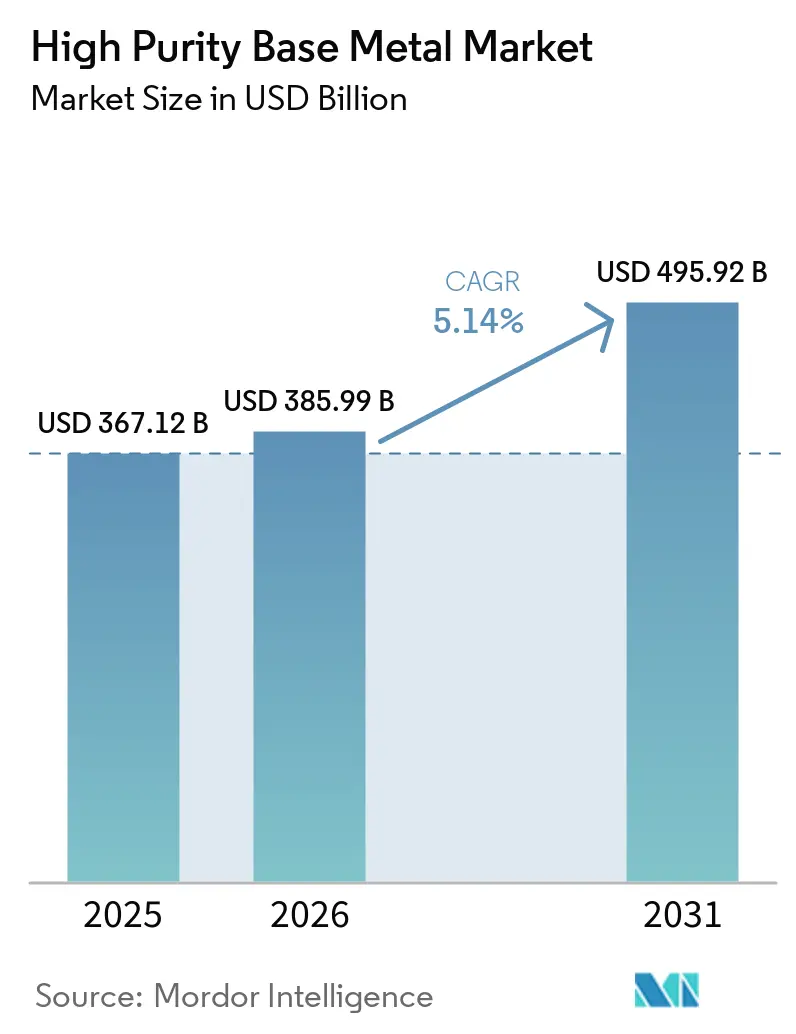
| Market Size (2026) | USD 385.99 Billion |
| Market Size (2031) | USD 495.92 Billion |
| Growth Rate (2026 - 2031) | 5.14 % |
| Fastest Growing Market | Asia-Pacific |
| Largest Market | Asia-Pacific |
| Market Concentration | Low |
Major Players *Disclaimer: Major Players sorted in no particular order Image © Mordor Intelligence. Reuse requires attribution under CC BY 4.0. | |
High Purity Base Metal Market Analysis by Mordor Intelligence
The High Purity Base Metal Market size was valued at USD 367.12 billion in 2025 and is estimated to grow from USD 385.99 billion in 2026 to reach USD 495.92 billion by 2031, at a CAGR of 5.14% during the forecast period (2026-2031). Demand is increasingly tied to semiconductor fabrication, battery manufacturing, power networks, and aerospace systems that need tightly controlled material composition. Higher purity requirements make qualification, traceability, and consistent refining capability more important than commodity-scale output. Producers are responding through investments in regional refining, recycling, and longer-term supply agreements with downstream manufacturers. This creates opportunities for suppliers that can meet documented quality requirements while managing energy use and feedstock risk. The high purity base metal market remains exposed to high conversion costs and concentrated specialist capabilities, which can delay new supply even where demand is rising.
Key Report Takeaways
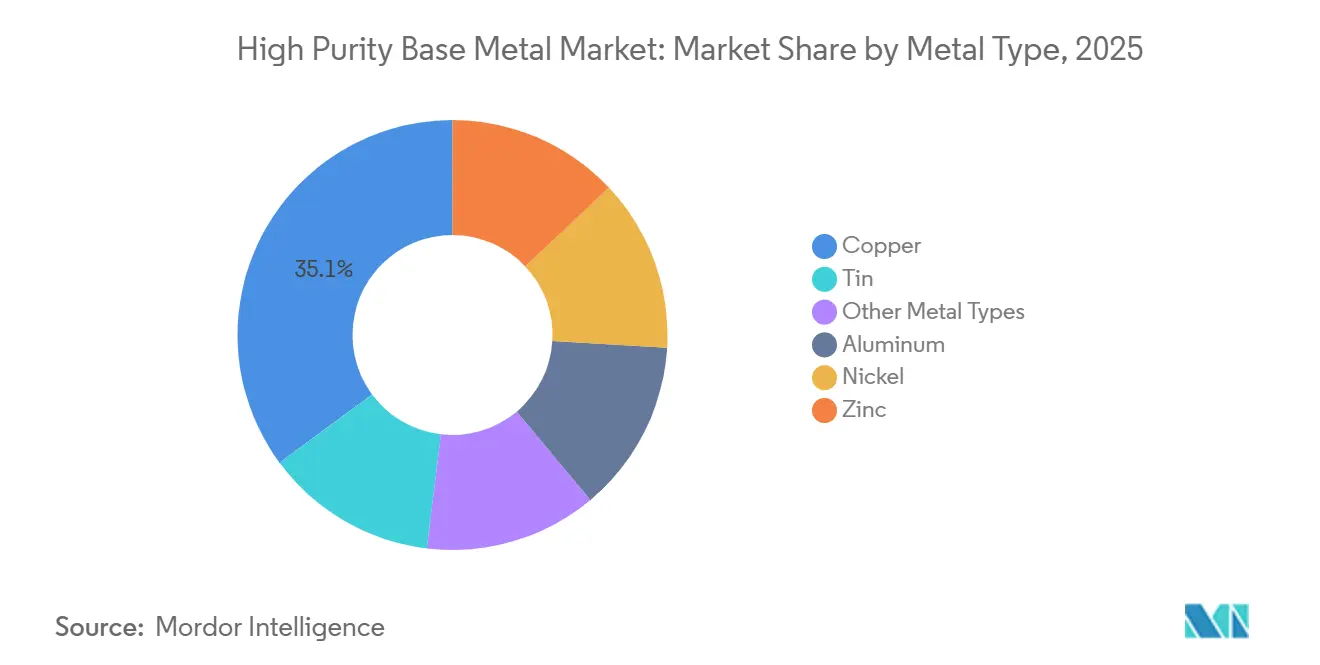
- By metal type, copper held 35.13% of the high purity base metal market share in 2025, while aluminum is projected to advance at a 5.64% CAGR through 2031.
- By purity level, more than 99.99% purity held 55.67% of the high purity base metal market share in 2025 and is projected to advance at a 5.77% CAGR through 2031.
- By form, ingots held 42.82% of the high purity base metal market share in 2025, while wires are projected to advance at a 5.58% CAGR through 2031.
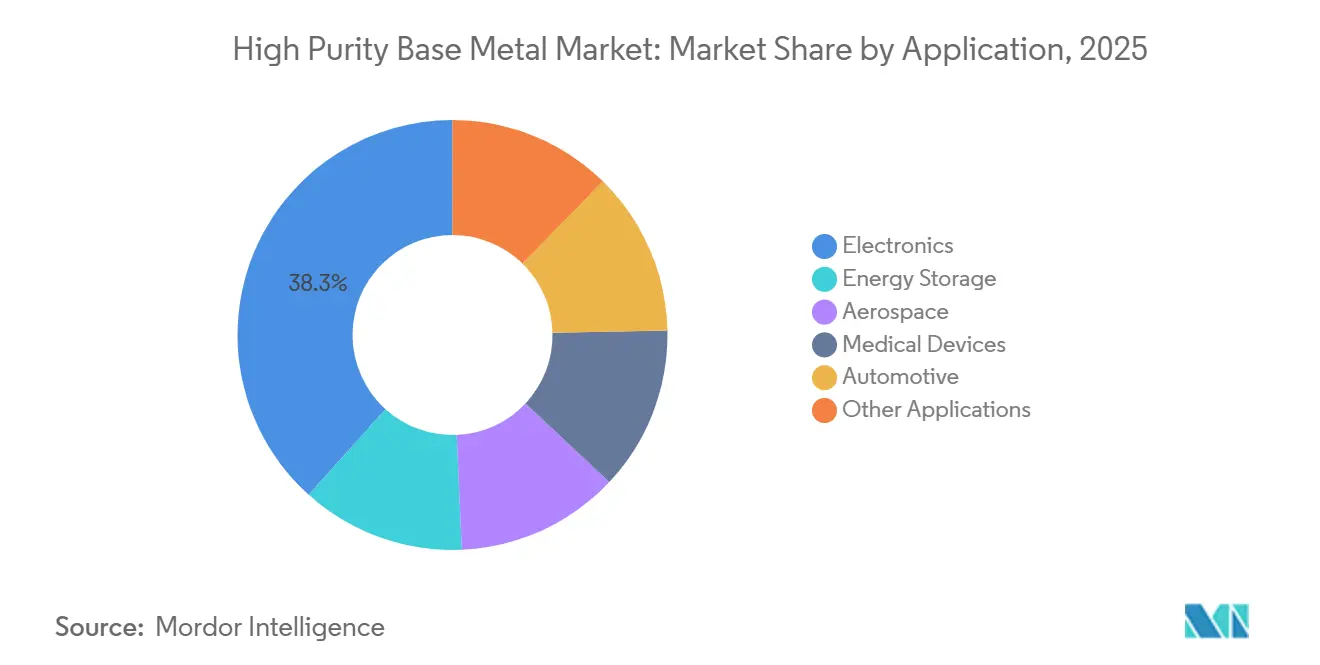
- By application, electronics held 38.34% of the high purity base metal market share in 2025, while aerospace is projected to advance at a 6.06% CAGR through 2031.
- By geography, Asia-Pacific held 38.36% of the high purity base metal market share in 2025 and is projected to advance at a 5.21% CAGR through 2031.
Note: Market size and forecast figures in this report are generated using Mordor Intelligence’s proprietary estimation framework, updated with the latest available data and insights as of January 2026.
Global High Purity Base Metal Market Trends and Insights
Drivers Impact Analysis*
| Driver | (~) % Impact on CAGR Forecast | Geographic Relevance | Impact Timeline |
|---|---|---|---|
| Semiconductor and Advanced Electronics Scaling | +1.8% | Global; core intensity in APAC (Japan, South Korea, Taiwan, China) and expanding fab clusters in North America under the CHIPS Act | Medium term (2–4 years) |
| Electrification and High-Voltage Power Hardware | +1.5% | Global; North America and Europe for grid modernization; APAC for EV battery and power electronics manufacturing | Long term (≥4 years) |
| Qualification Demand for Traceable, Application-Ready Metal | +0.9% | North America, Europe, and Japan (aerospace OEM qualification hubs); South Korea and Taiwan (semiconductor) | Medium term (2–4 years) |
| Refining Localization and Supply-Security Investment | +0.7% | North America (CHIPS Act, Inflation Reduction Act), Europe (EU Critical Raw Materials Act), India | Long term (≥4 years) |
| Circular Recovery of E-Waste, Black Mass and Process Scrap | +0.5% | Europe and North America (regulatory mandate); China (two-thirds of battery recycling capacity growth since 2020) | Medium term (2–4 years) |
| Source: Mordor Intelligence | |||
Semiconductor and Advanced Electronics Scaling
Logic chips moving toward 2 nanometers and below require copper materials with purity levels of 6N or higher for sputtering targets and chemical vapor deposition precursors. At sub-3-nanometer nodes, trace contamination can raise resistivity and reduce fabrication yields. JX Advanced Metals Corporation began mass production of high purity chemical vapor deposition and atomic layer deposition molybdenum compounds at its Ibaraki Office in March 2026. The materials are intended for 3D NAND, high-bandwidth memory, and advanced logic applications. The new line shows how advanced fabrication demand is extending beyond copper into specialized deposition materials. The high purity base metal market benefits when advanced packaging and heterogeneous integration require more suppliers to meet the same purity and qualification standards.
Electrification and High-Voltage Power Hardware
High purity aluminum and copper support electric vehicles, grid-scale energy storage, and long-distance power transmission. Cable systems and battery current collectors need low impurity levels to limit resistive losses and maintain electrochemical stability during repeated charge cycles. Norsk Hydro ASA confirmed a NOK 1.65 billion investment (approximately USD 154 million) in a 110,000 metric tons per year wire rod casthouse at Karmøy during 2025. Production is expected to begin in early 2028 and will serve the European electricity infrastructure. In 2026, Norsk Hydro ASA signed a five-year agreement with Nexans for 85,000 metric tons of low-carbon aluminum wire rod through 2030. These commitments show that infrastructure projects with multiyear material procurement cycles support the high purity base metal market.
Qualification Demand for Traceable, Application-Ready Metal
Semiconductor and aerospace buyers require traceability from mine origin through refining, forming, and composition certification. European Standard EN 6118:2025 covers pure aluminum ion vapor deposition coatings for aerospace fasteners and requires process qualification, lot documentation, and supplier approval. These requirements make documented process control part of the product specification. Established suppliers can retain pricing leverage because customers face validation work before changing material sources. The high purity base metal market, therefore, rewards refiners with a record of repeatable quality and application-specific approvals. This barrier matters particularly where a material change could affect component reliability or production yields.
Refining Localization and Supply-Security Investment
Supply security policies are encouraging refinery investments outside established East Asian supply corridors. The U.S. Department of Commerce awarded USD 210 million in CHIPS and Science Act funding to Crucible Metals, LLC in December 2025 for a planned USD 6.6 billion facility in Clarksville, Tennessee[1]U.S. Department of Commerce, “Department of Commerce Awards CHIPS Incentives to a Subsidiary of Korea Zinc,” National Institute of Standards and Technology, nist.gov. The site is expected to produce 540,000 metric tons per year across 13 critical and strategic minerals, including copper, gallium, and indium, by 2029. Such programs connect industrial policy with domestic processing capacity. The high purity base metal market can gain from more regional supply options, although large projects may add intermediate-grade capacity before they can meet the strictest specifications. Refiners with local feedstock access and strong quality systems are better placed to benefit from this investment cycle.
Restraints Impact Analysis*
| Restraint | (~) % Impact on CAGR Forecast | Geographic Relevance | Impact Timeline |
|---|---|---|---|
| Energy-Intensive Refining and High Conversion Cost | -1.2% | Global; most acute in Western Europe and North America where industrial power tariffs are prohibitively high relative to Asian and Middle Eastern benchmarks | Long term (≥4 years) |
| Long Customer Qualification and Requalification Cycles | -0.8% | North America and Europe (aerospace, medical, semiconductor OEM qualification chains); spillover globally where new supply targets these markets | Medium term (2–4 years) |
| Concentrated Feedstock, Equipment and Specialist-Capability Supply | -0.6% | Global; highest exposure in regions lacking domestic mining operations, zone-refining equipment manufacturers, and metallurgical process expertise | Long term (≥4 years) |
| Source: Mordor Intelligence | |||
Energy-Intensive Refining and High Conversion Cost
Producing 4N, 5N, and 6N grades requires multi-stage electrolytic refining, zone melting, or vacuum distillation. These processes have high energy needs that are difficult to reduce without changing the production route. Research published in Energy Conversion and Management during 2026 found that advanced electrification, including high-temperature heat pumps, can reduce greenhouse gas emissions from bauxite refining by up to 33%. The study also noted that these systems require substantial upfront investment. High power tariffs can limit the business case for new capacity near major demand centers. The high purity base metal market must therefore balance local supply security objectives against a refining cost structure that remains sensitive to electricity prices.
Concentrated Feedstock, Equipment and Specialist-Capability Supply
High purity refining depends on specialist equipment, reliable feedstock, and trained metallurgical teams. These capabilities are concentrated across a limited number of mining, processing, and equipment locations. The International Energy Agency reported that the combined share of the top 3 mining countries for key energy minerals increased from 73% in 2020 to 77% in 2024[2]International Energy Agency, “Global Critical Minerals Outlook 2025,” International Energy Agency, iea.org. This concentration can affect access to suitable feedstocks for regional refiners. New facilities also need time to establish the operating knowledge required for repeatable ultra high purity output. The high purity base metal market remains vulnerable when disruptions affect a narrow group of qualified feedstock or equipment suppliers.
*Our forecasts treat driver/restraint impacts as directional, not additive. The impact forecasts reflect baseline growth, mix effects, and variable interactions.
Segment Analysis
By Metal Type: Copper Anchors Revenue While Aluminum Gains Ground
Copper held 35.13% of high purity base metal market revenue in 2025, supported by semiconductor interconnects, thermal pathways, and high-frequency circuit architectures. At sub-3 nanometer nodes, copper interconnects need impurity ceilings below 0.0001%, which limits leading-edge procurement to 6N-grade suppliers. This requirement makes copper quality a direct factor in fabrication output, rather than a routine material input. Nickel supports jet engine superalloys and nickel manganese cobalt and nickel cobalt aluminum cathode materials. Zinc and tin serve precision soldering and electronic plating uses where material consistency remains important.
Aluminum is projected to advance at a 5.64% CAGR through 2031, driven by electric vehicle battery current collectors and semiconductor sputtering targets. It also serves compact conductors and power equipment where both conductivity and weight influence component design. Semiconductor packaging increases the importance of aluminum grades between 4N and 6N. Lower purity output cannot substitute for these uses because impurity limits are set within customer material specifications. The high purity base metal industry is seeing aluminum gain importance alongside copper in electrically intensive applications.



By Purity Level: More Than 99.99% Purity Defines the Market Standard
More than 99.99% purity held 55.67% of the high purity base metal market size in 2025 and is projected to advance at a 5.77% CAGR through 2031. Advanced semiconductor structures, high-bandwidth memory, and newer battery components require tighter impurity limits. A 2025 review found that trace impurities can reduce mechanical properties, corrosion resistance, and long-term stability in aerospace and microelectronics uses. Each application depends on stable and repeatable material performance across production lots. Suppliers with dependable 5N and 6N outputs can address uses where qualification is mandatory.
Less than 99.99% purity grades remain relevant for electrical conductors, automotive castings, and anti-corrosion coatings, where specifications accept more trace impurities. Electric drivetrains and grid equipment are nevertheless raising purity requirements in some uses. This moves more value toward higher grades while retaining a role for lower purity products. The high purity base metal market is increasingly differentiated by the contamination level that an end use can accept.
By Form: Ingots Lead, Wires Accelerate Alongside Electrification
Ingots held 42.82% of the high purity base metal market size in 2025 because they are the main traded input for foil rolling, wire drawing, powder atomization, and sputtering target fabrication. Downstream processors often use verified-composition ingots and conduct conversion in their own facilities. This reduces contamination risk during handling and lets customers align conversion with internal specifications. Ingots serve electronics, energy, and industrial processing applications. Their broad compatibility preserves their importance in the high purity base metal market.
Wires are projected to advance at a 5.58% CAGR through 2031 as grid investment and advanced semiconductor packaging expand. Norsk Hydro ASA agreed to supply NKT with 274,000 metric tons of low-carbon aluminum wire rod from 2026 through 2033. Its agreement with Nexans provides a further 85,000 metric tons from 2026 through 2030. Foils support battery cathode current collectors, while powders are used in aerospace additive manufacturing. Specialty rods, pellets, and custom forms serve research, catalysis, and thin-film deposition requirements.
By Application: Electronics Retains Dominance While Aerospace Outpaces
Electronics held 38.34% of the high purity base metal market share in 2025, supported by semiconductor fabrication, 5G hardware, and data center power networks. The application uses high purity copper in interconnects and specialized materials in deposition and packaging processes. Electronics production also requires traceability across material lots and repeatability during fabrication. The high purity base metal market supports this demand through qualified material supply and process documentation. Investment in advanced nodes increases demand for deposition materials with tightly controlled composition.
Aerospace is projected to advance at a 6.06% CAGR through 2031, supported by aluminum-lithium alloys, high purity nickel superalloys, and precision-deposited coatings. EN 6118:2025 requires documented process qualification for pure aluminum ion vapor deposition coatings used on aerospace fasteners. Aerospace and defense systems use high purity copper and nickel in avionics and guidance electronics. Medical devices require controlled materials for implants and diagnostic instruments. Automotive and energy storage demand is concentrated in current collectors, busbars, motor windings, and battery-grade aluminum foil.
Geography Analysis
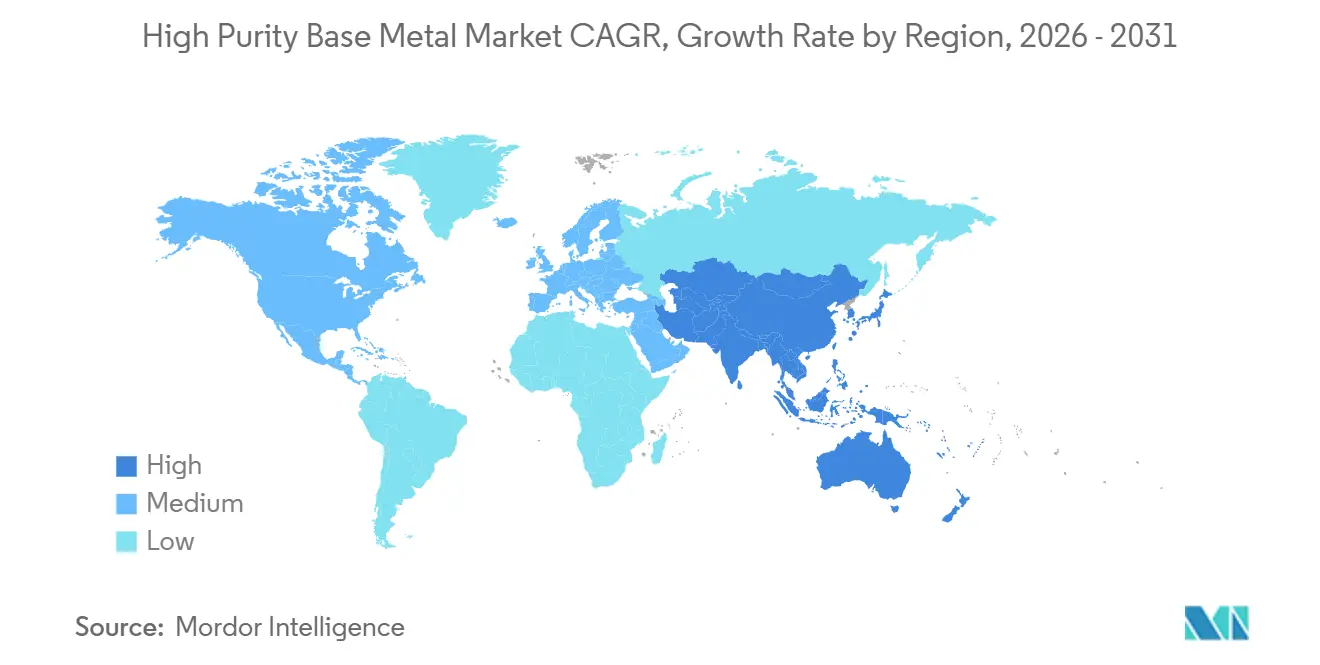
Asia-Pacific held 38.36% of the high purity base metal market share in 2025 and is projected to advance at a 5.21% CAGR through 2031. Japan, South Korea, Taiwan, and China combine semiconductor fabrication, battery manufacturing, and consumer electronics production. JX Advanced Metals Corporation is expanding capacity toward 60% above fiscal year 2023 levels by the second half of fiscal year 2027. Its investments support semiconductor material supply in the region.
India is developing domestic refining capabilities within the regional supply base. CVMR Corporation and Maheshwari Mining announced India’s first high purity nickel refinery in Andhra Pradesh in March 2025. The project reflects demand for more local critical-metal processing capacity. Regional diversification can reduce exposure to concentrated feedstock and specialist processing locations. Asia-Pacific’s electronics manufacturing depth and refining investment support the high purity base metal market.
North America and Europe form an important demand zone for semiconductor fabrication, aerospace and defense supply chains, and compliance-led materials sourcing. Aurubis AG started production at its Richmond Hill, Georgia, facility in September 2025, creating capacity to process up to 180,000 metric tons of complex recycling material each year. The company’s Hamburg recycling facility entered operation during July 2026 following an EUR 190 million investment (approximately USD 209 million). South America, the Middle East and Africa, and Russia remain important to mining supply and primary smelting. Lower power costs in the Middle East support competitive aluminum production, while European producers face a more difficult energy cost position.

Competitive Landscape
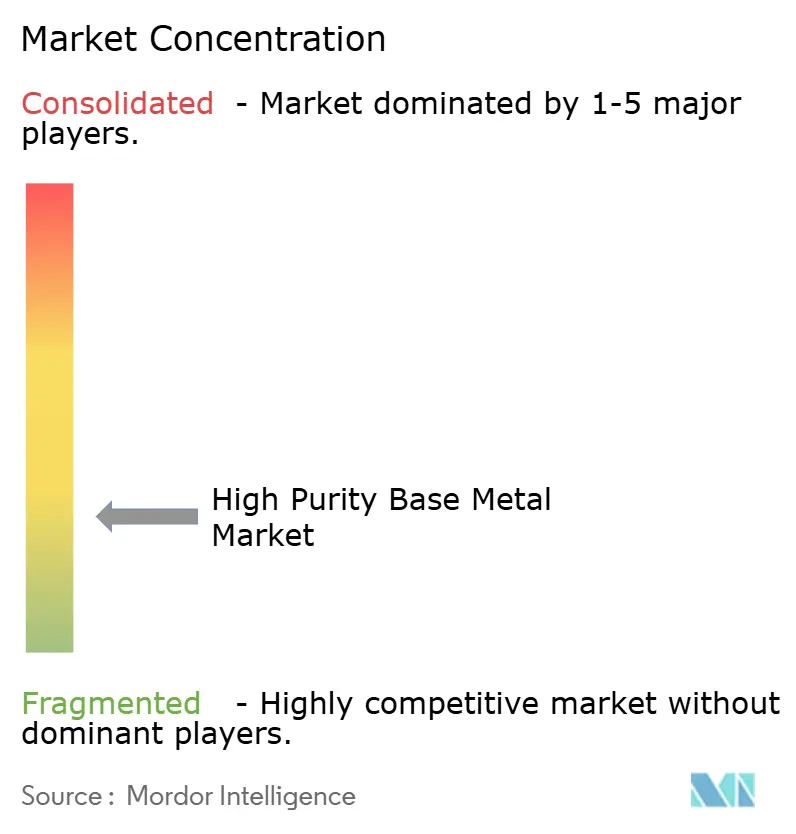
The high purity base metal market is highly fragmented, with the top five players including Aurubis AG, Aluminum Corporation of China Limited, Norsk Hydro ASA, JX Advanced Metals Corporation, and DOWA ELECTRONICS MATERIALS CO., LTD. Integrated suppliers that manage refining, forming, and quality certification hold a stronger position. JX Advanced Metals Corporation, Aurubis AG, Mitsubishi Materials Corporation, and DOWA ELECTRONICS MATERIALS CO., LTD. combine metallurgical capabilities with semiconductor and aerospace qualification pathways.
JX Advanced Metals Corporation launched its Ibaraki mass-production line for high purity chemical vapor deposition and atomic layer deposition materials in March 2026. Aurubis AG inaugurated its Complex Recycling Hamburg facility in July 2026 to recover strategic metals from complex feedstocks. Norsk Hydro ASA entered long-term supply agreements with NKT and Nexans for aluminum wire rod used in European grid projects. These moves secure demand, improve material availability, and strengthen regional supply chains.
The high purity base metal market favors players that pair technical quality with credible provenance and long-term customer supply arrangements. Secondary refining at scale and regional refining outside East Asia remain areas of opportunity. Aurubis AG’s facilities in Georgia and Hamburg show how recycling networks can support a traceable feedstock model. Their prospects depend on achieving the purity and reliability levels that established customers require.
High Purity Base Metal Industry Leaders
Aurubis AG
Aluminum Corporation of China Limited
Norsk Hydro ASA
JX Advanced Metals Corporation
DOWA ELECTRONICS MATERIALS CO., LTD.
- *Disclaimer: Major Players sorted in no particular order

Recent Industry Developments
- August 2026: Moses Lake Industries demonstrated a new process to recover and purify copper from semiconductor manufacturing waste streams to the purity levels required for advanced semiconductor applications. The development supports demand for high purity copper while creating a circular supply route for semiconductor-grade base metals as artificial intelligence (AI)-driven chip production expands.
- April 2026: Indium Corporation received a USD 3.2 million U.S. Department of Energy grant to develop domestic recovery of high purity gallium from metal-processing by-products, targeting production of at least 1 tonne per year of 4N-grade gallium. The project supports the development of domestic high purity metal supply for semiconductors, defense systems, and advanced electronics.


Global High Purity Base Metal Market Report Scope
High purity base metals are refined metallic materials with very low levels of impurities for applications requiring consistent chemical and physical properties. Their controlled composition supports reliable performance in advanced manufacturing and other precision applications.
The High Purity Base Metal Market is segmented by metal type, purity level, form, application, and geography. By metal type, the market is segmented into copper, aluminum, nickel, zinc, tin, and other metal types. By purity level, the market is segmented into less than 99.99% purity and more than 99.99% purity. By form, the market is segmented into ingots, foils, wires, powders, and other forms. By application, the market is segmented into electronics, aerospace, medical devices, automotive, energy storage, and other applications. The report also covers the market size and forecasts for high purity base metals in 16 countries across major regions. For each segment, the market sizing and forecasts have been done on the basis of value (USD).
| Copper |
| Aluminum |
| Nickel |
| Zinc |
| Tin |
| Other Metal Types |
| Less Than 99.99% Purity |
| More Than 99.99% Purity |
| Ingots |
| Foils |
| Wires |
| Powders |
| Other Forms |
| Electronics |
| Aerospace |
| Medical Devices |
| Automotive |
| Energy Storage |
| Other Applications |
| Asia-Pacific | China |
| India | |
| Japan | |
| South Korea | |
| ASEAN Countries | |
| Rest of Asia-Pacific | |
| North America | United States |
| Canada | |
| Mexico | |
| Europe | Germany |
| United Kingdom | |
| France | |
| Italy | |
| NORDIC Countries | |
| Russia | |
| Rest of Europe | |
| South America | Brazil |
| Argentina | |
| Rest of South America | |
| Middle East and Africa | Saudi Arabia |
| South Africa | |
| Rest of Middle East and Africa |
| By Metal Type | Copper | |
| Aluminum | ||
| Nickel | ||
| Zinc | ||
| Tin | ||
| Other Metal Types | ||
| By Purity Level | Less Than 99.99% Purity | |
| More Than 99.99% Purity | ||
| By Form | Ingots | |
| Foils | ||
| Wires | ||
| Powders | ||
| Other Forms | ||
| By Application | Electronics | |
| Aerospace | ||
| Medical Devices | ||
| Automotive | ||
| Energy Storage | ||
| Other Applications | ||
| By Geography | Asia-Pacific | China |
| India | ||
| Japan | ||
| South Korea | ||
| ASEAN Countries | ||
| Rest of Asia-Pacific | ||
| North America | United States | |
| Canada | ||
| Mexico | ||
| Europe | Germany | |
| United Kingdom | ||
| France | ||
| Italy | ||
| NORDIC Countries | ||
| Russia | ||
| Rest of Europe | ||
| South America | Brazil | |
| Argentina | ||
| Rest of South America | ||
| Middle East and Africa | Saudi Arabia | |
| South Africa | ||
| Rest of Middle East and Africa | ||


Key Questions Answered in the Report
What is the size of the high purity base metal market?
The high purity base metal market stands at USD 385.99 billion in 2026 and is projected to reach USD 495.92 billion by 2031.
What is driving demand for high purity base metals?
Semiconductor fabrication, electric vehicle batteries, power-grid infrastructure, and aerospace components are increasing the demand for materials with controlled purity.
Which metal type held the largest share in 2025?
Copper held 35.13% of revenue in 2025 because it supports semiconductor interconnects, thermal pathways, and high-frequency circuit designs.
Which purity level held the largest share in 2025?
More than 99.99% purity held 55.67% of revenue in 2025.
Page last updated on:





