
High-Entropy Alloys Market Size and Share
Market Overview
| Study Period | 2022 - 2032 |
|---|---|
| Market Size (2027) | USD 1.60 Billion |
| Market Size (2032) | USD 2.59 Billion |
| Growth Rate (2027 - 2032) | 10.13 % |
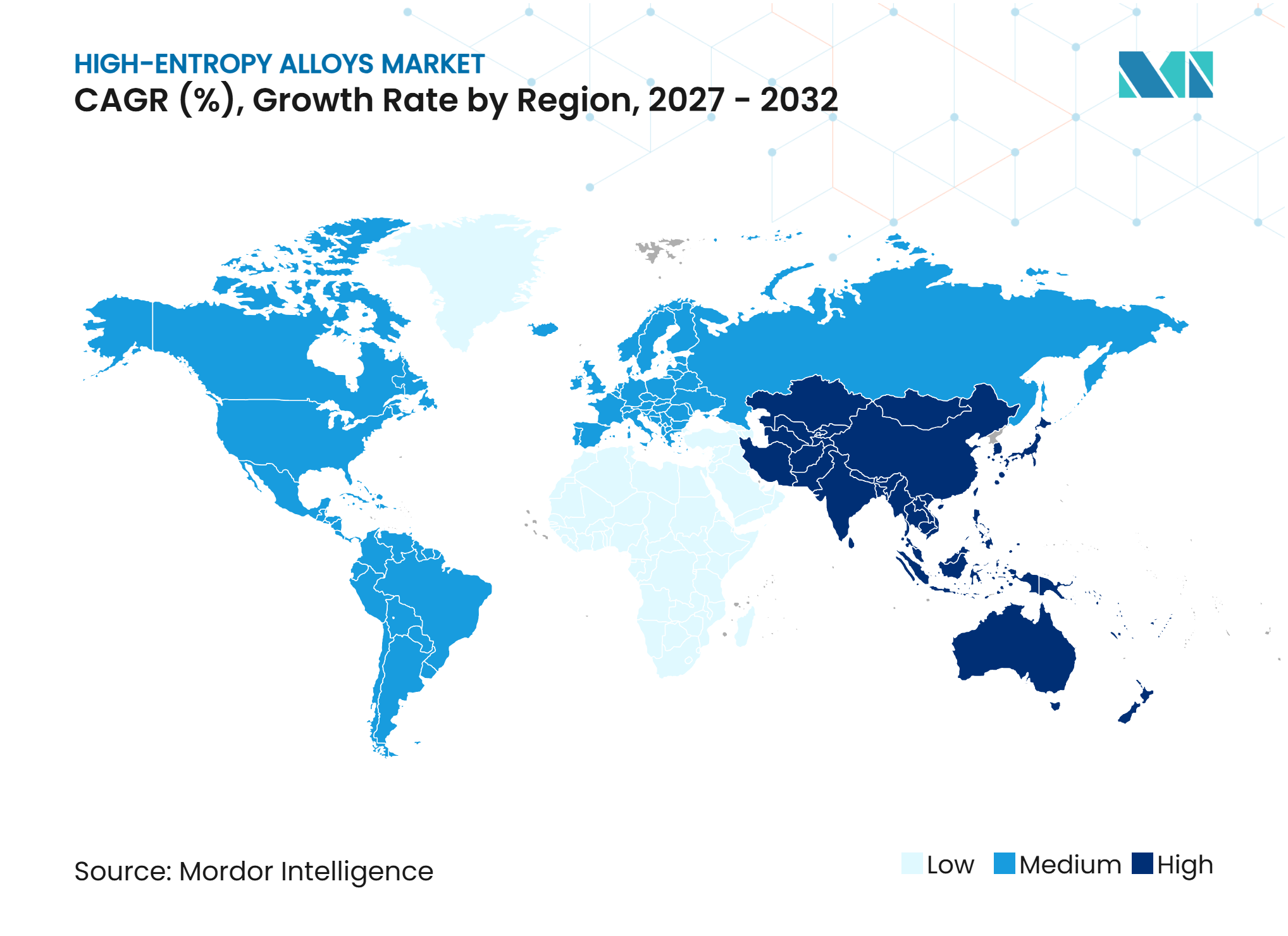
| Fastest Growing Market | Asia-Pacific |
| Largest Market | Asia-Pacific |
| Market Concentration | Low |
Major Players *Disclaimer: Major Players sorted in no particular order Image © Mordor Intelligence. Reuse requires attribution under CC BY 4.0. | |
High-Entropy Alloys Market Analysis by Mordor Intelligence
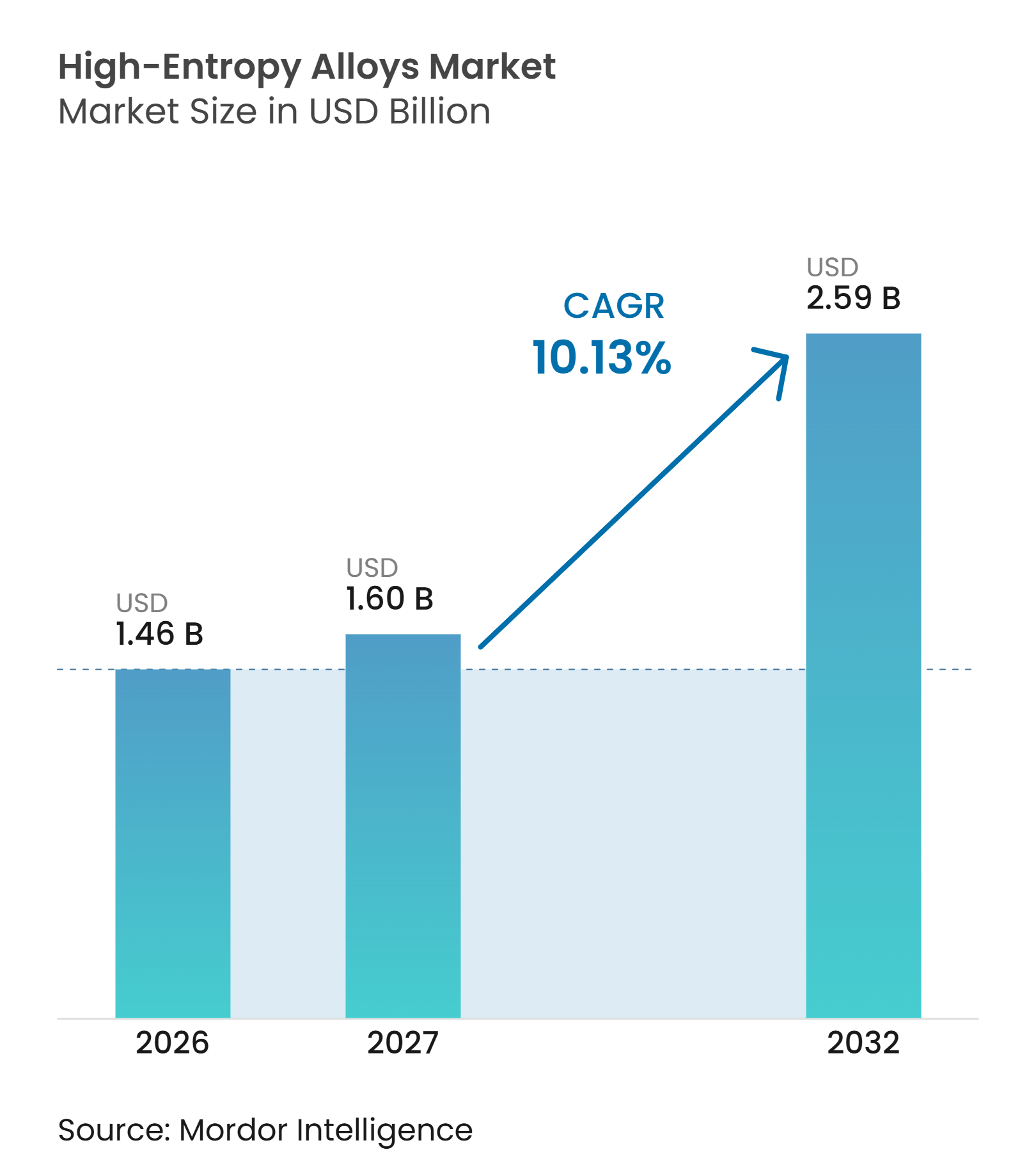
The high-entropy alloys market size was valued at USD 1.46 billion in 2026 and is estimated to grow from USD 1.60 billion in 2027 to USD 2.59 billion by 2032, at a CAGR of 10.13% during the forecast period (2027-2032). The high-entropy alloys market is transitioning from laboratory-led development toward qualified use in aerospace, defense, energy, and semiconductor applications. Demand is driven by materials that retain performance under heat, corrosion, radiation, and repeated mechanical loading. Public programs are improving access to testing, powder production, and alloy data, shortening the path from composition design to validation. Competition is increasingly shaped by a supplier's ability to combine qualified powder production with computational design and manufacturing expertise. Feedstock availability and lengthy approval cycles remain key constraints on the market's ability to convert technical interest into revenue.
Key Report Takeaways
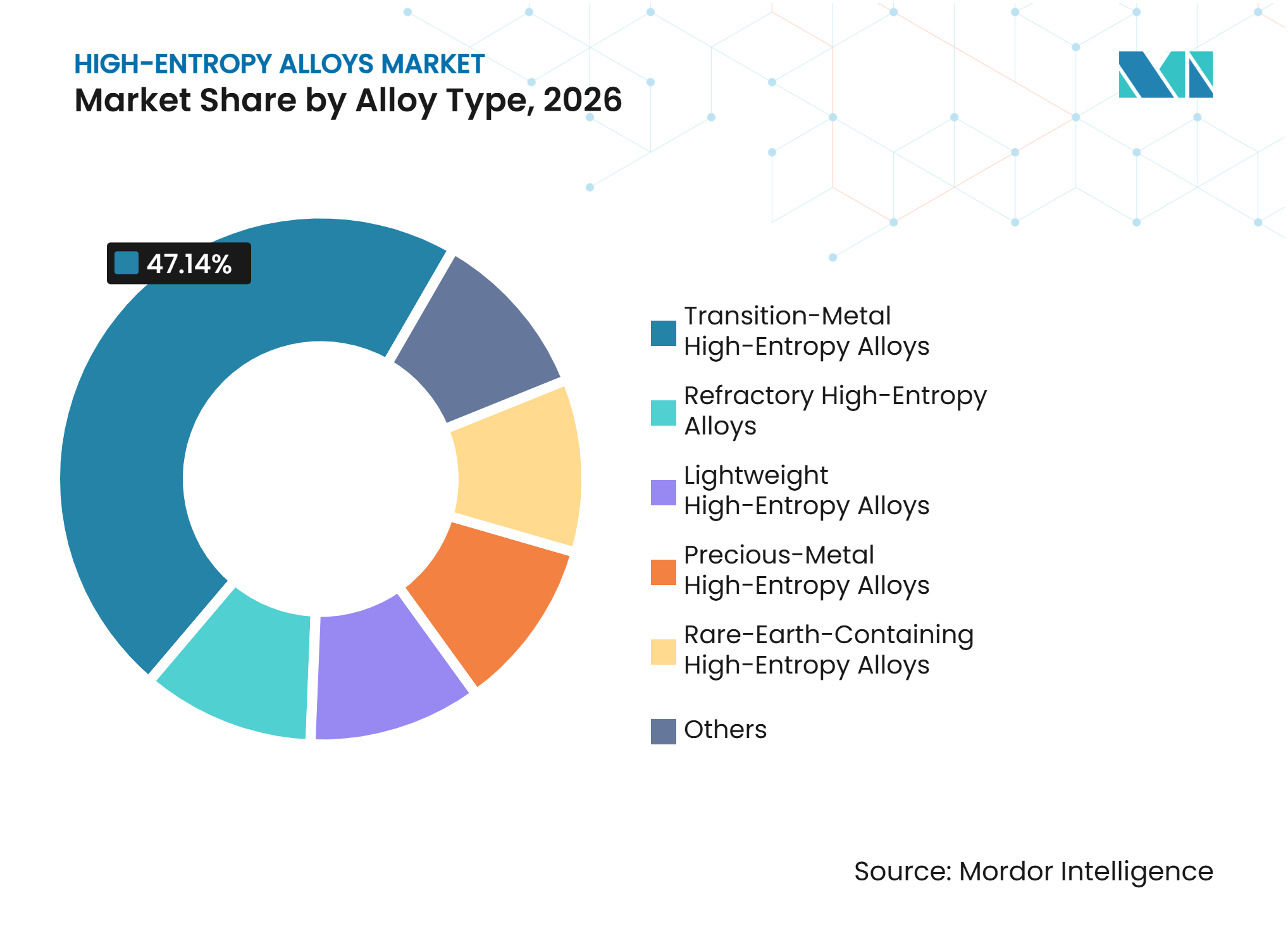
- By alloy type, transition-metal high-entropy alloys held 47.14% of the high-entropy alloys market share in 2026, while refractory alloys are forecast to grow at a 10.89% CAGR through 2032.
- By manufacturing process, casting and solidification held a 35.56% market share in 2026, while additive manufacturing is forecast to grow at an 11.32% CAGR through 2032.
- By application, structural components accounted for 41.37% of the market share in 2026, while extreme environment applications are forecast to grow at an 11.63% CAGR through 2032.
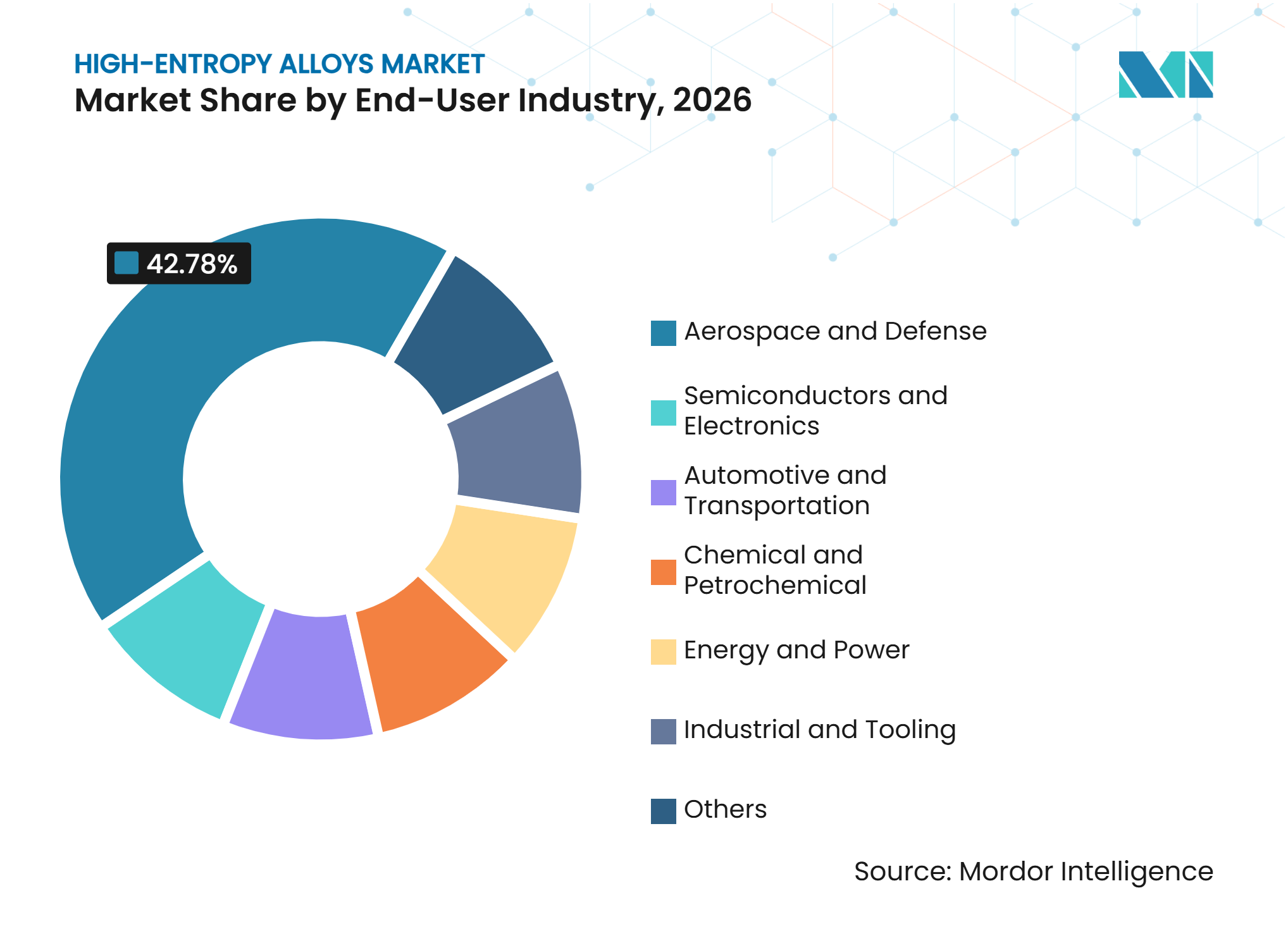
- By end-user industry, aerospace and defense accounted for a 42.78% market share in 2026, while energy and power are forecast to grow at an 11.89% CAGR through 2032.
- By geography, Asia-Pacific held a 36.33% market share in 2026 and is forecast to grow at an 11.44% CAGR through 2032.
Note: Market numbers in this report are based on Mordor Intelligence's proprietary estimation framework, which combines nine months of actuals with Q4 projections for base year 2026.
Market Trends and Insights
Drivers Impact Analysis of High-Entropy Alloys Market*
| Drivers | (~) % Impact on CAGR Forecast | Geographic Relevance | Impact Timeline |
|---|---|---|---|
| Demand for Extreme-Environment Aerospace and Defense Materials | +2.5% | Global, concentrated in North America and Asia-Pacific | Short term (≤ 2 years) |
| Government Funding for Hypersonic, Space, and Defense Materials | +1.8% | North America, Asia-Pacific, including China, Japan, and South Korea | Medium term (2-4 years) |
| Expansion of Additive Manufacturing and Powder-Based Production | +2.2% | Global, led by North America and Europe | Medium term (2-4 years) |
| Semiconductor and Sputtering-Target Applications | +1.5% | Asia-Pacific core, with spillover to North America and Europe | Short term (≤ 2 years) |
| Computational Alloy Design and AI-Assisted Materials Discovery | +1.3% | Global | Long term (≥ 4 years) |
| Source: Mordor Intelligence | |||
Demand for Extreme-Environment Aerospace and Defense Materials
The need for materials that operate under extreme heat is driving demand for high-entropy alloys in hypersonic and advanced propulsion programs. Conventional nickel superalloys can operate near 1,100°C with advanced cooling, whereas hypersonic vehicle surfaces experience higher, sustained thermal loads. In August 2025, the University of Arizona received USD 5 million from the U.S. Army to develop machine-learning-enabled additive manufacturing processes for critical hypersonic parts, following an earlier USD 3.1 million award for refractory-alloy development, with Raytheon supporting prototype production[1]. The Department of Defense identifies high-entropy alloys as a material class relevant to platform survivability in extreme environments. This institutional backing extends demand beyond exploratory research and provides producers with a clearer path to fund validation work. It also strengthens the position of suppliers that can offer powder quality, component processing, and traceable test data.
Government Funding for Hypersonic, Space, and Defense Materials
Government-funded testing and development programs are reducing technical and financial barriers for the high-entropy alloys market. Kratos received a USD 68.3 million U.S. contract in October 2025 to build Project Helios, an arc-jet and laser testing center intended to serve the broader industrial base. In Japan, the New Energy and Industrial Technology Development Organization (NEDO) aircraft-engine materials program targets at least two lightweight and heat-resistant alloys and a yearly output of 20,000 experimental datasets through automated synthesis and analysis. China's Ministry of Industry and Information Technology included new-material support measures in its 2025 to 2026 nonferrous metals plan, covering recycling and domestic supply measures for specialty metals. The European Commission has also sought feedback on an Advanced Materials Act intended to support production capacity and certification for advanced material classes. These programs create separate procurement and development routes across major producing regions, reducing dependence on a single source of demand.
Expansion of Additive Manufacturing and Powder-Based Production
Additive manufacturing expands the high-entropy alloys market by enabling the production of components with geometries that are difficult to achieve through casting. Researchers supported by the Japan Science and Technology Agency reported in March 2025 that a 3D-printed Ti-Zr-Nb-Mo-Ta alloy developed a cell-boundary structure that enhanced strength through rapid solidification. This finding is significant because processing can create useful microstructures rather than simply replicating the properties of cast material. The EWI Additive Manufacturing Consortium included the development of process parameters for the AlCoCrFeNiCu alloy in its 2025 research agenda. Aerospace powder suppliers must meet demanding traceability and quality requirements, including AS9100-based quality systems where applicable. These requirements raise entry barriers but also favor producers that can control powder morphology, chemistry, and batch documentation.
Semiconductor and Sputtering-Target Applications
Semiconductor applications offer the high-entropy alloys market a route with shorter qualification cycles than those in structural aerospace programs. Multi-principal-element sputtering targets can support thin-film compositions that are not available from single-element or binary targets. Materion reported USD 1.79 billion in full-year 2025 net sales and expanded its position in semiconductor materials in South Korea through its tantalum manufacturing assets. A March 2026 U.S. Army Research Laboratory study found that HfNbTaTi and HfNbTaTiV compositions formed homogeneous, low-porosity, single-phase structures after heat treatment, a finding relevant to sputtering-target performance. Advanced semiconductor nodes require barrier and functional films with tightly controlled chemistry. This channel can therefore diversify demand beyond airframe approval schedules and support higher-value powder and target supply.
Restraints Impact Analysis of High-Entropy Alloys Market*
| Restraints | (~) % Impact on CAGR Forecast | Geographic Relevance | Impact Timeline |
|---|---|---|---|
| High Alloying-Element and Refractory-Feedstock Costs | -1.8% | Global | Short term (≤ 2 years) |
| Lengthy Qualification and Certification Cycles | -1.2% | Global, most acute in North America and Europe | Long term (≥ 4 years) |
| Limited Powder Morphology and Composition Standardization | -0.8% | Global | Medium term (2-4 years) |
| Source: Mordor Intelligence | |||
High Alloying-Element and Refractory-Feedstock Costs
Refractory feedstock costs remain the most immediate commercial constraint on the high-entropy alloys market. Tungsten, niobium, tantalum, rhenium, and hafnium are sourced from a limited number of mines and processing facilities. Sandvik stated in its 2025 annual report that tungsten scarcity increased demand and prices during the year and that tariff-related effects necessitated pricing adjustments[2]. A multi-principal-element composition requires several controlled-purity inputs, so a movement in one input can affect total alloy cost more sharply than in simpler alloy systems. China's 2025 to 2026 policy plan recognizes the need for recycling and supply-side support in nonferrous metals. Producers with long-term supply agreements or internal processing capabilities are therefore better positioned to protect margins and meet customer lead times.
Lengthy Qualification and Certification Cycles
Qualification timelines limit the speed at which promising compositions reach commercial use in the high-entropy alloys market. Aerospace and nuclear customers require data on creep, fatigue, fracture toughness, corrosion, and long-duration service before accepting a new material. AS9100 practices and Aerospace Material Specifications (AMS) can require years of supporting evidence, while ASME Section III requirements for nuclear service demand extensive long-term test data. VDM Metals received an ASME Code Case for VDM Alloy 699 XA in October 2025 after a multi-year testing process, illustrating the investment required to obtain formal material approval. Existing suppliers can often extend qualified alloy platforms more readily than new entrants, which supports their position in regulated applications.
*Our forecasts treat driver/restraint impacts as directional, not additive. The impact forecasts reflect baseline growth, mix effects, and variable interactions.
High-Entropy Alloys Market Segment Analysis
By Alloy Type:
Refractory Grades Gain Momentum Against Transition-Metal DominanceTransition-metal alloys account for 47.14% of the high-entropy alloy market share in 2026, supported by established processing routes such as casting, powder metallurgy, and additive manufacturing. Their composition libraries include the CoCrFeMnNi family and related variants, which benefit from a broader base of research and processing knowledge. This supports use in structural parts, functional coatings, and sputtering targets. The range of applications allows suppliers to serve aerospace, electronics, and industrial tooling customers from related alloy platforms. Lightweight alloys using aluminum, magnesium, or titanium are also gaining attention where both weight reduction and heat resistance are required. A 2025 review in cMat documented the structure, properties, and applications of lightweight high-entropy alloys. Precious-metal- and rare-earth-containing grades remain more specialized, as their raw-material costs limit broad adoption. These grades are mainly relevant to catalytic and magnetic applications, where their performance justifies a higher material cost.
Refractory alloys are forecast to expand at a 10.89% CAGR through 2032, the highest rate within the alloy type segment. The high-entropy alloys market size for refractory alloys is supported by research programs connected to defense, energy, and aerospace applications. The U.S. Army Research Laboratory evaluated 15 refractory compositions and identified HfNbTaTi and HfNbTaTiV as promising single-phase candidates for scaled production. The ULTERA database had more than 12,540 manually extracted experimental data points across over 4,270 compositions by May 2025, improving access to screening data for these alloys. Better data can reduce the experimental work required before targeted physical testing begins. A 2025 review reported that body-centered-cubic refractory compositions can exceed the high-temperature performance of nickel-based superalloys above 1,200°C. Their adoption remains dependent on controlling feedstock cost, manufacturability, and qualification evidence.



By Manufacturing Process:
Additive Manufacturing Challenges Casting SupremacyCasting and solidification accounted for 35.56% of the manufacturing process share in 2026. The process remains attractive for large-scale production of transition-metal compositions with manageable melting ranges and established process control. Powder metallurgy supports net-shape manufacturing and fine microstructures that casting may not achieve. The New Energy and Industrial Technology Development Organization (NEDO)'s aircraft-engine materials initiative supports high-throughput alloy development and automated evaluation, which may also improve the production knowledge needed for powder-based routes. Thin-film deposition is used in sputtering-target and sensor-coating applications where uniform film chemistry is important. Other routes include spray forming, mechanical alloying, and electrochemical approaches, which are used when melt processing is unsuitable. Together, these routes offer the high-entropy alloys industry several processing options for compositions that differ considerably in melting temperature and reactivity. The choice of process is becoming as important as alloy composition in determining material performance and cost.
Additive manufacturing is forecast to grow at an 11.32% CAGR through 2032. This method does more than reproduce cast properties, as its rapid cooling can influence elemental distribution, phase formation, and dislocation structure. Japan Science and Technology Agency-supported work on a 3D-printed Ti-Zr-Nb-Mo-Ta alloy demonstrated that cell-boundary features can enhance strength. NEDO has funded six consortium projects in Japan to develop advanced metal additive manufacturing systems that integrate powder production, forming, and quality assurance. This integrated approach can improve the reliability of domestic supply chains for critical applications. AS9100 and National Aerospace and Defense Contractors Accreditation Program (NADCAP) requirements remain important compliance factors for aerospace components produced by additive methods. The high-entropy alloys market will favor firms that can demonstrate repeatable process control across successive builds and powder batches. Additive manufacturing is therefore likely to compete most directly with casting in complex, low-quantity, high-value parts rather than commodity forms.
By Application:
Extreme Environment Applications Move Toward Mission-Critical UseStructural components accounted for 41.37% of application demand in 2026. Their high-entropy alloy share reflects demand from aerospace structures, industrial tooling, and defense equipment. These applications require a combination of strength, ductility, fatigue resistance, and elevated-temperature stability. Functional applications include magnetic, thermoelectric, and catalytic roles, where composition tuning can yield useful combinations of properties. In June 2025, Nagoya University reported a mesoporous single-crystal multi-principal-element catalyst with 2.9 times the methanol-decomposition performance of platinum and 93% retention after 2,500 cycles. Coatings and surface treatments also employ high-entropy compositions to enhance oxidation resistance. Research published in 2025 found that HVOF-sprayed FeCoNiCrAl bond coats outperformed standard MCrAlX coatings in oxidation resistance at 1,150°C after 150 hours. These examples give producers a portfolio that extends beyond load-bearing parts.
Extreme environment applications are forecast to grow at an 11.63% CAGR through 2032. This expansion connects materials development with advanced nuclear systems, high-temperature power cycles, reusable rocket engines, and hypersonic vehicles. Idaho National Laboratory has reported preliminary results on baseline alloys produced at the laboratory and on wire arc additive manufacturing for advanced ultra-supercritical steam applications. A separate DOE record covers rapid Bayesian alloy designs fabricated via wire-arc additive manufacturing. Metalysis is developing refractory alloy powder for an ESA-funded Skyrora space-propulsion project, bringing HEA-related materials into reusable rocket-engine development. The high-entropy alloys market benefits when these demand channels progress independently, as a slowdown in one end use does not eliminate all advanced-material needs. However, each channel still requires component-specific testing before broad deployment. Suppliers with performance data across thermal, corrosion, and mechanical conditions will be better positioned within this application group.
By End-User Industry:
Energy and Power Emerge as a Growth CatalystAerospace and defense accounted for 42.78% of end-user demand in 2026. Long qualification cycles can lock materials into programs after approval, supporting durable demand for specialized alloy forms. Commercial aerospace backlogs also encourage the development of materials for higher-temperature engine systems. ATI reported USD 4.6 billion in fiscal 2025 revenue, with aerospace and defense representing 68% of sales. In June 2025, ATI brought a titanium alloy sheet facility online in South Carolina under a multiyear agreement with Airbus. The high-entropy alloys industry draws from the same need for technically demanding alloy forms, although material qualification remains composition-specific. Industrial tooling, semiconductors, automotive, chemical processing, and electronics provide additional demand channels. Sputtering targets and tool coatings are among the more commercially established applications outside aerospace and defense.
Energy and power is forecast to grow at an 11.89% CAGR through 2032, the strongest rate among end-user groups. High-entropy alloys can address corrosion and oxidation challenges in ultra-supercritical steam cycles, molten-salt systems, and solar thermal receivers. Advanced steam systems may operate at 650°C to 700°C under aggressive chemical conditions, where conventional material limits can affect efficiency and service life. Nuclear modernization programs in the United States, France, South Korea, and Japan are also evaluating materials capable of withstanding radiation, creep, and corrosive environments. A 2025 Journal of Alloys and Compounds study found that High Velocity Oxy-Fuel (HVOF) and cold-spray HEA coatings showed improved corrosion behavior in aggressive environments. Chemical and petrochemical operators may also benefit from more corrosion-resistant surfaces in chloride- and sulfur-bearing streams. The high-entropy alloys market size for energy applications will depend on whether testing data can be translated into recognized design codes. The long operating life of energy assets makes proven reliability more important than early laboratory performance.

Geography Analysis
Asia-Pacific
Asia-Pacific accounted for 36.33% of the high-entropy alloy market share in 2026 and is forecast to grow at an 11.44% CAGR through 2032. China has included materials-related support in policy measures for nonferrous metals, covering supply stability, recycling, and domestic capability. Japan's NEDO program aims to commercialize at least two lightweight, heat-resistant alloy candidates and produce 20,000 experimental datasets per year through automated research systems. South Korean researchers reviewed powder metallurgy routes for CoCrFeMnNi alloys in 2025, including grain-boundary and dispersion strengthening approaches. The region combines research capacity with semiconductor manufacturing, aerospace activity, and relatively direct access to certain rare-earth and refractory-metal supply chains. This combination supports both component production and demand for sputtering targets, coatings, and high-temperature materials. The high-entropy alloys market in the region also benefits from a broad base of metal-processing capabilities, although material quality standards and export controls can affect supply decisions.
North America
North America has a broad base of defense-funded research, powder development, and advanced-material customers. In August 2025, Radical AI received a USD 1.2 million AFWERX Direct-to-Phase II contract for AI-driven composition discovery for hypersonic thermomechanical applications. Project Helios is intended to provide arc-jet and coupled-laser testing capabilities between laboratory screening and the largest government test sites. 6K Additive reported a USD 31.4 million initial public offering and financing that supports a capacity increase from 200 metric tons to 1,000 metric tons per year at its Pennsylvania facility. Materion reported USD 1.79 billion in 2025 sales and supplies advanced materials for defense-related applications, illustrating the breadth of demand for specialist materials in the region. Regulatory requirements, including AS9100, Aerospace Material Specifications (AMS), and defense qualification standards, create high barriers to entry. These requirements can slow market entry, but they also protect suppliers that have established quality systems and customer approvals.
Europe, South America, and Middle East and Africa
Europe is building an institutional framework for advanced materials, while South America, the Middle East, and Africa remain at an earlier stage of development. The European Commission has consulted stakeholders on an Advanced Materials Act intended to improve certification pathways, production capacity, and supply resilience. This regulatory direction may help European producers develop greater local capability in refractory and specialty materials. Metalysis has supplied refractory powder for a European Space Agency (ESA)-supported space-propulsion program, demonstrating a European route into demanding aerospace applications. South American activity is primarily linked to academic research and the region's mineral base, including niobium and rare-earth resources. Activity in the Middle East and Africa is more closely associated with corrosion-resistant coatings for chemical and petrochemical operations. This mixed-geography group has room for growth, but requires more scalable processing and qualification infrastructure before it can challenge the current regional leaders.
Competitive Landscape
Market Concentration
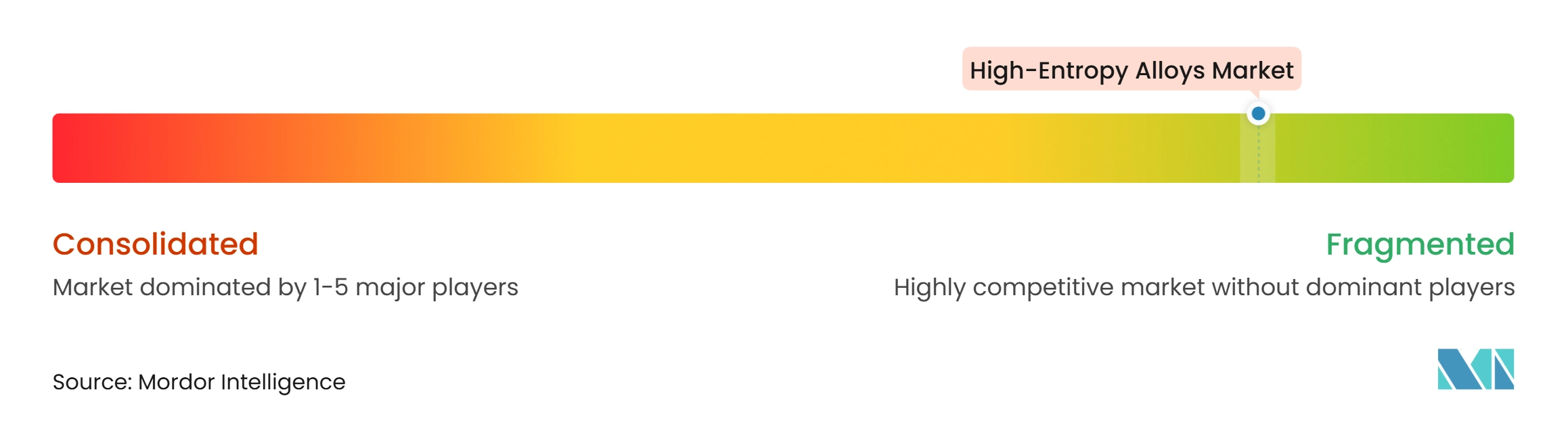
The high-entropy alloys market is fragmented, with no single supplier identified as controlling more than a low-teens share across all compositions and product forms. Integrated specialty alloy suppliers compete on portfolio breadth, customer relationships, and production scale. ATI, Aperam, and Sandvik's powder activities represent established capabilities in supplying advanced alloys. ATI reported a USD 3.7 billion fiscal 2025 backlog, indicating long-cycle demand visibility that can support investment in new material capabilities. Refractory specialists such as Plansee, VDM Metals, and Höganäs bring experience in powder metallurgy and high-melting-point metal processing. Sandvik also launched Osprey MAR 55 in 2025, a high-strength alloy designed for weldability, reflecting continued product development in specialty metal powder. Competition is therefore based on the depth of qualifications and process expertise as much as on output scale.
Computational alloy design is becoming an important competitive layer in the high-entropy alloys market. QuesTek has applied its Integrated Computational Materials Design (ICMD) platform to the development of printable, burn-resistant alloys for commercial space applications. In June 2025, Aubert & Duval and QuesTek announced work to advance predictive alloy design using the ICMD platform. These capabilities can shorten the initial design stage, but the resulting compositions still require validation of processes and services. Suppliers with powder capacity but limited design capability may seek licensing or technical partnerships. Metalysis uses an electrochemical approach that can produce alloy powders without melt processing, which is useful when elements have widely different melting points. The high-entropy alloys market is likely to favor firms that link proprietary powder routes with design tools and application-specific qualification evidence.
Intellectual property and certification are also shaping competitive positions. Oerlikon Metco received a U.S. patent in July 2025 for high-entropy oxide thermal barrier coating topcoats intended to maintain single-phase crystalline structures at high operating temperatures. The company also launched a digital thermal-spray platform in July 2025, which supports process management for coating operations. VDM Metals' ASME Code Case demonstrates the value of long-term testing and recognized approvals in energy and chemical applications. New entrants can offer novel compositions, but face a demanding path to acceptance in aerospace, nuclear, and defense programs. Established suppliers have an advantage where existing materials, quality systems, and customer relationships can be extended to related grades. Specialist start-ups remain relevant because they can introduce computational design and electrochemical processes that established casting-led producers may not possess. Market leadership will depend on the integration of composition design, powder control, intellectual property, and qualification execution.
High-Entropy Alloys Industry Leaders
-
Sandvik AB
-
Oerlikon Management AG
-
American Elements
-
Plansee SE
-
CRS Holdings, LLC
- *Disclaimer: Major Players sorted in no particular order
High-Entropy Alloys Market Companies Covered in this Report
- 6K Inc.
- American Elements
- Aperam S.A.
- ATI
- CRS Holdings, LLC
- HAYNES INTERNATIONAL
- Hitachi, Ltd.
- Höganäs AB
- Materion Corporation
- Metalysis
- Oerlikon Management AG
- Plansee SE
- QuesTek Innovations LLC
- Sandvik AB
- VDM Metals
Recent Industry Developments in High-Entropy Alloys Market
- October 2025: The U.S. Department of War awarded Kratos Defense a USD 68.3 million contract (Project Helios) to design and build a mid-tier arc-jet and coupled fiber-laser hypersonic materials testing center. The facility combines a 20-25 MW arc jet with 200 kW of laser capability, directly addressing gaps in the high-entropy alloy qualification infrastructure in the U.S. defense industrial base.
- October 2025: VDM Metals International GmbH received a new ASME Code Case for VDM Alloy 699 XA under the ASME standardization system, enabling its use in pressure vessel design. This qualification milestone required extensive multi-year testing and expanded the addressable market for high-entropy alloys in chemical processing and energy applications.
Global High-Entropy Alloys Market Report Scope
High-entropy alloys (HEAs) are metallic materials composed of five or more principal elements in equal or near-equal atomic proportions, typically ranging from 5% to 35% each. Unlike traditional alloys, which rely on a single dominant base metal such as iron or aluminum with minor additives, HEAs distribute compositional weight across multiple elements.
The high-entropy alloys market is segmented by alloy type, manufacturing process, application, end-user industry, and geography. By alloy type, the market is segmented into transition-metal high-entropy alloys, refractory high-entropy alloys, lightweight high-entropy alloys, precious-metal high-entropy alloys, rare-earth-containing high-entropy alloys, and others. By manufacturing process, the market is segmented into casting and solidification, powder metallurgy, additive manufacturing, thin-film deposition, and others. By application, the market is segmented into structural components, functional applications, coatings and surface treatments, extreme environment applications, and others. By end-user industry, the market is segmented into aerospace and defense, energy and power, industrial and tooling, semiconductors and electronics, automotive and transportation, chemical and petrochemical, and others. The report also covers market sizes and forecasts for high-entropy alloys across 15 countries in major regions. The market sizes and forecasts are provided in terms of value (USD).
Segmentation Overview
| Transition-Metal High-Entropy Alloys |
| Refractory High-Entropy Alloys |
| Lightweight High-Entropy Alloys |
| Precious-Metal High-Entropy Alloys |
| Rare-Earth-Containing High-Entropy Alloys |
| Others |
| Casting and Solidification |
| Powder Metallurgy |
| Additive Manufacturing |
| Thin-Film Deposition |
| Others |
| Structural Components |
| Functional Applications |
| Coatings and Surface Treatments |
| Extreme Environment Applications |
| Others |
| Aerospace and Defense |
| Energy and Power |
| Industrial and Tooling |
| Semiconductors and Electronics |
| Automotive and Transportation |
| Chemical and Petrochemical |
| Others |
| Asia-Pacific | China |
| India | |
| Japan | |
| South Korea | |
| ASEAN Countries | |
| Rest of Asia-Pacific | |
| North America | United States |
| Canada | |
| Mexico | |
| Europe | Germany |
| United Kingdom | |
| France | |
| Italy | |
| NORDIC Countries | |
| Rest of Europe | |
| South America | Brazil |
| Argentina | |
| Rest of South America | |
| Middle East and Africa | Saudi Arabia |
| South Africa | |
| Rest of Middle East and Africa |
| By Alloy Type | Transition-Metal High-Entropy Alloys | |
| Refractory High-Entropy Alloys | ||
| Lightweight High-Entropy Alloys | ||
| Precious-Metal High-Entropy Alloys | ||
| Rare-Earth-Containing High-Entropy Alloys | ||
| Others | ||
| By Manufacturing Process | Casting and Solidification | |
| Powder Metallurgy | ||
| Additive Manufacturing | ||
| Thin-Film Deposition | ||
| Others | ||
| By Application | Structural Components | |
| Functional Applications | ||
| Coatings and Surface Treatments | ||
| Extreme Environment Applications | ||
| Others | ||
| By End-User Industry | Aerospace and Defense | |
| Energy and Power | ||
| Industrial and Tooling | ||
| Semiconductors and Electronics | ||
| Automotive and Transportation | ||
| Chemical and Petrochemical | ||
| Others | ||
| By Geography | Asia-Pacific | China |
| India | ||
| Japan | ||
| South Korea | ||
| ASEAN Countries | ||
| Rest of Asia-Pacific | ||
| North America | United States | |
| Canada | ||
| Mexico | ||
| Europe | Germany | |
| United Kingdom | ||
| France | ||
| Italy | ||
| NORDIC Countries | ||
| Rest of Europe | ||
| South America | Brazil | |
| Argentina | ||
| Rest of South America | ||
| Middle East and Africa | Saudi Arabia | |
| South Africa | ||
| Rest of Middle East and Africa | ||
Key Questions Answered in the Report
What is current market size of High-Entropy Alloys Market?
The high-entropy alloys market size was valued at USD 1.46 billion in 2026 and is estimated to grow from USD 1.60 billion in 2027 to USD 2.59 billion by 2032, at a CAGR of 10.13% during the forecast period (2027-2032).
Which alloy type is growing fastest?
Refractory alloys are forecast to grow at a 10.89% CAGR through 2032 because of demand for high-temperature defense, aerospace, and energy applications.
Why is additive manufacturing relevant for high-entropy alloys?
It is forecast to grow at an 11.32% CAGR and can produce complex components with microstructures that differ from those of cast materials.
Which region leads to high-entropy alloy demand?
Asia-Pacific held a 36.33% share in 2026 and is forecast to grow at an 11.44% CAGR through 2032.