
Helicopters Market Size and Share
Market Overview
| Study Period | 2020 - 2032 |
|---|---|
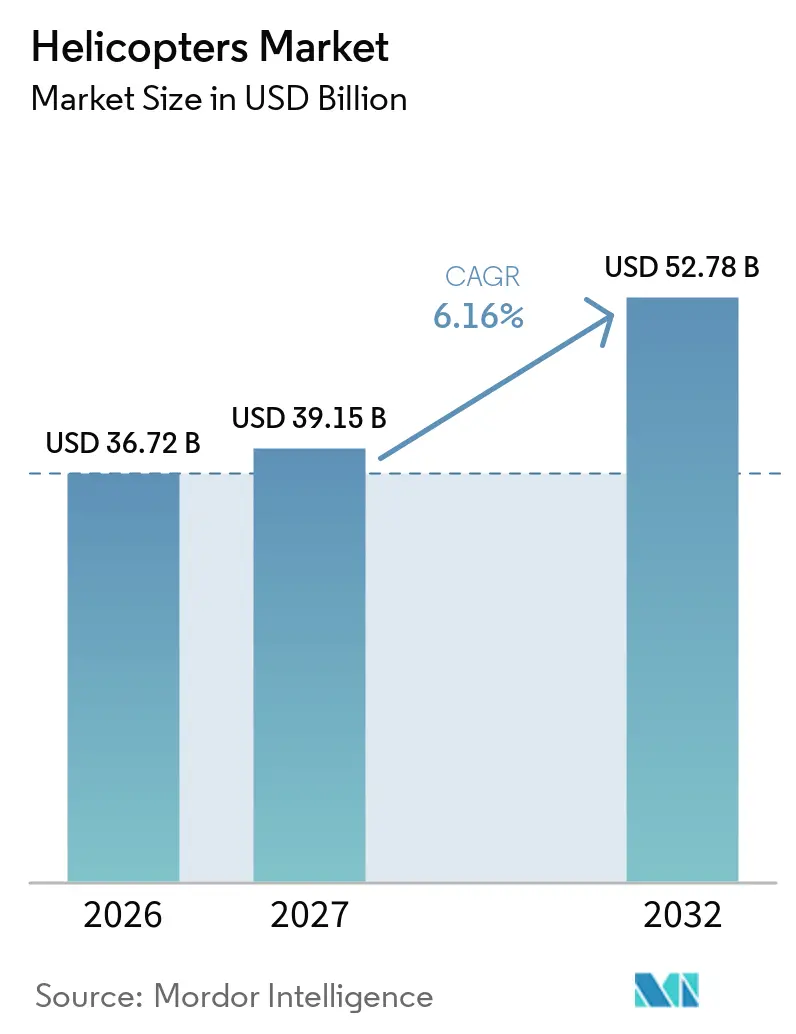
| Market Size (2027) | USD 39.15 Billion |
| Market Size (2032) | USD 52.78 Billion |
| Growth Rate (2027 - 2032) | 6.16 % |
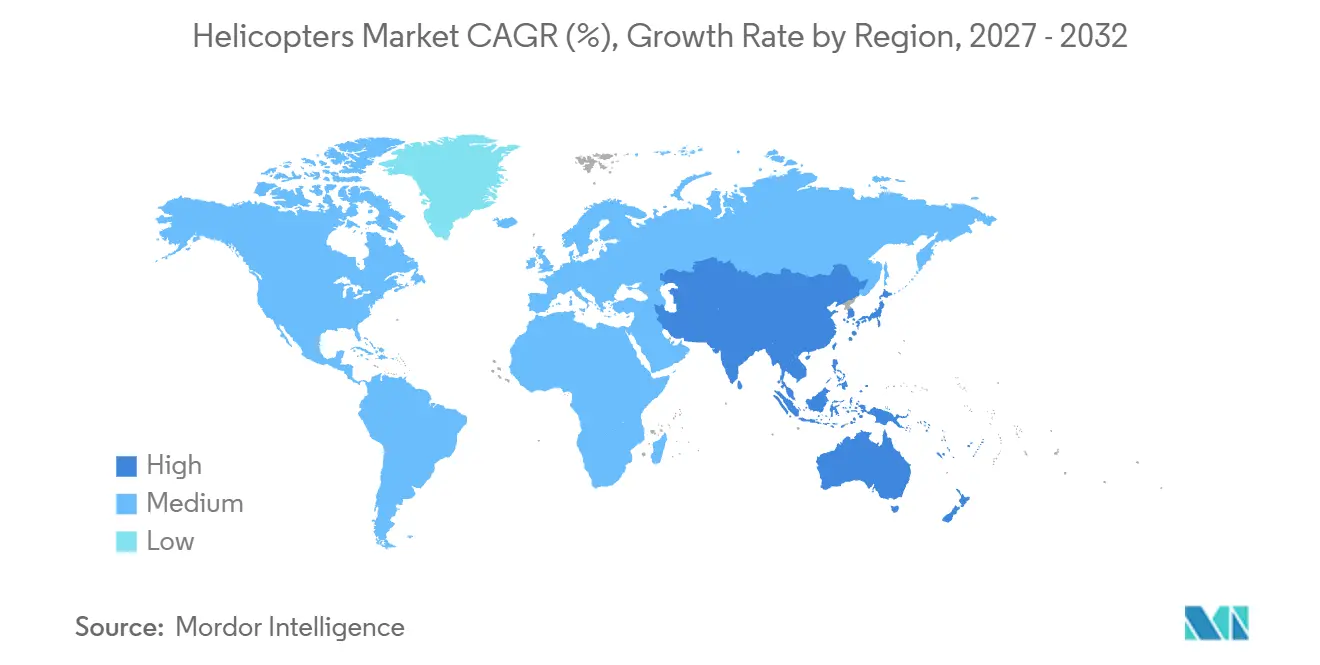
| Fastest Growing Market | Asia-Pacific |
| Largest Market | North America |
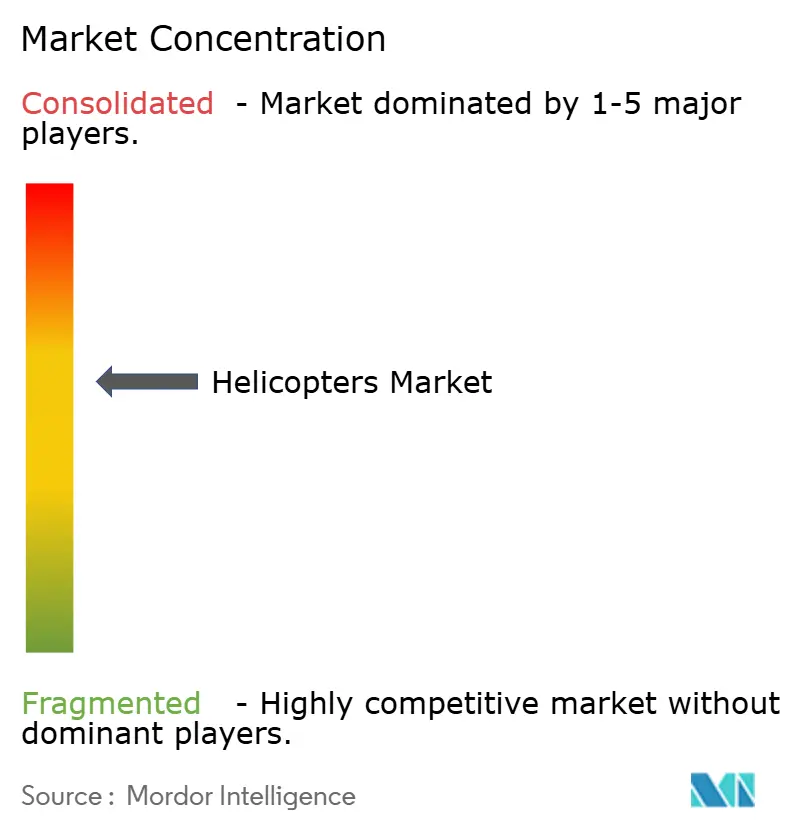
| Market Concentration | Medium |
Major Players *Disclaimer: Major Players sorted in no particular order Image © Mordor Intelligence. Reuse requires attribution under CC BY 4.0. | |
Helicopters Market Analysis by Mordor Intelligence
The helicopters market size was valued at USD 36.72 billion in 2026 and is forecast to grow from USD 39.15 billion in 2027 to reach USD 52.78 billion by 2032, at a 6.16% CAGR during the forecast period (2027-2032). Defense replacement programs remain the largest source of value, while emergency medical services, offshore energy, and public-safety contracts add demand outside military procurement cycles. The market is also benefiting from longer service contracts, which provide operators with clearer revenue visibility and support fleet financing. Demand is shifting toward aircraft that can support complex missions, including instrument flight, offshore transport, search and rescue, and crewed-uncrewed teaming. Supply constraints are likely to keep delivery volumes below demand in the near term and support aircraft values, lease rates, and aftermarket activity. These conditions favor manufacturers and operators with established production capacity, service networks, and long-term customer relationships.
Key Report Takeaways
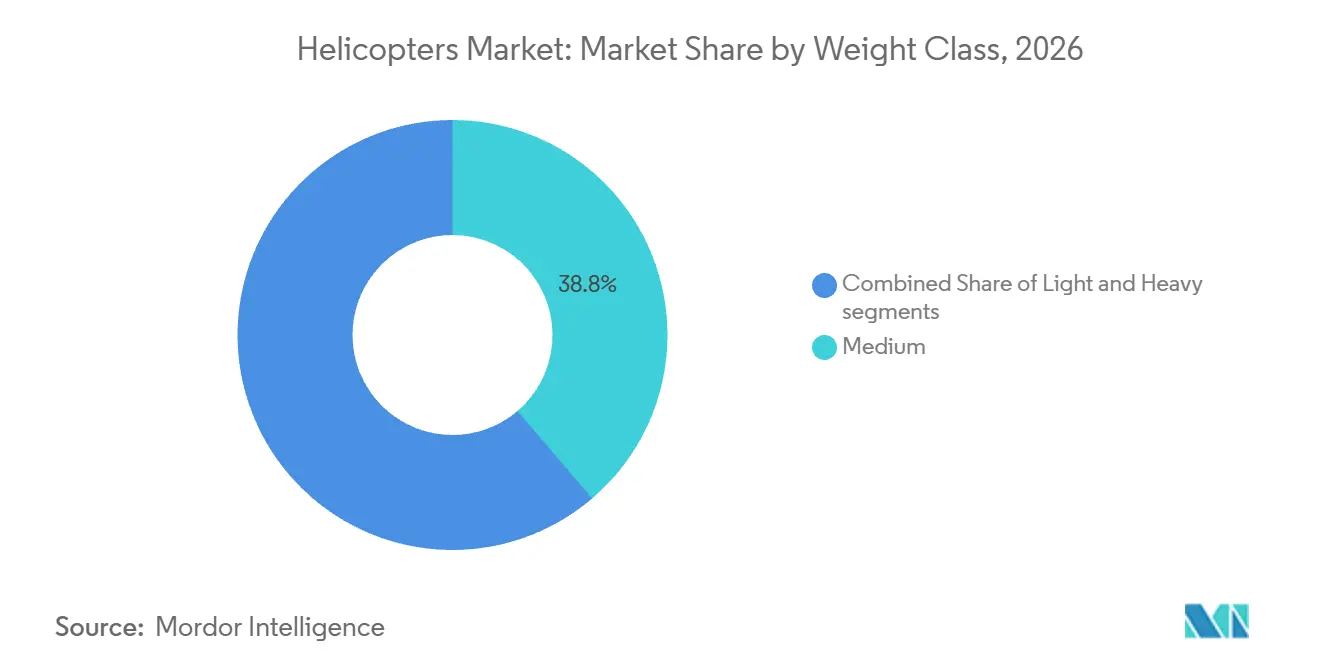
- By weight class, medium-weight helicopters held 38.75% of the global revenue share in 2026, while heavy-weight helicopters are forecast to grow at a 9.33% CAGR through 2032.
- By engine configuration, single-engine helicopters held 61.56% of the global revenue share in 2026, while twin-engine helicopters are forecast to grow at a 7.65% CAGR through 2032.
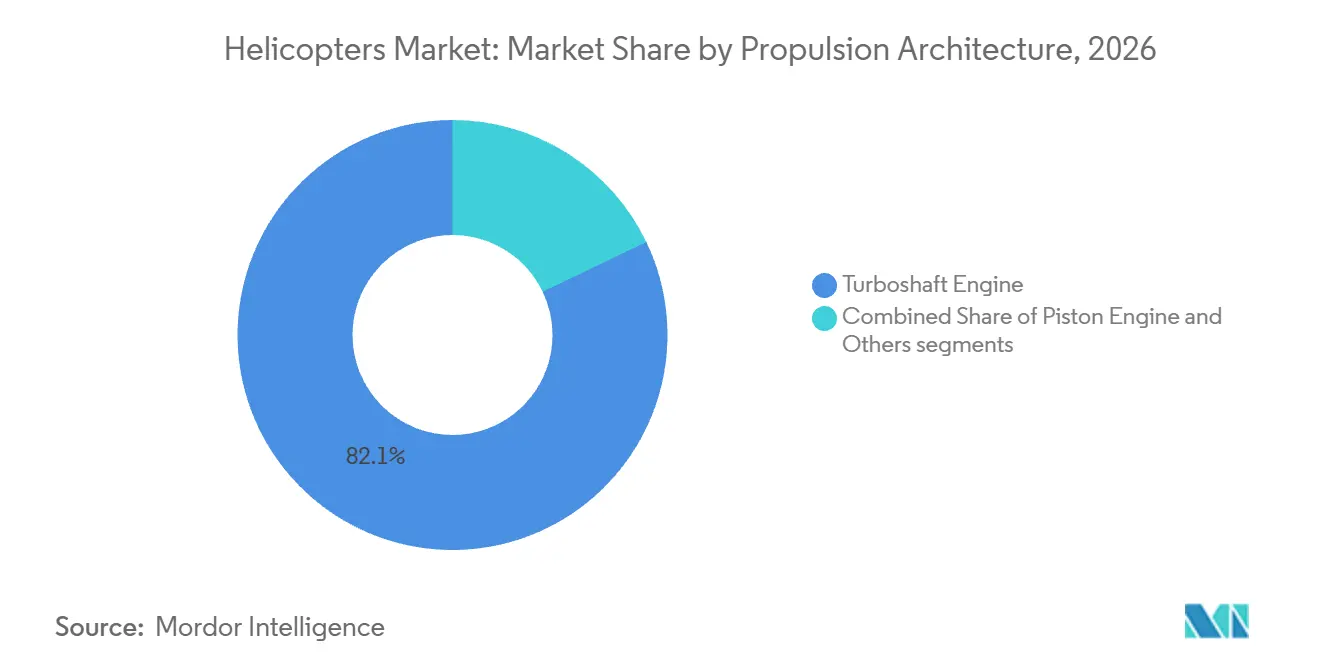
- By propulsion architecture, turboshaft held 82.12% of the global revenue share in 2026, while others are forecast to grow at a 12.76% CAGR through 2032.
- By end user, military held 74.34% of the global revenue share in 2026, while civil and commercial are forecast to grow at an 8.24% CAGR through 2032.
- By geography, North America accounted for 35.76% of the global revenue in 2026, while Asia-Pacific is forecast to grow at an 8.17% CAGR through 2032.
Note: Market numbers in this report are based on Mordor Intelligence's proprietary estimation framework, which combines nine months of actuals with Q4 projections for base year 2026.
Market Trends and Insights
Drivers Impact Analysis of Helicopters Market*
| Driver | (~) % Impact on CAGR Forecast | Geographic Relevance | Impact Timeline |
|---|---|---|---|
| Defense fleet modernization and aging-aircraft replacement | +1.8% | Global, with concentrated spending in North America, Europe, and Asia-Pacific | Long term (≥ 4 years) |
| Outsourced EMS fleet renewal | +1.2% | North America and Europe, with expansion into Asia-Pacific and Middle East and Africa | Medium term (2-4 years) |
| Offshore wind and deepwater energy expansion | +0.9% | Europe and Asia-Pacific | Medium term (2-4 years) |
| Wildfire, disaster-response, and public-safety contracting | +0.6% | Europe and North America, with expansion into Asia-Pacific | Short term (≤ 2 years) |
| Mission-system digitization and crewed-uncrewed teaming | +0.8% | North America and Europe, with secondary relevance in Asia-Pacific | Long term (≥ 4 years) |
| Helicopter leasing and pre-owned supply tightness | +0.5% | Global, strongest in North America and Europe | Short term (≤ 2 years) |
| Source: Mordor Intelligence | |||
Defense Fleet Modernization and Aging-Aircraft Replacement
Replacement of aging rotary-wing fleets remains the largest structural driver for the helicopters market. In September 2025, the US DoD and Sikorsky signed a 5-year procurement agreement for up to 99 CH-53K King Stallion helicopters, with a maximum value of USD 10.90 billion. The program is expected to deliver USD 1.50 billion in savings compared with annual contracting by providing suppliers with clearer demand signals and enabling larger purchase commitments. This model supports production planning and makes the helicopters market less dependent on one-year budget decisions. European governments are also replacing older fleets with aircraft that can act as connected mission platforms and work with uncrewed systems. These replacement programs extend demand across aircraft production, spares, training, and sustainment.
Outsourced EMS Fleet Renewal
EMS is creating demand in the helicopters market that does not align with defense budgets. Air Methods, which carries more than 100,000 patients each year, signed agreements for nearly 50 new helicopters at VERTICON 2025, including Bell 407GXi, Bell 429, Airbus H125, and Airbus H135 aircraft.[1] These purchases show that operators are renewing fleets to meet availability, safety, and clinical service requirements. Airbus also signed agreements for up to 15 H140 aircraft with Global Medical Response and for 10 H140 aircraft with ADAC Luftrettung and ÖAMTC Flugrettung. These fleet decisions support demand for instrument-flight-capable light- and medium-twin-engine helicopters.
Offshore Wind and Deepwater Energy Expansion
Offshore energy is creating a separate demand base for the helicopters market, including both oil and gas activity and offshore wind projects. NHV began using an H175 in full hoist configuration at the Deutsche Bucht offshore wind farm in April 2025, marking the first use of a super-medium helicopter for this type of North Sea operation. The aircraft can reduce technician transfer times when compared with vessels and can operate when sea conditions limit smaller aircraft. NHV also extended H175 operations to the Baltic Power Offshore Wind Farm in Poland during 2025. CHC Helicopter received a 21-month contract from Ørsted to operate an H175 and an AW139 for the 2.90 GW Hornsea 3 construction phase, with services starting in March 2026. Such contracts commonly run for several years and improve the predictability of operator revenue.
Wildfire, Disaster-Response, and Public-Safety Contracting
Wildfires and disaster-response requirements are shifting seasonal demand toward longer-term contracting in the helicopters market. Andalusia approved a EUR 112 million (USD 125.36 million) framework for heavy and semi-heavy firefighting helicopters under its INFOCA plan for 2026 to 2031. The 60-month structure gives operators a stronger basis for fleet investment than short seasonal charters. Greece ordered 8 Airbus H215 helicopters for firefighting, indicating that governments are also using direct ownership models to maintain essential aerial response capacity. In the United States, federal and state agencies continue to use exclusive-use and call-when-needed contracts for heavy firefighting aircraft. These arrangements create a demand floor that is less exposed to commodity prices and general corporate travel conditions.
Restraints Impact Analysis of Helicopters Market*
| Restraint | (~) % Impact on CAGR Forecast | Geographic Relevance | Impact Timeline |
|---|---|---|---|
| High acquisition, fuel, and lifecycle costs | -1.2% | Global, most acute in emerging Asia-Pacific markets and South America | Long term (≥ 4 years) |
| Pilot and maintenance technician shortages | -0.9% | Global, acute in North America and Europe and deepening in Asia-Pacific | Medium term (2-4 years) |
| Supply-chain bottlenecks and long OEM lead times | -0.8% | Global, with highest near-term impact in North America | Short term (≤ 2 years) |
| Airspace, noise, emissions, and certification constraints | -0.4% | Europe and North America, with wider relevance through international aviation frameworks | Long term (≥ 4 years) |
| Source: Mordor Intelligence | |||
High Acquisition, Fuel, and Lifecycle Costs
High ownership and operating costs remain a persistent restraint on the helicopters market. Rotorcraft require significant investment in the airframe, engines, training, maintenance, insurance, and mission equipment. Fuel costs also keep operating expenses above those of fixed-wing aircraft on routes where vertical access or rapid response is not essential. These economics are especially difficult for operators that rely on public budgets or have limited access to long-term financing. In lower-income markets, hard-currency purchase prices and imported parts can limit fleet renewal even when mission demand is present. This creates a divide between well-funded markets with contracted revenue and markets where interest in new aircraft is not matched by financing capacity.
Pilot and Maintenance Technician Shortages
Workforce shortages limit fleet availability and can slow growth across the helicopters market. According to Vertical Aviation International, civil helicopter operations will need more than 7,500 pilots and more than 40,000 maintenance technicians over the next 15 years. Specialized skills are particularly important for offshore operations, heavy helicopters, low-level utility work, and EMS. The Boeing Company forecasts that commercial aviation will require 728,000 new maintenance technicians over the next 20 years, adding pressure on the broader maintenance labor pool.[2] Training investments can ease the shortage over time, but they will not quickly replace experienced type-specific personnel.
*Our forecasts treat driver/restraint impacts as directional, not additive. The impact forecasts reflect baseline growth, mix effects, and variable interactions.
Helicopters Market Segment Analysis
By Weight Class:
Heavy Platforms Grow as Defense Contracts ExpandMedium helicopters held 38.75% of the helicopters market share in 2026. Their leading position reflects a balance of payload, range, cabin capacity, and operating cost for offshore transport, EMS, search-and-rescue, and utility missions. The category serves missions where a light platform cannot carry the required equipment or people, but where a heavy aircraft would add unnecessary operating cost. Operators can often assign the same airframe to crew transfer, patient transport, public safety, and infrastructure support over its service life. Cabin configurations can be adapted for passengers, medical equipment, rescue personnel, or cargo. This versatility improves aircraft utilization and helps customers spread financing costs over several contract types.
Heavy helicopters are forecast to expand at a 9.33% CAGR through 2032, the fastest rate among weight classes. The helicopters market size for heavy platforms is supported by the CH-53K procurement agreement and demand for large passenger loads in deepwater energy operations. These aircraft can carry more than 20 passengers in one lift on some offshore missions. Their size and lift capability also meet military airlift needs that cannot be served by smaller utility aircraft. Long production cycles mean customers usually place heavy-aircraft orders well before their existing fleets retire. Manufacturers are therefore aligning output with long-term contracted demand and with the service capacity required after delivery.

By Engine Configuration:
Twin-Engine Aircraft Gain Ground on Safety RequirementsSingle-engine helicopters held 61.56% of the helicopters market share in 2026. Their position reflects the use of large fleets for training, utility work, law enforcement, charter, and short-range services. Robinson R44 and R66 aircraft, the Airbus H125, and Bell 407 variants remain widely used in these roles. Operators often select a single-engine platform when a mission does not need a second powerplant or advanced instrument-flight capability. The category is particularly relevant where routes are familiar, daily flying hours are moderate, and a lighter platform is more practical. Lower acquisition and operating costs also support use by smaller fleet operators and flight schools.
Twin-engine helicopters are projected to grow at a 7.65% CAGR through 2032. The growth reflects safety and operating requirements in offshore, emergency medical, and search-and-rescue missions. These services often operate at night, over water, or far from alternate landing sites. A second engine gives operators additional redundancy for those conditions and can help meet customer or regulatory requirements. The Airbus H140 was introduced at VERTICON 2025 as a light-twin platform for EMS missions. The segment also benefits from demand for aircraft that retain light-category operating economics while meeting more demanding standards.
By Propulsion Architecture:
Turboshaft Platforms Remain Central While Alternatives DevelopTurboshaft helicopters accounted for 82.12% of the helicopters market size in 2026. Their position reflects a mature system of maintenance providers, trained crews, approved parts, and operating procedures. Turboshaft engines serve military, EMS, offshore, and utility aircraft across most weight classes. Piston-engine aircraft remain relevant in entry-level training and private flying, where lower acquisition cost is a priority. Operators also benefit from established maintenance records, engine support programs, and technician training for turbine-powered fleets. These practical advantages reduce risk in time-sensitive work and give gas-turbine aircraft a continuing advantage in high-utilization missions.
Other propulsion systems are projected to grow at a 12.76% CAGR through 2032. This category includes hybrid-electric, hydrogen fuel cell, and other alternative architectures in the early stages of development. The rate reflects investment from a small starting base rather than a large installed fleet. Safran’s Eco-Mode concept targets 15% fuel savings by allowing one engine to operate more efficiently during cruise in a twin-engine helicopter.[3] Broad adoption will require certified systems, dependable maintenance processes, and clear operating rules. It will also depend on operators' ability to support new power systems in active service.
By End User:
Civil and Commercial Applications Expand Faster than Military DemandMilitary operators accounted for 74.34% of the helicopters market size in 2026. This share reflects the high value of combat, transport, surveillance, and mission-equipped aircraft. Defense fleets require extensive training, sustainment, communications, and weapons integration over their service lives. Programs also involve national industrial commitments that can continue well after initial delivery. NATO countries and several Asia-Pacific nations are replacing older airframes as maintenance costs increase and mission requirements change. Military modernization therefore remains the core revenue base for major helicopter manufacturers.
Civil and commercial applications are forecast to grow at an 8.24% CAGR through 2032. EMS, offshore energy, search and rescue, and public safety work are increasing the use of multi-mission fleets. Avincis ordered 30 helicopters from Airbus and Leonardo in June 2026 for EMS, search-and-rescue, medevac, and offshore operations. These contracts strengthen the case for operators to acquire aircraft designed to move between several specialized roles. Civil demand makes manufacturer revenue less dependent on defense procurement alone.
Geography Analysis
North America held 35.76% of global revenue in 2026. The region combines the largest defense procurement base with a dense air medical network and a substantial offshore energy fleet. The USD 10.90 billion CH-53K agreement provides a large multi-year demand base for heavy-lift aircraft. Canada is extending the service life of its CH-149 Cormorant fleet while adding 3 aircraft. Europe is a significant center for defense modernization, EMS, and offshore wind support. European offshore wind projects support demand for super-medium aircraft capable of performing hoist operations and long-distance crew transfers. Europe also funds crewed and uncrewed systems and advanced mission equipment through defense procurement programs. These factors support both fleet orders and the long-term service work needed to keep aircraft ready for demanding missions.
Asia-Pacific is forecast to grow at an 8.17% CAGR through 2032. Airbus is building an H125 final assembly line in Vemagal, Karnataka, to support India’s stated aim of increasing rotorcraft manufacturing capability. Taiwan is developing offshore wind support services, including a dedicated helicopter maintenance team established by Dong Fang Offshore in May 2025. The regional demand is supported by military modernization, civil fleet requirements, and emerging energy operations. South America and the Middle East and Africa remain smaller markets, but Brazil’s UH-60M deliveries and continued regional defense investment indicate ongoing fleet modernization.
Competitive Landscape
The helicopters market is moderately concentrated among Airbus SE, Leonardo S.p.A., Lockheed Martin Corporation, Bell Textron Inc., and The Boeing Company. Operators are more fragmented across offshore, medical, and public-service fleets. Airbus SE recorded 536 net orders from 205 customers in 50 countries during 2025. It also reported a 51% share of civil and parapublic units. The company received 149 orders for the H145, underscoring the model’s importance in light- and medium-mission applications. Its product range and support network allow Airbus to serve civilian, public-service, and defense customers across several weight categories.
Leonardo S.p.A. is strengthening its position through military programs, multi-mission aircraft, and digital mission capabilities. The AW249 combines attack-helicopter capabilities with the ability to support crewed-uncrewed teaming. This capability can raise switching costs for military customers and support follow-on systems work. Manufacturers are also investing in production resilience to limit disruptions caused by constrained components and lengthy lead times. These moves show that supply-chain control and digital capability matter alongside aircraft performance. They also increase the value of long-term service relationships with defense and civil operators.
Opportunities remain in light-twin emergency medical aircraft, long-range offshore wind support, and sustainment packages linked to aircraft deliveries. Turkish Aerospace Industries and Hindustan Aeronautics are developing state-backed platforms that may compete in markets focused on cost and local industrial participation. Manufacturers are also developing connected mission capabilities with customers. The helicopters market is moving toward contracts that combine aircraft, maintenance, training, mission systems, and software support. These packages can improve customer retention by linking operational readiness to the manufacturer’s service organization. They also give operators a clearer framework for managing aircraft availability over a multi-year period.
Helicopters Industry Leaders
-
Airbus SE
-
Bell Textron Inc.
-
Leonardo S.p.A.
-
Lockheed Martin Corporation
-
The Boeing Company
- *Disclaimer: Major Players sorted in no particular order
Helicopters Market Companies Covered in this Report
- Airbus SE
- Bell Textron Inc.
- Leonardo S.p.A.
- Lockheed Martin Corporation
- The Boeing Company
- Russian Helicopters (Rostec)
- Robinson Helicopter Company
- Hindustan Aeronautics Limited
- Korea Aerospace Industries, Ltd.
- Turkish Aerospace Industries, Inc.
- Kawasaki Heavy Industries, Ltd.
- Aviation Industry Corporation of China
- Kaman Corporation
- MD Helicopters, LLC
- Enstrom Helicopter Corporation
- Erickson Incorporated
- Helicopteres Guimbal S.A.S
Recent Industry Developments in Helicopters Market
- June 2026: Airbus Helicopters and the Republic of Armenia signed a contract to acquire six H145 helicopters. The multi-purpose H145 helicopters will be used for transport missions.
- October 2026: The Romanian government signed a contract to procure 12 Airbus H225M helicopters to strengthen its defense capabilities.
- March 2025: At the VERTICON 2025 conference in Dallas, Air Methods signed major purchase agreements with Bell Textron Inc. and Airbus Helicopters to expand its fleet by nearly 50 aircraft. These agreements reinforce the company's commitment to expanding emergency medical transport services nationwide and serving more patients in need.
Global Helicopters Market Report Scope
The helicopters market comprises rotary-wing aircraft designed for VTOL, hovering, and operations across military, civil, and commercial applications. The scope includes helicopters procured for new fleet acquisitions, fleet expansion, and the replacement of aging aircraft by military and civilian operators.
The helicopters market is segmented by weight class, engine configuration, propulsion architecture, end user, and geography. By weight class, the market is segmented into light, medium, and heavy helicopters. By engine configuration, the market is segmented into single-engine and twin-engine. By propulsion architecture, the market is segmented into piston engine, turboshaft engine, and others. By end user, the market is segmented into military and civil and commercial. The report also covers market sizes and forecasts for the helicopters market in major countries across the regions. For each segment, the market size is provided in terms of value (USD).
Segmentation Overview
| Light |
| Medium |
| Heavy |
| Single-Engine |
| Twin-Engine |
| Piston Engine |
| Turboshaft Engine |
| Others |
| Military | Combat and Close Air Support |
| Troop Transport | |
| Humanitarian and Disaster Relief | |
| Pilot Training | |
| Civil and Commercial | Offshore Oil and Gas |
| Emergency Medical Services | |
| Corporate and VIP Charter | |
| Search and Rescue/Firefighting | |
| Others |
| North America | United States | |
| Canada | ||
| Mexico | ||
| Europe | United Kingdom | |
| France | ||
| Germany | ||
| Italy | ||
| Russia | ||
| Rest of Europe | ||
| Asia-Pacific | China | |
| India | ||
| Japan | ||
| South Korea | ||
| Australia | ||
| Rest of Asia-Pacific | ||
| South America | Brazil | |
| Argentina | ||
| Rest of South America | ||
| Middle East and Africa | Middle East | Saudi Arabia |
| United Arab Emirates | ||
| Israel | ||
| Rest of Middle East | ||
| Africa | South Africa | |
| Egypt | ||
| Rest of Africa | ||
| By Weight Class | Light | ||
| Medium | |||
| Heavy | |||
| By Engine Configuration | Single-Engine | ||
| Twin-Engine | |||
| By Propulsion Architecture | Piston Engine | ||
| Turboshaft Engine | |||
| Others | |||
| By End User | Military | Combat and Close Air Support | |
| Troop Transport | |||
| Humanitarian and Disaster Relief | |||
| Pilot Training | |||
| Civil and Commercial | Offshore Oil and Gas | ||
| Emergency Medical Services | |||
| Corporate and VIP Charter | |||
| Search and Rescue/Firefighting | |||
| Others | |||
| By Geography | North America | United States | |
| Canada | |||
| Mexico | |||
| Europe | United Kingdom | ||
| France | |||
| Germany | |||
| Italy | |||
| Russia | |||
| Rest of Europe | |||
| Asia-Pacific | China | ||
| India | |||
| Japan | |||
| South Korea | |||
| Australia | |||
| Rest of Asia-Pacific | |||
| South America | Brazil | ||
| Argentina | |||
| Rest of South America | |||
| Middle East and Africa | Middle East | Saudi Arabia | |
| United Arab Emirates | |||
| Israel | |||
| Rest of Middle East | |||
| Africa | South Africa | ||
| Egypt | |||
| Rest of Africa | |||
Key Questions Answered in the Report
What is the projected value of the helicopters market by 2032?
The helicopters market is forecast to reach USD 52.78 billion by 2032, from USD 36.72 billion in 2026, at a 6.16% CAGR during 2027 to 2032. This helicopters market outlook reflects sustained defense and civil-service demand. Longer procurement cycles and multi-year service contracts also help provide a more stable basis for manufacturer production planning across all major global product lines and services.
Which weight class leads helicopter revenue?
Medium helicopters lead with a 38.75% revenue share in 2026 because they can support offshore, EMS, search-and-rescue, and utility missions. Their payload and operating economics fit a broad range of contracted services.
Why are heavy helicopters growing quickly?
Heavy helicopters are forecast to grow at a 9.33% CAGR through 2032, supported by defense procurement and deepwater offshore transport requirements. They serve missions that require high lift capacity and larger passenger loads.
What is driving demand for twin-engine helicopters?
Offshore, EMS, and search-and-rescue (SAR) operations need greater safety redundancy and instrument-flight capability, supporting a 7.65% CAGR for twin-engine platforms. These conditions often involve night flying, remote locations, or operations over water.
Which region is growing fastest for helicopter demand?
Asia-Pacific is forecast to grow at an 8.17% CAGR through 2032, supported by defense modernization, civil fleet additions, and offshore wind activity. India and Taiwan illustrate the region’s growing manufacturing and offshore-service activity.
How concentrated is competition among helicopter manufacturers?
The helicopters market has a moderately concentrated manufacturer base, with Airbus Helicopters, Leonardo, Sikorsky, Boeing, and Bell Textron as leading participants, while operator markets remain more fragmented. Competition also depends on support networks, digital systems, and the ability to secure long-term contracts.