
Helicopter Avionics Market Size and Share
Market Overview
| Study Period | 2020 - 2032 |
|---|---|
| Market Size (2027) | USD 7.71 Billion |
| Market Size (2032) | USD 11.60 Billion |
| Growth Rate (2027 - 2032) | 8.51 % |
| Fastest Growing Market | Asia-Pacific |
| Largest Market | North America |
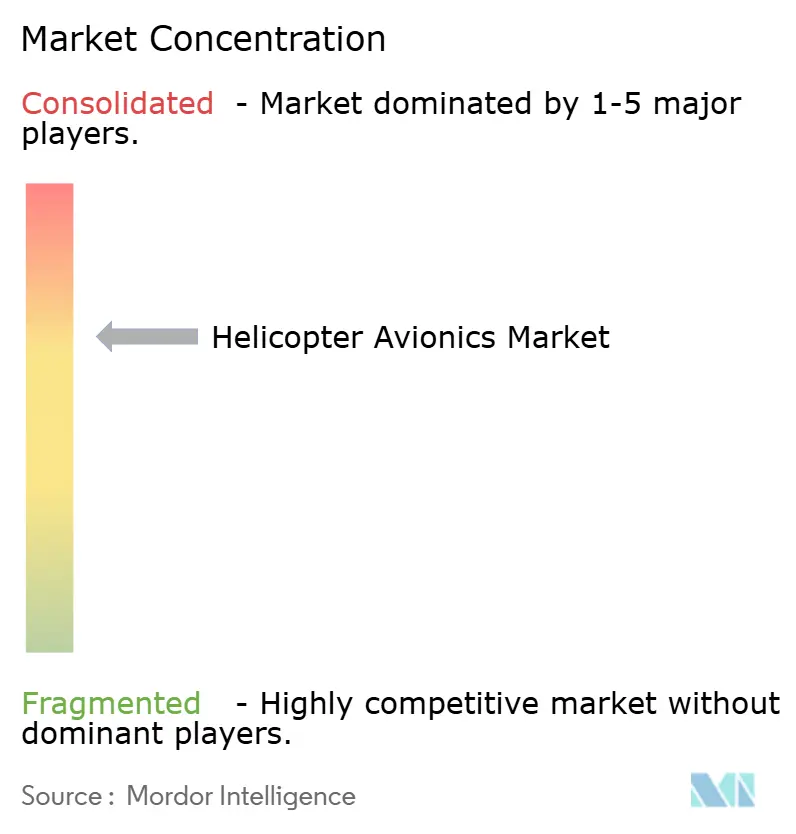
| Market Concentration | Medium |
Major Players *Disclaimer: Major Players sorted in no particular order Image © Mordor Intelligence. Reuse requires attribution under CC BY 4.0. | |
Helicopter Avionics Market Analysis by Mordor Intelligence
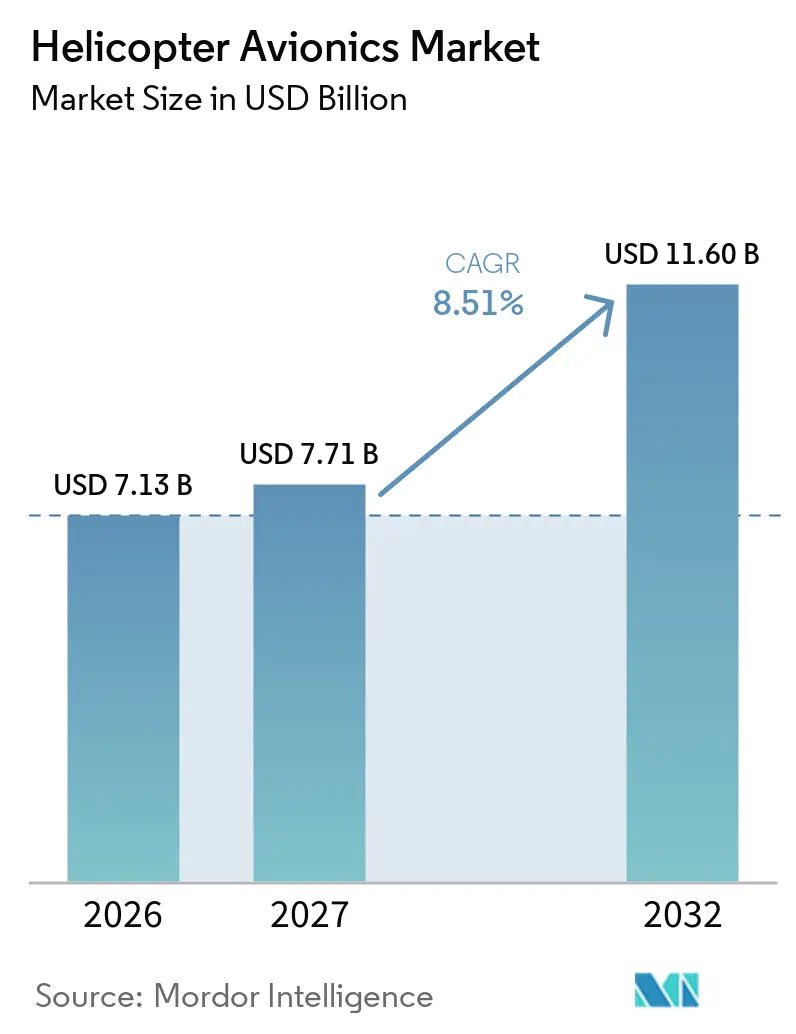
The helicopter avionics market size was valued at USD 7.13 billion in 2026 and is forecast to grow from USD 7.71 billion in 2027 to reach USD 11.60 billion by 2032, at an 8.51% CAGR during the forecast period (2027-2032). Defense fleet recapitalization, airspace compliance, and expanding demand for emergency and special-mission operations support. The helicopter avionics market is growing faster than helicopter deliveries because avionics content is increasing on both new and in-service aircraft. Operators are extending aircraft service lives and buying digital cockpit, navigation, and mission systems to maintain certification and expand mission capability. Military procurement leads to longer delivery schedules, while civil operators face more immediate compliance and operational requirements. Suppliers that can support certification, integration, and long-term equipment sustainment are therefore positioned to address the most durable demand in the helicopter avionics market.
Key Report Takeaways
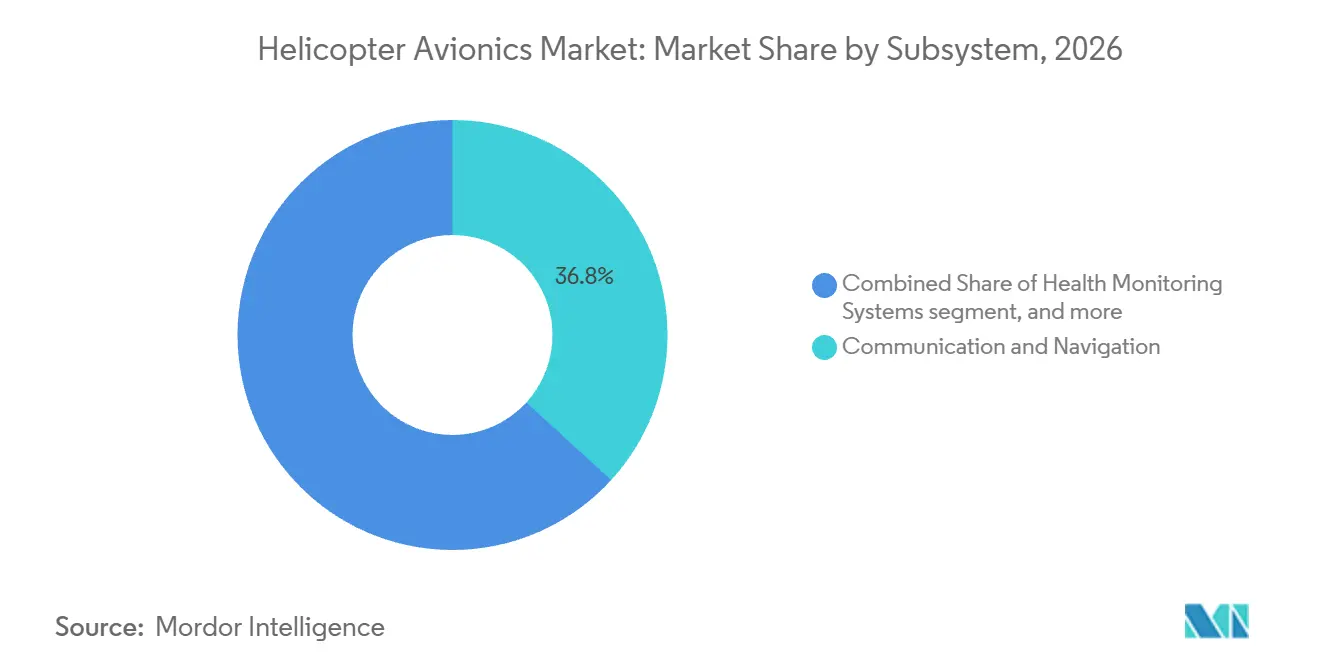
- By subsystem, communication and navigation held 36.78% of the helicopter avionics market share in 2026, while flight management and control is forecast to grow at a 9.43% CAGR through 2032.
- By application, military applications held 47.56% of the helicopter avionics market share in 2026, while civil applications are forecast to grow at a 9.62% CAGR through 2032.
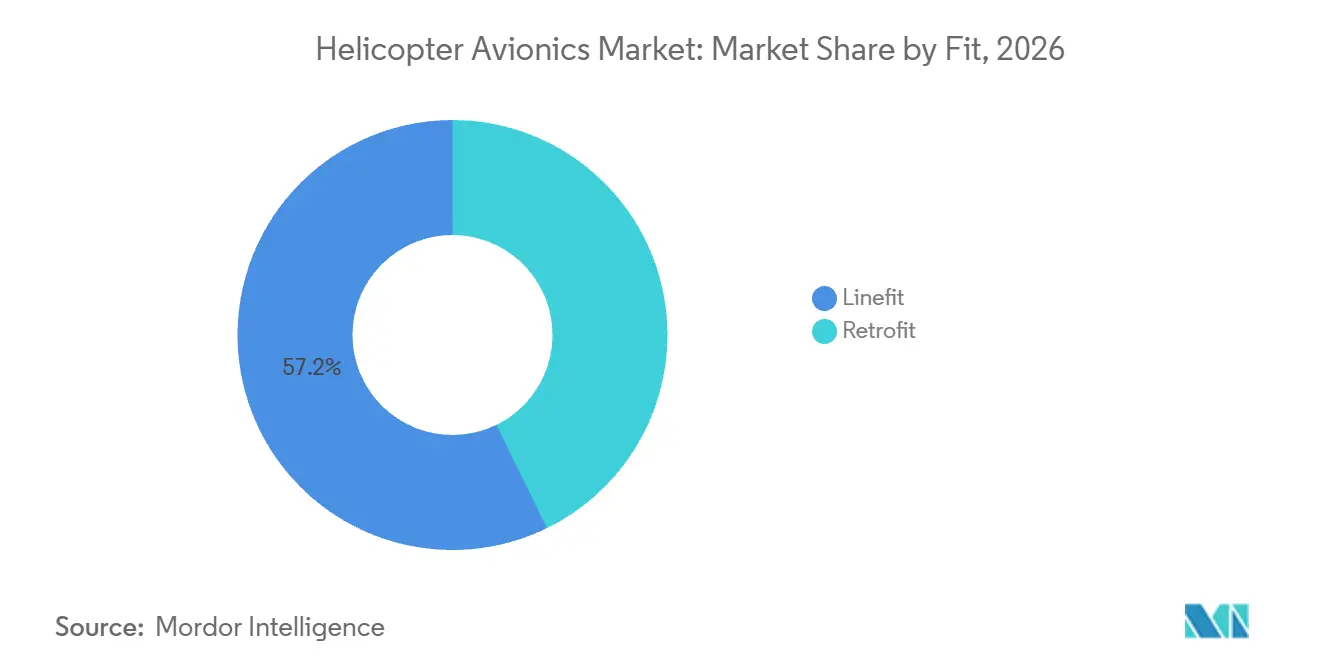
- By fit, linefit held 57.24% of revenue in 2026, while retrofit is forecast to grow at a 10.78% CAGR through 2032.
- By engine type, twin-engine helicopters held 61.25% of revenue in 2026, while single-engine helicopters are forecast to grow at a 10.45% CAGR through 2032.
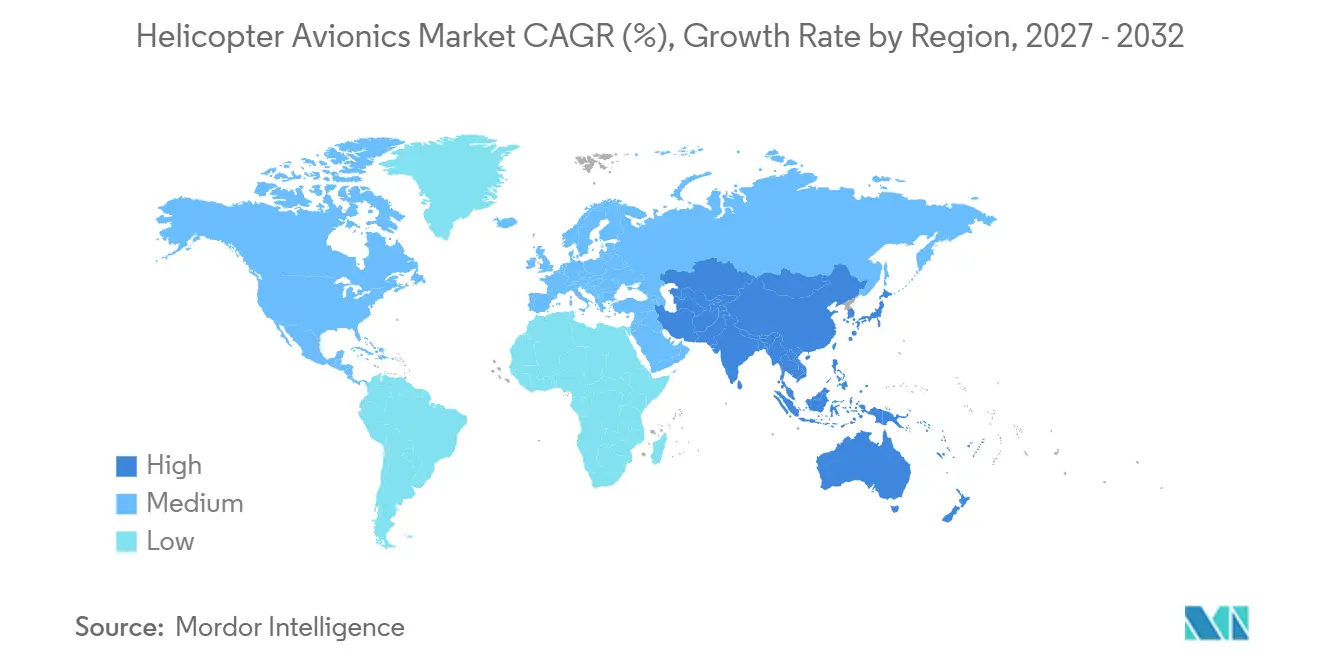
- By geography, North America held 37.45% of revenue in 2026, while Asia-Pacific is forecast to grow at a 9.87% CAGR through 2032.
Note: Market numbers in this report are based on Mordor Intelligence's proprietary estimation framework, which combines nine months of actuals with Q4 projections for base year 2026.
Market Trends and Insights
Drivers Impact Analysis of Helicopter Avionics Market*
| Driver | (~) % Impact on CAGR Forecast | Geographic Relevance | Impact Timeline |
|---|---|---|---|
| Military and civilian fleet modernization | +2.50% | Global, concentrated in North America and Europe | Medium term (2-4 years) |
| Safety, navigation, and airspace compliance upgrades | +1.30% | Global, with early gains in North America, EU, and Asia-Pacific | Short term (≤ 2 years) |
| Expansion of helicopter EMS, SAR, and utility operations | +1.10% | Global, particularly strong in Europe, Asia-Pacific, and North America | Medium term (2-4 years) |
| Integrated digital cockpit adoption | +1.20% | North America and Europe, with spillover to Asia-Pacific and Middle East and Africa | Medium term (2-4 years) |
| Open-architecture retrofitability for obsolescence management | +0.90% | Global, with high traction in North America and Europe | Medium term (2-4 years) |
| Secure connectivity for distributed mission operations | +0.70% | North America, Europe, and selective Asia-Pacific nations | Long term (≥ 4 years) |
| Source: Mordor Intelligence | |||
Military and Civilian Fleet Modernization
Active recapitalization programs across NATO and Indo-Pacific defense establishments are a major source of demand for the Helicopter avionics market. In March 2025, the US Army awarded Collins Aerospace a USD 80 million H-60M MOSA contract to replace legacy Black Hawk cockpit systems with modular equipment.[1] Collins Aerospace also received a contract worth up to USD 472 million in August 2026 to support CH-47 Chinook avionics modernization, including obsolescence mitigation and open-architecture standardization. These programs extend avionics spending beyond a single replacement cycle in the helicopter avionics market, as aircraft remain in service while their software and equipment are updated. Open systems can widen supplier participation in software while retaining integration and sustainment work for prime contractors.
Spain’s helicopter modernization program includes 50 additional NH90 units, 50 H-145M helicopters, 13 H-135 helicopters, and 6 H-175 helicopters, while the Tiger Mk III has progressed toward flight testing. The procurement covers several platform classes and supports equipment demand across the fleet. The US Army sought industry input in December 2025 on UH-60M modernization and stated plans to operate the platform beyond 2050. Long service commitments change the commercial basis for avionics suppliers because each aircraft can require several technology refreshes. Civil fleet modernization follows the same broad direction, although it is more closely tied to operating approvals, maintenance planning, and the available economics of each retrofit. These factors keep modernization relevant across military and civil fleets.
Safety, Navigation, and Airspace Compliance Upgrades
Airspace modernization creates mandatory upgrade requirements for operators in the helicopter avionics market. ADS-B Out, Mode S transponders, and instrument flight rules approvals require operators to assess navigation, surveillance, and cockpit equipment. The Federal Aviation Administration proposed an airworthiness directive in October 2026 addressing radio altimeter limitations near 5G Lower C-Band operations in Canadian airspace. This action demonstrates how external changes can trigger avionics remediation across civil fleets. Compliance spending is less discretionary than a general cabin or comfort upgrade because it can affect access to airspace and permitted operations. It can also make component availability, installation capacity, and approval schedules important to an operator’s maintenance plan. The resulting demand in the helicopter avionics market is distributed across communication, navigation, autopilot, and flight-information equipment.
The FAA certified the Airbus H125 for single-pilot IFR operations in March 2025, using an upgraded cockpit, new autopilot, and redundant systems developed with Moog’s Genesys Aerosystems.[2] This certification broadens the operational use of a single-engine platform for missions that require stronger navigation and flight management capabilities. More than 4,300 H125-family helicopters operate worldwide, providing a sizeable installed base for qualified upgrades. FAA special conditions issued in August 2026 for a Skyryse-modified Robinson R66 also show that certification pathways for digital fly-by-wire controls are developing in light helicopters. As approvals become more established, suppliers can apply certified architectures to more helicopter models. Safety and compliance demands, therefore, support equipment replacement and new operational roles simultaneously.
Expansion of Helicopter EMS, SAR, and Utility Operations
Emergency medical service, search-and-rescue, and utility operations require dependable navigation, automation, and health-monitoring capability. These missions operate in demanding weather, terrain, and dispatch conditions, making avionics complexity more important than the airframe’s purchase price. HALO-Flight became the first US helicopter air ambulance operator to implement the Foresight MX HUMS on its Bell 407GXi fleet in February 2025. The operator planned broader adoption alongside upgrades to IFR capability. This combination reflects the link among aircraft availability, operational safety, and mission completion. The equipment can provide a clearer basis for planned maintenance and help operators identify developing issues before they affect dispatch. It also expands use of systems that previously had stronger adoption in military fleets.
The FAA issued special conditions in March 2026 for the Airbus EC175B search-and-rescue automatic flight control system. The conditions address SAR-specific autopilot modes and establish a defined certification basis for future programs. Operators without comparable automatic flight-control capability may face a narrower mission set as operating standards rise. Utility and law-enforcement users also benefit from integrated cockpit systems, weather awareness, and reliable communications. The helicopter avionics market therefore gains from mission growth even when airframe orders remain limited. The demand in the helicopter avionics market is particularly relevant to operators that need to fly safely in low visibility, at night, or across difficult terrain. These mission conditions increase the value of a dependable flight-control system, clear cockpit information, and qualified operating procedures.
Open-Architecture Retrofit ability for Obsolescence Management
Obsolescence management is creating sustained retrofit work as analog component supply declines and manufacturer support for legacy equipment ends. Astronautics and WCF Aerospace submitted an FAA supplemental type certificate application in March 2026 for the RoadRunner electronic flight instrument for the Sikorsky UH-60A/L Black Hawk helicopters. The application targets replacement of obsolete analog attitude and heading instruments. Astronautics also pursued co-validation by the Japan Civil Aviation Bureau of the related FAA certificate for the Leonardo A109-series helicopter. A single certification campaign can thus support several markets and platform types. The helicopter avionics market benefits when qualified retrofit packages make upgrades practical for aircraft that would not be replaced.
In July 2026, the Portuguese Army selected Moog’s Genesys Avionics Suite and GRC 4000 4-axis autopilot for its UH-60L Black Hawk fleet through NATO’s NSPA Aviation Support Office. The program includes an IFR-capable glass cockpit and deliveries through 2028. Multilateral procurement can provide allied operators with access to retrofit solutions without requiring a separate bilateral procurement route. Modular equipment in the helicopter avionics market also supports future software and hardware changes without requiring a new airframe purchase. Digital cockpits and secure connectivity add to this effect because missions increasingly depend on integrated data and networked systems. Open architecture can therefore shift supplier revenue from a one-time installation to ongoing support, integration, and update activities.
Restraints Impact Analysis of Helicopter Avionics Market*
| Restraint | (~) % Impact on CAGR Forecast | Geographic Relevance | Impact Timeline |
|---|---|---|---|
| High certification and lifecycle costs | -1.50% | Global, most acute in North America and EU | Long term (≥ 4 years) |
| Legacy-airframe integration complexity | -1.00% | Global, concentrated in aging military fleets in EU and Asia-Pacific | Medium term (2-4 years) |
| Cybersecurity and export-control compliance burden | -0.80% | North America, EU, and cross-border military programs | Medium term (2-4 years) |
| Rotorcraft SWaP and power-cooling constraints | -0.60% | Global, particularly acute in light single-engine platforms | Long term (≥ 4 years) |
| Source: Mordor Intelligence | |||
High Certification and Lifecycle Costs
Certification and lifecycle costs limit the pace at which operators can modernize equipment in the helicopter avionics market. Novel architectures can require 3 to 5 years of FAA or EASA certification work and substantial qualification spending. DO-178C software and DO-254 hardware processes are important for safety-critical systems, but they make rapid product changes expensive. This favors suppliers with existing certification experience and a portfolio of approved equipment. Smaller operators in the helicopter avionics market can find that the cost of a retrofit is high relative to the value of an older helicopter. They must weigh the installation cost against expected remaining airframe life, available mission revenue, and the benefits of retaining the aircraft. The result is uneven modernization, with higher-value platforms generally receiving qualified packages first.
The cost burden continues after installation through software updates, continuing-airworthiness activity, component support, and maintenance across airframes that may remain in operation for more than 30 years. The FAA’s proposed 2026 radio-altimeter directive illustrates how a new compliance requirement can create necessary work while increasing costs for smaller operators. Export licenses under ITAR and EAR add lead times and administrative work for cross-border military sales and dual-use equipment. Cybersecurity requirements also add design, testing, and sustainment work as secure data links become more common. These restraints do not eliminate demand, but they can delay programs or limit their scope. Suppliers that reduce certification and support burdens can improve the economics of modernization.
Legacy-Airframe Integration Complexity
Modern equipment in the helicopter avionics market is difficult to integrate into airframes designed around analog instruments, proprietary data buses, limited electrical margins, and constrained installation space. Rotorcraft also face size, weight, power, and cooling limits that can restrict the equipment available for a retrofit. Bell delivered 6 Bell 412EP helicopters to Indonesian Army Aviation in March 2025 with BasiX-Pro Glass Cockpit Retrofit Kits that combined Astronautics displays and Garmin avionics. The installation required coordination among the aircraft manufacturer, an authorized maintenance center, and avionics suppliers. This illustrates why integration cost varies materially by platform. Wiring changes, interface testing, and placement of equipment each require attention to the helicopter’s original design and approved configuration. Complex retrofits need configuration control, engineering support, and qualifications that are less demanding on a production line.
High-profile military aircraft can attract nationally funded integration programs, while smaller civil and utility aircraft may lack a viable upgrade kit. In April 2026, NAHEMA and NHIndustries signed an NH90 Block 2 architecture study contract that emphasizes configuration commonality and modular avionics. The work seeks to reduce lifecycle integration burdens across a fleet of nearly 200 NH90 helicopters. Common architecture can ease future equipment changes, but it does not remove the challenges of legacy fleets that lack approved supplemental type certificates. The same technical limits affect the adoption of secure mission connectivity, advanced displays, and extra computing capacity. These constraints preserve a role for specialist integrators with deep platform knowledge.
*Our forecasts treat driver/restraint impacts as directional, not additive. The impact forecasts reflect baseline growth, mix effects, and variable interactions.
Helicopter Avionics Market Segment Analysis
By Subsystem:
Communication and Navigation Anchors Value While Flight Management AcceleratesCommunication and navigation accounted for 36.78% of the helicopter avionics market share in 2026. ADS-B Out, Mode S, and GNSS upgrade cycles drive demand because they are tied to operating compliance across the rotorcraft fleet. Operators cannot defer these systems as easily as discretionary cabin or mission enhancements that do not affect airspace access and approved procedures. Communication equipment also supports the secure exchange of information needed by civil and military missions. This dependable base makes the category a central source of subsystem value. It is relevant across older aircraft needing compliance upgrades and new helicopters delivered with more capable integrated systems. The breadth of these requirements means that demand for communication and navigation is not limited to a single mission category, region, or airframe class.
Flight management and control is forecast to expand at a 9.43% CAGR through 2032. Honeywell Aerospace, Inc., and Near Earth Autonomy completed an autonomous test flight of a Leonardo AW139 in June 2025, with autopilot modes controlled by onboard software.[3] This development supports future logistics and automation programs. Cockpit, visualization, and display systems are also moving toward integrated touchscreen suites that reduce weight and volume. Health-monitoring systems are extending from military applications to civil fleets as operators place more value on aircraft availability and maintenance planning. Electronic warfare (EW) and data-recording equipment remain smaller categories, but threat conditions and mission requirements support their use on utility and transport platforms.

By Application:
Military Scale Meets Industrial ExpansionMilitary applications accounted for 47.56% of the helicopter avionics market in 2026. Multi-year procurement schedules, complex platform configurations, and higher equipment content per aircraft give the segment a large revenue base. Defense customers are increasingly combining new aircraft orders with service-life extension and recapitalization programs. This reduces the distinction between original equipment and upgrade revenue within military demand. Modernization programs for Black Hawk and Chinook fleets show how long-lived platforms continue to consume avionics after their original production period. Military applications also require resilient communications, navigation, mission computers, flight controls, self-protection equipment, and reliable support. These requirements increase the value of avionics content and make sustainment support a continuing part of many defense contracts.
Civil applications are projected to grow at a 9.62% CAGR through 2032. Offshore energy, utility, and law-enforcement operators use cockpit and monitoring upgrades to improve dispatch reliability and support demanding flight profiles. Their aircraft must meet demanding availability, weather, navigation, and safety requirements without the scale of a large military program. Civil applications continue to rely on EMS, charter, and passenger transport fleets that need integrated cockpit, synthetic vision, and terrain-awareness systems. Combined data recording and health-monitoring systems are becoming more common in retrofit packages. These applications expand demand beyond conventional defense procurement cycles. Their requirements can support recurring work in monitoring, recording, communications, and qualified system maintenance across fleets serving specialized operational needs worldwide.
By Fit:
Retrofit Overtakes Linefit on the Growth TrajectoryLinefit equipment accounted for 57.24% of the helicopter avionics market in 2026, reflecting original equipment manufacturers' influence over new-aircraft configurations. New-generation platforms often carry premium cockpit, communications, navigation, and mission equipment from delivery. Linefit installations are efficient because equipment is integrated during production rather than after entry into service. They also establish the technical baseline for later service and upgrade work. The continued strength of this segment reflects demand for military and civil platforms that are delivered with more capable digital systems. It remains important even as retrofit activity accelerates. Original installations also create a support base that may later require maintenance, certified changes, and compatibility work throughout the helicopter's operating life. This relationship links production deliveries to subsequent aftermarket activity.
Retrofit is forecast to increase at a 10.78% CAGR through 2032, supported by aircraft life extension and the need for capabilities that new deliveries alone cannot provide. Garmin received supplemental type certificate approval in July 2025 for GFC 600H retrofit installation on Airbus H130 helicopters. The system adds hover assist, stability protection, and coupled approach capability. Garmin's selection of the G5000H for 24 Brazilian Air Force UH-60L helicopters in December 2025 also demonstrates the use of open-architecture commercial equipment in military modernization. Aircraft originally designed for 20 to 25 years are being retained for 35 to 40 years or more. That extended life creates repeat opportunities for avionics replacement.
By Engine Type:
Twin-Engine Dominance Masks Single-Engine OpportunityTwin-engine helicopters in the helicopter avionics market held 61.25% of revenue in 2026, reflecting their wide use in military, offshore, and EMS operations. These missions place a premium on redundancy, payload, and all-weather capability. Dual FADEC, redundant navigation and communications, and complex flight-management requirements increase avionics content per aircraft. The segment therefore produces higher equipment value than light single-engine platforms. Its position is reinforced by defense and emergency operators that require aircraft able to perform demanding missions. Twin-engine helicopters will remain an important revenue base for integrated avionics and long-term sustainment work. Their mission profile and system redundancy make their equipment requirements more extensive than those of many light helicopters. This need supports capable integrated flight decks and related sustainment work.
Single-engine helicopters are forecast to grow at a 10.45% CAGR through 2032. The FAA certification of the H125 for single-pilot IFR operations provides a pathway for stronger cockpit, autopilot, and navigation capability on a widely operated aircraft family. The H125 holds close to 80% of the intermediate single-engine category and has more than 4,300 aircraft in service. Enstrom also introduced an optional Garmin G500H display with ADS-B In and Out for new 480B turbine deliveries in 2026. These developments show the increasing presence of glass cockpits in light turbine helicopters. They also extend modern compliance capability to smaller operators. Lower electronics costs and more demanding operating requirements improve the case for certification investment across larger unit volumes.
Geography Analysis
North America held 37.45% of the helicopter avionics market share in 2026, supported by major US military procurement and modernization activity. The US Army’s H-60M modernization work and its August 2026 Chinook contract provide substantial demand for integration, capability insertion, and support. The planned operation of the UH-60M beyond 2050 also lengthens the addressable upgrade cycle. Civil operators add demand through health-monitoring systems and IFR-grade cockpit equipment. The large installed fleet also supports a broad base of maintenance, retrofit, and certification activity. Canada and Mexico contribute through search-and-rescue and oil-and-gas operations. The region combines large programs with a mature certification and service ecosystem.
Asia-Pacific is expected to record a 9.87% CAGR through 2032, the fastest regional rate. Bharat Electronics received an INR 2,210 crore (USD 261.54 million) contract in April 2025 for an indigenous EW suite for Indian Air Force Mi-17 V5 helicopters. Aitech also received a USD 63 million contract in May 2026 to supply avionics computing solutions for 156 Indian Light Combat Helicopters. India is both a technology buyer and a growing production base, supporting near-term imports while reshaping local procurement over time. This dual role sustains current demand while supporting local capability development and supplier participation over time.
Japan’s H60 and CH-47F upgrades and Taiwan’s AS365 modernization demonstrate broader demand across the Asia-Pacific region. Europe remains the second-largest regional market because France, Germany, the UK, Italy, and Spain support NATO-related helicopter programs. The NH90 Block 2 study will define modular architecture, connectivity, maintenance, and crewed-uncrewed teaming requirements for nearly 200 aircraft over a long operating horizon.
Middle East and Africa demand is supported by energy fleets and defense procurement, including Honeywell’s service agreement with Abu Dhabi Aviation through 2029. South America participates through Brazilian military retrofit activity. These regions broaden the helicopter avionics market beyond North American spending. Their programs create opportunities for equipment suppliers that can support local certification, maintenance arrangements, and long-term operator requirements.
Competitive Landscape
The helicopter avionics market is moderately consolidated among platform integrators, including Collins Aerospace (RTX Corporation), Honeywell Aerospace Inc., Garmin Ltd., Safran SA, and Thales Group. These companies compete through integrated suites, certification support, and long-term sustainment rather than through individual hardware sales alone. Moog, Inc., Elbit Systems Ltd., Curtiss-Wright Corporation, and other specialists are active in retrofit and mission-specific programs. GPMS International illustrates the role of a focused supplier in health-monitoring systems. Competition is increasing in the light civil helicopters sector, where the economics of an upgrade are improving. These aircraft have historically offered limited avionics spending, but lower electronics costs and IFR requirements are making qualified solutions more viable for fleet owners. Suppliers can address this group with targeted retrofit packages in which the operational benefit justifies the installation and approval costs.
Software-defined architecture and certification experience are central points of differentiation. Collins Aerospace’s Mosarc platform supports modular, third-party-capable avionics on US Army Black Hawks. Thales’ FlytX suite and integrated display approach address size and weight limitations by consolidating functions into fewer units. Suppliers that align with the NH90 Block 2 architecture can gain an advantage as future requirements become established. Honeywell’s autonomous AW139 flight test also highlights how certified flight-control and flight-management experience creates a barrier to entry. New entrants such as Skyryse are pursuing certification routes in segments where established competitors have had less presence. Competitive success depends on platform knowledge, approval history, and the ability to support upgrades over long service lives.
Recent strategic moves show how suppliers are securing positions through contracts, certifications, and partnerships. Collins Aerospace expanded its work on the H-60M and CH-47 fleets through modular modernization programs. Moog’s Portuguese Army selection positions its Genesys suite in a NATO-backed Black Hawk retrofit program. Garmin’s approvals and military cockpit selection demonstrate its ability to offer commercial technology for both civil and defense upgrades. The company set is diverse, but large integrators retain a strong position in large, approved programs where platform-wide qualification and long-term support are required. Specialists can compete effectively where an approved retrofit solves a defined equipment need. This mix supports the market’s moderate concentration and preserves routes for qualified niche competitors.
Helicopter Avionics Industry Leaders
-
Collins Aerospace (RTX Corporation)
-
Honeywell Aerospace Inc.
-
Thales Group
-
Garmin Ltd.
-
Safran SA
- *Disclaimer: Major Players sorted in no particular order
Helicopter Avionics Market Companies Covered in this Report
- Collins Aerospace (RTX Corporation)
- Honeywell Aerospace Inc.
- Thales Group
- Garmin Ltd.
- L3Harris Technologies, Inc.
- Safran SA
- Leonardo S.p.A.
- Elbit Systems Ltd.
- Northrop Grumman Corporation
- Airbus SE
- Avidyne Corporation
- Universal Avionics Systems Corporation
- Moog Inc.
- Astronautics Corporation of America
- BAE Systems plc
- GE Aerospace (General Electric Company)
- Curtiss-Wright Corporation
- Aspen Avionics, Inc.
Recent Industry Developments in Helicopter Avionics Market
- August 2026: The US Army awarded Collins Aerospace (RTX Corporation) a contract worth up to USD 472 million to provide engineering services supporting the modernization and sustainment of the CH-47 Chinook fleet. The engineering services will deliver avionics upgrades to integrate new capabilities, address obsolescence, and strengthen the aircraft's avionics architecture to support continued mission readiness in an evolving operational environment.
- July 2026: The Portuguese Army selected Moog's avionics suite and four-axis autopilot for the modernization of its UH-60L Black Hawk helicopter fleet. The modernization will include Moog's Genesys Avionics Suite and GRC 4000 autopilot, which integrate navigation, communications, flight management, and cockpit display functions.
- February 2026: The Israeli MoD signed a deal with Elbit Systems to integrate Israeli technologies, including command-and-control, avionics, EW systems, and the anti-missile DIRCM system, into 12 new helicopters.
Global Helicopter Avionics Market Report Scope
The helicopter avionics market comprises electronic systems and integrated technologies designed to support flight operations, navigation, communication, monitoring, control, and mission-critical functions across military, civil, and special-mission helicopters. The scope includes avionics systems supplied for new helicopter production and retrofit programs, including those integrated into single-engine and twin-engine helicopters used for military operations, passenger transport, emergency medical services, search and rescue, offshore operations, law enforcement, and industrial and special-mission applications.
The helicopter avionics market is segmented by subsystem, application, fit, engine type, and geography. By subsystem, the market is segmented into health monitoring systems, flight management and control systems, communication and navigation, cockpit systems, visualization and display systems, and other subsystems. By application, the market is segmented into military and civil. By fit, the market is segmented into linefit and retrofit. By engine type, the market is segmented into single-engine and twin-engine helicopters. The report also covers the market sizes and forecasts for the helicopter avionics systems market in major countries across different regions. For each segment, the market size is provided in terms of value (USD).
Segmentation Overview
| Health Monitoring Systems |
| Flight Management and Control Systems |
| Communication and Navigation |
| Cockpit Systems |
| Visualization and Display Systems |
| Other Subsystems |
| Military |
| Civil |
| Linefit |
| Retrofit |
| Single-Engine |
| Twin-Engine |
| North America | United States | |
| Canada | ||
| Mexico | ||
| Europe | United Kingdom | |
| Germany | ||
| France | ||
| Italy | ||
| Spain | ||
| Russia | ||
| Rest of Europe | ||
| South America | Brazil | |
| Rest of South America | ||
| Asia-Pacific | China | |
| India | ||
| Japan | ||
| South Korea | ||
| Australia | ||
| Rest of Asia-Pacific | ||
| Middle East and Africa | Middle East | Saudi Arabia |
| United Arab Emirates | ||
| Rest of Middle East | ||
| Africa | South Africa | |
| Rest of Africa | ||
| By Subsystem | Health Monitoring Systems | ||
| Flight Management and Control Systems | |||
| Communication and Navigation | |||
| Cockpit Systems | |||
| Visualization and Display Systems | |||
| Other Subsystems | |||
| By Application | Military | ||
| Civil | |||
| By Fit | Linefit | ||
| Retrofit | |||
| By Engine Type | Single-Engine | ||
| Twin-Engine | |||
| By Geography | North America | United States | |
| Canada | |||
| Mexico | |||
| Europe | United Kingdom | ||
| Germany | |||
| France | |||
| Italy | |||
| Spain | |||
| Russia | |||
| Rest of Europe | |||
| South America | Brazil | ||
| Rest of South America | |||
| Asia-Pacific | China | ||
| India | |||
| Japan | |||
| South Korea | |||
| Australia | |||
| Rest of Asia-Pacific | |||
| Middle East and Africa | Middle East | Saudi Arabia | |
| United Arab Emirates | |||
| Rest of Middle East | |||
| Africa | South Africa | ||
| Rest of Africa | |||
Key Questions Answered in the Report
What is driving demand for helicopter avionics?
Fleet modernization, mandated navigation upgrades, and expanding EMS, SAR, and utility missions support demand. The sector is projected to grow at an 8.51% CAGR through 2032.
Which helicopter avionics subsystem has the largest share?
Communication and navigation led with 36.78% of revenue in 2026, supported by ADS-B Out, Mode S, and GNSS upgrade requirements.
Which application is growing fastest through 2032?
Civil applications are forecast to grow at a 9.62% CAGR through 2032 as operators upgrade cockpits and health-monitoring capability.
Why are retrofit avionics growing quickly?
Retrofit is forecast to grow at a 10.78% CAGR as operators extend helicopter service lives and add current cockpit and flight-control capability.
Which region is expected to grow fastest?
Asia-Pacific is projected to record a 9.87% CAGR through 2032, supported by procurement and digital-cockpit programs in India, South Korea, Japan, and Taiwan.
How concentrated is the helicopter avionics sector?
The leading integrators have strong positions in large programs, but specialist suppliers remain active in retrofit and niche systems, making the competitive base moderately concentrated.