
Heat Treating Market Size and Share
Market Overview
| Study Period | 2022 - 2032 |
|---|---|
| Market Size (2027) | USD 115.51 Billion |
| Market Size (2032) | USD 144.36 Billion |
| Growth Rate (2027 - 2032) | 4.56 % |
| Fastest Growing Market | Asia-Pacific |
| Largest Market | Asia-Pacific |
| Market Concentration | Medium |
Major Players *Disclaimer: Major Players sorted in no particular order Image © Mordor Intelligence. Reuse requires attribution under CC BY 4.0. | |
Heat Treating Market Analysis by Mordor Intelligence
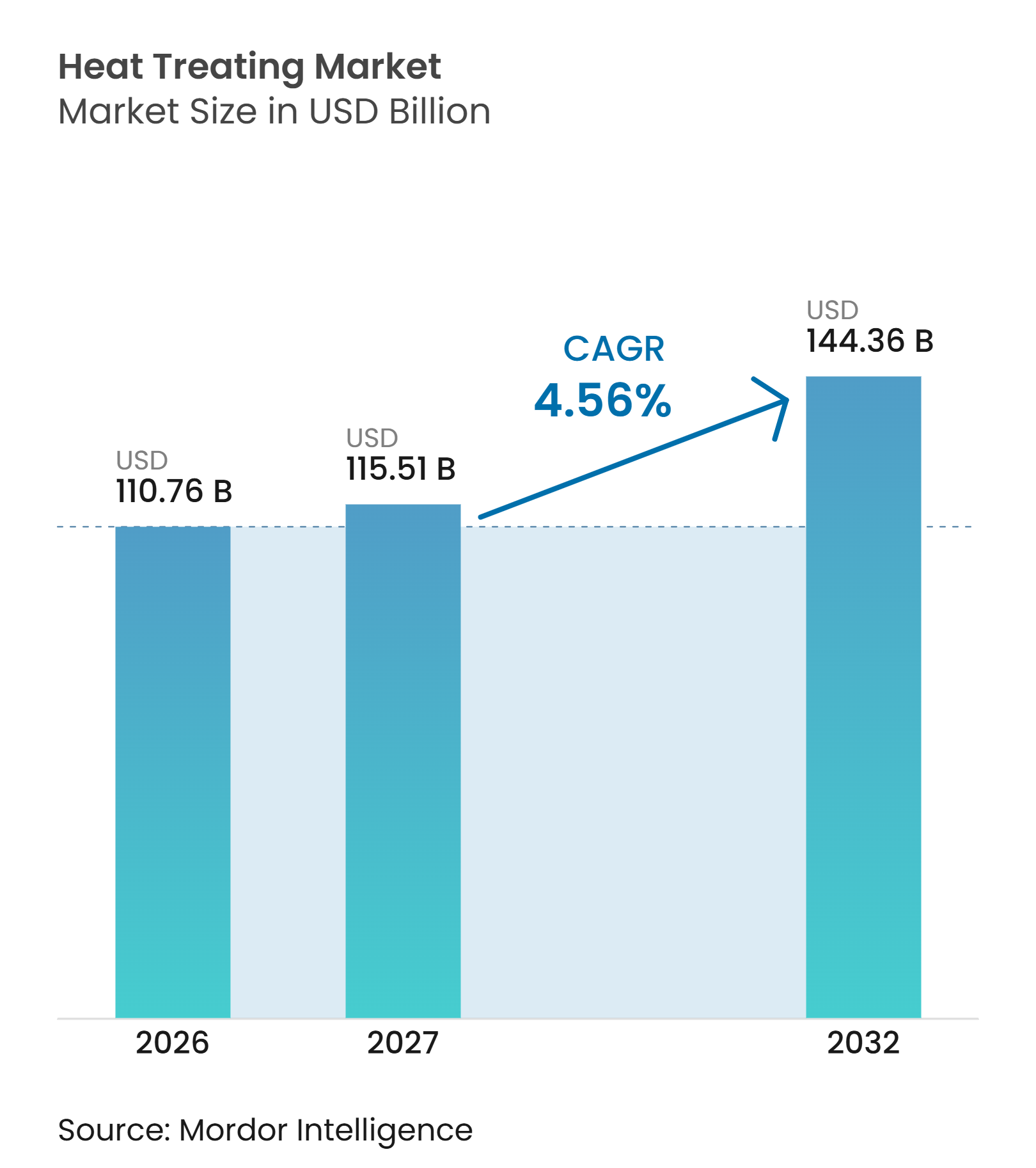
The heat treating market size was valued at USD 110.76 billion in 2026 and is estimated to grow from USD 115.51 billion in 2027 to USD 144.36 billion by 2032, at a CAGR of 4.56% during the forecast period (2027-2032). The heat treating market is supported by demand for components that meet fatigue, wear, dimensional accuracy, and traceability requirements. High energy costs and long furnace investment cycles constrain the pace of capacity expansion among suppliers. As a result, process reliability is a key consideration for commercial heat treatment service providers. Electric vehicle drivetrains, turbine alloys, and precision machinery require controlled thermal processing in their production routes. Investments in the automotive, aerospace, and industrial machinery industries generate distinct demand patterns for individual heat treatment processes; however, all these applications depend on reliable process control. Suppliers are expanding process capabilities, implementing digital recordkeeping, and adopting lower-emission furnace designs. Energy costs and long equipment payback periods remain barriers to investment, particularly for smaller service providers.
Key Report Takeaways
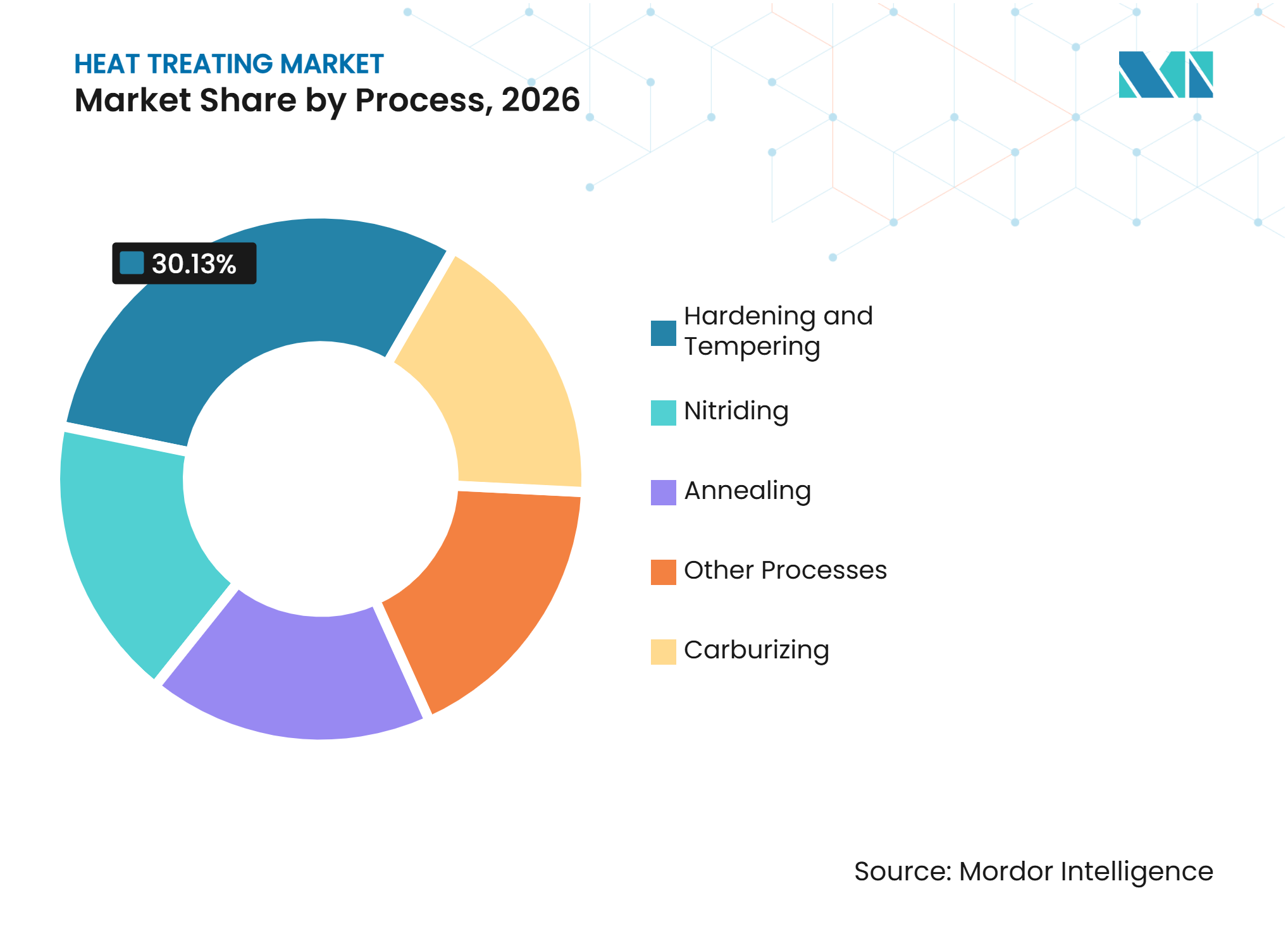
- By process, Hardening and Tempering held a 30.13% share in 2026, while Nitriding is forecast to grow at a CAGR of 5.15% through 2032.
- By material, Steel accounted for a 65.12% share in 2026, while Aluminum Alloys are forecast to grow at a CAGR of 5.42% through 2032.
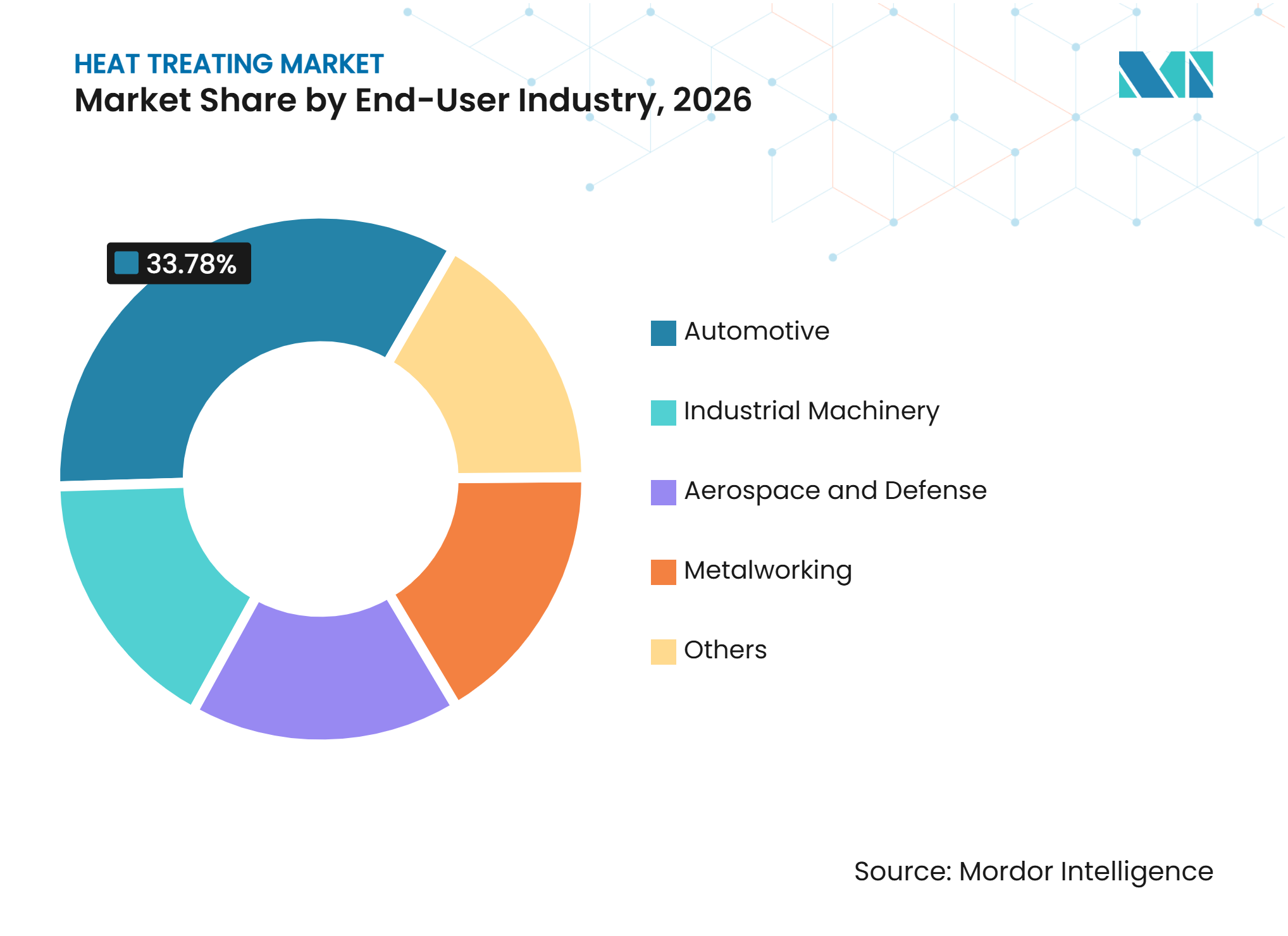
- By end-user industry, Automotive held a 33.78% share in 2026, while Aerospace and Defense is forecast to grow at a CAGR of 5.81% through 2032.
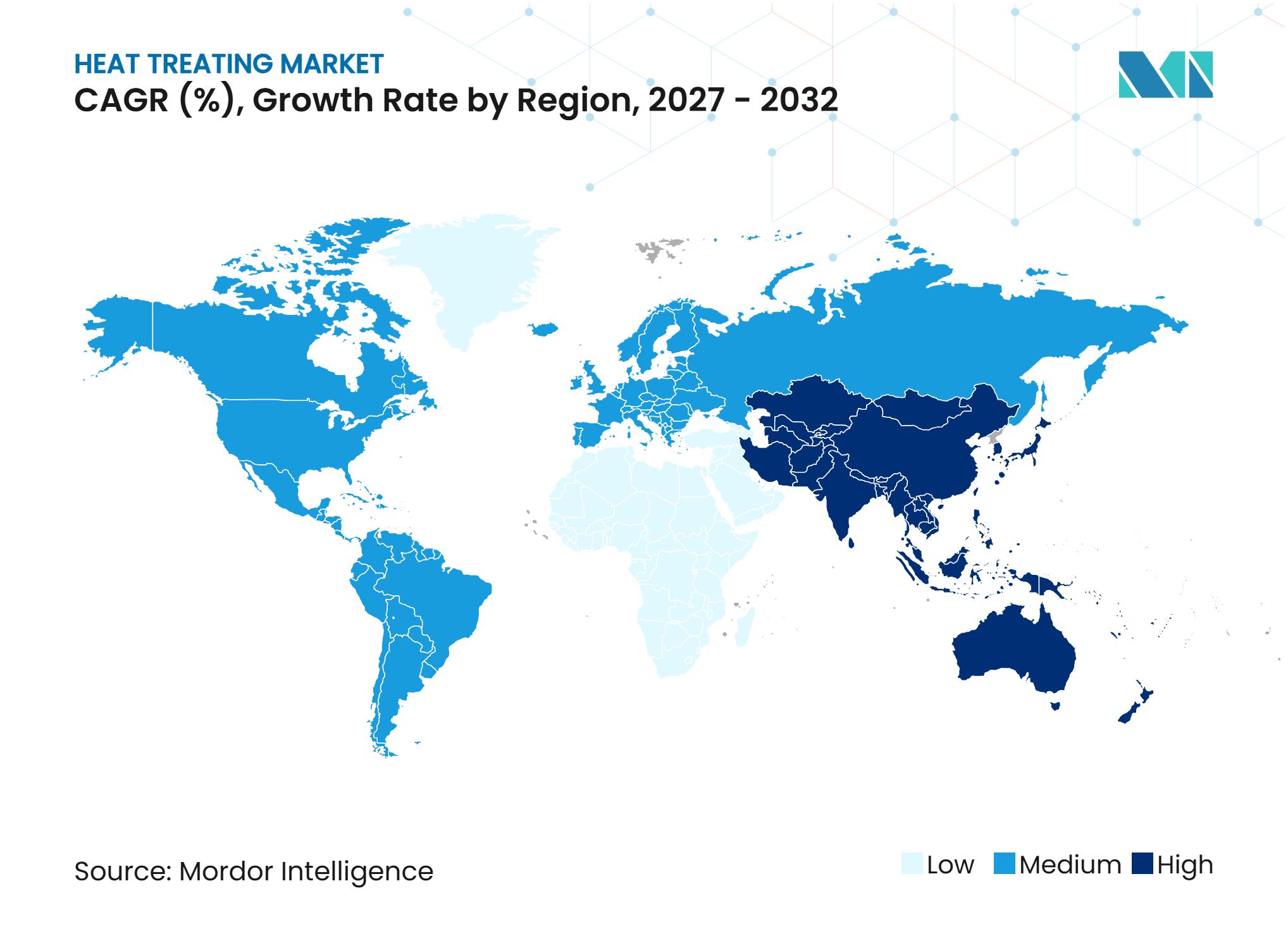
- By geography, Asia-Pacific held a 43.27% share in 2026 and is forecast to grow at a CAGR of 5.66% through 2032.
Note: Market numbers in this report are based on Mordor Intelligence's proprietary estimation framework, which combines nine months of actuals with Q4 projections for base year 2026.
Market Trends and Insights
Drivers Impact Analysis of Heat Treating Market*
| Drivers | (~) % Impact on CAGR Forecast | Geographic Relevance | Impact Timeline |
|---|---|---|---|
| Automotive and Electric Vehicle (EV) Precision Components | +1.4% | Global, strongest in China, South Korea, Japan, Mexico, and Germany | Short term (≤ 2 years) |
| Aerospace and Defense Qualified Alloy Demand | +0.9% | North America and Europe, with growing relevance in Asia-Pacific | Medium term (2-4 years) |
| Industrial Machinery and Infrastructure Investment | +0.7% | China and India, with effects in South America and the Middle East and Africa | Medium term (2-4 years) |
| Low-Carbon Furnace Electrification and Hybrid Heating | +0.6% | Europe, China, and North America | Long term (≥ 4 years) |
| Digital Traceability and AI-Assisted Process Control | +0.5% | Global, with early adoption in Germany, the United States, Japan, and South Korea | Medium term (2-4 years) |
| Source: Mordor Intelligence | |||
Automotive and EV Precision Components
The transition to electric vehicles changes the thermal specifications of drivetrain components rather than eliminating the need for heat treatment. Passenger vehicle reduction gearboxes can transmit more than 400 N·m of instantaneous torque, requiring carburized gears with effective case depths of 0.6 mm to 1.2 mm. This range exceeds the 0.4-0.8 mm typically used for internal combustion engine transmission gears. China produced 16.52 million new-energy vehicles in 2025, thereby supporting demand for precision heat-treated gears, shafts, and reduction-drive components[1]. Low-pressure carburizing and plasma nitriding support compliance with new qualification requirements and lower-distortion specifications. The heat treating market is seeing increased demand as original equipment manufacturers revise approved-supplier requirements for electric-vehicle components.
Aerospace and Defense Qualified Alloy Demand
Aerospace and defense applications support demand for controlled thermal processing of nickel and titanium alloys. Nadcap accreditation under AC7102 and pyrometry qualification to AMS 2750 remain requirements for flight-critical hardware. These requirements create barriers to entry for facilities without accredited special-process capabilities. High-vacuum heat treatment reduces intergranular oxidation during the processing of alloys used in engine hot sections and airframe structures. SECO/WARWICK reported orders for vacuum furnaces from China, supporting the expansion of aerospace-grade processing capacity. The heat treating market is supported by aerospace procurement requirements for process controls, documentation, and repeatable results.
Industrial Machinery and Infrastructure Investment
Industrial automation in Asia supports demand for heat-treated precision machine components. China produced 773,074 industrial robots in 2025, while output of general-purpose machinery increased by 8.0% during the same period. Robots, machine tools, and automation equipment use case-hardened gears, induction-hardened guideways, and nitrided spindles. These components require controlled processing to provide wear resistance, fatigue strength, and dimensional stability. Japan’s FY2025 vision for machine parts and tooling aims to increase the share of parts manufacturers serving high-value fields from 30% to 50% by 2040. These initiatives support the heat treating market, as the production of advanced equipment depends on consistent material performance in finished components.
Low-Carbon Furnace Electrification and Hybrid Heating
Industrial decarbonization is expanding investment in electrified process heat. The European Commission launched the IF25 Heat Auction, with EUR 1 billion in funding from European Union Emissions Trading System revenues for industrial process heat decarbonization projects. Eligible technologies include induction heating, resistance heating, heat pumps, and direct renewable alternatives. China’s JB/T 14951-2025 establishes green factory evaluation requirements for heat treatment facilities, including energy use, automation, and emissions considerations. Hybrid furnace systems can switch among natural gas, hydrogen, and electricity, reducing uncertainty related to fuel availability and future regulations. This equipment transition supports the heat treating market, although adoption depends on capital availability and local energy economics.
Restraints Impact Analysis of Heat Treating Market*
| Restraints | (~) % Impact on CAGR Forecast | Geographic Relevance | Impact Timeline |
|---|---|---|---|
| Energy Price Volatility and Emissions-Compliance Costs | -0.9% | Global, strongest in Europe and energy-import-dependent economies | Short term (≤ 2 years) |
| High Capital Intensity and Long Equipment Payback | -0.7% | Global, with higher pressure in regions with high borrowing costs | Medium term (2-4 years) |
| Skilled Labor, Process Data, and Cybersecurity Gaps | -0.4% | Global, with greater pressure in emerging Asia-Pacific and Middle East and Africa | Long term (≥ 4 years) |
| Source: Mordor Intelligence | |||
Energy Price Volatility and Emissions-Compliance Costs
Heat treatment is energy-intensive, with energy accounting for 30% to 40% of variable operating costs. Fixed-price service contracts can reduce margins when gas or electricity prices increase unexpectedly. The EU Emissions Trading System covers industrial furnace combustion, adding carbon costs to operating decisions. Operators must evaluate energy inputs and compliance costs over asset lifespans that typically range from 10 to 15 years. These factors can delay investment decisions among small and midsize commercial heat treaters that lack dedicated energy procurement resources. The heat treating market remains exposed to this constraint because process economics depend on reliable, affordable thermal energy.
High Capital Intensity and Long Equipment Payback
Modern vacuum heat-treating furnaces can cost more than USD 1 million per unit, while larger systems for aerospace and energy applications may require total investments of several million USD. Typical equipment payback periods range from 7 to 10 years, making demand visibility a critical investment consideration. China’s equipment-upgrade policy supports modernization across eligible industrial categories, including heat-treatment equipment. This support can direct investment toward markets with public incentives and strong industrial demand. Providers with greater financial capacity can replace aging systems more quickly than independent operators. Consequently, the heat treating market may develop a capability gap between larger groups and smaller facilities that continue to operate legacy equipment.
*Our forecasts treat driver/restraint impacts as directional, not additive. The impact forecasts reflect baseline growth, mix effects, and variable interactions.
Heat Treating Market Segment Analysis
By Process:
Precision Hardening Leads, Nitriding Gains GroundHardening and tempering accounted for 30.13% of the heat treating market share in 2026. The process is used for gears, shafts, bearings, and structural components in automotive and industrial machinery applications. It provides surface hardness, core toughness, and dimensional recovery for ferrous components. Its compatibility with both atmosphere and vacuum furnaces supports facilities with varying process requirements. Carburizing remains a significant process because it produces hard, wear-resistant cases on steel components. Electric vehicle reduction gears are increasing interest in low-pressure vacuum carburizing, which can provide consistent case-depth uniformity with lower distortion.
Nitriding is projected to register the fastest CAGR of 5.15% from 2027 to 2032. According to Advanced Heat Treat Corp., plasma and gas nitriding use controlled environments and can avoid direct carbon dioxide emissions during treatment. The process provides wear resistance and fatigue strength with minimal distortion, reducing the need for hard machining after the thermal treatment of complex components. Annealing remains important for electrical steel used in motor cores and transformer laminations, where grain control affects magnetic performance. Induction hardening, flame hardening, and hot isostatic pressing serve specialized requirements in tooling, additive manufacturing, and aerospace applications within the heat treating market.



By Material:
Steel Dominates, Aluminum Alloys AccelerateSteel held 65.12% of the heat treating market share in 2026, reflecting its use in automotive drivetrains, industrial machinery, and infrastructure equipment. Carburized gears, hardened steel shafts, nitrided spindles, and annealed structural sections account for a substantial share of commercial processing demand. Cast iron continues to be used in heavy machinery and engine block applications because of its vibration-damping and machinability. Nickel and titanium alloys serve smaller but higher-value applications in the aerospace and energy industries. These materials require tightly controlled vacuum heat treatment and compliance with Aerospace Material Specification (AMS) 2759 and Aerospace Material Specification (AMS) 2750 requirements for approved aerospace work.
Aluminum alloys are projected to record the highest CAGR, at 5.42%, from 2027 to 2032. Lightweighting initiatives, electric vehicle battery housings, and aircraft structures support this demand. Solution treatment and aging are critical processes for aerospace-grade aluminum at accredited suppliers. National Aerospace and Defense Contractors Accreditation Program (Nadcap) AC7102/2 requirements guide audits for aluminum heat treatment across aerospace supply chains. In December 2025, JTEKT Thermo Systems launched equipment for advanced semiconductor packaging, indicating the growing role of thermal equipment in applications beyond traditional ferrous components. Copper and titanium alloys generate additional specialized demand across electrical, marine, medical, and aerospace applications.
By End-User Industry:
Automotive Anchors Demand, Defense AcceleratesAutomotive held a 33.78% market share in 2026. Passenger vehicles contain heat-treated gears and drivetrain components, sustaining demand. Electric vehicle platforms are shifting the component mix toward reduction gearboxes, motor shafts, and structural battery housing components. These components may require different temperatures, specifications, and furnace configurations. Industrial machinery benefits from investments in automation, while metalworking supports demand for tooling, dies, and cutting tools. Energy, construction, and medical equipment applications also require thermal processing across the broader heat treating market.
Aerospace and defense are projected to register the fastest CAGR of 5.81% from 2027 to 2032. Commercial aircraft production recovery, defense procurement, and increased use of titanium and nickel superalloys support this growth. Nadcap accreditation, pyrometry records, and audited process controls remain essential for flight-critical applications. Bodycote reported that revenue from its Aerospace and Industrial Gas Turbine segment accelerated in the second half of 2025 as supply conditions improved. Industrial machinery and metalworking are expected to grow at a rate near the overall market growth rate, supported by investments in China, India, and Southeast Asia. This demand mix distributes demand across high-output and high-specification applications in the heat treating industry.

Geography Analysis
Asia-Pacific
Asia-Pacific held a 43.27% market share in 2026 and is projected to register the highest CAGR of 5.66% through 2032. China produced 16.52 million new-energy vehicles and 773,074 industrial robots in 2025, supporting demand for drivetrain and machine-component processing. Automotive assembly and advanced manufacturing activities in China, India, Japan, and South Korea support regional demand. China’s green-factory requirements for heat treatment address energy sources, automation, and emissions, driving equipment upgrades. Liaoning published performance-grading standards for metal surface treatment and heat-treatment processes in 2025. Aichelin opened an office in Pune in April 2026 and plans to establish a local production facility, reflecting demand from India’s automotive, defense, and electronics industries[2]. Japan and South Korea remain key markets for semiconductor equipment, aerospace components, and specialty alloys.
North America
North America has an established commercial heat-treating base, supported by defense procurement and the recovery of aerospace production. The Metal Treating Institute identified aerospace as a leading growth area for its U.S. heat-treating members in 2025. Aalberts Surface Technologies completed its acquisition of Paulo Products Company in May 2025, expanding its North American service footprint. Ipsen USA reported a 45% year-over-year increase in new equipment unit sales in 2025 and secured its largest equipment order in January 2026. Demand came from aerospace, defense, medical technology, and energy customers. The U.S. Department of Energy continues to identify process-heat efficiency as a priority for industrial decarbonization. This supports demand for hybrid and electrified furnace platforms, although capital and energy costs remain significant factors.
Europe, South America, and Middle East and Africa
Europe has a heat treating base across Germany, Italy, France, and the Nordic countries, although weak automotive and industrial output affected demand in 2025. The EU’s IF25 Heat Auction supports industrial furnace modernization from 2026 by funding verified carbon-abatement projects. This regulatory support may increase the adoption of electrified process heat in countries with favorable co-investment structures. South America is centered on Brazil’s industrial base and Argentina’s automotive supply chain. Tenova secured a contract in August 2025 to supply a walking-hearth furnace to Vinton Steel, reflecting demand for steel and mining-related production equipment. In the Middle East and Africa, demand is linked to Saudi Arabia’s industrial development, mining activities, and automotive production in South Africa. Growth across these regions depends on local manufacturing investment, workforce skills, and access to modern furnace technology.
Competitive Landscape
Market Concentration
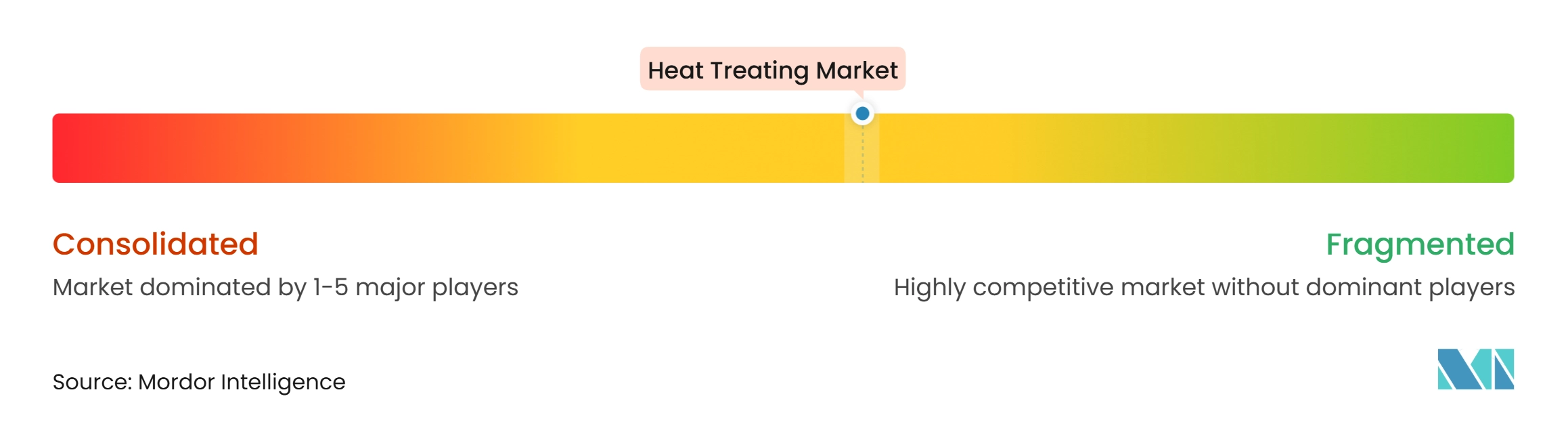
The heat treating market is moderately fragmented, comprising a small group of global service providers and equipment manufacturers, as well as numerous regional commercial heat-treating companies. Competition is based on geographic coverage, process certifications, digital batch records, and the ability to serve multinational original equipment manufacturers (OEMs). Bodycote operates 136 facilities across 22 countries, providing a broad commercial processing footprint. Nadcap and ISO 9001:2015 certifications remain important for suppliers serving aerospace and industrial customers. Larger networks can implement consistent process controls across multiple sites as OEMs centralize supplier qualification and seek to reduce supply chain complexity.
Aalberts Surface Technologies expanded its North American presence through the acquisition of Paulo Products Company in May 2025. In 2025, Aichelin acquired NITREX’s NTS and UPC divisions, adding nitriding-related technologies and services. Ipsen continued to develop hybrid furnace technology that supports flexible energy use and had planned to launch a next-generation operating system in 2026. These developments show how providers combine equipment, thermal-processing expertise, and process-data services. Nabertherm also introduced hybrid furnace solutions for thermal post-processing in additive manufacturing in 2025. Consequently, the heat treating market places increasing emphasis on systems that support production control and lower-emission operations.
Nadcap accreditation under AC7102 and compliance with AMS 2750 pyrometry requirements limit access to aerospace and defense work. These requirements require ongoing investment in documentation, equipment, and training. Induction-heating suppliers are also introducing connected systems for specific part geometries in large-scale production. Where production conditions are suitable, these systems can compete with conventional batch atmosphere furnaces. The competitive landscape remains diverse, as general-purpose commercial processing and accredited precision processing have distinct requirements.
Heat Treating Industry Leaders
-
JTEKT Thermo Systems Corporation
-
Ipsen
-
Chugai Ro Co., Ltd
-
Takasago Industry Co., Ltd.
-
SECO/WARWICK, INC.
- *Disclaimer: Major Players sorted in no particular order
Heat Treating Market Companies Covered in this Report
- Aalberts Surface Technologies
- Advanced Heat Treat Corp.
- Aichelin Group
- ALD Vacuum Technologies GmbH
- Bodycote
- Chugai Ro Co., Ltd
- Enrx
- GH Induction
- Inductotherm Group
- Ipsen
- JTEKT Thermo Systems Corporation
- Nabertherm GmbH
- SECO/WARWICK, INC.
- Takasago Industry Co., Ltd.
- Tenova S.p.A.
Recent Industry Developments in Heat Treating Market
- January 2026: Bodycote plc completed the acquisition of Spectrum Thermal Processing, an aerospace-focused precision heat treatment business based in Rhode Island, United States. The bolt-on acquisition added Nadcap-accredited aerospace heat treatment capacity in the northeastern United States. Bodycote also announced investments in its first S3P (Specialist Technologies Processing) facility in Asia and increased hot isostatic pressing capacity for aerospace and defense applications.
- December 2025: JTEKT Thermo Systems Corporation launched the SO2-60-F, a heat treatment device for advanced semiconductor packaging applications. The device targets AI- and 5G-related redistribution layer (RDL) interposer and glass interposer manufacturing. It operates at oxygen concentrations below 10 ppm and accommodates substrate sizes up to 600 × 600 mm, expanding the company’s heat treatment equipment portfolio for advanced packaging applications.
Global Heat Treating Market Report Scope
Heat treatment is an industrial manufacturing process that involves controlled heating and cooling of metals or alloys to modify physical, mechanical, and, in some cases, chemical properties while maintaining the material’s original shape and dimensions.
The heat treating market is segmented by process, material, end-user industry, and geography. By process, the market is segmented into carburizing, nitriding, hardening and tempering, annealing, and other processes. By material, the market is segmented into steel, cast iron, aluminum alloys, copper alloys, nickel alloys, titanium alloys, and other materials. By end-user industry, the market is segmented into automotive, aerospace and defense, metalworking, industrial machinery, and others. The report also covers market sizes and forecasts for heat treating across 15 countries in major regions. The market sizes and forecasts are provided in terms of value (USD).
Segmentation Overview
| Carburizing |
| Nitriding |
| Hardening and Tempering |
| Annealing |
| Other Processes |
| Steel |
| Cast Iron |
| Aluminum Alloys |
| Copper Alloys |
| Nickel Alloys |
| Titanium Alloys |
| Other Materials |
| Automotive |
| Aerospace and Defense |
| Metalworking |
| Industrial Machinery |
| Others |
| Asia-Pacific | China |
| India | |
| Japan | |
| South Korea | |
| ASEAN Countries | |
| Rest of Asia-Pacific | |
| North America | United States |
| Canada | |
| Mexico | |
| Europe | Germany |
| United Kingdom | |
| France | |
| Italy | |
| NORDIC Countries | |
| Rest of Europe | |
| South America | Brazil |
| Argentina | |
| Rest of South America | |
| Middle East and Africa | Saudi Arabia |
| South Africa | |
| Rest of Middle East and Africa |
| By Process | Carburizing | |
| Nitriding | ||
| Hardening and Tempering | ||
| Annealing | ||
| Other Processes | ||
| By Material | Steel | |
| Cast Iron | ||
| Aluminum Alloys | ||
| Copper Alloys | ||
| Nickel Alloys | ||
| Titanium Alloys | ||
| Other Materials | ||
| By End-User Industry | Automotive | |
| Aerospace and Defense | ||
| Metalworking | ||
| Industrial Machinery | ||
| Others | ||
| By Geography | Asia-Pacific | China |
| India | ||
| Japan | ||
| South Korea | ||
| ASEAN Countries | ||
| Rest of Asia-Pacific | ||
| North America | United States | |
| Canada | ||
| Mexico | ||
| Europe | Germany | |
| United Kingdom | ||
| France | ||
| Italy | ||
| NORDIC Countries | ||
| Rest of Europe | ||
| South America | Brazil | |
| Argentina | ||
| Rest of South America | ||
| Middle East and Africa | Saudi Arabia | |
| South Africa | ||
| Rest of Middle East and Africa | ||
Key Questions Answered in the Report
What is current market size of Heat Treating Market?
The heat treating market size was valued at USD 110.76 billion in 2026 and is estimated to grow from USD 115.51 billion in 2027 to USD 144.36 billion by 2032, at a CAGR of 4.56% during the forecast period (2027-2032).
Which process is expected to grow the fastest?
Nitriding has the highest projected CAGR at 5.15% through 2032.
Why are electric vehicles relevant to thermal processing demand?
Electric vehicle reduction gearboxes require precise case depths and low-distortion treatment for high-torque gears and shafts. Low-pressure carburizing and plasma nitriding can help suppliers meet updated component specifications as electric vehicle manufacturers develop approved supplier lists. This makes thermal-processing capability a selection factor in electric drivetrain supply chains rather than a routine finishing step.
Which region drives demand for heat treating services?
Asia-Pacific leads with a 43.27% share in 2026 and has the highest projected CAGR at 5.66% through 2032.