
Heart Scan Market Size and Share
Market Overview
| Study Period | 2020 - 2031 |
|---|---|
| Market Size (2026) | USD 18.01 Billion |
| Market Size (2031) | USD 25.11 Billion |
| Fastest Growing Market | Asia-Pacific |
| Largest Market | North America |
| Market Concentration | Medium |
Major Players *Disclaimer: Major Players sorted in no particular order Image © Mordor Intelligence. Reuse requires attribution under CC BY 4.0. | |
Heart Scan Market Analysis by Mordor Intelligence
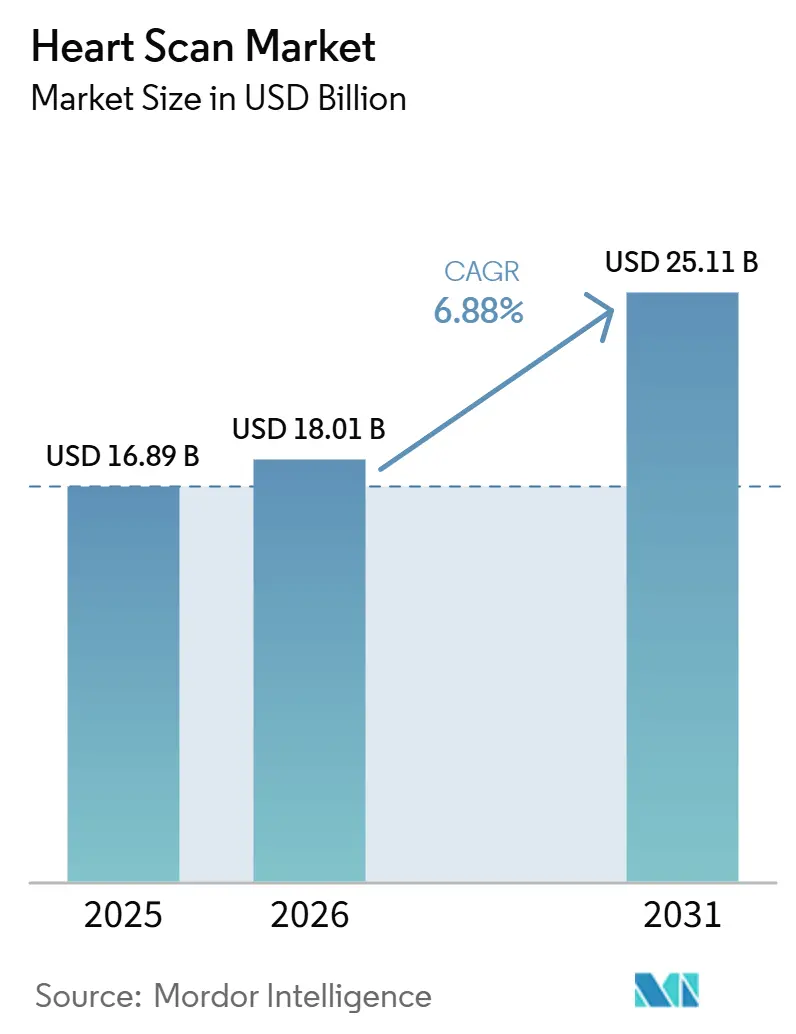
The Heart Scan Market size is expected to increase from USD 16.89 billion in 2025 to USD 18.01 billion in 2026 and reach USD 25.11 billion by 2031, growing at a CAGR of 6.88% over 2026-2031.
Health systems are expanding cardiac diagnostic infrastructure as cardiovascular risk rises and care shifts toward earlier assessment. The heart scan market is moving beyond replacement-led equipment sales as software-supported imaging creates recurring licensing and per-case billing opportunities. Reimbursement changes for coronary CT angiography, or CCTA, are strengthening the financial case for hospital investment in some settings. The heart scan market also faces a split in demand, with premium systems serving established centers while lower-cost, portable, connected solutions are needed in underserved health systems. Vendors are responding through hardware, workflow software, and clinical education partnerships that can support broader use of cardiac imaging.
Key Report Takeaways
- By modality, echocardiography held 31.35% of the heart scan market share in 2025, while cardiac magnetic resonance imaging is forecast to grow at a 10.48% CAGR through 2031.
- By application, coronary artery disease diagnosis accounted for 44.29% of the heart scan market size in 2025, while valvular heart disease evaluation is forecast to grow at a 12.60% CAGR through 2031.
- By end user, hospitals and clinics held 45.27% of the heart scan market share in 2025, while specialty cardiac centers are forecast to grow at an 11.08% CAGR through 2031.
- By technology, 2D imaging held 48.70% of the market in 2025, while AI-enabled imaging solutions are forecast to grow at a 16.52% CAGR through 2031.
- By geography, the North America region held 38.70% of the market in 2025, while the Asia-Pacific region is forecast to grow at a 10.60% CAGR through 2031.
Note: Market size and forecast figures in this report are generated using Mordor Intelligence’s proprietary estimation framework, updated with the latest available data and insights as of January 2026.
Global Heart Scan Market Trends and Insights
Drivers Impact Analysis*
| Driver | (~) % Impact on CAGR Forecast | Geographic Relevance | Impact Timeline |
|---|---|---|---|
| Rising Cardiovascular Disease Burden and Diagnostic Demand | +1.8% | Global | Long term (≥ 4 years) |
| Earlier Non-Invasive Cardiac Assessment | +1.2% | North America and EU | Medium term (2-4 years) |
| AI Workflow Automation and Quantitative Interpretation | +1.0% | Global, strongest in North America and APAC | Medium term (2-4 years) |
| Ambulatory and Point-of-Care Cardiac Imaging | +0.5% | North America, EU, and APAC | Short term (≤ 2 years) |
| CCTA and Cardiac AI Reimbursement Recognition | +0.6% | North America | Short term (≤ 2 years) |
| Contrast-Free and Lower-Resource Cardiac MRI Workflows | +0.3% | Global, with early gains in EU and APAC | Long term (≥ 4 years) |
| Source: Mordor Intelligence | |||
Rising Cardiovascular Disease Burden and Earlier Non-Invasive Assessment
Population aging, high blood pressure, dietary risks, and metabolic conditions are expected to increase the cardiovascular disease burden through 2050[1]R. Khera et al., “Global Burden of Cardiovascular Diseases: Projections From 2025 to 2050,” PubMed, pubmed.ncbi.nlm.nih.gov. More than 75% of cardiovascular disease deaths occur in low- and middle-income countries, where diagnostic imaging capacity remains limited. This gap supports demand in the heart scan market for systems that are lower cost, portable, and connected to clinical networks. It also favors suppliers with tiered portfolios rather than a single premium product line. Earlier non-invasive assessment widened the role of CCTA and echocardiography before invasive procedures are considered. Ambulatory and point-of-care settings can extend imaging access when equipment, staffing, and reimbursement support their use.
AI-Enabled Workflow Automation and Quantitative Interpretation
AI tools are changing image acquisition, measurement, and interpretation in the heart scan market. A 2025 scientific statement found that successful AI deployment in cardiac CT and MRI currently favors institutions with established information technology resources. This means that the near-term benefits of automation are likely to be concentrated in better-resourced care settings. Siemens Healthineers introduced the ACUSON Origin in 2025 with more than 500 AI-supported measurements, real-time cardiac view recognition, and automated Doppler placement. A 2025 clinical review reported that AI-enabled point-of-care echocardiography can reduce operator dependence and improve acquisition consistency. The heart scan market, therefore, includes both native AI embedded by equipment suppliers and cross-vendor software offered by specialized providers.
Reimbursement Recognition of CCTA and Cardiac AI Analysis
The payment policy supports CCTA use in the United States. In 2025, the Centers for Medicare & Medicaid Services moved CCTA to ambulatory payment classification 5572, raising hospital outpatient reimbursement from USD 175 to USD 357.13 for relevant procedure codes. CCTA use among Medicare beneficiaries had already increased substantially during the preceding decade, so the revised payment adds an institutional incentive to existing clinical demand. CMS coding guidance continues to define the covered billing framework for CCTA services. The provisional nature of the payment classification means providers must still monitor claims data and future policy decisions. In the heart scan market, this can support equipment demand while also increasing exposure to reimbursement changes. Vendors that link imaging systems with billable analysis workflows may be better positioned in this environment.
Contrast-Free and Lower-Resource Cardiac MRI Workflows
Gadolinium contrast can limit cardiac MRI use for patients with advanced kidney disease and can add complexity to imaging protocols. A July 2026 multicenter study evaluated AI-powered Virtual Native Enhancement, or VNE, in 136 patients across the United Kingdom and Chinese hospital centers. The study reported 94% accuracy for detecting myocardial infarction scars without contrast and found that 70% of patients produced images of sufficient quality to avoid gadolinium. Such workflows could extend eligibility in regions with a high prevalence of renal disease and limited contrast-handling infrastructure. They could also make cardiac MRI more practical where resources are constrained. The heart scan market may consequently see cardiac MRI compete more directly with echocardiography in price-sensitive settings.
Restraints Impact Analysis*
| Restraint | (~) % Impact on CAGR Forecast | Geographic Relevance | Impact Timeline |
|---|---|---|---|
| High Capital, Maintenance, and Total Cost of Ownership | -1.0% | Emerging markets, MEA, and South America | Long term (≥ 4 years) |
| Shortage of Cardiac Imaging Specialists and Sonographers | -0.8% | Global | Medium term (2-4 years) |
| Cross-Vendor Data Heterogeneity and AI Generalizability Risk | -0.3% | Global | Medium term (2-4 years) |
| Uneven Reimbursement and Limited Rural Imaging Capacity | -0.4% | South America, MEA, and APAC Tier 2 and 3 | Long term (≥ 4 years) |
| Source: Mordor Intelligence | |||
High Capital, Maintenance, and Total Cost of Ownership
Advanced imaging systems, including 3-Tesla cardiac MRI and photon-counting CT platforms, remain beyond the purchasing capacity of many public health systems. The cost extends beyond acquisition to service contracts, specialist training, contrast agents, and radiopharmaceutical supply chains. These expenses can lead providers to defer purchases, choose lower-specification equipment, or retain systems beyond their intended replacement cycle. The result is a widening diagnostic capability gap between high-income and lower-income settings. Portable ultrasound can lower some equipment costs, but it does not eliminate the requirements for trained personnel and clinical networks. The heart scan market needs purpose-built, lower-cost offerings and financing approaches that fit public-sector procurement conditions.
Shortage of Cardiac Imaging Specialists and Sonographers
Staffing shortages can limit imaging volumes even where equipment is already installed. U.S. sonography vacancy rates fell from 16.7% in 2023 to 12.4% in 2025, while ultrasound examination volumes rose 55% between 2011 and 2021. The shortage suppresses the utilization of installed equipment and can weaken capital expenditure proposals. Cross-vendor data differences and uneven performance across care settings also complicate the adoption of AI tools. Automation can help with acquisition, measurements, and initial interpretation, but clinical trust and workflow integration remain necessary before it can relieve capacity constraints at scale.
*Our forecasts treat driver/restraint impacts as directional, not additive. The impact forecasts reflect baseline growth, mix effects, and variable interactions.
Segment Analysis
By Modality: Echocardiography Anchors Volume, MRI Accelerates in High-Acuity Imaging
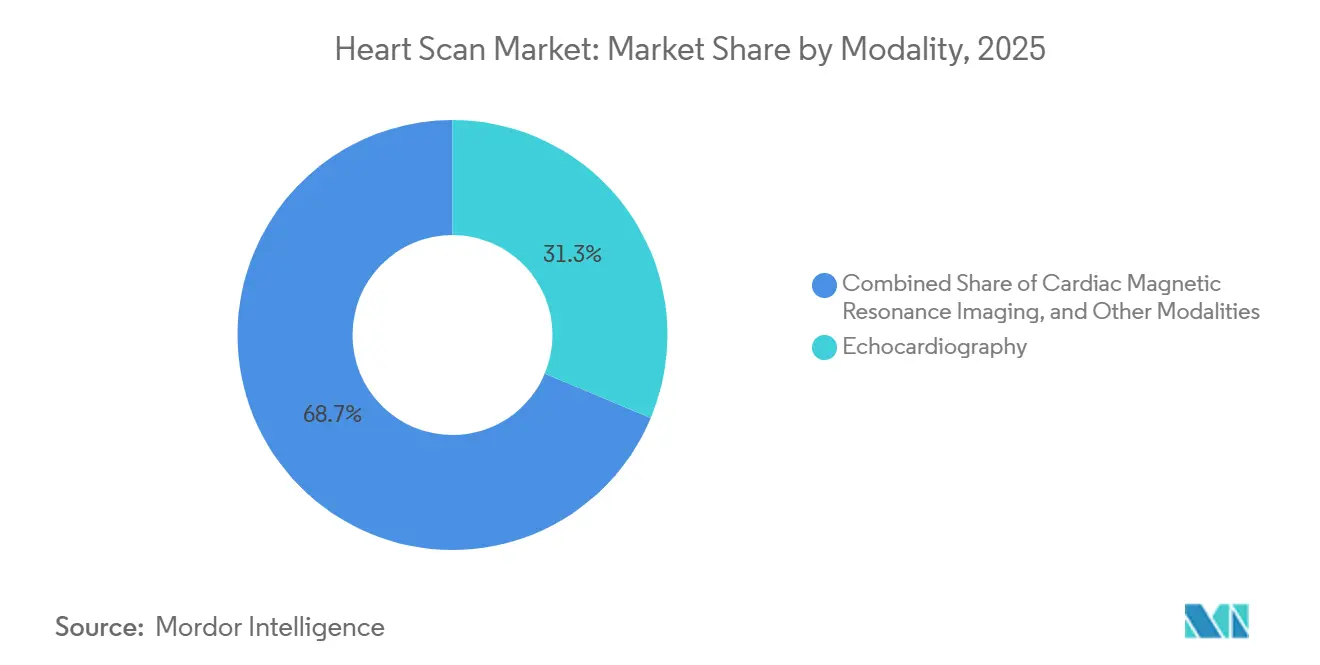
Echocardiography held 31.35% of the heart scan market in 2025, supported by its lower cost, broad availability, real-time imaging, and established reimbursement. Transthoracic echocardiography, or TTE, accounts for most procedure volume within the modality. Intracardiac echocardiography is gaining relevance as structural heart interventions increase. Cardiac CT includes CCTA, calcium scoring, and photon-counting CT applications. Nuclear cardiac imaging also remains relevant for perfusion assessment. Cardiac angiography and fluoroscopy primarily serve interventional rather than purely diagnostic use.
Cardiac magnetic resonance imaging is projected to grow at a 10.48% CAGR from 2026 to 2031, making it the fastest-growing modality in the heart scan industry. Its use is supported by evidence in cardiomyopathy characterization, myocardial viability assessment, and planning for structural heart procedures. The shift from 1.5-Tesla to 3-Tesla systems is increasing clinical interest in higher-resolution cardiac MRI. In February 2026, Inova became the first health system to implement GE HealthCare’s SIGNA Sprint Elite 1 system for high-resolution cardiac imaging. New MRI platforms must continue to meet MRI safety and quality-management requirements in major markets.



By Application: CAD Diagnosis Dominates, Valvular Disease Creates the Fastest Growth Corridor
Coronary artery disease diagnosis represented 44.29% of the heart scan market size in 2025, making it the largest application. Its position reflects the large global burden of ischemic heart disease, which affected 254.28 million people. CCTA is becoming a more important non-invasive coronary assessment method, particularly after the 2025 reimbursement change. Heart failure, structural heart disease, congenital heart disease, and arrhythmia assessment represent additional applications. These applications use different modality preferences, including cardiac MRI for cardiomyopathy and nuclear imaging for perfusion assessment. U.S. FDA clearance pathways and European CE marking under EU MDR 2017/745 continue to influence how new applications reach clinicians.
Valvular heart disease evaluation is forecast to grow at a 12.60% CAGR through 2031. Growth is tied to transcatheter aortic valve replacement and transcatheter mitral valve replacement, which require imaging before, during, and after procedures. In March 2026, Philips received FDA 510(k) clearance for EchoNavigator R5.0 with DeviceGuide, a real-time guidance system for mitral transcatheter edge-to-edge repair developed with Edwards Lifesciences. AI ECG screening tools may create additional referrals for echocardiography and cardiac CT. EchoNext achieved 77% structural heart disease detection accuracy using a standard 12-lead ECG, compared with 64% for unaided cardiologists. This creates a potential screening-to-imaging pathway that was less developed previously.
By End User: Hospital Volumes Hold Firm as Specialty Centers Scale
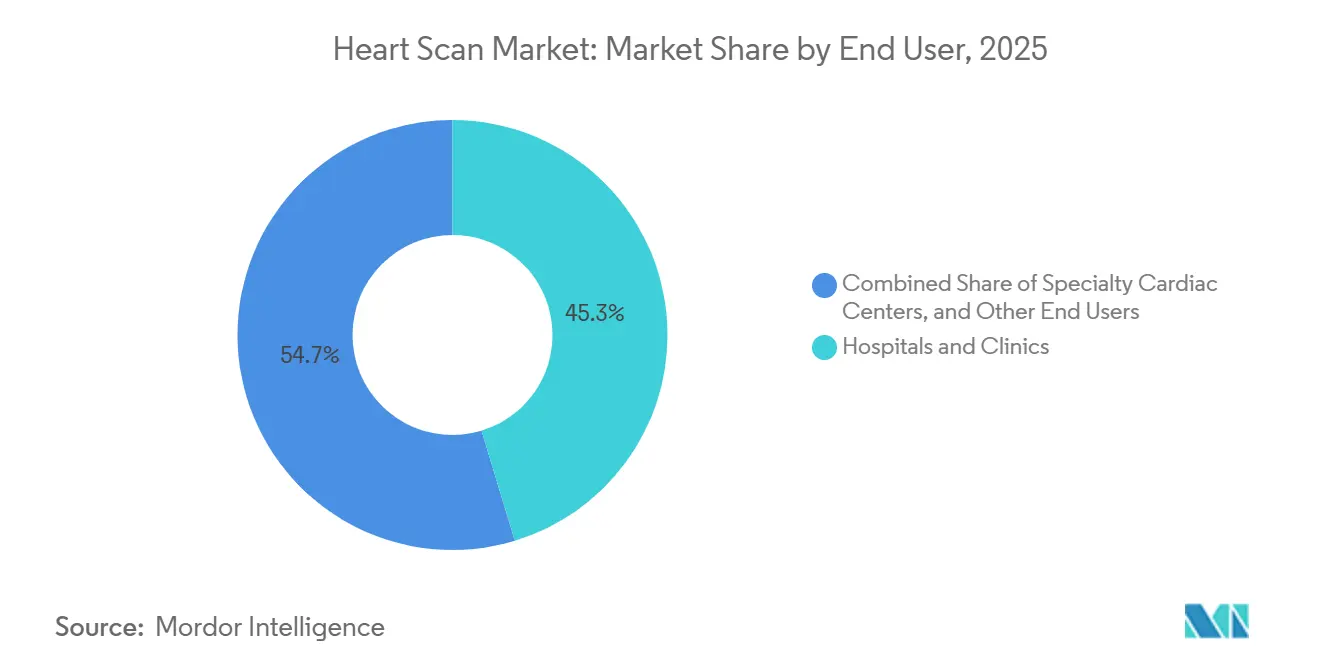
Hospitals and clinics accounted for 45.27% of the heart scan market in 2025. They continue to support resource-intensive modalities such as 3-Tesla cardiac MRI, nuclear imaging, and complex structural echocardiography. Diagnostic imaging centers are the second-largest end-user group. They benefit from volume efficiency in CCTA and standard echocardiography. Outpatient reimbursement also supports their role in routine workflows. Hospitals are likely to retain the workhorse capacity needed for broad cardiac imaging access.
Specialty cardiac centers are forecast to grow at an 11.08% CAGR through 2031. Complex procedures, including TAVR, TMVR, and left atrial appendage closure, are moving into dedicated cardiovascular facilities with integrated imaging and interventional capabilities. This shift creates a continuing equipment investment cycle at specialty centers. Ambulatory surgical centers are also gaining a role in lower-acuity procedures as outpatient eligibility expands. The heart scan industry is therefore developing separate procurement profiles. General hospitals prioritize echocardiography and CT capacity, while specialty facilities seek premium systems with interventional integration.
By Technology: 2D Imaging Provides the Volume Base, AI Solutions Change the Margin Stack
2D imaging held 48.70% of the heart scan market in 2025. It remains the basic diagnostic layer across echocardiography, fluoroscopy, and nuclear imaging. 3D and 4D imaging, Doppler, and contrast-enhanced imaging add functional and hemodynamic information. These technologies are important for structural heart assessment and procedural guidance. Established modalities continue to produce most imaging volume. Their per-procedure margins can decline as equipment costs are amortized.
AI-enabled imaging solutions are projected to grow at a 16.52% CAGR through 2031. Their growth reflects expanding use across echocardiography, CT, and MRI. The heart scan market is seeing equipment suppliers embed AI in their platforms to support loyalty across their installed base. Independent software providers are offering cross-vendor tools that can work alongside existing equipment. The heart scan market, therefore, includes suppliers that embed automation in their own equipment and software specialists that offer interoperable tools. It also affects how suppliers protect installed-base relationships and how customers select workflow upgrades.
Geography Analysis
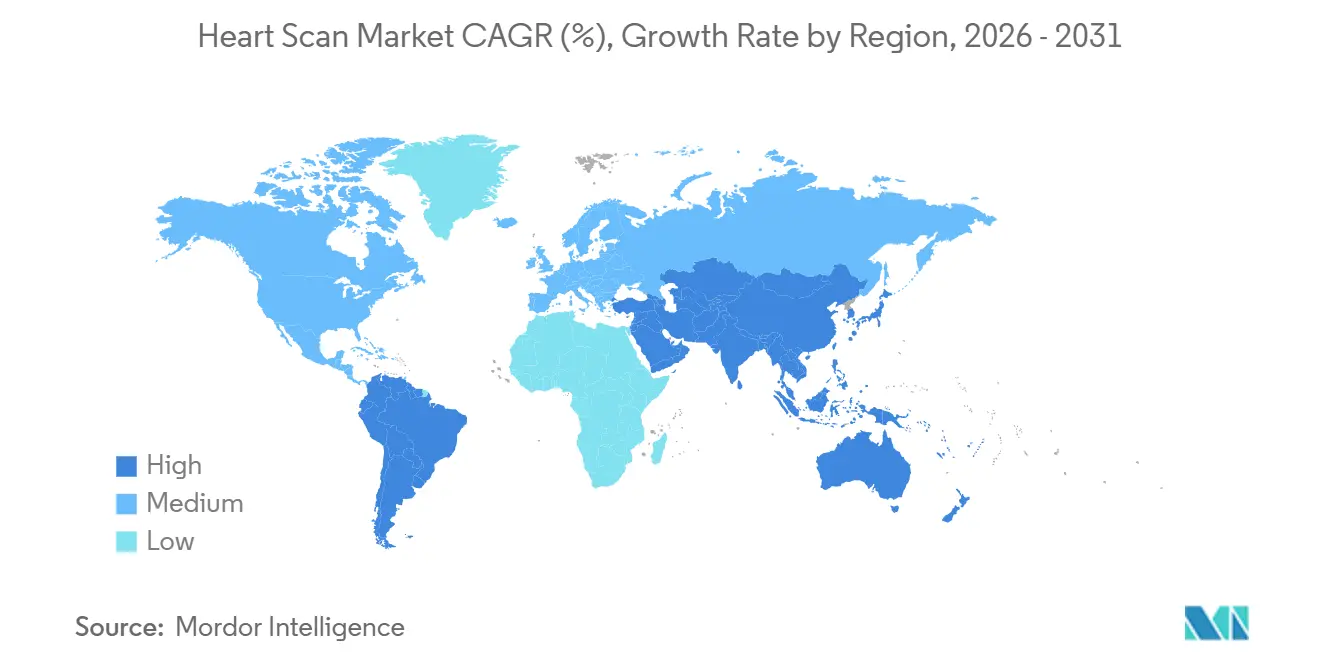
North America held 38.70% of the heart scan market in 2025. The United States accounted for much of the regional volume because of its institutional density, early technology adoption, and active reimbursement reform. The 2025 CCTA payment increase and new AI-supported imaging tools are supporting procurement activity in the region. GE HealthCare launched Flyrcado, a unit-dose PET myocardial perfusion imaging agent, in March 2025 with CMS pass-through status effective April 1, 2025. Canada and Mexico remain secondary regional markets with different reimbursement and procurement cycles.
Europe is the second-largest geography in the heart scan market. Its mature technology base and EU MDR 2017/745 requirements influence the order of product launches across modalities. Germany, the United Kingdom, and France support regional demand through cardiology networks, academic medical centers, and specialist care. The July 2026 VNE study across the United Kingdom and Chinese hospital centers showed how clinical partnerships can help standardize imaging protocols where gadolinium access differs. Italy and Spain have more price-sensitive procurement patterns. Other European countries remain at different stages of cardiac imaging infrastructure development.
Asia-Pacific is forecast to grow at a 10.60% CAGR from 2026 to 2031, making it the fastest-growing geographic area. Domestic Chinese manufacturers are expanding their presence in high-end imaging, supported by public hospital procurement and rising demand for advanced diagnostic capacity. India is expanding cardiac imaging capacity through private multi-specialty hospital investment, while cardiac MRI remains limited by scanner access and post-processing costs. Japan and South Korea are innovation and manufacturing centers, and their regulatory agencies set important quality expectations. The Middle East and Africa, and South America, provide smaller growth opportunities through cardiac-center investment and public healthcare expansion. Philips signed a May 2026 memorandum with the Asian Society of Cardiovascular Imaging to support education and AI collaboration across Asia-Pacific[2]“Asian Society of Cardiovascular Imaging and Philips Sign MOU to Strengthen Imaging Capabilities Across Asia Pacific,” Philips, philips.com.sg.

Competitive Landscape
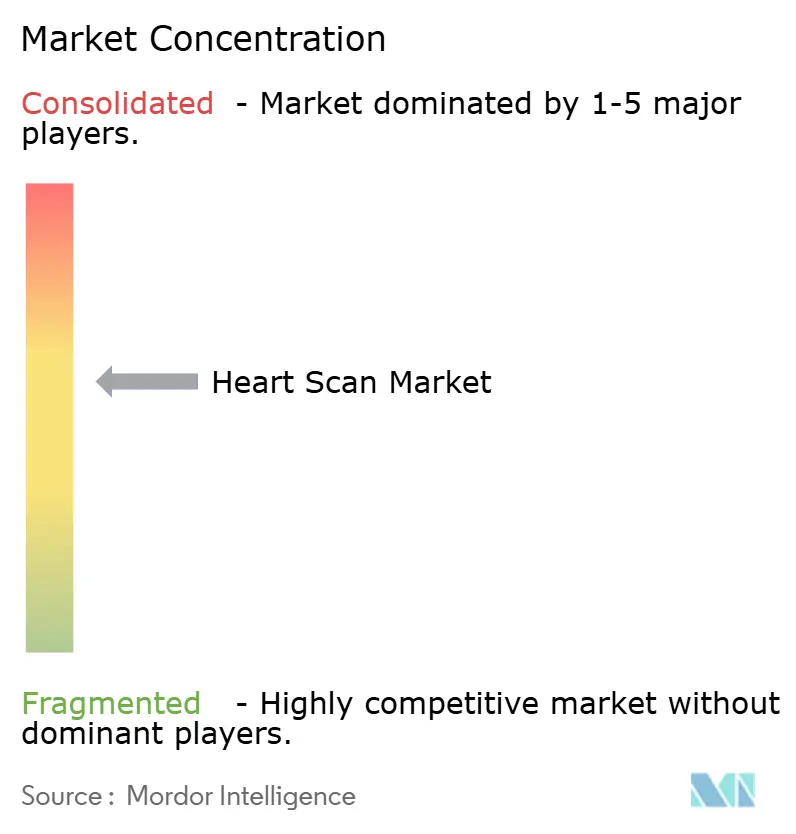
The heart scan market is moderately consolidated in premium imaging systems. GE HealthCare, Siemens Healthineers, and Philips have established installed bases and offer bundled AI capabilities. Competition is also increasing in software and post-processing, where suppliers compete on clinical workflow integration. Chinese challengers are expanding internationally with high-end CT and ultrasound portfolios. The competitive focus is increasingly on linking imaging hardware, diagnostic software, and cardiology information into usable clinical workflows.
Vertical integration is one strategy in the heart scan market. In December 2025, Philips agreed to acquire SpectraWAVE to add Enhanced Vascular Imaging technologies, including DeepOCT, NIRS, and AI-derived FFR, to its coronary imaging capabilities. Philips stated that its Azurion image-guided therapy platform treated more than 7.6 million patients annually across more than 80 countries. Partnership-led AI integration is another route for suppliers that do not pursue acquisition. These approaches allow firms to add workflow capabilities through acquisition or collaboration. They also show why compatibility with installed systems remains strategically important.
Contrast-free cardiac MRI and AI-supported remote imaging remain less developed areas of the heart scan market. These areas are relevant for low- and middle-income countries where contrast access, specialist availability, and imaging capacity can be constrained. HeartLung Corporation received FDA 510(k) clearance in January 2026 for AI-CVD, which supports opportunistic cardiovascular screening through CT imaging. Abbott received FDA clearance and CE Mark for Ultreon 3.0 in April 2026, integrating plaque characterization, sizing, guidance, and post-procedure assessment for coronary imaging. These developments show continuing competition between established equipment suppliers and specialized software or intravascular imaging companies. The resulting landscape supports investment in integrated systems while retaining space for focused clinical software.
Heart Scan Industry Leaders
GE HealthCare Technologies Inc.
Siemens Healthineers AG
Koninklijke Philips N.V.
Canon Medical Systems Corporation
FUJIFILM Holdings Corporation
- *Disclaimer: Major Players sorted in no particular order

Recent Industry Developments
- May 2026: Royal Philips signed a Memorandum of Understanding with the Asian Society of Cardiovascular Imaging at the 19th ASCI Congress in Singapore, establishing a framework for cardiovascular imaging education, clinical excellence, and AI technology collaboration across Asia-Pacific to address growing regional disease burden and workforce pressures.
- April 2026: Abbott received FDA clearance and CE Mark for Ultreon 3.0, its next-generation AI-powered optical coherence tomography coronary imaging platform integrating real-time plaque characterization, stent sizing, positioning guidance, and post-procedure assessment into a single 1-second pullback, advancing precision in complex coronary PCI.
- March 2026: Philips received FDA 510(k) clearance for EchoNavigator R5.0 with DeviceGuide, an AI-powered real-time guidance system for mitral transcatheter edge-to-edge repair developed with Edwards Lifesciences, representing the first FDA-cleared AI tool for real-time device navigation during this complex minimally invasive valvular procedure.


Global Heart Scan Market Report Scope
As per the report’s scope, a heart scan is a fast, painless, and non-invasive computed tomography (CT) test. The scan uses X-rays to detect and measure calcified plaque buildup in the coronary arteries. Clinicians use it to identify early indicators of heart disease and assess the risk of a heart attack.
The heart scan market is segmented by modality, application, end user, technology, and geography. By modality, the market is segmented into echocardiography, cardiac computed tomography, cardiac magnetic resonance imaging, nuclear cardiac imaging, and cardiac angiography and fluoroscopy. By echocardiography, the market is segmented into transthoracic echocardiography, transesophageal echocardiography, stress echocardiography, intracardiac echocardiography, and fetal echocardiography. By cardiac computed tomography, the market is segmented into coronary CT angiography, calcium scoring CT, cardiac CT for Structural Heart planning, and photon-counting cardiac CT. By cardiac magnetic resonance imaging, the market is segmented into closed cardiac MRI systems, open cardiac MRI systems, 1.5-Tesla and 3-Tesla cardiac MRI, and very high-field cardiac MRI. By nuclear cardiac imaging, the market is segmented into SPECT myocardial perfusion imaging, PET myocardial perfusion imaging, and Hybrid nuclear cardiac imaging. By cardiac angiography and fluoroscopy, the market is segmented into coronary angiography, digital subtraction angiography, intravascular ultrasound-guided imaging, and optical coherence tomography-guided imaging.
By application, the market is segmented into coronary artery disease diagnosis, heart failure assessment and monitoring, structural heart disease assessment, valvular heart disease evaluation, congenital heart disease evaluation, arrhythmia and electrophysiology assessment, and other applications. By end user, the market is segmented into hospitals and clinics, diagnostic imaging centers, specialty cardiac centers, ambulatory surgical centers, and other end users. By technology, the market is segmented into 2D imaging, 3D and 4D imaging, doppler and contrast-enhanced imaging, AI-enabled imaging solutions, and other technologies. Geographically, the market is segmented across North America, Europe, the Asia-Pacific region, the Middle East and Africa, and South America. The market report also covers the estimated market sizes and trends for 17 countries across major regions globally. For each segment, the market size and forecast are provided in terms of value (USD).
| Echocardiography | Transthoracic Echocardiography |
| Transesophageal Echocardiography | |
| Stress Echocardiography | |
| Intracardiac Echocardiography | |
| Fetal Echocardiography | |
| Cardiac Computed Tomography | Coronary CT Angiography |
| Calcium Scoring CT | |
| Cardiac CT for Structural Heart Planning | |
| Photon-Counting Cardiac CT | |
| Cardiac Magnetic Resonance Imaging | Closed Cardiac MRI Systems |
| Open Cardiac MRI Systems | |
| 1.5-Tesla and 3-Tesla Cardiac MRI | |
| Very High-Field Cardiac MRI | |
| Nuclear Cardiac Imaging | SPECT Myocardial Perfusion Imaging |
| PET Myocardial Perfusion Imaging | |
| Hybrid Nuclear Cardiac Imaging | |
| Cardiac Angiography and Fluoroscopy | Coronary Angiography |
| Digital Subtraction Angiography | |
| Intravascular Ultrasound-Guided Imaging | |
| Optical Coherence Tomography-Guided Imaging |
| Coronary Artery Disease Diagnosis |
| Heart Failure Assessment and Monitoring |
| Structural Heart Disease Assessment |
| Valvular Heart Disease Evaluation |
| Congenital Heart Disease Evaluation |
| Arrhythmia and Electrophysiology Assessment |
| Other Applications |
| Hospitals and Clinics |
| Diagnostic Imaging Centers |
| Specialty Cardiac Centers |
| Ambulatory Surgical Centers |
| Other End Users |
| 2D Imaging |
| 3D and 4D Imaging |
| Doppler and Contrast-Enhanced Imaging |
| AI-Enabled Imaging Solutions |
| Other Technologies |
| North America | United States |
| Canada | |
| Mexico | |
| Europe | Germany |
| United Kingdom | |
| France | |
| Italy | |
| Spain | |
| Rest of Europe | |
| Asia-Pacific | China |
| Japan | |
| India | |
| Australia | |
| South Korea | |
| Rest of Asia-Pacific | |
| Middle East and Africa | GCC |
| South Africa | |
| Rest of Middle East and Africa | |
| South America | Brazil |
| Argentina | |
| Rest of South America |
| By Modality | Echocardiography | Transthoracic Echocardiography |
| Transesophageal Echocardiography | ||
| Stress Echocardiography | ||
| Intracardiac Echocardiography | ||
| Fetal Echocardiography | ||
| Cardiac Computed Tomography | Coronary CT Angiography | |
| Calcium Scoring CT | ||
| Cardiac CT for Structural Heart Planning | ||
| Photon-Counting Cardiac CT | ||
| Cardiac Magnetic Resonance Imaging | Closed Cardiac MRI Systems | |
| Open Cardiac MRI Systems | ||
| 1.5-Tesla and 3-Tesla Cardiac MRI | ||
| Very High-Field Cardiac MRI | ||
| Nuclear Cardiac Imaging | SPECT Myocardial Perfusion Imaging | |
| PET Myocardial Perfusion Imaging | ||
| Hybrid Nuclear Cardiac Imaging | ||
| Cardiac Angiography and Fluoroscopy | Coronary Angiography | |
| Digital Subtraction Angiography | ||
| Intravascular Ultrasound-Guided Imaging | ||
| Optical Coherence Tomography-Guided Imaging | ||
| By Application | Coronary Artery Disease Diagnosis | |
| Heart Failure Assessment and Monitoring | ||
| Structural Heart Disease Assessment | ||
| Valvular Heart Disease Evaluation | ||
| Congenital Heart Disease Evaluation | ||
| Arrhythmia and Electrophysiology Assessment | ||
| Other Applications | ||
| By End User | Hospitals and Clinics | |
| Diagnostic Imaging Centers | ||
| Specialty Cardiac Centers | ||
| Ambulatory Surgical Centers | ||
| Other End Users | ||
| By Technology | 2D Imaging | |
| 3D and 4D Imaging | ||
| Doppler and Contrast-Enhanced Imaging | ||
| AI-Enabled Imaging Solutions | ||
| Other Technologies | ||
| By Geography | North America | United States |
| Canada | ||
| Mexico | ||
| Europe | Germany | |
| United Kingdom | ||
| France | ||
| Italy | ||
| Spain | ||
| Rest of Europe | ||
| Asia-Pacific | China | |
| Japan | ||
| India | ||
| Australia | ||
| South Korea | ||
| Rest of Asia-Pacific | ||
| Middle East and Africa | GCC | |
| South Africa | ||
| Rest of Middle East and Africa | ||
| South America | Brazil | |
| Argentina | ||
| Rest of South America | ||


Key Questions Answered in the Report
What is driving growth in the heart scan market?
The market is forecast to grow at a 6.88% CAGR from 2026 to 2031, supported by cardiovascular disease burden, earlier diagnosis, AI workflows, and payment support for CCTA.
Which cardiac imaging modality is growing fastest?
Cardiac magnetic resonance imaging is forecast to grow at a 10.48% CAGR through 2031, supported by cardiomyopathy assessment, viability imaging, and structural heart planning.
What is the largest application for cardiac imaging?
Coronary artery disease diagnosis was the largest application, with a 44.29% share in 2025.
Why are AI-enabled cardiac imaging solutions expanding?
AI can support image acquisition, measurements, interpretation, and workflow consistency. AI-enabled imaging solutions are forecast to grow at a 16.52% CAGR through 2031.
Which region is forecast to grow fastest for heart scans?
Asia-Pacific is projected to grow at a 10.60% CAGR from 2026 to 2031, supported by expanding hospital capacity and domestic imaging suppliers.
What limits broader adoption of cardiac imaging?
High capital and operating costs, specialist shortages, inconsistent reimbursement, limited rural capacity, and cross-vendor data issues constrain adoption.
Page last updated on:





