
Hearing Protection Devices Market Size and Share
Market Overview
| Study Period | 2020 - 2031 |
|---|---|
| Market Size (2026) | USD 0.91 Billion |
| Market Size (2031) | USD 1.39 Billion |
| Growth Rate (2026 - 2031) | 8.76 % |
| Fastest Growing Market | Asia-Pacific |
| Largest Market | North America |
| Market Concentration | Medium |
Major Players *Disclaimer: Major Players sorted in no particular order Image © Mordor Intelligence. Reuse requires attribution under CC BY 4.0. | |
Hearing Protection Devices Market Analysis by Mordor Intelligence
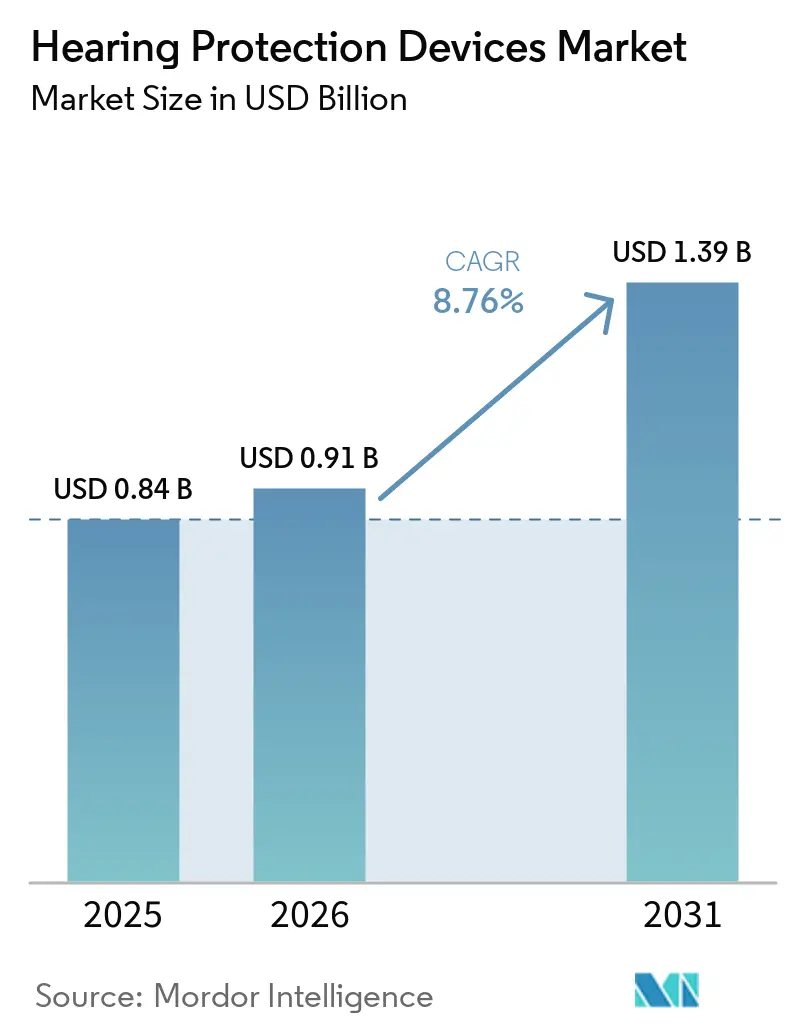
The Hearing Protection Devices Market size was valued at USD 0.84 billion in 2025 and is estimated to grow from USD 0.91 billion in 2026 to reach USD 1.39 billion by 2031, at a CAGR of 8.76% during the forecast period (2026-2031).
The market caters to healthcare environments where personnel operate near imaging equipment, dental instruments, transport vehicles, and surgical activities. These environments include operating theaters, radiology suites, emergency departments, and neonatal intensive care units, where staff may experience repeated sound exposure throughout their shifts, and clinical accountability directly shapes procurement decisions. Hospitals are increasingly integrating worker safety, infection control, and the ability to hear speech and alarms into their hearing protection procurement strategies. Accordingly, buyers assess product compatibility with masks, stethoscopes, and communication equipment rather than considering hearing protection a commodity purchase.
Replacement demand remains stable, as disposable products align with infection-control requirements across many clinical facilities. Demand is particularly significant in radiology suites, dental clinics, and ambulatory surgery centers, where limited reprocessing capacity and rotating personnel create a need for consistent product availability. Active products represent a higher-value solution for teams that require hearing protection without compromising awareness of clinical signals. Their relevance is particularly high in urgent and complex care settings, where personnel must distinguish patient alarms, verbal instructions, and other critical auditory cues. Healthcare infrastructure expansion across Asia-Pacific is increasing the number of facilities that require formal hearing-conservation programs and protective equipment. Group purchasing organizations and direct hospital contracts offer suppliers distinct routes to access these facilities.
Key Report Takeaways
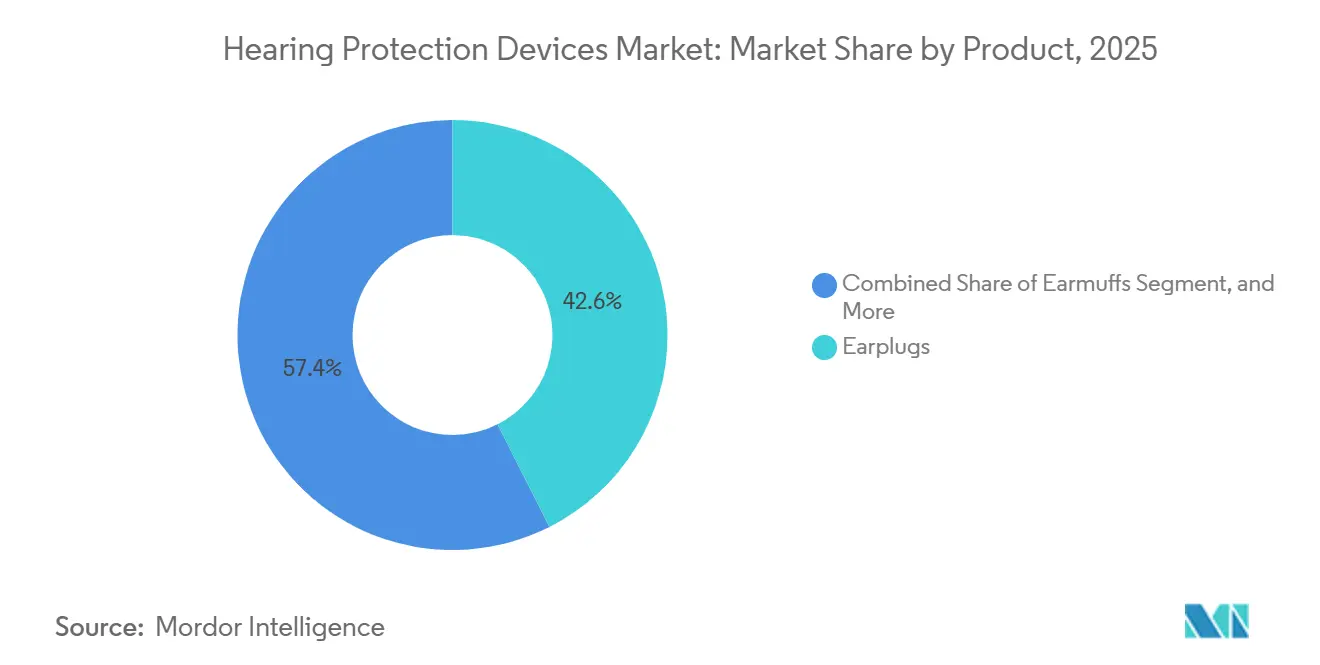
- By product, earplugs held 42.6% of the hearing protection devices market share in 2025, while hearing bands and canal caps are projected to grow at a 10.5% CAGR through 2031.
- By protection technology, passive devices held 68.5% of the hearing protection devices market share in 2025, while active devices are forecast to grow at a 10.7% CAGR through 2031.
- By form factor, in-ear devices held 45.7% of the segment in 2025, while over-ear devices are forecast to grow at a 0.5% CAGR through 2031.
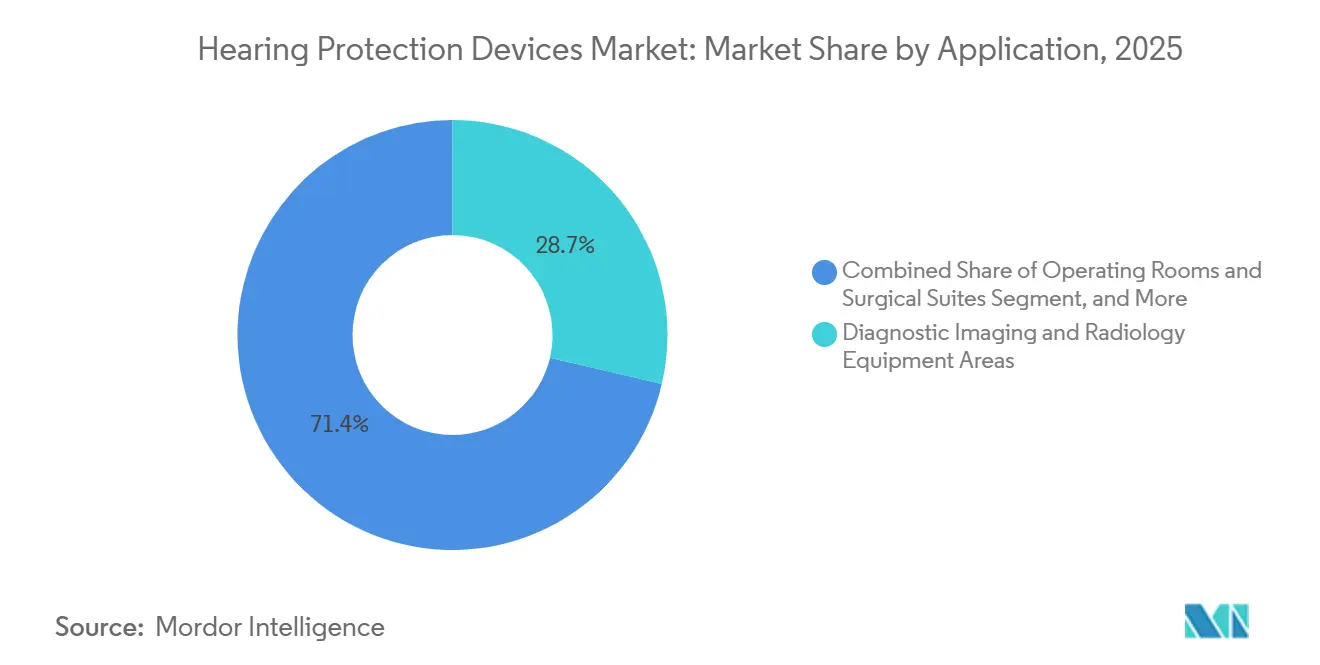
- By application, diagnostic imaging and radiology equipment areas held 28.7% of the segment in 2025, while emergency departments and trauma centers are projected to grow at a 11.8% CAGR through 2031.
- By distribution channel, hospital and health-system direct procurement held 39.7% of the segment in 2025, while group purchasing organizations are projected to grow at a 11.4% CAGR through 2031.
- By geography, North America held 43.5% of global revenue in 2025, while Asia-Pacific is forecast to grow at a 9.6% CAGR through 2031.
Note: Market size and forecast figures in this report are generated using Mordor Intelligence’s proprietary estimation framework, updated with the latest available data and insights as of January 2026.
Market Trends and Insights
Drivers Impact Analysis of Hearing Protection Devices Market*
| Driver | (~) % Impact on CAGR Forecast | Geographic Relevance | Impact Timeline |
|---|---|---|---|
| Increasing Noise Exposure in Hospitals and Clinical Facilities | +2.50% | Global, with highest intensity in North America and Northern Europe | Short term (≤ 2 years) |
| Occupational Hearing-Conservation Programs for Healthcare Workers | +1.80% | North America and Europe, with growth in Asia-Pacific and Middle East | Medium term (2-4 years) |
| Expansion of Diagnostic Imaging, Dental, and Surgical Infrastructure | +1.50% | Asia-Pacific, with spillover to Middle East, Africa, and South America | Medium term (2-4 years) |
| Demand for Communication-Preserving Protection in Clinical Workflows | +1.20% | Global, concentrated in advanced surgery and critical-care settings | Long term (≥ 4 years) |
| Growth of Customized and Reusable Protection for Long Shifts | +1% | North America and Europe, with demand emerging in Asia-Pacific private hospitals | Medium term (2-4 years) |
| Noise-Control Requirements in Neonatal and Critical-Care Environments | +0.80% | North America and Europe, with adoption potential in advanced Asia-Pacific hospitals | Long term (≥ 4 years) |
| Source: Mordor Intelligence | |||
Increasing Noise Exposure in Hospitals and Clinical Facilities
Noise exposure in hospitals is an increasingly important workplace safety concern, with clinical evidence indicating persistent sound levels and sharp noise peaks. Noise levels in intensive care units commonly range from 60 to 70 dB(A), while peak levels exceeded 90 dB(A) in the cited cohort study. These levels surpass the World Health Organization recommendation of 35 dB(A) for treatment and recovery rooms. A 2026 university dental hospital study found hearing loss among 30.4% of dental personnel, linking clinical noise exposure to an occupational health outcome. As a result, hospitals may increasingly position hearing protection as a workforce risk-management requirement rather than an optional supply item. This supports recurring procurement and creates a clear growth opportunity for the hearing protection devices market in high-exposure settings, as hospital managers can connect protective equipment decisions with audiometry outcomes, employee retention, and the operational costs associated with preventable hearing injuries.
Occupational Hearing-Conservation Programs for Healthcare Workers
OSHA requires general industry employers, including healthcare providers, to implement a hearing conservation program when workers are exposed to an 8-hour time-weighted average of 85 dBA or higher. The program includes noise monitoring, annual audiometry, and the provision of personal protective equipment. In January 2025, NIOSH updated its guidance and recommended individual quantitative fit testing to measure the level of protection each worker actually receives. This guidance reduces reliance on the labeled noise reduction rating as a substitute for real-world fit. Healthcare facilities can use fit testing to identify inadequate seals and select devices that meet individual user requirements. This approach can shift demand from generic disposable earplugs toward anatomically designed and testable products. It also strengthens the compliance case for higher-value formats in the hearing protection devices market, particularly among facilities that require documented fit and performance across different ear shapes, job roles, and combinations of clinical protective equipment.
Expansion of Diagnostic Imaging, Dental, and Surgical Infrastructure
The expansion of imaging rooms, dental operatories, and surgical facilities increases the number of work areas where employees may require hearing protection. Each MRI suite, CT room, and dental operatory generates ongoing equipment-related noise throughout its operating life. Dental instruments can produce high-frequency sound above 4,000 Hz, creating a specific need for products that preserve speech awareness while filtering selected frequencies. A 2025 dynamic earplug prototype for dental personnel provided 13 dB of speech-frequency amplification while attenuating high-frequency instrument noise. This product development highlights how clinical requirements differ from standard industrial applications. Consequently, healthcare construction and equipment upgrades in Asia-Pacific offer an addressable growth opportunity for the hearing protection devices market, as the need for staff protection begins when new equipment enters service and continues throughout its useful life.
Demand for Communication-Preserving Protection in Clinical Workflows
Clinical personnel must hear colleagues, alarms, and patient cues while reducing harmful sound exposure. Although passive products can lower noise levels, they may also limit awareness of critical signals in acute-care environments. A 2026 study of smart hearing protection reported lower surgical workload scores than passive sound-dampening conditions, with mean SURG-TLX scores of 43 and 55, respectively[1]Frontiers in Digital Health, “Measuring and Reducing Surgical Staff Stress in a Realistic Operating Room Setting Using EDA Monitoring and Smart Hearing Protection,” Frontiers in Digital Health, frontiersin.org. This finding supports the use of active systems in communication-intensive clinical settings. Sensear states that its SENS technology limits in-ear output to 82 dB(A) while maintaining speech intelligibility in high-noise conditions. Tertiary hospitals with substantial surgical and critical-care activity are likely to adopt these systems earlier than smaller facilities, as their care teams manage more communication-intensive procedures and have a greater need to balance noise control with continuous situational awareness.
Restraints Impact Analysis of Hearing Protection Devices Market*
| Restraint | (~) % Impact on CAGR Forecast | Geographic Relevance | Impact Timeline |
|---|---|---|---|
| Infection-Control and Reprocessing Requirements | -1.20% | Global, most acute in North America and Europe | Short term (≤ 2 years) |
| Compatibility Constraints With Stethoscopes, Masks, Headsets, and Other PPE | -0.90% | Global, especially surgical and emergency settings | Medium term (2-4 years) |
| Limited Healthcare-Specific Procurement Standards and Awareness | -0.70% | Asia-Pacific, Middle East, Africa, and smaller healthcare facilities globally | Medium term (2-4 years) |
| Risk of Masking Clinical Alarms and Patient Speech | -0.80% | Global, with greatest relevance in operating rooms, emergency departments, and critical-care units | Short term (≤ 2 years) |
| Source: Mordor Intelligence | |||
Infection-Control and Reprocessing Requirements
Reusable products can place a greater infection-control burden on clinical settings than on industrial workplaces. Custom-molded and multi-component devices require disinfection between users or shifts, while repeated chemical exposure can affect certain elastomeric materials. The Joint Commission’s revised infection-prevention materials require written policies for reusable personal protective equipment (PPE) and documented cleaning procedures that follow manufacturers’ instructions[2]Frontiers in Digital Health, “Measuring and Reducing Surgical Staff Stress in a Realistic Operating Room Setting Using EDA Monitoring and Smart Hearing Protection,” Frontiers in Digital Health, frontiersin.org. Smaller clinical facilities may lack the resources to validate and manage repeated reprocessing, leading them to prefer disposable products despite the longer service life of premium reusable formats. This variation in purchasing behavior can limit revenue growth per account for some suppliers in the hearing protection devices market. Health systems with established reprocessing protocols can capture the long-term value of reusable products, while smaller facilities often opt for simpler single-use alternatives.
Compatibility Constraints with Stethoscopes, Masks, Headsets, and Other PPE
Healthcare workers in surgical and emergency settings may need to wear masks, eye protection, headsets, and hearing protection simultaneously. This combination can create physical interference, compromise device seals, and reduce real-world noise attenuation. Available evidence indicates that foam earplugs can lose 30% to 50% of their noise reduction rating when a face-shield headband disrupts the seal. A 2026 dental hospital study found that technical and maintenance staff used multi-item PPE combinations more frequently than clinical staff and recorded the highest levels of audiometric hearing loss. Banded and neckband designs can reduce interference by avoiding certain headband contact points. Their compatibility with other equipment supports the faster growth expected for hearing bands and canal caps.
*Our forecasts treat driver/restraint impacts as directional, not additive. The impact forecasts reflect baseline growth, mix effects, and variable interactions.
Hearing Protection Devices Market Segment Analysis
By Product:
Disposable Earplugs Lead, Canal Caps Gain Clinical GroundEarplugs accounted for 42.6% of the hearing protection devices market by product in 2025, making them the leading product segment. Disposable foam and pre-molded earplugs are widely used in high-throughput settings, including radiology suites, dental clinics, and ambulatory surgery centers. These formats also support single-use infection-control protocols in facilities with limited reprocessing capacity. Their familiarity among purchasing teams and ability to be distributed at scale across large facilities further support demand. Earmuffs remain relevant in transport and imaging settings with high noise levels. However, their larger design can create discomfort when workers also wear masks, eyewear, or communication headsets. Uniform-attenuation earplugs serve a smaller premium segment where clinicians must communicate effectively with patients and colleagues. Dental and audiology practices have a stronger need for these products because communication is integral to treatment. A dynamic-earplug prototype in 2025 demonstrated that product development can combine high-frequency attenuation with amplification at speech frequencies. This capability supports specialized product positioning rather than a standardized offering across all clinical sites.
Hearing bands and canal caps are forecast to grow at a CAGR of 10.5% from 2026 to 2031, representing the fastest growth rate within the product category. Semi-insert canal caps sit outside the ear canal, reducing potential interference with masks and stethoscopes. This design benefits workers who frequently move between noisy and quiet rooms and reduces the need to insert and remove deeply fitted earplugs during short clinical tasks. Their compatibility with PPE configurations provides a practical advantage in operating rooms and emergency departments. Earmuffs continue to provide value in environments where noise levels exceed the practical attenuation range of certain small in-ear products. Product selection therefore depends on the source, duration, and pattern of sound exposure. The hearing protection devices market benefits when suppliers offer formats that address both noise-control requirements and clinical workflow needs. The product category also maintains a balance between low-cost disposable products and reusable specialty devices, enabling purchasing teams to align product selection with shift duration, expected exposure, cleaning capabilities, and the need for repeated communication during care delivery. This balance reflects the varied budgets and infection-control processes across healthcare facilities.



By Protection Technology:
Passive Formats Dominate but Active Systems Define Future ValuePassive devices accounted for 68.5% of the protection technology segment in 2025. Their leadership reflects a long procurement history, familiar pricing structures, and high annual volumes of disposable units. Hospitals can procure passive earplugs and earmuffs through established safety and supply channels. These devices remain suitable in settings where clear communication and alarm recognition are less critical. Their low unit cost also supports broad distribution across facilities. However, passive attenuation can make alarms, spoken instructions, and other clinical signals more difficult to recognize. This limitation is particularly important in operating rooms, intensive care units, and emergency environments. A review in 2025 identified alarm fatigue as a patient-safety concern shaped by the difficulty of distinguishing relevant alarms from other sounds. Clinical governance teams can therefore consider alarm-signal integrity when selecting hearing protection. This factor sustains the importance of passive products while limiting their suitability across all high-acuity workflows.
Active devices are projected to grow at a CAGR of 10.7% through 2031, the fastest rate in the protection technology category. These products selectively attenuate harmful sounds while allowing selected speech frequencies and alarm cues to remain audible. Active systems represent a smaller share of the hearing protection devices market than passive formats, but their clinical relevance is expanding. A surgical study anticipated in 2026 links smart hearing protection with lower reported workload than passive sound-dampening conditions. Active systems can support patient safety, worker safety, and communication objectives within a single purchasing decision. FDA action anticipated in July 2026 is expected to establish a Class II classification for active noise attenuation systems for infant incubators under 21 CFR 880.5405[3]U.S. Food and Drug Administration, “Active Noise Attenuation System for Infant Incubators, Final Order,” Federal Register, govinfo.gov. This classification would create a regulatory pathway for patient-level noise management in neonatal care. It also identifies a specialized technology area beyond staff-centered hearing protection. The technology category is therefore likely to gain value through clinical applications that require controlled sound rather than simple attenuation, as clinical objectives may include protecting workers while preserving patient safety, communication quality, and appropriate alarm awareness.
By Form Factor:
In-Ear Formats Lead; Over-Ear Devices Anchor High-Noise Sub-SegmentsIn-ear products accounted for 45.7% of the form-factor segment in 2025. Foam earplugs, pre-molded earplugs, and custom otoplastic devices comprise a substantial share of this volume. Their low-profile design supports use with face masks and other clinical garments. Disposable in-ear products also align with the purchasing practices of infection-sensitive facilities. Radiology, dental, and general clinical settings can use these products without adding significant weight or heat. Custom otoplastic devices occupy a smaller, higher-value position within this group. Audiologists, dental surgeons, and senior clinical staff may select these devices for long-term hearing conservation. Individual fit testing can strengthen the value proposition for custom or anatomically optimized formats. NIOSH recommendations in 2025 were focused on quantitative testing of actual protection rather than assumed label performance. This approach may increase revenue per unit, even where total unit-volume growth remains moderate. The in-ear category is expected to retain its role as the default choice for many routine clinical applications.
Over-ear devices are forecast to grow at a CAGR of 0.5% from 2026 to 2031. Although growth is slower, these devices remain necessary in settings with high impulse noise. Ambulance and helicopter transport can generate exposure levels that require stronger coverage than certain in-ear options provide. Helmet-integrated products also serve a role in trauma transport. Neckband and banded devices offer an intermediate option for workers moving between sound environments and can be easier to remove and replace than certain conventional designs. Comfort, heat, and interference with other PPE limit the broader adoption of over-ear formats in hospitals. Form factor is therefore both a workflow and protection consideration. The hearing protection devices industry must support multiple wearing configurations. The product mix will continue to depend on whether workers require mobility, communication, high attenuation, or repeated short-duration use. As a result, no single form factor can address every requirement across imaging, transport, dental, surgical, and general clinical environments.
By Application:
Radiology Leads Volume; Emergency Settings Drive GrowthDiagnostic imaging and radiology equipment areas accounted for 28.7% of the application segment in 2025. MRI scanner noise can reach 82 to 118 dB SPL, depending on the pulse sequence and field strength. These sound levels make hearing protection a standard requirement under many institutional procedures. Imaging departments also have a consistent employee base exposed to repeated noise, supporting recurring demand for disposable and reusable products. CT suites, MRI rooms, and related workspaces remain central to application volume. Operating rooms represent another important application because clinical staff must communicate during procedures. Their requirements can favor active formats that protect hearing without obstructing critical cues. The large application share highlights the importance of installed imaging infrastructure to the hearing protection devices market, as these departments generate recurring demand from a stable employee base that works around scanners as part of regular duties. This infrastructure also supports a stable base of institutional purchasing across mature hospital systems.
Emergency departments and trauma centers are forecast to grow at a CAGR of 11.8% through 2031. Ambulance fleet acoustics, helicopter activity, and busy trauma bays create distinct sound environments for staff. Supplied evidence indicates that ambulance and helicopter noise frequently exceeds 95 dB(A). Emergency departments also depend on rapid verbal coordination, increasing the value of devices that preserve communication. A hospital study in 2025 recorded the highest mean sound levels and peak noise-event counts in pharmacy and emergency department areas. The measured average range in these areas is expected to be 75 to 78 dB(A). Ambulance and patient transport services remain smaller applications but are gaining attention as employers formalize occupational health programs. Operating rooms hold a strategically important middle position because staff protection and alarm awareness are both critical. Patient-focused neonatal products also expand the boundaries of the application category. The FDA’s anticipated 2026 classification for infant-incubator noise attenuation supports this emerging patient-level use case.
By Distribution Channel:
Direct Procurement Anchors Volume; GPOs Gain InfluenceHospital and health-system direct procurement accounted for 39.7% of the distribution channel segment in 2025. Large integrated systems often negotiate supplier contracts directly and manage supply chains centrally. This structure gives facility-level relationships a strong role in volume purchasing. Suppliers can engage with occupational health, infection-control, and value-analysis teams through this channel. Direct contracts can also support product trials and fit-testing programs. The channel is particularly important when facilities require a tailored mix of disposable, reusable, and active devices. It enables product selection based on the clinical setting rather than a single standardized item. Medical supply distributors and occupational health providers serve many smaller facilities. Retail pharmacies and e-commerce channels also reach individual healthcare workers and smaller practices. Direct procurement consequently remains the most reliable volume channel in the hearing protection devices market
Geography Analysis
North America Hearing Protection Devices Market
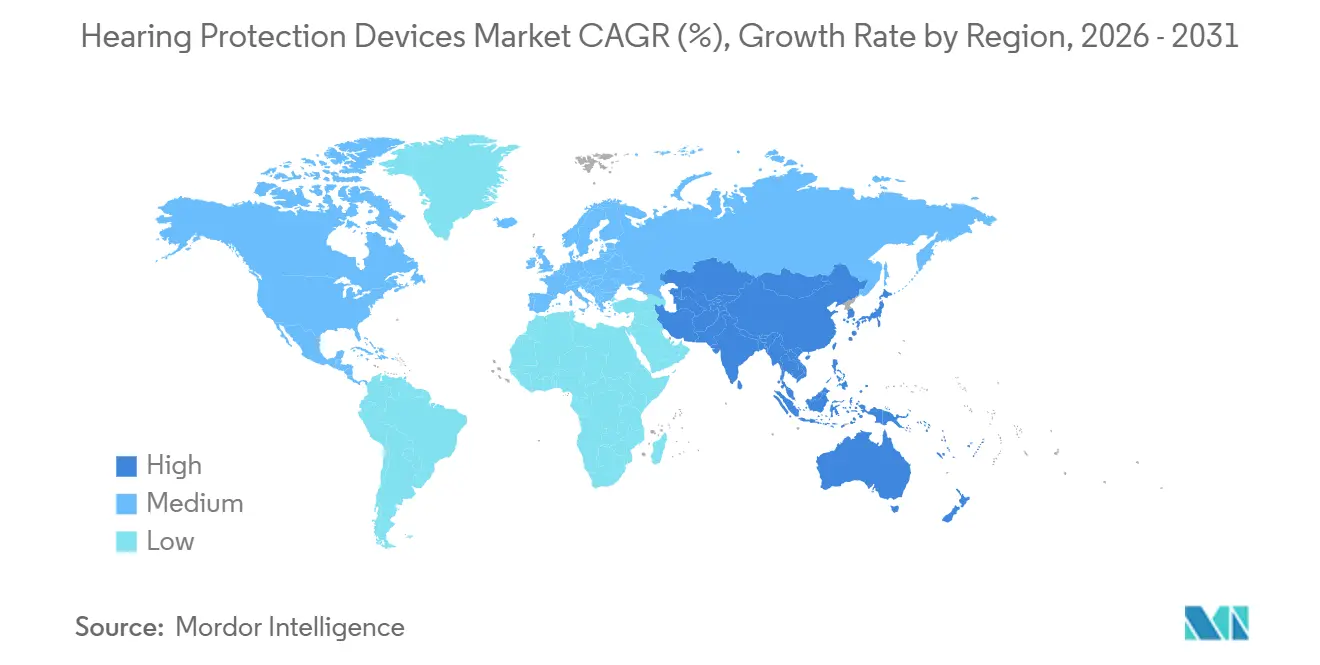
North America is projected to account for 43.5% of global revenue in 2025, representing the leading regional share of the hearing protection devices market. OSHA requirements support demand among healthcare workers who meet noise-exposure thresholds, while NIOSH’s 2025 guidance is expected to recommend individual quantitative fit testing. The United States drives a significant share of regional demand through its imaging, surgical, and emergency care infrastructure. Canada is increasingly aligning with comparable occupational health practices, while Mexico contributes to demand through the expansion of private hospitals. A hospital-worker study scheduled for January 2026 is expected to report hearing-loss prevalence ranging from 9% under OSHA Standard Threshold Shift criteria to 46% under ISO 7029:2017 criteria.
Europe Hearing Protection Devices Market
Europe represents the second-largest regional market in the supply analysis, led by Germany, the United Kingdom, and France. EU Directive 2003/10/EC requires structured management of noise-exposure risks and emphasizes risk assessment before selecting personal protective equipment (PPE). These requirements support demand for monitoring, audiometry, fit testing, and hearing protection devices across developed healthcare systems. The United Kingdom’s National Health Service serves as a major institutional buyer, while clinical facility upgrades support demand in Spain and Italy.
APAC, MEA and South America Hearing Protection Devices Market
Asia-Pacific is projected to grow at a CAGR of 9.6% through 2031, the highest regional growth rate in the supplied forecast. China and India generate a substantial share of incremental demand through investments in healthcare capacity and equipment. According to the source material, China had 38,710 hospitals and more than 1.04 million outpatient and primary care centers. Japan and South Korea sustain demand through mature healthcare standards, while Australia and Southeast Asia represent expanding markets. The Middle East and Africa and South America remain smaller markets, with growth linked to healthcare investment and the development of occupational health infrastructure.

Competitive Landscape
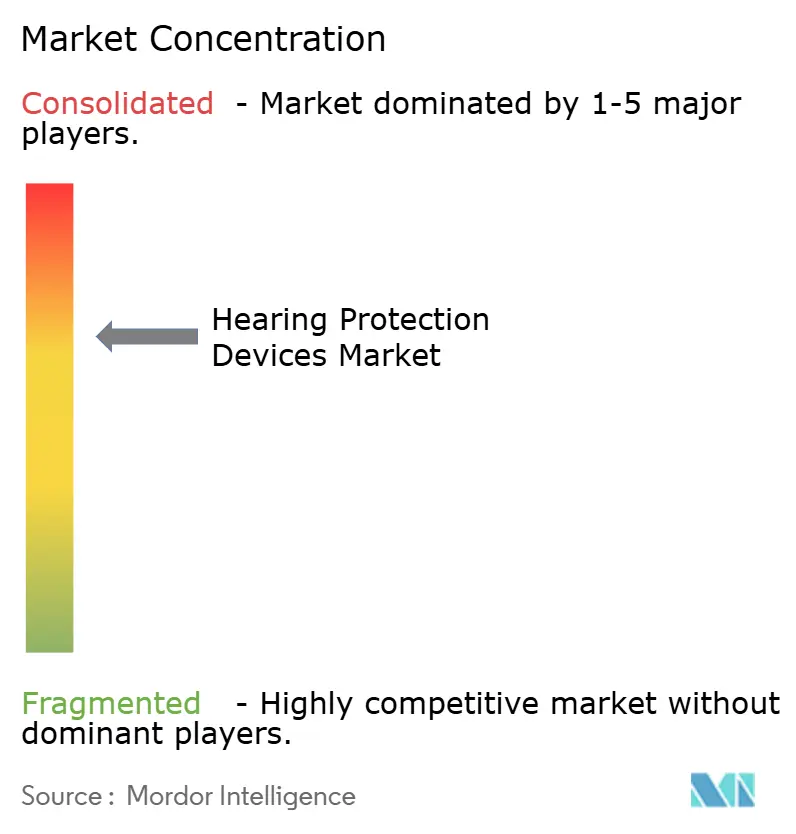
The hearing protection devices market is moderately fragmented. 3M, Honeywell International, and MSA Safety are leading participants, supported by broad product portfolios and established institutional relationships. Their market position is based on product breadth, compliance documentation, and experience working with hospital infection-control and occupational health teams. The supplied analysis does not provide the combined market share of the leading players. Moldex-Metric, uvex group, Delta Plus Group, and Sensear comprise a differentiated second tier. Moldex-Metric is associated with independent noise reduction rating verification, uvex group with European safety certification, and Sensear with communication-preserving hearing protection.
Sensear’s SENS technology limits in-ear output to 82 dB(A) while maintaining speech intelligibility in high-noise environments. In 2025, Sensear and Dräger formalized an integration collaboration involving communication products and powered air-purifying respirators. In July 2026, the FDA established a Class II classification for active noise attenuation systems for infant incubators under 21 CFR 880.5405. This action is expected to create a defined regulatory pathway for products that are substantially equivalent to the cited predicate.
ACS Custom, Cotral Lab, and Custom Protect Ear compete through audiologist relationships and ear-impression processing capabilities. Etymotic Research and Alpine Hearing Protection serve the uniform-attenuation niche in dental and audiology settings. In March 2026, Loop Earplugs secured EUR 50 million (USD 54.5 million) to support product development, international expansion, and distribution. In October 2024, 3M introduced the WorkTunes Connect + Solar Hearing Protector, featuring a 26 dB noise reduction rating and solar charging capabilities.
Hearing Protection Devices Industry Leaders
3M
Honeywell International Inc.
Sonova Holding AG
MSA Safety Incorporated
Sensear Pty Ltd.
- *Disclaimer: Major Players sorted in no particular order
Hearing Protection Devices Market Companies Covered in this Report
- 3M
- ACS Custom
- Alpine Hearing Protection B.V.
- Cotral Lab
- Delta Plus Group
- EAR Inc.
- Etymotic Research, Inc.
- Honeywell International
- Loop Earplugs
- MSA Safety Incorporated
- Moldex-Metric, Inc.
- PIP Global Safety
- Phonak Communications
- QuietOn Oy
- Radians, Inc.
- Sensear Pty Ltd.
- Sonova
- Uvex group

Recent Industry Developments in Hearing Protection Devices Market
- July 2026: FDA formalizes Class II classification for active noise attenuation systems for infant incubators (21 CFR 880.5405), effective July 27, 2026. The order, published in the Federal Register, allows manufacturers to pursue 510(k) premarket notification for neonatal noise-attenuation devices substantially equivalent to Invictus Medical's Neoasis, opening a new product category within clinical hearing protection.
- July 2025: e3 Diagnostics partnered with Alliant Purchasing GPO, giving more than 260 hospitals and 35,000 provider locations preferred pricing access to diagnostic and hearing-related clinical solutions.
- January 2025: Sensear launches SM1B-IS and SM1B-Ex intrinsically safe headsets for hazardous locations, featuring SENS technology and cabled two-way radio connectivity.


Global Hearing Protection Devices Market Report Scope
According to the report’s scope, hearing protection devices are equipment designed to reduce or block harmful noise exposure, preventing hearing loss. They include earplugs, earmuffs, and specialized earmuffs for noise attenuation.
The hearing protection devices market is segmented into product and geography. By product, the market is segmented into earplugs, earmuffs, hearing bands, canal caps, and uniform-attenuation earplugs. By protection technology, the market is segmented into passive hearing protection devices and active hearing protection devices. By form factor, the market is segmented into in-ear devices, over-ear devices, helmet-integrated devices, neckband and banded devices, and custom otoplastic devices. By application, the market is segmented into diagnostic imaging and radiology equipment areas, operating rooms and surgical suites, emergency departments and trauma centers, ambulance and patient transport services, and other applications. By distribution channel, the market is segmented into group purchasing organizations, hospital and health-system direct procurement, medical supply distributors, occupational health and safety providers, retail pharmacies and medical retail, and e-commerce and brand-owned online channels. By geography, the market is segmented into North America, Europe, Asia-Pacific, the Middle East and Africa, and South America. The report also covers the estimated market sizes and trends for 17 countries across major regions globally. The report offers values (USD) for all the above segments.
| Earplugs |
| Earmuffs |
| Hearing Bands and Canal Caps |
| Uniform-Attenuation Earplugs |
| Passive Hearing Protection Devices |
| Active Hearing Protection Devices |
| In-Ear Devices |
| Over-Ear Devices |
| Helmet-Integrated Devices |
| Neckband and Banded Devices |
| Custom Otoplastic Devices |
| Diagnostic Imaging and Radiology Equipment Areas |
| Operating Rooms and Surgical Suites |
| Emergency Departments and Trauma Centers |
| Ambulance and Patient Transport Services |
| Other Applications |
| Group Purchasing Organizations |
| Hospital and Health-System Direct Procurement |
| Medical Supply Distributors |
| Occupational Health and Safety Providers |
| Retail Pharmacies and Medical Retail |
| E-Commerce and Brand-Owned Online Channels |
| North America | United States |
| Canada | |
| Mexico | |
| Europe | Germany |
| United Kingdom | |
| France | |
| Italy | |
| Spain | |
| Rest of Europe | |
| Asia-Pacific | China |
| Japan | |
| India | |
| Australia | |
| South Korea | |
| Rest of Asia-Pacific | |
| Middle East and Africa | GCC |
| South Africa | |
| Rest of Middle East and Africa | |
| South America | Brazil |
| Argentina | |
| Rest of South America |
| By Product | Earplugs | |
| Earmuffs | ||
| Hearing Bands and Canal Caps | ||
| Uniform-Attenuation Earplugs | ||
| By Protection Technology | Passive Hearing Protection Devices | |
| Active Hearing Protection Devices | ||
| By Form Factor | In-Ear Devices | |
| Over-Ear Devices | ||
| Helmet-Integrated Devices | ||
| Neckband and Banded Devices | ||
| Custom Otoplastic Devices | ||
| By Application | Diagnostic Imaging and Radiology Equipment Areas | |
| Operating Rooms and Surgical Suites | ||
| Emergency Departments and Trauma Centers | ||
| Ambulance and Patient Transport Services | ||
| Other Applications | ||
| By Distribution Channel | Group Purchasing Organizations | |
| Hospital and Health-System Direct Procurement | ||
| Medical Supply Distributors | ||
| Occupational Health and Safety Providers | ||
| Retail Pharmacies and Medical Retail | ||
| E-Commerce and Brand-Owned Online Channels | ||
| Geography | North America | United States |
| Canada | ||
| Mexico | ||
| Europe | Germany | |
| United Kingdom | ||
| France | ||
| Italy | ||
| Spain | ||
| Rest of Europe | ||
| Asia-Pacific | China | |
| Japan | ||
| India | ||
| Australia | ||
| South Korea | ||
| Rest of Asia-Pacific | ||
| Middle East and Africa | GCC | |
| South Africa | ||
| Rest of Middle East and Africa | ||
| South America | Brazil | |
| Argentina | ||
| Rest of South America | ||


Key Questions Answered in the Report
What is the forecast value of the hearing protection devices market in 2031?
The forecast value is USD 1.39 billion in 2031, rising from USD 0.91 billion in 2026 at an 8.76% CAGR.
Which hearing protection product is used most widely in healthcare settings?
Earplugs led the product segment with 42.56% share in 2025, supported by disposable-use practices in infection-sensitive settings.
Why are active hearing protection devices gaining use in hospitals?
Active products can reduce harmful sound while helping users retain speech and alarm awareness. They are projected to grow at a 10.7% CAGR through 2031.
Which healthcare application is growing fastest for hearing protection devices?
Emergency departments and trauma centers are the fastest-growing application, with an 11.76% CAGR expected through 2031.
Which region has the largest demand for hearing protection devices?
North America led with 43.54% of global revenue in 2025, supported by established workplace safety requirements and clinical infrastructure.
How do hospitals purchase hearing protection devices?
Direct hospital and health-system procurement led with 39.65% share in 2025, while group purchasing organizations are expected to grow at an 11.4% CAGR through 2031.
Page last updated on:





