
Healthy Snack Chips Market Size and Share
Market Overview
| Study Period | 2022 - 2032 |
|---|---|
| Market Size (2027) | USD 20.52 Billion |
| Market Size (2032) | USD 27.20 Billion |
| Growth Rate (2027 - 2032) | 5.80 % |
| Fastest Growing Market | Middle East and Africa |
| Largest Market | North America |
| Market Concentration | Low |
Major Players *Disclaimer: Major Players sorted in no particular order Image © Mordor Intelligence. Reuse requires attribution under CC BY 4.0. | |
Healthy Snack Chips Market Analysis by Mordor Intelligence
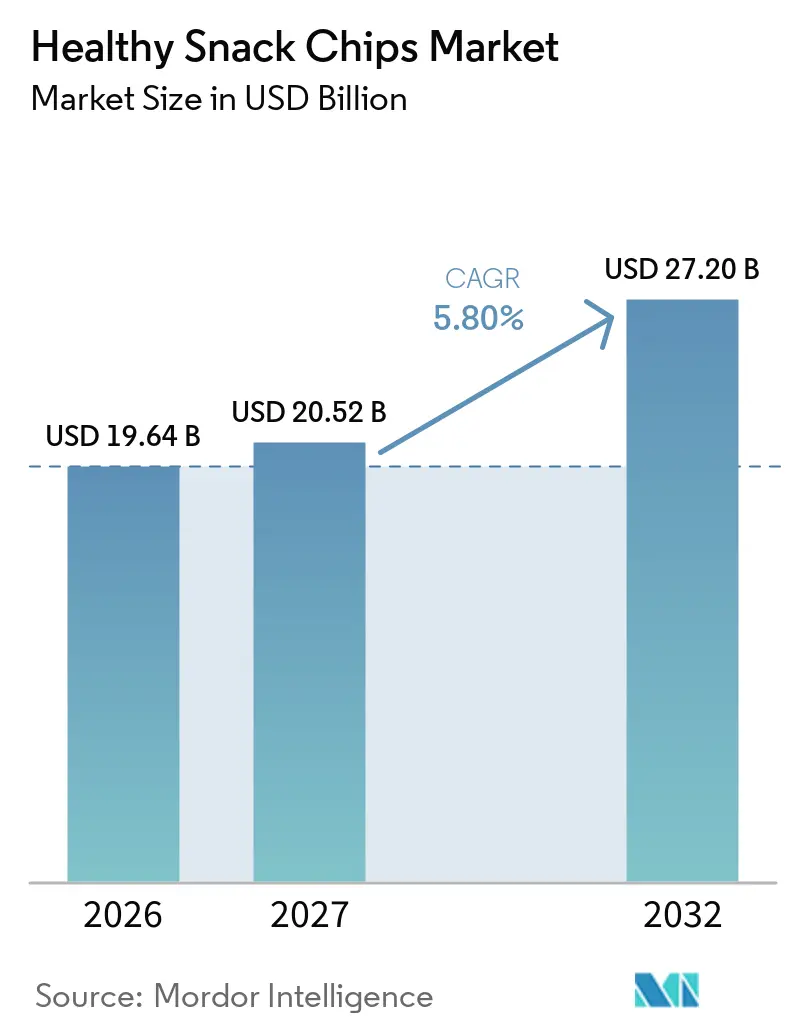
The healthy snack chips market size is projected to expand from USD 19.64 billion in 2026 and USD 20.52 billion in 2027 to USD 27.20 billion by 2032, registering a CAGR of 5.8% between 2027 to 2032. Growth reflects a shift toward snacks that fit smaller meal occasions while offering simpler ingredient lists, protein, fiber, or vegetable-based formats. Demand also benefits from consumers who compare packaged snack labels more closely and seek products that support satiety without giving up familiar flavors. This creates room for brands that can pair credible nutrition with dependable taste, consistent availability, and accessible pricing. Larger snack companies are responding through acquisitions and product reformulation, while smaller brands continue to compete through ingredient transparency and focused product ranges. Supply constraints for specialty ingredients and stricter rules for health claims may favor companies with stronger sourcing programs and the ability to revise labels or recipes quickly.
Key Report Takeaways
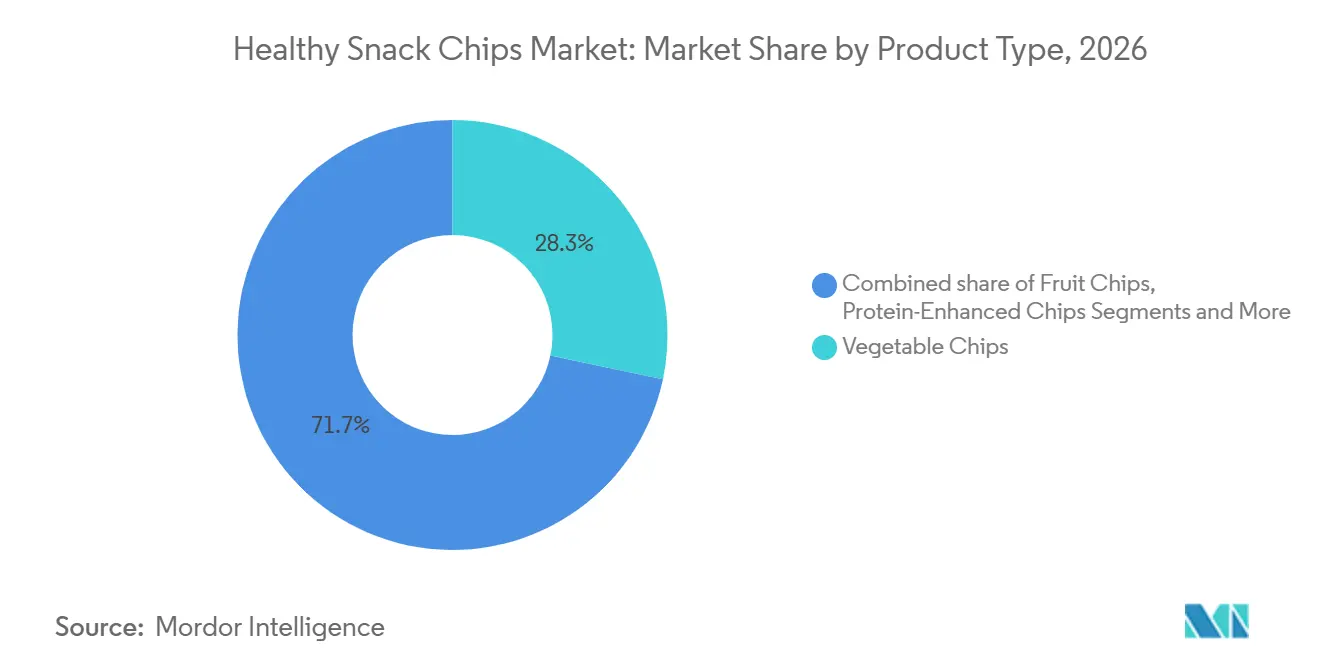
- By product type, vegetable chips held 28.3% of the healthy snack chips market share in 2026, while protein-enhanced chips are forecast to grow at a 6.5% CAGR through 2032.
- By ingredient source, plant-based accounted for 78.2% of category value in 2026, while hybrid blends are projected to expand at a 7.2% CAGR through 2032.
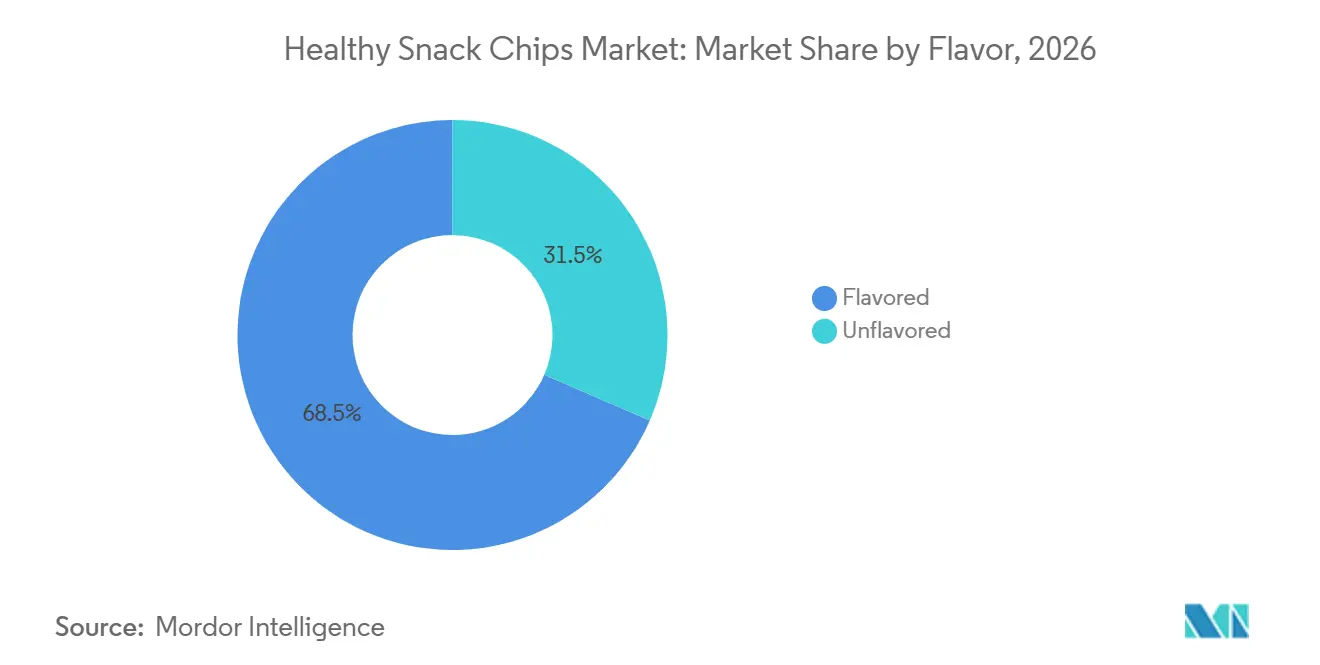
- By flavor, flavored variants held 68.5% of the healthy snack chips market size in 2026, while unflavored formats are forecast to grow at an 8.1% CAGR through 2032.
- By distribution channel, supermarkets and hypermarkets accounted for 38.8% of category value in 2026, while online retail stores are projected to grow at a 7.8% CAGR through 2032.
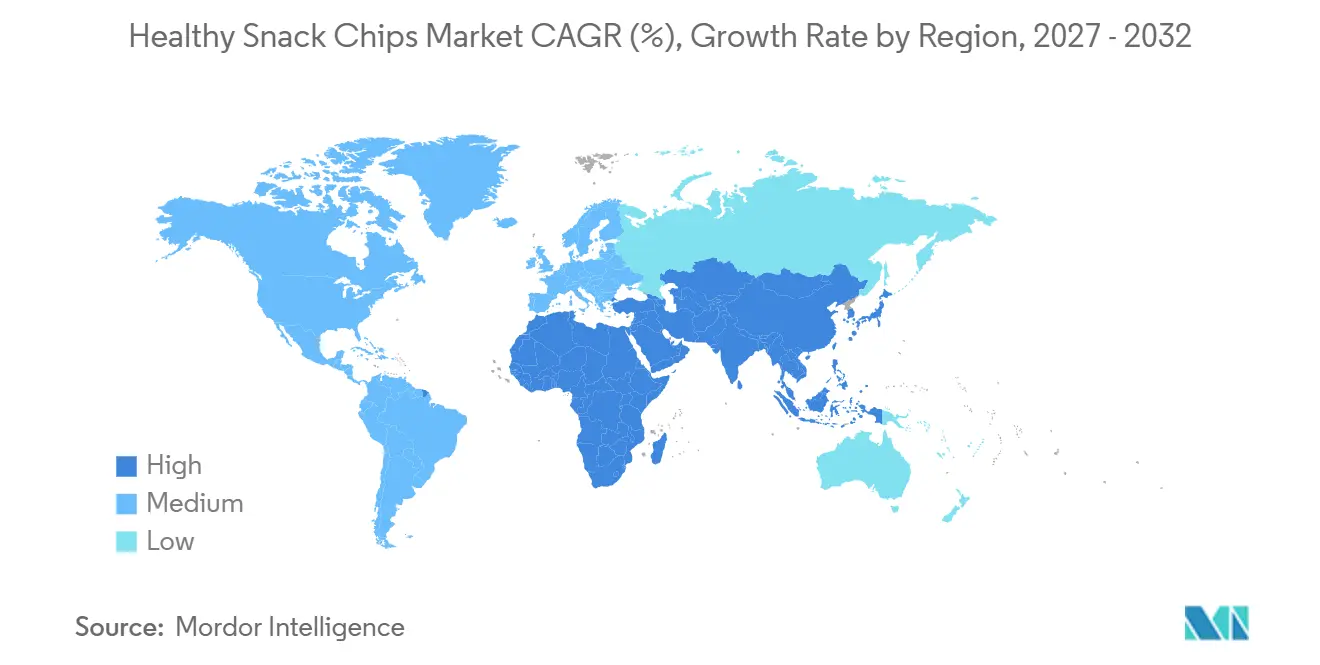
- By geography, North America held 36.4% of global category value in 2026, while the Middle East and Africa is forecast to expand at a 6.9% CAGR through 2032.
Note: Market numbers in this report are based on Mordor Intelligence's proprietary estimation framework, which combines nine months of actuals with Q4 projections for base year 2026.
Global Healthy Snack Chips Market Trends and Insights
Drivers Impact Analysis*
| Drivers | (~) % Impact on CAGR Forecast | Geographic Relevance | Impact Timeline |
|---|---|---|---|
| Rising Obesity and Lifestyle-Disease Awareness | +1.0% | Global | Long term (≥ 4 years) |
| Premiumization and Experiential Snacking | +0.8% | North America and Europe | Medium term (2-4 years) |
| Social Media and Influencer Influence | +0.7% | Global, strongest in North America and Asia-Pacific | Short term (≤ 2 years) |
| Clean-Label and Natural Ingredient Preference | +0.9% | North America, Europe, and Asia-Pacific | Long term (≥ 4 years) |
| Convenience and Portability | +0.6% | Global | Medium term (2-4 years) |
| Functional Fortification With Protein, Fiber, and Micronutrients | +1.1% | North America and Europe, expanding to Asia-Pacific | Long term (≥ 4 years) |
| Source: Mordor Intelligence | |||
Rising Obesity and Lifestyle-Disease Awareness
Public health data is directly re-routing snack dollar flows. The WHO reports that overweight and obesity affect more than 2.5 billion adults globally, while the CDC confirms a 40.3% obesity prevalence among U.S. adults as of 2025, a figure that is translating into measurable behavioral change at the point of purchase[1]. SNAC International's 2025 State of the Industry Report found that sales of snacks labeled "low-sodium" and "organic" rose 12% in the most recent full year, significantly outpacing total category performance SNAC International, 2025. A less-discussed dynamic with material commercial consequences: the rapid adoption of GLP-1 receptor agonists is creating a structurally distinct consumer cohort that seeks high-protein, high-satiety chip formats capable of functioning as nutritionally efficient mini-meals, ADM identifies this as one of the four primary drivers fueling the functional snacking market, and brands that formulate for GLP-1 users are securing first-mover advantages in premium shelf segments ahead of large-scale market penetration of these medications.
Premiumization and Experiential Snacking
Consumers are demonstrating a consistent willingness to trade up for chip experiences that combine bold flavor with provenance narratives, artisanal processing cues, and clean oils. Glanbia's 2025 State of the Healthy Snack Market report finds that two in five consumers globally have increased their healthy snack consumption over the past year, and that healthy snacks are now consumed more frequently than indulgent options, 56% of consumers eat a healthy snack at least once daily, versus 49% for indulgent snack occasions. Premiumization is unlocking higher average selling prices in the vegetable chip sub-category, where avocado oil-cooked formats command a retail premium of 18–25% over conventional equivalents in the United States. The less obvious implication: premiumization is expanding to formats and flavors previously associated with indulgence, as witnessed by the growth of globally inspired chip variants that merge health credentials with experiential flavor discovery, a strategy that positions healthy chips as a discovery category rather than a deprivation alternative.
Social Media and Influencer Influence
Social media has fundamentally compressed the product-discovery-to-purchase funnel for healthy snack chips, a dynamic that is creating both explosive demand waves and supply chain vulnerabilities. Data analytics firm Spate projects an 18.4% year-over-year sales increase in the broader healthy snacking category into 2026, with protein-focused snacks recording a 99.2% surge in year-over-year search volume, growth directly traceable to platform-driven amplification. Cargill's publicly released 2025 snacking study, surveying 4,452 U.S. participants, identifies two structurally important consumer archetypes, "Health Seekers" who demand functional, high-quality ingredients and "Purposeful Snackers" who snack with intention around satiety and convenience, both of whom actively engage with social content to discover products. The embedded second-order risk: social-media-driven demand spikes for niche ingredients can outpace procurement capacity, as 2025 shortages in matcha and functional mushrooms demonstrated, leaving brands with concentrated sourcing exposed to availability gaps at peak consumer interest moments.
Clean-Label and Natural Ingredient Preference
Clean-label attributes have moved from differentiating features to baseline purchase criteria for a growing segment of chip consumers. The FDA's updated "healthy" nutrient content claim, finalized and effective February 25, 2025, significantly streamlines the clean-label path for vegetable, legume, and grain-based chips: whole vegetables, fruits, legumes, and nuts now automatically qualify for the "healthy" claim without meeting additional nutrient thresholds, a classification that directly benefits manufacturers of plant-forward chip formats[2]. Concurrently, the FDA's January 2025 proposed front-of-package nutrition information rule, which would require a standardized Nutrition Info box rating saturated fat, sodium, and added sugar on most packaged food fronts, will, if finalized, materially shift shelf-space economics in favor of minimally processed, clean-ingredient chip formulations by making their nutritional advantages immediately visible to browsing shoppers. Brands that have already reformulated toward cleaner ingredient lists will be positioned to benefit commercially from regulatory compliance that latecomers will scramble to achieve.
Restraints Impact Analysis*
| Restraint | (~) % Impact on CAGR Forecast | Geographic Relevance | Impact Timeline |
|---|---|---|---|
| Supply-Chain Fragility for Niche Ingredients | -0.4% | Global | Short term (≤ 2 years) |
| Regulatory Scrutiny on Health Claims and Labeling | -0.5% | North America and European Union | Medium term (2-4 years) |
| Intense Competition From Traditional Snack Giants | -0.6% | Global | Long term (≥ 4 years) |
| Taste and Texture Gap Versus Traditional Chips | -0.5% | Global | Medium term (2-4 years) |
| Source: Mordor Intelligence | |||
Supply-Chain Fragility for Niche Ingredients
Supply chain fragility is the healthy snack chips category's most underappreciated structural risk. FoodNavigator reported in June 2025 that social-media-driven demand surges caused documented shortages in matcha, pistachios, Brazil nuts, feta, and functional mushrooms within the year, affecting manufacturers sourcing these ingredients for premium chip formulations. The SNAC International 2025 SOI separately identified ongoing stress from tariff uncertainty on materials from Europe and Asia, impacting co-branded and specialty ingredient procurement lines. Brands that concentrate sourcing in a single trendy ingredient face a compounded risk: supply unavailability intersecting with the rapid demand reversal that typically follows social media's attention cycle, potentially leaving manufacturers with stranded inventory at precisely the moment consumer interest deflates. Diversified sourcing strategies, long-term supplier contracts, and ingredient substitution protocols are therefore prerequisites for competing credibly in a market where ingredient trends move faster than traditional supply chain lead times.
Regulatory Scrutiny on Health Claims and Labeling
The compliance environment for healthy chip claims has become materially more demanding. Beyond the FDA's February 2025 "healthy" claim update, the Make America Healthy Again (MAHA) Commission's 2025 national assessment raised public concerns about sodium, refined grains, seed oils, and certain additives in processed snacks, creating reputational exposure even for products not technically violating existing FDA rules, as consumers increasingly cross-reference ingredient lists against MAHA-amplified concern lists. At the state level, SNAC International's 2025 industry commentary notes efforts to create patchwork ingredient regulation governing seed oils and specific additives that could create significant manufacturing and labeling complexity for brands operating across multiple U.S. states. The dual pressure of federal rule tightening and state-level regulatory divergence imposes disproportionate costs on mid-tier brands that lack the R&D and legal resources of multinational players, potentially accelerating market consolidation toward larger operators who can absorb compliance investment as part of broader reformulation programs.
*Our forecasts treat driver/restraint impacts as directional, not additive. The impact forecasts reflect baseline growth, mix effects, and variable interactions.
Segment Analysis
By Product Type: Vegetable Chips Lead While Protein-Enhanced Chips Grow Fastest
Vegetable chips held 28.3% of the healthy snack chips market size in 2026, making them the leading product type. Their position reflects demand for chips made from ingredients that consumers can readily identify, including sweet potato, beetroot, kale, and carrot. These products fit the preference for plant-forward recipes and short ingredient lists. Cooking methods such as air frying, baking, freeze drying, and the use of avocado oil give manufacturers additional ways to distinguish a product. Vegetable chips also allow brands to emphasize the base ingredient without relying solely on a general health claim.
Protein-enhanced chips are expected to advance at a 6.5% CAGR through 2032, the fastest rate among product types. They are supported by interest in filling snack portions, fitness-oriented eating, and meal replacement occasions. PepsiCo launched Doritos Protein in February 2026 with 10g of protein per 1-ounce serving. It followed with PopCorners Protein, which provides 9g of protein per serving, and Quaker Protein Rice Crisps, which provide 6g of protein per serving. These launches show that the healthy snack chips market is moving protein from a specialist proposition into established snack brands.

By Ingredient Source: Plant-Based Ingredients Dominate While Hybrid Blends Expand
Plant-based ingredients accounted for 78.2% of category value in 2026. Pea protein, chickpea, black bean, lentil, and soy are the main foundations of this product group. The segment benefits from its connection with plant-forward eating, allergen avoidance, and ingredient familiarity. It also serves several snack occasions, from lighter vegetable crisps to more substantial legume products. Improvements in taste and texture have made these ingredients more usable across snack formats.
Hybrid blends are projected to grow at a 7.2% CAGR through 2032. These products bring together different ingredient sources to address taste, texture, and broader dietary preferences. ADM found interest in hybrid or blended protein products among 53% of Baby Boomers, 66% of Gen X, 75% of Millennials, and 72% of Gen Z. The broad appeal gives producers in the healthy snack chips market a route to serve consumers who do not identify with one dietary approach. Hybrid formats can support premium positioning when the blend produces a better eating experience and the ingredient statement remains clear.
By Flavor: Flavored Products Hold the Larger Position While Unflavored Chips Accelerate
Flavored variants accounted for 68.5% of category value in 2026, showing that consumers still expect a satisfying taste experience from products positioned as healthier alternatives. Flavor helps brands reduce the perceived compromise between nutritional content and enjoyment. It also creates a reason for seasonal releases and limited product lines. Calbee America launched Asian Style Chips in March 2025 in Japanese, Thai, Chinese, and Korean-inspired flavor varieties. The line was dairy-free, wheat-free, and peanut-free, linking flavor variety with allergen-friendly positioning.
Unflavored formats are forecast to grow at an 8.1% CAGR through 2032. Their appeal comes from consumers who want the base ingredient to remain the main taste cue. Limited ingredient lists can strengthen a clean-label position and support emphasis on sourcing or cooking methods. Kale, vegetable, and legume formats can communicate this simplicity to shoppers cautious about added flavorings and seed oils. The healthy snack chips market also requires producers to maintain texture and freshness because these products have fewer flavor elements to offset a less satisfying bite.
By Distribution Channel: Supermarkets Lead While Online Retail Supports Discovery
Supermarkets and hypermarkets held 38.8% of the healthy snack chips market size in 2026. Their scale gives shoppers access to both affordable private-label products and premium brands in the same visit. These stores also provide enough shelf capacity to carry vegetable, pulse, grain, and protein-led formats. Physical retail remains important because shoppers can compare pack sizes, ingredients, and prices directly. Strong placement and clear packaging can help healthy snack brands compete for attention next to conventional salty snacks.
Online retail stores are forecast to grow at a 7.8% CAGR through 2032. Digital channels provide product descriptions, nutrition information, customer reviews, and subscriptions that can help a new or premium brand justify a higher price. Online retail also gives companies a direct route to test flavors and build repeat purchases. The healthy snack chips market can benefit from this channel when companies use clear product information and reliable fulfillment. Digital growth does not remove the need for physical availability because consumers frequently make snack purchases during routine store visits.
Geography Analysis
North America accounted for 36.4% of global category value in 2026. The region has an established base of shoppers who are familiar with better-for-you packaged food and nutrition-led claims. Its retail system supports a wide range of premium, mainstream, and private-label snack products. U.S. labeling rules also encourage manufacturers to review sodium, saturated fat, sugar, and ingredient statements. The region continues to offer room for more accessible pricing, especially for consumers who see healthier options as costly.
Europe is another important established region for the healthy snack chips market, where consumers in several countries are familiar with labels that compare nutritional content. This supports recipes that use vegetables, legumes, grains, and lower-sodium formulations. Brands need to balance nutrition expectations with flavor because conventional salty snacks remain a strong alternative. Plant-based and minimally processed formats can benefit when their ingredients are easy to recognize. Companies also need to adjust packaging and recipes for individual country requirements and shopper preferences.
Asia-Pacific offers substantial volume potential across markets with different consumer habits and retail structures. India has growing demand for healthy snacks as urban distribution and digital commerce expand beyond major cities. Japan remains a more mature snack market where texture, flavor quality, and local brand strength matter, as shown by Calbee America's July 2025 Shrimp Chips packaging refresh and its Chili Lime and Roasted Seaweed flavor launches. The healthy snack chips market is projected to grow fastest in the Middle East and Africa at a 6.9% CAGR through 2032, supported by young populations, urbanization, demand for halal-aligned and clean-label products, while South America provides an opening for lower-sodium and nutrition-oriented formats where front-of-pack labels encourage reformulation.
Competitive Landscape
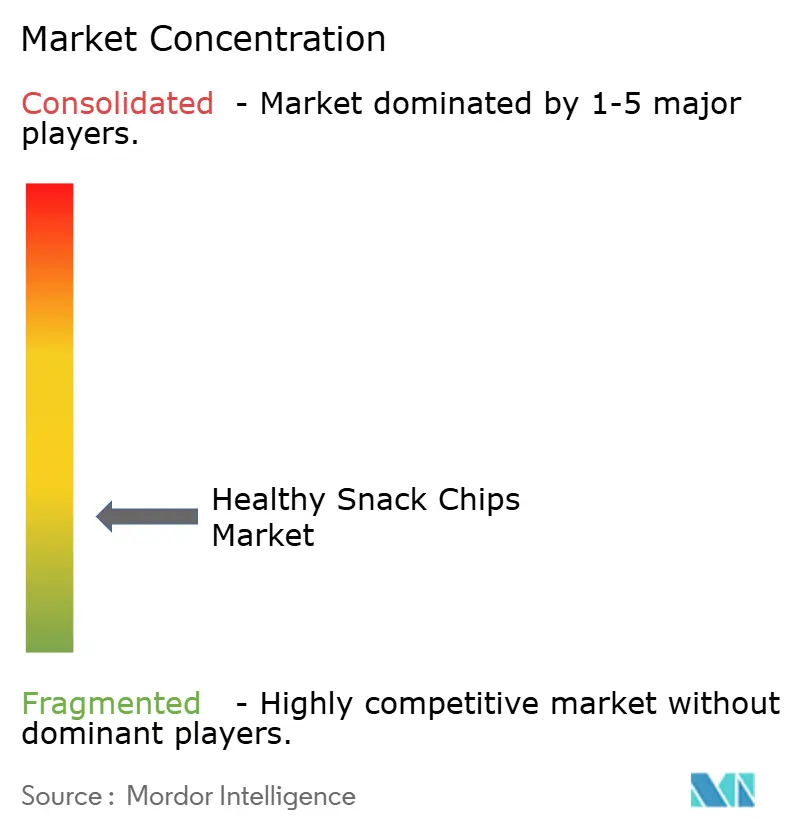
The healthy snack chips market is fragmented, with global packaged food companies, specialist brands, and smaller ingredient-focused businesses competing for shelf space. PepsiCo is expected to complete its acquisition of Siete Family Foods for USD 1.2 billion in January 2025, adding grain-free tortilla chips, potato chips, and puffs to its better-for-you snack portfolio. PepsiCo also leverages established brands to enter functional snack formats through Doritos Protein, PopCorners Protein, Quaker Protein Rice Crisps, SunChips Fiber, and Smartfood FiberPop. This strategy raises the competitive benchmark for taste, distribution, and clearly communicated nutritional benefits.
Hershey is expected to complete its acquisition of LesserEvil for USD 756 million in November 2025. The acquisition will add an organic snack platform that uses coconut and avocado oils to complement Hershey's SkinnyPop and Pirate's Booty brands. Intersnack Group is expected to acquire Utz Brands in July 2026 for an enterprise value of USD 2.9 billion, creating a significant presence in the United States and adding the Boulder Canyon natural chip brand to its portfolio. These developments indicate that the healthy snack chips market is attracting acquisitions that strengthen companies' clean-label and better-for-you snack positions.
Smaller brands compete through focused recipes, ingredient transparency, and specialized formats that are difficult to replicate across broad legacy portfolios. Popchips, Rhythm Superfoods, and Hunter Foods LLC use vegetable-, grain-, and clean-oil-based positioning to maintain a premium identity. Hunter Foods offers vegetable chips, quinoa chips, and mushroom chips within its alternative snack range. Convenience stores remain a channel with limited healthier snack options, creating opportunities for regional brands with clearly differentiated product lines and reliable sales performance. Companies that address taste and texture constraints while maintaining simple ingredient lists are likely to be better positioned as larger competitors expand their functional product ranges. In the healthy snack chips market, execution across formulation, packaging, distribution, and shelf communication is as important as the choice of base ingredient, as shoppers can readily switch when competing products appear similar.
Healthy Snack Chips Industry Leaders
-
PepsiCo, Inc.
-
Kellanova
-
The Hain Celestial Group, Inc.
-
Calbee, Inc.
-
Utz Brands, Inc.
- *Disclaimer: Major Players sorted in no particular order
Recent Industry Developments
- July 2026: Intersnack Group announced a definitive agreement to acquire Utz Brands, Inc. for approximately USD 2.9 billion (enterprise value) at USD 14.25 per share, a 91% premium over Utz's July 20, 2026 closing price. The transaction provides Intersnack with its first significant U.S. snack market presence, anchored by Utz's better-for-you Boulder Canyon chip brand. Upon closing, Utz will become private, with Intersnack and the Rice and Lissette Family Entities each holding a 50% stake.
- April 2026: PepsiCo's Quaker brand launched Protein Rice Crisps delivering 6g of protein and 9g of whole grains per serving, extending the brand's functional portfolio following survey data showing 86% of Americans actively add protein to their daily diet. The launch joins Doritos Protein, SunChips Fiber, PopCorners Protein, and Smartfood FiberPop as part of PepsiCo's coordinated functional snack platform expansion.
- March 2026: PepsiCo introduced Good Warrior, a new protein snack masterbrand launching with beef sticks in Original and Jalapeño Pepper flavors. The brand signals PepsiCo Foods' intent to compete across the full spectrum of protein-forward snack occasions, from chip-adjacent formats to premium meat snacks, within a single branded architecture.
- March 2026: PepsiCo launched SunChips Fiber, containing 6g of fiber per serving made with real black beans and whole grains, and Smartfood FiberPop, extending its functional nutrition portfolio to address the growing consumer demand for fiber-enriched snack formats.
Global Healthy Snack Chips Market Report Scope
The Healthy Snack Chips Market refers to the market for snack chips positioned as healthier alternatives to conventional fried snacks, including products made from vegetables, fruits, legumes, pulses, grains, seeds, and protein-rich ingredients, with formulations that may emphasize nutritional, natural, or functional attributes. By product type, the market is segmented into vegetable chips, fruit chips, legume and pulse chips, grain and seed chips, protein-enhanced chips, sweet potato chips, beef chips, and other product types. By ingredient source, the market is segmented into plant-based, animal-based, and hybrid blends. By flavor, the market is divided into flavored and unflavored products. By distribution channel, the market is segmented into supermarkets/hypermarkets, convenience stores, online retail stores, and other distribution channels. Geographically, the market covers North America, Europe, Asia-Pacific, South America, and the Middle East and Africa, with country-level coverage across major markets. Market forecasts are presented in terms of value (USD).
| Vegetable Chips |
| Fruit Chips |
| Legume and Pulse |
| Grain and Seed |
| Protein-Enhanced Chips |
| Sweet Potato Chips |
| Beef Chips |
| Other Product Types |
| Plant-Based |
| Animal-Based |
| Hybrid Blends |
| Flavored |
| Unflavored |
| Supermarkets/Hypermarkets |
| Convenience Stores |
| Online Retail Stores |
| Other Distribution Channels |
| North America | United States |
| Canada | |
| Mexico | |
| Rest of North America | |
| Europe | Germany |
| United Kingdom | |
| Italy | |
| France | |
| Spain | |
| Netherlands | |
| Poland | |
| Belgium | |
| Sweden | |
| Rest of Europe | |
| Asia-Pacific | China |
| India | |
| Japan | |
| Australia | |
| Indonesia | |
| South Korea | |
| Thailand | |
| Singapore | |
| Rest of Asia-Pacific | |
| South America | Brazil |
| Argentina | |
| Colombia | |
| Chile | |
| Peru | |
| Rest of South America | |
| Middle East and Africa | South Africa |
| Saudi Arabia | |
| United Arab Emirates | |
| Nigeria | |
| Egypt | |
| Morocco | |
| Turkey | |
| Rest of Middle East and Africa |
| By Product Type | Vegetable Chips | |
| Fruit Chips | ||
| Legume and Pulse | ||
| Grain and Seed | ||
| Protein-Enhanced Chips | ||
| Sweet Potato Chips | ||
| Beef Chips | ||
| Other Product Types | ||
| By Ingredient Source | Plant-Based | |
| Animal-Based | ||
| Hybrid Blends | ||
| By Flavor | Flavored | |
| Unflavored | ||
| By Distribution Channel | Supermarkets/Hypermarkets | |
| Convenience Stores | ||
| Online Retail Stores | ||
| Other Distribution Channels | ||
| By Geography | North America | United States |
| Canada | ||
| Mexico | ||
| Rest of North America | ||
| Europe | Germany | |
| United Kingdom | ||
| Italy | ||
| France | ||
| Spain | ||
| Netherlands | ||
| Poland | ||
| Belgium | ||
| Sweden | ||
| Rest of Europe | ||
| Asia-Pacific | China | |
| India | ||
| Japan | ||
| Australia | ||
| Indonesia | ||
| South Korea | ||
| Thailand | ||
| Singapore | ||
| Rest of Asia-Pacific | ||
| South America | Brazil | |
| Argentina | ||
| Colombia | ||
| Chile | ||
| Peru | ||
| Rest of South America | ||
| Middle East and Africa | South Africa | |
| Saudi Arabia | ||
| United Arab Emirates | ||
| Nigeria | ||
| Egypt | ||
| Morocco | ||
| Turkey | ||
| Rest of Middle East and Africa | ||
Key Questions Answered in the Report
What is the forecast growth rate for healthy snack chips through 2032?
The category is forecast to grow at a 5.8% CAGR from 2027 to 2032, reaching USD 27.20 billion by 2032. The healthy snack chips market is growing as convenient foods are expected to meet clearer nutrition, ingredient, flavor, and portion expectations across everyday eating occasions in homes, workplaces, and travel settings.
Which product category holds the leading position?
Vegetable chips lead product types with 28.3% share in 2026, supported by recognizable plant-based ingredients and clean-label appeal.
Which format is expected to grow the fastest?
Unflavored chips are forecast to grow at an 8.1% CAGR through 2032, the fastest rate among the listed flavor formats.
Which sales channel is growing fastest for healthy snack chips?
Online retail stores are forecast to expand at a 7.8% CAGR through 2032 because they can present detailed nutrition information and support repeat orders.