
Hard Surface Flooring Market Size and Share
Market Overview
| Study Period | 2021 - 2032 |
|---|---|
| Market Size (2027) | USD 211.30 Billion |
| Market Size (2032) | USD 249.15 Billion |
| Growth Rate (2026 - 2032) | 3.35 % |
| Fastest Growing Market | Asia-Pacific |
| Largest Market | Asia-Pacific |
| Market Concentration | Low |
Major Players *Disclaimer: Major Players sorted in no particular order Image © Mordor Intelligence. Reuse requires attribution under CC BY 4.0. | |
Hard Surface Flooring Market Analysis by Mordor Intelligence
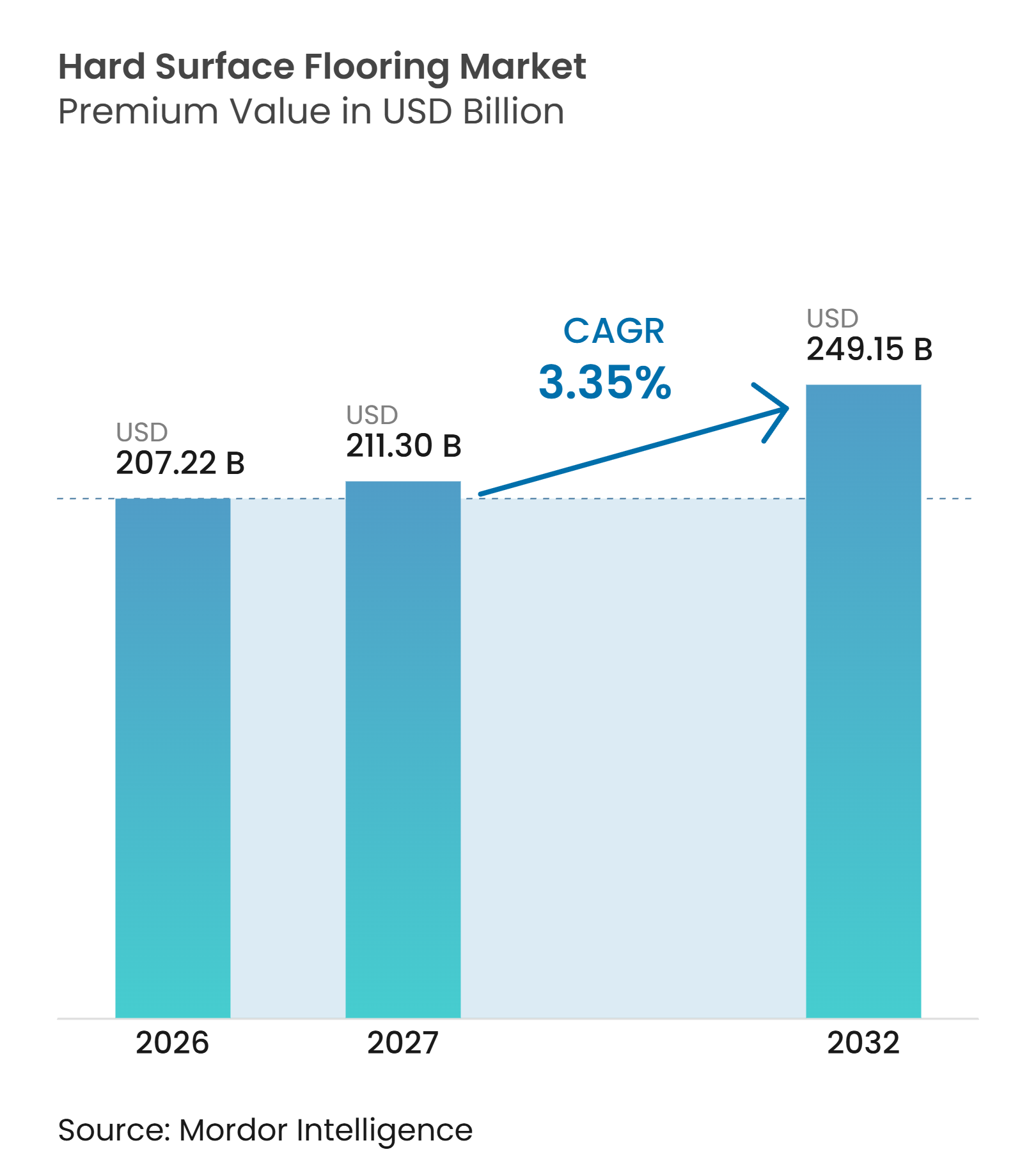
The hard surface flooring market size was valued at USD 207.22 billion in 2026 and is estimated to grow from USD 211.30 billion in 2027 to reach USD 249.15 billion by 2032, at a CAGR of 3.35% during the forecast period from 2027 to 2032. The hard surface flooring market is supported by replacement demand in aging homes and by renovation programs in commercial buildings. Buyers continue to favor surfaces that are easy to clean, durable, and suitable for high-traffic settings. Construction activity in Asia-Pacific supports volume demand, while refurbishment and product replacement support demand in mature economies. Manufacturers are balancing broader product portfolios with investments in local production, digital product selection, and material documentation. Competitive advantage increasingly depends on specification support, dependable supply, and products that meet indoor-air-quality and circularity requirements.
Key Report Takeaways
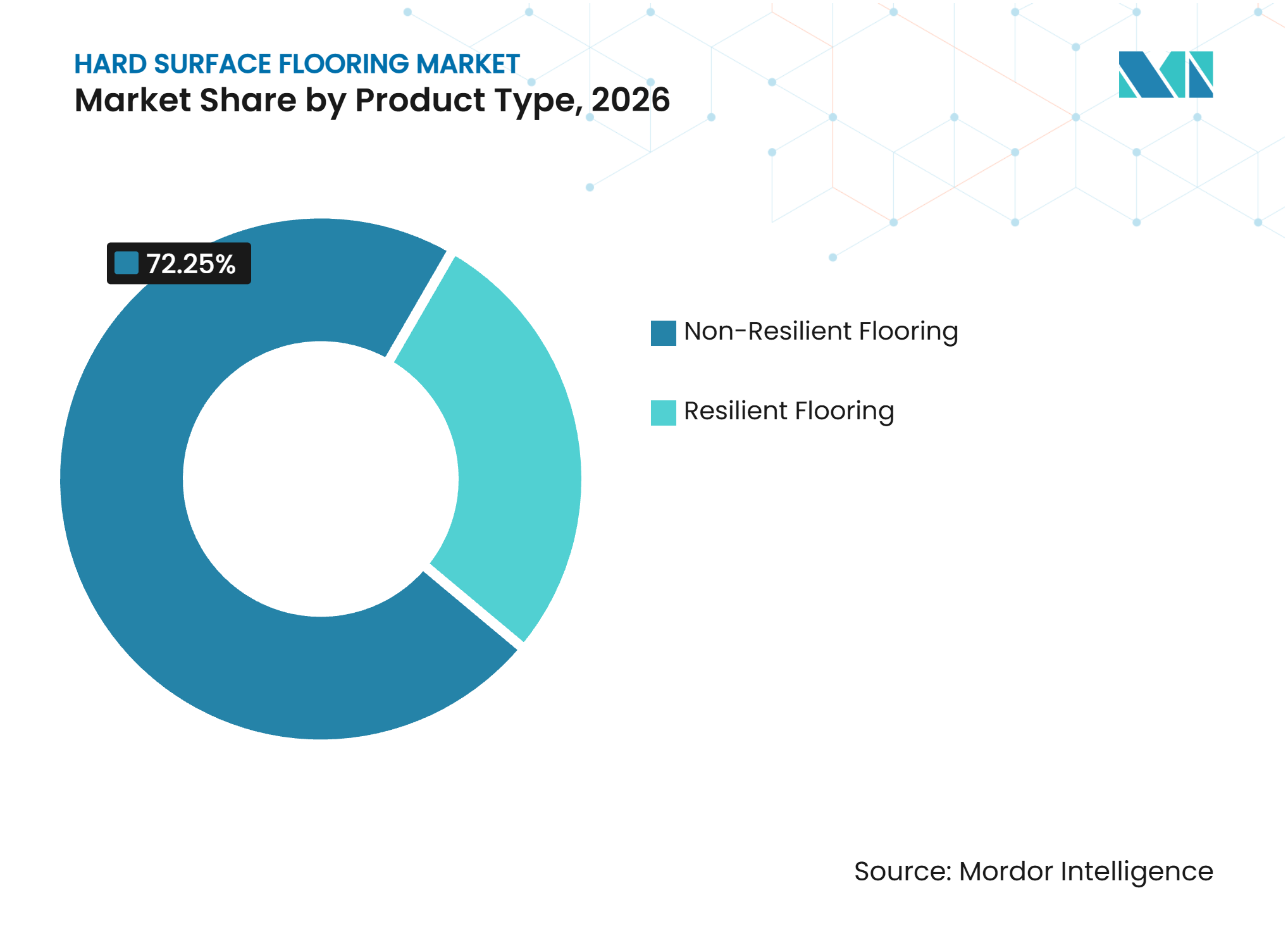
- By product type, non-resilient flooring held 72.25% of the hard surface flooring market share in 2026, while resilient flooring is projected to grow at the fastest CAGR of 4.52% between 2027 and 2032.
- By end-user, residential accounted for 68.84% of the hard surface flooring market share in 2026, while commercial is projected to grow at the fastest CAGR of 3.55% between 2027 and 2032.
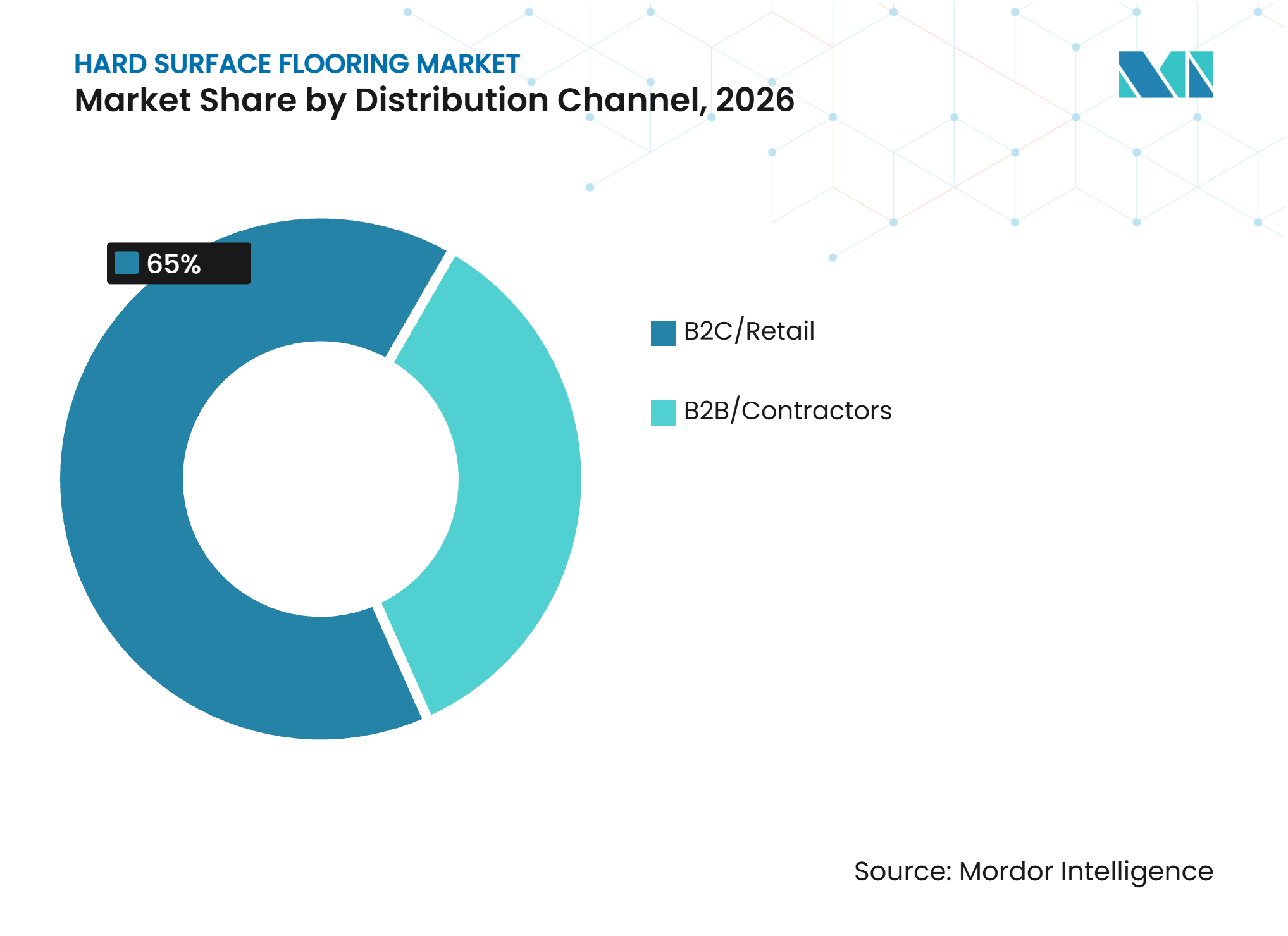
- By distribution channel, B2C/Retail held 65.00% of the hard surface flooring market share in 2026 and is projected to grow at the fastest CAGR of 4.28% between 2027 and 2032.
- By geography, Asia-Pacific held 40.61% of the hard surface flooring market share in 2026 and is projected to grow at the fastest CAGR of 3.84% between 2027 and 2032.
Note: Market numbers in this report are based on Mordor Intelligence's proprietary estimation framework, which combines nine months of actuals with Q4 projections for base year 2026.
Market Trends and Insights
Drivers Impact Analysis of Hard Surface Flooring Market*
| Driver | (~) % Impact on CAGR Forecast | Geographic Relevance | Impact Timeline |
|---|---|---|---|
| Residential Renovation and Replacement Activity | +0.8% | Global, with greater relevance in North America and Western Europe | Medium term (2-4 years) |
| Commercial and Institutional Modernization | +0.7% | Global, led by Asia-Pacific and North America | Medium term (2-4 years) |
| Commercial Infrastructure Expansion and Flooring Upgrades | +0.5% | Asia-Pacific core, with spillover to the Middle East and Africa | Long term (≥ 4 years) |
| Demand for Waterproof, Low-Maintenance Surfaces | +0.5% | Global | Short term (≤ 2 years) |
| Regionalization of Resilient Flooring Production | +0.3% | North America and Europe | Medium term (2-4 years) |
| Digital Visualization and Faster Selection-to-Installation Cycles | +0.2% | North America and Europe | Short term (≤ 2 years) |
| Source: Mordor Intelligence | |||
Residential Renovation and Replacement Activity
The hard surface flooring market benefits from replacement projects when households defer moving and invest in existing homes. Renovation activity favors hard surfaces because kitchens, bathrooms, and entryways require materials that tolerate moisture and frequent cleaning. Premium purchases are often linked to design preferences and longer expected product life. This supports demand for ceramic, porcelain, engineered wood, LVT, and rigid-core formats across different price points. The pattern is especially relevant in mature housing markets, where the existing building stock is a large source of recurring demand. Producers with wide design ranges and reliable retail availability are better placed to capture these smaller and more frequent projects.
Commercial and Institutional Modernization
The hard surface flooring market gains from healthcare, education, and office renovation programs that require durable and hygienic surfaces. Interface reported 21% growth in healthcare billings and 8% growth in education billings during fiscal 2025, showing the continued relevance of these settings to commercial flooring demand[1]. Healthcare facilities commonly require resilient and rubber surfaces that support cleaning protocols, underfoot comfort, and frequent traffic. Schools also require durable floors that can withstand equipment movement and daily use. Public procurement increasingly asks suppliers for environmental documentation and product-health information. These requirements favor suppliers that can provide tested products, specification assistance, and reliable installation support.
Demand for Waterproof, Low-Maintenance Surfaces
The hard surface flooring market continues to benefit from demand for products that combine moisture resistance with easier upkeep. LVT and rigid-core products are used in areas where consumers previously selected laminate or wood but now need better water protection. Commercial purchasers also consider acoustics, indoor air quality, and maintenance requirements during specification. Tarkett presents its commercial LVT portfolio around healthy materials, acoustic comfort, and indoor air quality, reflecting the broader criteria used in institutional selection. FloorScore and EN 14041 provide recognized reference points for product emissions and performance documentation. These factors support suppliers that maintain clear test records and can explain material performance to contractors and designers.
Digital Visualization and Faster Selection-to-Installation Cycles
The hard surface flooring market is increasingly influenced by digital tools that help buyers compare products before visiting a store or placing an order. Research on augmented reality in interior design found that these tools can improve spatial decision-making and reduce redesign costs. Tarkett offers an online room planner that allows users to preview flooring designs in a room image[2]. Such tools can make product choice easier when color, texture, and room scale affect the purchase decision. In May 2025, Lowe's expanded its online marketplace through a partnership with Mirakl, widening the assortment available to DIY and professional customers[3]. Manufacturers that maintain accurate imagery, installation guidance, and accessible product data can improve conversion and reduce selection errors.
Restraints Impact Analysis of Hard Surface Flooring Market*
| Restraint | (~) % Impact on CAGR Forecast | Geographic Relevance | Impact Timeline |
|---|---|---|---|
| Volatility in PVC, Resin, Wood, Ceramic, and Freight Costs | -1.1% | Global, particularly Asia-Pacific production hubs and North America | Medium term (2-4 years) |
| Housing Affordability and Interest-Rate Pressure | -0.9% | North America and Western Europe primarily | Medium term (2-4 years) |
| Shortage of Certified Flooring Installers | -0.5% | North America and the United Kingdom | Medium term (2-4 years) |
| Limited Recycling Routes for Multilayer Flooring | -0.3% | Europe and North America | Long term (≥ 4 years) |
| Source: Mordor Intelligence | |||
Volatility in PVC, Resin, Wood, Ceramic, and Freight Costs
The hard surface flooring market is exposed to changing costs for resin, energy, wood, ceramics, and freight. These inputs affect resilient flooring, laminate, wood products, and tile through different supply chains. PVC-based products are particularly sensitive to petrochemical costs because resin is a major material input. Changes in trade routes can add logistical complexity and make purchasing decisions less predictable. Companies with regional manufacturing, stable supplier relationships, or internal material capabilities can respond more effectively to cost movements. Smaller assemblers may face more pressure when costs rise before selling prices can be adjusted.
Housing Affordability and Interest-Rate Pressure
The hard surface flooring market faces slower demand when high borrowing costs reduce new-home purchases and larger remodeling projects. The Tile Council of North America reported that United States ceramic tile consumption fell to an estimated 2.67 billion square feet in 2025, the lowest level since 2014. EPLF members reported a 6.50% decline in laminate flooring sales during 2025, with significant weakness in Germany and Great Britain[4]. Tight household budgets can move demand from premium products toward entry-level rigid-core flooring or laminate. This can reduce average selling prices even where installed area is relatively stable. Firms that preserve product availability and a balanced price range may be positioned to benefit once housing activity improves.
*Our forecasts treat driver/restraint impacts as directional, not additive. The impact forecasts reflect baseline growth, mix effects, and variable interactions.
Hard Surface Flooring Market Segment Analysis
By Product Type:
Non-Resilient Scale and Resilient Structural MomentumNon-resilient flooring held 72.25% of the hard surface flooring market share in 2026. Ceramic and porcelain products remain widely used in bathrooms, kitchens, hospitality settings, and institutional buildings. Their installed base is supported by long service life, visual variety, and strong performance in wet areas. Large-format porcelain slabs are expanding design choices for floors, walls, counters, and facades. RAK Ceramics stated that its Continua+ PCR 2180 technology can produce slabs measuring up to 162 by 324 centimeters. Ceramic World Web reported that global ceramic tile production declined to 14,401 million square feet in 2025 from 14,993 million square feet in 2024. The decline reflected weaker demand in China, although production capacity in Vietnam and Indonesia offered some offset. Wood, laminate, and stone remain relevant where design authenticity, dimensional stability, or premium visual appeal shapes purchase decisions.
Resilient flooring is forecast to expand at a 4.52% CAGR from 2027 to 2032, making it the fastest-growing product group. This part of the hard surface flooring industry is supported by demand for water resistance, simple maintenance, and fast installation. The MMFA reported that SPC sales by its members rose 26.64% in 2025 to 85.7 million square feet. SPC represented 83.00% of members' polymer flooring sales in 2025, compared with 31.00% in 2019. WPC, rubber, linoleum, cork, and vinyl sheet serve different needs in homes, healthcare facilities, schools, and green-building projects. Documented indoor-air-quality performance is important in commercial specifications. This creates opportunities for producers that can combine practical product performance with clear environmental and health information.


By End-User:
Residential Scale and Commercial PrecisionResidential end-users accounted for 68.84% of the hard surface flooring market share in 2026. Homeowners use hard surfaces in renovation projects because the products can improve room appearance while meeting practical needs for durability and maintenance. Demand differs by price tier, with premium buyers often focused on finish quality and longer product life. Households with tighter budgets may postpone purchases or select lower-priced alternatives. Cork and linoleum remain smaller residential niches for buyers seeking biobased or low-VOC materials. Builder channel activity depends more directly on new housing construction and varies by local affordability conditions. The segment continues to provide the volume base for retail sales and for a large share of product discovery through home centers and specialty stores.
Commercial flooring is projected to grow at a 3.55% CAGR from 2027 to 2032. Commercial buyers require surfaces that meet specifications for wear layers, backing systems, acoustics, and low-VOC performance. Interface's 2025 results showed faster billings growth in healthcare and education than in other commercial settings. These sectors can provide steadier purchasing than discretionary office renovation. Hospitality supports demand through hotel renovations and new leisure projects, while retail investment remains linked to store experience. Corporate office demand remains variable as hybrid work patterns influence space usage. Environmental Product Declarations are becoming more relevant in government and institutional purchasing. The hard surface flooring market therefore benefits from suppliers that can meet technical requirements and support designers through specification decisions.
By Distribution Channel:
B2C/Retail Scale and Digital-Driven GrowthB2C/Retail held 65.00% of the hard surface flooring market share in 2026 and is forecast to expand at a 4.28% CAGR through 2032. The channel includes home centers, specialty flooring stores, online sellers, and retailer-supported contractor sales. It remains central to residential demand because consumers use these outlets to compare designs, materials, and installation options. Digital search often precedes a store visit, particularly for products where color and texture matter. HIRI documented the growing role of online research in home-improvement product shopping. Home centers and specialty stores remain important because customers may need samples, installation referrals, and immediate product advice. Online tools are extending the reach of these retailers while increasing price visibility and competition.
B2B/Contractors represented the remaining 35.00% of 2026 sales. This channel is served through distributors, wholesalers, direct manufacturer relationships, and specialist installers. Its value lies in project knowledge, material availability, and the ability to coordinate delivery with installation schedules. In April 2025, Lowe's acquired Artisan Design Group, gaining a provider of flooring design, distribution, and installation services for homebuilders. The transaction expanded Lowe's professional offering and added a network of specialized installers. Manufacturer-direct tools and digital takeoff systems are also changing procurement behavior among contractors. Independent distributors need strong technical service and local relationships to remain differentiated. The hard surface flooring market will continue to reward channels that reduce delays between product choice, delivery, and installation.

Geography Analysis
Asia-Pacific
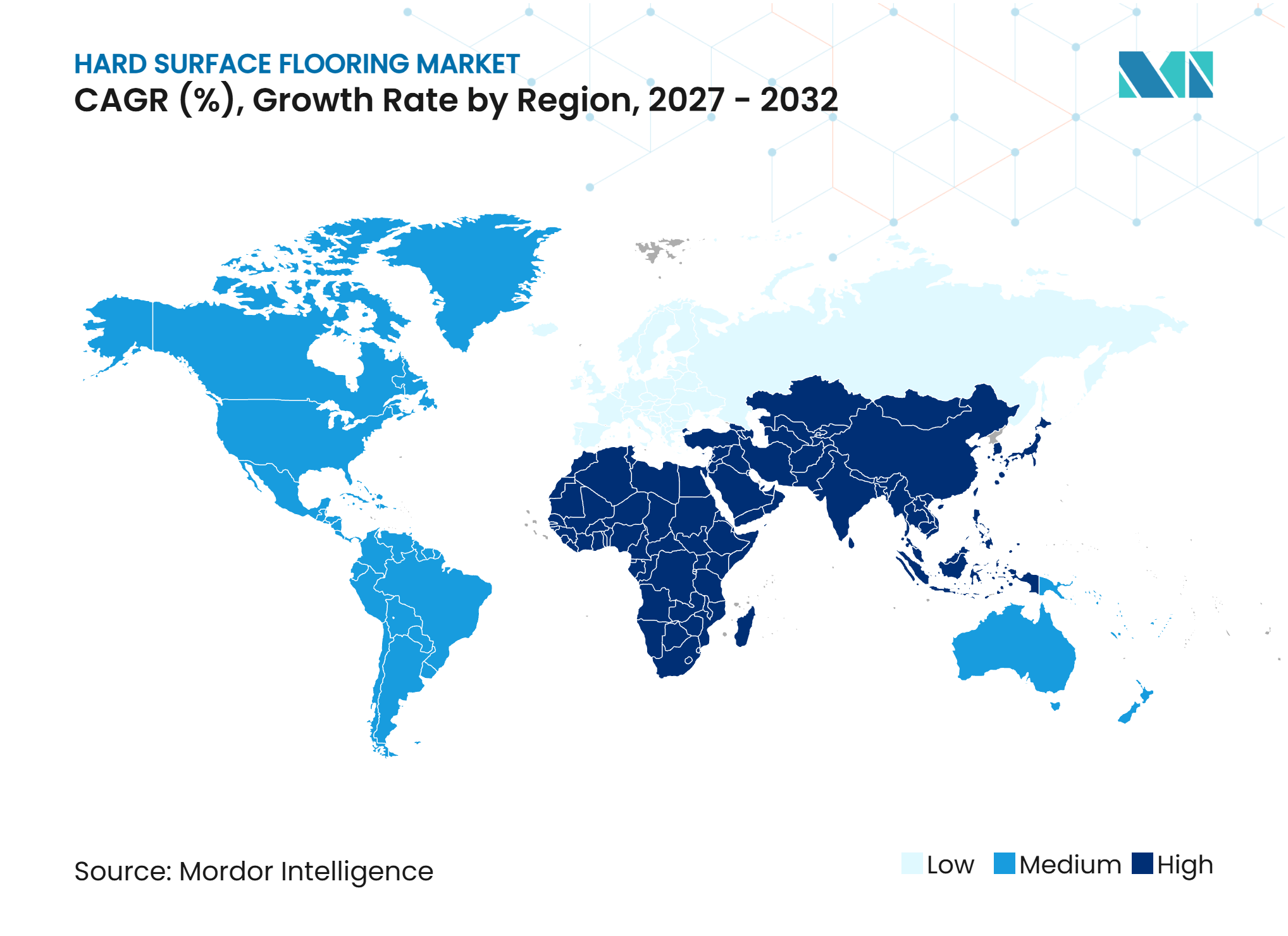
Asia-Pacific accounted for 40.61% of the hard surface flooring market share in 2026 and is expected to grow at a 3.84% CAGR through 2032. Construction activity, urbanization, and infrastructure development support regional flooring demand. China remains a major ceramic tile producer, although domestic conditions affected output in 2025. Ceramic World Web reported that Chinese tile production declined by more than 1 billion square meters during that year. Vietnam and Indonesia are increasing their production role as supply chains diversify. Kajaria Ceramics reported a 62.32% increase in FY2026 net profit and approved capacity expansion at its Srikalahasti facility. Japan and Australia offer demand for higher-specification products tied to refurbishment, acoustic comfort, and ESG-led building upgrades. Regional suppliers are also gaining export importance in resilient flooring, which changes sourcing choices for North American buyers.
North America
North America combines a mature replacement market with demand from healthcare, education, and residential renovation. The region's housing affordability constraints limited some residential activity in 2025. TCNA recorded 4.60% year-on-year growth in United States ceramic tile consumption in the first quarter of 2025, ending several quarters of decline. Healthcare facilities support commercial demand because they require hygienic and durable materials. Import sourcing is changing as Vietnam and Thailand take a larger role in LVT supply. Lowe's acquisition of ADG is an example of distribution consolidation around professional interior finishes. Canada and Mexico add renovation and construction demand, with Mexico also supported by domestic tile producers. Product documentation, low-emission requirements, and contractor access remain important competitive factors in the region.
Europe, South America, and the Middle East and Africa
Europe showed uneven product performance in 2025, while South America and the Middle East and Africa offered different construction-led opportunities. MMFA members reported polymer flooring growth in France, Germany, and Poland during 2025. At the same time, EPLF recorded a 6.50% decline in member laminate sales. The EU Energy Performance of Buildings Directive supports renovation activity and reinforces attention to materials that meet emissions and performance requirements. Brazil remains an important tile market, and Unilin opened a laminate flooring factory in Piên in January 2026. Saudi Arabia and the United Arab Emirates (UAE) support ceramic and porcelain demand through large construction programs. RAK Ceramics reported 8.40% growth in its tiles segment in the third quarter of 2026. Africa remains smaller in scale but is supported by urban development and incremental commercial construction.
Competitive Landscape
Market Concentration
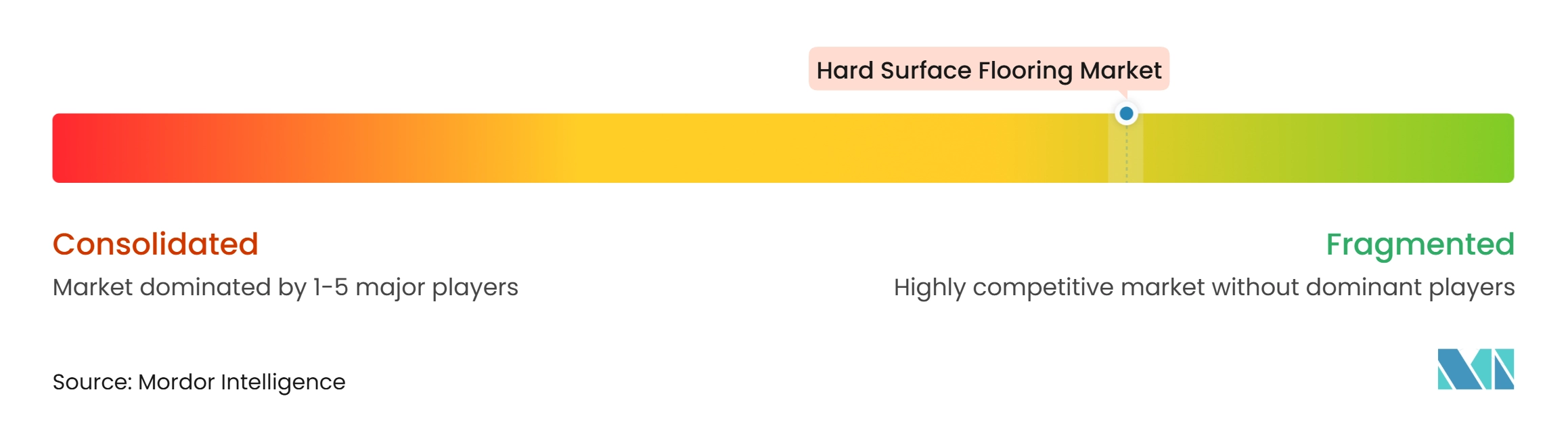
The hard surface flooring market is moderately fragmented, with large global manufacturers competing alongside regional tile and resilient-flooring specialists. Mohawk Industries reported USD 10.8 billion in net sales for fiscal 2025 across its global ceramic, flooring North America, and flooring rest of world segments. Its scale gives it broad exposure across product categories and geographies. Regional ceramic companies such as RAK Ceramics, Kajaria Ceramics, Somany Ceramics, Pamesa Cerámica, Atlas Concorde, and Porcelanosa remain important in their home markets and export niches. Tarkett, Forbo, Gerflor, Beaulieu International Group, Mannington Mills, NOX, and Polyflor compete strongly in resilient flooring. Product performance, sustainability documentation, design capability, and local distribution are central sources of competition. Cost pressure is particularly acute in SPC and LVT, where Asian production has cost advantages and local manufacturers need strong service or differentiated products.
Mohawk uses its Unilin business and click-lock installation technology to support a wider competitive position in laminate and LVT. Shaw Industries stated that nearly 90.00% of its product portfolio was Cradle to Cradle Certified in its 2025 sustainability report. This supports its position in projects that assess material health and green-building credits. Tarkett operates its ReStart take-back program in 29 countries and reported collections of more than 124,000 tons of flooring since the program began. Interface is expanding its position in healthcare and education as part of its One Interface strategy. These moves show that companies are using circularity, specification support, and commercial diversification rather than product price alone. The hard surface flooring industry is also seeing closer links between material suppliers, distributors, and installation networks.
Lower-carbon products and circular systems are becoming more important in public and institutional procurement. Forbo introduced Sphera Elite b+, a bio-attributed homogeneous vinyl product that it states has a carbon footprint more than 50.00% lower than standard homogeneous vinyl. The EU-funded CISUFLO project has demonstrated routes for using recycled wood fibers in HDF for laminate flooring. Recofloor has diverted more than 8,200 tonnes of vinyl flooring from landfill through its take-back scheme. Academic research has also found that circular wood-parquet models can reduce environmental impacts while meeting comparable profit targets. Vietnamese and Thai producers are also increasing competitive pressure through resilient-flooring capacity, design improvements, and export reach. The competitive environment will favor firms that combine verifiable environmental performance with reliable product availability.
Hard Surface Flooring Industry Leaders
-
Mohawk Industries, Inc.
-
Tarkett S.A.
-
Shaw Industries Group, Inc.
-
Grupo Lamosa, S.A.B. de C.V.
-
Victoria PLC
- *Disclaimer: Major Players sorted in no particular order
Hard Surface Flooring Market Companies Covered in this Report
- Mohawk Industries, Inc.
- Tarkett S.A.
- Shaw Industries Group, Inc.
- Grupo Lamosa, S.A.B. de C.V.
- Victoria PLC
- Forbo Holding AG
- Gerflor Group
- Beaulieu International Group
- Interface, Inc.
- RAK Ceramics P.J.S.C.
- Kajaria Ceramics Limited
- Somany Ceramics Limited
- SCG Ceramics Public Company Limited
- Pamesa Cerámica, S.L.
- Porcelanosa Grupo
- Atlas Concorde S.p.A.
- Mannington Mills, Inc.
- AHF Products
- NOX Corporation
- Polyflor Ltd.
Recent Industry Developments in Hard Surface Flooring Market
- September 2026: RAK Ceramics presented at Cersaie 2026 under the One Step Ahead theme. The company announced a multi-year partnership with Maison Roberto Cavalli for a new Surfaces & Wellness collection and continued development of the Elie Saab Surfaces & Wellness line. The initiatives expanded the company's portfolio across flooring and bathroom categories.
- August 2026: Tarkett launched the Paired Path luxury vinyl tile collection. The collection includes two commercial platforms: Align 2.5 and Transition 4.5. Both platforms feature 0.508 mm wear layers and a Techtonic protective coating for commercial applications with aesthetic performance and budget requirements.
- February 2026: Interface Inc. launched noravant. The PVC-free resilient rubber flooring solution features a woodgrain design in rubber. The product expanded the noravant rubber flooring portfolio with design flexibility and a low carbon footprint.
- January 2026: Unilin, a subsidiary of Mohawk Industries, opened a laminate flooring factory in Piên, Brazil. The facility involved an investment of USD 12.64 million (BRL 70 million) and has an annual production capacity of 10 million m². The factory serves as a dedicated manufacturing hub for the Latin American market.
Global Hard Surface Flooring Market Report Scope
Hard surface flooring encompasses a variety of durable and easy-to-maintain flooring options designed to withstand heavy foot traffic and provide long-lasting functional and aesthetic value. The hard surface flooring market is segmented by product type, end-user, distribution channel, and geography. By product type, the market is segmented into resilient flooring (vinyl flooring, rubber flooring, linoleum flooring, cork flooring, and other resilient flooring) and non-resilient flooring (ceramic and porcelain tiles, wood flooring, laminate flooring, stone flooring, and other non-resilient flooring). By end-user, the market is segmented into residential and commercial (healthcare facilities, education buildings, retail and shopping centers, hospitality and leisure, corporate offices, public and government buildings, and other commercial users). By distribution channel, the market is segmented into B2B/contractors and B2C/retail (home centers, specialty flooring stores, online, and other distribution channels). By geography, the market is segmented into North America, South America, Europe, Asia-Pacific, and the Middle East and Africa. The report offers the market size in value terms in USD for all the above-mentioned segments.
Segmentation Overview
| Resilient Flooring | Vinyl Flooring |
| Rubber Flooring | |
| Linoleum Flooring | |
| Cork Flooring | |
| Other Resilient Flooring | |
| Non-Resilient Flooring | Ceramic and Porcelain Tiles |
| Wood Flooring | |
| Laminate Flooring | |
| Stone Flooring | |
| Other Non-Resilient Flooring |
| Residential | |
| Commercial | Healthcare Facilities |
| Education Buildings | |
| Retail & Shopping Centers | |
| Hospitality & Leisure | |
| Corporate Offices | |
| Public & Government Buildings | |
| Other Commercial Users |
| B2B/Contractors | |
| B2C/Retail | Home Centers |
| Specialty Flooring Stores | |
| Online | |
| Other Distribution Channels |
| North America | Canada |
| United States | |
| Mexico | |
| South America | Brazil |
| Peru | |
| Chile | |
| Argentina | |
| Rest of South America | |
| Europe | United Kingdom |
| Germany | |
| France | |
| Spain | |
| Italy | |
| BENELUX (Belgium, Netherlands, Luxembourg) | |
| NORDICS (Denmark, Finland, Iceland, Norway, Sweden) | |
| Rest of Europe | |
| Asia-Pacific | India |
| China | |
| Japan | |
| Australia | |
| South Korea | |
| South-East Asia | |
| Rest of Asia-Pacific | |
| Middle East & Africa | United Arab Emirates |
| Saudi Arabia | |
| South Africa | |
| Nigeria | |
| Rest of Middle East & Africa |
| By Product Type | Resilient Flooring | Vinyl Flooring |
| Rubber Flooring | ||
| Linoleum Flooring | ||
| Cork Flooring | ||
| Other Resilient Flooring | ||
| Non-Resilient Flooring | Ceramic and Porcelain Tiles | |
| Wood Flooring | ||
| Laminate Flooring | ||
| Stone Flooring | ||
| Other Non-Resilient Flooring | ||
| By End-User | Residential | |
| Commercial | Healthcare Facilities | |
| Education Buildings | ||
| Retail & Shopping Centers | ||
| Hospitality & Leisure | ||
| Corporate Offices | ||
| Public & Government Buildings | ||
| Other Commercial Users | ||
| By Distribution Channel | B2B/Contractors | |
| B2C/Retail | Home Centers | |
| Specialty Flooring Stores | ||
| Online | ||
| Other Distribution Channels | ||
| By Geography | North America | Canada |
| United States | ||
| Mexico | ||
| South America | Brazil | |
| Peru | ||
| Chile | ||
| Argentina | ||
| Rest of South America | ||
| Europe | United Kingdom | |
| Germany | ||
| France | ||
| Spain | ||
| Italy | ||
| BENELUX (Belgium, Netherlands, Luxembourg) | ||
| NORDICS (Denmark, Finland, Iceland, Norway, Sweden) | ||
| Rest of Europe | ||
| Asia-Pacific | India | |
| China | ||
| Japan | ||
| Australia | ||
| South Korea | ||
| South-East Asia | ||
| Rest of Asia-Pacific | ||
| Middle East & Africa | United Arab Emirates | |
| Saudi Arabia | ||
| South Africa | ||
| Nigeria | ||
| Rest of Middle East & Africa | ||
Key Questions Answered in the Report
What is the projected size of the hard surface flooring market by 2032?
The hard surface flooring market is projected to reach USD 249.15 billion by 2032, growing at a 3.35% CAGR from 2027 to 2032.
Which product type is growing fastest in hard surface flooring?
Resilient flooring is projected to grow at a 4.52% CAGR between 2027 and 2032, supported by demand for waterproof and low-maintenance surfaces.
Which end-user segment has the largest share?
Residential end-users accounted for 68.84% of 2026 sales, while commercial applications are projected to grow faster at a 3.55% CAGR.
Why are LVT and SPC gaining adoption?
LVT and SPC provide water resistance, durable wear performance, and easier installation. MMFA members reported 26.64% SPC sales growth in 2025.
Which region leads demand for hard surface flooring?
Asia-Pacific held 40.61% of 2026 sales and is expected to record the fastest regional CAGR of 3.84% through 2032.
What are the main constraints on demand?
Material-cost volatility and housing affordability pressures can delay purchases, particularly in residential construction and major remodeling projects.