
Guatemala Residential Real Estate Market Size and Share
Market Overview
| Study Period | 2021 - 2032 |
|---|---|
| Forecast Data Period | 2027 - 2032 |
| Base Year Market Size (2026) | USD 5.99 Billion |
| Market Size (2027) | USD 6.35 Billion |
| Market Size (2032) | USD 8.5 Billion |
| Growth Rate (2027 - 2032) | 6.01 % |
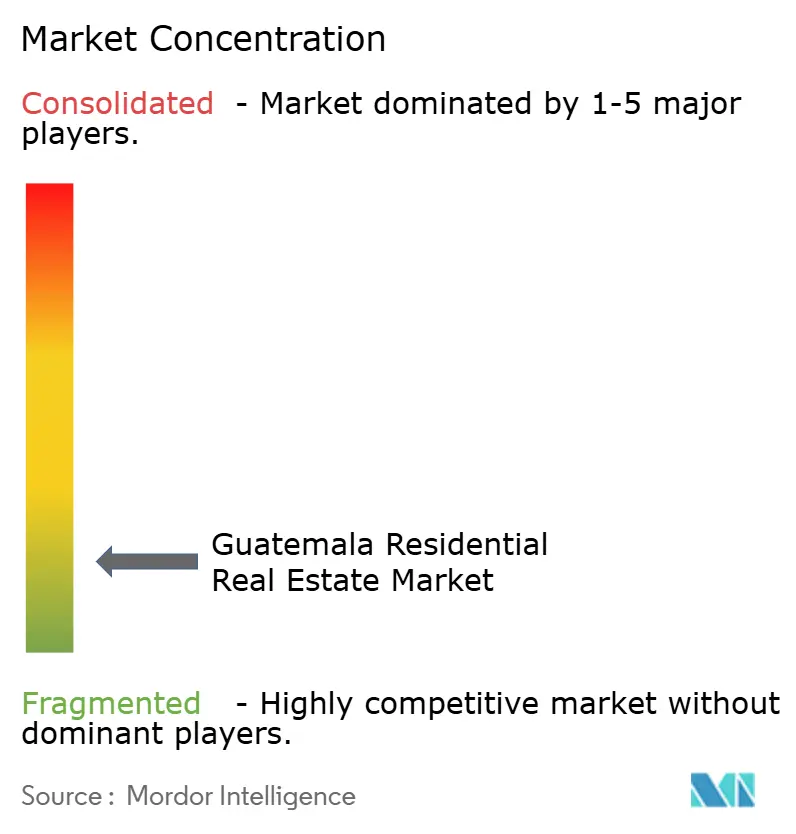
| Market Concentration | Low |
Major Players *Disclaimer: Major Players sorted in no particular order Image © Mordor Intelligence. Reuse requires attribution under CC BY 4.0. | |
Guatemala Residential Real Estate Market Analysis by Mordor Intelligence
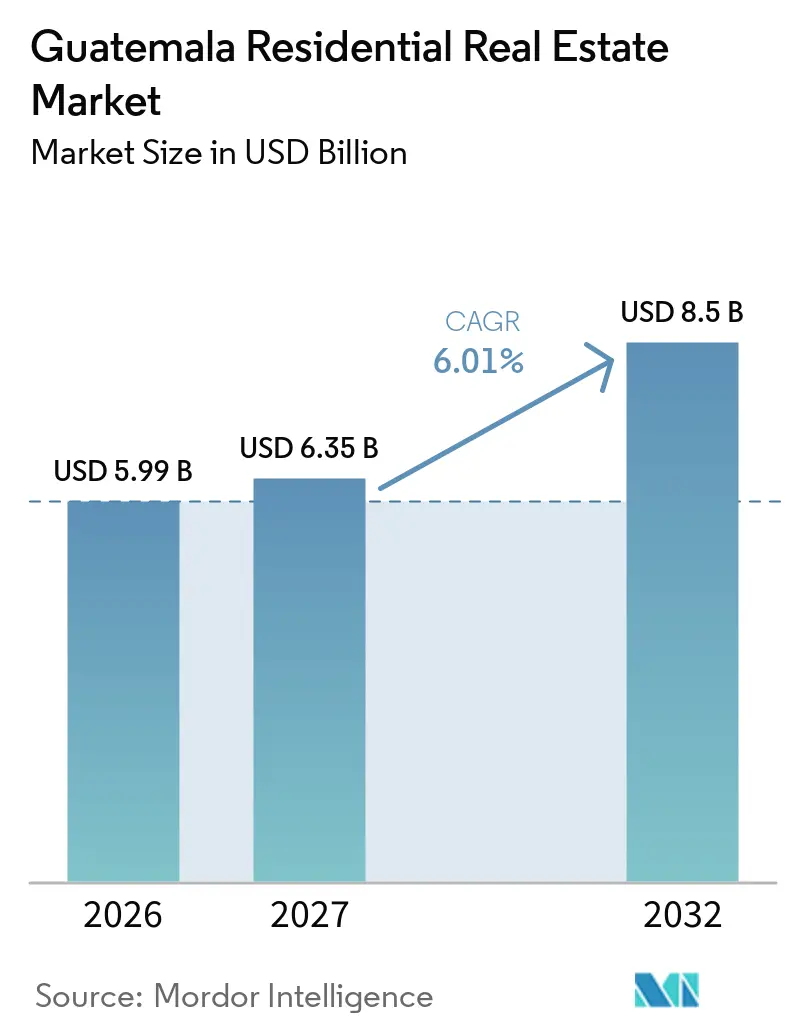
The Guatemala Residential Real Estate Market size is projected to be USD 5.99 billion in 2026, USD 6.35 billion in 2027, and reach USD 8.5 billion by 2032, growing at a CAGR of 6.01% from 2027 to 2032.
Demand is being supported by a housing deficit, urban population growth, and remittance-funded home construction, while formal supply remains limited in many cities. The Guatemala residential real estate market is also being shaped by public programs that link lower-income households to insured mortgages and approved projects. Developers are responding with smaller apartments, shared amenities, and projects in suburban and secondary-city locations where land is more accessible. The main opportunity lies in matching FHA-approved supply with households that receive remittances or have stable formal employment. Affordability, utility connections, land records, and rising urban land costs remain important limits on project delivery.
Key Report Takeaways
- By property type in sales, apartments and condominiums held 59.1% of the Guatemala residential real estate market share in 2026, while the same segment is projected to grow at a 6.88% CAGR through 2032.
- By price band in sales, affordable homes held 55.3% of residential sales in 2026 and are forecast to expand at a 6.75% CAGR through 2032.
- By mode of sale in sales, primary transactions accounted for 60.1% of the Guatemala residential real estate market in 2026 and are forecast to grow at a 6.69% CAGR through 2032.
- By key region in sales, Guatemala City held 47.2% of the Guatemala residential real estate market in 2026, while Escuintla is forecast to expand at a 7.04% CAGR through 2032.
- By property type in rentals, apartments and condominiums held 82.6% of the Guatemala residential real estate market in 2026, while villas and landed houses are forecast to grow at a 6.80% CAGR through 2032.
Note: Market numbers in this report are based on Mordor Intelligence's proprietary estimation framework, which combines nine months of actuals with Q4 projections for base year 2026.
Market Trends and Insights
Drivers Impact Analysis of Guatemala Residential Real Estate Market*
| Drivers | (~) % Impact on CAGR Forecast | Geographic Relevance | Impact Timeline |
|---|---|---|---|
| Remittance-Funded Formal Housing Purchases | +1.5% | National, with concentration in Alta Verapaz, San Marcos, and Guatemala City | Short term (≤ 2 years) |
| Government-Backed Affordable Housing Programs | +1.2% | National, with early delivery in Suchitepéquez, Jutiapa, Alta Verapaz, and Quetzaltenango | Medium term (2-4 years) |
| Demand for Secure Amenity-Rich Communities | +1% | Guatemala City, Mixco, Villa Nueva, and Escuintla | Medium term (2-4 years) |
| Secondary-City Employment Growth | +0.8% | Quetzaltenango, Escuintla, Mixco, and Villa Nueva | Medium term (2-4 years) |
| Higher Urban Density Supporting High-Rise Apartments | +0.7% | Guatemala City, San Cristóbal, and suburban corridors | Long term (≥ 4 years) |
| Improved Mortgage Access for First-Time Buyers | +0.6% | National, with early gains in Guatemala City, Mixco, and Escuintla | Short term (≤ 2 years) |
| Source: Mordor Intelligence | |||
Sustained Remittance Inflows Supporting Formal Housing Purchases
Guatemala received USD 25.5 billion in remittances during 2025, up 18.7.04% from USD 21.5 billion in 2024[1]. The Inter-American Development Bank reported that 80% of the country’s remittance inflows reached households that were not poor but were vulnerable to poverty without those transfers[2]. This group can support demand for affordable apartments when project prices, monthly payments, and mortgage requirements are aligned with household income and the predictable timing of remittance receipts. Developers in the Guatemala residential real estate market can use FHA certification to make this demand more visible to lenders that rely on formal payroll records, particularly when borrowers have income sources that do not fit conventional credit assessments. Remittances also support housing construction and maintenance in locations that have limited access to formal financing.
Government-Backed Affordable Housing Programs Supporting Formal Development
The Mi Primera Casa program has committed USD 523.7 million across 3 years to support at least 10,000 families through soft loans, based on the exchange rate implied by Banco de Guatemala’s 2025 remittance figures[3]. In 2025, the program expanded its eligible income ceiling and had 50 FHA-certified developments in its catalog. The Crédito Hipotecario Nacional, or CHN, projected 1,500 authorized credits by the end of 2025. The Fondo para la Vivienda, or FOPAVI, delivered 2,482 housing subsidies across 10 departments in 2025. These programs give Guatemala's residential real estate market a clearer path for lower-income buyers to enter formal housing. The FHA can also reduce the required down payment to 5%, which helps lenders extend credit to qualifying households.
Secure, Amenity-Rich Communities and Urban Density Supporting Apartment Demand
Guatemala City developers are adapting to land scarcity by delivering smaller units with shared facilities such as pools, workspaces, gyms, and green areas. The Guatemalan Construction Chamber reported that average apartment size declined from 147 square meters to 94 square meters as developers shifted more value into common amenities. This approach is particularly relevant to younger buyers who want access to employment centers but cannot purchase larger homes in established districts. The Guatemala residential real estate market is therefore concentrating new projects in corridors where transit, services, and security are already available. Higher density can also improve the economics of building on constrained sites. Over time, this product model may influence buyer expectations in secondary cities as well as the capital.
Employment Growth in Secondary Cities Supporting Broader Residential Demand
Escuintla benefits from industrial and logistics activity related to the Pacific corridor and Puerto Quetzal. Its 7.04% forecast CAGR indicates that housing demand is expanding beyond the capital’s established residential areas. Quetzaltenango also has a broad base of education, health care, and commercial services that supports household formation. Mixco and Villa Nueva are absorbing households that work in Guatemala City but cannot meet prime-zone prices. The Guatemala residential real estate market can gain from these locations when developers secure serviced sites and reliable project approvals. Secondary-city development still requires careful review of utility access, land registration, and local demand conditions.
Restraints Impact Analysis of Guatemala Residential Real Estate Market*
| Restraints | (~) % Impact on CAGR Forecast | Geographic Relevance | Impact Timeline |
|---|---|---|---|
| Low Incomes and Down-Payment Barriers | -1.2% | National, strongest in rural and peri-urban areas and with spillover to secondary cities | Long term (≥ 4 years) |
| Inadequate Water, Sanitation, and Road Infrastructure | -0.8% | Rural and peri-urban areas and secondary-city outskirts | Long term (≥ 4 years) |
| Land Title Irregularities and Registration Delays | -0.7% | National, especially rural areas and secondary cities with incomplete records | Medium term (2-4 years) |
| Rising Prime-Urban Land Costs | -0.6% | Guatemala City Zones 10, 14, and 15 | Medium term (2-4 years) |
| Source: Mordor Intelligence | |||
Income Constraints and Down-Payment Barriers Limiting Addressable Demand
Many lower-income households remain outside the formal mortgage system because they cannot document income or meet lender credit requirements. Standard down-payment expectations create a major savings barrier for workers at or near the minimum wage. Program-backed loans can lower the initial cost, but monthly payments, insurance, and income eligibility still limit access for many households. The Guatemala residential real estate market has its broadest demand base in the affordable band, which also has the greatest pressure on developer margins. Rising land and construction costs make it difficult to provide enough units at accessible price points. Wider access to suitable credit products for informal earners would be needed to reduce this gap.
Infrastructure and Land Records Limiting Developable Supply
Water, sanitation, road access, and clear land titles remain decisive limits on new projects outside established metropolitan areas. A United Nations mission in 2025 reported that communities on the edge of Guatemala City often lacked sewerage and had only intermittent communal water supplies. The International Monetary Fund stated that only 20% of rural households were connected to drainage networks and reported weak local execution of infrastructure spending. The U.S. Department of State has also identified conflicting ownership claims and incomplete records as risks that can delay transactions. These conditions raise development costs and can prevent affordable projects from moving forward where demand is strongest. They also keep the Guatemala residential real estate market reliant on a relatively narrow group of serviced locations.
*Our forecasts treat driver/restraint impacts as directional, not additive. The impact forecasts reflect baseline growth, mix effects, and variable interactions.
Guatemala Residential Real Estate Market Segment Analysis
By Property Type (Sales):
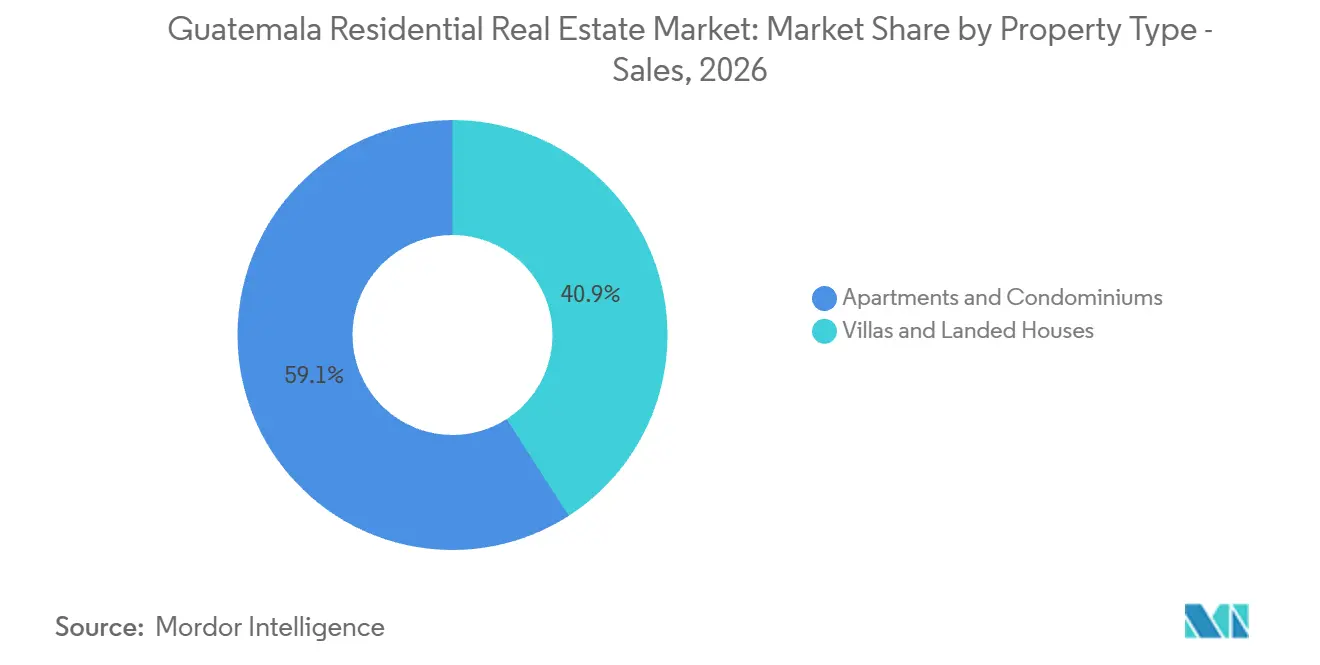
Apartments and Condominiums Lead Vertical Housing SupplyApartments and condominiums captured 59.1% of the Guatemala residential real estate market share in sales during 2026. Land scarcity and access to employment centers make vertical formats more practical in Guatemala City and its nearby municipalities. The Guatemalan Construction Chamber recorded 235 multifamily buildings completed in the capital over the prior 4 years. Shared amenities allow developers to make smaller unit sizes more appealing without reducing the role of location and security. Buyers also benefit from projects that are close to offices, retail services, and established transport routes.
The segment is projected to grow at a 6.88% CAGR through 2032, which makes it the fastest-growing property type in sales. FHA-approved apartment projects can connect qualifying first-time buyers with the Mi Primera Casa program. ÍNTEGRO launched Alana Ave. Las Américas in 2025 with 485 apartments in 2 towers in Zone 13 and a declared investment of USD 83 million. Villas and landed houses remain relevant for families seeking private outdoor space in suburban communities. The Guatemala residential real estate industry will continue to require both formats because household needs differ by income, family size, and location.
By Price Band (Sales):
Affordable Homes Serve the Broadest Buyer BaseAffordable homes held 55.3% of sales revenue in 2026, the largest price band in the Guatemala residential real estate market. This position reflects limited purchasing power across much of the urban population. Public financing is directed toward families earning 1 to 6 non-agricultural minimum wages, which supports demand in this price range. The segment depends on developers being able to maintain feasible prices while meeting formal construction, service, location, and risk-insurance standards that lenders and buyers expect. It is also affected by land prices in areas with good transport and utility access.
The affordable segment is forecast to grow at a 6.75% CAGR through 2032, faster than other sales price bands. Its growth depends on continued public funding, a sufficient supply of FHA-approved developments, and access to mortgage credit. Mid-market housing still serves professionals and upper-middle-income households, although project margins are under pressure from land and input costs. Luxury homes remain concentrated in higher-income districts and master-planned areas, where they contribute substantial project value but serve a smaller buyer group. The Guatemala residential real estate market therefore has a strong reason to protect the flow of approved affordable housing after the current government term ends in 2028.
By Mode of Sale (Sales):
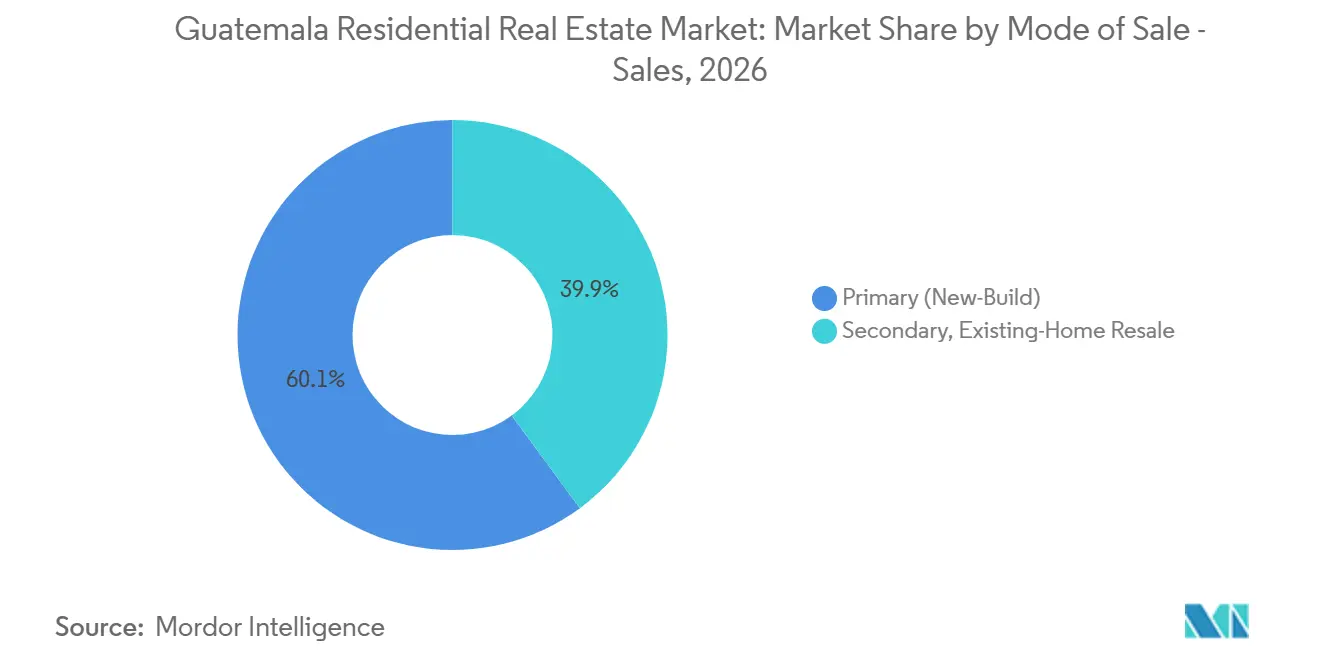
Primary Transactions Reflect Formal Supply NeedsPrimary transactions represented 60.1% of sales in 2026, making new construction the leading mode in the Guatemala residential real estate market. Buyers often prefer developer-led projects because the title chain and documentation are typically reviewed before sale. This is particularly important for households using mortgages or government-supported financing. The U.S. Department of State reported that land-title irregularities and conflicting ownership claims can delay property transactions. These risks make existing-home purchases harder to evaluate in parts of the country.
Primary transactions are projected to expand at a 6.69% CAGR through 2032. The pipeline of certified projects in the capital and secondary cities supports growth. Higher construction-license activity also points to continued developer interest, although project delivery will depend on infrastructure and buyer financing. The resale market has room to develop if cadastral systems and registration procedures become more reliable. A more transparent resale channel would offer buyers greater choice and could reduce pressure on new-build supply.
By Property Type (Rental):
Apartments and Condominiums Dominate Rental InventoryApartments and condominiums accounted for 82.6% of rental property types in 2026. This level of concentration reflects the availability of furnished and managed units in Guatemala City’s professional districts. Young professionals and corporate renters often prioritize access to employment centers and commercial services. Apartment supply is also easier to organize in dense urban locations than larger rental homes. These features give the Guatemala residential real estate market a large urban rental base even where institutional leasing is limited.
Villas and landed houses are forecast to grow at a 6.80% CAGR through 2032, faster than apartments in rental demand. Many families that cannot purchase a new home still need larger living areas and private space. Rental arrangements remain less standardized than sales transactions because much of the inventory is owned by individual landlords. This can limit transparency and make professional property management harder to scale. It also gives early operators an opening to establish formal, multi-unit rental services in the Guatemala residential real estate market.
Geography Analysis
Guatemala City accounted for 47.2% of regional sales in 2026 and remains the core location for formal residential development. The city combines a high concentration of employers, lenders, certified developers, formal retail, education services, and health care facilities, which supports a broad pool of owner-occupier and rental demand. The Guatemalan Construction Chamber identified Zones 10, 12, 14, 15, and 16 as locations that held more than 80% of new projects and more than 20,000 homes in active supply. Guatemala City’s mix of high-price and lower-price districts lets developers serve different household budgets. The Guatemala residential real estate market has its most developed apartment pipeline in this metropolitan area.
Escuintla is forecast to grow at a 7.04% CAGR through 2032, supported by employment linked to logistics, ports, and agro-processing. FHA listings include projects in Escuintla that serve buyers seeking formal housing outside the capital. Mixco and Villa Nueva provide more accessible locations for workers who commute to Guatemala City. Quetzaltenango has a separate demand base from its education, health care, and commercial functions. These markets can reduce the concentration of the Guatemala residential real estate market in the capital if services, financing, and land records improve, allowing developers to bring standardized housing products to places where formal supply has been limited.
Interior and highland areas remain more dependent on incremental building and remittance-funded self-construction. FOPAVI delivered housing subsidies across multiple departments in 2025, including locations outside the main urban corridors. The United Nations also identified tenure insecurity and incomplete cadastral coverage as major obstacles for rural and Indigenous communities. These constraints limit formal project delivery even when household demand exists. Better service infrastructure and clearer property records would allow the Guatemala residential real estate market to bring more of this demand into formal channels.
Competitive Landscape
The Guatemala residential real estate market is moderately fragmented, with no developer holding a dominant position across all regions and customer segments. Competition includes integrated developers, vertical-project specialists, brokerages, and digital listing platforms, with each group serving a different role in project planning, finance, marketing, transactions, or rental administration. Financial institutions also influence development because FHA approval affects project standards and buyer eligibility. At the same time, the availability of insured credit can determine whether a project reaches its intended affordable or middle-income customer base. Multi-Proyectos CMI, ÍNTEGRO, and Grupo Cayalá have mixed-use or large-scale residential capabilities, while Impulsa Desarrollos, Milésimo, and Desarrollos Palo Blanco participate through more focused development activity.
Developers are differentiating through location, project quality, financing alignment, and shared amenities. ÍNTEGRO launched Alana Ave. Las Américas in 2025, a 485-unit apartment project in Zone 13 with FHA certification. The company also introduced Reserva Valere in Santa Lucía Cotzumalguapa, extending its residential approach to the coastal south. These moves show that market leaders are seeking opportunities beyond Guatemala City. Companies that can manage land diligence, utility servicing requirements, local construction coordination, and FHA compliance may have an advantage in secondary cities, where formal project delivery has historically been less consistent.
Rental management and resale transaction services remain less structured than formal new-build development. This creates space for platforms and service providers that can improve documentation, tenant management, and property due diligence. Developers also face land-cost pressure in prime districts, which encourages them to pursue suburban and secondary-city sites. The Guatemala residential real estate market may become more competitive as foreign capital and local partners fund additional projects. Still, execution quality, price discipline, financing access, and the ability to deliver usable infrastructure remain more important than scale alone.
Guatemala Residential Real Estate Industry Leaders
-
Multi-Proyectos CMI
-
Spectrum
-
ÍNTEGRO
-
COMOSA
-
Desarrollos Palo Blanco
- *Disclaimer: Major Players sorted in no particular order
Guatemala Residential Real Estate Market Companies Covered in this Report
- Multi-Proyectos CMI
- Spectrum
- ÍNTEGRO
- COMOSA
- Desarrollos Palo Blanco
- Impulsa Desarrollos
- Grupo Cayalá
- Metroproyectos
- Grupo Mi Tierra S.A.
- Milésimo
- Qualicons
- CityMax Guatemala
- RE/MAX Guatemala
- CBR Guatemala
- MapaInmueble
- Crédito Hipotecario Nacional
- Instituto de Fomento de Hipotecas Aseguradas
- Banco Industrial
- Banrural
- Habitat for Humanity Guatemala
Recent Industry Developments in Guatemala Residential Real Estate Market
- September 2026: COMOSA launched ENZO Las Charcas, a 435-apartment vertical residential development in Zone 11, Guatemala City. The project includes more than 20 shared amenities and a placemaking-centered design model, extending COMOSA's 70-year, 200-project portfolio into a high-density urban corridor.
- August 2026: Grupo Cayalá / CICOMSA placed the final series of a USD 50 million bond program, including USD 30 million at a 7.77% annual interest rate over 7 years. The placement settled simultaneously with investors in Guatemala, Panama, and Costa Rica through Guatemala's Central de Valores Nacional, LatinClear, and Interclear.
- June 2026: Visión Desarrollo broke ground on Mateo 7, an 8-level building with 46- to 53-square-meter apartments in Zone 7, Guatemala City. The project is being developed under the Municipalidad de Guatemala's Vivienda Prioritaria, or Priority Housing, framework and is intended to expand formally accredited affordable housing near Calzada Roosevelt.
Guatemala Residential Real Estate Market Report Scope
Segmentation Overview
| Apartments and Condominiums |
| Villas and Landed Houses |
| By Property Type | Apartments and Condominiums |
| Villas and Landed Houses |
Key Questions Answered in the Report
What is the forecast growth rate for Guatemala residential real estate through 2032?
The sector is projected to grow at a 6.01% CAGR from 2027 to 2032, reaching USD 8.5 billion by 2032. Growth is supported by urban demand, formal financing initiatives, remittance-funded housing activity, and developers extending selected projects beyond the capital into suburban and secondary-city areas.
Which property type leads residential sales in Guatemala?
Apartments and condominiums lead sales with a 59.1% share in 2026 and are forecast to grow at a 6.88% CAGR through 2032.
What supports demand for affordable homes in Guatemala?
The Mi Primera Casa program, FHA-backed financing, and remittance income support demand for qualifying households. These supports are most important where buyers can document income, meet project eligibility rules, and secure homes within the affordable price band.
Which area is growing fastest for residential sales?
Escuintla is forecast to grow at a 7.04% CAGR through 2032, supported by industrial, logistics, and port-related employment.
Why are new-build homes more common than resales in Guatemala?
Primary transactions held 60.1% of sales in 2026 because formal new-build projects can offer clearer title documentation and financing access. Existing-home transactions can involve more uncertainty when property records are incomplete, or ownership claims are disputed.
What are the main barriers to residential development in Guatemala?
Limited household affordability, gaps in water and sanitation, land-title issues, and high land costs constrain project delivery. These factors are especially material in peri-urban and secondary-city locations, where available land may not yet have the infrastructure required for formal housing, mortgage approval, and dependable long-term occupancy.