
Guar Market Analysis by Mordor Intelligence
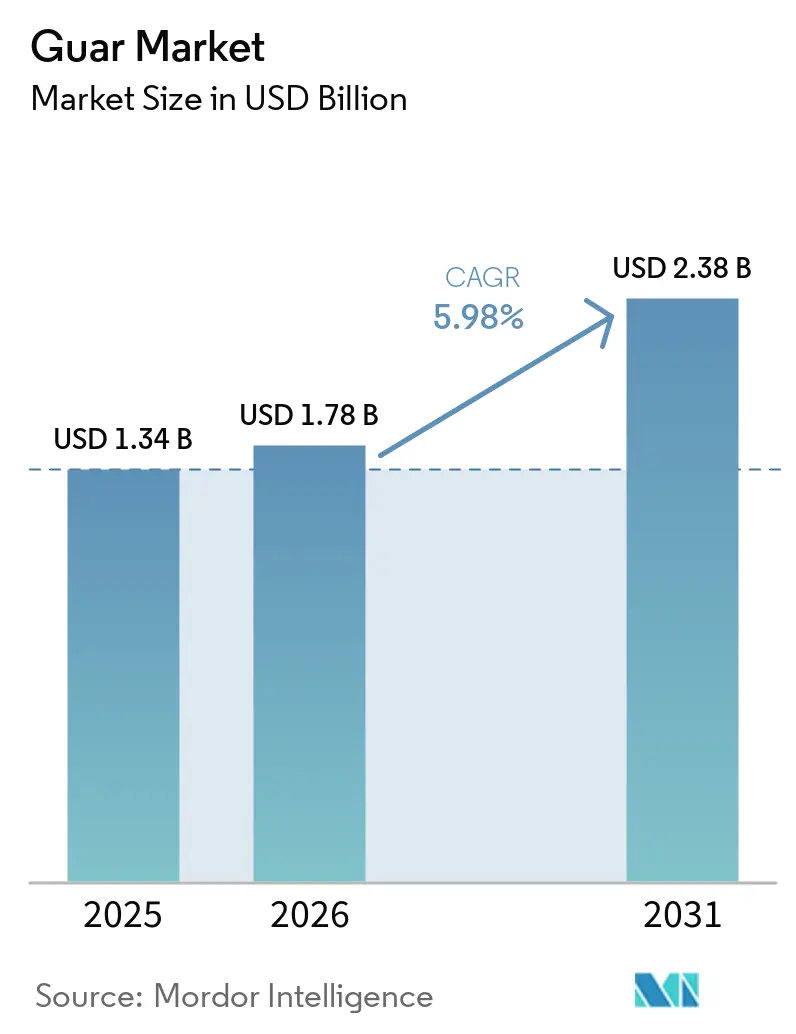
The guar market size is projected to grow from USD 1.34 billion in 2025 to USD 1.78 billion in 2026 and is forecast to reach USD 2.38 billion by 2031 at a 5.98% CAGR over 2026-2031. Robust demand for guar gum as a clean-label thickener in food and beverages and as a fast-hydrating polymer in hydraulic fracturing supports this expansion, even as drilling cycles in North America introduce periodic volatility[1]Source: Agricultural and Processed Food Products Export Development Authority, “Fresh Fruits and Vegetables,” APEDA.GOV.IN. India supplied 70-80% of global output in 2024, and Rajasthan alone accounted for more than 70% of the country’s production, making the global value chain sensitive to monsoon variability and infrastructure bottlenecks [2]Source: Business Standard, “Guar Seed Prices Fall Rs 100, Guar Gum Down Rs 300 on Weak Export Demand,” BUSINESS-STANDARD.COM. The Asia-Pacific region dominates global guar demand, followed by North America, with Europe representing the next major consumption market. South America, the Middle East, and Africa collectively account for a smaller but steadily growing share. Long-term growth opportunities are driven by clean-label reformulation in packaged foods, the use of digital agriculture tools to improve guar productivity, and policy support for drought-resilient crops. However, market growth is constrained by the availability of synthetic substitutes, increasing compliance costs due to pesticide-residue regulations, and price volatility influenced by monsoon variability[3]Source: NITI Aayog, “Agriculture Roadmap 2047,” NITI.GOV.IN.
Key Report Takeaways
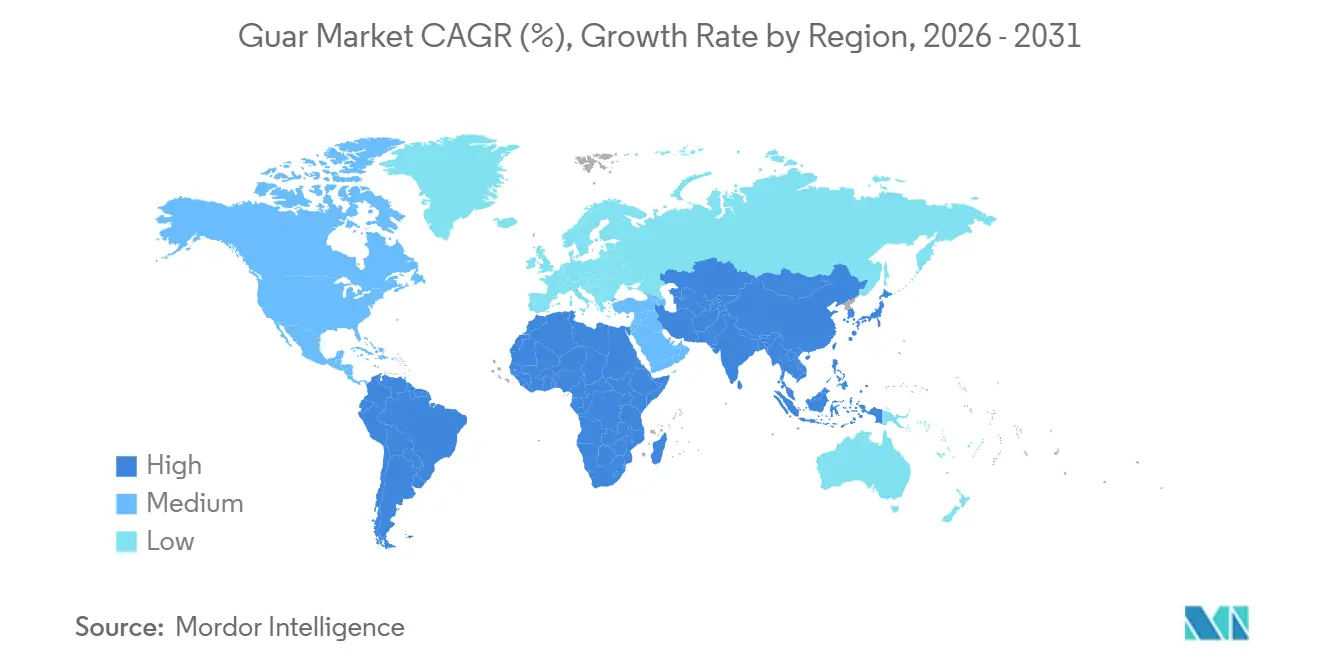
- By geography, Asia-Pacific led with 44% guar market share in 2025, and South America is forecast to expand at a 6.6% CAGR through 2031.
Note: Market size and forecast figures in this report are generated using Mordor Intelligence’s proprietary estimation framework, updated with the latest available data and insights as of January 2026.
Market Trends and Insights
Drivers Impact Analysis of Guar Market*
| Driver | (~) % Impact on CAGR Forecast | Geographic Relevance | Impact Timeline |
|---|---|---|---|
| Growing demand for natural thickening agents in food and beverages | +1.20% | Global, with focus on North America, Europe, and Asia-Pacific urban centers | Medium term (2 – 4 years) |
| Expansion of hydraulic fracturing fluids consumption in oil and gas | +1.50% | North America (Permian Basin, Eagle Ford), Middle East, and South America (Vaca Muerta) | Short term (≤ 2 years) |
| Substitution of synthetic drilling polymers by plant-based guar gum | +0.80% | North America and Middle East, extended to Asia-Pacific offshore drilling | Medium term (2 – 4 years) |
| Premiumization in pet-food formulations using clean-label hydrocolloids | +0.50% | North America, Europe, and Asia-Pacific premium segments | Long term (≥ 4 years) |
| Government incentives for drought-resilient crops in arid regions | +0.90% | India, Pakistan, Iran, Sudan, and Nigeria | Long term (≥ 4 years) |
| AI-enabled yield forecasting and contract-farming adoption | +0.60% | India, China, pilot sites in Africa and South America | Medium term (2 – 4 years) |
| Source: Mordor Intelligence | |||
Growing Demand for Natural Thickening Agents in Food and Beverages
Clean-label preferences are fueling guar market growth as manufacturers replace modified starches and synthetic emulsifiers with plant-based alternatives across dairy, bakery, and beverage lines. Guar gum delivers high viscosity at dosages of 0.2 to 0.5% by weight, which keeps formulation costs in check relative to xanthan or locust bean gum. Revised European labeling rules under the Food Information to Consumers Regulation strengthen guar’s appeal because its E412 designation offers regulatory clarity absent in many synthetics [4]Source: United States Department of Agriculture Foreign Agricultural Service, “Maximum Residue Limits Database,” FAS.USDA.GOV. North American brands pair guar with carrageenan or pectin to trim overall hydrocolloid load, while Asia-Pacific’s expanding middle class lifts demand for premium ice cream, gluten-free bread, and ready-to-eat meals that all benefit from guar’s moisture retention and freeze–thaw stability.
Expansion of Hydraulic Fracturing Fluids Consumption in Oil and Gas
Horizontal-well completions rely on guar’s ability to suspend proppants at high temperature and pressure. The Permian Basin absorbs 60-70% of North America’s guar imports when crude prices are above USD 70 per barrel. Argentina’s Vaca Muerta, delivering 140,000 barrels per day in 2025, mirrors that model and triggers fresh demand. Middle-East offshore programs tap guar derivatives with superior thermal resilience for high-salinity reservoirs. However, a shift toward slickwater designs and synthetic friction reducers moderates absolute volume growth, illustrating that guar demand remains cyclical with drilling activity.
Substitution of Synthetic Drilling Polymers by Plant-Based Guar Gum
Environmental, social, and governance mandates are driving operators to switch from polyacrylamide to biodegradable guar systems. Regulators in the European Union and several United States states scrutinize acrylamide contamination, making Guar’s rapid biodegradation 80 to 90% within 28 days under aerobic conditions an attractive compliance lever. Oilfield-service majors have commercialized cross-linked guar gels optimized for high-temperature wells, allowing operators to meet sustainability targets without sacrificing proppant transport efficiency. When environmental fees are factored in, the cost gap between guar and synthetics narrows, bolstering guar’s competitiveness.
Government Incentives for Drought-Resilient Crops in Arid Regions
Minimum support prices and subsidized inputs encourage Indian farmers to plant guar on marginal land, while Pakistan offers acreage-linked subsidies and crop insurance. Iran’s Sistan and Baluchestan province funds guar pilots who use 40-50% less irrigation than cotton. These programs diversify global supply, tempering price volatility linked to India’s monsoon. They also improve farmers' economics because guar fixes atmospheric nitrogen, reducing fertilizer costs for subsequent crops.
Restraints Impact Analysis of Guar Market*
| Restraint | (~) % Impact on CAGR Forecast | Geographic Relevance | Impact Timeline |
|---|---|---|---|
| Monsoon-driven price volatility in major producing belts | -1.00% | India and Pakistan, with global spillover | Short term (≤ 2 years) |
| Availability of low-cost synthetic substitutes such as polyacrylamide | -0.70% | North America, Middle East, and offshore projects worldwide | Medium term (2 – 4 years) |
| Stricter pesticide-residue limits in key importing countries | -0.50% | Europe, North America, and Japan | Medium term (2 – 4 years) |
| Logistics bottlenecks in remote producing regions | -0.40% | Rajasthan and Gujarat in India, Punjab in Pakistan, and Sudan | Short term (≤ 2 years) |
| Source: Mordor Intelligence | |||
Availability of Low-Cost Synthetic Substitutes Such as Polyacrylamide
When guar exceeds USD 1.50 per kg, many North American shale operators default to polyacrylamide friction reducers that deliver consistent viscosity at lower dosage rates. Slickwater fracturing further reduces guar intensity per well by 20-30%. In foods, xanthan and carboxymethyl cellulose compete effectively in gluten-free baking and dairy stabilization because they offer superior freeze–thaw stability and pH tolerance, even at higher per-kilogram prices.
Stricter Pesticide-Residue Limits in Key Importing Countries
The European Union enforces a default limit of 0.01 milligram per kilogram for pesticides without specific Maximum Residue Limits (MRLs), and guar beans fall under code 0260010-006. Compliance requirements force exporters to fund lab tests and traceability, adding USD 10-15 per 100 kgs to landed costs [5]Source: United States Department of Agriculture Foreign Agricultural Service, “Maximum Residue Limits Database,” FAS.USDA.GOV. Similar standards in Japan and the United States raise the barrier for smallholders who lack training in approved agrochemicals and application timing.
*Our forecasts treat driver/restraint impacts as directional, not additive. The impact forecasts reflect baseline growth, mix effects, and variable interactions.
Geography Analysis
APAC Guar Market
In 2025, the Asia-Pacific region accounted for 44% of the guar market share, driven by India's significant role in cultivation, processing, and exports. Guar production in this region is concentrated in arid and semi-arid areas and is supported by a fragmented processing base catering to food, pharmaceutical, textile, and industrial applications. Domestic consumption within Asia-Pacific has steadily increased, reflecting the growing use of guar gum in packaged foods, healthcare products, and value-added industrial applications. This trend has gradually reduced the region's reliance on exports.
South America Guar Market
South America is the fastest-growing guar market, with a compound annual growth rate (CAGR) of 6.6%. This growth is fueled by demand from the energy sector in Argentina and clean-label reformulation trends in Brazil's food industry. In Argentina, shale development drives the need for guar-based drilling fluids, while Brazilian dairy and bakery manufacturers increasingly use guar gum as a replacement for synthetic stabilizers. Although the region's reliance on imports makes it vulnerable to currency fluctuations, demand remains robust across strong end-use sectors.
North America and EMEA Guar Market
North America and Europe are mature guar markets with stable consumption patterns, supported by applications in food processing, pharmaceuticals, pet food, and industrial sectors. The United States and major European economies rely heavily on imports and face increasingly stringent compliance requirements for pesticide residues and sustainability standards. In contrast, the Middle East and Africa represent smaller but developing markets. Growth in these regions is supported by oil and gas applications, mining, food processing, and interest in guar as a drought-resistant crop. However, infrastructure and local processing limitations continue to constrain short-term expansion.


Regulatory Landscape
Guar gum fits within established food-additive frameworks across major importing regions, with Codex Alimentarius (GSFA) listing guar gum for multiple functions (including stabilizer and thickener) under GMP, which supports cross-border formulation alignment for multinational food manufacturers. In the United States, FDA regulations (21 CFR 184.1339) recognize guar gum as GRAS for food use with category-specific conditions, supporting continued use in mainstream processed foods and beverages.
In Europe, the regulatory focus is tightening around specifications and analytical control. Commission Regulation (EU) 2026/196 updated specifications for guar gum (E 412), including terminology and methods of analysis, reinforcing purity and testing expectations for suppliers serving EU buyers. On the trade and export governance side, India remains pivotal, with APEDA continuing to administer export-linked support through its Financial Assistance Scheme aligned to the 2021-2022 to 2025-2026 cycle. The Directorate General of Foreign Trade (DGFT) issued amendments affecting guar gum export policy in April 2026, which adds another compliance checkpoint for exporters and processors.
Value Chain Analysis
The guar value chain starts with input supply (seed, crop-protection chemicals, and limited irrigation in arid belts) and farm production concentrated in India, particularly Rajasthan, with additional cultivation in states such as Gujarat and Haryana. Upstream aggregation typically moves from smallholder farmers to village traders and commission agents, then to stockists and split manufacturers, before reaching organized guar gum processors. Processors mill and refine into industrial-grade guar powder and higher-value food and pharmaceutical grades, which are then sold through exporters, ingredient distributors, and direct contracts to end users in food, personal care, and oilfield services.
Bottlenecks cluster around monsoon dependence, price speculation, and logistics constraints from remote producing districts to processing hubs and ports, which can amplify landed-cost volatility for importers. Downstream, market access is shaped by buyer-led quality assurance (traceability, residue testing, viscosity specifications) and procurement shifts linked to oil and gas drilling cycles. Organized processors with integrated sourcing, testing, and export documentation capabilities are better placed to meet stricter import requirements, while smaller mills face higher per-unit compliance and financing burdens.
Competitive Landscape
Guar cultivation is characterized by its highly fragmented nature, with production distributed among millions of smallholder farmers. In contrast, the processing segment is more consolidated, dominated by a limited number of organized players. Companies such as Hindustan Gum have established strong positions through vertically integrated operations encompassing farmer sourcing, milling, and logistics, ensuring consistent quality and a reliable supply. Other key processors, including Vikas WSP, Jai Bharat Gum, Neelkanth Polymers, and Sunita Hydrocolloids, significantly contribute to the processing landscape, collectively bolstering the organized segment despite the fragmented upstream structure.
Competition in the guar processing industry is increasingly shaped by factors such as quality assurance, compliance, and procurement efficiency rather than scale alone. Global specialty-ingredient companies like Ingredion and Corbion have implemented stricter supplier audit requirements, encouraging Indian guar processors to adopt advanced quality-testing technologies, digital traceability systems, and improved environmental management practices. At the sourcing level, agtech platforms are facilitating direct procurement from farmers, reducing dependence on commission agents and lowering transaction costs. However, the adoption of technology remains uneven. Leading processors are utilizing automated grading systems and in-line viscosity monitoring, while smaller mills continue to rely on manual inspection methods.
End-market exposure plays a critical role in differentiating processors. While oilfield applications provide volume stability, they often exert pressure on margins, prompting companies to diversify into higher-value segments such as food, pharmaceuticals, and cosmetics. Processors like Hindustan Gum, Vikas WSP, and Neelkanth Polymers are increasingly focusing on value-added guar derivatives to mitigate commodity price risks and enhance profitability. Concurrently, research collaborations, often involving universities, are driving the development of advanced guar chemistries. These innovations are expanding application possibilities and strengthening the competitive position of innovation-driven players in the guar market.
Market Opportunities and Future Outlook
Opportunities are increasingly tied to buyers raising the bar on traceability and specification control, particularly for food-grade guar gum supplied into high-compliance markets. The European Union update to guar gum specifications under Commission Regulation (EU) 2026/196 supports investments in purity testing, standardized methods of analysis, and tighter supplier qualification, which favors processors that can document consistent E 412 compliance and residue controls. This also opens capacity for Indian processors to push more volume into higher-value grades and for global ingredient solution providers to bundle guar with complementary hydrocolloids for clean-label texture systems.
A second opportunity area is value extraction beyond traditional guar gum powder through derivatives and byproduct upcycling. Demand-side volatility from hydraulic fracturing encourages processors to balance portfolios with application-specific guar derivatives, including hydroxypropyl and carboxymethyl guar for performance-driven industrial and pharmaceutical uses, and to monetize processing byproducts such as guar korma into higher-protein ingredients. On the risk-management side, the July 2026 NCDEX introduction of guar korma futures provides exporters, processors, and feed manufacturers with a formal hedging tool for a key byproduct stream, supporting more structured contracting and inventory decisions across the chain.
Recent Industry Developments in Guar Market
- July 2026: NCDEX announced the launch of guar korma futures effective July 24, 2026, expanding regulated hedging tools beyond guar seed and guar gum. The contract targets exporters, processors, and feed manufacturers that use guar korma, improving price-discovery and contractability for a key byproduct stream.
- October 2025: Texas A&M AgriLife released two new organic guar varieties, TAMG 101 and TAMG 102, to support domestic organic production in the Southern United States. The varietal pipeline improves supply optionality outside South Asia and aligns with rising demand for organic-labeled ingredient sourcing.
- March 2024: European Union enforcement dynamics around the default pesticide Maximum Residue Level of 0.01 mg/kg increased compliance requirements in the EU-India guar trade during 2024. Exporters responded by strengthening traceability and testing, which increased the advantage of organized processors and contributed to consolidation pressure in the processing segment.


Guar Market Report Scope and Research Methodology
Market Definition and Coverage
For this study, the guar market is defined as the commercial value generated from guar and processed guar-based products traded for industrial and food uses, measured at the point where the product is sold into distribution or end-use channels.
Scope exclusions: We exclude downstream finished goods where guar is only a minor ingredient and any non-commercial on-farm seed retention that does not enter trade.
Segments Covered in This Report
- By Geography
- North America
- United States
- Production Analysis (Area Harvested, Yield, and Production Volume)
- Consumption Analysis (Consumption Value and Volume)
- Import Market Analysis (Import Value, Volume, and Key Supplying Markets)
- Export Market Analysis (Export Value, Volume, and Key Destination Markets)
- Wholesale Price Trend Analysis and Forecast
- Regulatory Framework
- List of Key Players
- Logistics and Infrastructure
- Seasonality Analysis
- Mexico
- Production Analysis (Area Harvested, Yield, and Production Volume)
- Consumption Analysis (Consumption Value and Volume)
- Import Market Analysis (Import Value, Volume, and Key Supplying Markets)
- Export Market Analysis (Export Value, Volume, and Key Destination Markets)
- Wholesale Price Trend Analysis and Forecast
- Regulatory Framework
- List of Key Players
- Logistics and Infrastructure
- Seasonality Analysis
- United States
- Europe
- Russia
- Production Analysis (Area Harvested, Yield, and Production Volume)
- Consumption Analysis (Consumption Value and Volume)
- Import Market Analysis (Import Value, Volume, and Key Supplying Markets)
- Export Market Analysis (Export Value, Volume, and Key Destination Markets)
- Wholesale Price Trend Analysis and Forecast
- Regulatory Framework
- List of Key Players
- Logistics and Infrastructure
- Seasonality Analysis
- Italy
- Production Analysis (Area Harvested, Yield, and Production Volume)
- Consumption Analysis (Consumption Value and Volume)
- Import Market Analysis (Import Value, Volume, and Key Supplying Markets)
- Export Market Analysis (Export Value, Volume, and Key Destination Markets)
- Wholesale Price Trend Analysis and Forecast
- Regulatory Framework
- List of Key Players
- Logistics and Infrastructure
- Seasonality Analysis
- France
- Production Analysis (Area Harvested, Yield, and Production Volume)
- Consumption Analysis (Consumption Value and Volume)
- Import Market Analysis (Import Value, Volume, and Key Supplying Markets)
- Export Market Analysis (Export Value, Volume, and Key Destination Markets)
- Wholesale Price Trend Analysis and Forecast
- Regulatory Framework
- List of Key Players
- Logistics and Infrastructure
- Seasonality Analysis
- Germany
- Production Analysis (Area Harvested, Yield, and Production Volume)
- Consumption Analysis (Consumption Value and Volume)
- Import Market Analysis (Import Value, Volume, and Key Supplying Markets)
- Export Market Analysis (Export Value, Volume, and Key Destination Markets)
- Wholesale Price Trend Analysis and Forecast
- Regulatory Framework
- List of Key Players
- Logistics and Infrastructure
- Seasonality Analysis
- Russia
- Asia-Pacific
- China
- Production Analysis (Area Harvested, Yield, and Production Volume)
- Consumption Analysis (Consumption Value and Volume)
- Import Market Analysis (Import Value, Volume, and Key Supplying Markets)
- Export Market Analysis (Export Value, Volume, and Key Destination Markets)
- Wholesale Price Trend Analysis and Forecast
- Regulatory Framework
- List of Key Players
- Logistics and Infrastructure
- Seasonality Analysis
- India
- Production Analysis (Area Harvested, Yield, and Production Volume)
- Consumption Analysis (Consumption Value and Volume)
- Import Market Analysis (Import Value, Volume, and Key Supplying Markets)
- Export Market Analysis (Export Value, Volume, and Key Destination Markets)
- Wholesale Price Trend Analysis and Forecast
- Regulatory Framework
- List of Key Players
- Logistics and Infrastructure
- Seasonality Analysis
- Japan
- Production Analysis (Area Harvested, Yield, and Production Volume)
- Consumption Analysis (Consumption Value and Volume)
- Import Market Analysis (Import Value, Volume, and Key Supplying Markets)
- Export Market Analysis (Export Value, Volume, and Key Destination Markets)
- Wholesale Price Trend Analysis and Forecast
- Regulatory Framework
- List of Key Players
- Logistics and Infrastructure
- Seasonality Analysis
- Australia
- Production Analysis (Area Harvested, Yield, and Production Volume)
- Consumption Analysis (Consumption Value and Volume)
- Import Market Analysis (Import Value, Volume, and Key Supplying Markets)
- Export Market Analysis (Export Value, Volume, and Key Destination Markets)
- Wholesale Price Trend Analysis and Forecast
- Regulatory Framework
- List of Key Players
- Logistics and Infrastructure
- Seasonality Analysis
- China
- South America
- Brazil
- Production Analysis (Area Harvested, Yield, and Production Volume)
- Consumption Analysis (Consumption Value and Volume)
- Import Market Analysis (Import Value, Volume, and Key Supplying Markets)
- Export Market Analysis (Export Value, Volume, and Key Destination Markets)
- Wholesale Price Trend Analysis and Forecast
- Regulatory Framework
- List of Key Players
- Logistics and Infrastructure
- Seasonality Analysis
- Argentina
- Production Analysis (Area Harvested, Yield, and Production Volume)
- Consumption Analysis (Consumption Value and Volume)
- Import Market Analysis (Import Value, Volume, and Key Supplying Markets)
- Export Market Analysis (Export Value, Volume, and Key Destination Markets)
- Wholesale Price Trend Analysis and Forecast
- Regulatory Framework
- List of Key Players
- Logistics and Infrastructure
- Seasonality Analysis
- Brazil
- Middle East
- Turkey
- Production Analysis (Area Harvested, Yield, and Production Volume)
- Consumption Analysis (Consumption Value and Volume)
- Import Market Analysis (Import Value, Volume, and Key Supplying Markets)
- Export Market Analysis (Export Value, Volume, and Key Destination Markets)
- Wholesale Price Trend Analysis and Forecast
- Regulatory Framework
- List of Key Players
- Logistics and Infrastructure
- Seasonality Analysis
- Iran
- Production Analysis (Area Harvested, Yield, and Production Volume)
- Consumption Analysis (Consumption Value and Volume)
- Import Market Analysis (Import Value, Volume, and Key Supplying Markets)
- Export Market Analysis (Export Value, Volume, and Key Destination Markets)
- Wholesale Price Trend Analysis and Forecast
- Regulatory Framework
- List of Key Players
- Logistics and Infrastructure
- Seasonality Analysis
- Turkey
- Africa
- Nigeria
- Production Analysis (Area Harvested, Yield, and Production Volume)
- Consumption Analysis (Consumption Value and Volume)
- Import Market Analysis (Import Value, Volume, and Key Supplying Markets)
- Export Market Analysis (Export Value, Volume, and Key Destination Markets)
- Wholesale Price Trend Analysis and Forecast
- Regulatory Framework
- List of Key Players
- Logistics and Infrastructure
- Seasonality Analysis
- Egypt
- Production Analysis (Area Harvested, Yield, and Production Volume)
- Consumption Analysis (Consumption Value and Volume)
- Import Market Analysis (Import Value, Volume, and Key Supplying Markets)
- Export Market Analysis (Export Value, Volume, and Key Destination Markets)
- Wholesale Price Trend Analysis and Forecast
- Regulatory Framework
- List of Key Players
- Logistics and Infrastructure
- Seasonality Analysis
- South Africa
- Production Analysis (Area Harvested, Yield, and Production Volume)
- Consumption Analysis (Consumption Value and Volume)
- Import Market Analysis (Import Value, Volume, and Key Supplying Markets)
- Export Market Analysis (Export Value, Volume, and Key Destination Markets)
- Wholesale Price Trend Analysis and Forecast
- Regulatory Framework
- List of Key Players
- Logistics and Infrastructure
- Seasonality Analysis
- Nigeria
- North America
Data Sources, Market Sizing, and Validation
Desk Research
Desk work started with mapping the guar supply chain, since production and trade flows strongly influence pricing and availability year to year. We used public sources such as FAOSTAT for crop area and yield signals, UN Comtrade for import and export checks, and official agriculture statistics from producing countries for season outcomes and acreage shifts.
To convert volume signals into value, we also reviewed published commodity and agri-derivative price references, customs unit values, and publicly available trade association updates where they existed. Company annual reports, investor presentations, and reputable press were used to confirm capacity additions, procurement shifts, and application demand changes. A paid subscription for company financials and a patent database were used selectively to cross-check revenue exposure and technology movement. These sources are illustrative only, and we reviewed many other public and paid references for data collection, validation, and clarification.
Primary Interviews and Surveys
Primary work focused on aligning what the data says with what the market is actually transacting, especially when monsoon outcomes, export availability, or oilfield activity change quickly. We spoke with participants across farming-linked procurement, processors, exporters, distributors, and major end-use buyers to confirm conversion ratios, price realization patterns, and typical contracting behavior.
Coverage was balanced across major producing and consuming regions so assumptions on trade mix, grade preference, and application demand could be checked before finalizing the model.
Distribution of primary research fieldwork respondents
| Company type | Respondent position | Region |
|---|---|---|
| Top tier: 27% | CXOs: 13% | APAC: 46% |
| Mid tier: 58% | Functional/Unit leaders: 42% | EMEA: 34% |
| Smaller Players: 15% | Managers: 45% | Americas: 20% |
Market-Sizing & Forecasting
Sizing was built using a top-down structure where production, trade, and apparent consumption were reconstructed by region and then translated into market value using observed price bands for the relevant guar formats. To keep the totals realistic, we also used selective bottom-up approximations, such as processor capacity utilization checks, sampled exporter and distributor price quotes, and an ASP times volume sanity check for the major application pools.
A few practical inputs were treated as key model levers, including guar acreage and yield swings, export volumes from major origins, import demand by key consuming regions, wholesale price direction, and demand shifts from food thickening versus oilfield use. Where coverage gaps appeared in the bottom-up checks, the missing portion was bridged using trade-derived volume shares and conservative price realization assumptions, and then re-tested in follow-up calls.
Forecasting relied on scenario analysis supported by short-series trend smoothing, since the market is sensitive to weather and drilling cycles. Base, high, and low cases were tied to expected acreage response, normalized yields, and an application mix outlook agreed with primary respondents, then rolled forward with consistent currency timing and inflation handling.
Data Validation & Update Cycle
Model outputs were validated through cross-checks against independent signals, including year-over-year changes in trade balances, price movements that match crop and inventory conditions, and capacity-led constraints that would cap short-term growth. When an outlier appeared, we traced the driver back to the input layer, reviewed it with another analyst, and corrected only after the assumption was supported by at least two independent references.
The report is refreshed annually, and interim updates are triggered when material events occur, such as major crop shocks, policy changes affecting exports, or sharp shifts in oilfield demand. Before delivery, a final review pass is completed to ensure the latest public statistics and interview feedback are reflected in the published numbers.
Mordor Intelligence's Guar Market Size Measured Against Other Published Estimates
Published market sizes for guar often differ because sources do not always count the same products, the same value point in the chain, or the same year basis. The result is that two numbers can both look reasonable, yet they are built from different building blocks.
The main gap comes from whether the estimate is limited to guar gum only or also includes wider guar trade and processing value, where Mordor Intelligence counts value across production and trade-linked signals (including exports, imports, and wholesale price trend inputs) and then keeps the forecast consistent with those volume checks.
Benchmark comparison
| Source | Market Size | Gaps in Research Methodology |
|---|---|---|
| Mordor Intelligence | USD 1.34 B (2025) | |
| Global Consultancy A | USD 1.43 B (2025) | Often presented as guar gum only, which can pull the value toward processed gum revenues and away from broader guar trade value, and the year basis may follow a different price averaging window. |
| Industry Publisher B | USD 1.57 B (2024) | Uses a different base year and typically applies segment-led growth assumptions by grade and function, which can shift totals if application mix and price progression are not reconciled with trade and crop season swings. |
Across the three figures, most of the spread is explained by product scope choices and the base year used for pricing and currency timing. By keeping inputs tied to observable crop, trade, and pricing signals, the estimate remains repeatable and easier to audit when conditions change.


Key Questions Answered in the Report
What is the projected guar market size in 2031?
The guar market size is forecast to reach USD 2.38 billion in 2031 based on a 5.98% CAGR from 2026.
Which region leads global demand for guar gum?
Asia-Pacific leads with 44% share, anchored by India’s production and processing infrastructure.
Why are pesticide-residue limits a challenge for exporters?
The European Union and other high-compliance markets impose a 0.01 mg/kg default MRL for guar beans, adding USD 10 to USD 15 per 100 Kgs in testing and traceability costs.
How does AI improve guar farming?
AI-enabled advisory platforms optimize planting windows and inputs, lifting yields significantly in Rajasthan pilots.
Page last updated on:


 Your data is secure and never sold or shared.


