
Ground Mounted Solar PV Mounting Systems Market Size and Share
Market Overview
| Study Period | 2022 - 2032 |
|---|---|
| Market Size (2027) | USD 28.81 Billion |
| Market Size (2032) | USD 36.57 Billion |
| Growth Rate (2027 - 2032) | 4.89 % |
| Fastest Growing Market | Asia-Pacific |
| Largest Market | Asia-Pacific |
| Market Concentration | Medium |
Major Players *Disclaimer: Major Players sorted in no particular order Image © Mordor Intelligence. Reuse requires attribution under CC BY 4.0. | |
Ground Mounted Solar PV Mounting Systems Market Analysis by Mordor Intelligence
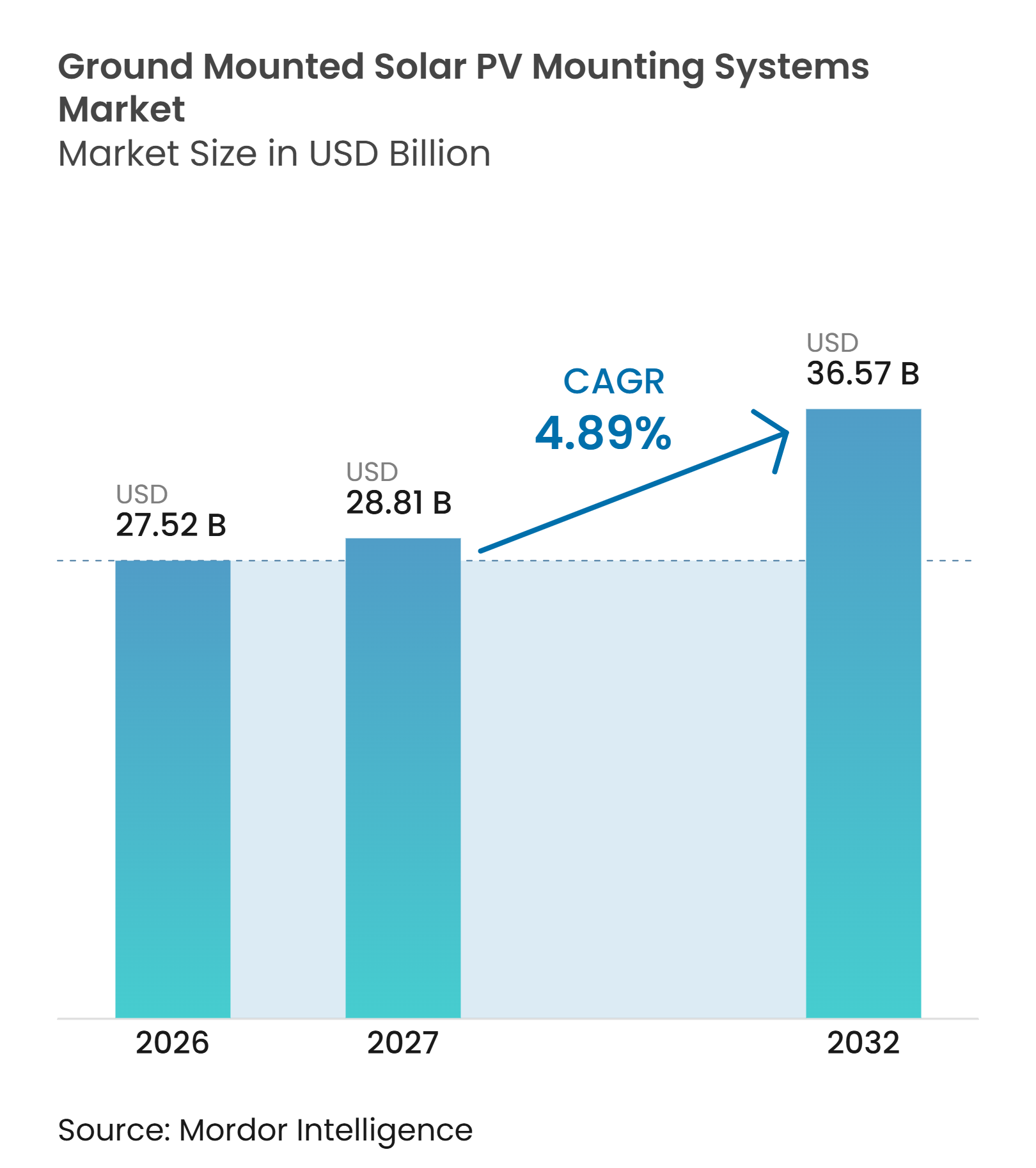
The Ground Mounted Solar PV Mounting Systems Market size is projected to expand from USD 27.52 billion in 2026 and USD 28.81 billion in 2027 to USD 36.57 billion by 2032, registering a CAGR of 4.89% between 2027 and 2032. Utility-scale solar additions remain the main source of demand because each project requires structural mounting equipment before modules can be commissioned in the Ground Mounted Solar PV Mounting Systems Market. U.S. utility-scale solar added 30 GW (AC) in 2024, which represented 54% of new grid-connected capacity additions that year and reinforced the Ground Mounted Solar PV Mounting Systems Market demand base.[1] India also had 100.80 GW of ground-mounted solar capacity installed by December 31, 2025, which supports sustained demand for racking and trackers.[2] Procurement is becoming more complex as developers weigh hardware cost, energy yield, domestic-content rules, and site conditions. Suppliers that pair structural systems with controls, monitoring, and weather-response capabilities have more ways to differentiate their offerings.
Key Report Takeaways
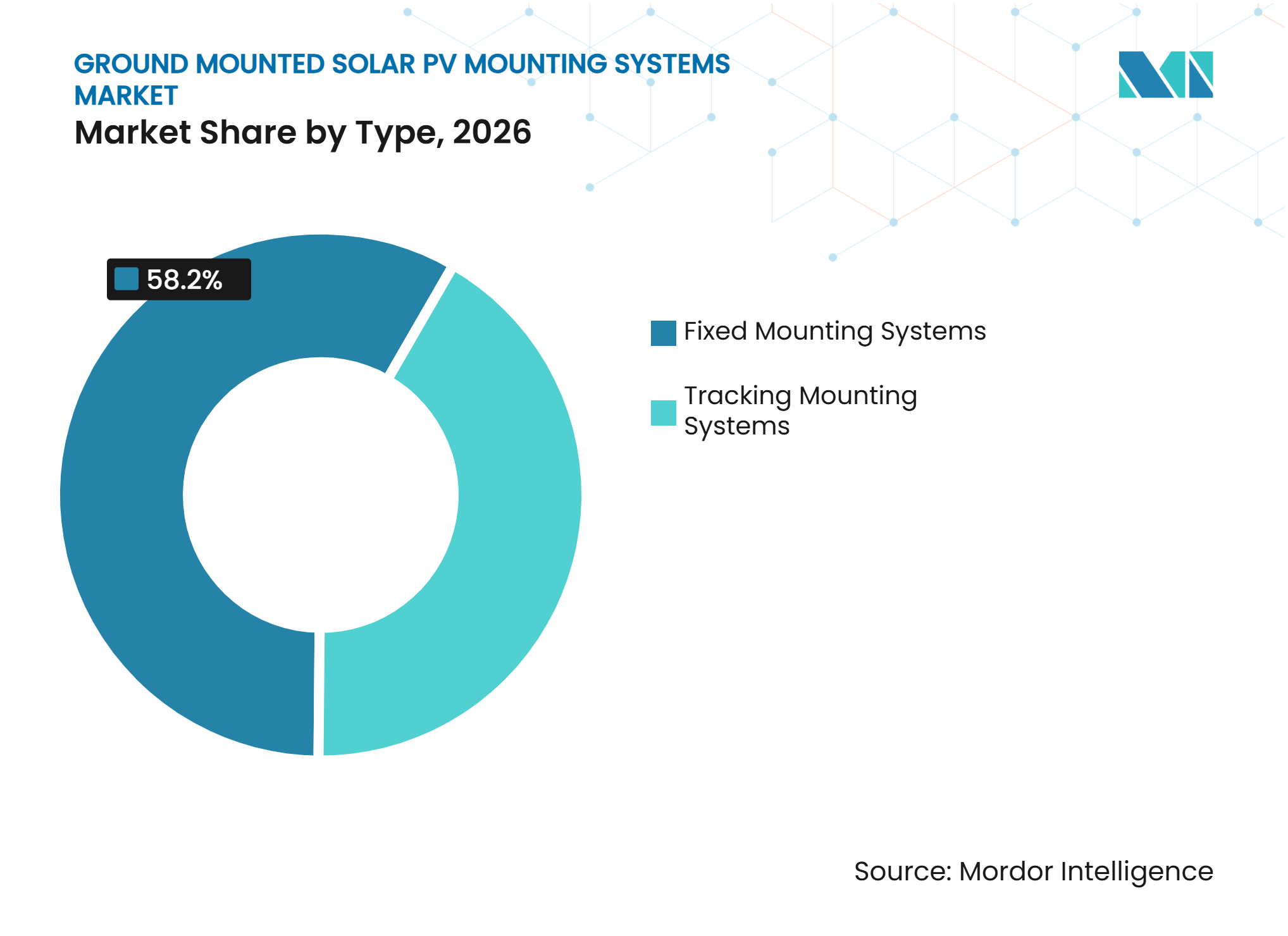
- By type, Fixed Mounting Systems held 58.2% of the Ground Mounted Solar PV Mounting Systems Market share in 2026, while Tracking Mounting Systems are projected to grow at a 6.5% CAGR through 2032.
- By material, Galvanized Iron accounted for 43.6% of the Ground Mounted Solar PV Mounting Systems Market share in 2026 and is forecast to expand at a 6.2% CAGR through 2032.
- By technology compatibility, Crystalline Silicon PV Modules held 81.4% share in 2026, while Bifacial Solar Panels are forecast to grow at an 8.1% CAGR through 2032.
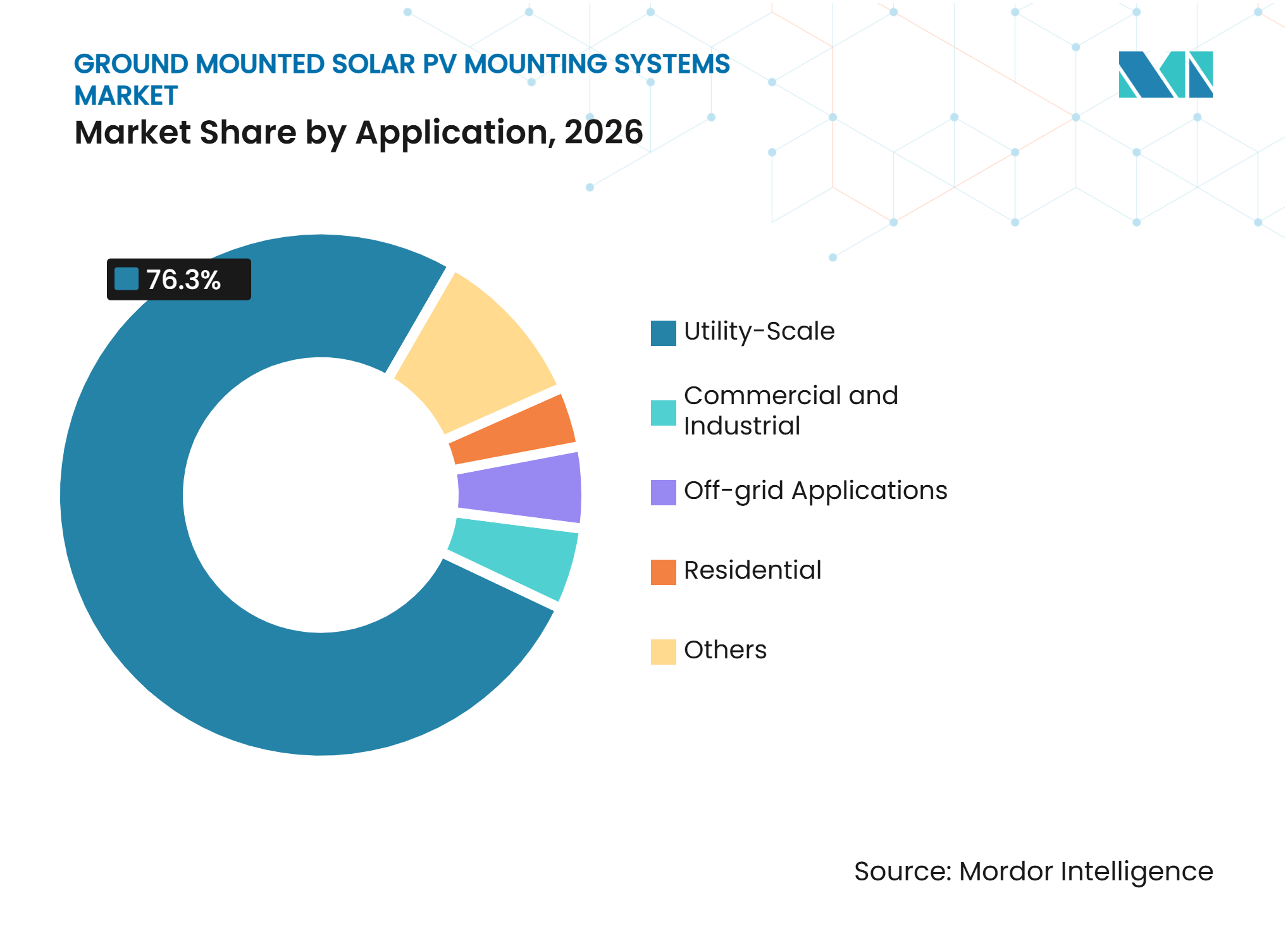
- By application, Utility-Scale applications accounted for a 76.3% share in 2026 and are forecast to grow at a 5.7% CAGR through 2032.
- By end user, EPC Companies held a 39.7% share in 2026, while Solar Project Developers are forecast to grow at a 5.9% CAGR through 2032.
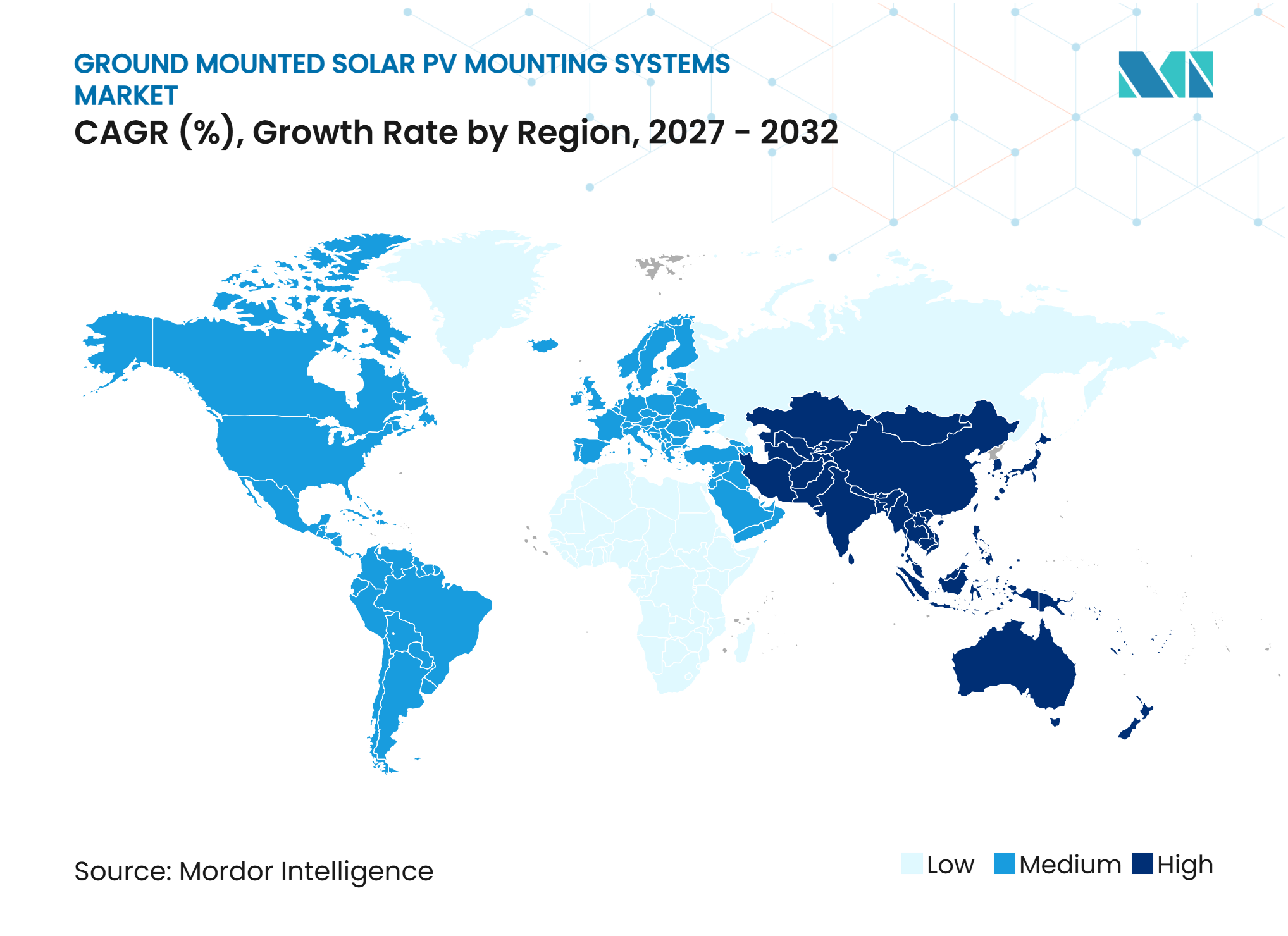
- By geography, Asia-Pacific held 47.8% share in 2026 and is forecast to grow at a 6.1% CAGR through 2032.
Note: Market numbers in this report are based on Mordor Intelligence's proprietary estimation framework, which combines nine months of actuals with Q4 projections for base year 2026.
Market Trends and Insights
Drivers Impact Analysis of Ground Mounted Solar PV Mounting Systems Market*
| Driver | (~) % Impact on CAGR Forecast | Geographic Relevance | Impact Timeline |
|---|---|---|---|
| Utility-Scale Solar Capacity Additions | +1.8% | Global, concentrated in Asia-Pacific, North America, and Middle East and Africa | Short term (≤ 2 years) |
| Bifacial Modules And Single-Axis Tracker Adoption | +1.2% | Global, with strong adoption in the United States, India, Latin America, and Australia | Medium term (2-4 years) |
| Policy-Led Domestic Manufacturing And Solar Deployment | +0.8% | United States, India, and Europe | Medium term (2-4 years) |
| Land-Use Optimization Through Agrivoltaics | +0.4% | Europe, Japan, and China | Medium term (2-4 years) |
| Demand For Terrain-Adaptive And Extreme-Weather Structures | +0.3% | Global, with relevance in high-wind and hail-prone regions | Long term (≥ 4 years) |
| Digital Controls, Predictive Maintenance, And Yield Optimization | +0.2% | Global, concentrated in mature solar markets | Long term (≥ 4 years) |
| Source: Mordor Intelligence | |||
Utility-Scale Solar Capacity Additions Drive Consistent Racking Volumes
Utility-scale capacity additions directly shape annual demand in the Ground Mounted Solar PV Mounting Systems Market, especially for suppliers serving large project orders. The United States added 30 gigawatts alternating current (GWAC) of utility-scale ground-mounted solar in 2024, equal to 54% of its new grid-connected capacity additions and supporting the Ground Mounted Solar PV Mounting Systems Market. India added 44.61 GW of solar capacity in FY 2025-26, compared with 23.83 GW in FY 2024-25, and ground-mounted projects accounted for 34.8 GW of the later total. These additions support large, repeatable orders for fixed structures and tracker systems. Large public tenders also influence supplier economics because awarded prices become procurement reference points for later projects. The U.S. Investment Tax Credit domestic-content provisions further encourage Engineering, Procurement, and Construction (EPC) firms to consider locally manufactured structural equipment when planning qualifying projects.[3]
Bifacial Modules and Single-Axis Tracker Adoption Redefine Levelized Cost of Energy (LCOE) Benchmarks
Bifacial modules and single-axis trackers are being deployed together in many utility-scale projects, changing requirements in the Ground Mounted Solar PV Mounting Systems Market. Nextracker states that single-axis trackers can increase annual energy yield by up to 25% compared with fixed-tilt systems.[4] Arctech Solar reports that bifacial modules can generate 10-20% more power under standard conditions, with larger gains under optimized conditions. This equipment combination strengthens the case for tracker-based design where land, irradiance, and grid conditions support higher output. It also moves mounting-system selection beyond basic structural specifications and toward expected plant performance. Suppliers are responding with real-time controls, backtracking functions, Supervisory Control and Data Acquisition (SCADA) links, and predictive maintenance features. Arctech Solar states that its SkySmart II system uses machine learning to set module angles and reduce inter-row shading.
Policy-Led Domestic Manufacturing Bifurcates Global Supply Chains
Policy support is separating the Ground Mounted Solar PV Mounting Systems Market into domestic-content and globally sourced supply channels, which affects supplier selection. In the United States, tax-credit rules encourage developers to document domestic content and procurement timing for eligible projects in the Ground Mounted Solar PV Mounting Systems Market. GameChange Solar reported that module-flexible tracker designs can allow developers to preserve project options while meeting safe-harbor procurement requirements. India’s domestic-content requirements direct part of the procurement base toward domestic steel fabricators and mounting-system assemblers. Europe’s Net-Zero Industry Act identifies solar manufacturing as a strategic area and supports faster permitting and financial access for related clean-technology production. Procurement specifications increasingly include CE marking and relevant EN or IEC structural standards. This shifts competition toward compliance capability as well as delivered cost.
Agrivoltaics, Terrain-Adaptive Structures, And Digital Controls Expand Product Requirements
Agrivoltaics is widening the set of structural requirements that suppliers must meet in the Ground Mounted Solar PV Mounting Systems Market, particularly in constrained agricultural sites. Gonvarri Solar Steel announced a 73 MWp supply agreement for an Italian agrivoltaic project that used tracker structures with motor-pile heights of up to 3 meters and 2.1 meters of ground clearance. Such requirements support crop access, airflow, and farm machinery movement. Terrain-following designs also reduce the need for extensive grading on difficult sites. GameChange Solar states that its Genius Tracker TF can accommodate post-to-post slope variations of up to 1.7 degrees. Digital controls and predictive maintenance add another layer of differentiation because they help operators manage yield and weather-response decisions. These specialized systems create opportunities for suppliers with design, software, and field-engineering capability.
Restraints Impact Analysis of Ground Mounted Solar PV Mounting Systems Market*
| Restraint | (~) % Impact on CAGR Forecast | Geographic Relevance | Impact Timeline |
|---|---|---|---|
| Steel And Aluminum Price Volatility | -1.0% | Global, concentrated in North America and Europe | Short term (≤ 2 years) |
| Land Assembly, Permitting, And Community Acceptance | -0.6% | North America and Europe | Medium term (2-4 years) |
| Tracker Reliability, Weather Stow, And Insurance Risk | -0.4% | Global, with relevance in the U.S. Great Plains, Australia, and South Africa | Medium term (2-4 years) |
| Interconnection Constraints And Curtailment Exposure | -0.4% | United States, Australia, and Europe | Long term (≥ 4 years) |
| Source: Mordor Intelligence | |||
Steel And Aluminum Price Volatility, Tracker Reliability, And Weather Risk Limit Margins
Material costs remain a major constraint because steel and aluminum form a large share of mounting-system inputs. Solar Energy Industries Association (SEIA) reported that changes to U.S. Section 232 tariffs increased domestic prices for steel, copper, and aluminum, while electrical and structural equipment costs rose in the fourth quarter of 2025. Manufacturers operating under fixed-price EPC contracts have limited room to absorb fast price movements. Array Technologies reported adjusted gross margin of 27.0% in FY2025, down from 34.1% in FY2024, citing tariff effects and average selling price pressure. Weather exposure adds a separate risk for tracker suppliers and owners. AXIS Capital found that tracker systems that failed to stow during hail events produced average losses of USD 380,000 per MW, compared with USD 150,000 per MW where stow systems operated successfully. This strengthens the commercial case for tested weather-stow controls and reliable operating procedures.
Land Assembly, Permitting, Interconnection Constraints, And Curtailment Delay Procurement
Permitting, land assembly, grid connections, and curtailment can delay the point at which a solar pipeline becomes a mounting-system order. Lawrence Berkeley National Laboratory recorded 956 GW of solar capacity in active U.S. interconnection queues at the end of 2024. Historical completion rates indicate that only a small share of queued projects progresses to operation. Federal Energy Regulatory Commission (FERC) Order No. 2023 seeks to improve queue management through a first-ready, first-served approach and stronger readiness requirements. The Australian Energy Market Operator also identified material congestion risk for proposed generation projects in Victoria and South Australia. These limits can weaken project economics even where module and mounting prices are favorable. Manufacturers therefore benefit from assessing grid status and delivery timing before allocating capacity to prospective projects.
*Our forecasts treat driver/restraint impacts as directional, not additive. The impact forecasts reflect baseline growth, mix effects, and variable interactions.
Ground Mounted Solar PV Mounting Systems Market Segment Analysis
By Type:
Trackers Increase Their Role in Utility-Scale DesignTracking Mounting Systems are projected to grow at a 6.5% CAGR through 2032. The segment benefits from broad use of single-axis trackers in utility-scale projects where higher energy yield can justify additional equipment cost. Nextracker reported that most utility-scale projects in established markets use solar trackers, with adoption also developing in newer solar markets. Tracker demand is particularly strong in the United States, India, Latin America, Australia, the Middle East, and parts of Africa. Site design has become an important point of differentiation because developers are increasingly seeking to avoid high civil-work expenses. GameChange Solar’s terrain-following tracker is designed for lower grading needs on sloped sites.
Fixed Mounting Systems held 58.2% of global segment value in 2026. Their leading position reflects continued use in lower-complexity projects, off-grid installations, distributed generation, and sites where tracker payback is less attractive. Fixed structures retain value in lower-irradiance European markets and in applications that prioritize installation simplicity. They also provide a practical option for sites with limited operating support or lower project scale. Supplier competition in this part of the Ground Mounted Solar PV Mounting Systems Market is more exposed to fabrication cost and steel sourcing. Trackers, by contrast, command stronger differentiation where software, terrain adaptation, and weather-response functions affect plant economics.


By Material:
Galvanized Iron Combines Durability with Scale EconomicsGalvanized Iron held 43.6% of global segment value in 2026 and is forecast to grow at a 6.2% CAGR through 2032. The material is widely used because it offers structural durability and cost efficiency in large Ground Mounted Solar PV Mounting Systems Market projects. Hot-dip galvanizing is relevant for systems expected to operate for 25-30 years under varied soil and weather conditions. EN ISO 1461 provides requirements for hot-dip galvanized coatings on fabricated iron and steel articles. These standards can influence procurement specifications, particularly where corrosion risk needs formal evaluation. Large-scale fabrication capacity also supports shorter supply cycles for high-volume project orders.
Steel remains important for deep-foundation and screw-pile applications in permafrost, high-wind, and other demanding site conditions. Aluminum retains advantages where lower handling weight and faster installation are important. However, tariff exposure can weaken its cost position in U.S. ground-mount projects. Composites and polymers occupy a smaller role, mainly where corrosion resistance or low weight outweighs the initial cost premium. The material mix therefore changes with soil conditions, wind loading, installation approach, and local trade policy. In the Ground Mounted Solar PV Mounting Systems Market, raw-material availability can shape bid competitiveness as much as a supplier’s design capability and delivery reliability.
By Technology Compatibility:
Bifacial Modules Change Structural Design PrioritiesBifacial Solar Panels are forecast to grow at an 8.1% CAGR through 2032. Developers use bifacial configurations to capture output from the rear side of the module, which increases the importance of structural shading and ground-clearance decisions. Arctech Solar cites testing that indicates 10-20% additional output under standard conditions, with greater gains under favorable rear-albedo conditions. Mounting systems must therefore limit underside shading and support appropriate module elevation. Narrower structural members and non-shading fastener designs can become more important in bifacial projects. Tracker geometry, row spacing, and backtracking settings can also affect realized gains.
Crystalline Silicon PV Modules accounted for 81.4% of the technology-compatibility segment in 2026. Their scale and established manufacturing base make them the central compatibility requirement for most mounting-system suppliers. Thin-film modules remain smaller in volume but can matter in domestic-content procurement. TerraSmart integrated its fixed-tilt racks and TerraTrak 1P tracker with First Solar’s Series 7 TR1 module in January 2025. This provides an example of mounting suppliers adapting their designs for module-specific use cases.
By Application:
Utility-Scale Projects Support the Largest Contract VolumesUtility-Scale applications accounted for 76.3% of global segment value in 2026 and are projected to expand at a 5.7% CAGR through 2032. Large projects concentrate both structural volume and tracker demand in a smaller number of procurement decisions. The United States, Asia-Pacific, North America, and the Middle East continue to support this application through large solar additions and planned capacity programs. Utility-scale contracts can include more than hardware because developers often seek monitoring systems, yield-management tools, and weather-stow protocols. Nextracker states that its TrueCapture system can reduce energy losses in operating plants. These integrated offers can increase system value while raising the importance of performance validation.
Commercial and industrial applications are the next relevant outlet for ground-mounted structures. Corporate power purchase agreements and on-site solar requirements support this demand in the United States, Europe, Japan, and other markets. Unirac acquired TerraSmart’s racking and foundation business in July 2026 for USD 5 million, expanding its ground-mount, tracker, and canopy product offering. Residential ground mounts provide a smaller but useful distributed-generation channel in Australia and Germany. Off-grid demand serves mining, telecommunications, rural electrification, and specialized applications. The Ground Mounted Solar PV Mounting Systems Market therefore has a large-project center of gravity while retaining smaller application channels with distinct engineering needs.

By End User:
EPC Companies Retain Scale While Developers Buy More DirectlyEPC Companies accounted for 39.7% of the end-user segment in 2026. Their role reflects their responsibility for engineering, procurement, construction, supplier qualification, and delivery coordination in major projects. Large EPC firms can use preferred-supplier frameworks to negotiate multi-project supply terms. These arrangements may reduce the engineering work required to approve mounting equipment across repeated projects. EPC procurement remains important where project sponsors prefer a single point of delivery responsibility. It also supports high shipment volumes for suppliers that can meet delivery, quality, and bankability requirements.
Solar Project Developers are forecast to grow at a 5.9% CAGR through 2032. Direct procurement gives developers more control over module flexibility, tariff risk, and long-term operating obligations. GameChange Solar linked module-flexible tracker procurement to safe-harbor planning for utility-scale projects. Utilities and independent power producers are also becoming more direct buyers for projects above 100 MW. Government and defense customers remain smaller but can require domestically sourced equipment and higher specifications. Installers and integrators primarily serve distributed and off-grid systems through distributor channels. These different purchasing models broaden the sales approach required in the Ground Mounted Solar PV Mounting Systems Market.
Geography Analysis
Asia-Pacific: Scale, Manufacturing Capacity, And Strong Project Activity
Asia-Pacific held 47.8% of global value in 2026 and is forecast to grow at a 6.1% CAGR through 2032. India had 100.80 GW of installed ground-mounted solar capacity at the end of 2025, while its solar additions reached 44.61 GW in FY 2025-26. This scale supports recurring demand for both domestic and imported Ground Mounted Solar PV Mounting Systems Market equipment. China continues to influence equipment pricing through high-volume manufacturing and public procurement. Japan remains more focused on premium, aluminum-intensive systems where installation constraints and quality requirements influence product selection. ASEAN countries provide additional demand through large projects in Thailand, Indonesia, and the Philippines. India’s National Institute of Solar Energy assessed ground-mounted solar potential at 3,343 GWp, which indicates a long development runway.
North America: Domestic Content and Grid Reform Shape Procurement
North America remains a major tracker market. Domestic-content incentives and trade measures are encouraging new structural manufacturing capacity in the United States. PV Hardware expanded its Houston facility in October 2026 and reported a 42% increase in pre-assembled tracker component capacity. Array Technologies reported USD 1.284 billion in FY2025 revenue, with tracker volumes rising 35%. Federal Energy Regulatory Commission (FERC) Order No. 2023 is a regulatory influence on project timing because it changes the interconnection process. Its progress matters for mounting-system demand because projects need executed grid arrangements before final procurement. Canada is also developing as a new sales area, reflected in Clenergy’s appearance at Electricity Transformation Canada 2025.
Europe, South America, Middle East and Africa, And Australia: Different Design Needs Influence Demand
Europe is developing demand for elevated agrivoltaic systems because land-use constraints are directing projects toward designs that preserve agricultural activity. Gonvarri Solar Steel’s 73 MWp Italian project illustrates the role of specialized clearance and tracker specifications in this setting. The European Union’s Net-Zero Industry Act also places solar manufacturing within its strategic clean-technology framework. South America is opening larger tracker opportunities, including Gonvarri Solar Steel’s 472 MWp supply agreement for Peru’s CSF Illa project. Middle East and Africa demand is tied to utility-scale programs, including a 600 MW ground-mount delivery reported by Xiamen Mibet New Energy in 2025. Australia faces a different constraint because transmission congestion can increase curtailment risk. Australian Energy Market Operator (AEMO)’s congestion information highlights the importance of location and network conditions for proposed generation. Smart tracker controls may become more relevant where operators need to align plant operation with changing network conditions.
Competitive Landscape
Market Concentration
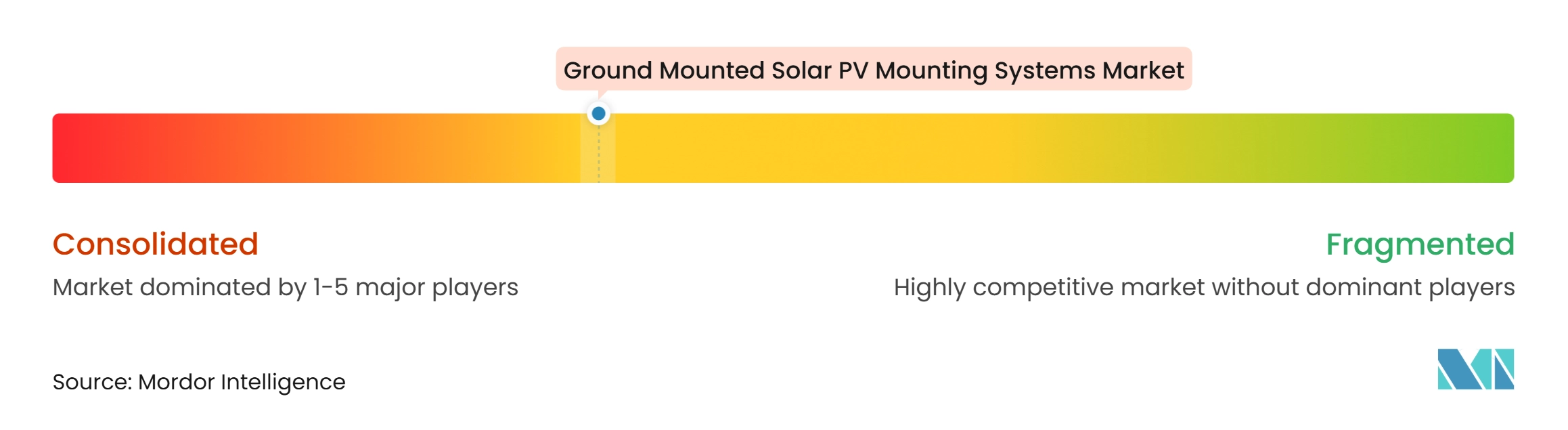
The Ground Mounted Solar PV Mounting Systems Market is moderately concentrated, with clear differences between tracker and fixed-tilt suppliers. Global tracker specialists compete through energy yield, software, installation efficiency, and bankability, while high-volume structural manufacturers compete strongly on price in fixed-tilt procurement. Nextracker reported FY2025 revenue of USD 3.0 billion and year-end backlog exceeding USD 4.5 billion. Its TrueCapture system shows how suppliers are extending their offers into operating performance services. Certification also remains important in project financing reviews. IEC 62817 addresses photovoltaic tracker design qualification, while UL 2703 covers mounting-system bonding and related safety requirements.
Digital planning and engineering tools are becoming more visible in competitive positioning. K2 Systems introduced its K2 KAI digital planning assistant at Intersolar 2025. Schletter Group launched its Schletter Creator planning tool in April 2025. Antaisolar announced more than 2 GW of partnership agreements at SNEC 2025, covering markets across 6 continents. These actions show that suppliers are expanding market access through digital tools, channel relationships, and global partnerships. The resulting competition extends beyond basic steel fabrication. Suppliers must show product compatibility, engineering support, and ability to deliver at project scale.
Unirac’s July 2026 acquisition of TerraSmart’s racking and foundation business from Gibraltar Industries for USD 5 million consolidated parts of the North American ground-mount and distributed-generation offering. The deal brought ground-mount, tracker, and canopy capability under Unirac’s platform. Opportunities remain in systems for difficult terrain, agrivoltaic designs, and weather-resilient operation. AXIS Capital’s hail analysis makes the commercial importance of reliable stow performance clear. Company-level share data for the leading suppliers is not provided in the source material. The Ground Mounted Solar PV Mounting Systems Market therefore does not support a quantified ranking of the leading suppliers based on combined share.
Ground Mounted Solar PV Mounting Systems Industry Leaders
-
Nextracker Inc.
-
Arctech Solar
-
GameChange Energy
-
ARRAY Technologies, Inc.
-
PV Hardware (PVH)
- *Disclaimer: Major Players sorted in no particular order
Ground Mounted Solar PV Mounting Systems Market Companies Covered in this Report
- Antaisolar
- Arctech Solar
- Array Technologies, Inc.
- Clenergy
- GameChange Solar
- Gonvarri Solar Steel
- Jiangsu Guoqiang Zinc-Plating Industrial Co., Ltd.
- K2 Systems GmbH
- Landpower Solar Technology Co., Ltd.
- Mounting Systems GmbH
- Nextracker Inc.
- Powerway Renewable Energy Co., Ltd.
- PV Hardware (PVH)
- RBI Solar, Inc.
- Schletter Group
- Terrasmart
- Unirac, Inc.
- Xiamen Grace Solar Technology Co., Ltd.
- Xiamen Huge Energy Technology Co., Ltd.
- Xiamen Mibet New Energy Co., Ltd.
Recent Industry Developments in Ground Mounted Solar PV Mounting Systems Market
- October 2026: PV Hardware USA announced a major expansion of its Houston, Texas manufacturing facility, adding 3,180 square meters of space and increasing pre-assembled tracker component capacity by 42%. The expansion moves complex assembly from outdoor construction jobsites into a controlled factory environment, reducing field labor costs for EPC customers. The expansion follows a USD 30 million investment in PVH’s original Houston facility in May 2024 and a 95,000-square-foot tracker factory addition in September 2025.
- July 2026: Unirac acquired the solar racking and foundation business of TerraSmart from Gibraltar Industries for USD 5 million, extending Unirac’s platform from residential and commercial flat-roof racking to include ground-mount, tracker, and canopy solutions serving C&I and distributed generation solar markets across North America. TerraSmart’s brand, engineering team, and product portfolio are integrated into Unirac’s combined entity.
- November 2025: Antaisolar officially launched the AT-Spark intelligent tracking system, featuring a self-developed octagonal torque tube improving stiffness by 40% and strength by 50% while reducing material costs by 30% versus prior-generation designs. The system supports a 143-meter tracker span, incorporates 4 intelligent weather-protection modes for wind, snow, flood, and hail, and is paired with the SmartTrail control system providing real-time SCADA monitoring and remote O&M management.
- September 2025: GameChange Solar released FlexRail, a mounting system allowing the same tracker design to accommodate multiple PV module types without field remediation, directly addressing module supply volatility created by tariffs and logistics disruptions. The system features clamp-based rail systems, flexible purlins, unpunched torque tubes, and low-profile bearings, and is compliant with UL 2703 per testing at Intertek.
Global Ground Mounted Solar PV Mounting Systems Market Report Scope
A ground-mounted solar PV mounting system is an engineered structural and racking framework fixed directly into the ground to support and position photovoltaic (PV) solar panels. Unlike rooftop installations, it operates independently of building architecture, allowing panels to be placed at optimal tilt angles and orientations across open land.
The ground mounted solar PV mounting systems market is segmented into type, material, technology compatibility, application, end user, and geography. By type, the market is divided into fixed mounting systems and tracking mounting systems. By material, the market is divided into aluminum, steel, galvanized iron, and others (composites, polymers). By technology compatibility, the market is segmented into crystalline silicon pv modules, thin film PV modules, bifacial solar panels, and others. By application, the market is segmented into residential, commercial and industrial, utility-scale, off-grid applications, and others. By end user, the market is divided into EPC companies, solar project developers, installers and integrators, utilities and IPPs, government and defense, and others. The report also covers the market size and forecasts for the global ground mounted solar PV mounting systems market across 20 countries in key regions. For each segment, the market sizing and forecasts have been provided on the basis of value (USD).
Segmentation Overview
| Fixed Mounting Systems |
| Tracking Mounting Systems |
| Aluminum |
| Steel |
| Galvanized Iron |
| Others (Composites, Polymers) |
| Crystalline Silicon PV Modules |
| Thin-Film PV Modules |
| Bifacial Solar Panels |
| Others |
| Residential |
| Commercial and Industrial |
| Utility-Scale |
| Off-grid Applications |
| Others |
| EPC Companies |
| Solar Project Developers |
| Installers and Integrators |
| Utilities and IPPs |
| Government and Defense |
| Others |
| North America | United States |
| Canada | |
| Mexico | |
| Europe | Germany |
| United Kingdom | |
| France | |
| Italy | |
| NORDIC Countries | |
| Russia | |
| Rest of Europe | |
| Asia-Pacific | China |
| India | |
| Japan | |
| South Korea | |
| ASEAN Countries | |
| Rest of Asia-Pacific | |
| South America | Brazil |
| Argentina | |
| Rest of South America | |
| Middle East and Africa | Saudi Arabia |
| United Arab Emirates | |
| South Africa | |
| Egypt | |
| Rest of Middle East and Africa |
| By Type | Fixed Mounting Systems | |
| Tracking Mounting Systems | ||
| By Material | Aluminum | |
| Steel | ||
| Galvanized Iron | ||
| Others (Composites, Polymers) | ||
| By Technology Compatibility | Crystalline Silicon PV Modules | |
| Thin-Film PV Modules | ||
| Bifacial Solar Panels | ||
| Others | ||
| By Application | Residential | |
| Commercial and Industrial | ||
| Utility-Scale | ||
| Off-grid Applications | ||
| Others | ||
| By End-user | EPC Companies | |
| Solar Project Developers | ||
| Installers and Integrators | ||
| Utilities and IPPs | ||
| Government and Defense | ||
| Others | ||
| By Geography | North America | United States |
| Canada | ||
| Mexico | ||
| Europe | Germany | |
| United Kingdom | ||
| France | ||
| Italy | ||
| NORDIC Countries | ||
| Russia | ||
| Rest of Europe | ||
| Asia-Pacific | China | |
| India | ||
| Japan | ||
| South Korea | ||
| ASEAN Countries | ||
| Rest of Asia-Pacific | ||
| South America | Brazil | |
| Argentina | ||
| Rest of South America | ||
| Middle East and Africa | Saudi Arabia | |
| United Arab Emirates | ||
| South Africa | ||
| Egypt | ||
| Rest of Middle East and Africa | ||
Key Questions Answered in the Report
What is the expected growth rate for ground-mounted solar PV mounting systems?
The global ground mounted solar PV mounting systems market is forecast to grow at a CAGR of 4.89% from 2027 to 2032 and reach USD 36.57 billion by 2032.
Which mounting-system type is growing fastest?
Tracking Mounting Systems are forecast to grow at a 6.5% CAGR through 2032, supported by single-axis tracker use in utility-scale projects.
Why are bifacial solar modules important for mounting suppliers?
Bifacial Solar Panels are forecast to grow at an 8.1% CAGR through 2032. They increase the importance of limiting rear-side shading, setting suitable module height, and optimizing tracker geometry.
What material has the largest role in ground-mounted structures?
Galvanized Iron held 43.6% share in 2026 and is projected to grow at a 6.2% CAGR through 2032 because it combines durability with large-project cost efficiency.
Which region leads demand for mounting systems?
Asia-Pacific held 47.8% share in 2026 and is forecast to grow at a 6.1% CAGR through 2032, supported by solar activity in India, China, Japan, and ASEAN countries.
What risks affect solar mounting-system procurement?
Material-price changes, tracker weather performance, permitting, grid interconnection delays, and curtailment can delay or reduce project procurement.