
Green Steel Market Size and Share
Market Overview
| Study Period | 2021 - 2031 |
|---|---|
| Market Size (2026) | USD 14.13 Billion |
| Market Size (2031) | USD 99.58 Billion |
| Growth Rate (2026 - 2031) | 47.78 % |
| Fastest Growing Market | Asia-Pacific |
| Largest Market | Asia-Pacific |
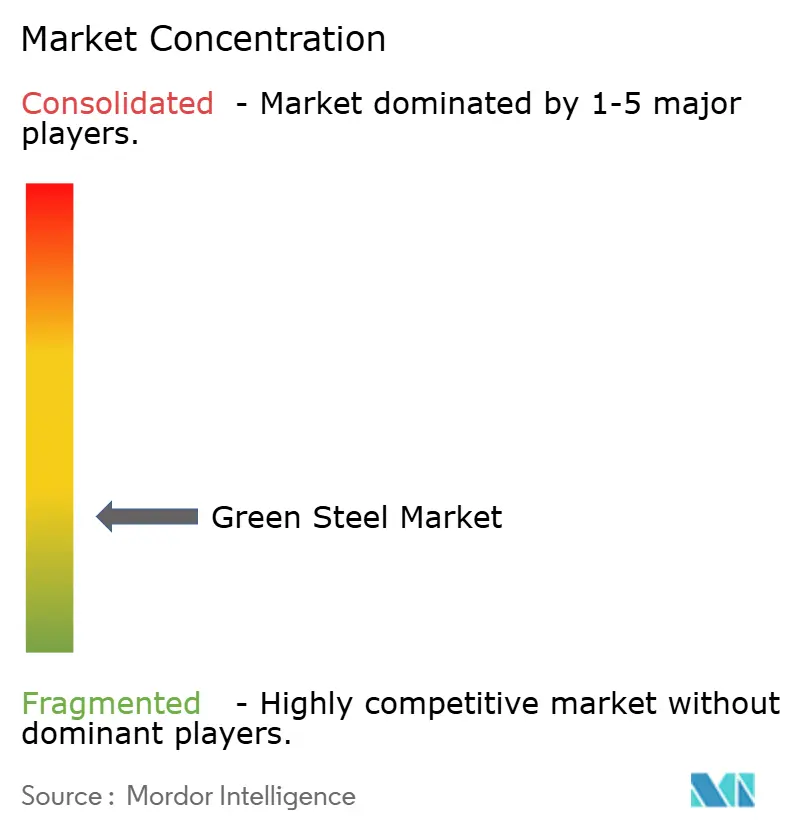
| Market Concentration | Low |
Major Players *Disclaimer: Major Players sorted in no particular order Image © Mordor Intelligence. Reuse requires attribution under CC BY 4.0. | |
Green Steel Market Analysis by Mordor Intelligence
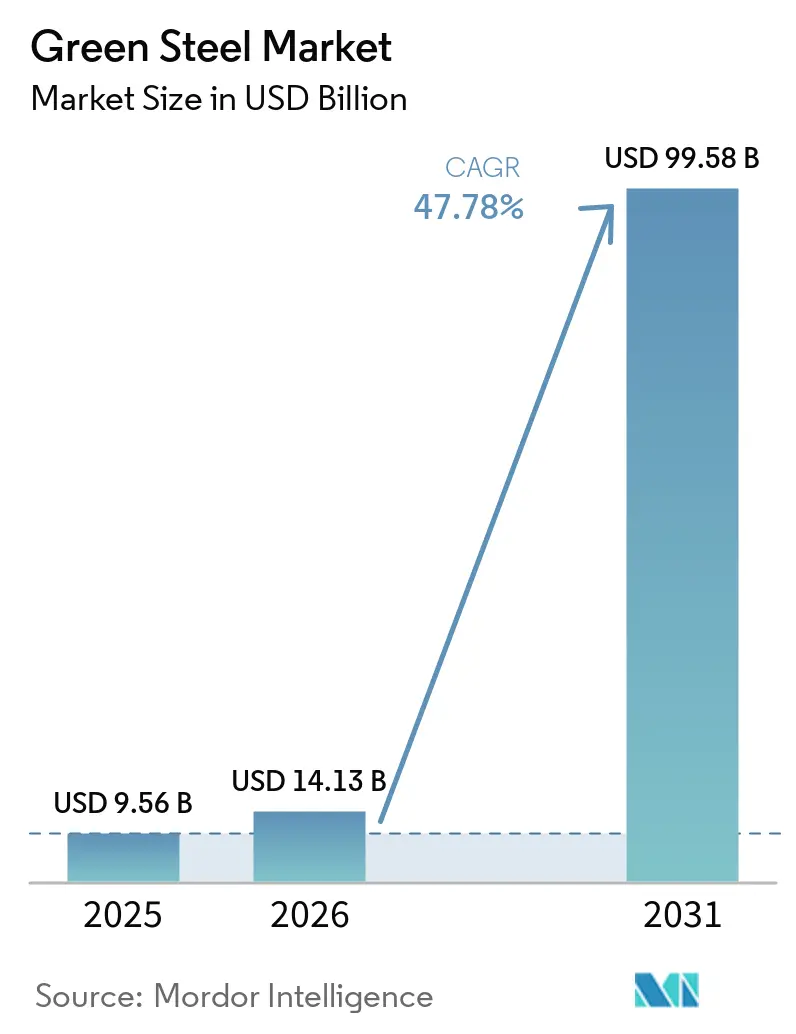
The Green Steel Market size was valued at USD 9.56 billion in 2025 and is estimated to grow from USD 14.13 billion in 2026 to reach USD 99.58 billion by 2031, at a CAGR of 47.78% during the forecast period (2026-2031). Carbon pricing is changing the economics of steel procurement, particularly as the European Union Carbon Border Adjustment Mechanism (CBAM) moved into full compliance in January 2026. Buyers in automotive and other steel-intensive sectors are placing greater emphasis on documented emissions and long-term supply arrangements. Public incentives are helping producers fund electric arc furnace (EAF), direct reduction, renewable power, and hydrogen projects. The green steel market also faces higher production costs and limited availability of key inputs, which keeps the transition uneven across regions. Producers that can verify lower emissions and secure feedstock are better placed to capture demand as purchasing requirements become more formal.
Key Report Takeaways
- By production technology, renewable electric arc furnace held 55.13% of the green steel market share in 2025, while hydrogen-based direct reduction and electric arc furnace are projected to advance at a 49.11% CAGR through 2031.
- By product form, hot-rolled coil held 34.56% of the green steel market share in 2025 and is projected to advance at a 49.56% CAGR through 2031.
- By end-use, automotive and transportation held 38.68% of the green steel market share in 2025 and are projected to advance at a 50.48% CAGR through 2031.
- By geography, Asia-Pacific held 40.19% of the green steel market share in 2025 and is projected to advance at a 48.95% CAGR through 2031.
Note: Market size and forecast figures in this report are generated using Mordor Intelligence’s proprietary estimation framework, updated with the latest available data and insights as of January 2026.
Market Trends and Insights
Drivers Impact Analysis of Green Steel Market*
| Driver | (~) % Impact on CAGR Forecast | Geographic Relevance | Impact Timeline |
|---|---|---|---|
| Carbon Pricing, CBAM and Declining Free Emissions Allocations | +8.5% | EU primary; APAC and North America spillover | Short term (≤ 2 years) |
| Corporate Scope 3 Procurement and Low-Carbon Product Requirements | +7.2% | Global; North America & EU lead, APAC accelerating | Medium term (2–4 years) |
| Public Funding, Clean Procurement and Industrial Decarbonization Incentives | +6.1% | North America, EU, APAC core | Medium term (2–4 years) |
| Renewable Electricity and Green Hydrogen Integration | +5.3% | APAC, EU, MENA; emerging in South America | Long term (≥ 4 years) |
| Cross-Regional HBI and DRI Trade Corridors | +3.9% | MENA, APAC; spillover to EU and North America | Medium term (2–4 years) |
| Source: Mordor Intelligence | |||
Carbon Pricing, CBAM and Declining Free Emissions Allocations
The Carbon Border Adjustment Mechanism entered its full compliance phase in January 2026. Importers must purchase certificates that reflect the European Union Emissions Trading System price for embedded emissions in imported steel. Research on the earlier reporting phase found that Indian exporters with higher emissions recorded a 9% additional decline in European Union-bound revenue compared with lower-emissions peers. The policy raises the value of credible product-level emissions records for steelmakers and their customers. The green steel market, therefore, gives an advantage to producers that can maintain carbon accounting systems alongside lower-emissions production routes. This information can also shape commercial discussions between mills, importers, and downstream customers.
Corporate Scope 3 Procurement and Low-Carbon Product Requirements
Corporate Scope 3 procurement is moving low-carbon steel purchases toward longer-term offtake agreements. Within the green steel market procurement, these agreements give new projects a clearer basis for financing and reduce uncertainty for producers. Nissan Motor expanded its use of low-carbon steel 5-fold in fiscal year 2025 for vehicles sold in Japan. The company sourced material from NIPPON STEEL CORPORATION, JFE Holdings, Inc., and POSCO. In the green steel market, this pattern separates buyers who accept a premium for certified supply from spot buyers who remain focused on immediate price. It also makes stable buyer commitments more valuable when producers plan new capacity.
Public Funding, Clean Procurement and Industrial Decarbonization Incentives
Public funding is helping convert announced projects into operating assets in the green steel market. ArcelorMittal received USD 280.5 million in Inflation Reduction Act investment tax credits for its Calvert electrical steel expansion. thyssenkrupp Steel Europe received German federal and state support for its Duisburg direct reduction transformation. These programs help producers manage the capital required for electric arc furnaces, renewable power, hydrogen, and related infrastructure. The resulting investment pattern favors markets that offer both financing support and clear compliance rules. It also extends the role of public procurement beyond direct grants and tax incentives.
Renewable Electricity and Green Hydrogen Integration
Renewable electricity is becoming a central cost and location factor for low-carbon steel production. China’s cumulative installed new-energy generation capacity reached 1.41 billion kilowatts at the end of 2024, following 33.9% annual growth. Research published in 2026 found that operating flexibility across Hydrogen-Based Direct Reduction and Electric Arc Furnace systems can reduce the levelized cost of steel by 6% to 10%. The Organisation for Economic Co-operation and Development identifies Hydrogen-Based Direct Reduction and Electric Arc Furnace as the commercially scalable near-zero primary steelmaking route[1]. Electricity can represent close to 20% of electric arc furnace mill costs, which increases the importance of a reliable renewable supply. Producers must therefore consider power availability alongside hydrogen supply when selecting project locations.
Restraints Impact Analysis of Green Steel Market*
| Restraint | (~) % Impact on CAGR Forecast | Geographic Relevance | Impact Timeline |
|---|---|---|---|
| High Capital Intensity and Green Cost Premiums | -5.8% | Global; most acute in APAC emerging markets and South America | Long term (≥ 4 years) |
| Green Hydrogen, Renewable Power and Grid Infrastructure Gaps | -4.7% | EU, APAC, South America; nascent in MENA | Medium term (2–4 years) |
| Limited DR-Grade Pellets, High-Quality Scrap and HBI Availability | -3.4% | Global; most acute in EU and APAC | Medium term (2–4 years) |
| Source: Mordor Intelligence | |||
High Capital Intensity and Green Cost Premiums
High capital costs and operating premiums remain the main barrier to wider green steel adoption. The International Council on Clean Transportation estimated that a greenfield hydrogen-based direct reduction and electric arc furnace plant in the United States produces steel at USD 812 per metric ton[2]. This level was 34% above the cost of relining a conventional blast furnace and basic oxygen furnace facility. Energy and raw materials accounted for 77% of production costs in that assessment. Capital availability and policy support will continue to shape which green steel market projects reach commercial operation first. The effect is strongest where producers must replace existing integrated assets rather than build on electric arc furnace capacity.
Green Hydrogen, Renewable Power and Grid Infrastructure Gaps
Hydrogen, renewable power, and grid constraints can delay projects even when producers have committed capital. SSAB moved the expected startup of its Luleå mill from the end of 2028 to the end of 2029 because of national grid modernization delays. Research published in 2025 found that hydrogen compression from electrolyzer output to pipeline specifications can consume 10% to 15% of total energy input. A large hydrogen-based direct reduction and electric arc furnace plant also requires extensive renewable generation and land. These conditions make co-located renewable power and industrial infrastructure more important for the green steel market. They can also affect project schedules when grid reinforcement does not progress as planned.
*Our forecasts treat driver/restraint impacts as directional, not additive. The impact forecasts reflect baseline growth, mix effects, and variable interactions.
Green Steel Market Segment Analysis
By Production Technology:
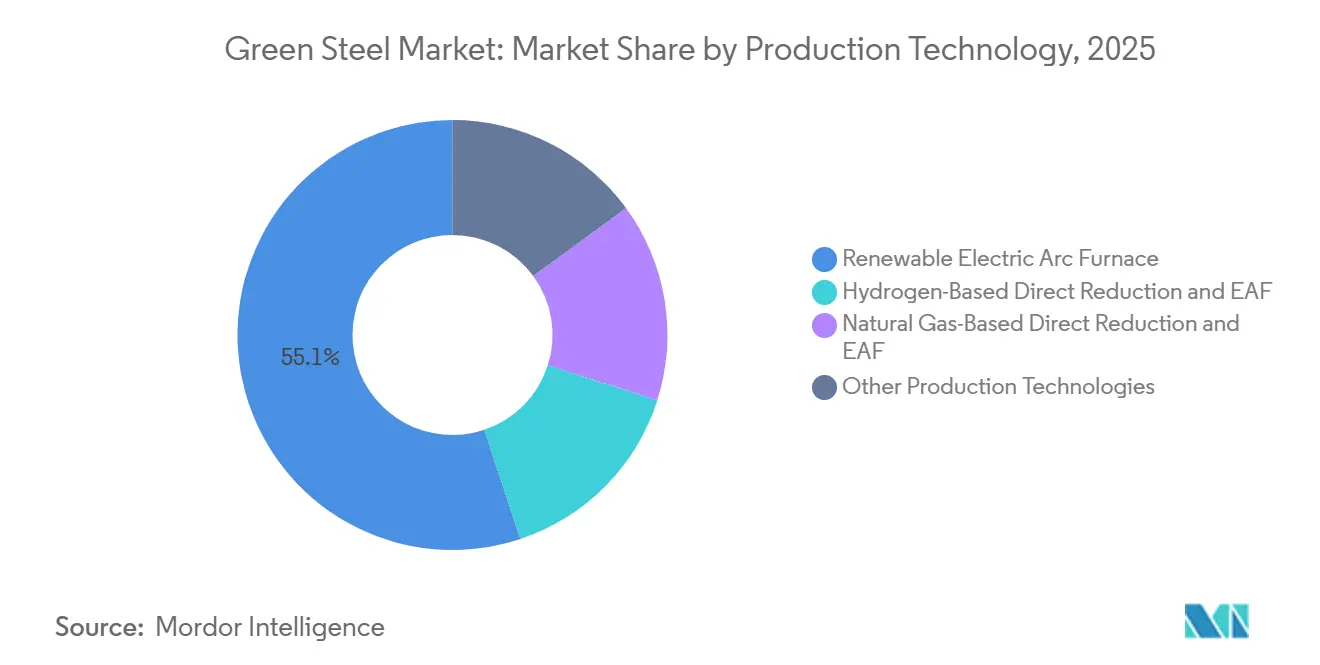
Renewable Electric Arc Furnace Leads Current Output While Hydrogen-Based Direct Reduction and EAF ExpandThe renewable electric arc furnace held 55.13% of the green steel market share in 2025, while hydrogen-based direct reduction and EAF are projected to advance at a 49.11% CAGR through 2031. The route can deliver up to 89% lower greenhouse gas emissions than conventional blast furnace and basic oxygen furnace production. It can also increase electricity demand by up to 18 times, which places grid capacity at the center of site selection. SSAB met the International Energy Agency's near-zero carbon dioxide equivalent threshold in September 2025 using hydrogen-reduced iron from HYBRIT. Stegra’s Boden project represents a purpose-built approach that competes on low emissions intensity rather than gradual emissions reduction.
A renewable electric arc furnace can use available scrap and renewable electricity without waiting for a full green hydrogen supply chain. This gives it a near-term cost and scaling advantage in areas with strong scrap collection systems. The majority of the United States steel production already uses electric arc furnaces, providing a lower-carbon starting point for new capacity. Natural gas-based direct reduction and electric arc furnaces remain a transition option, while hydrogen-ready shaft furnaces can give producers a path to lower emissions as hydrogen supply develops.

By Product Form:
Hot-Rolled Coil Leads Both Share and GrowthHot-rolled coil held 34.56% of the market share in 2025 and is projected to advance at a 49.56% CAGR through 2031. Its broad use in electric vehicle body panels, wind towers, and construction framing supports green steel market demand for certified lower-emissions supply. thyssenkrupp Steel Europe began supplying bluemint recycled steel to BMW Group for the BMW iX3 in February 2026. The agreement covers outer panels and battery housings, without requiring changes to BMW Group production lines. This illustrates the shift from general catalog purchases toward verified, application-specific supply agreements.
Slabs are a key upstream material for hot-rolled coil and become more important as producers integrate certified supply chains. Cold-rolled coil serves automotive and electronics applications that require tighter material specifications. NIPPON STEEL CORPORATION and JFE Holdings, Inc., market certified low-carbon grades for electric vehicle component supply chains. Galvanized and coated steel receives higher green premiums in some European applications because buyers seek verified lower-emissions surface steel. Plate and structural sections are also gaining interest for energy and infrastructure projects that specify embodied emissions in material procurement.
By End-Use:
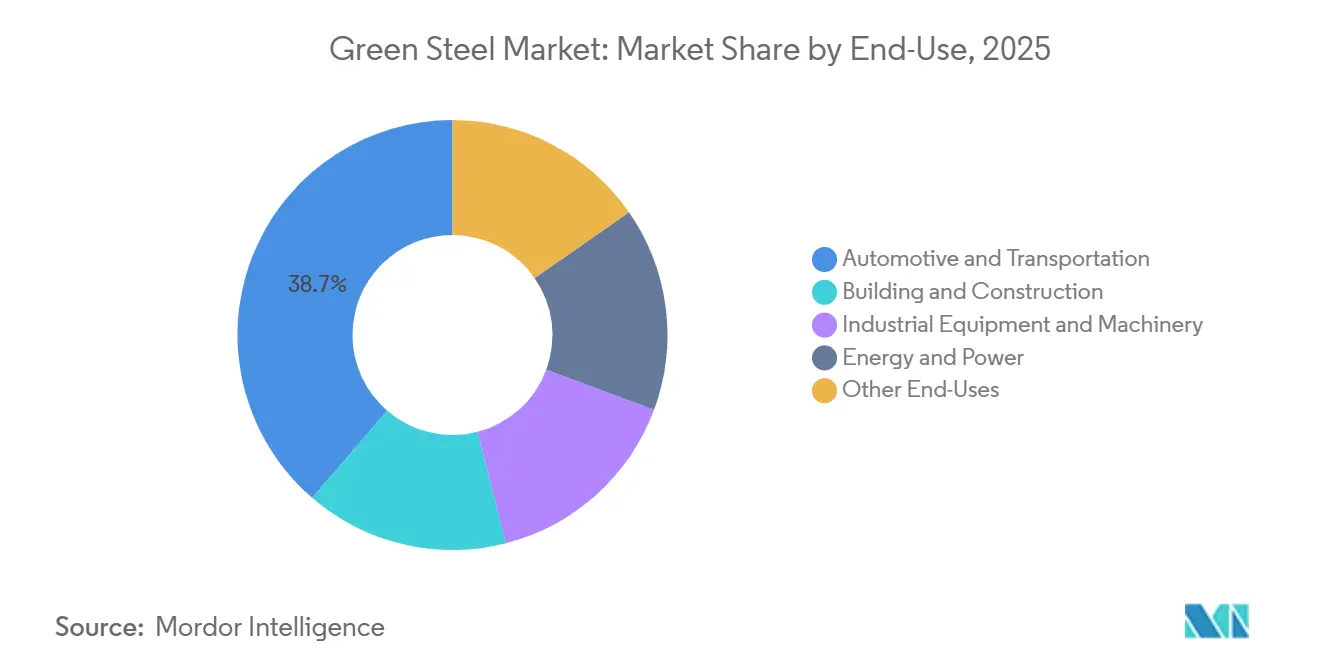
Automotive and Transportation Drives Long-Term ProcurementAutomotive and transportation held 38.68% of the green steel market in 2025 and is projected to advance at a 50.48% CAGR through 2031. Automotive buyers need steel with documented emissions reductions to support their wider supply-chain targets. Nissan Motor’s 2025 sourcing increase shows how vehicle manufacturers are broadening procurement of low-carbon grades. Many buyers are seeking bilateral supply agreements that extend several years into the future. This behavior supports plant financing but can limit supply availability for customers who continue to buy only in the spot market.
Public procurement requirements for low-carbon materials in infrastructure programs support building and construction. Industrial equipment and machinery buyers move more gradually because mechanical performance remains the first purchasing consideration. Energy and power demand are supported by steel use in renewable equipment. Wind turbines contain 40% to 50% iron and steel by weight. Shipbuilding and defense represent smaller early-stage uses where export requirements and public procurement can shape demand for verified material.
Geography Analysis
APAC Green Steel Market
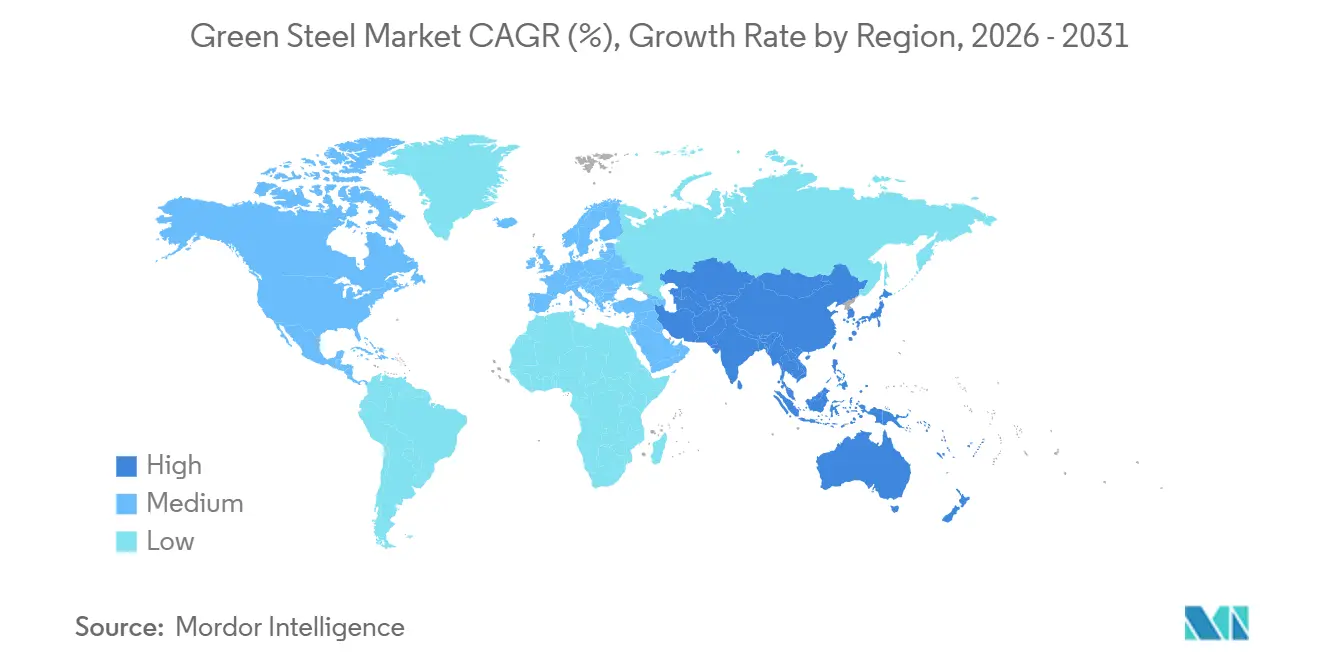
Asia-Pacific held 40.19% of the green steel market in 2025 and is projected to advance at a 48.95% CAGR through 2031. POSCO inaugurated South Korea’s largest electric arc furnace at Gwangyang in June 2026. The 2.5 million metric ton per year facility can reduce carbon dioxide emissions by up to 75% compared with blast furnace routes. India launched its Green Steel Taxonomy in 2025, and AM/NS India became the first integrated producer certified under it for hot-rolled coil and cold-rolled coil products.
Europe Green Steel Market
Europe is the most policy-intensive regional green steel market. Producers are investing in electric arc furnaces and direct reduction capacity as Carbon Border Adjustment Mechanism compliance changes procurement economics. ArcelorMittal confirmed a EUR 1.3 billion (approximately USD 1.48 billion) electric arc furnace investment at Dunkirk in February 2026. SSAB began construction of its EUR 4.5 billion (approximately USD 5.11 billion) Luleå mill in September 2025, while Germany, France, Sweden, and the United Kingdom host a large share of active projects, and Nordic electricity systems support lower-carbon electric arc furnace production.
The Americas and MEA Green Steel Market
North America benefits from an established electric arc furnace base, with most of the United States steel production already using the route. Nucor Corporation struck the first arc at its USD 4 billion West Virginia sheet mill in August 2026. The facility is expected to ramp to 3 million metric tons per year in 2027. South America can supply green iron because of its magnetite resources and renewable energy potential. The Middle East and Africa are oriented toward direct reduced iron and hot briquetted iron exports, although their long-product mix limits access to Europe’s higher-value flat steel demand.
Competitive Landscape
The green steel market is highly fragmented, with the top five players including ArcelorMittal, SSAB, Stegra, Salzgitter AG, and thyssenkrupp Steel Europe. Their strategies differ between phased electric arc furnace conversion and full route replacement. POSCO is developing HyREX, which targets hydrogen-based direct reduction of fine ores without pelletizing and is planned for commercial deployment by 2030.
Technology development, certification, and raw-material access shape competitive positioning in the green steel market. SSAB uses HYBRIT, POSCO uses HyREX, and voestalpine AG is developing Hy4Smelt. ArcelorMittal, thyssenkrupp Steel Europe, and NIPPON STEEL CORPORATION are using product certification to support premium grades. Salzgitter AG’s SALCOS program includes an electric arc furnace at its Hüttenwerke Krupp Mannesmann (HKM) Duisburg plant, with production through the new route expected in the first half of 2027.
New entrants and downstream integrators are putting pressure on producers that rely on incremental upgrades to conventional routes. Stegra is building capacity around hydrogen-based direct reduction and electric arc furnace production. Marcegaglia and Danieli signed a EUR 450 million (approximately USD 511 million) agreement in April 2026 for an electric arc furnace and flat rolling facility in Fos-sur-Mer, France. The project targets 2 million metric tons per year of liquid steel and 3 million metric tons per year of hot-rolled coil. Competition increasingly depends on whether producers can combine credible certification, feedstock security, and commercially reliable delivery.
Green Steel Industry Leaders
-
ArcelorMittal
-
SSAB
-
Stegra
-
Salzgitter AG
-
thyssenkrupp Steel Europe
- *Disclaimer: Major Players sorted in no particular order
Green Steel Market Companies Covered in this Report
- ArcelorMittal
- BAOWU Metal
- Cleveland-Cliffs Inc.
- HYUNDAI STEEL
- JFE Holdings, Inc.
- NIPPON STEEL CORPORATION
- Nucor Corporation
- POSCO
- Salzgitter AG
- SSAB
- Stegra
- Tata Steel Limited
- thyssenkrupp Steel Europe
- United States Steel Corporation
- voestalpine AG
Recent Industry Developments in Green Steel Market
- September 2026: ArcelorMittal and Moeve launched a joint innovation platform under their Green Molecules to Green Steel (G2G) alliance to develop projects using renewable hydrogen, biogas, biomethane, and other green molecules for lower-emission steel production. The initiative supports the green steel market by advancing scalable energy and process solutions for decarbonizing steelmaking.
- September 2026: Stegra selected ESL Shipping, Royal Wagenborg, Pangaea Logistics Solutions, and Clarksons to manage maritime transportation for its green steel operations in Boden, Sweden. The logistics network will support inbound scrap and iron supplies and outbound transportation of green steel products across Europe, strengthening the supply-chain infrastructure supporting green steel production.
Global Green Steel Market Report Scope
Green steel refers to steel produced through manufacturing routes designed to significantly reduce greenhouse gas emissions compared with conventional steelmaking. It relies on lower-carbon energy sources, alternative reduction processes, and cleaner production pathways to reduce the carbon intensity of steel production.
The Green Steel Market is segmented by production technology, product form, end-use, and geography. By production technology, the market is segmented into renewable electric arc furnace, hydrogen-based direct reduction and EAF, natural gas-based direct reduction and EAF, and other production technologies. By product form, the market is segmented into hot-rolled coil, slabs, cold-rolled coil, galvanized and coated steel, and other product forms. By end-use, the market is segmented into automotive and transportation, building and construction, industrial equipment and machinery, energy and power, and other end-uses. The report also covers the market size and forecasts for green steel across 15 countries. For each segment, the market sizing and forecasts have been done on the basis of value (USD).
Segmentation Overview
| Renewable Electric Arc Furnace |
| Hydrogen-Based Direct Reduction and EAF |
| Natural Gas-Based Direct Reduction and EAF |
| Other Production Technologies |
| Hot-Rolled Coil |
| Slabs |
| Cold-Rolled Coil |
| Galvanized and Coated Steel |
| Other Product Forms |
| Automotive and Transportation |
| Building and Construction |
| Industrial Equipment and Machinery |
| Energy and Power |
| Other End-Uses |
| Asia-Pacific | China |
| India | |
| Japan | |
| South Korea | |
| ASEAN Countries | |
| Rest of Asia-Pacific | |
| North America | United States |
| Canada | |
| Mexico | |
| Europe | Germany |
| United Kingdom | |
| France | |
| Italy | |
| NORDIC Countries | |
| Rest of Europe | |
| South America | Brazil |
| Argentina | |
| Rest of South America | |
| Middle East and Africa | Saudi Arabia |
| South Africa | |
| Rest of Middle East and Africa |
| By Production Technology | Renewable Electric Arc Furnace | |
| Hydrogen-Based Direct Reduction and EAF | ||
| Natural Gas-Based Direct Reduction and EAF | ||
| Other Production Technologies | ||
| By Product Form | Hot-Rolled Coil | |
| Slabs | ||
| Cold-Rolled Coil | ||
| Galvanized and Coated Steel | ||
| Other Product Forms | ||
| By End-Use | Automotive and Transportation | |
| Building and Construction | ||
| Industrial Equipment and Machinery | ||
| Energy and Power | ||
| Other End-Uses | ||
| By Geography | Asia-Pacific | China |
| India | ||
| Japan | ||
| South Korea | ||
| ASEAN Countries | ||
| Rest of Asia-Pacific | ||
| North America | United States | |
| Canada | ||
| Mexico | ||
| Europe | Germany | |
| United Kingdom | ||
| France | ||
| Italy | ||
| NORDIC Countries | ||
| Rest of Europe | ||
| South America | Brazil | |
| Argentina | ||
| Rest of South America | ||
| Middle East and Africa | Saudi Arabia | |
| South Africa | ||
| Rest of Middle East and Africa | ||
Key Questions Answered in the Report
What is the size of the green steel market?
The green steel market stands at USD 14.13 billion in 2026 and is projected to reach USD 99.58 billion by 2031.
What is driving demand for lower-emissions steel?
Carbon Border Adjustment Mechanism compliance, corporate Scope 3 purchasing, public funding, and renewable power development are supporting demand.
Which production technology is expected to grow fastest through 2031?
Hydrogen-based direct reduction and EAF are projected to advance at a 49.11% CAGR through 2031.
Which product form held the largest share in 2025?
Hot-rolled coil held 34.56% of the market share in 2025.