
Graphite Purification Chemicals Market Size and Share
Market Overview
| Study Period | 2022 - 2032 |
|---|---|
| Market Size (2027) | USD 543 Million |
| Market Size (2032) | USD 899.03 Million |
| Growth Rate (2027 - 2032) | 10.61 % |
| Fastest Growing Market | Asia-Pacific |
| Largest Market | Asia-Pacific |
| Market Concentration | Medium |
Major Players *Disclaimer: Major Players sorted in no particular order Image © Mordor Intelligence. Reuse requires attribution under CC BY 4.0. | |
Graphite Purification Chemicals Market Analysis by Mordor Intelligence
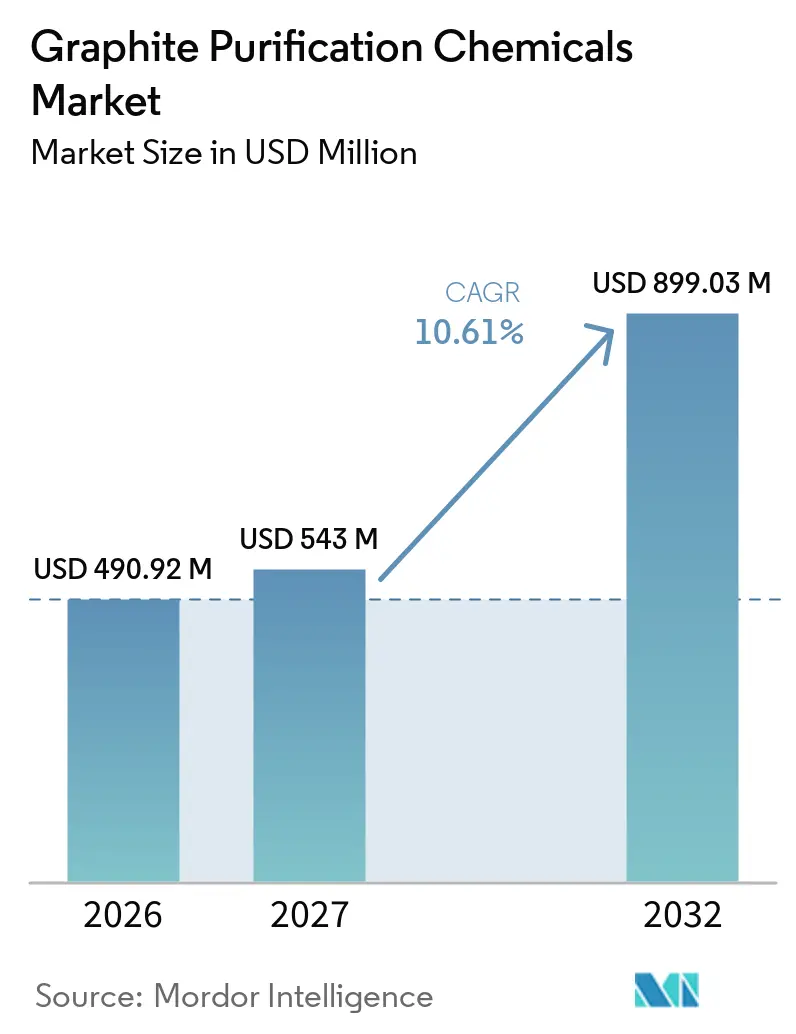
The Graphite Purification Chemicals Market size was valued at USD 490.92 million in 2026 and is estimated to grow from USD 543.00 million in 2027 to reach USD 899.03 million by 2032, at a CAGR of 10.61% during the forecast period (2027-2032). The graphite purification chemicals market grows as battery and energy-storage producers require graphite with high carbon purity and controlled metallic impurities. Semiconductor manufacturing also supports demand because graphite components used in wafer processing need tightly managed impurity profiles. Chemical suppliers are responding by combining high-purity grades, local production, and technical qualification support. New processing projects outside China create openings for regional suppliers of hydrofluoric acid (HF), hydrochloric acid (HCl), sulfuric acid (H₂SO₄), and related reagents. At the same time, wastewater treatment, energy use, and long customer approval periods can slow the conversion of planned processing capacity into chemical sales.
Key Report Takeaways
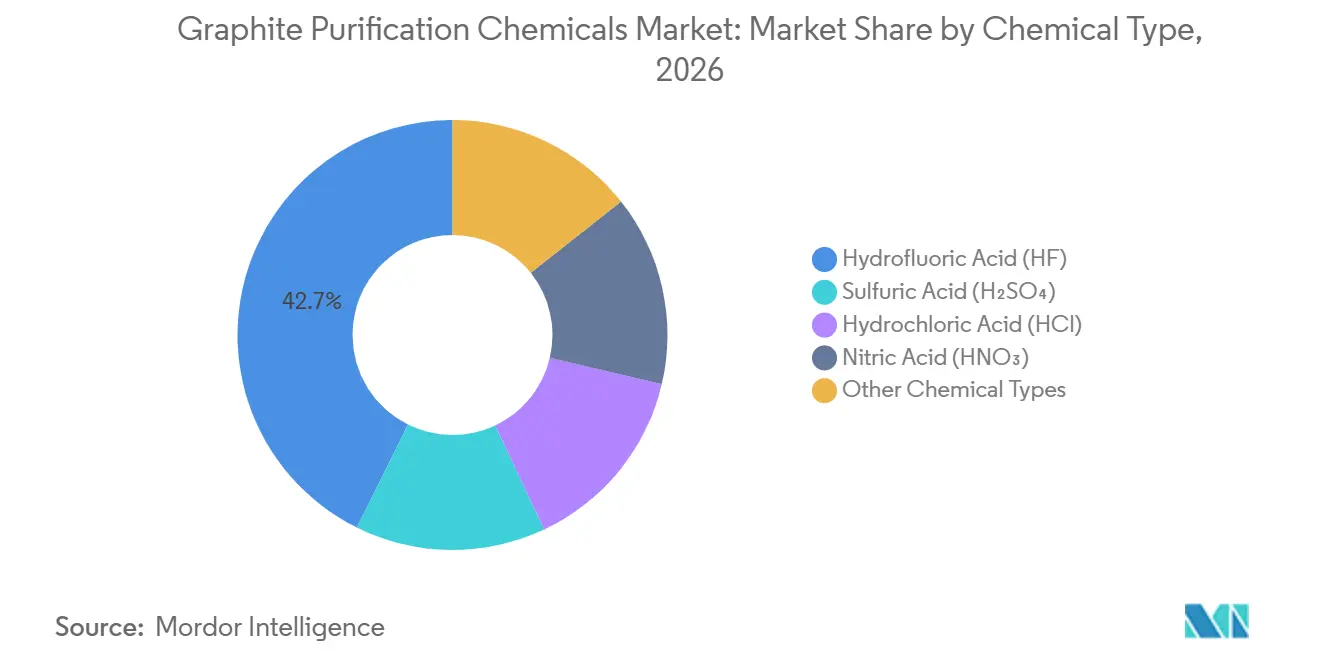
- By chemical type, hydrofluoric acid (HF) held 42.67% of the graphite purification chemicals market share in 2026 and is projected to advance at an 11.45% CAGR through 2032.
- By purification method, acid leaching held 45.13% of the graphite purification chemicals market share in 2026, while thermal purification is projected to advance at a 12.67% CAGR through 2032.
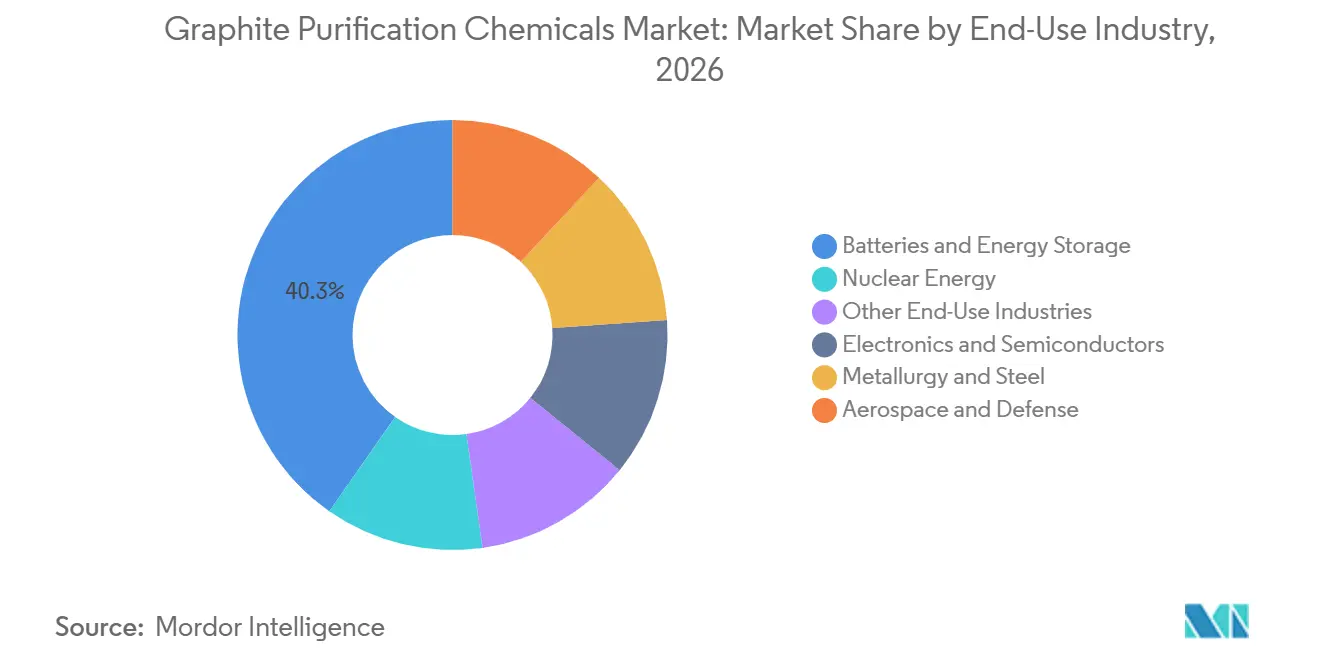
- By end-use industry, batteries and energy storage held 40.28% of the graphite purification chemicals market share in 2026 and are projected to advance at a 12.92% CAGR through 2032.
- By geography, Asia-Pacific held 52.74% of the graphite purification chemicals market share in 2026 and is projected to advance at an 11.58% CAGR through 2032.
Note: Market numbers in this report are based on Mordor Intelligence's proprietary estimation framework, which combines nine months of actuals with Q4 projections for base year 2026.
Global Graphite Purification Chemicals Market Trends and Insights
Drivers Impact Analysis*
| Driver | (~) % Impact on CAGR Forecast | Geographic Relevance | Impact Timeline |
|---|---|---|---|
| Accelerating Lithium-Ion Battery Anode Demand | +3.2% | Global, concentrated in APAC, EU, and North America | Short term (≤ 2 years) |
| Semiconductor and Silicon Processing Expansion | +2.4% | APAC core (Taiwan, Japan, South Korea), spillover to North America and EU | Medium term (2-4 years) |
| Supply-Chain Localization and Ex-China Purification Capacity | +1.8% | North America & EU | Medium term (2-4 years) |
| Growing Demand for Ultra-High-Purity Graphite in Nuclear and Aerospace Applications | +1.2% | North America, EU, APAC | Long term (≥ 4 years) |
| Customer Qualification Advantage of Consistent Impurity Profiles | +0.7% | Global | Medium term (2-4 years) |
| Source: Mordor Intelligence | |||
Accelerating Lithium-Ion Battery Anode Demand
China’s anode-material shipments reached 1.29 million metric tons in the first half of 2025, and artificial graphite represented 90.7% of output. The graphite purification chemicals market benefits when anode production rises because natural and synthetic graphite require controlled purification before battery use. Battery-grade graphite commonly requires at least 99.95% carbon purity, which supports use of HF, HCl, and H₂SO₄ in purification sequences. Higher energy-density targets can also require tighter metallic-impurity control in anode material. This increases the number and rigor of chemical treatment stages for suitable feedstock.
Semiconductor and Silicon Processing Expansion
Semiconductor and silicon-processing facilities use graphite in susceptors, growth crucibles, heaters, and related equipment. These applications need materials with tightly controlled impurity profiles, which supports demand for high-purity purification chemicals. BASF announced a new semiconductor-grade sulfuric-acid facility at Ludwigshafen, Germany, with operations expected by 2027 to support expanding European chip production. Stella Chemifa Corporation reported 105,000 metric tons of annual high-purity HF capacity across its Kitakyushu, Sanpo, and Singapore plants. Semiconductor customers use lengthy supplier qualification procedures before accepting material changes. Once a specification is approved, the graphite purification chemicals market can have more stable demand than commodity chemical markets.
Supply-Chain Localization and Ex-China Purification Capacity
The graphite purification chemicals market is gaining new regional demand nodes as processors seek purification capacity outside China. The U.S. Geological Survey identified China as the leading source of natural graphite production in 2025 and reported continued trade in spherical purified graphite[1]. New non-Chinese processing facilities need local access to HF, HCl, H₂SO₄, and waste-treatment capability. Northern Graphite signed a letter of intent with Alkeemia in November 2025 to pursue a lower-carbon, lower-cost HF-based purification process at a 200-metric-ton-per-year Porto Marghera pilot facility. POSCO Future M started localizing spherical graphite production in April 2025, showing interest in reducing dependence on imported processing. Chemical suppliers that qualify early with such facilities can develop durable regional supply relationships.
Growing Demand for Ultra-High-Purity Graphite in Nuclear and Aerospace Applications
Nuclear energy, aerospace, and defense applications require grades that place greater emphasis on purity consistency and validation. Focus Graphite achieved 99.999% carbon purity from Lac Knife natural graphite in June 2025 and received conditional funding to advance a Canadian electrothermal fluidized purification demonstration plant. Thermal routes can still require acid pretreatment to lower metallic impurities before furnace processing. This retains a role for HCl and H₂SO₄ in hybrid workflows. Those premium applications have longer approval cycles and can be less exposed to short-term price changes.
Restraints Impact Analysis*
| Restraint | (~) % Impact on CAGR Forecast | Geographic Relevance | Impact Timeline |
|---|---|---|---|
| Hazardous Effluent Treatment and Chemical Handling Costs | -1.8% | Global, most acute in North America & EU | Short term (≤ 2 years) |
| Energy Intensity of Thermal and Hybrid Purification | -1.3% | Global, most acute in APAC and EU | Medium term (2-4 years) |
| Long Qualification Cycles for Battery and Semiconductor Customers | -0.7% | Global | Medium term (2-4 years) |
| Source: Mordor Intelligence | |||
Hazardous Effluent Treatment and Chemical Handling Costs
HF-based purification can generate fluoride-bearing wastewater that requires treatment, controlled handling, and disposal. These needs raise operating and capital costs, especially where environmental and worker-safety standards are stringent. The U.S. Resource Conservation and Recovery Act and the European Union Registration, Evaluation, Authorisation and Restriction of Chemicals framework require facilities to plan for containment, treatment, and safe chemical use. An ACS Energy & Fuels study reported that an ammonium fluoride and sulfuric-acid electrochemical system increased fixed-carbon purity from 97.72% to 99.9% under experimental conditions. Such routes may reduce direct HF exposure, but their broad commercial use remains uncertain. Compliance costs can therefore limit smaller facilities entering the graphite purification chemicals market.
Energy Intensity of Thermal and Hybrid Purification
Thermal purification requires very high temperatures when processors seek ultra-high-purity graphite. This energy requirement raises production costs and limits use to applications that can support premium processing charges. Research on electrically heated fluidized beds identifies heat-transfer behavior, electrical resistivity, and scale-up as important factors for future continuous purification designs. High energy use also affects hybrid routes that combine acid pretreatment with furnace treatment. Suppliers can still benefit from pretreatment demand, but the timing of new thermal projects may be slower than announced capacity suggests. This moderates the short-term pull that thermal processing can create for the graphite purification chemicals market.
*Our forecasts treat driver/restraint impacts as directional, not additive. The impact forecasts reflect baseline growth, mix effects, and variable interactions.
Segment Analysis
By Chemical Type: Hydrofluoric Acid Anchors Revenue and Growth
Hydrofluoric acid held 42.67% of the graphite purification chemicals market share in 2026 and is projected to advance at an 11.45% CAGR through 2032. HF is effective in removing silicate minerals such as quartz and aluminosilicates from natural graphite. This makes it important where feedstock has persistent mineral impurities. HCl addresses iron, calcium, and magnesium compounds and commonly supports pretreatment before HF use. H₂SO₄ and nitric acid (HNO₃) are used in acid-alkali sequences and oxidizing treatments for metallic contaminants. The graphite purification chemicals market relies on these chemical combinations because the appropriate sequence depends on feedstock impurities and required final purity.
The product mix is moving toward electronic-grade purity classifications as semiconductor demand grows. Stella Chemifa Corporation lists HF grades from 9N SA to 12N SA-XXX for electronic applications, indicating the very low impurity levels available for demanding uses. Alternative fluoride chemistry may eventually serve applications that do not require direct HF contact. The reported ammonium fluoride and H₂SO₄ electrochemical approach is relevant because it raises carbon purity while addressing handling concerns. Sodium hydroxide and blended alkaline reagents are also relevant to fluoride-reduction strategies. Suppliers must match chemical grade, delivery reliability, and process support to each customer’s purification route.

By Purification Method: Acid Leaching Dominates Revenue as Thermal Purification Targets Premium Grades
Acid leaching held 45.13% revenue share in 2026. It is widely used because it balances cost, scalability, and the purity requirements of mainstream battery-grade graphite. Acid leaching can achieve the 98% to 99.95% carbon range needed across much of battery anode production. Thermal purification is projected to advance at a 12.67% CAGR through 2032 as nuclear, aerospace, defense, and advanced semiconductor requirements expand. An ACS Omega study found that thermal treatment at 2,900 °C to 3,000 °C can reach target purity in 5 to 15 minutes when initial impurity conditions are suitable. The graphite purification chemicals market remains closely linked to acid treatment even when thermal methods grow.
Thermal routes can reduce wet-chemical use at some stages, but they often need HCl or H₂SO₄ pretreatment before furnace entry. Therefore, thermal adoption changes the type and sequence of acids consumed rather than removing chemical demand altogether. Combined Acid-Alkali Purification and Alkaline Purification are used to reduce HF consumption through caustic pretreatment. The GR4FITE3 project describes low-fluoride purification approaches for natural graphite that support this direction. Carbochlorination and microwave-assisted approaches are still emerging and could create additional specialty-chemical demand.
By End-Use Industry: Batteries and Energy Storage Anchor Revenue and Growth
Batteries and energy storage held 40.28% of the market share in 2026 and are projected to advance at a 12.92% CAGR through 2032. Battery anodes require purified graphite, making reagent consumption directly tied to cell production and anode-material output. Electronics and Semiconductors also require high-purity graphite components and rigorous chemical control. These conditions support demand for electronic-grade reagents and long-term supply relationships.
Metallurgy and steel use graphite in electrodes and refractories at lower purity thresholds than battery or semiconductor applications. These uses can consume HCl and H₂SO₄ in processing but generally have different value and purity requirements. Aerospace and defense and nuclear energy require highly controlled grades and formal testing. Focus Graphite’s 5N result shows the relevance of advanced purification for nuclear-related applications. These smaller end uses provide opportunities for suppliers that can meet stringent specifications.
Geography Analysis
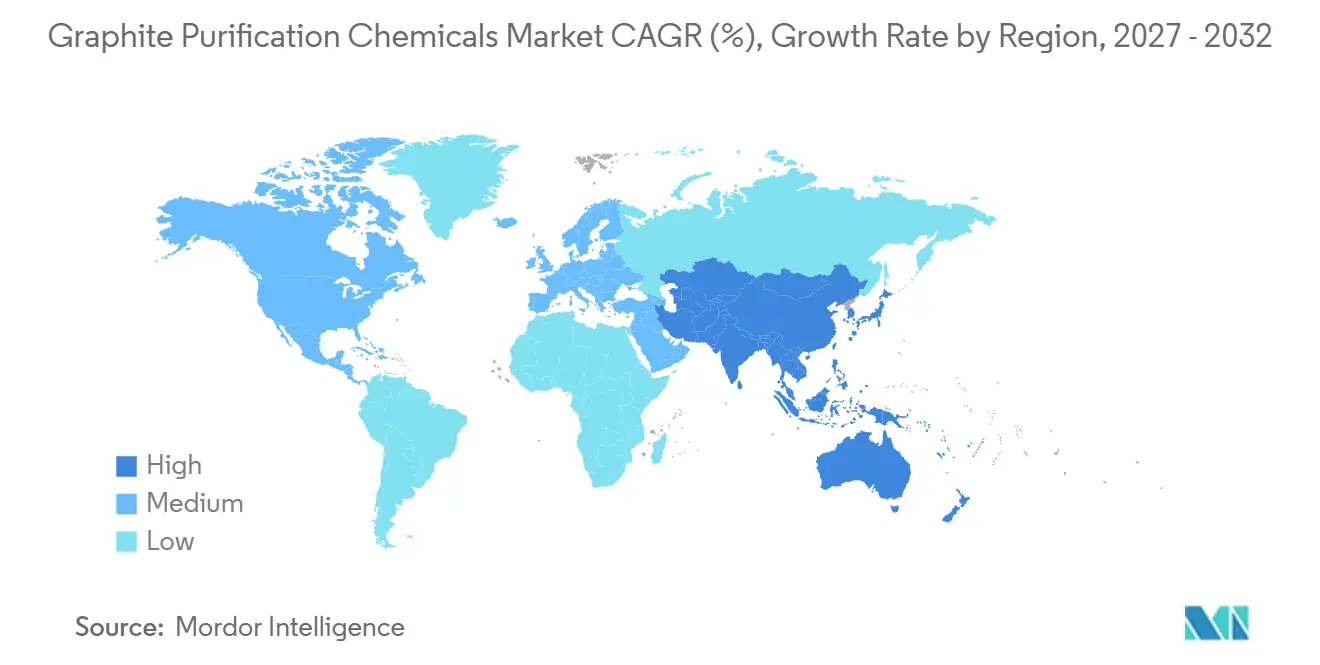
Asia-Pacific held 52.74% of the market share in 2026 and is projected to advance at an 11.58% CAGR through 2032. The region is anchored by China’s graphite mining and processing base, along with high-purity chemical demand in Japan and South Korea. The U.S. Geological Survey estimated that China produced 82% of global natural graphite in 2025. China also exported 37,400 metric tons of spherical purified graphite in the first 9 months of 2025, 29% more than in the same period of 2024. Japan and South Korea contribute high-purity chemical supply for semiconductor and battery-material applications. India’s battery-manufacturing ambitions and graphite-processing investments add future demand potential, though its commercial base remains smaller than China’s.
North America is gaining relevance as trade policy and supply security concerns support domestic anode-material processing. The graphite purification chemicals market gains from new U.S. facilities that need regional supplies of HF, HCl, and H₂SO₄. Titan Mining started construction of a New York graphite-processing facility in May 2025, targeting 1,000 to 1,200 metric tons per year of concentrate for U.S. defense and industrial customers. Chemical suppliers are also building capability that can serve electronic and materials customers. Regional projects need to establish waste treatment, reliable logistics, and customer qualifications before reaching full demand levels. This makes local technical service as important as chemical production capacity.
Europe is developing new processing plans under policies intended to reduce dependence on single-country supply. International Graphite and Alkeemia signed a binding joint venture agreement in May 2026 for a graphite-processing hub at Porto Marghera, Italy, integrating chemical and purification capability. BASF has announced semiconductor-grade H₂SO₄ and electronic-grade ammonium hydroxide investments at Ludwigshafen to support European semiconductor demand[2]. Northern Graphite and European partners also launched the German-funded USE-G program in February 2026 for a European processing route covering natural and recycled graphite. South America, the Middle East, and Africa remain at earlier stages, although resource projects in Brazil, Tanzania, and Mozambique could add demand as processing infrastructure develops.
Competitive Landscape
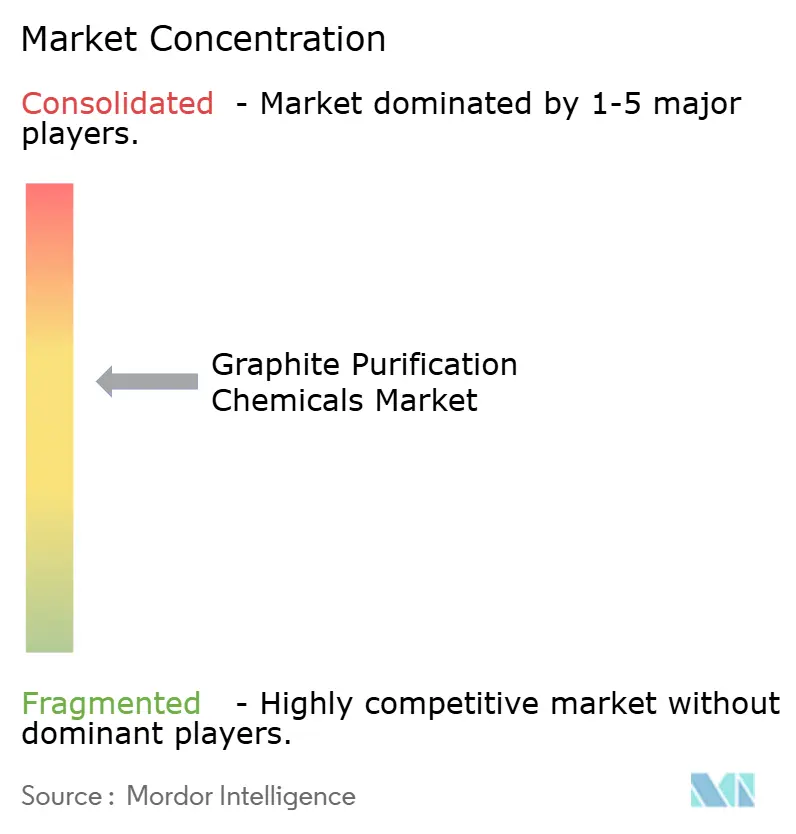
The graphite purification chemicals market is moderately concentrated, with the top five players including Honeywell International Inc., Solvay, Stella Chemifa Corporation, DAIKIN INDUSTRIES, Ltd., and Duofuduo New Materials Co., Ltd. High-purity suppliers are relevant where semiconductor and advanced battery applications require closely controlled specifications. Bulk producers remain important because acid leaching uses significant volumes of common process acids.
Companies are also expanding capability adjacent to battery and purification demand. Chemtrade Logistics completed its USD 150 million acquisition of Polytec, Inc. in November 2025, expanding its presence in water-treatment solutions that are relevant to chemical handling and effluent management. Arkema invested EUR 10 million, (approximately USD 10.8 million) in its Global Battery Center of Excellence in the Lyon region in October 2026. BASF’s planned semiconductor-grade H₂SO₄ capacity supports its position in high-purity process chemicals. These actions show that chemical producers are positioning around higher-value battery and semiconductor supply chains.
Competition in the graphite purification chemicals market increasingly depends on supply security, traceability, and wastewater performance. The World Intellectual Property Organization (WIPO) low-waste closed-loop patent application highlights chemical recovery and lower discharge as potential product and process differentiators. Alkeemia’s position alongside European graphite processing proposals illustrates the advantage of linking chemical supply with downstream purification capability. Companies that secure early qualification with new non-Chinese processors may retain relationships through later capacity expansion. Formal testing standards and long customer approval cycles favor suppliers with demonstrated consistency. The market remains open to regional specialists that combine high-quality reagents, local delivery, and strong environmental support.
Graphite Purification Chemicals Industry Leaders
-
Honeywell International Inc.
-
Solvay
-
Stella Chemifa Corporation
-
DAIKIN INDUSTRIES, Ltd.
-
Duofuduo New Materials Co., Ltd.
- *Disclaimer: Major Players sorted in no particular order
Recent Industry Developments
- June 2026: Renascor Resources commenced graphite processing at its South Australian demonstration plant using an HF-free purification flowsheet and chemical reagents. The initiative supports the Graphite Purification Chemicals Market by demonstrating alternative chemical purification pathways for producing battery-grade graphite without hydrofluoric acid.
- February 2026: GreenRoc Strategic Materials advanced its Amitsoq graphite project, with purification equipment for its active anode material pilot plant shipped to Denmark. The project is designed to scale graphite purification to approximately 1,000 kg of purified material per month, supporting demand for purification chemicals in battery-grade graphite production.
Global Graphite Purification Chemicals Market Report Scope
Graphite purification chemicals are chemical agents used to remove mineral impurities and other contaminants from natural or synthetic graphite to achieve the required purity levels. They support the production of high-purity graphite for applications where controlled chemical composition and material performance are essential.
The Graphite Purification Chemicals Market is segmented by chemical type, purification method, end-use industry, and geography. By chemical type, the market is segmented into hydrofluoric acid (HF), hydrochloric acid (HCl), nitric acid (HNO₃), sulfuric acid (H₂SO₄), and other chemical types. By purification method, the market is segmented into acid leaching, alkaline purification, combined acid-alkali purification, thermal purification, and other purification methods. By end-use industry, the market is segmented into batteries and energy storage, electronics and semiconductors, metallurgy and steel, aerospace and defense, nuclear energy, and other end-use industries. The report also covers the market size and forecasts for graphite purification chemicals across 15 countries. For each segment, the market sizing and forecasts have been done on the basis of value (USD).
| Hydrofluoric Acid (HF) |
| Hydrochloric Acid (HCl) |
| Nitric Acid (HNO₃) |
| Sulfuric Acid (H₂SO₄) |
| Other Chemical Types |
| Acid Leaching |
| Alkaline Purification |
| Combined Acid-Alkali Purification |
| Thermal Purification |
| Other Purification Methods |
| Batteries and Energy Storage |
| Electronics and Semiconductors |
| Metallurgy and Steel |
| Aerospace and Defense |
| Nuclear Energy |
| Other End-Use Industries |
| Asia-Pacific | China |
| India | |
| Japan | |
| South Korea | |
| ASEAN Countries | |
| Rest of Asia-Pacific | |
| North America | United States |
| Canada | |
| Mexico | |
| Europe | Germany |
| United Kingdom | |
| France | |
| Italy | |
| NORDIC Countries | |
| Rest of Europe | |
| South America | Brazil |
| Argentina | |
| Rest of South America | |
| Middle East and Africa | Saudi Arabia |
| South Africa | |
| Rest of Middle East and Africa |
| By Chemical Type | Hydrofluoric Acid (HF) | |
| Hydrochloric Acid (HCl) | ||
| Nitric Acid (HNO₃) | ||
| Sulfuric Acid (H₂SO₄) | ||
| Other Chemical Types | ||
| By Purification Method | Acid Leaching | |
| Alkaline Purification | ||
| Combined Acid-Alkali Purification | ||
| Thermal Purification | ||
| Other Purification Methods | ||
| By End-Use Industry | Batteries and Energy Storage | |
| Electronics and Semiconductors | ||
| Metallurgy and Steel | ||
| Aerospace and Defense | ||
| Nuclear Energy | ||
| Other End-Use Industries | ||
| By Geography | Asia-Pacific | China |
| India | ||
| Japan | ||
| South Korea | ||
| ASEAN Countries | ||
| Rest of Asia-Pacific | ||
| North America | United States | |
| Canada | ||
| Mexico | ||
| Europe | Germany | |
| United Kingdom | ||
| France | ||
| Italy | ||
| NORDIC Countries | ||
| Rest of Europe | ||
| South America | Brazil | |
| Argentina | ||
| Rest of South America | ||
| Middle East and Africa | Saudi Arabia | |
| South Africa | ||
| Rest of Middle East and Africa | ||
Key Questions Answered in the Report
What is the size of the graphite purification chemicals market?
The Graphite Purification Chemicals Market size was valued at USD 490.92 million in 2026 and is estimated to grow from USD 543.00 million in 2027 to reach USD 899.03 million by 2032, at a CAGR of 10.61% during the forecast period (2027-2032).
What chemicals are used to purify graphite?
HF, HCl, H₂SO₄, HNO₃, sodium hydroxide, and specialty blended reagents are used according to feedstock impurities and target purity.
Why is hydrofluoric acid important for graphite purification?
Hydrofluoric acid held a 42.67% share in 2026 because it removes silicate impurities that are difficult to address with other acids.
Which end-use industry is projected to advance fastest through 2032?
Batteries and energy storage are projected to advance at a 12.92% CAGR through 2032, supported by rising anode-material demand.