
Golf Club Market Size and Share
Market Overview
| Study Period | 2022 - 2032 |
|---|---|
| Market Size (2027) | USD 8.53 Billion |
| Market Size (2032) | USD 10.82 Billion |
| Growth Rate (2027 - 2032) | 4.86 % |
| Fastest Growing Market | Asia-Pacific |
| Largest Market | North America |
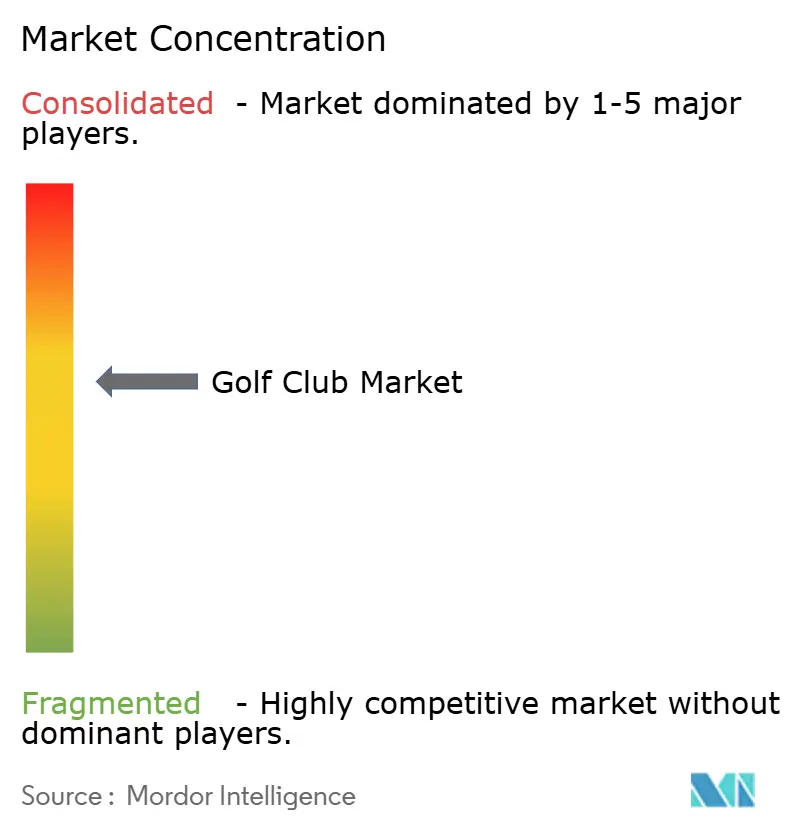
| Market Concentration | Medium |
Major Players *Disclaimer: Major Players sorted in no particular order Image © Mordor Intelligence. Reuse requires attribution under CC BY 4.0. | |
Golf Club Market Analysis by Mordor Intelligence
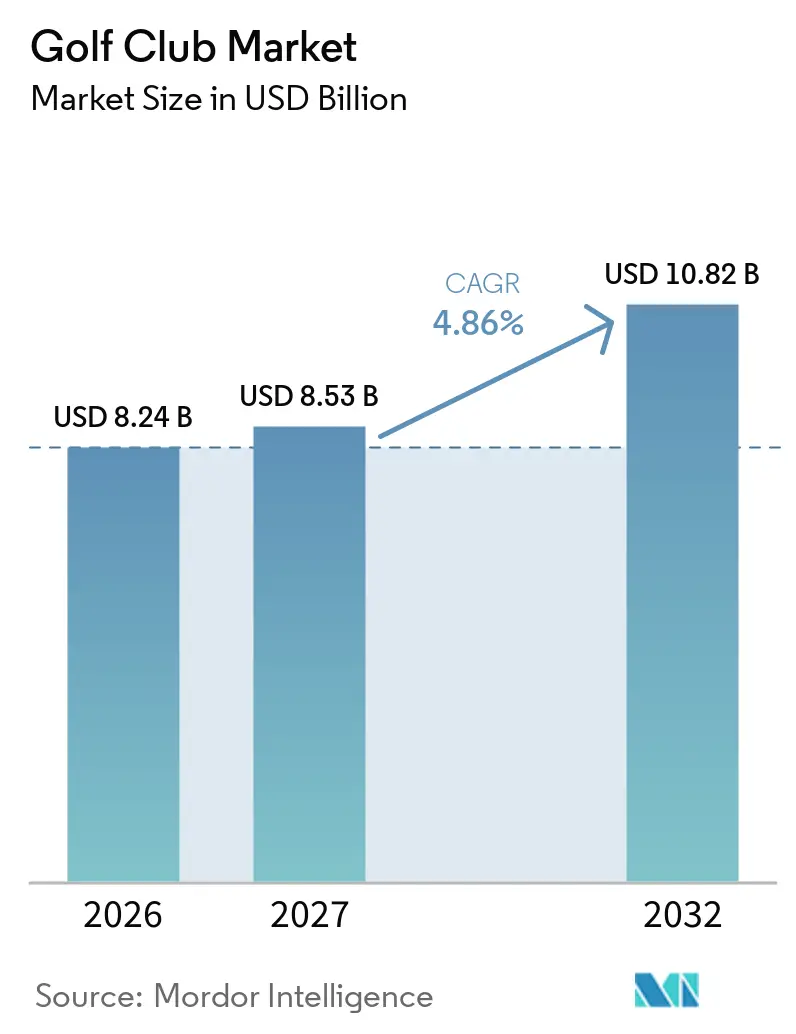
The golf club market size is expected to grow from USD 8.24 billion in 2026 to USD 8.53 billion in 2027 and is forecast to reach USD 10.82 billion by 2032 at a 4.86% CAGR over 2027-2032. The market is supported by rising golf participation, growing interest in the sport, and continued demand for equipment upgrades and replacement. Increasing engagement among new and experienced players supports demand for golf equipment, while advancements in materials, design, and manufacturing technologies encourage product innovation. Manufacturers are focusing on improving performance, durability, comfort, and customisation to address evolving consumer expectations. Digital retail channels are also improving product accessibility and providing consumers with more convenient purchasing options. Competition is shaped by brand recognition, product quality, technological development, and investment in research and development. Companies continue to strengthen their market positions through product innovation, brand development, and efforts to meet the changing needs of golfers.
Key Report Takeaways
- By club type, irons held 42.31% of the golf club market share in 2026, while wedges are forecast to record a 5.82% CAGR during 2027-2032.
- By category, premium clubs accounted for 58.33% of the golf club market share in 2026 and are projected to grow at a 5.41% CAGR during 2027-2032.
- By end user, adults captured 89.76% of golf club market size in 2026, while the kids/children segment is forecast to expand at a 5.31% CAGR during 2027-2032.
- By distribution channel, offline retail stores represented a 72.43% share in 2026, while online retail stores are forecast to grow at a 5.95% CAGR during 2027-2032.
- By geography, North America held a 45.74% share in 2026, while Asia-Pacific is forecast to grow at a 5.21% CAGR during 2027-2032.
Note: Market numbers in this report are based on Mordor Intelligence's proprietary estimation framework, which combines nine months of actuals with Q4 projections for base year 2026.
Market Trends and Insights
Drivers Impact Analysis of Golf Club Market*
| Driver | (~) % Impact on CAGR Forecast | Geographic Relevance | Impact Timeline |
|---|---|---|---|
| Growth in golf participation and course access | +0.9% | Global, led by North America, Europe, and Asia-Pacific | Medium term (2–4 years) |
| Replacement demand for aging golf equipment | +0.7% | North America and Europe core, with spill-over to Asia-Pacific | Short term (≤ 2 years) |
| Expansion of online golf equipment purchasing | +0.6% | Global, strongest uptick in Asia-Pacific and North America | Medium term (2–4 years) |
| Growth in beginner participation and first-time equipment purchases | +0.8% | Global, particularly pronounced in Asia-Pacific and Europe | Medium term (2–4 years) |
| Increasing adoption of custom-fitted golf clubs | +0.7% | North America, Japan, South Korea; spill-over to Europe | Long term (≥ 4 years) |
| Demand for technologically advanced and forgiving clubs | +0.6% | Global | Short to medium term (≤ 4 years) |
| Source: Mordor Intelligence | |||
Growth in Golf Participation and Course Access
Growing participation in golf is expanding the sport's overall player base and supporting demand for golf clubs. According to The R&A's 2025 Global Participation Report, 112.2 million adults and juniors participated in golf across all formats in its affiliated markets outside the United States and Mexico, an increase of 4.2 million year-on-year. The report also recorded 18,500 golf courses across these markets, reflecting the established network of facilities available to players[1]. Continued participation growth, alongside access to golf courses and alternative playing venues, supports the long-term development of the sport and its associated equipment market. The expansion of opportunities to play can also strengthen engagement with golf across different age groups and communities. As participation becomes more established, sustained interest in the sport supports the underlying demand for golf equipment.
Replacement Demand for Aging Golf Equipment
Replacement demand supports recurring sales in the golf club market as players periodically renew equipment following years of regular use. According to the National Golf Foundation's 2024 industry update, nearly 50% of surveyed golfers expected to purchase at least one golf club within the following 12 months[2]. The organisation also identified a typical golf club replacement cycle of four to six years, depending on the type of club. These purchasing patterns highlight the contribution of existing golfers to ongoing equipment demand beyond initial purchases. Regular use over multiple playing seasons gradually increases the need to assess equipment condition and determine when replacement is appropriate. This recurring purchasing behaviour provides manufacturers and retailers with continued sales opportunities beyond demand from first-time buyers. As players continue participating over successive seasons, periodic replacement purchases help sustain golf club sales.
Expansion of Online Golf Equipment Purchasing
The expansion of digital retail channels is creating additional opportunities for consumers to access golf equipment and compare products across retailers. According to the Association of Golf Merchandisers' 2025 membership survey, 50% of surveyed members reported generating a portion of their sales through an online presence, up from 40% in 2024[3]. Online platforms enable golf equipment retailers to showcase wider product assortments and reach customers beyond their physical store locations. Brand-owned websites and specialist golf retail platforms also provide convenient access to product specifications, pricing, and purchasing options. As retailers increasingly incorporate digital channels into their sales operations, online purchasing continues to develop as an important route to market for golf equipment.
Growth in Beginner Participation and First-Time Equipment Purchases
Growing interest in golf among new participants creates opportunities for first-time golf club purchases as individuals acquire equipment to begin playing. As newcomers become more familiar with the sport, they may transition from borrowed or shared equipment to owning their own clubs. This progression supports demand for golf club sets and individual clubs suited to different experience levels, budgets, and playing preferences. Manufacturers and retailers can address this demand by offering accessible product options that help new golfers get started. Introductory golf programmes and lessons can further encourage participants to invest in equipment as they become more engaged with the sport. The continued entry of new participants provides an additional source of demand for golf clubs alongside purchases by established players.
Restraints Impact Analysis of Golf Club Market*
| Restraint | (~) % Impact on CAGR Forecast | Geographic Relevance | Impact Timeline |
|---|---|---|---|
| High upfront cost of premium golf clubs and equipment | -0.8% | Global, most acute in price-sensitive emerging markets and for first-time buyers | Short to medium term (≤ 4 years) |
| Competition from used and refurbished golf clubs | -0.7% | North America and Europe, where secondary-market platforms are most developed | Medium term (2–4 years) |
| Seasonal and weather-related fluctuations in golf activity | -0.5% | Northern Europe, Canada, Northern United States, Asia-Pacific temperate markets | Short term (≤ 2 years) |
| Economic uncertainty reducing discretionary spending on golf equipment | -0.6% | Global, with particular sensitivity in North America and Asia | Short to medium term (≤ 4 years) |
| Source: Mordor Intelligence | |||
High Upfront Cost of Premium Golf Clubs and Equipment
The high upfront cost of premium golf clubs and related equipment can limit affordability for some consumers and influence purchasing decisions. Golfers may need to allocate a substantial budget to acquire a complete set of clubs, particularly when purchasing higher-priced products. These costs can make it more difficult for budget-conscious consumers to enter the market or upgrade their existing equipment. As a result, some buyers may postpone purchases, retain their current clubs for longer, or opt for more affordable alternatives. Price sensitivity can therefore influence purchasing frequency and product selection across the golf club market. Additional expenses associated with golf accessories and other playing essentials may further increase the overall cost of participation. Consequently, manufacturers must balance product features and quality with a range of price points to address the needs of consumers with different spending capacities.
Competition from Used and Refurbished Golf Clubs
The availability of used and refurbished golf clubs creates competition for sales of new equipment by offering consumers more affordable purchasing alternatives. Pre-owned clubs allow buyers to access established brands and different product categories at lower prices than comparable new products. This can appeal to budget-conscious golfers and individuals seeking to manage equipment expenses without compromising their ability to participate in the sport. Online marketplaces, specialist resale retailers, and trade-in programmes also improve access to second-hand equipment. As these channels develop, consumers have greater flexibility in deciding between new and pre-owned clubs. This competition can influence demand for new golf clubs, particularly among price-sensitive buyers who prioritise affordability when making purchasing decisions.
*Our forecasts treat driver/restraint impacts as directional, not additive. The impact forecasts reflect baseline growth, mix effects, and variable interactions.
Golf Club Market Segment Analysis
By Club Type:
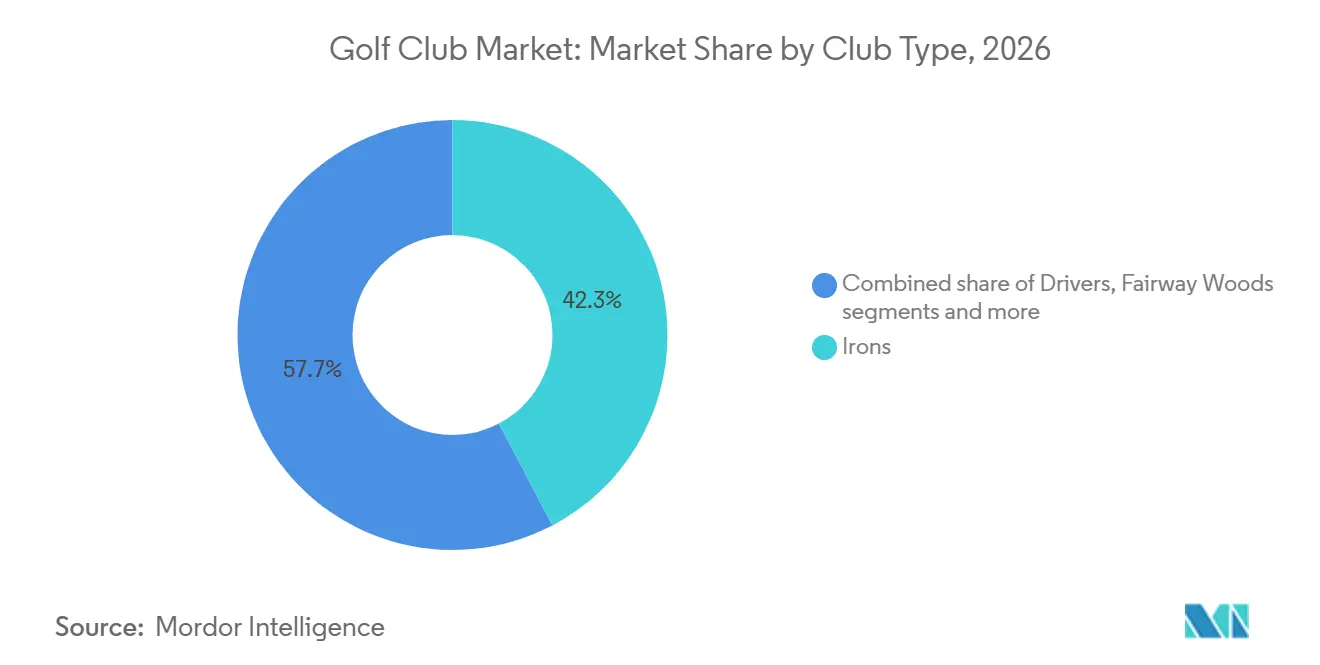
Irons Anchor Revenue, Wedges Lead GrowthIrons account for the largest share of the golf club market, at 42.31% in 2026, reflecting their importance across different skill levels and playing preferences. Their inclusion in complete club sets and availability as individual purchases support consistent demand. Manufacturers offer varied designs and constructions to accommodate different performance requirements. Demand spans entry-level sets and premium products designed for experienced golfers. Their versatility across a wide range of playing situations reinforces their position in the market. These factors support the continued prominence of irons in golf equipment purchases.
Wedges are projected to record the fastest growth, with a compound annual growth rate (CAGR) of 5.82% over 2027–2032, supported by golfers' focus on short-game performance. Their role in approach shots, bunker play, and shots around the green makes them an important part of equipment selection. Different lofts and sole configurations allow golfers to choose clubs suited to varied playing conditions. Manufacturers continue to offer options catering to different playing styles and performance preferences. Interest in improving accuracy and control around the green supports demand for wedges. These factors are expected to contribute to segment growth over the forecast period.

By Category:
Premium Commands Share and GrowthThe premium segment accounts for 58.33% of the golf club market in 2026 and is projected to grow at a compound annual growth rate (CAGR) of 5.41% over 2027–2032. This position reflects demand for golf clubs offering advanced construction, quality materials, and enhanced playing performance. Established brands continue to attract consumers through product differentiation and strong brand recognition. Customisation options and specialised retail services also contribute to the appeal of premium equipment. Golfers seeking greater consistency and performance may favour higher-priced products when upgrading their equipment. These factors support the premium segment's substantial market share and continued growth.
The mass segment supports accessibility by offering golf clubs at more affordable price points for budget-conscious consumers. Lower-cost equipment can appeal to casual players, families, and individuals seeking to manage the initial expense of participating in golf. Manufacturers serve this segment through entry-level sets and practical product configurations designed to meet basic playing needs. A broad range of price points allows consumers to select equipment according to their budgets and level of engagement with the sport. This segment remains important in reaching customers who may not initially consider premium products. Its continued availability helps serve diverse purchasing preferences across the golf club market.
By End User:
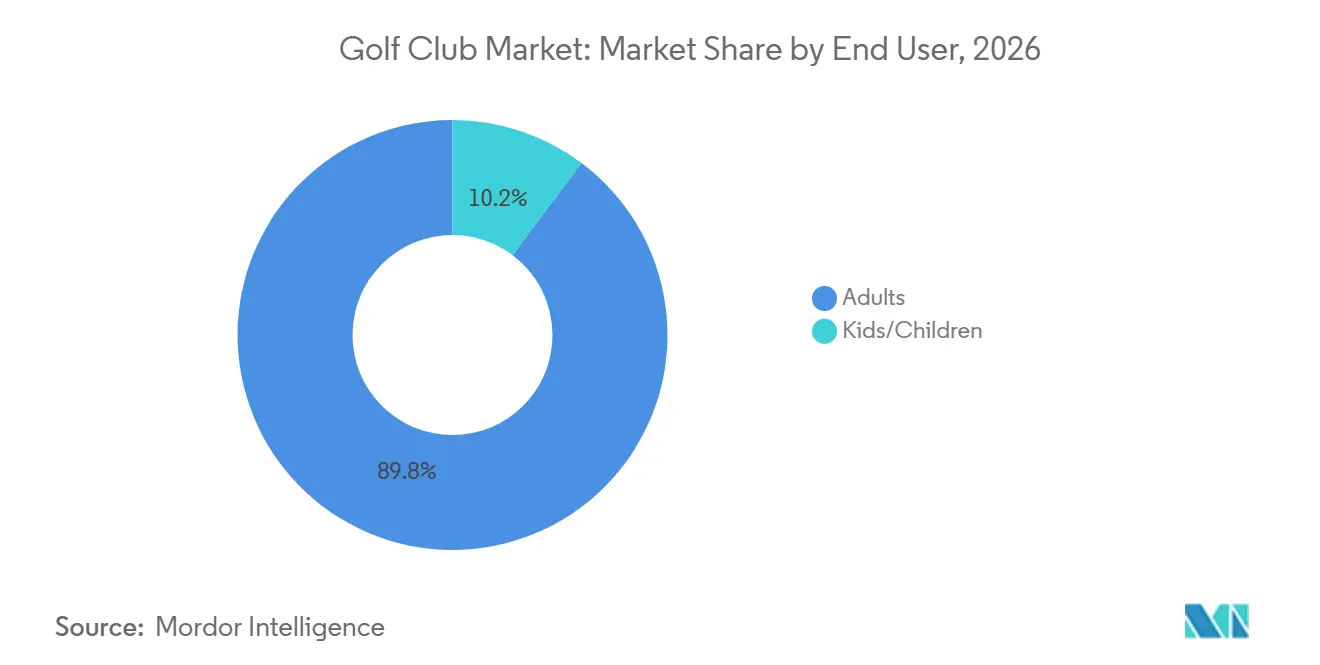
Adults Drive Volume, Kids Shape TrajectoryThe Adults segment accounts for the largest share of the golf club market, at 89.76% in 2026, reflecting the established base of adult golfers and their ongoing participation in the sport. Regular engagement supports demand for golf clubs across different playing preferences and experience levels. Adult golfers contribute to equipment purchases as they continue participating and maintaining their involvement in the game. Manufacturers cater to this broad consumer group through varied product offerings designed to address different playing needs. Continued engagement among adult players reinforces their importance to the golf club market.
The Kids/Children segment is projected to record the fastest growth, with a compound annual growth rate (CAGR) of 5.31% over 2027–2032, supported by increasing interest in junior golf participation. Greater involvement in the sport creates opportunities for demand for age-appropriate golf clubs designed to accommodate younger players. Manufacturers and specialist providers address this demand through equipment tailored to children's physical development and playing requirements. Junior golf programmes and organised activities can also encourage sustained engagement with the sport. As young players develop their skills and continue participating, their equipment needs may evolve, supporting demand for children's golf clubs over the forecast period.
By Distribution Channel:
Offline Leads, Online Reshapes EconomicsOffline retail stores account for the largest share of the golf club market, at 72.43% in 2026, supported by in-person product evaluation and access to knowledgeable staff. Physical stores allow golfers to examine clubs directly and receive guidance when selecting equipment suited to their preferences. Club fitting services also help customers assess different options before making a purchase. Specialist retailers cater to golfers with varying levels of experience and equipment requirements. The ability to combine product demonstrations, personalised assistance, and immediate access to products supports the continued importance of offline retail in golf club sales.
Online retail is projected to record the fastest growth, with a compound annual growth rate (CAGR) of 5.95% over 2027–2032, supported by convenience, product variety, and price comparison. Digital platforms allow consumers to review different club specifications, compare prices, and explore products across multiple brands without visiting physical stores. Online purchasing also provides access to specialised products that may not be available through nearby retailers. Direct-to-consumer channels offer another route to market by allowing manufacturers to sell directly to customers. These channels can provide greater pricing flexibility and broaden access to golf equipment. The continued development of online retail is expected to support its growth within the golf club market.
Geography Analysis
North America Golf Club Market
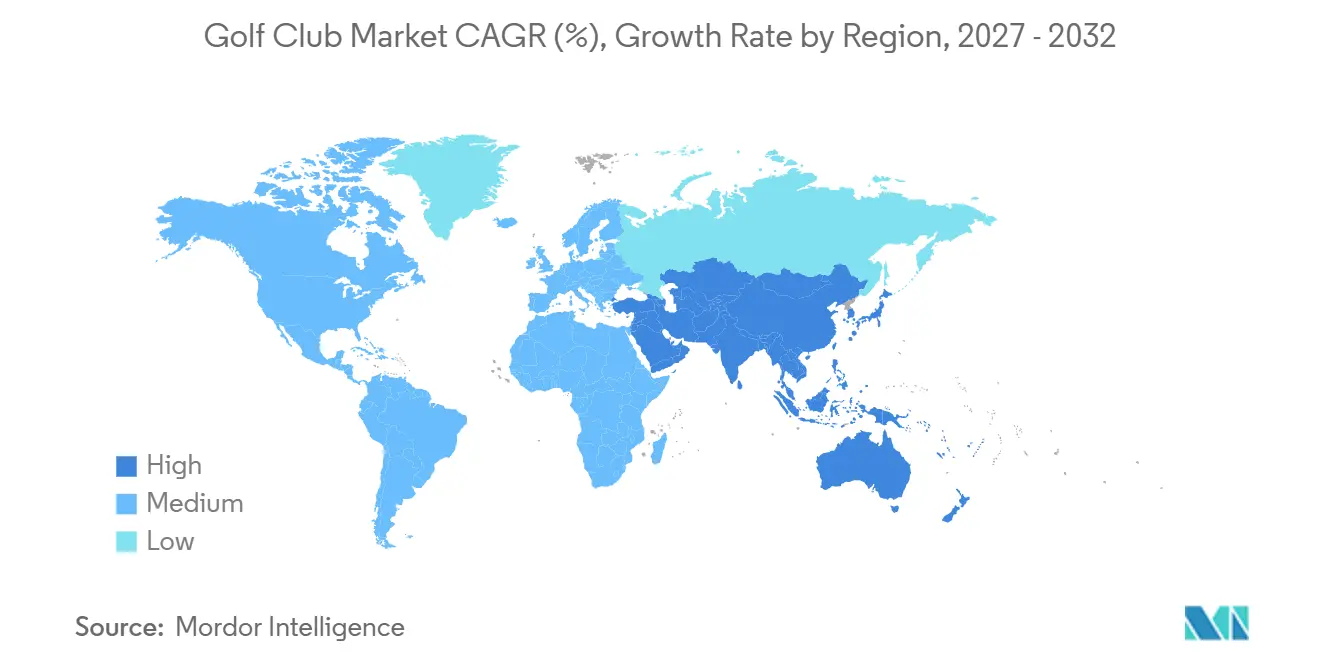
North America holds the largest share of the golf club market, accounting for 45.74% in 2026, supported by established golf participation, extensive course infrastructure, and a well-developed specialty retail network. The United States represents the region's primary market, while Canada contributes through its established base of adult golfers. Mexico also participates in the regional golf industry through consumer demand and golf club assembly operations. The availability of golf facilities, specialist retailers, and a broad range of golf equipment supports the region's leading position. However, tariff exposure and associated equipment cost increases may influence manufacturing decisions and retail pricing across the region.
APAC Golf Club Market
Asia-Pacific is projected to record the fastest growth in the golf club market, with a compound annual growth rate (CAGR) of 5.21% over 2027–2032. Japan and South Korea represent important markets, supported by established golfer populations and continued demand for golf equipment. In Japan, interest in custom fitting and demand associated with inbound tourism provide additional opportunities for equipment retailers. Australia's golf retail sector also reflects ongoing commercial interest, including cross-border investment in specialist retail businesses. These developments, alongside the region's established golf markets and evolving retail landscape, are expected to support growth over the forecast period.
EMEA and South America Golf Club Market
Europe remains an important regional market, supported by established golf participation and a broad network of golf facilities. Germany is a key contributor, with a substantial base of adult golfers and golf clubs that serve players across different experience levels. Junior participation also supports the region's longer-term market potential by encouraging continued engagement with the sport. South America and the Middle East and Africa represent smaller markets, with Brazil, Argentina, the United Arab Emirates, and South Africa contributing through golf participation, tourism, and course development. Further development of golf facilities and related services in these regions may support gradual demand for golf clubs.
Competitive Landscape
The golf club market is moderately concentrated, with major players including Callaway Golf Company, Acushnet Holdings Corp., TaylorMade Golf Company, Inc., PING, and Sumitomo Rubber Industries, Ltd. These companies compete across established golf club categories, including drivers, irons, wedges, and putters, with differentiation based on product design, materials, performance characteristics, and custom-fitting services. Their established brands, product development capabilities, and distribution networks support their competitive positions, while specialist manufacturers and direct-to-consumer brands serve more focused customer segments.
Leading companies continue to compete through product launches, technological development, and strategic business decisions. Callaway Golf Company, Acushnet Holdings Corp., TaylorMade Golf Company, Inc., PING, and Sumitomo Rubber Industries, Ltd. maintain product portfolios targeting golfers with different playing preferences and performance requirements. Their competitive activities include updating club product lines, refining club designs, and offering equipment suited to different skill levels. Investment in product development and custom fitting also enables established manufacturers to differentiate their offerings and respond to evolving golfer preferences.
Emerging and specialist players contribute to competition by focusing on specific product categories, alternative retail models, and differentiated engineering approaches. Direct-to-consumer brands such as Sub70 Golf provide another purchasing option by selling clubs through online channels, while specialist manufacturers such as L.A.B. Golf focus on distinctive putter designs. These companies can compete through product specialisation, pricing, and more targeted customer engagement rather than matching the full product breadth of larger manufacturers. Their presence adds variety to the competitive landscape and encourages established players to continue refining product offerings and distribution strategies.
Golf Club Industry Leaders
-
Callaway Golf Company
-
Acushnet Holdings Corp.
-
PING
-
Sumitomo Rubber Industries, Ltd.
-
TaylorMade Golf Company, Inc.
- *Disclaimer: Major Players sorted in no particular order
Golf Club Market Companies Covered in this Report
- Callaway Golf Company
- Acushnet Holdings Corp.
- TaylorMade Golf Company, Inc.
- PING
- Sumitomo Rubber Industries, Ltd.
- Cobra Golf Incorporated
- Mizuno Corporation
- Bridgestone Sports Co., Ltd.
- Parsons Xtreme Golf, LLC
- Honma Golf Limited
- Wilson Sporting Goods Co.
- L.A.B. Golf.
- YONEX CO., LTD.
- Tour Edge Golf Manufacturing, Inc.
- U.S. Kids Golf, LLC
- Miura Golf Inc.
- Bettinardi Golf, LLC
- Fourteen Co., Ltd.
- Evnroll
- Sub70 Golf
Recent Industry Developments in Golf Club Market
- August 2026: TaylorMade Golf introduced its Hi-Toe 5 wedge family, featuring forged soft carbon steel construction, full-face saw-milled grooves, and five sole-grind configurations designed to accommodate different swing types and playing conditions. The launch also included MyHi-Toe 5, a customisation platform that allows golfers to personalise wedge finishes, text, logos, and other design elements. The new range expands TaylorMade's wedge portfolio with additional short-game fitting and personalisation options.
- June 2026: HONMA Golf partnered with Bugatti to introduce a co-branded collection comprising the BERES Super Premium Collection, Tour World Premium Collection and Super Premium Bugatti Putter. The products combine HONMA's clubmaking craftsmanship with Bugatti-inspired design elements, with the Tour World range incorporating titanium-carbon composite technology in its driver. The collaboration expands the premium golf club offering through a luxury automotive brand partnership.
- January 2026: Callaway Golf Company launched its Quantum family of drivers, fairway woods, irons and hybrids. The new drivers feature Tri-Force Face technology, designed to improve distance performance. The multi-category launch expands Callaway's club portfolio across several key equipment segments and provides golfers with updated options for different playing requirements.
- July 2025: Titleist introduced updated T100, T150 and T350 irons, together with the new T250 model and T250 Launch Spec variant. The lineup incorporates design refinements intended to improve launch, spin consistency and carry-distance consistency across the set. The launch broadened the company's iron offering for different player profiles, from tour-oriented golfers to those seeking greater distance.
Global Golf Club Market Report Scope
The golf club market comprises the manufacturing and sale of golf clubs used by players for different shots and playing conditions. The market is segmented by club type into drivers, fairway woods, hybrids, irons, wedges, and putters; by category into mass and premium; by end user into adults and kids/children; by distribution channel into offline retail stores and online retail stores; and by geography into North America, Europe, Asia-Pacific, South America, and the Middle East and Africa. The market forecasts are provided in terms of value in USD.
Segmentation Overview
| Drivers |
| Fairway Woods |
| Hybrids |
| Irons |
| Wedges |
| Putters |
| Mass |
| Premium |
| Adults |
| Kids/Children |
| Offline Retail Stores |
| Online Retail Stores |
| North America | United States |
| Canada | |
| Mexico | |
| Rest of North America | |
| Europe | United Kingdom |
| Germany | |
| Spain | |
| France | |
| Italy | |
| Sweden | |
| Ireland | |
| Austria | |
| Rest of Europe | |
| Asia-Pacific | China |
| Japan | |
| South Korea | |
| New Zealand | |
| Australia | |
| Rest of Asia-Pacific | |
| South America | Brazil |
| Argentina | |
| Rest of South America | |
| Middle East and Africa | United Arab Emirates |
| South Africa | |
| Rest of Middle East and Africa |
| By Club Type | Drivers | |
| Fairway Woods | ||
| Hybrids | ||
| Irons | ||
| Wedges | ||
| Putters | ||
| By Category | Mass | |
| Premium | ||
| By End User | Adults | |
| Kids/Children | ||
| By Distribution Channel | Offline Retail Stores | |
| Online Retail Stores | ||
| By Geography | North America | United States |
| Canada | ||
| Mexico | ||
| Rest of North America | ||
| Europe | United Kingdom | |
| Germany | ||
| Spain | ||
| France | ||
| Italy | ||
| Sweden | ||
| Ireland | ||
| Austria | ||
| Rest of Europe | ||
| Asia-Pacific | China | |
| Japan | ||
| South Korea | ||
| New Zealand | ||
| Australia | ||
| Rest of Asia-Pacific | ||
| South America | Brazil | |
| Argentina | ||
| Rest of South America | ||
| Middle East and Africa | United Arab Emirates | |
| South Africa | ||
| Rest of Middle East and Africa | ||
Key Questions Answered in the Report
What is the projected value of the golf club sector by 2032?
The golf club market is forecast to reach USD 10.82 billion by 2032, from USD 8.24 billion in 2026, at a 4.86% CAGR during 2027-2032.
Which golf club type has the largest share?
Irons hold the largest share at 42.31% in 2026.
Which golf club category is growing the fastest?
Wedges are forecast to grow at a 5.82% CAGR during 2027-2032.
Which region has the strongest forecast growth?
Asia-Pacific is forecast to grow at a 5.21% CAGR during 2027-2032.