
Wine Cabinets Market Size and Share
Market Overview
| Study Period | 2021 - 2031 |
|---|---|
| Market Size (2026) | USD 1.51 Billion |
| Market Size (2031) | USD 1.9 Billion |
| Growth Rate (2026 - 2031) | 4.90 % |
| Fastest Growing Market | Asia-Pacific |
| Largest Market | North America |
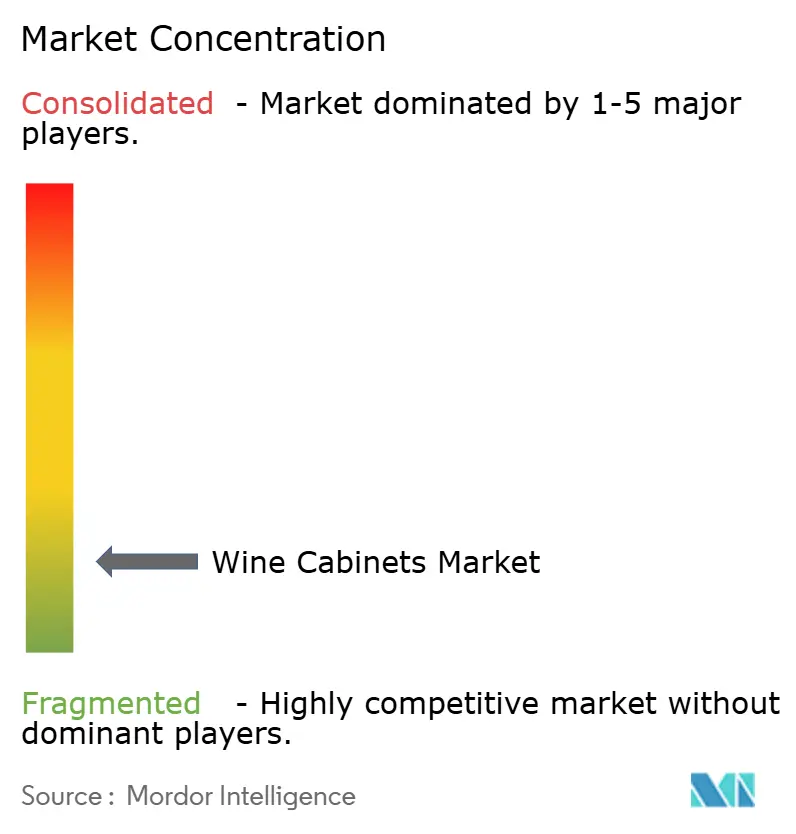
| Market Concentration | Low |
Major Players *Disclaimer: Major Players sorted in no particular order Image © Mordor Intelligence. Reuse requires attribution under CC BY 4.0. | |
Wine Cabinets Market Analysis by Mordor Intelligence
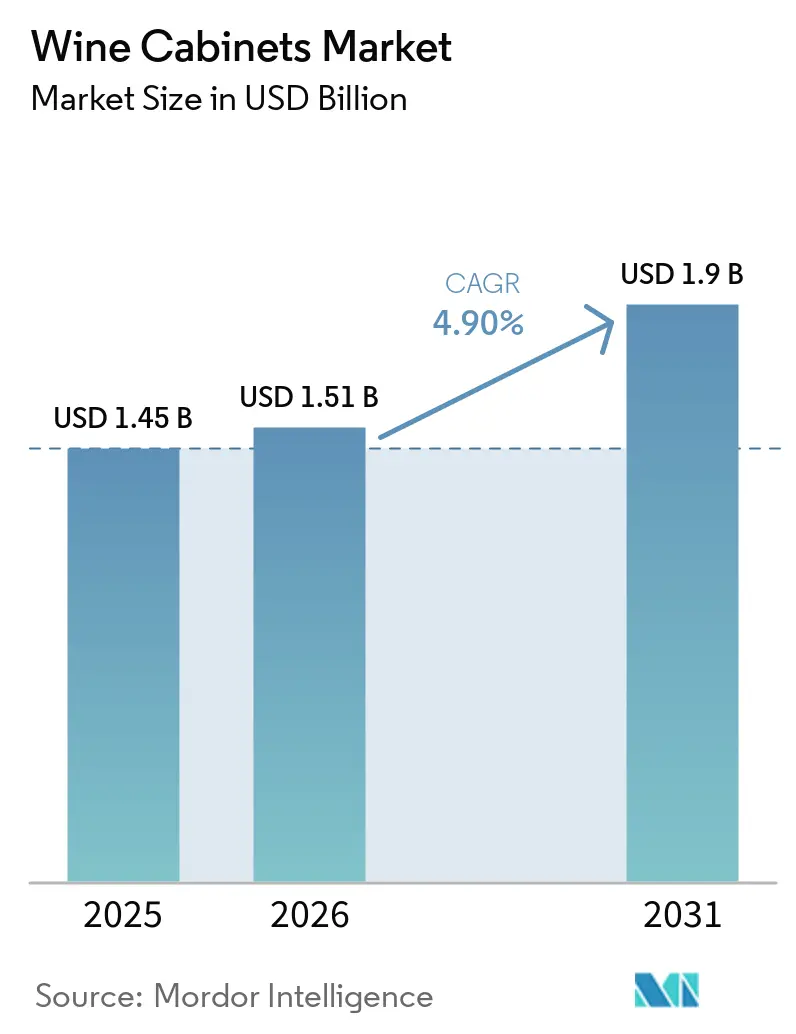
The wine cabinets market size is expected to increase from USD 1.45 billion in 2025 to USD 1.51 billion in 2026 and reach USD 1.90 billion by 2031, growing at a CAGR of 4.90% over 2026-2031. The wine cabinets market is supported by consumers who buy fewer bottles but place greater value on the bottles they keep, whether for regular entertaining, personal collections, or longer holding periods, as storage becomes more important when a buyer wants wines to be ready for planned meals, celebrations, gifts, and future consumption rather than consumed immediately after purchase. Global wine consumption fell to 208 million hectoliters in 2025, down 2.7% from 2024, which makes dependable storage more relevant to buyers who want to protect higher-value collections from heat, light, vibration, and unsuitable temperature changes[1]International Organisation of Vine and Wine, “State of the World Wine Sector in 2025: Tariffs, Climate and Consumer Trends Drive Sector Adaptation,” OIV, oiv.int. Better temperature, humidity, and light protection are becoming more relevant to premium residential kitchens and visible hospitality displays, where the cabinet needs to be functional but may also be expected to complement the room’s overall design. Manufacturers are responding with connected controls, panel-ready designs, more efficient cooling systems, multiple temperature zones, and formats suited to compact homes as well as larger residential and commercial spaces. The wine cabinets market also faces limits from high purchase costs, limited space in urban homes, buyer awareness, and tighter energy rules that can raise development costs for refrigeration products, particularly at entry-level price points, where buyers tend to compare an added cabinet against other household purchases and may delay a decision until their collections become larger.
Key Report Takeaways
- By product type, single-zone cabinets led with 56.16% of the wine cabinets market share in 2025, while multi-zone and 3+ zone cabinets are projected to expand at a 7.67% CAGR through 2031.
- By installation type, freestanding cabinets led with 53.73% of the wine cabinets market share in 2025, while countertop cabinets are projected to expand at a 6.44% CAGR through 2031.
- By bottle capacity, 20-50 bottle units led with 33.25% of the wine cabinets market share in 2025, while sub-20 bottle units are projected to expand at a 5.82% CAGR through 2031.
- By end user, residential users led with 72.74% of the wine cabinets market share in 2025, while commercial users are projected to expand at a 6.63% CAGR through 2031.
- By distribution channel, indirect sales led with 88.92% of the wine cabinets market share in 2025 and are projected to expand at a 5.51% CAGR through 2031.
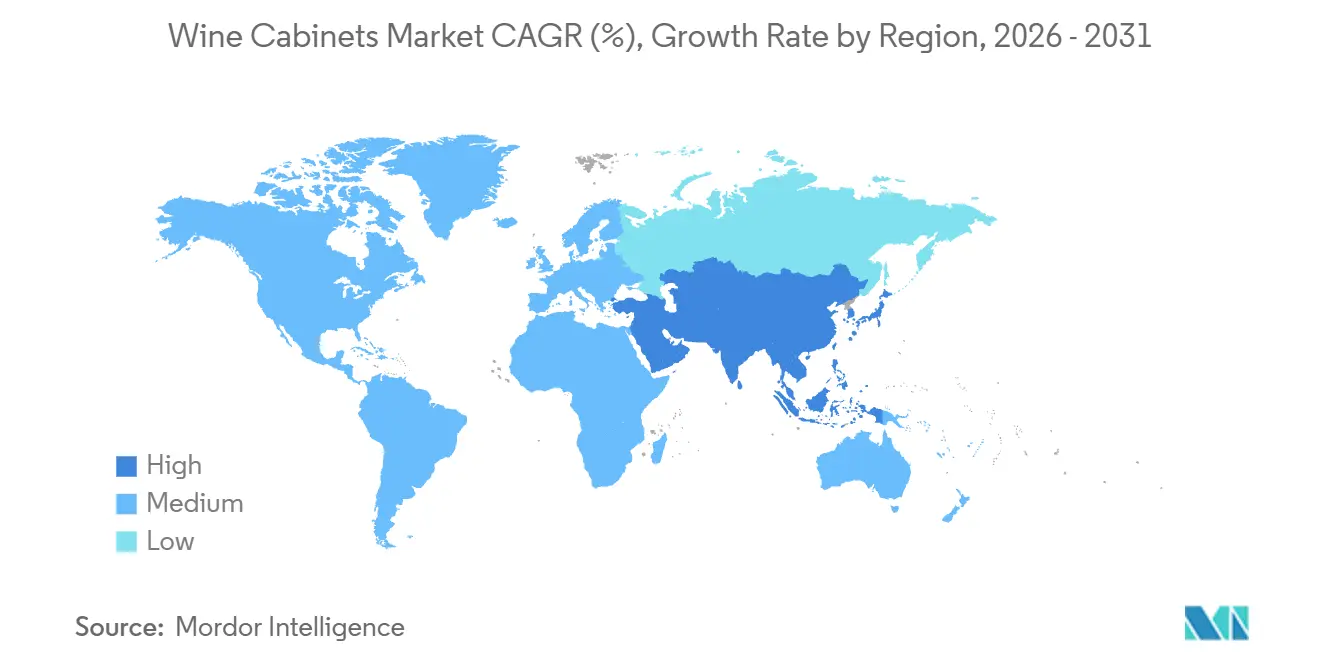
- By geography, North America led with 31.01% of the wine cabinets market share in 2025, while Asia-Pacific is projected to expand at a 7.05% CAGR through 2031.
Note: Market size and forecast figures in this report are generated using Mordor Intelligence’s proprietary estimation framework, updated with the latest available data and insights as of January 2026.
Global Wine Cabinets Market Trends and Insights
Drivers Impact Analysis*
| Driver | (~) % Impact on CAGR Forecast | Geographic Relevance | Impact Timeline |
|---|---|---|---|
| Premium Home Wine Storage | +1.3% | Global, with stronger relevance in North America and Europe | Long term (≥ 4 years) |
| Emerging Wine Culture | +0.8% | Asia-Pacific, especially India and Southeast Asia, with relevance in the Middle East and Africa | Medium term (2-4 years) |
| Luxury Kitchen Renovations | +0.7% | North America and Europe, with early demand in Asia-Pacific cities | Medium term (2-4 years) |
| Smart Connected Cabinets | +0.6% | Global, with faster adoption in North America, Europe, and Asia-Pacific technology hubs | Short term (≤ 2 years) |
| Hospitality and Wine Tourism | +0.5% | Chile, India, the United Arab Emirates, and Saudi Arabia | Medium term (2-4 years) |
| Modular Storage for Urban Homes | +0.4% | Japan, South Korea, Southeast Asia, and European cities | Short term (≤ 2 years) |
| Source: Mordor Intelligence | |||
Premiumization of Home Wine Storage
The most durable demand driver is not wine consumption growth, which is actually declining, but a structural shift toward higher-value bottles among remaining wine drinkers. The United States consumer spending on wine grew 3% in 2025 to more than USD 115 billion, even as drinking frequency fell[2]BMO Wine Report / Vinetur, “BMO Wine Market Report 2025,” BMO, vinetur.com. A collection with expensive red, white, and sparkling wines needs more consistent storage than a short-term household supply. This need favors cabinet features such as compressor cooling, ultraviolet protection, controlled humidity, and separate temperature settings. The wine cabinets market, therefore, gains value even when total wine volume is under pressure, because preservation needs become more important when each retained bottle represents a more deliberate household purchase. It also gives manufacturers room to offer higher-specification cabinets to collectors who view storage as part of preserving the value and condition of their bottles.
Smart Connected Wine Cabinet Adoption
Connected features are moving into midrange and premium cabinet lines as buyers seek alerts and simple control over storage conditions. Liebherr introduced Vinidor and Vinidor Selection models in March 2025 with TempProtect Plus, SmartDevice alerts, FreshAir filtration, and EnergyStar certification. EuroCave launched Harmonie in May 2025 with EuroCave Connect App support for remote temperature monitoring, lighting control, and malfunction alerts[3]EuroCave, “Harmonie: A Unique Wine Cabinet,” EuroCave, eurocave.nl. These functions help owners monitor cabinets without checking them in person. They also give manufacturers a way to connect wine storage with their broader home appliance platforms. The wine cabinets market is likely to reward brands that make these controls easy to use and dependable over the cabinet’s service life, particularly when alerts and settings work consistently across different home networks and customer skill levels.
Growth of Luxury Kitchen Renovations
Wine storage is increasingly included in kitchen and living-area designs instead of being placed in utility rooms. GE Appliances introduced the Monogram 24-inch Panel-Ready Undercounter Wine Reserve at KBIS 2025 with walnut shelving, a black interior, proximity lighting, and a starting price of USD 2,700[4]GE Appliances, “Monogram Introduces New Undercounter Wine Reserve and Beverage Center at KBIS 2025,” GE Appliances Pressroom, pressroom.geappliances.com. Miele also updated its panel-ready undercounter wine refrigerator in 2025 with adjustable racks, individual humidity control, and connected functions. These launches show how cabinet makers are adapting products to finishes, cabinetry, and appliance suites. Panel-ready formats give homeowners a way to add wine storage without disrupting a coordinated kitchen design. The wine cabinets market benefits when wine storage is considered during planning rather than added after renovation work is complete, since dimensions, door clearances, ventilation, and exterior panels can be addressed before cabinetry is installed.
Hospitality and Wine Tourism Expansion
Hotels, restaurants, wine boutiques, and tasting venues are using wine storage as part of the guest experience. Commercial operators can use glass-front displays, separate temperature zones, and visible bottle presentation to support service and brand positioning. This need differs from residential use because cabinets must often support display, frequent access, and a wider selection of wines. Wine tourism sites can create a similar requirement in tasting rooms and hospitality areas. The wine cabinets market gains from these projects because commercial purchases often require larger capacity and more specialized designs. At the same time, display needs can raise demand for glass-front doors, organized shelving, and separate service temperatures. The same visible formats can also influence residential buyers who want to recreate a hotel or tasting-room setting at home.
Restraints Impact Analysis*
| Restraint | (~) % Impact on CAGR Forecast | Geographic Relevance | Impact Timeline |
|---|---|---|---|
| Purchase and Installation Costs | -0.7% | Global, with stronger effects in emerging Asia-Pacific markets, the Middle East, and Africa | Long term (≥ 4 years) |
| Energy Use and Efficiency Concerns | -0.5% | Europe and North America, with cost effects for manufacturers globally | Medium term (2-4 years) |
| Limited Preservation Awareness | -0.4% | Emerging Asia-Pacific, South America, the Middle East, and Africa | Short term (≤ 2 years) |
| Space and Installation Limits | -0.3% | Tokyo, Mumbai, Seoul, and compact European cities | Short term (≤ 2 years) |
| Source: Mordor Intelligence | |||
High Purchase and Installation Costs
Purchase cost remains a clear barrier for households that do not yet see a dedicated cabinet as necessary. Entry-level thermoelectric single-zone units can sell for less than USD 200, while premium dual-zone or multi-zone compressor models can cost USD 1,000 to USD 6,000 or more. Built-in models can require added installation work and dedicated electrical capacity in older homes. These costs are more difficult to justify in markets where wine storage is still unfamiliar. The Wine Market Council reported that 29% of American adults, or 76 million people, drank wine in 2026, compared with 34% 2 years earlier. The wine cabinets market must balance entry prices with features that make a first purchase useful for casual drinkers as well as collectors, including simple controls, practical capacity, and a format that fits smaller homes.
Energy Consumption and Efficiency Concerns
Energy performance requirements increase development and component costs for cabinet manufacturers. Commission Regulation (EU) 2019/2019 sets Energy Efficiency Index thresholds of 172% for transparent-door models and 140% for other wine storage appliances from March 2024. Manufacturers may need more efficient compressors, better insulation, and lower global warming potential refrigerants to meet these requirements. Thermoelectric models can face greater challenges at larger sizes, which can limit their use in higher-capacity products. The wine cabinets market may see higher costs passed through to buyers, especially in value-oriented product lines, where there is less room to offset added component expenses through premium pricing. Established premium brands are better placed to absorb compliance costs through higher prices and existing engineering capabilities.
*Our forecasts treat driver/restraint impacts as directional, not additive. The impact forecasts reflect baseline growth, mix effects, and variable interactions.
Segment Analysis
By Product Type/Temperature Zone: Multi-Zone Cabinets Support Higher-Value Collections
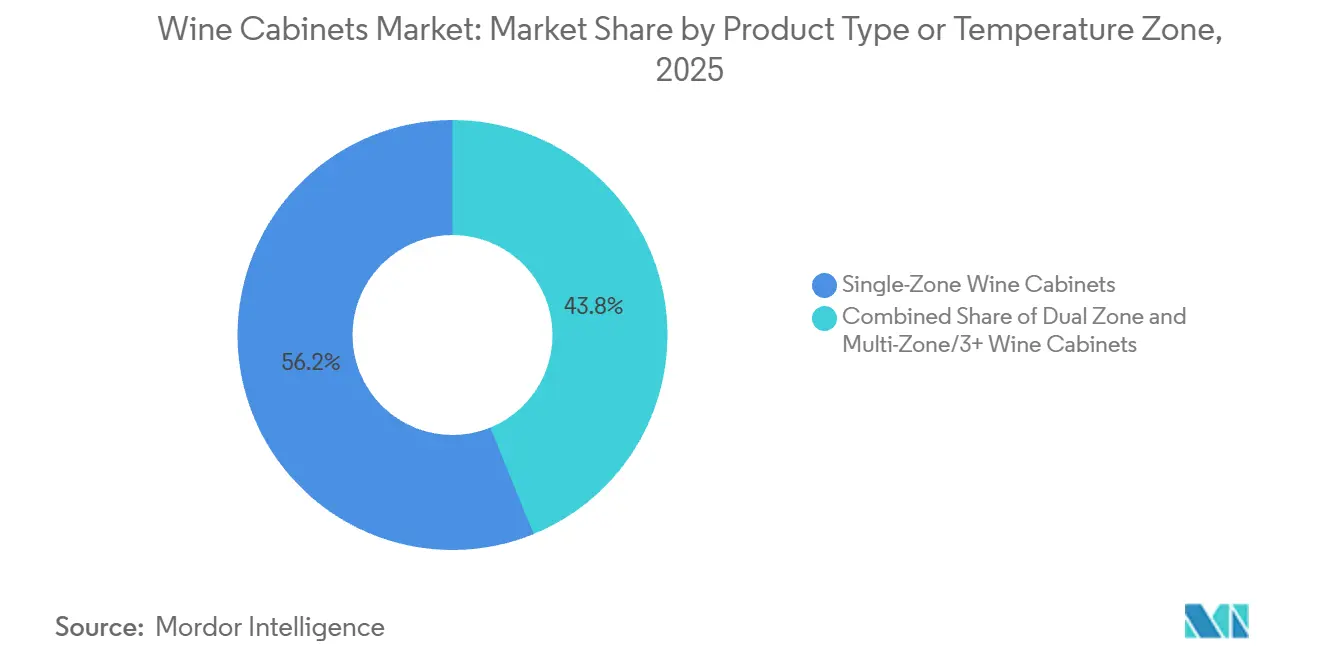
Single-zone cabinets held a 56.16% revenue share in 2025, supported by residential buyers who need reliable storage at one set temperature. The format remains practical for smaller collections that are bought for near-term consumption rather than long aging. Its lower initial cost makes it easier for a first-time buyer to choose dedicated storage instead of a standard refrigerator. Straightforward controls also appeal to households that do not need different settings for several wine styles. Dual-zone cabinets provide the next step for buyers who keep red and white wine and want each group stored separately. They give enthusiasts more flexibility without requiring the size or price of a larger collector cabinet. The wide availability of single-zone products across retail channels helps preserve their leading position. It also allows manufacturers to reach customers with different budgets and kitchen layouts. These products remain an important volume base for the wine cabinets industry. Their continuing role does not prevent a shift toward more advanced temperature control among higher-spending buyers.
Multi-zone and 3+ zone cabinets are projected to expand at a CAGR of 7.67% through 2031. Their separate compartments allow sparkling wine, white wine, and aged red wine to be kept at different temperatures in a single unit. This flexibility is useful for consumers whose collections have grown beyond a small group of similar bottles. These cabinets commonly offer compressor cooling, stronger insulation, ultraviolet protection, and construction that limits vibration. Liebherr’s Vinidor Selection Wgb7470 includes 3 independently controlled temperature zones, a sommelier board, and a bottle decanting presenter. Such product design speaks directly to buyers who want storage that also supports serving and display. Multi-zone cabinets can cost 3-5 times more than basic single-zone units. This price difference means a modest increase in unit demand can have a larger effect on revenue. The wine cabinets market benefits when collectors treat a cabinet as a longer-term home appliance purchase. The segment’s growth reflects the willingness of buyers with varied collections to pay for specialized storage.



By Installation Type: Countertop Models Widen Access in Compact Homes
Freestanding cabinets held 53.73% of the wine cabinets market share in 2025, reflecting their flexibility across homes and commercial locations. Buyers can place them without changing cabinetry or undertaking major kitchen construction. This supports retrofit purchases and makes the format useful to people living in rental properties. The range includes small compact models as well as taller cabinets designed for larger collections. A buyer can also relocate a freestanding unit more easily than an integrated product. This helps explain why the format serves both entry-level customers and established collectors. Retailers can stock a broad mix of sizes and price points within the category. Buyers can compare capacity, temperature zones, and exterior finishes before making a purchase. The wine cabinets market continues to depend on freestanding products because they suit many housing situations. Their convenience remains a practical advantage even as integrated kitchen design gains attention.
Countertop cabinets are expected to grow at a CAGR of 6.44% through 2031. Their small footprint suits micro-apartments, modest kitchens, and homes with limited unused floor space. These products can lower the initial cost of trying dedicated wine storage and reduce the need for professional installation. They are also easier to place where a full-height or undercounter cabinet would not fit. Built-in and integrated models meet a different need for a finished and coordinated kitchen layout. Liebherr expanded its undercounter portfolio in February 2026 with integrated models that include pull-out wine racks, PowerCooling, and FreshAir filtration. Panel-ready products can match surrounding cabinetry and are often considered during a planned renovation. Buyers therefore have a choice between a portable compact unit and a permanent integrated installation. This choice depends on available space, ownership status, cabinet design, and budget. The wine cabinets market can serve both needs through countertop, freestanding, and built-in formats.
By Bottle Capacity: Small Units Grow Alongside Mainstream 20-50 Bottle Cabinets
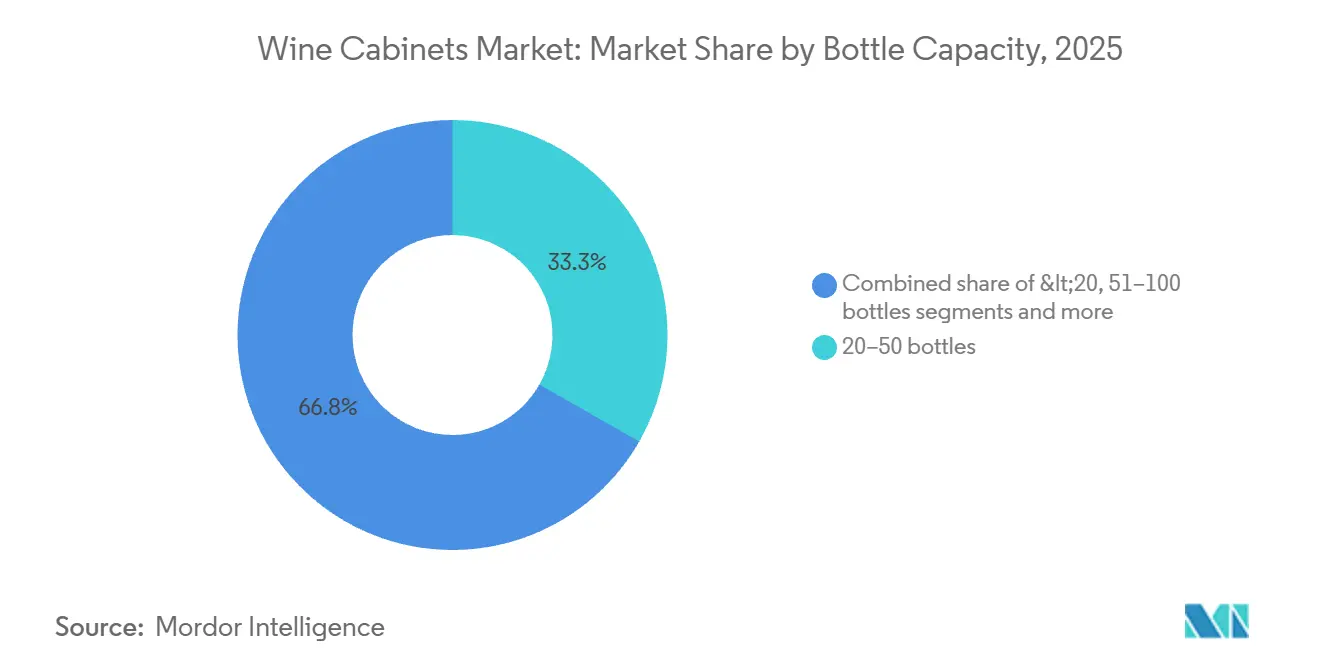
The 20-50 bottle segment accounted for a 33.25% revenue share in 2025. It fits households that maintain a rotating collection without investing in a dedicated wine room. This capacity is large enough for regular entertaining and for keeping several wine styles on hand. It remains manageable within a standard kitchen, dining area, or living space. Buyers can choose freestanding, built-in, undercounter, single-zone, or multi-zone products within this range. The segment, therefore, offers the broadest combination of price points, finishes, and cooling configurations. It also meets the needs of buyers who want more capacity than a countertop unit without a commercial-scale installation. A curated home collection can be maintained without requiring extensive floor space. Retailers can use the range as a central category for customers moving beyond basic wine storage. This balance keeps 20-50 bottle units important to the wine cabinets market.
Sub-20 bottle cabinets are projected to grow at a CAGR of 5.82% through 2031. These units appeal to apartment residents, newer wine drinkers, and buyers purchasing a cabinet as a gift. Their small dimensions support countertop placement and simplify delivery and installation. A compact model offers a lower-risk entry into temperature-controlled storage for someone with a limited collection. Larger 51-100 bottle cabinets serve enthusiasts who are building collections for aging and more frequent entertaining. Units with capacity above 100 bottles are more common in hotels, restaurants, private clubs, and dedicated cellars. Haier introduced compact HWS34GGH1 and HWS32GDG models in the Middle East in March 2026 for residential users seeking professional cooling in a small footprint. This launch reflects the demand for accessible products that do not require a large home. The available capacity range lets suppliers address both first-time owners and commercial customers. It gives the wine cabinets market a route to expand without relying only on larger premium installations.
By End User: Commercial Sites Create a Higher-Growth Demand Base
Residential buyers represented a 72.74% revenue share in 2025. This group includes casual drinkers, regular enthusiasts, collectors, and homeowners who use wine storage for entertaining. Their requirements range from a 12-bottle starter unit to larger cabinets for a tasting room or home bar. Housing space, renovation activity, and household budget all influence the kind of product purchased. Some buyers focus on basic temperature control, while others expect humidity management, low vibration, and multiple zones. Compact and single-zone products are important entry points for many households. Premium collectors may choose larger, built-in, or panel-ready cabinets as part of a wider kitchen project. This breadth creates different levels of price sensitivity and different expectations for service. Residential sales remain the largest part of current demand. The wine cabinets market, therefore, remains closely tied to the practical needs and purchasing choices of homeowners.
Commercial buyers are forecast to grow at a CAGR of 6.63% through 2031. This group includes hotels, restaurants, premium wine boutiques, specialty liquor stores, executive lounges, and tasting venues. Operators use cabinets not only to preserve stock but also to show customers the range and quality of their wine selection. Glass-front products, display columns, and separate temperature zones are useful where bottles must be visible and readily available for service. Commercial sites can require greater capacity and more durable systems than a typical household purchase. They may also need designs that fit a restaurant bar, hotel lounge, or retail display. Tasting rooms and wine clubs accounted for 53% of United States winery direct sales in 2026, supporting the role of experiential wine venues in equipment demand. This setting makes storage part of the customer experience as well as an operational need. The wine cabinets market can benefit from projects that combine display, service access, and preservation. Commercial growth gives suppliers an additional demand base beyond the much larger residential segment.
By Distribution Channel: Indirect Retail Remains Central to Product Discovery
Indirect channels accounted for an 88.92% revenue share in 2025. This category includes home centers, appliance specialists, electronics retailers, general trade outlets, and online marketplaces. These channels enable consumers to compare cabinet capacity, zone configuration, external dimensions, and installation requirements before purchase. Appliance specialists play a particularly important role in premium product sales, as these products often require demonstrations or guidance on custom panels. Physical stores also help buyers assess door clearance, ventilation requirements, and the suitability of freestanding versus integrated formats. Online marketplaces broaden access to compact and freestanding products for consumers who prefer digital product comparisons.
Indirect sales are forecast to grow at a CAGR of 5.51% through 2031. Manufacturers also sell through showrooms and brand-operated online stores, but direct activity accounted for the remaining 11.08% of 2025 sales. Direct routes let a brand control how it presents product materials, finishes, and service options. They can also provide a closer path between customers and the manufacturer’s own support team. Online research is increasingly important before consumers buy an appliance with specific space and installation requirements. Clear specifications, room-planning tools, and reliable customer reviews can reduce uncertainty before purchase. Manufacturers need consistent content across retailer sites and their own digital channels. A poor product listing can make it harder for a buyer to compare capacity, temperature controls, and cabinet dimensions. The wine cabinets market will continue to use both routes because each serves a different part of the buying process. Indirect retail will retain the broader reach, while direct channels support brand control and detailed product communication.
Geography Analysis
North America held 31.01% of the wine cabinets market share in 2025, supported by the United States’ mature installed base and established consumer audience for dedicated wine storage. The Wine Market Council reported that the share of American adults who drank wine fell to 29% in 2026 from 34% 2 years earlier. Still, buyers who remain active may place greater value on selected bottles and dependable storage. Canada supports demand for imported premium wines and products suited to established collectors. Mexico offers room for growth through wine tourism, modern retail, and a growing affluent middle class. The wine cabinets market in the region is supported by renovation activity, specialized retailers, and a broad range of premium appliance brands.
Europe has a stable position in the wine cabinets market because wine culture is established across France, Italy, Germany, Spain, and the United Kingdom. France is home to EuroCave, La Sommelière, and Climadiff, whose products serve collectors who value controlled temperature, low vibration, and long-term storage conditions. Germany has a demand for premium built-in cabinets, particularly in urban kitchen renovation projects where integrated appliances are considered early in the design process. EU Ecodesign rules apply across member states and require compliant refrigeration performance, which can support replacement demand for older equipment. Nordic and BENELUX countries also have demand for connected home appliances, while European consumers across the region require storage for imported, local, and aged wines.
Asia-Pacific is projected to grow at a CAGR of 7.05% through 2031, making it the fastest-growing regional area in the wine cabinets market. China imported USD 1.4 billion in wine in 2025, while import volume fell 11% and average unit values rose, supporting the need to protect fewer, higher-value bottles. India’s middle class is projected to reach 47% of the population, or 715 million people, by 2031, while Japan, South Korea, and Australia provide more established demand for premium storage. The Middle East and Africa have a different demand profile, with licensed hospitality venues, premium hotels, compact home products, integrated kitchens, and visible commercial storage creating routes for the wine cabinets market to expand.

Competitive Landscape
The wine cabinets market operates across a bifurcated competitive structure. The wine cabinets market includes premium specialists and higher-volume appliance brands. EuroCave, Sub-Zero, Liebherr, Miele, and Perlick compete through temperature management, cabinet materials, low-vibration design, and relationships with kitchen designers who influence appliance selection. Haier, Danby, Avanti, NewAir, and Samsung compete through price, capacity, retail access, and product availability across a broader group of households. This gives buyers a choice between specialized preservation features, established design credentials, and more accessible cabinet formats. Sub-Zero promotes a dual-evaporator system that maintains separate humidity and temperature conditions within a unit, illustrating the technical differentiation used by premium suppliers.
Liebherr expanded its undercounter range in February 2026 with the UBCgb3730 and UBC3760 models, bringing pull-out wine racks, PowerCooling, FreshAir filtration, and SmartDeviceBox integration to compact integrated products. EuroCave introduced Harmonie in May 2025 as its first connected wine cabinet, combining 2 temperature zones with app-based monitoring and lighting control. GE Appliances also brought a panel-ready undercounter wine reserve to KBIS 2025, with 2 zones, WiFi, and capacity for up to 42 bottles. Together, these product moves show that connected functions, cabinet integration, and compact premium formats are important points of competition. The wine cabinets market also gives suppliers an opportunity to offer mid-priced multi-zone cabinets for apartment dwellers and new collectors. At the same time, commercial display systems remain a specialized area for product development.
Digital product presentation matters as buyers compare dimensions, temperature zones, design options, ventilation needs, and installation requirements before purchase. Brands with clear online product content and useful retail reviews can improve visibility in the midrange segment. CASO Design, Dunavox, and ArteVino target buyers seeking premium-looking cabinets at more accessible prices, while La Sommelière and Climadiff serve French specialist demand for low vibration and natural convection. Energy requirements and connected features increase the development burden for smaller suppliers, so the wine cabinets market is likely to favor firms that can offer dependable cooling, compliant energy performance, and simple controls across several cabinet sizes.
Wine Cabinets Industry Leaders
Sub-Zero Group, Inc.
EuroCave
Liebherr Group
Vinotemp International
U-Line Corporation
- *Disclaimer: Major Players sorted in no particular order

Recent Industry Developments
- March 2026: Haier Group launched a wine cooler range in the Middle East with four models: HWS34GGH1, HWS32GDG, HWS42GDAU1, and the 205-bottle HWS205GGEH1. The models include cooling systems, Wi-Fi connectivity through the Home app, and cellar management functions. The launch increased the company's presence in residential and hospitality wine storage applications in the Gulf region.
- February 2026: Liebherr USA expanded the undercounter appliance portfolio with the UBCgb3730 and UBC3760 fully integrated beverage refrigerators. The models include pull-out wine racks, PowerCooling, and FreshAir filtration. The company also introduced the URD3753 double-drawer unit with SmartDeviceBox integration. The expansion followed the 2025 undercounter redesign and addressed compact kitchen demand in North America and the Asia Pacific.
- October 2025: Miele launched an updated panel-ready undercounter wine refrigerator with a standard height of 86 cm. Features included FlexiFrame adjustable wire racks for different bottle shapes and sizes, adjustable humidity control, UV-filtering glass, and Miele@home app connectivity. The model supported integrated installation in premium remodeling projects.
- September 2025: Liebherr showcased a panel-ready Vinidor Selection undercounter wine refrigerator at IFA 2025 in Berlin. The refrigerator was designed for handleless kitchen formats with installation heights ranging from 82 cm to 92 cm. Features included a 38-bottle capacity FlexFit beechwood racks and a push-to-open TipOpen mechanism. The model added a panel-ready option for ultra-flat kitchen designs.


Global Wine Cabinets Market Report Scope
Wine cabinets are specialized storage units engineered to maintain optimal temperature, humidity, and vibration-free conditions for preserving and aging wine collections. The wine cabinets market is segmented by product type/temperature zone, installation type, bottle capacity, end-user, distribution channel, and geography. By product type/temperature zone, the market is segmented into single-zone wine cabinets, dual-zone wine cabinets, and multi-zone/3+ wine cabinets. By installation type, the market is segmented into freestanding wine cabinets, built-in/integrated wine cabinets, and countertop wine cabinets. By bottle capacity, the market is segmented into <20 bottles, 20–50 bottles, 51–100 bottles, and >100 bottles. By end-user, the market is segmented into residential and commercial. By distribution channel, the market is segmented into direct sales (offline, online [direct-to-consumer]) and indirect sales (offline [home centers, specialty electronics retailers, general trade, trade shows, etc.], online [marketplaces]). By geography, the market is segmented into North America, South America, Europe, Asia-Pacific, and the Middle East & Africa. The report offers the market size in value terms in USD for all the above-mentioned segments.
| Single-Zone Wine Cabinets |
| Dual Zone Wine Cabinets |
| Multi-Zone/3+ Wine Cabinets |
| Freestanding Wine Cabinets |
| Built-In / Integrated Wine Cabinets |
| Countertop Wine Cabinets |
| Below 20 bottles |
| 20–50 bottles |
| 51–100 bottles |
| Above 100 bottles |
| Residential (Wine Collectors & Serious Enthusiasts, Affluent Homeowners & Lifestyle Buyers) |
| Commercial (HoReCa, Premium Wine Boutiques, Specialty Liquor Stores, Executive Lounges, Private Clubs, etc.) |
| Direct Sales | Offline |
| Online (Direct-to-Consumer) | |
| Indirect Sales | Offline (home centers, specialty electronics retailers, general trade, trade shows, etc.) |
| Online (marketplaces) |
| North America | Canada |
| United States | |
| Mexico | |
| South America | Brazil |
| Peru | |
| Chile | |
| Argentina | |
| Rest of South America | |
| Europe | United Kingdom |
| Germany | |
| France | |
| Spain | |
| Italy | |
| BENELUX (Belgium, Netherlands, Luxembourg) | |
| NORDICS (Denmark, Finland, Iceland, Norway, Sweden) | |
| Rest of Europe | |
| Asia-Pacific | India |
| China | |
| Japan | |
| Australia | |
| South Korea | |
| South-East Asia | |
| Rest of Asia-Pacific | |
| Middle East & Africa | United Arab Emirates |
| Saudi Arabia | |
| South Africa | |
| Nigeria | |
| Rest of Middle East & Africa |
| By Product Type/Temperature Zone | Single-Zone Wine Cabinets | |
| Dual Zone Wine Cabinets | ||
| Multi-Zone/3+ Wine Cabinets | ||
| By Installation Type | Freestanding Wine Cabinets | |
| Built-In / Integrated Wine Cabinets | ||
| Countertop Wine Cabinets | ||
| By Bottle Capacity | Below 20 bottles | |
| 20–50 bottles | ||
| 51–100 bottles | ||
| Above 100 bottles | ||
| By End-User | Residential (Wine Collectors & Serious Enthusiasts, Affluent Homeowners & Lifestyle Buyers) | |
| Commercial (HoReCa, Premium Wine Boutiques, Specialty Liquor Stores, Executive Lounges, Private Clubs, etc.) | ||
| By Distribution Channel | Direct Sales | Offline |
| Online (Direct-to-Consumer) | ||
| Indirect Sales | Offline (home centers, specialty electronics retailers, general trade, trade shows, etc.) | |
| Online (marketplaces) | ||
| By Geography | North America | Canada |
| United States | ||
| Mexico | ||
| South America | Brazil | |
| Peru | ||
| Chile | ||
| Argentina | ||
| Rest of South America | ||
| Europe | United Kingdom | |
| Germany | ||
| France | ||
| Spain | ||
| Italy | ||
| BENELUX (Belgium, Netherlands, Luxembourg) | ||
| NORDICS (Denmark, Finland, Iceland, Norway, Sweden) | ||
| Rest of Europe | ||
| Asia-Pacific | India | |
| China | ||
| Japan | ||
| Australia | ||
| South Korea | ||
| South-East Asia | ||
| Rest of Asia-Pacific | ||
| Middle East & Africa | United Arab Emirates | |
| Saudi Arabia | ||
| South Africa | ||
| Nigeria | ||
| Rest of Middle East & Africa | ||


Key Questions Answered in the Report
What is the projected value of the wine cabinets market by 2031?
The wine cabinets market is forecast to reach USD 1.90 billion by 2031, expanding at a 4.90% CAGR from 2026. Growth reflects demand for reliable temperature-controlled storage in premium homes, compact urban properties, and commercial venues.
Which wine cabinet type is growing fastest?
Multi-zone and 3+ zone cabinets are the fastest-growing product type, with a projected 7.67% CAGR through 2031. Their separate temperature settings help buyers store red, white, and sparkling wines within one cabinet.
Why are multi-zone wine cabinets gaining demand?
They store red, white, and sparkling wines at separate temperatures, which suits households with higher-value and more varied collections. These models also offer features such as compressor cooling, ultraviolet protection, and reduced vibration.
Which installation type leads sales?
Freestanding cabinets led with a 53.73% share in 2025, while countertop models are forecast to grow fastest at a 6.44% CAGR. Freestanding designs remain popular because they are easier to place, move, and sell through retail channels.
Which region will expand fastest through 2031?
Asia-Pacific is forecast to grow at a 7.05% CAGR through 2031, supported by premiumization in China and wine culture growth in India. Compact home formats and commercial hospitality demand also support the regional opportunity.
What is the key restraint on wine cabinet adoption?
Premium dual-zone and multi-zone compressor cabinets can cost USD 1,000 to USD 6,000 or more, which limits first-time purchases. Installation costs and energy performance requirements can add to the buyer’s total cost.
Page last updated on:


 Your data is secure and never sold or shared.


