
Sustainable Marine Fuels Market Size and Share
Market Overview
| Study Period | 2022 - 2032 |
|---|---|
| Market Size (2027) | USD 7.51 Billion |
| Market Size (2032) | USD 11.13 Billion |
| Growth Rate (2027 - 2032) | 8.20 % |
| Fastest Growing Market | Europe |
| Largest Market | Asia-Pacific |
| Market Concentration | Low |
Major Players *Disclaimer: Major Players sorted in no particular order Image © Mordor Intelligence. Reuse requires attribution under CC BY 4.0. | |
Sustainable Marine Fuels Market Analysis by Mordor Intelligence
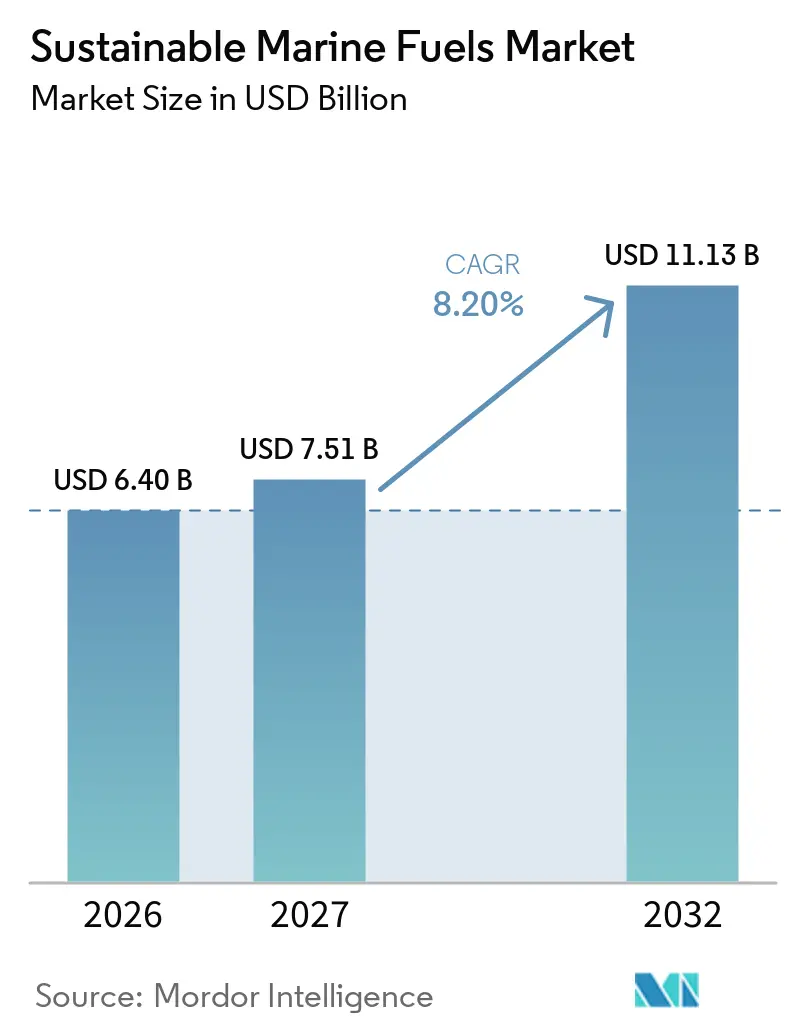
The global sustainable marine fuels market size is projected to be USD 6.40 billion in 2026, USD 7.51 billion in 2027, and reach USD 11.13 billion by 2032, at a CAGR of 8.20% from 2027 to 2032. Compliance requirements have moved fuel decisions from voluntary programs into fleet operating plans, shaping the sustainable marine fuels market. The International Maritime Organization (IMO) carbon-intensity framework and FuelEU Maritime have increased the cost of continuing with conventional fuel choices on regulated routes.[1] FuelEU Maritime uses well-to-wake accounting, which places greater scrutiny on methane slip from fossil liquefied natural gas (LNG) and recognizes lifecycle reductions from qualifying biofuels and renewable methanol. This shifts procurement toward fuels with verified lifecycle credentials, especially for vessels trading with Europe. The sustainable marine fuels market also faces supply constraints for certified feedstocks and renewable electricity, while uncertain timing for the IMO Net-Zero Framework has delayed some investment decisions. Active green shipping corridors, new dual-fuel engine capability, and port fuel projects are creating a clearer route from vessel orders to fuel demand.
Key Report Takeaways
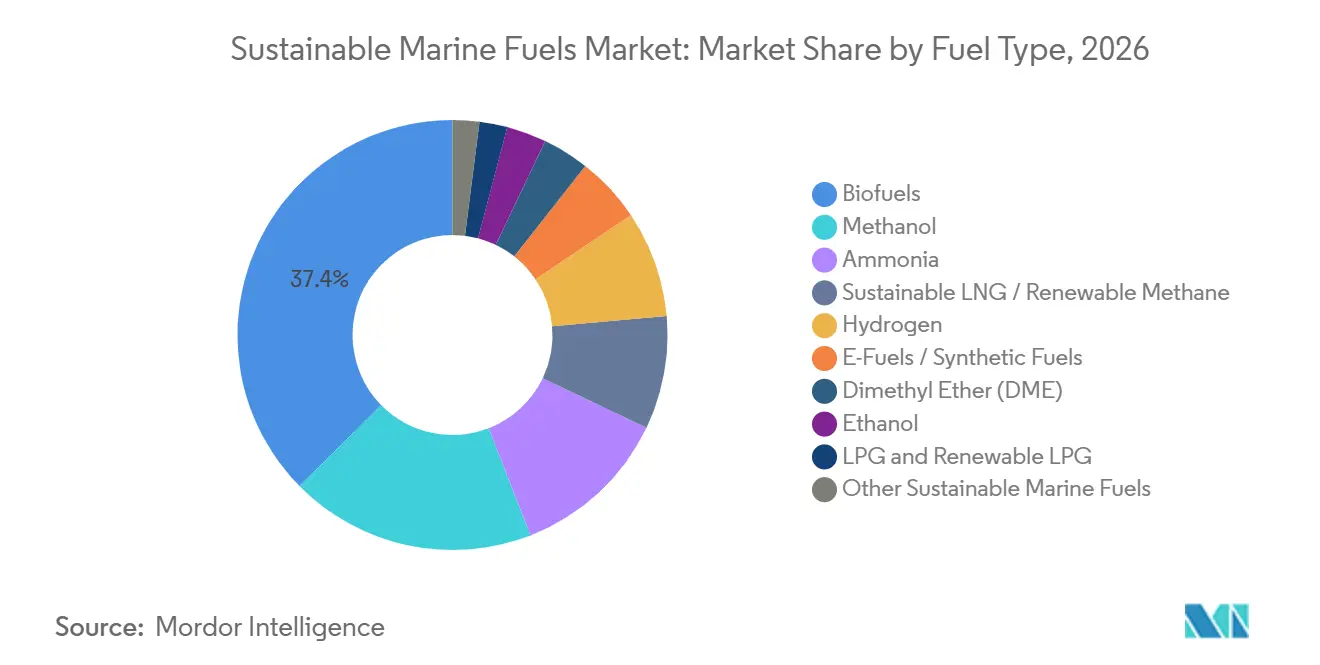
- By fuel type, biofuels led with 37.4% of the sustainable marine fuels market share in 2026, while ammonia is forecast to expand at an 8.9% CAGR through 2032.
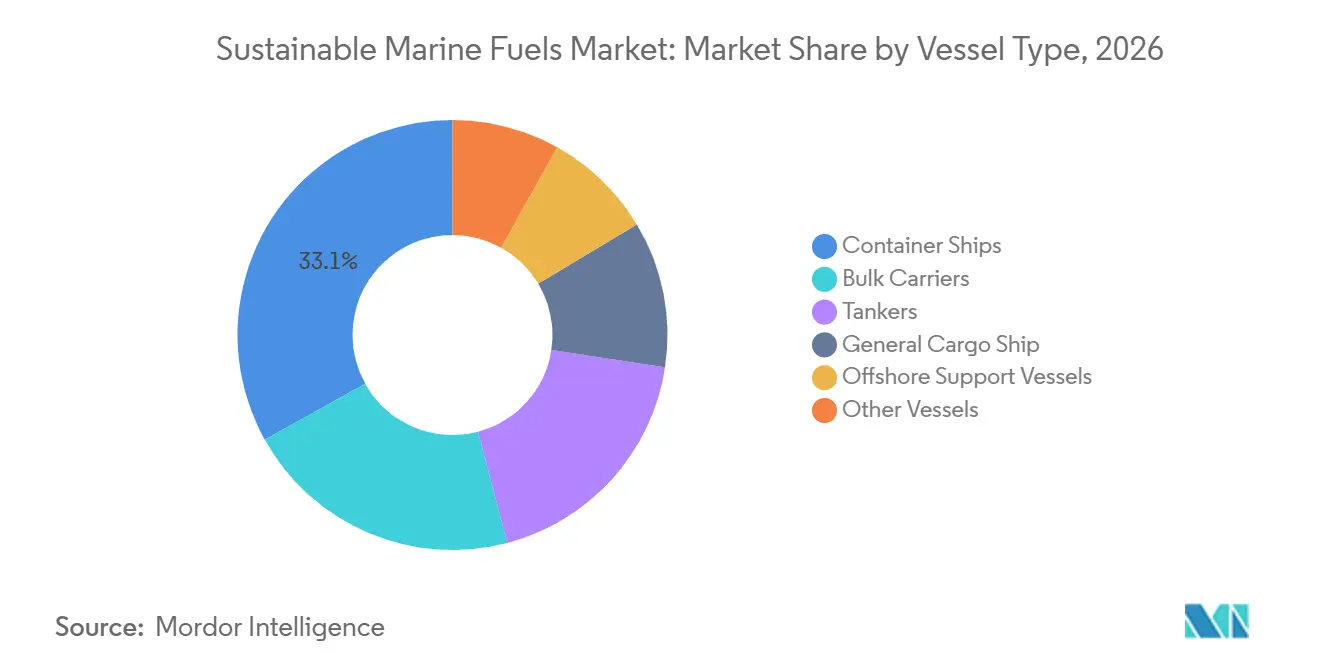
- By vessel type, container ships held 33.1% of the sustainable marine fuels market share in 2026, while offshore support vessels recorded the highest projected CAGR at 9.4% through 2032.
- By geography, Asia-Pacific accounted for 45.7% of the sustainable marine fuels market size in 2026, while Europe is projected to grow at a 9.2% CAGR through 2032.
Note: Market numbers in this report are based on Mordor Intelligence's proprietary estimation framework, which combines nine months of actuals with Q4 projections for base year 2026.
Market Trends and Insights
Drivers Impact Analysis of Sustainable Marine Fuels Market*
| Driver | (~) % Impact on CAGR Forecast | Geographic Relevance | Impact Timeline |
|---|---|---|---|
| IMO And Regional Carbon-Intensity Compliance | +1.5% | Global, concentrated enforcement in EU/EEA and CII-monitored ports | Short term (≤ 2 years) |
| Green Shipping Corridors And Cargo-Owner Procurement | +0.9% | Global, strongest on Asia-Europe and Trans-Pacific trade lanes | Medium term (2-4 years) |
| Drop-In Biofuel Compatibility With Existing Fleets | +1.2% | Global, highest uptake in Asia-Pacific bunkering hubs and the ARA region | Short term (≤ 2 years) |
| Methanol- And Ammonia-Ready Vessel Orders | +0.7% | Global, concentrated in East Asian shipbuilding centers | Medium term (2-4 years) |
| Port Bunkering And Renewable-Fuel Infrastructure Investment | +0.5% | North America and Europe, with spillover to Singapore, South Korea, and India | Medium term (2-4 years) |
| Certified Scope 3 Decarbonization Demand From Shippers | +0.4% | Europe, the United Kingdom, and North America, with early gains among consumer-facing exporters | Long term (≥ 4 years) |
| Source: Mordor Intelligence | |||
IMO and Regional Carbon-Intensity Compliance Reshape Fleet Economics
The sustainable marine fuels market is responding to a 2.625% annual Carbon Intensity Indicator (CII) reduction factor through 2030 under amendments considered at Marine Environment Protection Committee (MEPC) 83. Shipowners can reduce speed, retrofit vessels, or switch fuels to avoid poor ratings, and these choices integrate fuel compliance into routine fleet management. FuelEU Maritime, which came into full effect in January 2025, created well-to-wake greenhouse gas intensity obligations for vessels serving the European Union.[2] Its first verification cycle is underway in 2026, and financial exposure increases as the regulation becomes more stringent. Pooling allows fleets with stronger compliance balances to offset weaker performers, which can make verified biofuel blends more practical for operators managing compliance across their fleet. The International Maritime Organization (IMO) framework approved in principle in April 2025 would add a global greenhouse gas fuel-intensity standard upon adoption, strengthening the long-term demand signal for lower-carbon marine fuels.
Green Shipping Corridors and Cargo-Owner Procurement Create Commercial Anchors
The sustainable marine fuels market benefits when named trade routes combine fuel supply, vessel deployment, port readiness, and cargo demand. As of November 2025, 84 active green shipping corridor initiatives had been identified, including 25 launched during that year. These corridors can provide the longer-term offtake commitments needed to support fuel production and bunkering investment. Cargo owners with Scope 3 targets have shown a greater willingness to pay for lower-carbon freight than companies without such commitments. That willingness weakened during 2025 as costs and regulation became more important to procurement decisions, meaning corridor projects require firm commercial contracts rather than brand-led commitments. A Korea-Europe corridor assessment indicated that fuel offtake commitments could support emissions reductions above 70% on Pyeongtaek to European automotive routes.
Drop-in Biofuel Compatibility Supports Existing Fleets
Biofuels held 37.4% of the sustainable marine fuels market in 2025 because they can be blended and delivered through established bunkering systems. At lower blend levels, they avoid immediate engine modifications and reduce the need for new crew qualifications. In May 2025, the IMO issued provisional guidance increasing the allowable biofuel blend ceiling in conventional fuel supply tankers from 25% to 30%. This enabled a wider range of supply arrangements and supported compliance pooling under FuelEU Maritime. Biofuel blends can also serve as a bridge for methanol- and ammonia-ready vessels while dedicated bunkering systems mature. Rising bioenergy costs linked to feedstock volatility reduce the price advantage, but existing infrastructure remains an important practical benefit.
Methanol- and Ammonia-Ready Vessel Orders Build Future Fuel Demand
The sustainable marine fuels market has a growing pipeline of vessel commitments that will require different fuel supply arrangements after delivery. Lloyd's Register reported 590 alternative-fuel-capable vessel orders in 2025, representing 45.5 million GT, including 134 methanol and 6 ammonia (NH3) orders. The cumulative orderbook stood at 385 methanol-capable ships and 45 NH3-capable ships. Many dual-fuel methanol vessels still operate on fossil-derived methanol, so lifecycle rules increase the pressure to secure renewable supply. Ocean Network Express ordered 12 methanol dual-fuel 13,000 TEU container ships for 2027 delivery, while COSCO Shipping Development ordered 15 methanol- and NH3-ready Newcastlemax bulk carriers for approximately USD 1.17 billion. WinGD completed factory acceptance testing for its X72DF-A NH3 engine in June 2026, confirming that large-scale NH3 propulsion is commercially available.
Restraints Impact Analysis of Sustainable Marine Fuels Market*
| Restraint | (~) % Impact on CAGR Forecast | Geographic Relevance | Impact Timeline |
|---|---|---|---|
| Sustainable Feedstock And Renewable Power Scarcity | -0.9% | Global, acutest in Europe and Southeast Asia where waste-based used cooking oil supply is tightest | Short term (≤ 2 years) |
| Green Premium And Uncertain Fuel-Price Pass-Through | -0.7% | Global, with cargo-owner willingness to pay falling most sharply outside the European Union regulatory perimeter | Medium term (2-4 years) |
| Safety And Bunkering Complexity For Ammonia And Hydrogen | -0.5% | Global, concentrated where port certification and crew training lag vessel delivery schedules | Medium term (2-4 years) |
| Fragmented Lifecycle Certification And Fuel-Accounting Rules | -0.4% | Global, with friction across regions operating under incompatible ETS, CII, and FuelEU frameworks | Long term (≥ 4 years) |
| Source: Mordor Intelligence | |||
Sustainable Feedstock and Renewable Power Scarcity Constrain Supply
The sustainable marine fuels market depends on feedstocks that meet lifecycle and certification requirements, rather than on fuel volume alone. Waste cooking oil, animal fats, and agricultural residues are limited in supply, and the aviation industry competes for the same qualifying materials. This competition is significant because aviation can offer higher returns for individual certified molecules. Det Norske Veritas has warned that aviation mandates could constrain marine biodiesel supply by drawing used cooking oil and tallow toward aviation refining.[3] Green ammonia and e-fuels face a separate constraint in access to affordable renewable electricity. Green ammonia was priced at USD 1,897 per metric ton of Very Low Sulfur Fuel Oil equivalent (VLSFOe) in Singapore, compared with USD 484 per metric ton for conventional Very Low Sulfur Fuel Oil (VLSFO). Safety approval, bunkering capability, and compatible lifecycle certification present additional challenges for ammonia (NH3), hydrogen (H2), and synthetic fuels.
Green Premium and Uncertain Fuel-Price Pass-Through Limit Adoption
The sustainable marine fuels market faces a cost-sharing challenge, as shipowners invest in dual-fuel assets and higher-cost fuel before freight customers agree to cover the price difference. This dynamic is under pressure when cargo owners reduce their willingness to pay for lower-carbon freight. Average willingness to pay stood at 3% in 2025, with cost identified as the main barrier by 40% of respondents. Delayed certainty around the International Maritime Organization (IMO) framework also makes longer-term fuel offtake agreements and green freight contracts harder to finalize. Oil-based fuels represented 97% of the global bunker mix in 2024, illustrating the gap between policy objectives and current purchasing patterns. Fragmented fuel-accounting rules across the Emissions Trading System (ETS), Carbon Intensity Indicator (CII), and FuelEU frameworks add administrative complexity, particularly for operators working across multiple regulatory regions.
*Our forecasts treat driver/restraint impacts as directional, not additive. The impact forecasts reflect baseline growth, mix effects, and variable interactions.
Sustainable Marine Fuels Market Segment Analysis
By Fuel Type:
Biofuels Lead Current Demand While Ammonia Builds Future GrowthBiofuels accounted for 37.4% of the sustainable marine fuels market in 2026, supported by drop-in use, certified waste-based supply chains, and established bunkering logistics. The sustainable marine fuels market includes biofuels, methanol, ammonia, hydrogen, sustainable LNG and renewable methane, e-fuels and synthetic fuels, dimethyl ether (DME), ethanol, LPG and renewable LPG, and other sustainable fuels. Methanol represents a second tier of activity, supported by a 385-vessel orderbook. However, its current operating base still relies heavily on fossil-derived methanol, which creates a transition requirement as lifecycle accounting is more fully applied. Hydrogen remains at an early stage and is mainly suited to short-sea and ferry applications. Sustainable LNG and renewable methane provide a bridge option on routes that already have LNG bunkering capacity.
Ammonia is forecast to expand at an 8.9% CAGR through 2032, the fastest rate among fuel types in the sustainable marine fuels market. This reflects its zero-carbon combustion potential, commercial engine approvals, and green-ammonia investment linked to the IMO goal for zero- or near-zero-emission fuels. EXMAR delivered MGC ANTWERPEN in June 2026 as the first oceangoing vessel capable of ammonia propulsion. IMO interim guidelines provide a route for safety and certification, although binding prescriptive requirements are not expected before 2032. E-fuels remain the highest-cost option, but FuelEU Maritime contains a Renewable Fuels of Non-Biological Origin (RFNBO) provision that could trigger a 2% quota from 2034 if a 1% threshold is not met by 2031. In July 2026, Maersk supplied 2,800 tonnes of bioethanol to Antonia Mærsk in Barcelona, while CMA CGM bunkered CMA CGM IRON with Brazilian sugarcane ethanol at Santos, broadening the fuel options available to alcohol-capable vessels.[4]

By Vessel Type:
Container Ships Carry Compliance Exposure While Offshore Vessels Grow FastestContainer ships held 33.1% of the sustainable marine fuels market in 2026, reflecting their direct exposure to emissions regulations and port obligations. FuelEU Maritime requires container ships to connect to onshore power at European Union berths from 2030, creating both operational and fuel-intensity requirements. Bulk carriers and tankers remain substantial demand areas for lower-carbon fuels. Tankers are important to biofuel distribution, as updated IMO guidance allows biofuel transport at blends up to 30% in conventional fuel tankers. General cargo ships face lower immediate pressure, although annual Carbon Intensity Indicator (CII) reductions will make higher-blend biofuel strategies more relevant through the forecast period. This segment therefore combines near-term compliance demand in liner shipping with an expanding need for distribution capacity.
Offshore support vessels are projected to grow at a 9.4% CAGR through 2032, making them the fastest-growing vessel category in the sustainable marine fuels market. Norway's low-emission offshore operating requirements from 2025 and zero-emission newbuild expectations from 2029 create an early domestic demand base for ammonia (NH3). Eidesvik Offshore is converting Viking Energy to ammonia (NH3) propulsion for Equinor, supported by EUR 5 million in EU Horizon Europe funding, with completion targeted for autumn 2026. The project will generate operational evidence from a commercial offshore service environment. CMB.TECH and Fortescue also agreed in June 2026 to develop up to 12 ammonia (NH3)-capable bulk carriers, including 3 dual-fuel vessels for delivery by end of 2026 and 9 ammonia-ready vessels. These orders indicate that industrial vessel owners are preparing for lower-carbon fuel supply alongside container operators.
Geography Analysis
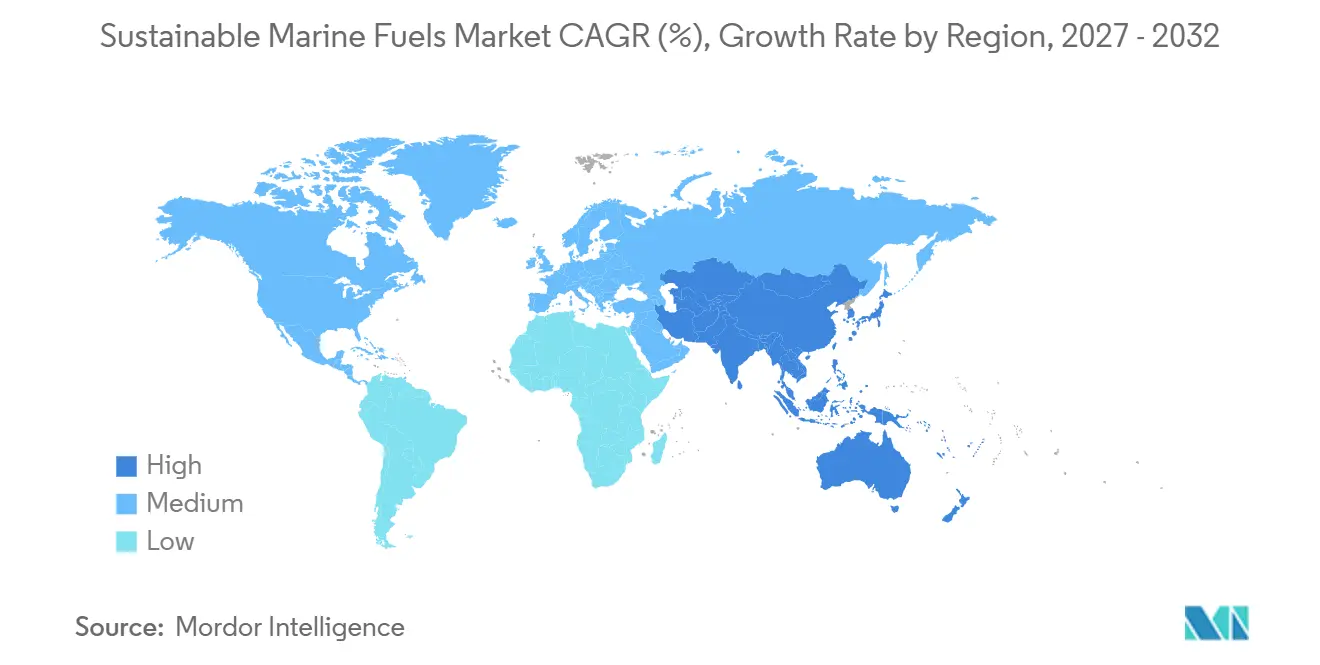
Asia-Pacific accounted for 45.7% of the sustainable marine fuels market in 2026, supported by Singapore's role as the largest bunkering port and biofuel programs in China, South Korea, and India. Singapore's biobunker sales reached 1.36 million metric tons in 2025, an increase of 54.4% from the prior year, as European-trading vessels purchased compliant fuel before westbound voyages. China completed its first marine biofuel blending under the Zhoushan pilot in March 2026, following approval for bonded blending and export. Reports indicate 120,000 metric tons of Chinese biofuel bunkering volumes in 2025, compared with less than 100 metric tons in 2024. South Korea's S-OIL Corporation began B30 Very Low Sulfur Fuel Oil (VLSFO) blend operations at Ulsan. Singapore introduced an ammonia bunkering technical reference in 2026 and opened applications for new LNG supply licenses.
Europe is forecast to grow at a 9.2% CAGR through 2032, the highest regional rate in the sustainable marine fuels market. FuelEU Maritime obligations and EU Emissions Trading System (EU ETS) coverage of 50% of international voyage emissions reduce the effective premium for operators trading with Europe. Service Terminal Rotterdam launched its GreenSTR project in June 2026, adding 100,000 m³ of storage for biodiesel, methanol, and ethanol. Moeve and Exolum secured EUR 105 million (USD 112 million) for the Muelle Sur hub at the Port of Huelva in July 2026, linking second-generation biofuel production with maritime distribution. Hamburg completed ammonia bunkering safety protocols in 2026 ahead of a planned import terminal expected to operate from 2029.
North America has lower bio-bunker demand because ocean-going vessels do not qualify for federal Renewable Identification Number credits, leaving United States ports at a price disadvantage. Brazil updated marine-fuel rules to permit up to B100 biofuel use, offering a different demand trajectory for South America. CMA CGM completed the first deep-sea containership bioethanol bunkering at the Port of Santos in July 2026. Middle East and Africa remain longer-term opportunities in the sustainable marine fuels market. Indian Oil Corporation began a USD 25 million bunkering expansion at Port Louis, Mauritius, in August 2026, adding 27,500 tonnes of storage capacity to support an Indian Ocean bunkering hub, reflecting the importance of trade-route location in developing new fuel infrastructure.
Competitive Landscape
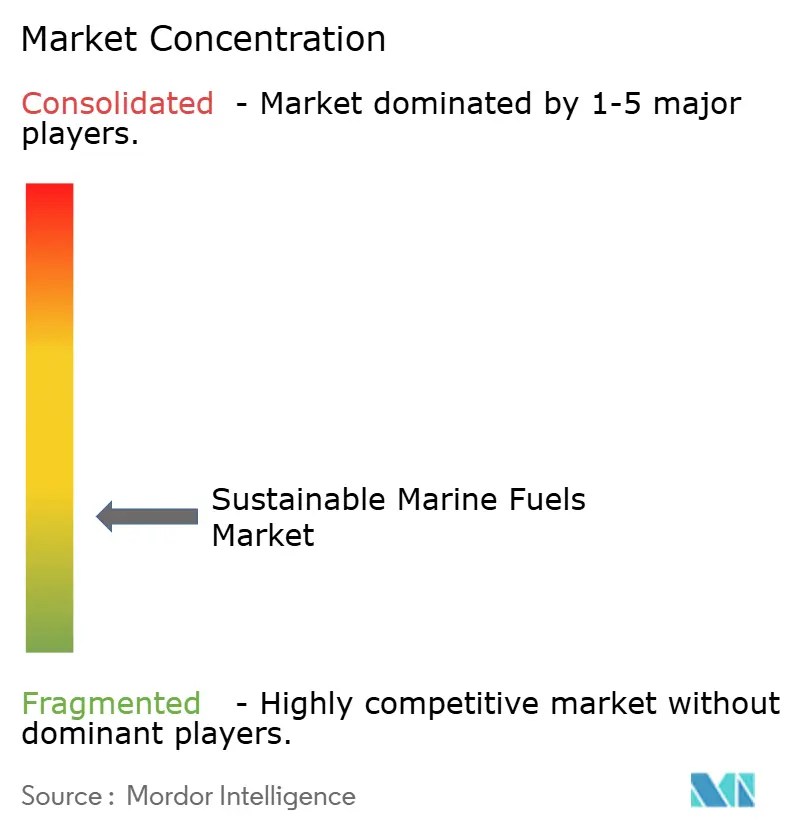
The sustainable marine fuels market is moderately fragmented, as no single company offers global capability across fuel production, lifecycle certification, bunkering logistics, and port infrastructure. Integrated energy companies, including Shell, TotalEnergies, BP, ExxonMobil, and Chevron, use refining assets and global bunkering networks. Certified-fuel specialists such as Neste, FincoEnergies, GoodFuels, and Argent Energy compete through waste-based feedstock credentials and traceable supply chains. Propulsion developers, including Wärtsilä, MAN Energy Solutions, and WinGD, influence demand because engine specifications can define a vessel's fuel choices for 20 to 25 years. This structure encourages joint ventures and long-term supply agreements rather than a single integrated operating model, creating space for regional suppliers that can provide compliant fuel and documentation at secondary ports.
Major energy companies are building supply positions in bio-LNG and bio-methanol through longer-term contracts. Specialist suppliers focus on certification systems, chain-of-custody records, and digital bunker delivery documentation that supports FuelEU and Carbon Intensity Indicator (CII) compliance. Wärtsilä increased the power output of its 25 Ammonia engine in April 2026 to 315/345 kW per cylinder, matching its LNG-fueled equivalent and enabling direct LNG-to-ammonia (NH₃) conversion, which reduces technical risk for owners considering ammonia-ready specifications. In January 2026, Wärtsilä received its first newbuild application for the engine from Skarv Shipping Solutions.
Yara Clean Ammonia and NYK Line concluded a time-charter arrangement for an ammonia-fueled medium gas carrier in November 2025. In April 2026, NYK Line, Golden Island, and Yara Clean Ammonia launched a Singapore partnership for ammonia (NH₃) fuel sales and marketing. Equinor signed a two-year bio-methanol supply agreement with Wallenius Wilhelmsen in March 2026. These arrangements indicate that supply certainty is becoming as important as access to engines and vessels. Regional bunkering operators with credible documentation remain relevant where large global suppliers have limited physical coverage. A market concentration score cannot be assigned from the available material, as it provides no combined market share figure for the leading companies.
Sustainable Marine Fuels Industry Leaders
-
Neste Oyj
-
Shell plc
-
TotalEnergies SE
-
BP p.l.c.
-
FincoEnergies B.V.
- *Disclaimer: Major Players sorted in no particular order
Sustainable Marine Fuels Market Companies Covered in this Report
- A.P. Moller - Maersk A/S
- Argent Energy
- BP p.l.c.
- Cargill, Incorporated
- Chevron Corporation
- CMA CGM S.A.
- CMB.TECH NV
- Eni S.p.A.
- Exxon Mobil Corporation
- FincoEnergies B.V.
- Gevo, Inc.
- GoodFuels
- Kvasir Technologies ApS
- MAN Energy Solutions SE
- Methanex Corporation
- Mitsui O.S.K. Lines, Ltd.
- Neste Oyj
- OCI Global
- Repsol, S.A.
- Shell plc
- Steeper Energy ApS
- TotalEnergies SE
- Wärtsilä Corporation
- Yara International ASA
Recent Industry Developments in Sustainable Marine Fuels Market
- July 2026: CMA CGM Group completed the world's first deep-sea containership bioethanol bunkering operation at the Port of Santos, Brazil, supplying its tri-fuel vessel CMA CGM IRON with certified sugarcane-based bioethanol sourced from Copersucar. This operation positions Brazil as an emerging low-carbon marine fuel hub and demonstrates commercial-scale bioethanol adoption in ocean shipping.
- July 2026: A.P. Møller-Maersk completed the first large-scale bunkering of 100% bioethanol onto the 16,200 TEU container vessel Antonia Mærsk at Barcelona. Approximately 2,800 tonnes of bioethanol were supplied, marking the expansion of alcohol-fuel operations from feeder ships to intercontinental container services.
- June 2026: EXMAR delivered MGC ANTWERPEN, the world's first oceangoing vessel capable of using ammonia as a propulsion fuel. Developed with HD Hyundai Heavy Industries, WinGD, and Lloyd's Register, the vessel is expected to achieve up to 90% greenhouse gas reductions when operating on low-carbon ammonia.
- June 2026: WinGD successfully completed factory acceptance testing for its X72DF-A ammonia-fueled two-stroke engine, installed on a 210,000 DWT bulk carrier ordered by CMB.TECH. This confirmed the commercial readiness of large-bore ammonia propulsion technology for deep-sea bulk shipping.
Global Sustainable Marine Fuels Market Report Scope
Sustainable marine fuels (SMF) are low-carbon alternatives to traditional petroleum-based bunker fuels, such as heavy fuel oil (HFO), designed to reduce greenhouse gas emissions from maritime transportation. These fuels are produced from renewable, non-fossil resources, including biological waste, recycled carbon, or synthetic molecules generated through green hydrogen and captured carbon emissions. They offer significant life-cycle greenhouse gas reductions and lower emissions of sulfur oxides (SOx), nitrogen oxides (NOx), and particulate matter during combustion.
The global sustainable marine fuels market is segmented by fuel type into biofuels, methanol, ammonia, hydrogen, sustainable LNG/renewable methane, e-fuels/synthetic fuels, dimethyl ether (DME), ethanol, LPG and renewable LPG, and other sustainable marine fuels. By vessel type, the market is segmented into container ships, bulk carriers, tankers, general cargo ships, offshore support vessels, and other vessels. The report also covers the market size and forecasts for the global sustainable marine fuels market across 26 countries in key regions. For each segment, the market sizing and forecasts have been provided on the basis of value (USD).
Segmentation Overview
| Biofuels |
| Methanol |
| Ammonia |
| Hydrogen |
| Sustainable LNG / Renewable Methane |
| E-Fuels / Synthetic Fuels |
| Dimethyl Ether (DME) |
| Ethanol |
| LPG and Renewable LPG |
| Other Sustainable Marine Fuels |
| Container Ships |
| Bulk Carriers |
| Tankers |
| General Cargo Ship |
| Offshore Support Vessels |
| Other Vessels |
| North America | United States |
| Canada | |
| Mexico | |
| Europe | Germany |
| Norway | |
| Denmark | |
| Netherlands | |
| Sweden | |
| United Kingdom | |
| France | |
| Spain | |
| Italy | |
| Rest of Europe | |
| Asia-Pacific | China |
| Japan | |
| South Korea | |
| Singapore | |
| India | |
| Australia | |
| Rest of Asia-Pacific | |
| South America | Brazil |
| Argentina | |
| Chile | |
| Rest of South America | |
| Middle East and Africa | Saudi Arabia |
| United Arab Emirates | |
| Egypt | |
| South Africa | |
| Oman | |
| Rest of Middle East and Africa |
| By Fuel Type | Biofuels | |
| Methanol | ||
| Ammonia | ||
| Hydrogen | ||
| Sustainable LNG / Renewable Methane | ||
| E-Fuels / Synthetic Fuels | ||
| Dimethyl Ether (DME) | ||
| Ethanol | ||
| LPG and Renewable LPG | ||
| Other Sustainable Marine Fuels | ||
| By Vessel Type | Container Ships | |
| Bulk Carriers | ||
| Tankers | ||
| General Cargo Ship | ||
| Offshore Support Vessels | ||
| Other Vessels | ||
| By Geography | North America | United States |
| Canada | ||
| Mexico | ||
| Europe | Germany | |
| Norway | ||
| Denmark | ||
| Netherlands | ||
| Sweden | ||
| United Kingdom | ||
| France | ||
| Spain | ||
| Italy | ||
| Rest of Europe | ||
| Asia-Pacific | China | |
| Japan | ||
| South Korea | ||
| Singapore | ||
| India | ||
| Australia | ||
| Rest of Asia-Pacific | ||
| South America | Brazil | |
| Argentina | ||
| Chile | ||
| Rest of South America | ||
| Middle East and Africa | Saudi Arabia | |
| United Arab Emirates | ||
| Egypt | ||
| South Africa | ||
| Oman | ||
| Rest of Middle East and Africa | ||
Key Questions Answered in the Report
What is the projected size of the sustainable marine fuels market by 2032?
The sustainable marine fuels market is forecast to reach USD 11.13 billion by 2032, growing from USD 7.51 billion in 2027 at a CAGR of 8.20%.
Which fuel leads demand for lower-carbon shipping?
Biofuels held a 37.4% share in 2026, driven by compatibility with existing bunkering infrastructure and vessel engines at suitable blend levels.
Which marine fuel is growing fastest through 2032?
Ammonia is forecast to grow at a CAGR of 8.9% through 2032, supported by commercial engine availability and new vessel orders.
Why are shipowners adopting sustainable marine fuels?
IMO carbon-intensity regulations and FuelEU Maritime requirements make lifecycle emissions and verified fuel credentials important operating considerations for regulated voyages.
Which region accounts for the largest share of marine fuel bunkering?
Asia-Pacific held 45.7% of demand in 2026, with Singapore supporting biofuel activity and planning for ammonia and LNG supply.
What is slowing the shift to lower-carbon marine fuels?
Limited certified feedstock, high renewable electricity costs, uncertain price pass-through, and inconsistent fuel-accounting requirements continue to constrain adoption.