
Stirling Engines Market Size and Share
Market Overview
| Study Period | 2022 - 2032 |
|---|---|
| Market Size (2027) | USD 1.18 Billion |
| Market Size (2032) | USD 1.72 Billion |
| Growth Rate (2027 - 2032) | 7.80 % |
| Fastest Growing Market | Asia-Pacific |
| Largest Market | Asia-Pacific |
| Market Concentration | Medium |
Major Players *Disclaimer: Major Players sorted in no particular order Image © Mordor Intelligence. Reuse requires attribution under CC BY 4.0. | |
Stirling Engines Market Analysis by Mordor Intelligence
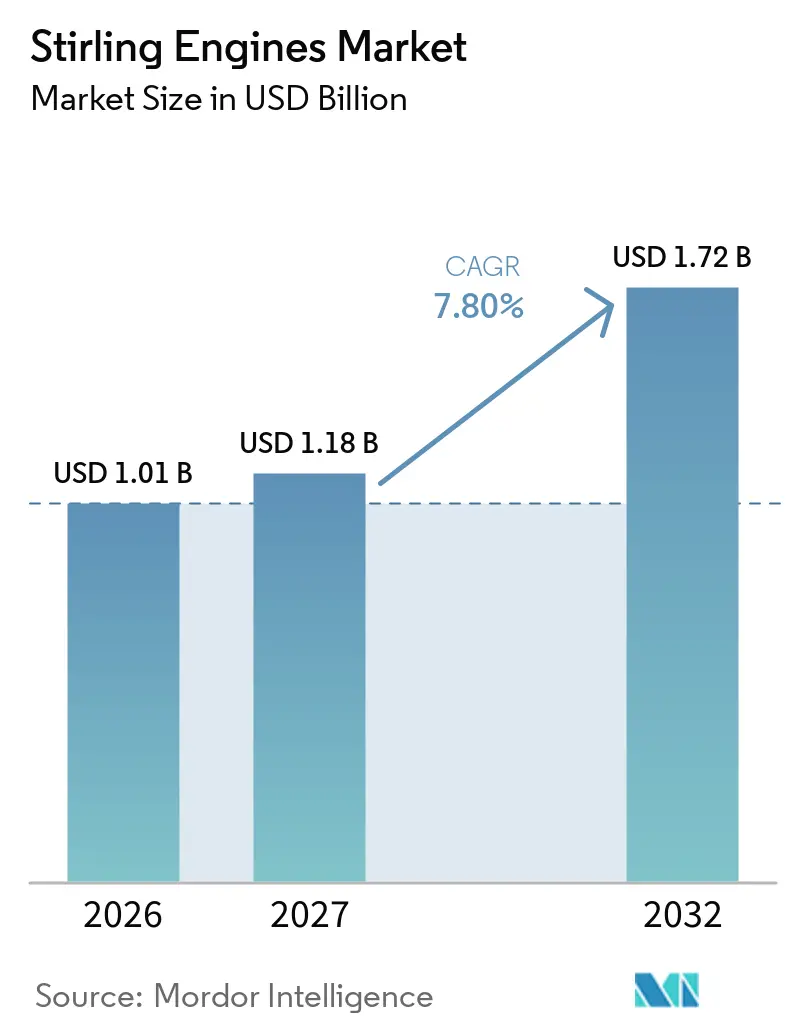
The stirling engines market size was valued at USD 1.01 billion in 2026 and is estimated to grow from USD 1.18 billion in 2027 to reach USD 1.72 billion by 2032, at a CAGR of 7.80% during the forecast period (2027-2032). The global Stirling engines market is supported by industrial decarbonization, remote energy needs, and the need for distributed generation. Its external-combustion design allows the equipment to work with solar heat, biomass, waste heat, low-grade gas, and other heat sources. This flexibility matters as users seek to reduce reliance on a single fuel source. Combined heat and power systems, methane abatement projects, and thermal storage are widening the range of projects that can use Stirling engines. Precision engineering, high-temperature materials, and specialist sealing requirements still slow adoption in price-sensitive residential and commercial applications.
Key Report Takeaways
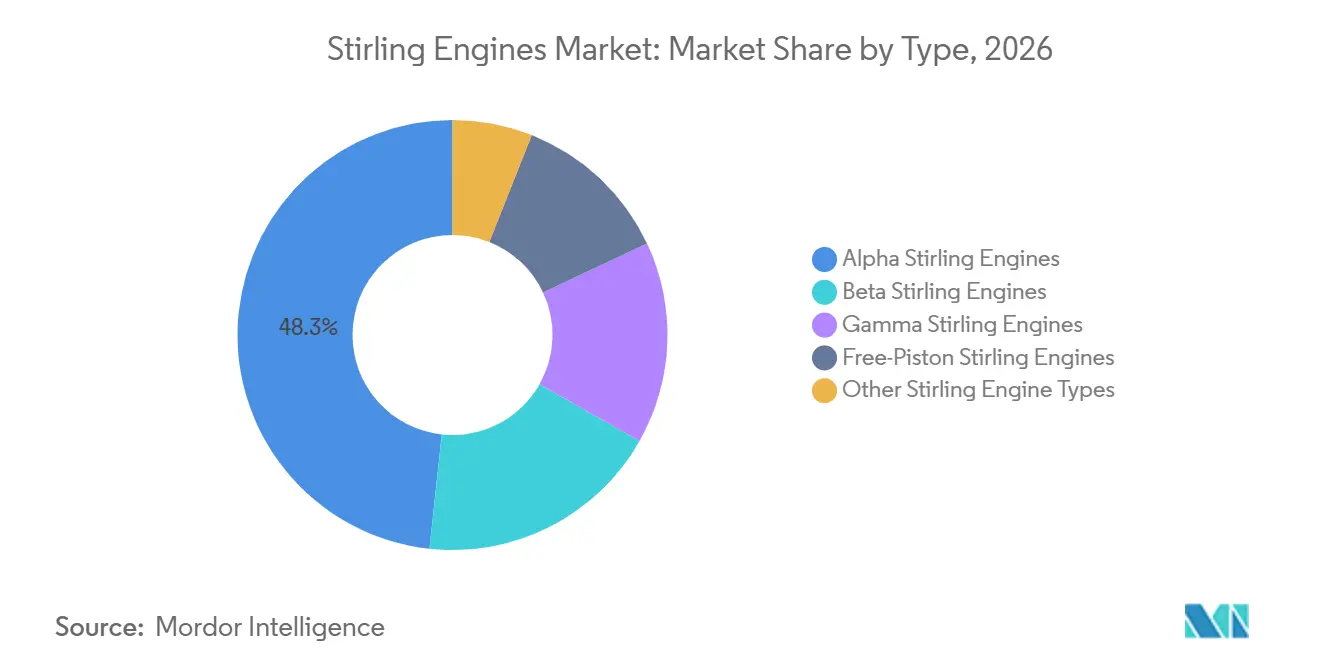
- By type, alpha Stirling engines held a 48.3% revenue share in 2026, while free-piston Stirling engines are forecast to grow at an 9.1% CAGR through 2032.
- By power output, medium-power Stirling engines held a 43.2% revenue share in 2026, while low-power Stirling engines are forecast to grow at an 8.5% CAGR through 2032.
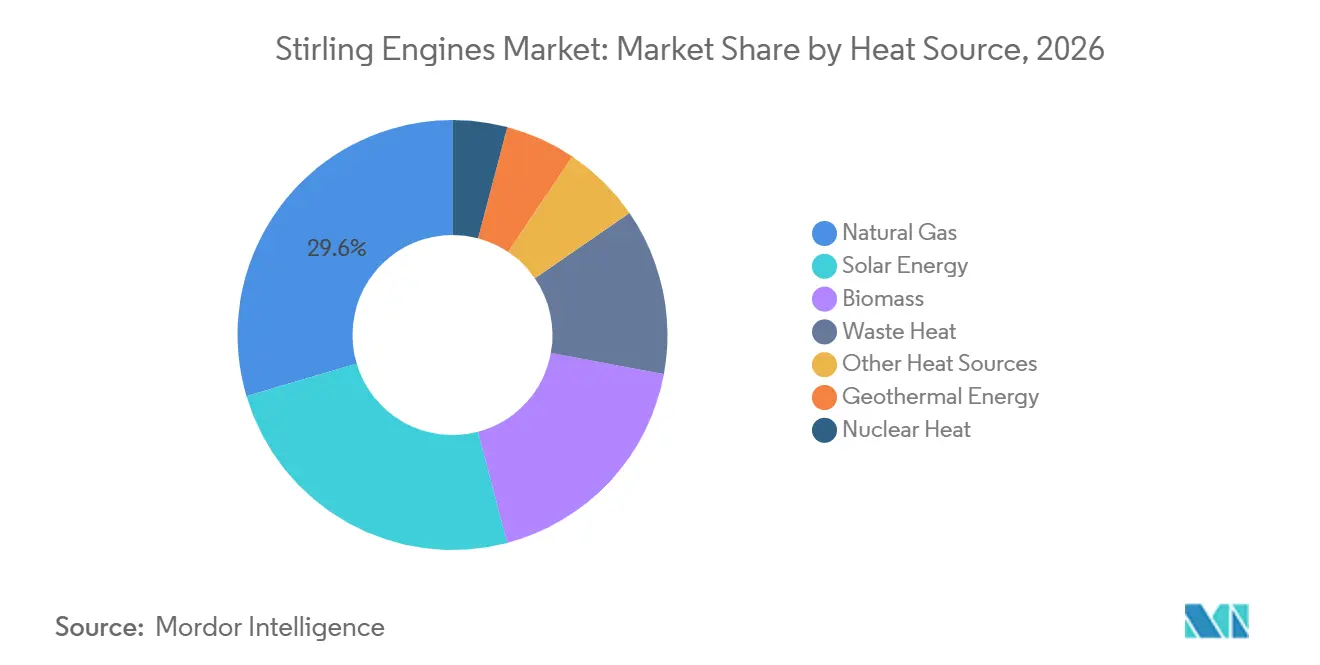
- By heat source, natural gas held 29.6% of the global Stirling engines market share in 2026, while solar energy is projected to expand at a 10.2% CAGR through 2032.
- By application, heating and cooling accounted for 39.4% of the global Stirling engines market size in 2026, while solar power generation is advancing at a 9.8% CAGR through 2032.
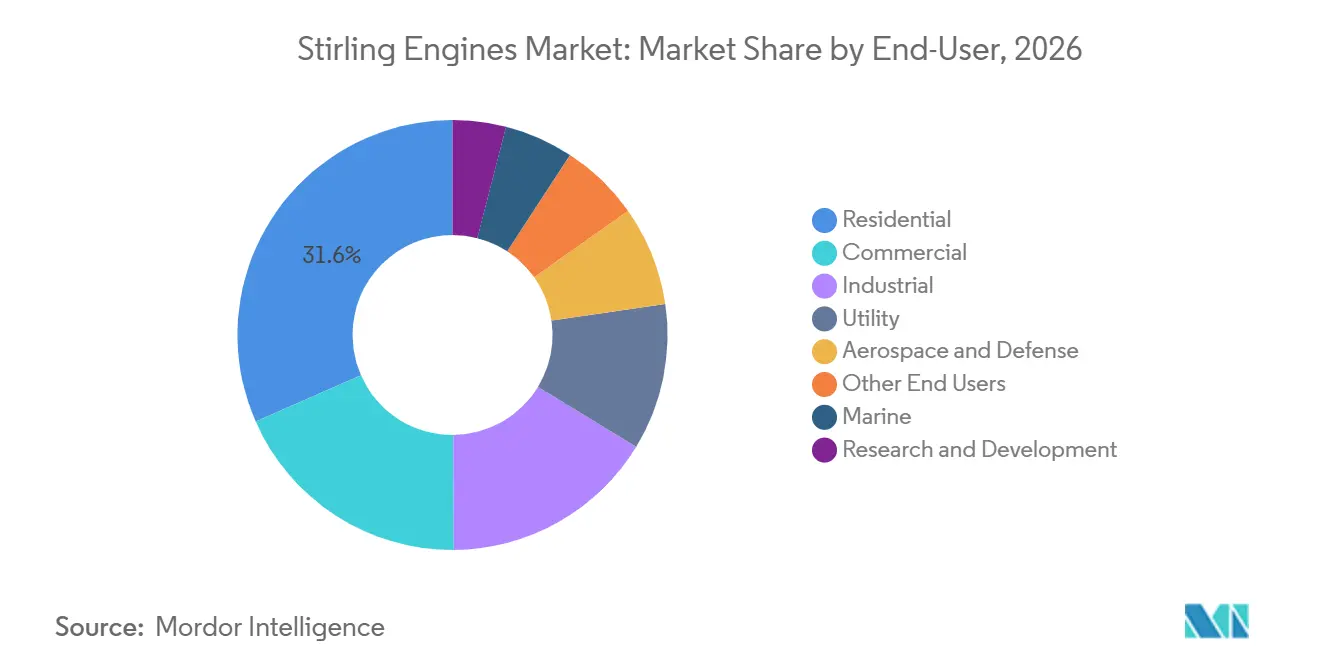
- By end user, the residential segment held a 31.6% share in 2026, while industrial use is expected to record an 8.8% CAGR through 2032.
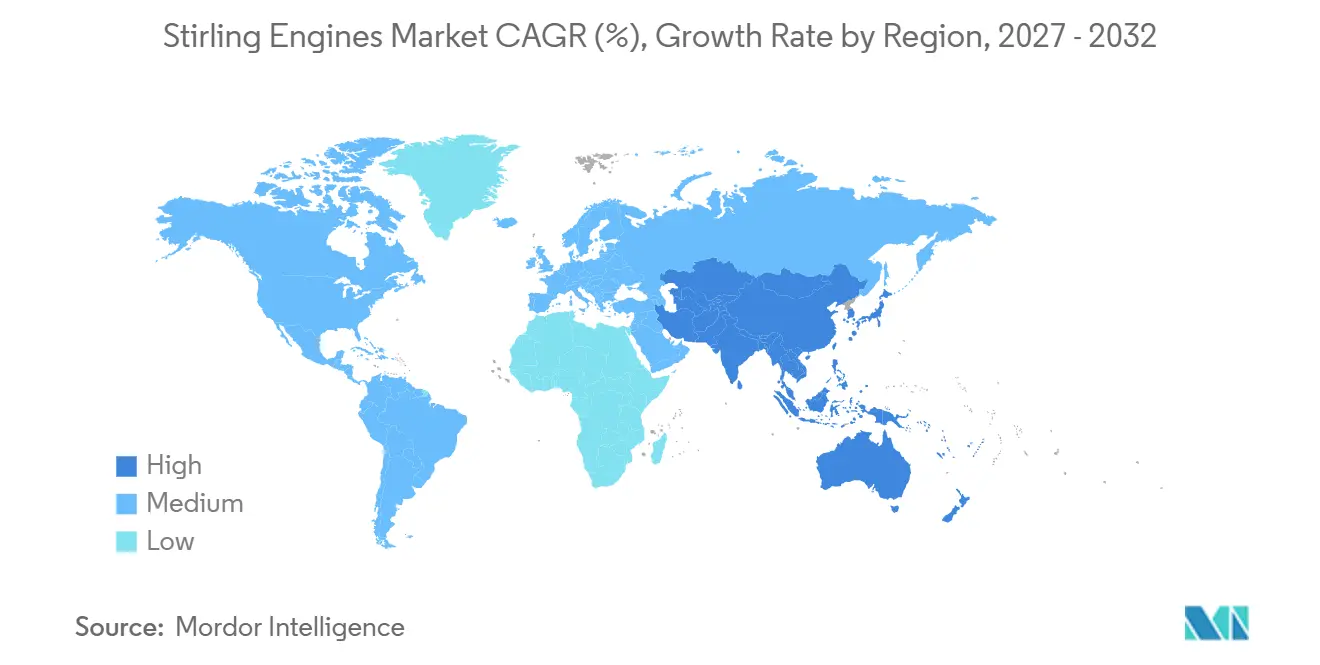
- By geography, Asia-Pacific held 55.1% of revenue in 2026 and is projected to expand at a 8.5% CAGR through 2032.
Note: Market numbers in this report are based on Mordor Intelligence's proprietary estimation framework, which combines nine months of actuals with Q4 projections for base year 2026.
Global Stirling Engines Market Trends and Insights
Drivers Impact Analysis*
| Driver | (~) % Impact on CAGR Forecast | Geographic Relevance | Impact Timeline |
|---|---|---|---|
| Low-Emission Distributed Power Demand | +1.9% | Global, strongest in Asia-Pacific and Europe | Medium term (2-4 years) |
| Waste-Heat Recovery and Cogeneration Expansion | +1.6% | Global, concentrated in industrial corridors of China, Germany, Japan, and South Korea | Medium term (2-4 years) |
| Renewable Heat Source Deployment | +1.3% | Asia-Pacific and Middle East and Africa for solar, Europe and North America for biomass | Long term (≥ 4 years) |
| Off-Grid and Remote Power Requirements | +1% | North America, Middle East and Africa, and Asia-Pacific | Short term (≤ 2 years) |
| Methane Abatement and Low-Grade Gas Monetization | +0.8% | North America, Latin America, and Australia | Short term (≤ 2 years) |
| Thermal Storage Coupled With Stirling Conversion | +0.6% | Asia-Pacific, Middle East and Africa, and Southern Europe | Long term (≥ 4 years) |
| Source: Mordor Intelligence | |||
Rising Demand for Low-Emission Distributed
Decarbonization commitments are moving procurement away from diesel generators and toward systems that can use different fuels. The global Stirling engines market benefits because its external-combustion design separates the working gas from the heat source. This design supports use across renewable heat and waste-heat settings without changing the engine's basic operating principle. Proceedings from the Japan Society of Mechanical Engineers reported performance work on a 1-kW alpha-type engine using renewable and low-temperature heat sources. The results reinforce the relevance of Stirling systems where available heat is below traditional fossil-fuel operating conditions. Industrial buyers can therefore consider the technology in emissions-focused energy plans as well as in efficiency projects.
Expansion of Waste-Heat Recovery and Cogeneration
Manufacturing sites still discharge substantial thermal energy that is not converted into useful power or heat. Stirling-based combined heat and power systems can use this heat in smaller installations where large steam recovery equipment is less suited. A 2024 study reported 95.7% peak efficiency and 4.03 kW electrical output for a free-piston Stirling combined heat and power system.[1] This level of performance makes the global Stirling engines market relevant to industrial users seeking both energy efficiency and lower emissions. Japan's energy-efficiency support framework has continued to cover qualifying waste-heat recovery equipment under its 2026 guidance.[2] Procurement decisions can consequently reflect operating costs and regulatory requirements together.
Increasing Deployment of Renewable Heat Sources
Solar dish-Stirling systems are gaining attention when paired with phase-change-material thermal storage. A 2026 Oman field study reported 31.9% overall thermal efficiency and generation for 6 hours after sunset in a hybrid dish-Stirling configuration.[3] Storage reduces the dependence of output on immediate solar radiation, which has constrained solar Stirling projects. A 2025 study also reported stable low-temperature solar Stirling operation at temperature differences of 65-75°C. These operating conditions broaden the possible role of the global Stirling engines market in domestic solar-assisted energy systems. Biomass systems in Europe also combine pellet boilers with micro-combined heat and power equipment for residential packages.
Growth of Off-Grid and Remote Power Requirements
Remote sites place a high value on equipment that needs little maintenance and avoids frequent fuel deliveries. A free-piston Stirling power converter operated maintenance-free for more than 14 years in testing reported by ASME. This durability is relevant to offshore facilities, isolated energy systems, and telecommunications infrastructure. Qnergy has described PowerGen deployments on unmanned offshore platforms that provide power for battery charging across multi-well sites. The global Stirling engines market can address sites where servicing conventional generators is difficult or expensive. Lower maintenance needs also make the technology relevant where diesel transport is a major share of site operating costs.
Restraints Impact Analysis*
| Restraint | (~) % Impact on CAGR Forecast | Geographic Relevance | Impact Timeline |
|---|---|---|---|
| Higher Costs Than Internal-Combustion Alternatives | -0.9% | Global, especially price-sensitive residential segments in South Asia, Latin America, and Southeast Asia | Medium term (2-4 years) |
| Limited Awareness and Commercial Adoption | -0.7% | Emerging markets globally and secondary markets in Europe and North America | Short term (≤ 2 years) |
| High-Temperature Materials and Sealing Requirements | -0.5% | Global supply chain, especially markets without precision manufacturing ecosystems | Long term (≥ 4 years) |
| Slow Load Following and Integration Complexity | -0.4% | Grid-connected uses in North America and Europe and industrial variable-load settings | Medium term (2-4 years) |
| Source: Mordor Intelligence | |||
Higher System Costs Versus Internal-Combustion Alternatives
Capital cost remains a clear barrier for residential and light commercial buyers. A 2025 analysis placed residential Stirling combined heat and power system costs at EUR 10,000-13,000, with a payback period of 6-9 years and annual energy savings of EUR 500-900. The supplied analysis also places comparable gas-boiler costs at one-third to one-half of the initial Stirling system cost. Long service lives of 40,000-60,000 hours and annual maintenance costs of EUR 100-200 improve the ownership case but do not remove the initial cost gap. Energy-efficiency policies can partly narrow the gap in some European jurisdictions. Those mechanisms remain uneven and are less available in many of the global Stirling engines market's faster-growing regions.
Limited Awareness and Commercial Adoption
Stirling engines remain less familiar than boilers, diesel generators, and other established energy equipment. Awareness is stronger in combined heat and power markets such as Germany, Japan, and the Netherlands. A 2024 systematic review found household Stirling research concentrated in Europe and East Asia, with limited coverage of Southeast Asia, India, and Africa. This pattern reflects a wider gap in commercial awareness across residential growth markets. Heating and cooling equipment channels have limited familiarity with Stirling products in many countries. The global Stirling engines market therefore faces a route-to-market challenge even where a technical case already exists.
*Our forecasts treat driver/restraint impacts as directional, not additive. The impact forecasts reflect baseline growth, mix effects, and variable interactions.
Segment Analysis
By Type: Alpha Engines Lead Installed Use While Free-Piston Designs Broaden Applications
Alpha Stirling engines held 48.3% of the global Stirling engines market share within the type segment in 2026. Their installed position reflects long use in industrial combined heat and power and waste-heat recovery systems. The configuration uses 2 pistons in separate cylinders. This arrangement supports stable thermal gradients and manageable heat-exchanger design. These features remain important where predictable operation is valued more than peak thermodynamic performance. Beta engines have gained renewed attention in the 10-25 kW residential combined heat and power range. Improvements in bearing and seal materials support this interest. Gamma configurations have been used in low-temperature renewable heat prototypes, including the Oman dish-Stirling configuration.
Free-piston Stirling engines are the fastest-growing type through 2032 in the global Stirling engines market. Their design reduces friction and uses a sealed architecture that suits cryogenic cooling and high-grade power generation. The absence of conventional crank mechanisms can also support long service intervals in remote installations. University of New Mexico researchers modeled a free-piston engine with 21.7% efficiency and 20.7 kWe output at microreactor scale. The researchers indicated that the design could scale toward 500 kWe per unit in the future. This type is used in both space-power research and oil-and-gas methane-abatement equipment. That spread of uses gives free-piston designs a wider application base than other engine types. It also ties their growth to remote power, low-grade gas, and advanced energy-system projects.
Type selection reflects the balance between performance, operating simplicity, and the required heat source. Alpha engines remain relevant because industrial users can work with a familiar configuration. Beta and gamma designs show how the same thermodynamic principle can be adapted for different sizes and temperatures. Free-piston systems are distinct because their sealed construction can reduce wear-related maintenance needs. The global Stirling engines market thus includes established configurations alongside designs aimed at newer energy applications. This structure gives suppliers room to specialize by application instead of competing only on engine architecture. It also means that advances in materials and seals can affect several types at the same time.

By Power Output: Medium-Power Systems Anchor Demand While Low-Power Units Expand
Medium-power Stirling engines were the largest power-output segment in 2026 and held 43.2% share within the global Stirling engines market. They serve commercial combined heat and power, industrial waste-heat recovery, and mid-scale off-grid installations. Their kilowatt-to-tens-of-kilowatt range aligns with micro-district heating networks and light industrial facilities. These users often need steady output rather than very large unit capacity. Medium-power systems can also fit sites that have usable heat but lack the scale for large steam-cycle equipment. High-power engines have a smaller commercial role because manufacturing complexity increases at larger sizes. Their leading uses are submarine air-independent propulsion and concentrated solar pilot projects. The limited number of high-power deployments keeps this segment specialized.
Low-power Stirling engines are forecast to grow at an 8.5% CAGR through 2032. Miniaturized free-piston units support residential micro-combined heat and power, remote sensors, and telecommunications backup power. The global Stirling engines industry benefits when precision manufacturing costs decline for these smaller units. A 2024 study assessed a 1 kWe Stirling engine with 28 m² of photovoltaic-thermal collectors across housing types. The study reported 22% exergy efficiency and carbon dioxide reductions of 30-45% for detached houses. National combined heat and power incentives can strengthen the case for this equipment in European and East Asian homes. Lower-power adoption may also expand the installed base that service providers and heating-equipment channels support.
Power rating influences both the customer group and the engineering requirements for a Stirling system. Low-power equipment is relevant where space, servicing, and local electricity needs are constrained. Medium-power units fit facilities that require continuous heat and power without utility-scale equipment. High-power designs must manage greater manufacturing complexity and remain limited to specialized projects. The global Stirling engines market can therefore grow through smaller decentralized units as well as established commercial systems. The mix of power ratings also reduces dependence on a single project type. It allows suppliers to focus on the parts of the energy system where their designs are technically suited.
By Heat Source: Natural Gas Holds Current Demand While Solar Gains Momentum
Natural gas held 29.6% of global Stirling engines market size by heat source in 2026. Its leading position comes from broad infrastructure availability and compatibility with residential and commercial energy systems. Natural gas provides a lower-capital route for users that have not adopted renewable heat systems. This is particularly relevant in North America and Europe. Biomass is the next established heat source in residential combined heat and power settings. European systems have paired pellet boilers with free-piston engines, including the Microgen-Waltis WoodGen S-Tronic pilot described in the supplied material. Waste heat provides steady demand from industrial operations with recoverable thermal energy. Nuclear heat is also gaining attention through microreactor-linked free-piston engine development.
Solar energy is projected to record a 10.2% CAGR through 2032, the highest rate among heat sources. Cost reductions in concentrating solar systems and thermal storage support this growth. Phase-change-material storage allows an engine to continue producing power after direct solar input declines. The Oman field results showed 6 hours of post-sunset operation for a hybrid dish-Stirling design. This feature addresses the intermittent operating pattern associated with solar generation. ISO standards for solar thermal systems and IEC 62788 for photovoltaic system components provide related compliance infrastructure in regulated settings. Geothermal heat remains at an early commercial stage. It is being explored in Japan, Iceland, and the U.S. Pacific Northwest where subsurface heat can suit Stirling operation.
Each heat source presents a different deployment path for the global Stirling engines market. Natural gas can use existing fuel infrastructure, while biomass depends on fuel handling and boiler integration. Waste heat depends on industrial process conditions and the quality of recoverable energy. Solar systems need suitable irradiance and equipment that can retain heat when sunlight falls. Nuclear-linked designs remain connected to research and microreactor development. Geothermal applications depend on local resource conditions. This heat-source diversity is a central feature of Stirling technology because the engine relies on external heat rather than internal fuel combustion.
By Application: Heating and Cooling Lead While Solar Generation Grows Fastest
Heating and cooling accounted for 39.4% of the global Stirling engines market share by application in 2026. Residential and commercial micro-combined heat and power demand in Europe and Japan supports this position. Cold climates, high gas prices, and combined heat and power incentives have reinforced use in these markets. Free-piston systems can deliver both useful heat and electricity at the point of demand. A peer-reviewed configuration achieved combined heat and power efficiency of up to 95.7%. This performance supports the use of Stirling systems where heating demand is steady. Waste-heat recovery is another important volume application. Industrial operators can treat recovered thermal energy as an energy-management asset under ISO 50001 practices.
Solar power generation is forecast to advance at a 9.8% CAGR through 2032. Thermal storage gives solar Stirling systems a path to output after sunset. The global Stirling engines market therefore gains an application that combines renewable heat with more controllable delivery. Marine propulsion and auxiliary power remain strategically important despite lower volume. Sweden and Japan have used Stirling air-independent propulsion submarines for more than 2 decades. Defense procurement activity in South Korea, Australia, and India is evaluating the technology for future conventional submarines. Remote and off-grid generation and space power systems have limited direct rivalry from other Stirling applications. Cryogenic and cooling uses remain stable in liquefied-gas handling and medical pre-cooling.
Application demand is shaped by whether users need electricity, useful heat, cooling, or a combination of these outputs. Combined heat and power remains suited to locations where both electricity and heat are consumed on site. Solar generation depends on the availability of concentrated solar resources and the cost of storage. Remote power values durability and limited servicing, while cryogenic uses value stable cooling performance. Marine applications are supported by specialized defense requirements rather than broad-volume demand. These differences create a diverse application base for global Stirling engines market suppliers. They also require suppliers to adapt system design to the heat source and operating setting.
By End User: Residential Holds the Largest Base While Industrial Demand Accelerates
Residential users held 31.6% of the global Stirling engines market share by end user in 2026. This base is supported by mature micro-combined heat and power installations in Europe and Japan. Germany, the Netherlands, and Japan have provided field-performance experience that reduces perceived risk for later buyers. Residential demand is tied to heating needs, gas infrastructure, and local policy support. The segment is also exposed to higher initial system costs. That exposure limits adoption in locations without incentives or established service networks. Commercial users form the second-largest volume segment. Their uses include light commercial buildings, district-heating nodes, and telecommunications infrastructure.
Industrial use is forecast to grow at an 8.8% CAGR through 2032. Decarbonization requirements, energy costs, and measurable waste-heat recovery returns support this outlook. Industrial facilities can use Stirling systems where high-temperature exhaust or process heat is available. This creates a direct link between demand and energy-management programs. Aerospace and defense demand grows more steadily because procurement cycles are long. Reliability, low noise, and low emissions remain important attributes in mission-focused uses. Utility-scale projects are still at an early stage.
The industrial case depends on the temperature, continuity, and accessibility of the available heat source. Sites with stable thermal processes can evaluate a Stirling unit as part of broader heat-recovery equipment. Users must also account for the engine's integration requirements and the availability of specialized maintenance support. These factors can delay decisions even when energy savings are measurable. Residential demand follows a different path because system cost and installer familiarity have more influence. The global Stirling engines market consequently serves several customer groups with different purchasing criteria. This variation limits direct substitution between residential, industrial, and defense deployments.
Geography Analysis
Asia-Pacific held 55.1% of global Stirling engines market size in 2026 and remains the fastest-growing regional segment through 2032. The region combines concentrated industrial activity with government support for distributed energy. China has supported combined cooling, heating, and power work at district scale, which has stimulated domestic Stirling research and development. Japan's Stirling Engine Promotion Association has promoted policy support for biomass-powered and waste-heat combined heat and power under the country's Biomass Nippon approach. South Korea's industrial energy-efficiency agenda adds to regional demand. India is exploring waste-heat recovery in cement, steel, and glass industries. Vietnam, Thailand, and Indonesia offer potential demand where distributed industrial power and biomass energy access overlap.
North America and Europe contribute meaningful revenue to the global Stirling engines market with different demand patterns. In North America, methane-abatement requirements for landfill gas destruction and pneumatic-device replacement support free-piston generator use. Qnergy describes its technology as a commercial free-piston Stirling platform for remote power and methane management.[4] Europe is supported by residential and commercial micro-combined heat and power installations in Germany, the Netherlands, and the United Kingdom. Energy-efficiency policy frameworks continue to shape equipment choices in these countries. A 2026 study found levelized-cost-of-heat reductions of 3-12% and carbon dioxide emission reductions of 24-63% for high-temperature Stirling heat pumps in Germany and Spain compared with traditional gas boilers. These findings are relevant to policy and subsidy decisions around industrial heat and combined heat and power.
South America and the Middle East and Africa are smaller regional markets with demand driven by specific applications. Brazil and Mexico are associated with industrial waste-heat recovery and off-grid agricultural power uses in the supplied material. Chile's solar resource offers potential for dish-Stirling systems along renewable-energy corridors being developed for green hydrogen export. Middle East and Africa demand is linked to off-grid power needs in sub-Saharan Africa and concentrating solar development in Morocco and Saudi Arabia. Saudi Arabia's Vision 2030 renewable-energy direction includes diversified solar thermal deployment. This creates indirect demand for Stirling-compatible concentrating solar systems. Manufacturing localization goals may also shape how solar thermal equipment is sourced. Technology maturity remains lower than in the major combined heat and power markets.
Competitive Landscape
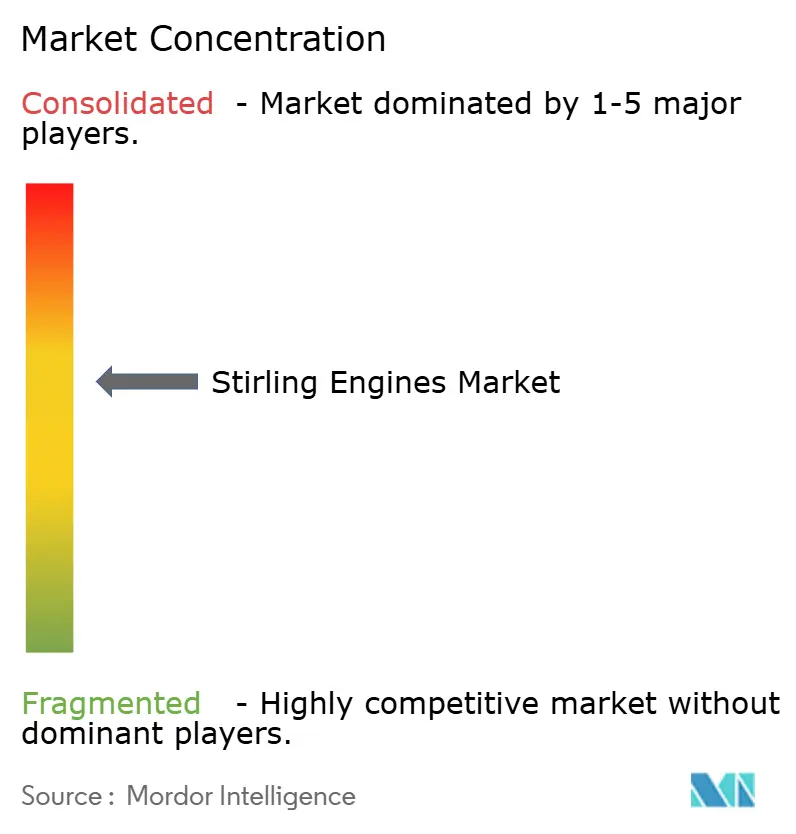
The global Stirling engines market is moderately fragmented across full-system integrators, engine suppliers, and application specialists. Qnergy, Microgen Engine Corporation, and Viessmann Climate Solutions have been positioned around remote power, micro-combined heat and power, and residential heating. Sunpower, Stirling Technology, and Stirling Cryogenics are described as engine-focused suppliers in the supplied material. Kockums AB and Global Cooling serve specialized marine and cryogenic applications. European manufacturers have a strong position in residential combined heat and power, while North American firms have more visibility in remote power and methane abatement.
Qnergy has used its QB80 Series free-piston architecture to support a remote-power and methane-management position. The company describes the architecture as part of its commercial free-piston Stirling technology platform. Its approach includes equipment deployment for sites where fuel logistics and maintenance are difficult. Viessmann has integrated Vitotwin equipment into broader building-energy management offerings, according to the supplied material. Microgen's biomass combined heat and power work shows how suppliers can partner around specific heat-source configurations.
High-temperature waste heat from steel, cement, and glass furnaces remains an area with limited commercial coverage in the supplied material. Yanmar E-Stir is pursuing this area with a dedicated platform. Methane destruction can create carbon-credit opportunities when equipment meets project requirements. Qnergy's company materials link its technology to methane-management applications. These application-specific positions help explain why no single supplier has consolidated the global Stirling engines market.
Stirling Engines Industry Leaders
-
Sunpower, Inc.
-
Qnergy
-
Microgen Engine Corporation Holding B.V.
-
Stirling Cryogenics B.V.
-
TEXEL Energy AB
- *Disclaimer: Major Players sorted in no particular order
Recent Industry Developments
- July 2026: A research team from Sultan Qaboos University published experimental validation results for a hybrid concentrated solar power system combining a dish-Stirling engine with phase-change-material (PCM) thermal storage. Field tests conducted in Oman achieved 31.9% overall thermal efficiency, while the molten-salt thermal storage subsystem sustained electricity generation for six hours after solar input ceased, improving the dispatchability of Stirling-based solar power systems.
- June 2026: Saab AB signed a contract with the Polish State Treasury Armaments Agency for the production and delivery of three A26-class submarines, along with weapons, training, and support packages, in a deal valued at approximately SEK 47 billion (USD 4.8 billion). Deliveries will be carried out progressively, with the final delivery scheduled for 2038. The A26 platform incorporates Saab AB's Stirling air-independent propulsion (AIP) technology, enabling extended submerged operations with significantly reduced acoustic signatures compared with conventional diesel-electric submarines.
- March 2025: Qnergy unveiled TORCH4, a self-powered methane-abatement solution that combines the company's free-piston Stirling engine technology with an enclosed flare system for landfill applications. Designed for small and unregulated landfills, TORCH4 operates with methane (CH4) concentrations as low as 30%, achieves 99.99% CH4 destruction, and can process up to 2,500 tonnes of CH4 annually.
- January 2025: University of New Mexico researchers published the design and analysis of a 20 kWe free-piston Stirling engine (FPSE) intended for nuclear microreactor applications. The proposed system delivered 20.7 kWe output with 21.7% conversion efficiency, highlighting Stirling engines as a potential compact and low-maintenance power conversion technology for next-generation microreactors and remote energy systems.
Global Stirling Engines Market Report Scope
A Stirling engine is a closed-cycle regenerative heat engine that converts thermal energy into mechanical work through the cyclic compression and expansion of a working fluid, such as air, helium, or hydrogen, at different temperatures. Unlike internal combustion engines, Stirling engines operate on an external heat source, allowing them to use diverse energy inputs, including solar, biomass, and industrial waste heat. These engines operate quietly and efficiently without internal combustion, making them suitable for sustainable decentralized power generation, combined heat and power (CHP) systems, and specialized marine propulsion.
The global Stirling engines market is segmented by type into alpha, beta, gamma, free-piston, and other Stirling engine types. By power output, the market is segmented into low-power, medium-power, and high-power Stirling engines. By heat source, the market is segmented into solar energy, biomass, natural gas, waste heat, geothermal energy, nuclear heat, and other heat sources. By application, the market is segmented into solar power generation, combined heat and power (CHP), waste heat recovery, heating and cooling, marine propulsion and auxiliary power, remote and off-grid power generation, space power systems, cryogenic and cooling applications, and other applications. By end user, the market is segmented into residential, commercial, industrial, utility, aerospace and defense, marine, research and development, and other end users. The report also covers market size and forecasts for the global Stirling engines market across 26 countries in key regions. For each segment, market sizing and forecasts are provided on the basis of value (USD).
| Alpha Stirling Engines |
| Beta Stirling Engines |
| Gamma Stirling Engines |
| Free-Piston Stirling Engines |
| Other Stirling Engine Types |
| Low Power Stirling Engines |
| Medium Power Stirling Engines |
| High Power Stirling Engines |
| Solar Energy |
| Biomass |
| Natural Gas |
| Waste Heat |
| Geothermal Energy |
| Nuclear Heat |
| Other Heat Sources |
| Solar Power Generation |
| Combined Heat and Power (CHP) |
| Waste Heat Recovery |
| Heating and Cooling |
| Marine Propulsion and Auxiliary Power |
| Remote and Off-Grid Power Generation |
| Space Power Systems |
| Cryogenic and Cooling Applications |
| Other Applications |
| Residential |
| Commercial |
| Industrial |
| Utility |
| Aerospace and Defense |
| Marine |
| Research and Development |
| Other End Users |
| North America | United States |
| Canada | |
| Mexico | |
| Europe | Germany |
| France | |
| Italy | |
| Spain | |
| United Kingdom | |
| Poland | |
| Russia | |
| Rest of Europe | |
| Asia-Pacific | China |
| India | |
| Japan | |
| South Korea | |
| Australia | |
| Indonesia | |
| Vietnam | |
| Thailand | |
| Rest of Asia-Pacific | |
| South America | Brazil |
| Argentina | |
| Chile | |
| Rest of South America | |
| Middle East and Africa | Saudi Arabia |
| United Arab Emirates | |
| Egypt | |
| South Africa | |
| Morocco | |
| Rest of Middle East and Africa |
| By Type | Alpha Stirling Engines | |
| Beta Stirling Engines | ||
| Gamma Stirling Engines | ||
| Free-Piston Stirling Engines | ||
| Other Stirling Engine Types | ||
| By Power Output | Low Power Stirling Engines | |
| Medium Power Stirling Engines | ||
| High Power Stirling Engines | ||
| By Heat Source | Solar Energy | |
| Biomass | ||
| Natural Gas | ||
| Waste Heat | ||
| Geothermal Energy | ||
| Nuclear Heat | ||
| Other Heat Sources | ||
| By Application | Solar Power Generation | |
| Combined Heat and Power (CHP) | ||
| Waste Heat Recovery | ||
| Heating and Cooling | ||
| Marine Propulsion and Auxiliary Power | ||
| Remote and Off-Grid Power Generation | ||
| Space Power Systems | ||
| Cryogenic and Cooling Applications | ||
| Other Applications | ||
| By End User | Residential | |
| Commercial | ||
| Industrial | ||
| Utility | ||
| Aerospace and Defense | ||
| Marine | ||
| Research and Development | ||
| Other End Users | ||
| By Geography | North America | United States |
| Canada | ||
| Mexico | ||
| Europe | Germany | |
| France | ||
| Italy | ||
| Spain | ||
| United Kingdom | ||
| Poland | ||
| Russia | ||
| Rest of Europe | ||
| Asia-Pacific | China | |
| India | ||
| Japan | ||
| South Korea | ||
| Australia | ||
| Indonesia | ||
| Vietnam | ||
| Thailand | ||
| Rest of Asia-Pacific | ||
| South America | Brazil | |
| Argentina | ||
| Chile | ||
| Rest of South America | ||
| Middle East and Africa | Saudi Arabia | |
| United Arab Emirates | ||
| Egypt | ||
| South Africa | ||
| Morocco | ||
| Rest of Middle East and Africa | ||
Key Questions Answered in the Report
What is the forecast growth rate for the global Stirling engines market?
The global Stirling engines market is forecast to grow at a CAGR of 7.80% from 2027 to 2032, reaching USD 1.72 billion.
Which Stirling engine type is growing fastest?
Free-piston Stirling engines are the fastest-growing type through 2032. Their sealed, low-friction design supports remote power, cryogenic cooling, and advanced power applications.
What heat source is growing fastest for Stirling engines?
Solar energy is the fastest-growing heat source, with a projected CAGR of 10.2% through 2032. Thermal storage can extend operation beyond sunset.
Which region leads demand for Stirling engines?
Asia-Pacific held a 55.1% share in 2026 and is expected to remain the fastest-growing region through 2032.
What limits wider adoption of Stirling systems?
Higher upfront system costs, limited market awareness, specialist materials, sealing requirements, and integration complexity limit adoption, particularly in price-sensitive settings.