
STEM Education Market Size and Share
Market Overview
| Study Period | 2022 - 2032 |
|---|---|
| Market Size (2027) | USD 94.43 Billion |
| Market Size (2032) | USD 159.17 Billion |
| Growth Rate (2027 - 2032) | 11.01 % |
| Fastest Growing Market | Asia-Pacific |
| Largest Market | North America |
| Market Concentration | Low |
Major Players *Disclaimer: Major Players sorted in no particular order Image © Mordor Intelligence. Reuse requires attribution under CC BY 4.0. | |
STEM Education Market Analysis by Mordor Intelligence
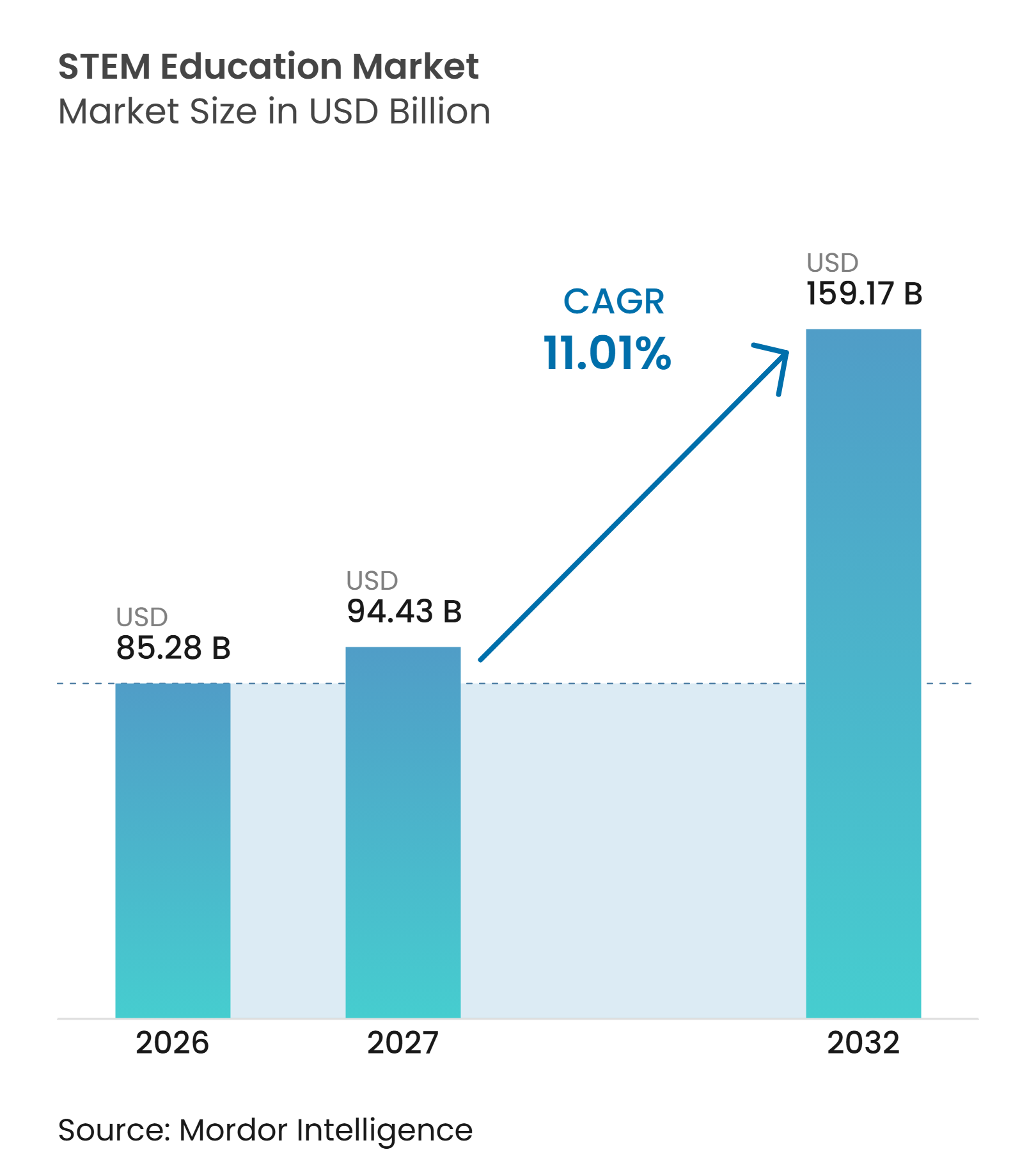
The global STEM education market size was valued at USD 85.28 billion in 2026 and is estimated to grow from USD 94.43 billion in 2027 to reach USD 159.17 billion by 2032, at a CAGR of 11.01% during the forecast period (2027-2032). The global STEM education market is supported by public curriculum requirements, employer demand for digital capabilities, and the growing use of supplementary learning services. Demand extends beyond formal classrooms as employers seek training in artificial intelligence, data analytics, cybersecurity, and engineering. Government initiatives are more sustainable when legislation includes dedicated funding and teacher development programs. Providers are expanding offerings to include assessment tools, physical computing, virtual laboratories, and flexible credentials. Growth remains uneven because access to devices, connectivity, qualified teachers, and compliant data practices vary significantly across countries.
Key Report Takeaways
- By delivery mode, instructor-led learning accounted for 50.70% of the global STEM education market share in 2026, while self-paced learning is projected to grow at a 13.23% CAGR through 2032.
- By offering, curriculum and instructional content accounted for 37.30% of the global STEM education market size in 2026, while robotics, coding, and engineering kits are projected to grow at an 11.50% CAGR through 2032.
- By subject, mathematics accounted for 30.30% of the global STEM education market share in 2026, while technology and computer science are projected to grow at an 11.70% CAGR through 2032.
- By end user, after-school and supplementary learning centers accounted for 35.20% of the global STEM education market size in 2026, while corporate and professional training is projected to grow at a 12.44% CAGR through 2032.
- By geography, North America accounted for 34.90% of the global STEM education market revenue in 2026, while Asia-Pacific is projected to grow at a 12.60% CAGR through 2032.
Note: Market numbers in this report are based on Mordor Intelligence's proprietary estimation framework, which combines nine months of actuals with Q4 projections for base year 2026.
Market Trends and Insights
Drivers Impact Analysis of STEM Education Market*
| Driver | (~) % Impact on CAGR Forecast | Geographic Relevance | Impact Timeline |
|---|---|---|---|
| Government STEM Funding and Curriculum Mandates | +2.5% | Global, concentrated in North America, Europe, and Asia-Pacific | Medium term (2-4 years) |
| AI, Adaptive Learning, and Learning Analytics Adoption | +2.2% | Global, with early deployment in North America and East Asia | Short term (≤ 2 years) |
| Employer Demand for Digital and Green Skills | +1.8% | Global, with high intensity in North America, Europe, and Middle East and Africa | Medium term (2-4 years) |
| Hands-On Robotics, Coding, and Maker-Based Learning | +1.5% | Global, with Asia-Pacific and North America as primary markets | Medium term (2-4 years) |
| Teacher Upskilling and Implementation-Service Demand | +1.0% | Global, with growing emphasis in South America and Africa | Long term (≥ 4 years) |
| Falling Cost of Cloud, Devices, and Open Hardware | +0.8% | Global, with high relevance in South America, Middle East and Africa, and Southeast Asia | Medium term (2-4 years) |
| Source: Mordor Intelligence | |||
Government STEM Funding and Curriculum Mandates
Government policies support demand for STEM education, although funding commitments and implementation requirements vary. Oregon’s House Bill 3038 (2025) revised grant frameworks, allocating 40% of available funds to STEM education and 60% to career and technical education. The European Commission’s STEM Education Strategic Plan, issued in March 2025, proposed 2030 participation targets and linked skills development to Digital Decade objectives. In the Philippines, Republic Act No. 12310, approved in October 2025, expanded the scholarship-based Philippine Science High School System. Iowa’s Executive Order 14, signed in August 2025, prioritized work-based learning and career exploration[1]. These initiatives create potential opportunities for curriculum providers, educational technology suppliers, equipment manufacturers, and teacher-training service providers. However, actual purchasing demand depends on implementation, budgets, and procurement decisions.
AI, Adaptive Learning, and Learning Analytics Adoption
Artificial Intelligence (AI)-supported personalization is expanding STEM education by enabling adaptive practice, individualized feedback, and targeted assessments. A 2025 meta-analysis of 99 independent datasets from 32 studies found a significant positive effect on K-12 STEM learning outcomes. Augmented Reality/Virtual Reality (AR/VR) had the largest subgroup effect, although the evidence was based on only eight datasets. These findings support evaluating adaptive mathematics platforms and interactive simulations alongside conventional instructional tools. In August 2025, Cengage announced that its AI-powered Student Assistant would reach more than 1 million higher education students across over 100 products, demonstrating commercial scale beyond K-12[2]. The EU AI Act, GDPR, COPPA, and applicable state student privacy laws impose compliance obligations that vary by platform, user group, and jurisdiction. Privacy safeguards and responsible AI design are therefore important procurement considerations.
Employer Demand for Digital and Green Skills
Employer demand is expanding the global STEM education market beyond traditional degree programs and school-based settings. The World Economic Forum’s Future of Jobs Report 2025 identified AI and big data, networks and cybersecurity, and technological literacy as the fastest-growing skills employers expected to require through 2030, supporting demand for short courses and stackable credentials. The Institution of Engineering and Technology’s 2025 survey found that 30% of United Kingdom engineering employers struggled to recruit professionals with technical or specialist sustainability skills, highlighting the need for targeted upskilling[3]. In March 2025, the Colorado School of Mines launched Mines ProEd, offering flexible professional courses and customized corporate training in AI, ESG, and decarbonization. These developments create opportunities for providers offering industry-aligned, flexible STEM training that addresses specific workforce skill gaps.
Hands-On Robotics, Coding, and Maker-Based Learning
Hands-on learning is driving demand for robotics kits, drones, coding tools, and implementation support across the global STEM education market. In December 2025, CAST reported that its Take Flight program reached more than 1,100 students across 33 schools in 11 United States states, with statistically significant gains in STEM career interest and drone and coding skills. VEX Robotics reported that educators in 73 countries completed certifications in 2025 and highlighted its VEX AIM classroom robotics platform. The World Robot Olympiad engaged more than 42,000 young people across 14 African countries in 2025, demonstrating the reach of robotics education through competitions and educator networks. LEGO Education announced a hands-on K-8 computer science and AI solution in January 2026, with shipments beginning in April. These developments create opportunities for equipment suppliers, curriculum developers, and teacher-training providers offering practical, classroom-ready STEM learning.
Restraints Impact Analysis of STEM Education Market*
| Restraint | (~) % Impact on CAGR Forecast | Geographic Relevance | Impact Timeline |
|---|---|---|---|
| Unequal Device, Connectivity, and Laboratory Access | -1.8% | Highest in Sub-Saharan Africa, Southeast Asia, and South America | Long term (≥ 4 years) |
| Shortage of Qualified Cross-Disciplinary STEM Teachers | -1.5% | Global, with acute shortages in rural North America, the United Kingdom, and Sub-Saharan Africa | Long term (≥ 4 years) |
| Data Privacy, Child Safety, and AI Governance Requirements | -1.0% | Primarily North America and Europe | Medium term (2-4 years) |
| Fragmented Curriculum Alignment and Weak Outcome Evidence | -0.7% | Global | Long term (≥ 4 years) |
| Source: Mordor Intelligence | |||
Unequal Device, Connectivity, and Laboratory Access
Unequal access to devices, affordable internet connectivity, and laboratory resources limits participation in the global STEM education market. UNICEF’s Childhood in a Digital World 2025 report reiterates that an estimated 1.3 billion children aged 3-17 lacked internet access at home. A United Nations policy brief published in 2024 highlights disparities in computer access and reports that Africa’s average mobile data cost was USD 43.75 per GB in 2023, the highest globally[4]. More recent UN analysis identifies infrastructure gaps, affordability constraints, and low digital literacy as barriers to digital STEM adoption. These challenges limit the use of virtual laboratories, adaptive learning platforms, and cloud-based tutoring in underserved regions. Providers can expand access through offline-capable content, low-bandwidth applications, shared-device learning models, and partnerships with local schools.
Shortage of Qualified Cross-Disciplinary STEM Teachers
Teacher shortages can constrain the global STEM education market, even when governments provide funding and schools procure new products. A peer-reviewed study published in 2025 found that annual United States STEM teacher production declined from approximately 31,000 teachers a decade earlier to fewer than 20,000 in 2022. The Learning Policy Institute estimated that at least 411,549 United States teaching positions were unfilled or staffed by teachers without full certification in 2025, highlighting broader workforce constraints. In England, the Institute of Physics reported that more than 700,000 General Certificate of Secondary Education (GCSE) physics students lacked access to a specialist physics teacher at the start of the 2025 school year. These shortages can hinder robotics, laboratory science, and inquiry-based learning, which often require subject-matter expertise and instructional support. Providers can support implementation through teacher training, guided lesson plans, and self-directed digital tools; however, these measures cannot replace qualified educators.
*Our forecasts treat driver/restraint impacts as directional, not additive. The impact forecasts reflect baseline growth, mix effects, and variable interactions.
Student & Learner Behavior Analysis
Learners in STEM education increasingly favor practical, interactive activities that build confidence and link classroom concepts to real-world skills. A global LEGO Education survey of more than 6,000 educators, parents, administrators, and students found that hands-on learning made students nearly 1.5 times more confident in science. However, only 55% of students regularly received such opportunities. Robotics programs also demonstrate strong engagement potential. FIRST LEGO League reached more than 650,000 students aged 4-16 across 77 countries in 2025, while FIRST Tech Challenge engaged more than 109,000 students across 81 countries. Sphero's 2025 updates introduced Python programming and AI-assisted code explanations to its learning platform. These trends create opportunities for providers offering physical kits, progressive coding challenges, and digital guidance. However, the 45% of students without regular hands-on learning opportunities highlight an access gap that affordable, reusable classroom kits and teacher-ready activities could help address.
Education Performance Intelligence
Institutional performance in the global STEM education market increasingly depends on measurable learning outcomes, learner engagement, and scalable practical instruction. After-school and supplementary learning centers accounted for 35.20% of revenue in 2026, highlighting their importance as buyers of enrichment tools. Evidence supporting virtual labs strengthens the case for outcome-based procurement. Labster reported that an analysis of 151,552 students showed engagement levels of 74-82%, while users achieved quiz scores of 92-100%. A two-year study at Arizona State University involving more than 4,000 students found that students using required virtual reality biology labs improved their average grade by one-quarter in the subsequent course. These findings create opportunities for suppliers that combine simulations, assessment dashboards, and measurable outcomes. However, smaller and under-resourced institutions may continue to face staffing and connectivity barriers.
STEM Education Market Segment Analysis
By Delivery Mode:
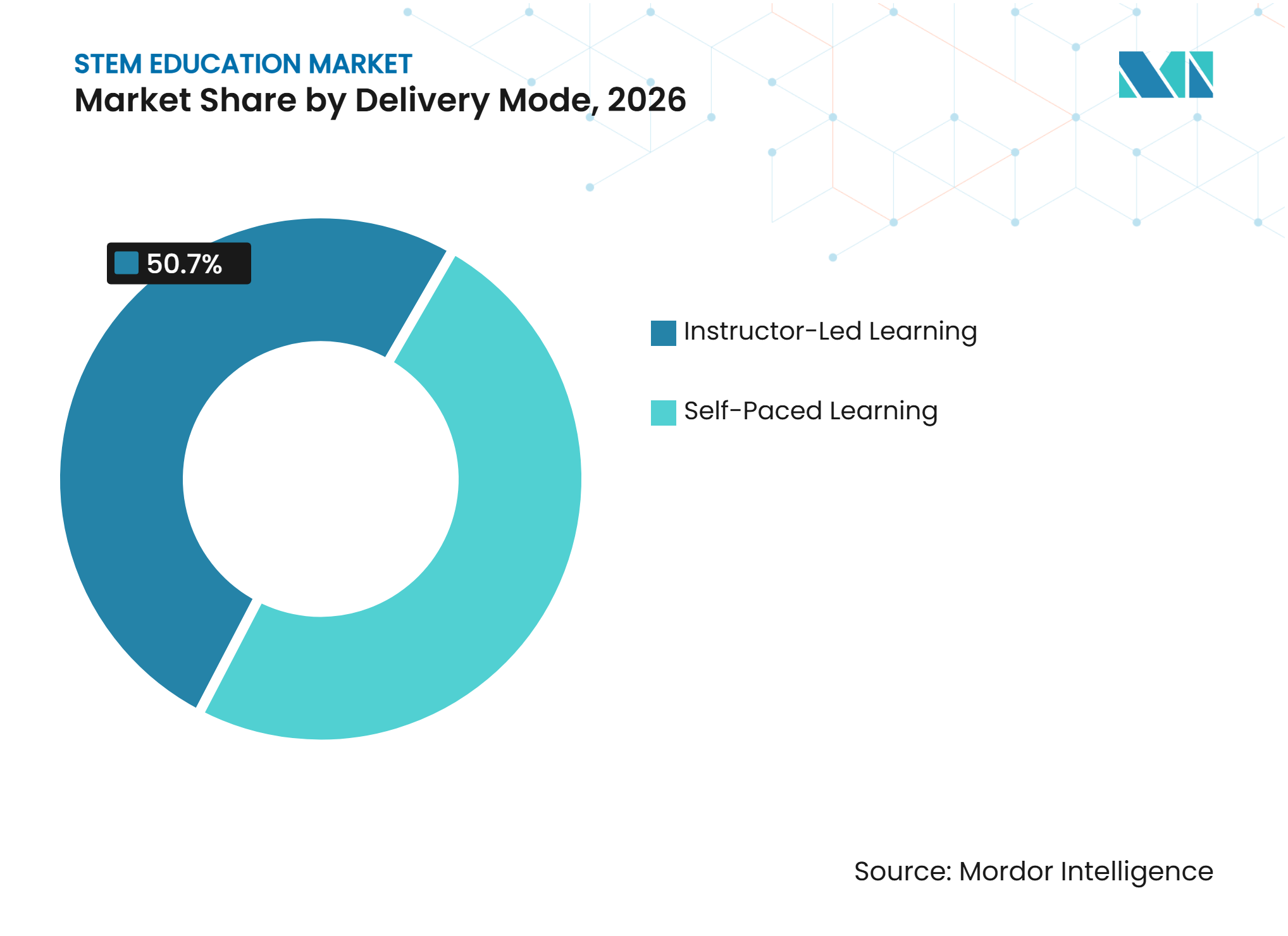
Instructor-Led Learning Anchors Revenue as Self-Paced Platforms AccelerateInstructor-led learning accounted for 50.70% of global STEM education market revenue in 2026, supported by district, university, and training contracts that include teacher materials and professional development. The National Center for Education Statistics reported that 87% of United States public schools offered tutoring during the 2023-24 school year, demonstrating the established delivery model. Formal instruction aligns with procurement structures that bundle onboarding, coaching, assessment support, and standards alignment. These services increase contract value beyond content licenses. Instructor-led models remain important when safety, equipment use, and complex concepts require teacher facilitation.
Self-paced learning is forecast to grow at a CAGR of 13.23% through 2032, the highest rate among delivery modes. In May 2025, SEMI and Purdue University launched self-paced AI and data analytics courses with certificate options through the SEMI University platform. This format supports employees who need content outside standard working hours and enables providers to serve learners across regions without a large local instructor base. The global STEM education market is likely to favor hybrid models combining scheduled support with self-directed learning and practice.


By Offering:
Curriculum Content Dominates While Robotics Kits Define the Growth FrontierCurriculum and instructional content accounted for 37.30% of global STEM education market revenue in 2026. Long school adoption cycles support this position, as curricula must align with standards and receive approval from educators and administrators. Established publishers benefit from district relationships and broad content portfolios. In June 2025, McGraw Hill and Pearson agreed to integrate Pearson’s PRoPL (Pearson Review of Progress & Learning) interim assessment capability into McGraw Hill’s K-12 programs, starting with California Reveal Math for the 2025-26 school year. These integrations can increase switching barriers by embedding assessment data in institutional processes.
Robotics, coding, and engineering kits are forecast to grow at an 11.50% CAGR through 2032. These products support computer science and engineering requirements through physical devices and applied problem-solving. In January 2026, Cengage School partnered with Qubits to market and distribute a K-12 computer science curriculum in more than 100 countries, excluding India, the Middle East, and Brazil. The partnership shows how curriculum providers can add specialized capabilities through distribution. Assessment tools, learning software, laboratory equipment, and teacher services remain complementary offerings as purchasers increasingly expect integrated delivery.
By Subject:
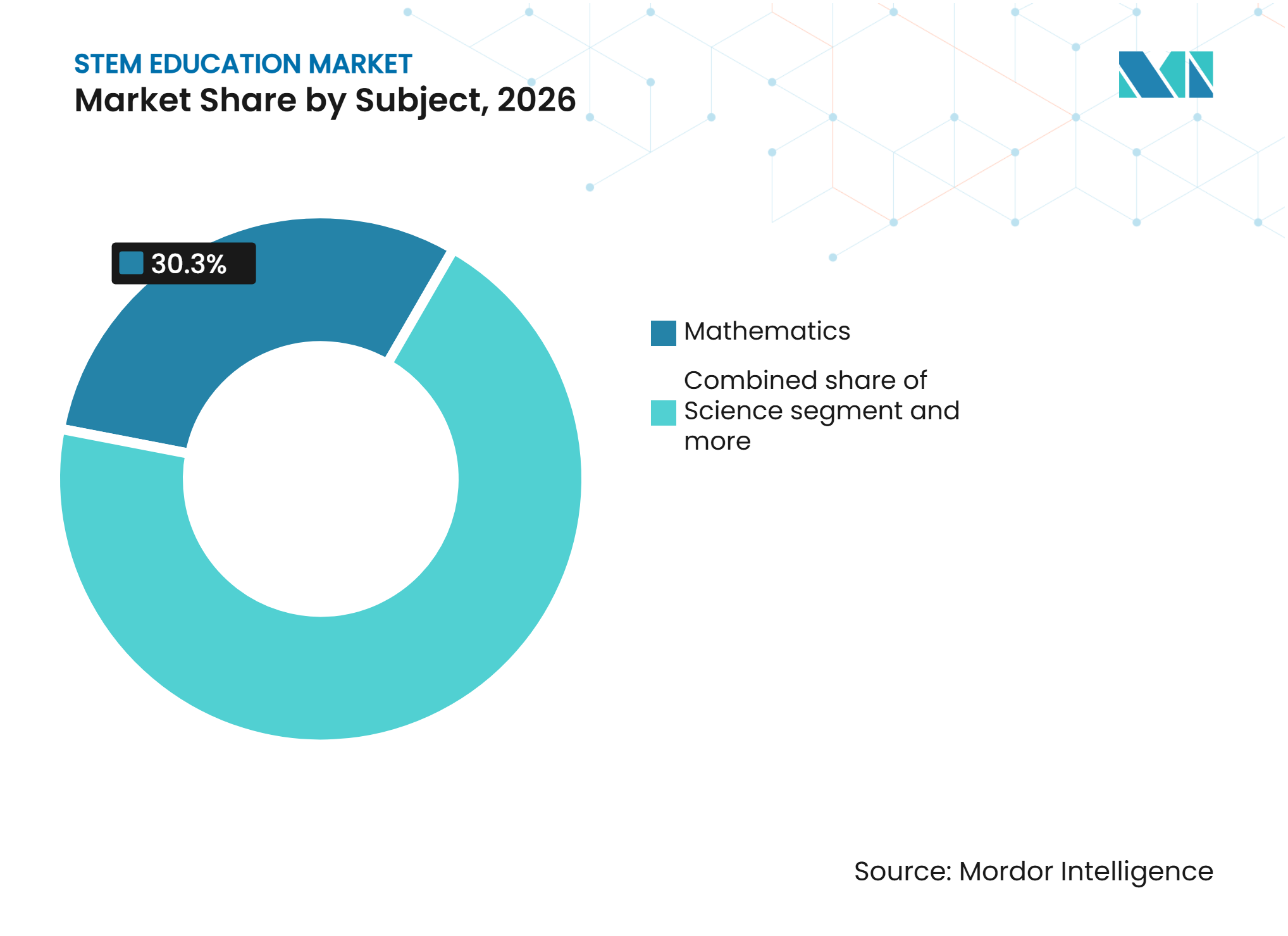
Mathematics Anchors Spend as Technology and Computer Science Reset Growth ExpectationsMathematics accounted for 30.30% of revenue in 2026, reflecting its required role across education systems and its importance for engineering and computer science pathways. Adaptive mathematics platforms generate frequent learner data, supporting personalization and institutional engagement monitoring. Households in Asia-Pacific, North America, and the Middle East also spend on supplementary mathematics learning. Carnegie Learning offers AI-supported mathematics products across United States schools, reflecting competition in the subject. Schools view mathematics as a core investment because it supports progression into other STEM disciplines.
The technology and computer science area is projected to grow at an 11.70% CAGR through 2032. Computer science mandates in Oregon, new STEM school provisions in the Philippines, and European policies emphasizing digital capabilities support this growth. Virtual laboratories expand science content where physical capacity is limited. Engineering and robotics learning are linked to the growing educational kit category and employer demand for technical skills. The global STEM education industry is shifting toward portfolios combining mathematics with practical computing, science, and engineering experiences.


By End User:
After-School Centers Lead Revenue as Corporate Training Posts the Fastest GrowthAfter-school and supplementary learning centers accounted for 35.20% of the global STEM education market size in 2026. The segment benefited from demand for private tutoring and enrichment programs, particularly in Asia-Pacific and the Middle East. Direct procurement from content and kit vendors can shorten purchasing cycles compared with public education systems. K-12 schools remained a stable revenue source due to recurring procurement driven by curriculum calendars and public funding. Higher education institutions generated demand for laboratory simulations, assessments, and employment-linked programs.
Corporate and professional training is projected to grow at a 12.44% CAGR through 2032. The World Economic Forum’s 2025 skills outlook supports demand for AI, big data, cybersecurity, and technological literacy. Employers seek short, work-compatible programs linked to specific job skills. Universities and associations offer certificates, microcredentials, and industry-linked courses. Suppliers combining recognized credentials, flexible learning, and current technical content can serve this global STEM education market segment.
Geography Analysis
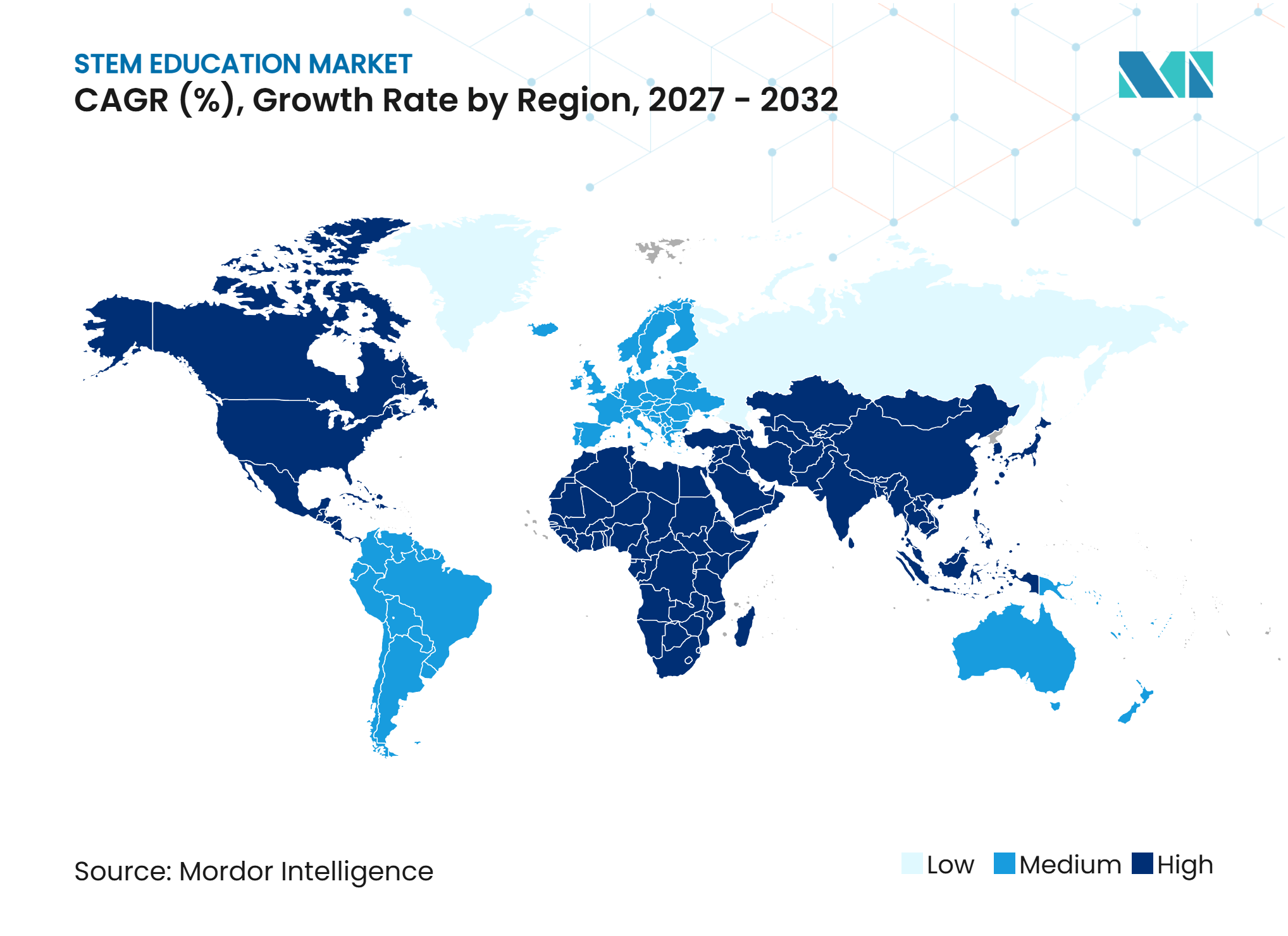
North America accounted for 34.90% of global STEM education market revenue in 2026. Established school district procurement systems, education technology suppliers, universities, and corporate learning organizations supported demand. Oregon’s funded computer science requirement and Iowa’s work-based learning directive reflected public support for workforce-linked STEM instruction. Privacy, student safety, and learning outcomes influenced purchasing, while teacher shortages and research funding constraints slowed implementation. Canada’s digital learning investments and Mexico’s manufacturing-linked technical training need further expanded demand.
Asia-Pacific is forecast to grow at a 12.60% CAGR through 2032. Large student populations, rising education spending, and workforce policies support demand. The Philippines’ 2025 science high school legislation expanded STEM capacity. India, China, and South Korea drive demand for localized content and technology tools, while Australia provides higher education and teacher development capacity. Suppliers need language-adapted content, locally aligned curricula, and appropriate pricing.
Europe’s 2025 strategy linked STEM education with digital and industrial priorities. The European Commission’s GDPR influenced product design and procurement. The Middle East and Africa faced uneven connectivity and equipment access, while the World Robot Olympiad’s 2025 activities across 14 African countries expanded robotics exposure. Brazil and Colombia supported demand through supplementary learning and public programs. Low-bandwidth, offline-capable, locally supported models remain essential.
Education Infrastructure & Development Intelligence
Public education spending and institutional infrastructure drive demand for STEM learning tools, although funding levels and delivery capacity vary significantly across countries. UNESCO’s 2026 SDG 4 Monitoring Report found that median public education spending accounted for 4.2% of GDP in 2024. However, only 22% of countries with available data met both international benchmarks: allocating at least 4% of GDP and 15% of total public expenditure to education.
Oregon allocated USD 6.74 million to support 13 Regional STEM Hubs from 2023 to 2025. The hubs provided professional development to 2,603 educators and delivered more than 13,000 hours of programming to over 92,000 students. Colombia’s 2025 initiative invested over COP 5 billion to establish 214 STEM+ learning centers, targeting more than 6,300 students through teacher training and learning materials. These programs favor suppliers offering integrated kits, educator training, and ongoing implementation support. Virtual laboratories and low-cost digital resources can complement, but not replace, physical infrastructure.
Competitive Landscape
Market Concentration
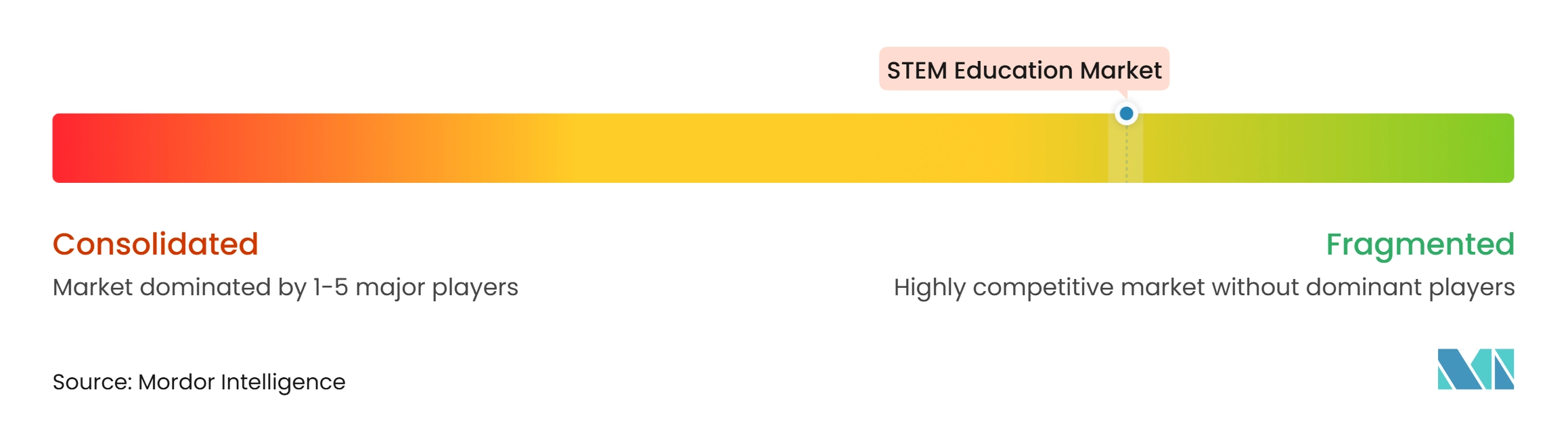
The global STEM education market is fragmented, with curriculum publishers, assessment specialists, robotics suppliers, virtual laboratory providers, and learning platforms serving different parts of the value chain. Pearson, McGraw Hill, Cengage, Houghton Mifflin Harcourt (HMH), and LEGO Education hold established positions through curriculum breadth, institutional relationships, and product specialization. Pearson completed its USD 225 million acquisition of eDynamic Learning in 2025, expanding its digital career and technical education offerings. Competition requires content, assessment, technology, and service capabilities aligned with institutional procurement processes.
Companies use acquisitions, partnerships, and product launches to address capability gaps. McGraw Hill launched Sharpen Advantage, an AI-powered study solution for higher education institutions, in September 2025. Cengage’s collaborations with AWS and Qubits expanded AI infrastructure and computer science distribution capabilities. LEGO Education introduced a K-8 computer science and AI solution in 2026.
Local-language content, low-connectivity platforms, and green-skills training remain underserved areas. Providers in emerging regions must address device access, teacher confidence, and local curriculum requirements. Specialized suppliers can compete in virtual laboratories, coding kits, or workforce credentials. The market remains fragmented, as no supplier controls all delivery modes, offerings, subjects, end users, and regions.
STEM Education Industry Leaders
-
Pearson plc
-
McGraw Hill LLC
-
Houghton Mifflin Harcourt (HMH)
-
Cengage Group LLC
-
LEGO Education
- *Disclaimer: Major Players sorted in no particular order
STEM Education Market Companies Covered in this Report
- Pearson plc
- McGraw Hill LLC
- Cengage Group LLC
- Houghton Mifflin Harcourt Company
- LEGO Education
- Savvas Learning Company
- Amplify Education, Inc.
- Discovery Education, Inc.
- Stride, Inc.
- Carnegie Learning, Inc.
- Accelerate Learning, Inc.
- Coursera, Inc.
- Udemy, Inc.
- Instructure, Inc.
- Chegg, Inc.
- Labster ApS
- VEX Robotics, Inc.
- Makeblock Co., Ltd.
- Sphero, Inc.
- Wonder Workshop, Inc.
Recent Industry Developments in STEM Education Market
- January 2026: LEGO Education announced a K-8 computer science and AI learning solution, shipped from April 2026. It combines LEGO bricks, hardware, and 30 lessons.
- January 2026: Cengage School partnered exclusively with Qubits to distribute standards-aligned K-12 computer science, AI, and cybersecurity curricula globally, excluding the Middle East, India, and Brazil. In United States high schools, 82% had computer science access, but 6.4% enrolled.
- November 2025: Cengage Group expanded its AWS collaboration to develop generative AI solutions for education and workforce learning, including personalized K-12 content and AI-supported instructional tools.
- October 2025: Pearson confirmed its USD 225 million acquisition of eDynamic Learning, serving over 885,000 K-12 students across 9,000+ institutions, strengthening its career-readiness and Early Careers offerings.
Global STEM Education Market Report Scope
The global STEM education market report analyzes STEM learning products and services across school, higher education, supplementary learning, and professional training settings. The market is segmented by delivery mode, offering, subject, end user, and geography. The study examines key drivers, including government STEM funding and curriculum mandates, AI-enabled adaptive learning and analytics, employer demand for digital and green skills, hands-on robotics and coding, teacher upskilling, and lower-cost cloud, device, and open-hardware solutions. It also assesses restraints such as unequal access to devices, connectivity and laboratories, shortages of qualified STEM teachers, data privacy and child safety requirements, and fragmented curriculum alignment. The report evaluates education spending, infrastructure development, student-teacher ratios, institutional density, student enrollment, tuition fees, and learner behavior. It provides market size and growth forecasts, regional and country-level assessments, competitive landscape analysis, market share estimates, strategic developments, and profiles of leading STEM education providers. It also explores opportunities in offline-first STEM platforms, localized learning content, teacher enablement, and accessible digital and hands-on learning solutions. Market estimates and forecasts are presented in value (USD) across all covered segments.
Segmentation Overview
Key Questions Answered in the Report
What is the projected value of the global STEM education sector by 2032?
The global STEM education sector is forecast to reach USD 159.17 billion by 2032, expanding at an 11.01% CAGR from 2027.
Which delivery format is growing fastest in STEM education?
Self-paced learning is projected to grow at a 13.23% CAGR through 2032 because it supports flexible upskilling for working learners.
Why are robotics and coding kits gaining adoption in schools?
Robotics, coding, and engineering kits are forecast to grow at an 11.50% CAGR as schools expand computer science and applied engineering instruction.
Which end user segment has the highest growth outlook?
Corporate and professional training is forecast to expand at a 12.44% CAGR through 2032, supported by demand for AI, cybersecurity, and digital skills.
Which region is expected to grow fastest in STEM education?
Asia-Pacific is forecast to grow at 12.60% CAGR through 2032, supported by large student populations and government workforce programs.
What are the limits to the adoption of digital STEM learning platforms?
Unequal device and connectivity access, teacher shortages, privacy requirements, and curriculum alignment needs can slow adoption.