
Solar Microinverter and Power Optimizer Market Size and Share
Market Overview
| Study Period | 2022 - 2032 |
|---|---|
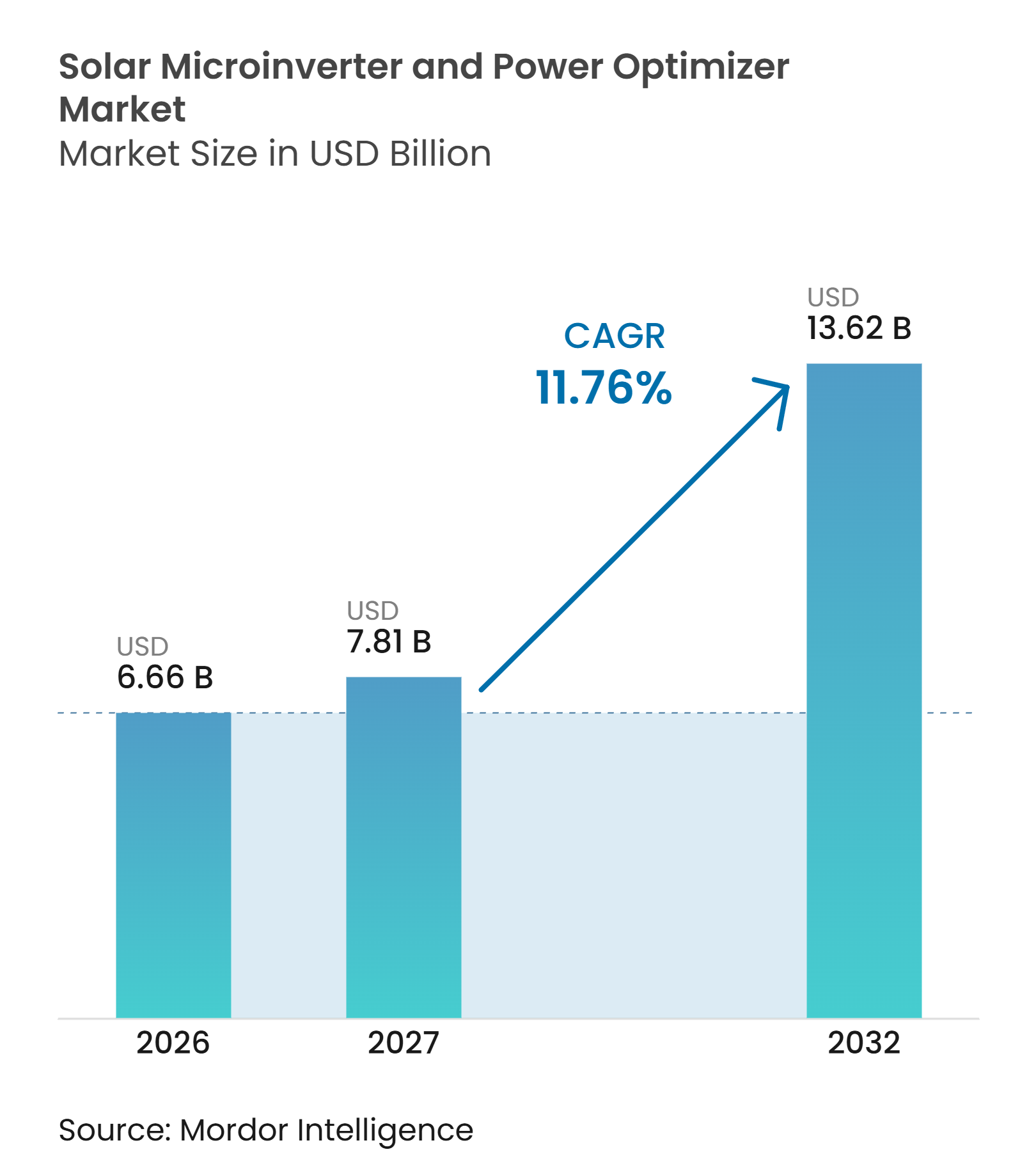
| Market Size (2027) | USD 7.81 Billion |
| Market Size (2032) | USD 13.62 Billion |
| Growth Rate (2027 - 2032) | 11.76 % |
| Fastest Growing Market | Asia-Pacific |
| Largest Market | North America |
| Market Concentration | Medium |
Major Players *Disclaimer: Major Players sorted in no particular order Image © Mordor Intelligence. Reuse requires attribution under CC BY 4.0. | |
Solar Microinverter and Power Optimizer Market Analysis by Mordor Intelligence
The solar microinverter and power optimizer market size is projected to expand from USD 6.66 billion in 2026 and USD 7.81 billion in 2027 to USD 13.62 billion by 2032, at a CAGR of 11.76% between 2027 and 2032. The market is shifting toward module-level equipment as rooftop systems require better safety, monitoring, and performance under uneven operating conditions. Distributed photovoltaic additions rose from 119.5 GW in 2022 to 228.1 GW in 2024, expanding the installed base for module-level power electronics.[1] In the United States, rapid-shutdown regulations make module-level control an important design consideration for many building-mounted systems. Battery pairing is also changing equipment requirements, as solar systems increasingly need to manage generation, charging, and grid interaction together. The market has opportunities in replacement demand, commercial rooftops, and solar-storage systems, although higher upfront costs and limited suitability for large utility projects remain constraints.
Key Report Takeaways
- By product, microinverters held 56.1% of the market share in 2026, while power optimizers are forecast to grow at a 12.5% CAGR through 2032.
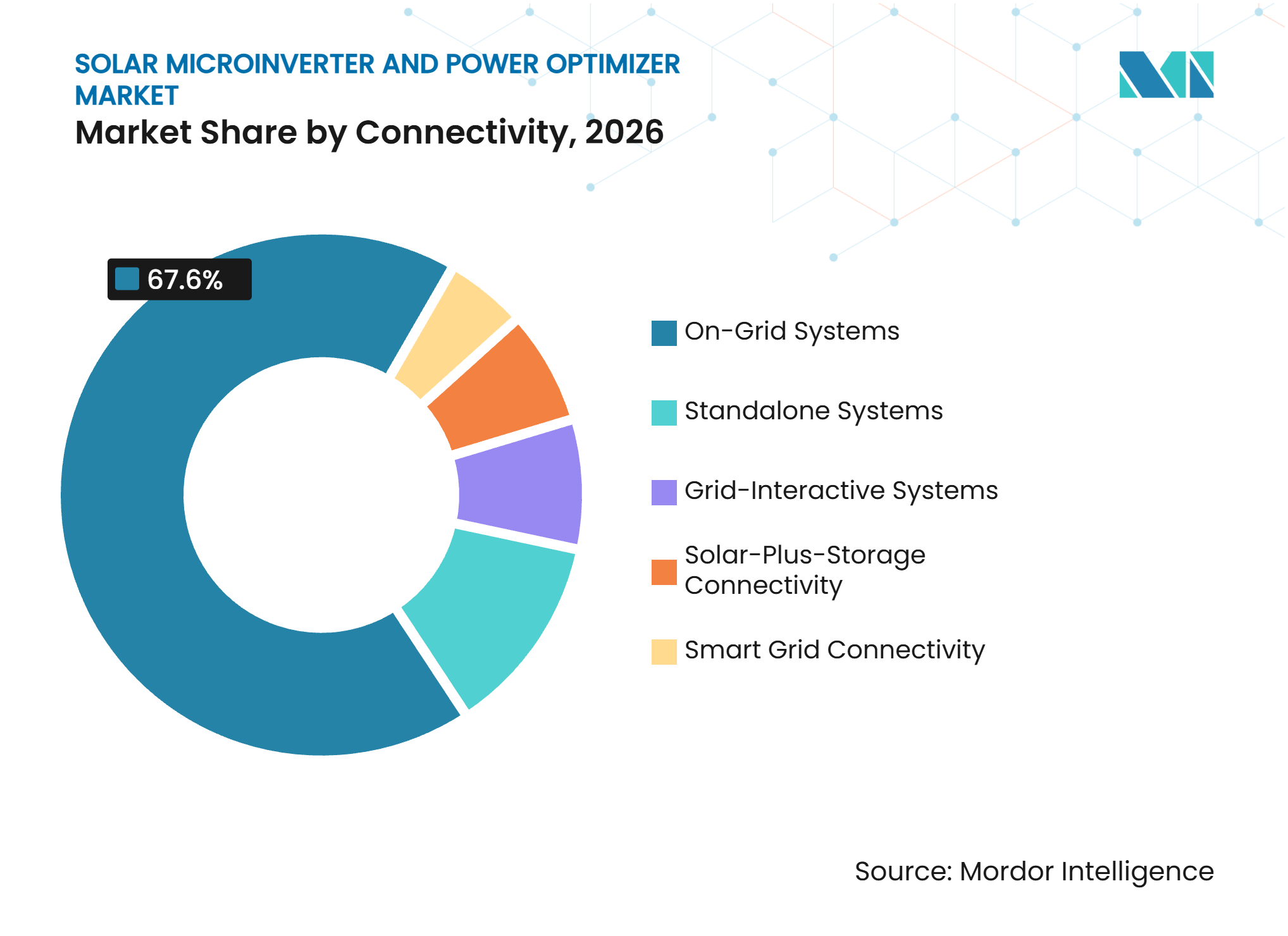
- By connectivity, on-grid systems held 67.6% of the market share in 2026, while solar-plus-storage connectivity is forecast to grow at a 13.4% CAGR through 2032.
- By power rating, the 300 to 500 W segment held 45.3% of revenue in 2026, while the 500 to 700 W segment is forecast to grow at a 12.7% CAGR through 2032.
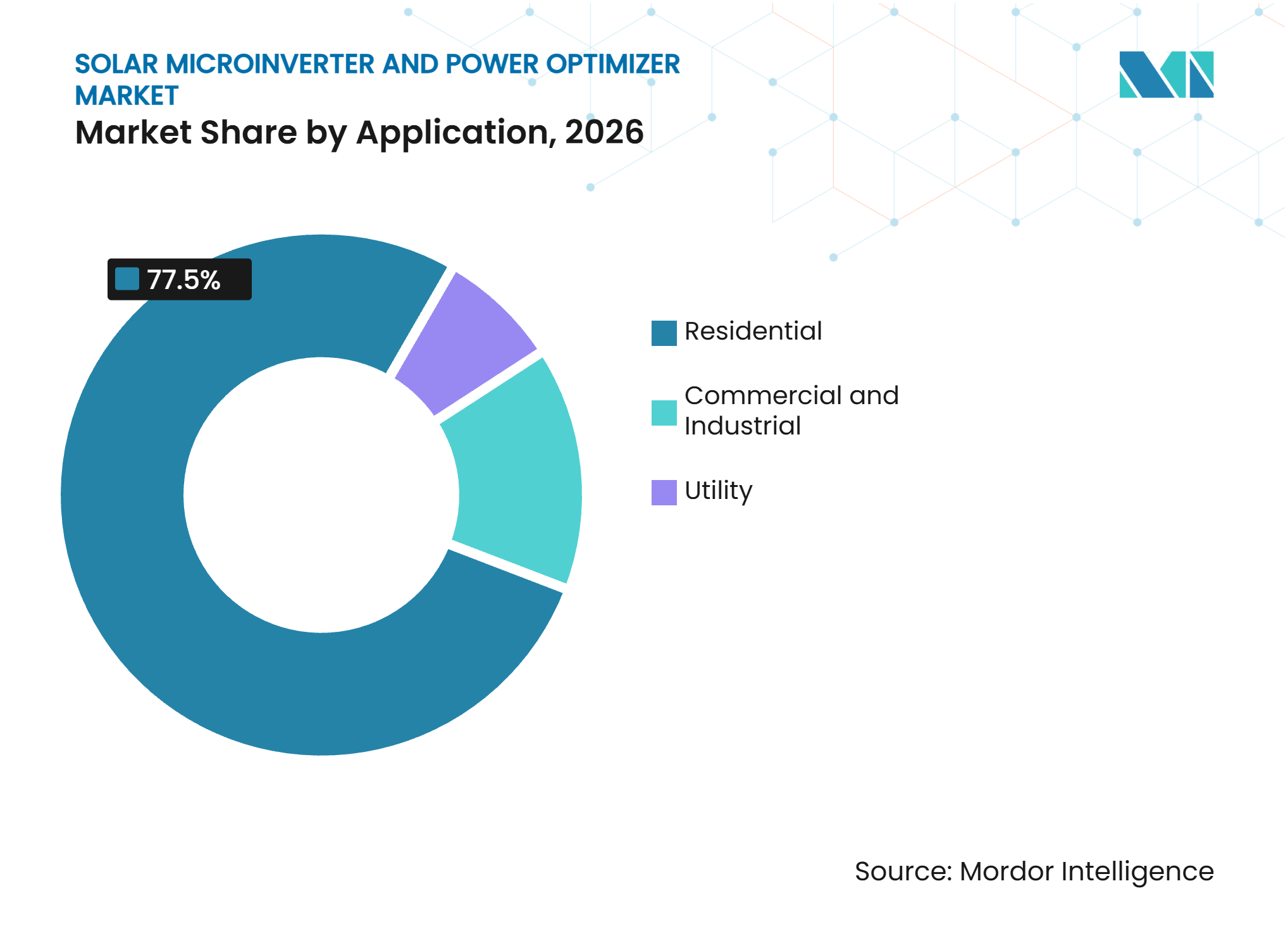
- By application, residential installations held 77.5% of revenue in 2026, while the commercial and industrial segment is forecast to grow at a 12.3% CAGR through 2032.
- By geography, North America held 41.3% of revenue in 2026, while Asia-Pacific is forecast to grow at a 13.3% CAGR through 2032.
Note: Market numbers in this report are based on Mordor Intelligence's proprietary estimation framework, which combines nine months of actuals with Q4 projections for base year 2026.
Market Trends and Insights
Drivers Impact Analysis of Solar Microinverter and Power Optimizer Market*
| Driver | (~) % Impact on CAGR Forecast | Geographic Relevance | Impact Timeline |
|---|---|---|---|
| Rooftop Solar Deployment and Distributed Generation | +3.2% | Global, density in North America, Europe, Asia-Pacific | Short term (≤ 2 years) |
| Module-Level Energy Yield Optimization | +2.0% | Global, highest penetration gains in Europe and APAC core | Medium term (2–4 years) |
| Rapid-Shutdown and Module-Level Safety Requirements | +1.8% | North America primary; spill-over to Australia and select EU markets | Short term (≤ 2 years) |
| Solar-Plus-Storage and Smart-Grid Integration | +2.1% | North America, Europe, APAC core; spill-over to MEA | Medium term (2–4 years) |
| Commercialization of Higher-Power Microinverters | +1.0% | North America, Europe | Medium term (2–4 years) |
| Installer Demand for Granular Monitoring and Predictive Maintenance | +0.8% | Global, concentrated in North America and Europe | Long term (≥ 4 years) |
| Source: Mordor Intelligence | |||
Rooftop Solar Deployment and Distributed Generation
The solar microinverter and power optimizer market benefits from a larger and more geographically diverse rooftop solar base. Global distributed photovoltaic additions increased from 119.5 GW in 2022 to 228.1 GW in 2024. Australia added 1,894 MW of rooftop capacity in the first half of 2026, a 35% year-on-year increase, while battery pairing reached 153 units per 100 solar installations.[2] India recorded a 360 MW supply agreement between Hoymiles and Kosol Energie for residential rooftop projects under PM Suryaghar Yojana. A broader mix of national markets reduces reliance on any single residential solar cycle and gives suppliers more routes to growth when local policy or financing conditions shift.
Module-Level Energy Yield Optimization
Module-level power tracking helps systems manage uneven output across roofs with varying pitch, orientation, or shading conditions. Northern Electric Power Technology states that its product design supports maximum power point tracking accuracy above 99.5%. This capability is relevant for commercial rooftops, where complex layouts can amplify the impact of underperforming modules on a string. Power optimizers address the same issue by allowing each panel to operate at its own power point. The solar microinverter and power optimizer market can also benefit when older rooftop systems receive higher-output replacement modules, as such replacements can create output mismatches that make module-level control more valuable than a standard replacement approach.
Rapid-Shutdown and Module-Level Safety Requirements
Rapid-shutdown requirements support demand for equipment that can reduce rooftop electrical risk. Microinverters use an all-AC design, so removing AC power de-energizes the module-level equipment without the need for separate rooftop rapid-shutdown hardware. The 2023 NEC introduced the UL 3741 photovoltaic hazard control pathway for eligible non-enclosed structures, while many residential designs continue to use module-level solutions. Enphase Energy stated that its IQ9N-3P and IQ9S-3P platforms carry UL 1741-SB and IEEE 1547-2018 certifications. Established certification portfolios can shorten product deployment time for suppliers and installers. The solar microinverter and power optimizer market is likely to retain an advantage in roof designs where module-level safety is central to system selection.
Solar-Plus-Storage and Smart-Grid Integration
Solar and battery systems increasingly require equipment that functions across generation, storage, backup, and grid connection. Battery storage was paired with 37% of new U.S. residential solar systems in 2025. APsystems introduced seven product lines at SNEC 2026 covering AC coupling, hybrid AC-DC coupling, off-grid use, and string-type energy storage. Hoymiles introduced the HiBattery 4020 Series for European homes, including a hybrid version that connects directly to photovoltaic modules.[3] These releases indicate that suppliers are extending their offerings beyond the inverter itself, making equipment compatibility, monitoring, and service relationships more important over the life of a solar system.
Restraints Impact Analysis of Solar Microinverter and Power Optimizer Market*
| Restraint | (~) % Impact on CAGR Forecast | Geographic Relevance | Impact Timeline |
|---|---|---|---|
| Higher Upfront Cost Than Conventional String Inverters | -1.3% | Global, most pronounced in cost-sensitive APAC and South America | Short term (≤ 2 years) |
| Limited Power-Handling Economics in Large-Scale Projects | -0.7% | Global, particularly utility-scale segments in Asia and MENA | Medium term (2–4 years) |
| Semiconductor and Wide-Bandgap Component Concentration | -0.9% | Global supply chain, sourcing concentrated in East Asia | Short term (≤ 2 years) |
| Installer Training, Compatibility, and Warranty Complexity | -0.5% | Emerging APAC and Latin America markets | Medium term (2–4 years) |
| Source: Mordor Intelligence | |||
Higher Upfront Cost Than Conventional String Inverters
Module-level systems typically require more equipment per project than conventional string-inverter designs. This cost difference is most significant in the solar microinverter and power optimizer market, where residential and commercial customers prioritize initial capital cost over the full operating life of the installation. Higher upfront costs can slow procurement in price-sensitive rooftop programs, even when monitoring and warranty coverage improve lifecycle value. Semiconductor supply expansion may reduce some of this pressure over time. Infineon Technologies is scaling gallium nitride wafer production on 300-millimeter substrates, and STMicroelectronics and Innoscience have announced a development and manufacturing agreement for gallium nitride technologies. Greater component availability may support lower equipment costs, but it does not eliminate the immediate spending hurdle for buyers.
Limited Power-Handling Economics in Large-Scale Projects
Module-level products are less attractive for large projects with uniform module orientation and minimal shading. In these conditions, the energy gain may not offset the cost of deploying equipment at every panel. This limitation is most pronounced for utility-scale fixed-tilt arrays, which commonly use central or string inverter designs. Power optimizers remain relevant for commercial rooftops and shaded carports where mismatch risk is more persistent. The solar microinverter and power optimizer market therefore remains focused on distributed, residential, and commercial applications rather than utility-scale replacement. Higher-power product designs can expand the commercial use case, but they do not resolve the fundamental cost challenge at multi-megawatt scale.
*Our forecasts treat driver/restraint impacts as directional, not additive. The impact forecasts reflect baseline growth, mix effects, and variable interactions.
Solar Microinverter and Power Optimizer Market Segment Analysis
By Product:
Higher-Power Products Expand Commercial OptionsMicroinverters held 56.1% of product revenue in 2026, giving them the leading position in this product category. Their all-AC architecture supports rooftop safety requirements and avoids high-voltage DC conductors on the roof. Enphase Energy began production shipments of the 427 VA IQ9N-3P in December 2025 for modules up to 600 W. The company began shipping the 548 VA IQ9S-3P in June 2026 for panels up to 770 W and reported 97.5% CEC weighted efficiency. These products extend microinverter use toward commercial rooftops where module wattage is rising. Infineon Technologies stated that its CoolGaN bidirectional switch technology can deliver efficiency gains of up to 68% compared with silicon carbide bidirectional switches.
Power optimizers are forecast to grow at a 12.5% CAGR from 2027 to 2032. They can benefit from lower-cost DC-coupled commercial designs and compatibility with several inverter brands. This allows installers to retain an existing inverter approach while adding module-level functions. Optimizers are useful where shading or varied panel conditions reduce string-level output. Hybrid arrangements are also gaining relevance as battery storage becomes more common. Smart power optimizers with fault detection can support a shift from one-time equipment revenue toward monitoring and service revenue.
By Connectivity:
Storage Changes Equipment SelectionOn-grid systems represented 67.6% of connectivity revenue in 2026. This position reflects the large installed base of grid-connected rooftop solar in North America and Europe. Grid-tied installations remain the most established use case in the solar microinverter and power optimizer market. They also provide installers with a familiar method for meeting performance and safety requirements. The installed base creates ongoing demand for monitoring, warranty service, and replacement equipment, and also creates an entry point for storage upgrades as households seek backup capability.
Solar-plus-storage connectivity is forecast to grow at a 13.4% CAGR from 2027 to 2032. Product releases from established suppliers indicate the direction of market development. Hoymiles has positioned its HiBattery 4020 Series for European solar-storage use. APsystems has introduced products covering hybrid, off-grid, and storage applications. These offerings can simplify equipment selection for installers working on systems that combine solar generation and batteries. Standalone systems remain relevant for off-grid settings, while grid-interactive products can support virtual power plant programs and grid-balancing services.



By Power Rating:
Rising Module Output Supports the 500-700 W RangeThe 300-500 W bracket held 45.3% of power-rating revenue in 2026. This reflected the large number of residential modules installed in the solar microinverter and power optimizer market across North America and Europe during the 2019-2024 period. The bracket remains important because many existing rooftop systems use panels within this range. Replacement, service, and retrofit activity can continue to support demand for compatible equipment. The range also remains suitable for standard residential applications, though its importance will gradually be affected by higher module output in new commercial and residential projects.
The 500-700 W bracket is forecast to grow at a 12.7% CAGR from 2027 to 2032. The market is adapting as higher-output silicon and TOPCon modules move above 600 W. Tigo Energy states that its TS4-A optimizer supports modules up to 725 Wp and its TS4-X supports modules up to 800 Wp. Enphase Energy's 548 VA commercial microinverter supports modules up to 770 W. Higher ratings require market suppliers to update product designs, certifications, and installer training. The above-700 W category has a smaller base but can gain relevance as commercial installations use larger modules.
By Application:
Residential Leads While Commercial and Industrial Grows FasterResidential installations held 77.5% of application revenue in 2026. This market position was built through years of homeowner-focused deployment and module-level rapid-shutdown requirements. The large residential base supports continued demand for monitoring, warranty management, replacement modules, and storage upgrades. Residential systems also suit microinverters because roof geometry and partial shading can vary widely. The installed base gives established suppliers direct relationships with homeowners and installers. Near-term US residential volumes face uncertainty from the scheduled expiry of the Section 25D credit.
Commercial and industrial applications are forecast to grow at a 12.3% CAGR from 2027 to 2032. Higher-power commercial microinverters can expand the market by reducing rooftop DC exposure and supporting larger panels. Optimizers can offer a lower-cost option for DC-coupled commercial systems. Commercial rooftops often have shading, equipment obstructions, and varied orientations that strengthen the case for module-level control. The opportunity is particularly relevant in projects between 100 kW and 500 kW, where the choice between full microinverter systems and standard string solutions is less straightforward. Utility projects remain a smaller application because the per-panel cost is difficult to justify for large, uniform arrays.

Geography Analysis
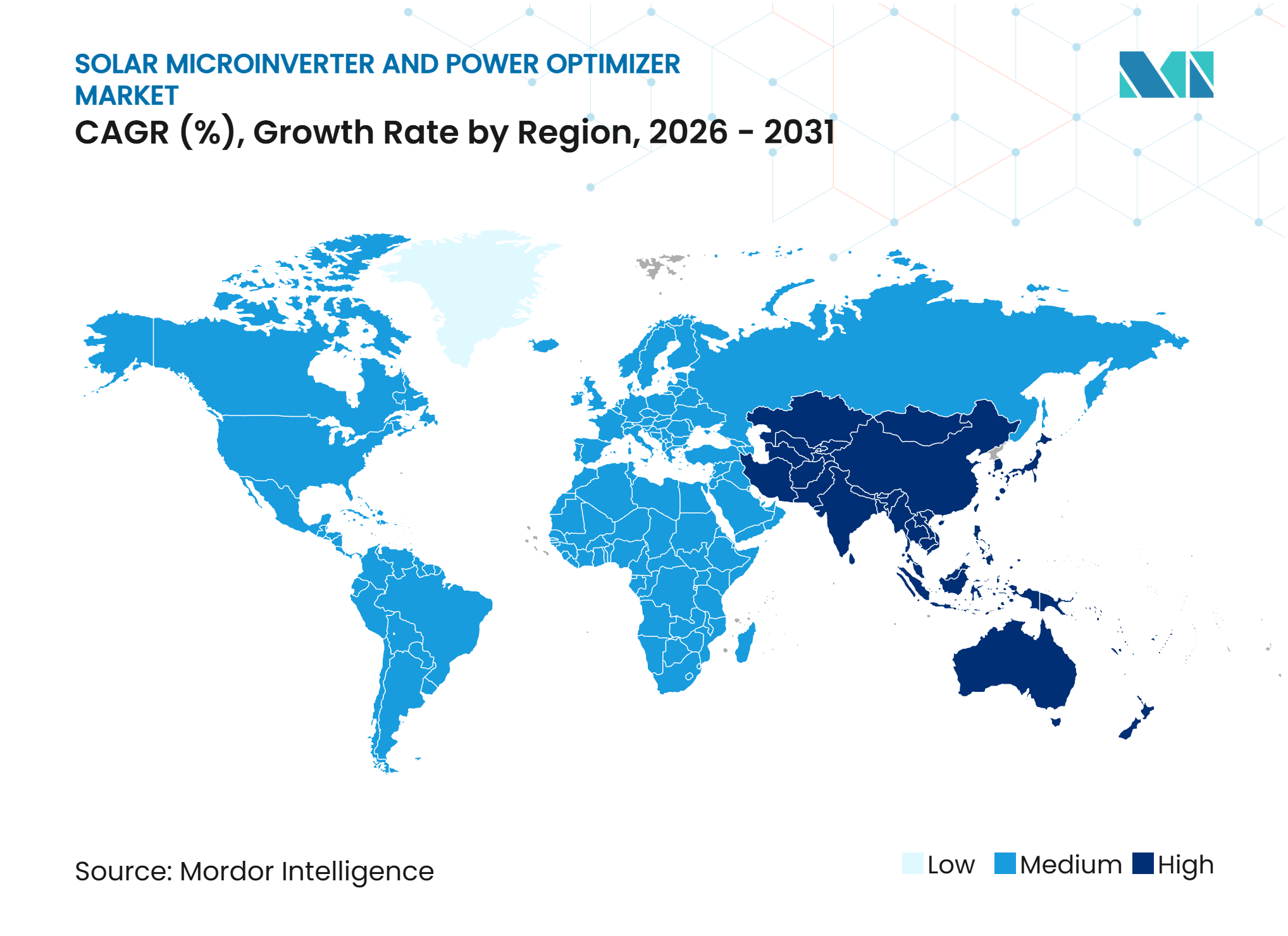
North America held 41.3% of revenue in 2026, representing the largest share of the solar microinverter and power optimizer market by geography. The region has a substantial residential solar installed base and strong focus on module-level safety requirements. In the United States, battery storage was paired with 37% of new residential solar systems in 2025. This trend increases demand for products that can coordinate solar generation, storage, and backup power. Canada and Mexico present additional rooftop and commercial opportunities. The scheduled Section 25D credit expiry is a near-term risk for US residential demand.
Asia-Pacific is forecast to grow at a 13.3% CAGR from 2027 to 2032. The region combines residential activity, commercial deployment, and public rooftop programs across several national markets. Hoymiles and Kosol Energie signed a 360 MW agreement for residential rooftop solar in Andhra Pradesh in January 2026. Australia installed 180,878 rooftop systems in the first half of 2026, and battery pairing reached 153 units per 100 solar installations. Enphase Energy established Enphase Energy Japan LLC in Tokyo in September 2025 with support from the Japan External Trade Organization.[4] These developments indicate that the solar microinverter and power optimizer market has multiple growth avenues across the region.
Europe remains an important regional market for three-phase residential and commercial module-level equipment. Enphase Energy launched its GaN-based IQ9N microinverter across nine European countries in June 2026, reporting 97.44% EU weighted efficiency with a 25-year warranty. Germany, France, and the Netherlands represent established demand across residential and commercial applications. South America and the Middle East and Africa are earlier-stage markets but are relevant to supplier expansion plans. Hoymiles entered the Philippines through a distribution partnership with Brills Marketing Corporation in July 2026. These regions may favor modular monitoring solutions where digital energy management is part of rooftop solar deployment.
Competitive Landscape
Market Concentration
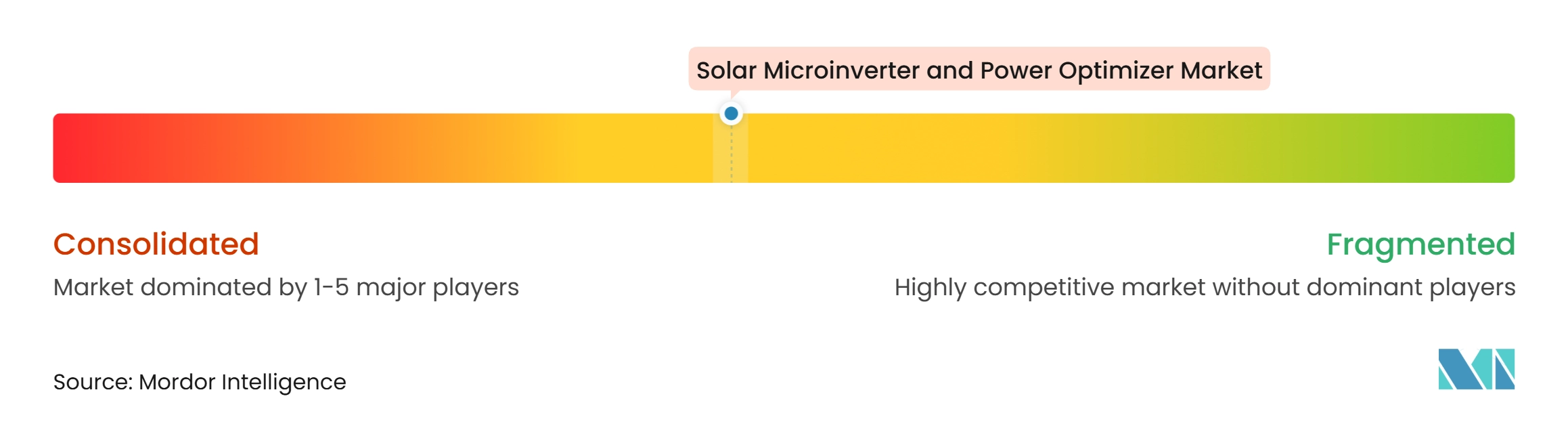
The solar microinverter and power optimizer market is moderately concentrated. Enphase Energy and SolarEdge Technologies remain key suppliers of residential module-level power electronics, particularly in North America and Europe. Enphase Energy reported USD 1.47 billion in fiscal 2025 revenue and 86.4 million cumulative microinverters shipped across 5.1 million systems in more than 160 countries. SolarEdge Technologies reported USD 1.18 billion in 2025 revenue, a 31.4% year-on-year increase. Cost competition from Chinese suppliers is increasing. The competitive focus is shifting from individual inverter units to coordinated solar, storage, monitoring, and service platforms.
Enphase Energy expanded its commercial portfolio with the 548 VA IQ9S-3P, which supports panels up to 770 W. The company also expanded commercial microinverter deployments from facilities in Texas and South Carolina in April 2026. Tigo Energy delivered its first US-designed and assembled 650 W optimizers to EG4 Electronics in May 2026. These developments address market needs related to higher module ratings, commercial demand, and domestic-content procurement, and indicate that manufacturing location and certification can influence competitive positioning.
Hoymiles, APsystems, and Tigo Energy are broadening their product portfolios around storage and system integration. Hoymiles introduced the HiOne all-in-one residential storage system in February 2026. APsystems introduced seven product lines for hybrid, off-grid, and storage applications at SNEC 2026. Hoymiles reported a 17.4% share of global microinverter shipments in 2025, based on S&P Global Energy data. The 100 kW to 500 kW commercial range remains a competitive opportunity, as roof complexity, system cost, and monitoring requirements can vary significantly across projects.
Solar Microinverter and Power Optimizer Industry Leaders
-
Enphase Energy, Inc.
-
SolarEdge Technologies, Inc.
-
Altenergy Power System Inc.
-
Tigo Energy, Inc.
-
Hoymiles Power Electronics Inc.
- *Disclaimer: Major Players sorted in no particular order
Solar Microinverter and Power Optimizer Market Companies Covered in this Report
- Alencon Systems, LLC
- Altenergy Power System Inc.
- Ampt, LLC
- APsystems
- Chilicon Power, LLC
- Darfon Electronics Corp.
- Delta Electronics, Inc.
- Enphase Energy, Inc.
- Ferroamp Elektronik AB
- Fronius International GmbH
- Ginlong Technologies Co., Ltd.
- GoodWe Technologies Co., Ltd.
- Hoymiles Power Electronics Inc.
- Huawei Technologies Co., Ltd.
- KACO New Energy GmbH
- NingBo Deye Inverter Technology Co., Ltd.
- Northern Electric Power Technology Inc.
- SMA Solar Technology AG
- SolarEdge Technologies, Inc.
- Sparq Systems Inc.
- Sungrow Power Supply Co., Ltd.
- Tigo Energy, Inc.
Recent Industry Developments in Solar Microinverter and Power Optimizer Market
- August 2026: Hoymiles launched the HiSwitch and HiBox gateway solutions, designed to work with its HiOne All-in-One Battery Energy Storage System (BESS). The products enable off-grid switching, expandable whole-home backup, and integration of solar, storage, and backup power within a single ecosystem, strengthening the company's residential solar-plus-storage offering.
- July 2026: Hoymiles expanded into the Philippines through a partnership with Brills Marketing Corporation, targeting residential and commercial solar-plus-storage installations. The agreement strengthens Hoymiles' distribution footprint in Southeast Asia and supports wider adoption of microinverter-based solar systems.
- June 2026: Enphase Energy began production shipments of the IQ9S-3P Commercial Microinverter, its most powerful microinverter to date. The GaN-based device delivers 548 VA output, supports solar modules up to 770 W, operates on 480Y/277 V three-phase grids, and achieves 97.5% CEC weighted efficiency, targeting high-power commercial solar installations.
- May 2026: Tigo Energy delivered its first shipment of U.S.-designed and assembled 650 W TS4 Flex optimizers to EG4 Electronics. The products are intended for domestically manufactured inverter systems that qualify for Section 45X, MACR, and enhanced domestic-content tax incentives in the United States.
Global Solar Microinverter and Power Optimizer Market Report Scope
Solar microinverters and power optimizers are module-level power electronics (MLPE) devices used to maximize the performance and energy output of solar photovoltaic (PV) systems. Microinverters convert DC electricity from individual solar panels into AC power, while power optimizers condition and optimize DC output before sending it to a central inverter. These technologies help reduce the impact of shading, panel mismatch, and performance losses, while enabling module-level monitoring and control. They are widely used in residential, commercial, and utility-scale solar installations to improve system reliability, safety, and energy generation.
The global solar microinverter and power optimizer market is segmented by product into microinverters, grid-tied microinverters, off-grid microinverters, hybrid microinverters, power optimizers, module-level power electronics, string optimizers, and smart power optimizers. By connectivity, the market is segmented into standalone systems, on-grid systems, grid-interactive systems, solar-plus-storage connectivity, and smart grid connectivity. By power rating, the market is segmented into up to 300 W, 300-500 W, 500-700 W, and above 700 W. By application, the market is segmented into residential, commercial and industrial, and utility sectors. The report also covers the market size and forecasts for the global solar microinverter and power optimizer market across 26 countries in key regions. For each segment, the market sizing and forecasts are provided on the basis of value (USD).
Segmentation Overview
| Microinverters | Grid-Tied Microinverters |
| Off-Grid Microinverters | |
| Hybrid Microinverters | |
| Power Optimizers | Module-Level Power Electronics |
| String Optimizers | |
| Smart Power Optimizers |
| Standalone Systems |
| On-Grid Systems |
| Grid-Interactive Systems |
| Solar-Plus-Storage Connectivity |
| Smart Grid Connectivity |
| Up to 300 W |
| 300–500 W |
| 500–700 W |
| Above 700 W |
| Residential |
| Commercial and Industrial |
| Utility |
| North America | United States |
| Canada | |
| Mexico | |
| Europe | Germany |
| France | |
| Italy | |
| Spain | |
| United Kingdom | |
| Poland | |
| Russia | |
| Rest of Europe | |
| Asia-Pacific | China |
| India | |
| Japan | |
| South Korea | |
| Australia | |
| Indonesia | |
| Vietnam | |
| Thailand | |
| Rest of Asia-Pacific | |
| South America | Brazil |
| Argentina | |
| Chile | |
| Rest of South America | |
| Middle East and Africa | Saudi Arabia |
| United Arab Emirates | |
| Egypt | |
| South Africa | |
| Morocco | |
| Rest of Middle East and Africa |
| By Product | Microinverters | Grid-Tied Microinverters |
| Off-Grid Microinverters | ||
| Hybrid Microinverters | ||
| Power Optimizers | Module-Level Power Electronics | |
| String Optimizers | ||
| Smart Power Optimizers | ||
| By Connectivity | Standalone Systems | |
| On-Grid Systems | ||
| Grid-Interactive Systems | ||
| Solar-Plus-Storage Connectivity | ||
| Smart Grid Connectivity | ||
| By Power Rating | Up to 300 W | |
| 300–500 W | ||
| 500–700 W | ||
| Above 700 W | ||
| By Application | Residential | |
| Commercial and Industrial | ||
| Utility | ||
| By Geography | North America | United States |
| Canada | ||
| Mexico | ||
| Europe | Germany | |
| France | ||
| Italy | ||
| Spain | ||
| United Kingdom | ||
| Poland | ||
| Russia | ||
| Rest of Europe | ||
| Asia-Pacific | China | |
| India | ||
| Japan | ||
| South Korea | ||
| Australia | ||
| Indonesia | ||
| Vietnam | ||
| Thailand | ||
| Rest of Asia-Pacific | ||
| South America | Brazil | |
| Argentina | ||
| Chile | ||
| Rest of South America | ||
| Middle East and Africa | Saudi Arabia | |
| United Arab Emirates | ||
| Egypt | ||
| South Africa | ||
| Morocco | ||
| Rest of Middle East and Africa | ||
Key Questions Answered in the Report
What is the projected value of the solar microinverter and power optimizer market by 2032?
The market is forecast to reach USD 13.62 billion by 2032, from USD 7.81 billion in 2027, at an 11.76% CAGR.
Which product category held the largest revenue share in 2026?
Microinverters led with 56.1% of revenue in 2026, supported by rooftop safety and monitoring requirements.
Which connectivity type is growing fastest through 2032?
Solar-plus-storage connectivity is forecast to grow at a 13.4% CAGR through 2032 as solar and battery systems become more integrated.
Why do rapid-shutdown requirements matter for rooftop solar equipment?
Module-level products support rapid de-energization and are well suited to residential roofs where safety requirements shape system design.
Which application is expected to grow fastest?
Commercial and industrial installations are forecast to grow at a 12.3% CAGR through 2032, supported by higher-power equipment and complex rooftop layouts.
Which region is expected to grow fastest?
Asia-Pacific is forecast to grow at a 13.3% CAGR through 2032, supported by rooftop programs, commercial demand, and expanding storage adoption.