
Solar Hybrid Inverter Market Size and Share
Market Overview
| Study Period | 2022 - 2032 |
|---|---|
| Market Size (2027) | USD 13.27 Billion |
| Market Size (2032) | USD 21.05 Billion |
| Growth Rate (2027 - 2032) | 9.67 % |
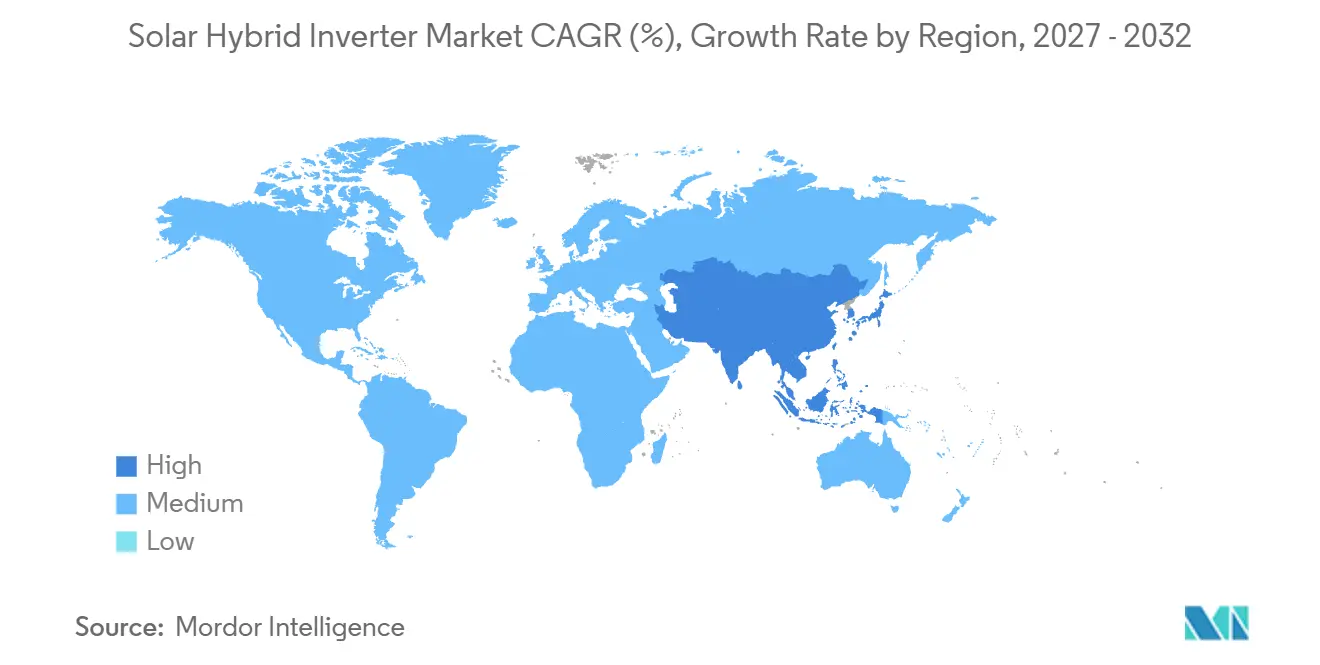
| Fastest Growing Market | Asia-Pacific |
| Largest Market | North America |
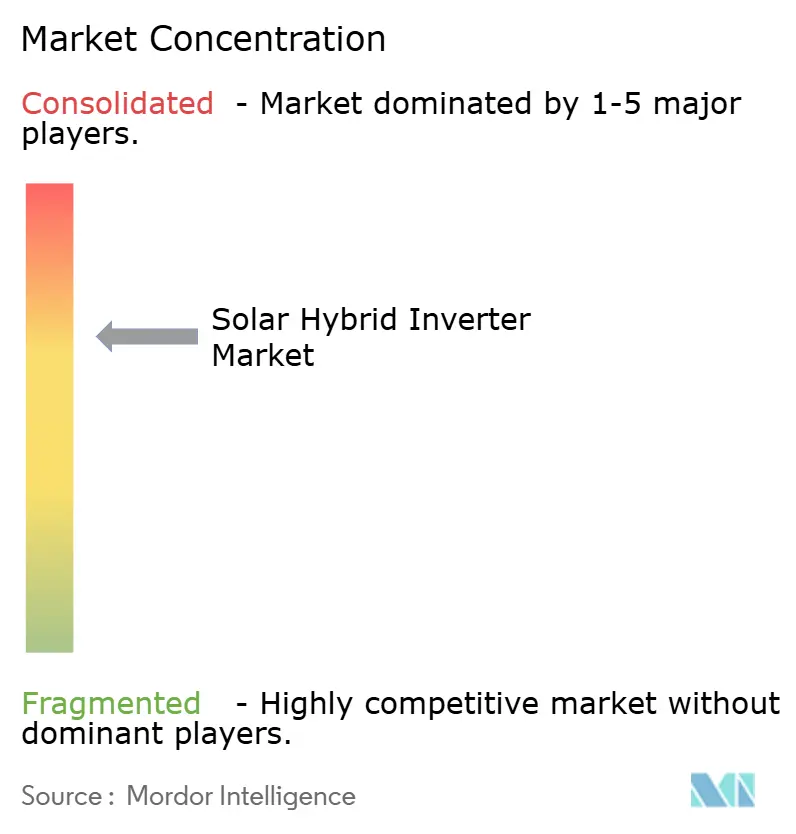
| Market Concentration | Medium |
Major Players *Disclaimer: Major Players sorted in no particular order Image © Mordor Intelligence. Reuse requires attribution under CC BY 4.0. | |
Solar Hybrid Inverter Market Analysis by Mordor Intelligence
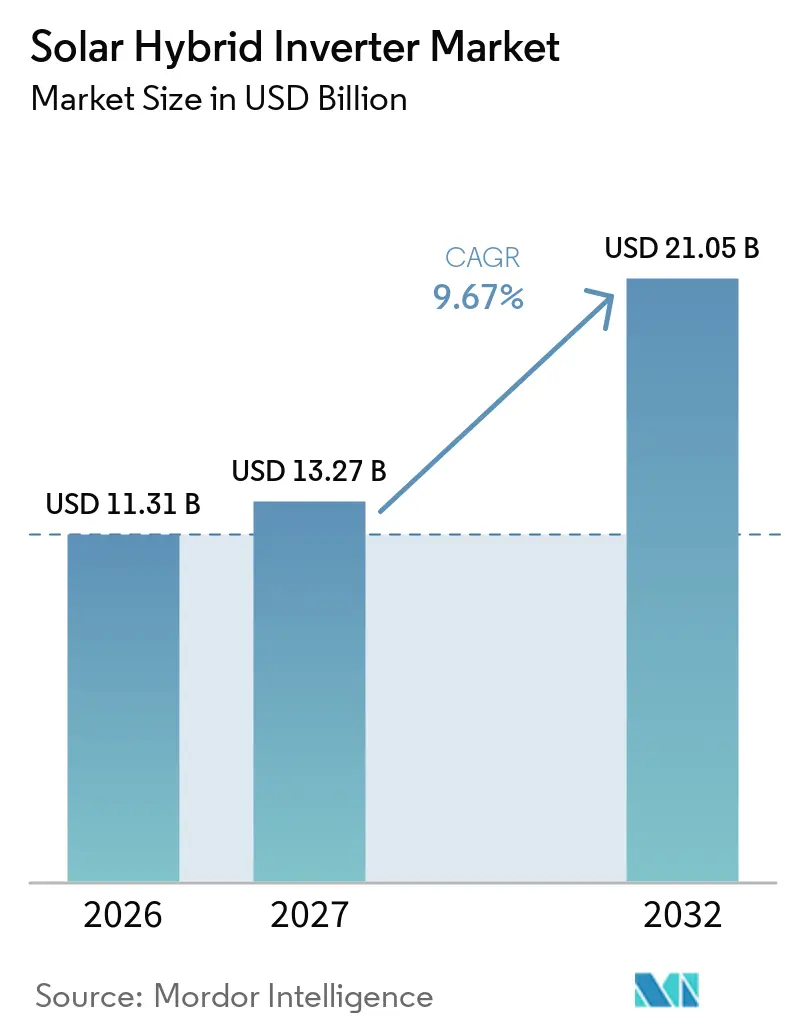
The global solar hybrid inverter market size is expected to increase from USD 11.31 billion in 2026 to USD 13.27 billion in 2027 and reach USD 21.05 billion by 2032, at a CAGR of 9.67% over 2027-2032. The market is supported by lower lithium iron phosphate (LiFePO4) battery costs, higher retail electricity tariffs, and net-zero policies that make solar and storage more attractive as an integrated system. As hardware pricing remains competitive, suppliers are placing greater emphasis on energy management software, monitoring, maintenance, and grid-service capabilities. Manufacturers are also broadening their production footprints in Vietnam, Turkey, and Mexico in response to trade measures, certification requirements, and supply chain risks. The market is therefore moving toward products that support self-consumption, backup power, and participation in distributed energy programs, rather than solar generation alone. Regulatory changes can also influence purchase timing, particularly when incentive structures favor commercial ownership or retrofit installations over direct residential purchases.
Key Report Takeaways
- By product type, three-phase inverters held 63.2% of the solar hybrid inverter market share in 2026, while single-phase inverters are forecast to grow at a 9.8% CAGR through 2032.
- By connection type, on-grid systems held 52.5% of the solar hybrid inverter market share in 2026, while off-grid systems are forecast to expand at a 10.1% CAGR through 2032.
- By capacity, systems up to 10 kW accounted for 44.7% of the solar hybrid inverter market size in 2026, while 10 to 50 kW systems are projected to grow at a 10.3% CAGR through 2032.
- By end user, residential users held a 45.5% share in 2026, while commercial installations are forecast to grow at a 10.7% CAGR through 2032.
- By geography, North America held a 41.2% share in 2026, while Asia-Pacific is forecast to grow at a 10.5% CAGR through 2032.
Note: Market numbers in this report are based on Mordor Intelligence's proprietary estimation framework, which combines nine months of actuals with Q4 projections for base year 2026.
Market Trends and Insights
Drivers Impact Analysis of Solar Hybrid Inverter Market*
| Driver | (~) % Impact on CAGR Forecast | Geographic Relevance | Impact Timeline |
|---|---|---|---|
| Solar-Plus-Storage Adoption | +3.0% | Global, strongest in Europe, Australia, the United States, and India | Short term (≤ 2 years) |
| Grid Resilience and Backup-Power Demand | +1.8% | Global, most acute in the Middle East and Africa, South Asia, and North America | Short term (≤ 2 years) |
| Government Incentives and Net-Zero Policies | +1.5% | North America and Europe primarily, with spillover to Asia-Pacific and Latin America | Medium term (2-4 years) |
| Commercial and Industrial Energy-Cost Optimization | +1.2% | Global, led by Asia-Pacific, North America, and Europe | Medium term (2-4 years) |
| Hybrid Mini-Grids for Weak-Grid and Off-Grid Electrification | +0.8% | Sub-Saharan Africa, South Asia, Southeast Asia, and Latin America | Long term (≥ 4 years) |
| Solar, Battery, EV, and Demand-Response Convergence | +0.7% | North America, Europe, and core Asia-Pacific markets | Long term (≥ 4 years) |
| Source: Mordor Intelligence | |||
Solar-Plus-Storage Adoption as the Core Demand Signal
Solar and storage are increasingly purchased as a combined residential energy system, strengthening demand in the solar hybrid inverter market. Sungrow Power Supply Co., Ltd introduced its PowerHarbor residential energy storage system at Intersolar Europe 2026 with modular lithium iron phosphate (LiFePO4) battery blocks ranging from 6 kWh to 120 kWh and energy optimization through iSolarCloud.[1] This configuration indicates that buyers increasingly expect storage, control software, and solar conversion equipment to function together, shifting the purchasing decision from comparing individual inverters to evaluating the overall value of a complete energy package for the household. Time-of-use tariffs make this value more visible, as stored electricity can be used when grid prices are higher. IEC TS 62257-301:2025 also established a dedicated technical framework for integrating solar with other generation sources in hybrid off-grid systems, supporting standardized mini-grid deployment.[2]
Grid Resilience and Backup-Power Demand Shaping Investment Decisions
Backup capability has become a central purchasing factor in areas where outages, public safety shutoffs, or weak distribution networks affect electricity supply. Sungrow Power Supply Co., Ltd launched EnergyBridge in Australia in June 2026 as a compact backup solution that combines a changeover switch, circuit breaker, meter, bypass switch, and current transformer. The product was designed to reduce installation complexity for residential backup systems. A backup-capable inverter can also connect a household to virtual power plant programs where local rules and utility contracts permit, creating a potential service layer beyond equipment sales for companies with connected energy platforms. Washington State Senate Bill 5727 provides residential storage incentives of up to USD 450 per kWh, or USD 765 per kWh for eligible low-income customers, when systems meet program conditions. These measures link resilience investment with time-of-use and grid-service participation.
Government Incentives and Net-Zero Policies Reshaping Demand Channels
Policy design is changing which customer groups can most readily finance hybrid systems. The Internal Revenue Service states that the residential clean energy credit does not apply to property placed in service after December 31, 2025 under the current rule. At the same time, commercial storage can still benefit from the Section 48E investment tax credit, subject to applicable requirements, which supports third-party ownership and commercial installations. This difference can shift activity toward service providers and larger solar operators that can structure financed offerings. Italy's published incentive information showed a 50% home renovation benefit in 2025, scheduled to decline to 36% by 2027. Oregon's April 2026 rule amendments extended program eligibility to certain storage retrofits on previously purchased solar systems. The solar hybrid inverter market can therefore draw demand from both new systems and upgrades to earlier solar installations.
The effect of policy is not uniform across customer groups. Homeowners tend to respond to rebates, retail tariffs, and financing availability. Commercial customers can use tax structures and service contracts that are less accessible to individual buyers. Installers must therefore manage a wider mix of customer needs, ranging from simple retrofit batteries to financed solar-storage offerings. Suppliers that make products compatible with existing photovoltaic systems can benefit when incentives are directed toward upgrades rather than new installations. This keeps demand tied to local policy details rather than a single global incentive pattern.
Commercial and Industrial Energy-Cost Optimization Driving Mid-Range Capacity Adoption
Commercial and industrial buyers assess hybrid systems against demand charges, peak-period purchases, and the cost of operational interruptions. Inhenergy introduced a 125 kW hybrid inverter in March 2026 with 200% PV oversizing capability, 98% peak efficiency, and 10 ms UPS switching for commercial facilities.[3] Such equipment targets factories, warehouses, hospitals, hotels, and other sites where continuity of supply has direct operating value. The solar hybrid inverter market also benefits when facilities can combine solar generation, storage, and managed loads within a single control arrangement. Sungrow Power Supply Co., Ltd presented its C&I PowerStack On and Off-Grid solution at Intersolar Europe 2026, combining the SH125CX hybrid inverter and ST245CS-S storage system in a DC-coupled design. The solution supports grid-connected operation, off-grid operation, and retrofits to existing photovoltaic systems. Larger commercial projects may also consider grid-support functions where market rules permit.
Restraints Impact Analysis of Solar Hybrid Inverter Market*
| Restraint | (~) % Impact on CAGR Forecast | Geographic Relevance | Impact Timeline |
|---|---|---|---|
| High Upfront System and Battery Costs | -2.0% | Global, most constraining in emerging markets and price-sensitive residential segments | Short term (≤ 2 years) |
| Interoperability and Certification Complexity | -1.4% | North America, Europe, and Asia-Pacific | Medium term (2-4 years) |
| Grid-Connection and Net-Metering Uncertainty | -1.0% | Global, most impactful in markets undergoing net-metering reform in the United States, Australia, and Europe | Medium term (2-4 years) |
| Installer Capability and After-Sales-Service Gaps in Emerging Markets | -0.6% | Sub-Saharan Africa, South Asia, Southeast Asia, and Latin America | Long term (≥ 4 years) |
| Source: Mordor Intelligence | |||
High Upfront System and Battery Costs Constraining Adoption Pace
System cost remains a material barrier for price-sensitive households in the solar hybrid inverter market, even as battery prices decline. A typical 10 kWp photovoltaic system with 10 kWh of storage and a hybrid inverter in Germany was estimated to cost EUR 18,000 to 22,000 in 2026, equivalent to USD 19,500 to 23,900. While a 3 to 4 year payback period is achievable under prevailing German tariff conditions, the initial outlay can still exclude households without access to suitable financing. In Brazil, 5 kW residential hybrid inverters were priced at BRL 7,000 to 10,000, or USD 1,270 to 1,820. Import duties can raise equipment costs further when suppliers pass part of the added cost to buyers. Installation labor and commissioning also represent a significant cost component, accounting for 15 to 25% of total system cost in developed markets.
Interoperability and Certification Complexity Adding Time and Cost to Market Entry
Product certification has become more demanding for connected solar and storage equipment. Manufacturers must meet applicable safety and performance requirements for photovoltaic inverters and battery energy storage converters, and must also address different grid codes across North America, Europe, and Australia. Communication mismatches among inverter controls and battery management systems can complicate commissioning, particularly across CANbus, RS485, and Modbus interfaces. These issues can generate post-sale service costs that are not evident in standard product specifications. The solar hybrid inverter market favors suppliers with the technical resources to maintain multiple certification pathways and provide reliable local support.
This challenge is especially relevant for smaller suppliers entering markets outside their home region. A product can meet basic electrical requirements and still require changes to its communications, protection settings, or documentation before receiving local approval. Installers also require clear guidance on compatible batteries and software updates. Delays in these areas can affect project timelines and customer confidence. The need for dependable field support gives established suppliers an advantage in markets where distributed storage is growing rapidly.
*Our forecasts treat driver/restraint impacts as directional, not additive. The impact forecasts reflect baseline growth, mix effects, and variable interactions.
Solar Hybrid Inverter Market Segment Analysis
By Product Type:
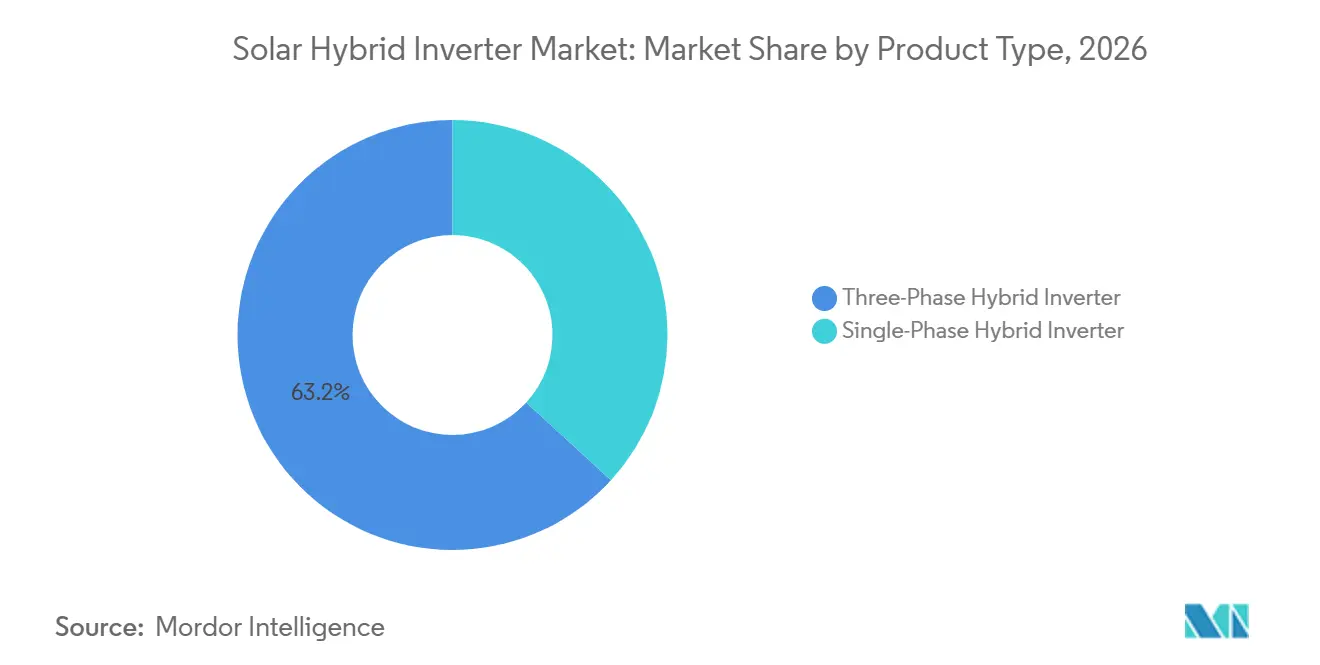
Three-Phase Systems Retain Scale While Single-Phase Demand ExpandsThree-phase hybrid inverters held 63.2% of revenue in 2026, giving the category the largest global share. Europe and Asia provide a substantial installed base, as three-phase connections are common in residential and commercial applications. Germany, France, Italy, and Spain support steady demand for systems that can serve three-phase grids. HTW Berlin reported that DC-coupled systems with hybrid inverters represented 87% of home storage sold in Germany in 2024. This architecture combines solar conversion and battery charging in one system and supports self-consumption without requiring a separate battery inverter in many applications. These conditions help maintain the category's relevance in mature storage markets.
Single-phase hybrid inverters are forecast to grow at a 9.8% CAGR from 2027 to 2032. Residential and agricultural connections in India, Indonesia, Vietnam, Thailand, and other South and Southeast Asian markets often use single-phase supply, making the category suitable for smaller rooftop systems that are adding batteries for backup and self-consumption. Single-phase products can serve as an entry point to newer solar-plus-storage markets, and their role grows as customers move from solar-only installations to systems with storage and load control.

By Connection Type:
On-Grid Systems Lead While Off-Grid Systems Grow FasterOn-grid hybrid inverters held 52.5% of revenue in 2026, representing the largest share by connection type. Grid-connected residential and commercial installations in Europe, North America, and East Asia supplied most of this demand. This segment benefits from established installers, interconnection rules, and incentive programs. On-grid systems are typically the first choice for customers with reliable utility service who want self-consumption and backup capability. Net-metering arrangements and retail electricity prices influence the value of these systems. On-grid equipment can also connect to battery storage without requiring customers to leave the utility network, which helps maintain the segment's lead.
For many customers, the value of these systems lies in flexibility rather than complete independence from the grid. Stored solar electricity can be used during high-price periods while utility service remains available when needed. This approach suits markets where the grid is reliable but electricity prices create a reason to manage consumption more closely. It also provides a practical starting point for customers that may expand battery capacity later.
Off-grid hybrid inverters are forecast to grow at a 10.1% CAGR through 2032, the highest rate among connection types. Mini-grid programs in Sub-Saharan Africa, rural India, Indonesia, and Latin America are expanding the use of solar and battery systems where grid service is unavailable or unreliable. The World Bank has identified several government approaches for supporting solar hybrid mini-grids, including frameworks that mobilize private participation and address rural service needs. IEC TS 62257-301:2025 provides developers and financiers a common basis for hybrid off-grid system design. Battery-backed systems that operate across grid-connected and independent modes are useful in markets such as India, South Africa, and Nigeria, where both power continuity and electricity cost savings are priorities.
By Capacity:
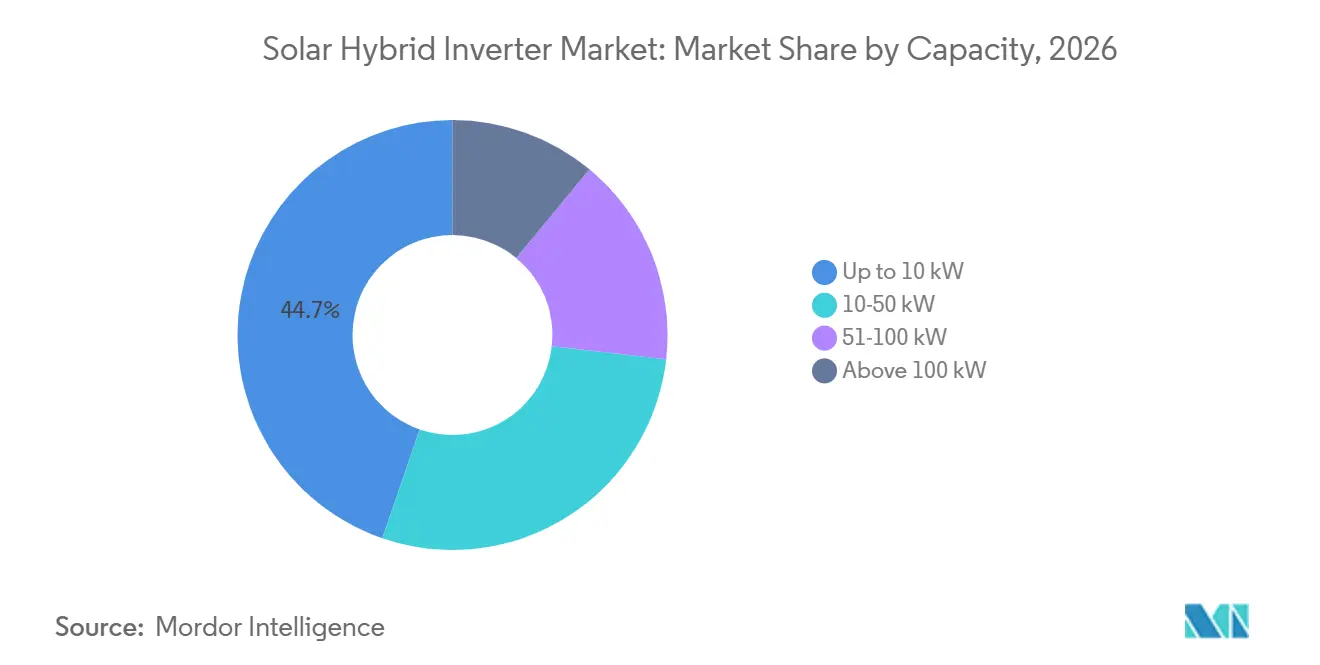
Residential Systems Lead While Mid-Range Systems Gain GroundSystems up to 10 kW held 44.7% of the solar hybrid inverter market in 2026, supported by the large global base of household photovoltaic installations. These systems commonly use single-phase or light three-phase equipment for household energy management. Falling lithium iron phosphate (LiFePO4) battery costs are making larger residential systems more accessible for some buyers, and building policies in Germany, France, and Australia are encouraging battery-ready infrastructure in new construction, which may gradually increase average equipment size. The smaller capacity category remains central as it serves the broadest residential customer base.
The 10 to 50 kW range is forecast to grow at a 10.3% CAGR through 2032. Small factories, agricultural processors, commercial buildings, telecom sites, and light industrial facilities are using this range for peak management and backup power, giving these users a middle option between household equipment and large utility-scale storage projects. The 51 to 100 kW and above-100 kW categories remain smaller but are relevant for microgrids, data centers, and larger commercial sites. Sungrow Power Supply Company's commercial and industrial solution uses the SH125CX hybrid inverter for this type of deployment, while Inhenergy's 125 kW product includes three-phase unbalanced output for weak or rural grids. These designs address sites that would otherwise require more complex inverter configurations.
Capacity selection is closely linked to load patterns and the financial value of avoided peak demand. A smaller system may support selected loads during a short outage, while a larger installation can combine storage with solar generation across a broader share of site consumption. This distinction matters for commercial buyers that need a clear operating case before committing capital. Suppliers that offer modular equipment can support expansion without requiring customers to replace the entire system.
By End User:
Residential Users Lead While Commercial Demand AcceleratesResidential users held 45.5% of the market in 2026, making households the largest end-user group. Rooftop solar growth and the bundling of storage with new systems support this position. Sungrow Power Supply Company states that it serves more than 3 million households worldwide and markets residential systems ranging from compact backup products to larger modular storage packages. These options allow the market to serve households pursuing self-consumption, short-duration backup, or broader home energy management. Residential demand is especially important in Europe, North America, and Australia, and it supports wider installer networks and product availability.
Commercial installations are forecast to grow at a 10.7% CAGR through 2032. Retail parks, hotels, food and beverage sites, and light industrial facilities assess systems against avoided demand charges, high-tariff electricity purchases, and continuity of operations. Telecom, remote-site, utility-scale, and agricultural users remain smaller groups but are important for off-grid and weak-grid projects. This shift in end-user mix supports larger system sizes and more advanced control requirements, and it creates demand for suppliers able to provide engineering, commissioning, and ongoing service.
Geography Analysis
North America Solar Hybrid Inverter Market
North America held a 41.2% share in 2026, making it the largest regional contributor to the solar hybrid inverter market. California's NEM 3.0 rules reduced the value of exported electricity, strengthening the case for self-consumption and storage. The commercial Section 48E tax credit continues to support qualified clean electricity investments and storage projects.[4] The end of the residential Section 25D credit for property placed in service after 2025 may favor third-party ownership and larger installer offerings. Canada adds demand through provincial programs and rural off-grid applications. Mexico is developing as a commercial solar location, particularly in manufacturing corridors near the United States. UL 1741, IEEE 1547-2018, and emerging cybersecurity requirements remain significant for product market access in the region.
Europe Solar Hybrid Inverter Market
Europe remains a major residential and commercial storage region for the solar hybrid inverter market, with Germany, the United Kingdom, Italy, France, Poland, and Spain as important markets. Fraunhofer ISE reported that Germany had more than 20.8 GW and 32.4 GWh of battery storage capacity installed by August 2026, including home and grid-scale systems. A German proposal to remove the fixed 20-year feed-in tariff for new photovoltaic systems from 2027 has been reported; if adopted, this policy direction would support self-consumption economics. Italy's incentive reduction from 50% in 2025 to 36% in 2027 may bring installations forward before the reduction takes effect. Enphase Energy launched the IQ Battery 5P with FlexPhase across several European markets during 2025. The European solar hybrid inverter market continues to be shaped by established installers, local standards, and a substantial base of homes suitable for retrofit storage.
APAC, South America and MEA Solar Hybrid Inverter Market
Asia-Pacific is forecast to grow at a 10.5% CAGR from 2027 to 2032, the highest regional rate in the solar hybrid inverter market. China remains a major production center and consumer of solar hybrid inverters, while India, Australia, Indonesia, Vietnam, and Thailand provide additional demand. India's rooftop solar measures and distributed energy needs support residential, agricultural, and small commercial deployment. Australia's high retail electricity prices and state programs support residential solar-plus-storage adoption. Sungrow Power Supply chose Australia for its June 2026 EnergyBridge launch, reflecting the importance of backup functionality in the region. In South America, Brazil leads the market, where network-use charges have reinforced the value of self-consumption and storage. The Middle East and Africa combine Gulf smart-grid projects with off-grid and weak-grid opportunities across Nigeria, Kenya, South Africa, Morocco, and Egypt. ATESS documented a Nigerian solar mini-grid project using hybrid solar-battery equipment, illustrating the rural electrification use case.
Competitive Landscape
The solar hybrid inverter market has a moderately concentrated manufacturing base, with key players including Sungrow, Huawei Digital Power, Growatt, GoodWe, Ginlong, Deye, and SOFARSOLAR. These suppliers compete on cost, battery integration, research investment, and distribution network reach. Their platforms increasingly combine inverter hardware with monitoring, energy management, and grid-response capabilities. Sungrow's iSolarCloud, Huawei's FusionSolar, and GoodWe's EzManager reflect this shift toward connected energy management. Huawei launched FusionSolar 9.0 in Europe in April 2026, introducing the SUN2000-506KTL grid-forming string inverter and a 1,000 V AC photovoltaic design. The company stated that this design could lower balance-of-system costs by EUR 0.27 to EUR 0.55 per watt. This approach shifts competition beyond conversion hardware toward large-scale system design and operation.
SolarEdge Technologies reported USD 346.2 million in second-quarter 2026 revenue, a 20% year-over-year increase. Sigenergy offers a 5-in-1 SigenStor system that integrates an inverter, battery, energy management, EV charging, and vehicle-to-home capability. Victron Energy maintains a distinct position in professional off-grid and marine applications through its Quattro inverter/charger ecosystem and third-party integration approach. These companies address different customer needs, ranging from integrated household systems to configurable off-grid solutions. Suppliers in the solar hybrid inverter market are also placing greater emphasis on cybersecurity certification, grid-support compliance, and local service capability.
Opportunities remain in the 51 to 100 kW range for commercial operators in tropical and emerging markets that require IP66-rated, generator-compatible, grid-forming products. Retrofit kits represent another opportunity, as many European solar owners are evaluating battery additions for existing string-inverter systems. Agricultural irrigation applications in India and Sub-Saharan Africa also present demand for systems that can replace diesel generation with solar and storage. Suppliers that can adapt products to local grid regulations, battery options, installation practices, and service requirements are well-positioned to capture growth in the solar hybrid inverter market.
Solar Hybrid Inverter Industry Leaders
-
Huawei Technologies Co., Ltd.
-
Sungrow Power Supply Co., Ltd.
-
Growatt New Energy Technology Co., Ltd.
-
SMA Solar Technology AG
-
SolarEdge Technologies Inc.
- *Disclaimer: Major Players sorted in no particular order
Solar Hybrid Inverter Market Companies Covered in this Report
- Huawei Technologies Co., Ltd.
- Sungrow Power Supply Co., Ltd.
- Growatt New Energy Technology Co., Ltd.
- SMA Solar Technology AG
- SolarEdge Technologies Inc.
- Schneider Electric SE
- Enphase Energy, Inc.
- GoodWe Power Supply Technology Co., Ltd.
- Ginlong Technologies Co., Ltd.
- Fronius International GmbH
- Delta Electronics, Inc.
- ABB Ltd.
- KACO New Energy GmbH
- SolaX Power Network Technology (Zhejiang) Co., Ltd.
- Deye Inverter Technology Co., Ltd.
- SOFARSOLAR Co., Ltd.
- Victron Energy B.V.
- OutBack Power Technologies, Inc.
- Luminous Power Technologies Pvt. Ltd.
- Havells India Limited
- Microtek International Pvt. Ltd.
- Tabuchi Electric Co., Ltd.
- Redback Technologies Pty Ltd
- Servotech Renewable Power Systems Limited
- FIMER S.p.A.
Recent Industry Developments in Solar Hybrid Inverter Market
- June 2026: At Intersolar Europe 2026 in Munich, Sungrow Power Supply Co., Ltd. unveiled the PowerHarbor all-in-one residential energy storage solution. The system integrates hybrid inverter capacities ranging from 10 kW to 30 kW with modular 6 to 10 kWh LFP battery units, expandable up to 120 kWh. The platform features 1.6x PV-to-battery charging capability, AI-driven energy optimization, and PID ZERO technology for high-capacity residential solar-plus-storage applications.
- June 2026: Sungrow Power Supply Co., Ltd. introduced EnergyBridge in Australia, an integrated backup power solution for residential solar and storage installations. The product combines a changeover switch, circuit breaker, energy meter, bypass switch, and current transformer within a single compact unit, simplifying backup power deployment and reducing installation complexity for hybrid inverter systems.
- April 2026: Huawei Digital Power Technologies Co., Ltd. launched FusionSolar 9.0 for the European market, featuring the SUN2000-506KTL grid-forming string inverter, an 11 MW smart transformer station, and a 1,000 V AC photovoltaic architecture. The platform is designed to enhance grid support capabilities, improve renewable energy integration, and support utility-scale solar and storage deployments requiring advanced inverter functionality.
- March 2026: GoodWe Technologies Co., Ltd. introduced the ES LD bifacial hybrid inverter series in the 5 to 10 kW range for Brazil and other Latin American markets. The products support multiple regional voltage configurations, both grid-tied and off-grid operating modes, and compatibility with 48 V low-voltage battery systems, targeting residential and small-commercial solar-plus-storage installations.
Global Solar Hybrid Inverter Market Report Scope
A solar hybrid inverter is an electrical device that combines a traditional solar inverter with a battery inverter into a single unit, managing power flow from solar panels, utility grids, and battery storage systems to maximize energy efficiency. The system directs solar energy to power home appliances first, routes excess electricity to charge backup batteries, and exports surplus power to the grid where permitted. By integrating battery storage, it ensures a continuous power supply during nighttime hours or utility grid outages, unlike standard grid-tied systems.
The global solar hybrid inverter market is segmented by product type into single-phase hybrid inverters and three-phase hybrid inverters. By connection type, the market is segmented into on-grid hybrid inverters, off-grid hybrid inverters, and battery-backed hybrid inverters. By capacity, the market is segmented into up to 10 kW, 10-50 kW, 51-100 kW, and above 100 kW. By end user, the market is segmented into residential, commercial, industrial, utility-scale and microgrid, telecom and remote-site power, and agricultural and rural users. The report also covers the market size and forecasts for the global solar hybrid inverter market across 26 countries in key regions. For each segment, the market sizing and forecasts are provided on the basis of value (USD).
Segmentation Overview
| Single-Phase Hybrid Inverter |
| Three-Phase Hybrid Inverter |
| On-Grid Hybrid Inverter |
| Off-Grid Hybrid Inverter |
| Battery-Backed Hybrid Inverter |
| Up to 10 kW |
| 10-50 kW |
| 51-100 kW |
| Above 100 kW |
| Residential |
| Commercial |
| Industrial |
| Utility-Scale and Microgrid |
| Telecom and Remote-Site Power |
| Agricultural and Rural Users |
| North America | United States |
| Canada | |
| Mexico | |
| Europe | Germany |
| France | |
| Italy | |
| Spain | |
| United Kingdom | |
| Poland | |
| Russia | |
| Rest of Europe | |
| Asia-Pacific | China |
| India | |
| Japan | |
| South Korea | |
| Australia | |
| Indonesia | |
| Vietnam | |
| Thailand | |
| Rest of Asia-Pacific | |
| South America | Brazil |
| Argentina | |
| Chile | |
| Rest of South America | |
| Middle East and Africa | Saudi Arabia |
| United Arab Emirates | |
| Egypt | |
| South Africa | |
| Morocco | |
| Rest of Middle East and Africa |
| By Product Type | Single-Phase Hybrid Inverter | |
| Three-Phase Hybrid Inverter | ||
| By Connection Type | On-Grid Hybrid Inverter | |
| Off-Grid Hybrid Inverter | ||
| Battery-Backed Hybrid Inverter | ||
| By Capacity | Up to 10 kW | |
| 10-50 kW | ||
| 51-100 kW | ||
| Above 100 kW | ||
| By End User | Residential | |
| Commercial | ||
| Industrial | ||
| Utility-Scale and Microgrid | ||
| Telecom and Remote-Site Power | ||
| Agricultural and Rural Users | ||
| By Geography | North America | United States |
| Canada | ||
| Mexico | ||
| Europe | Germany | |
| France | ||
| Italy | ||
| Spain | ||
| United Kingdom | ||
| Poland | ||
| Russia | ||
| Rest of Europe | ||
| Asia-Pacific | China | |
| India | ||
| Japan | ||
| South Korea | ||
| Australia | ||
| Indonesia | ||
| Vietnam | ||
| Thailand | ||
| Rest of Asia-Pacific | ||
| South America | Brazil | |
| Argentina | ||
| Chile | ||
| Rest of South America | ||
| Middle East and Africa | Saudi Arabia | |
| United Arab Emirates | ||
| Egypt | ||
| South Africa | ||
| Morocco | ||
| Rest of Middle East and Africa | ||
Key Questions Answered in the Report
What is the projected size of the solar hybrid inverter market by 2032?
The market is forecast to reach USD 21.05 billion by 2032, rising from USD 13.27 billion in 2027 at a 9.67% CAGR. This forecast reflects demand for systems that combine solar conversion, stored energy, and household load management in a single installation.
Which product type leads solar hybrid inverter sales?
Three-phase systems led with 63.2% of revenue in 2026, supported by established three-phase connections in Europe and Asia. These connections are common across residential and commercial installations in several major European and Asian countries.
Which connection type is growing fastest?
Off-grid systems are forecast to grow at a 10.1% CAGR through 2032, supported by mini-grid and rural electrification projects. This category is relevant where a reliable utility connection is unavailable or where users need the ability to operate independently during outages.
Why are commercial buyers adopting hybrid inverter systems?
Commercial users adopt these systems to manage peak electricity costs, support backup power, and reduce the impact of outages on operations. Small factories, retail locations, hotels, food and beverage sites, and telecom facilities can weigh these benefits against the operating costs of grid electricity and service interruptions.
Which region is expected to grow fastest through 2032?
Asia-Pacific is forecast to grow at a 10.5% CAGR, driven by demand in China, India, Australia, Indonesia, Vietnam, and Thailand. Growth is linked to distributed solar deployment, residential storage demand, agricultural uses, and small commercial applications across these countries.
What are the main barriers to wider adoption?
High upfront system costs, complex certification requirements, uncertain grid rules, and gaps in installer and service capabilities can slow adoption. These barriers can raise project costs, delay commissioning, and make it harder for new suppliers to enter markets with varying technical standards.