
Self-Priming Pumps Market Size and Share
Market Overview
| Study Period | 2022 - 2032 |
|---|---|
| Market Size (2027) | USD 31.35 Billion |
| Market Size (2032) | USD 40.41 Billion |
| Growth Rate (2027 - 2032) | 5.21 % |
| Fastest Growing Market | Asia-Pacific |
| Largest Market | Asia-Pacific |
| Market Concentration | Low |
Major Players *Disclaimer: Major Players sorted in no particular order Image © Mordor Intelligence. Reuse requires attribution under CC BY 4.0. | |
Self-Priming Pumps Market Analysis by Mordor Intelligence
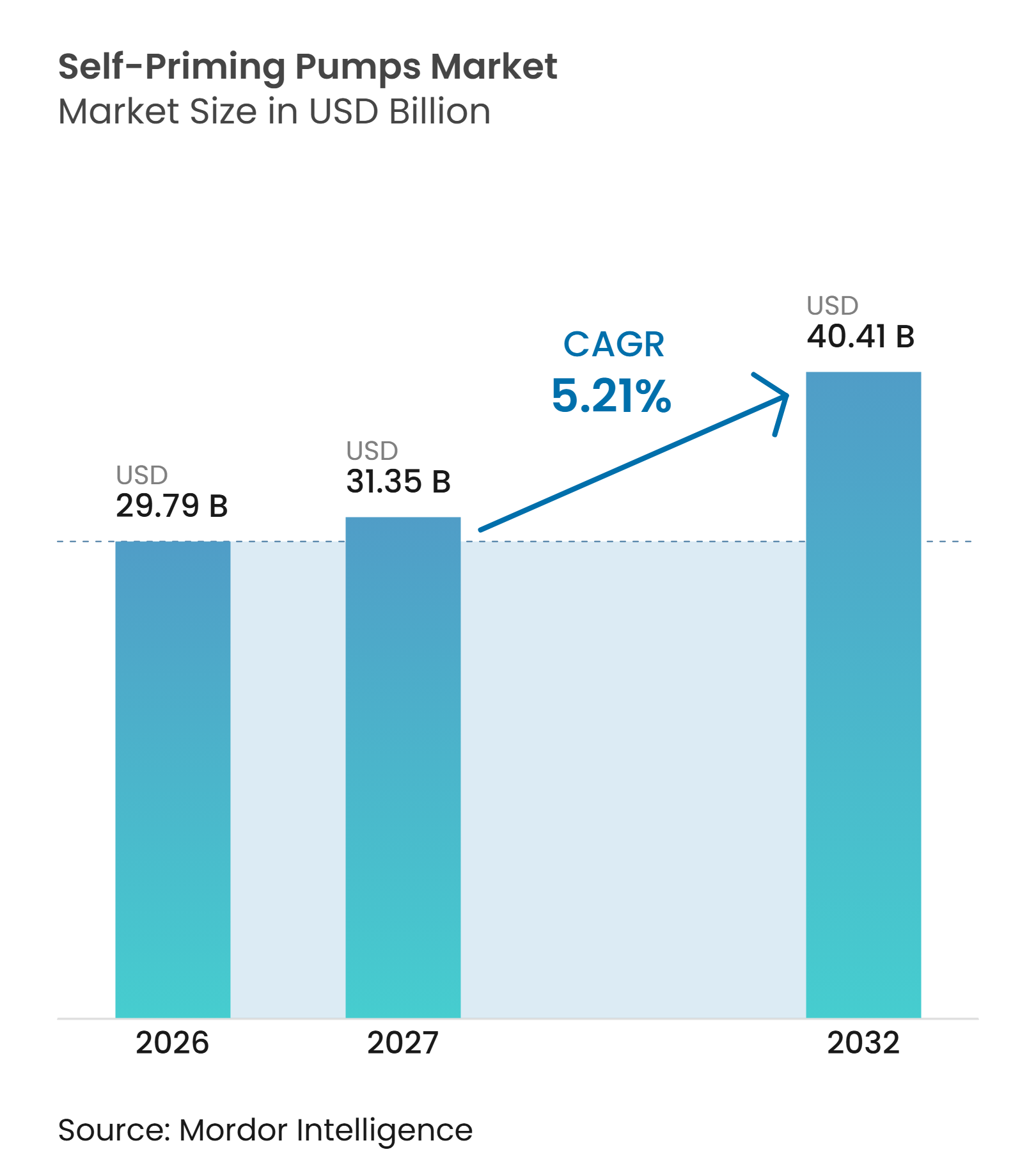
The global self-priming pumps market size is projected to expand from USD 29.79 billion in 2026 and USD 31.35 billion in 2027 to USD 40.41 billion by 2032, registering a CAGR of 5.21% between 2027 and 2032. The market is supported by municipal water upgrades, agricultural water transfer, construction dewatering, and industrial fluid handling. Above-ground installation remains a practical advantage where pump stations require regular inspection and intermittent-flow capability. Water stress and public infrastructure programs are driving demand for reliable transfer equipment in both developed and developing economies. Manufacturers are responding through digital monitoring, efficiency upgrades, specialized dewatering products, and acquisitions that broaden their application coverage. Price pressure, smart-system costs, submersible alternatives, and limited technician availability continue to influence purchasing decisions.
Key Report Takeaways
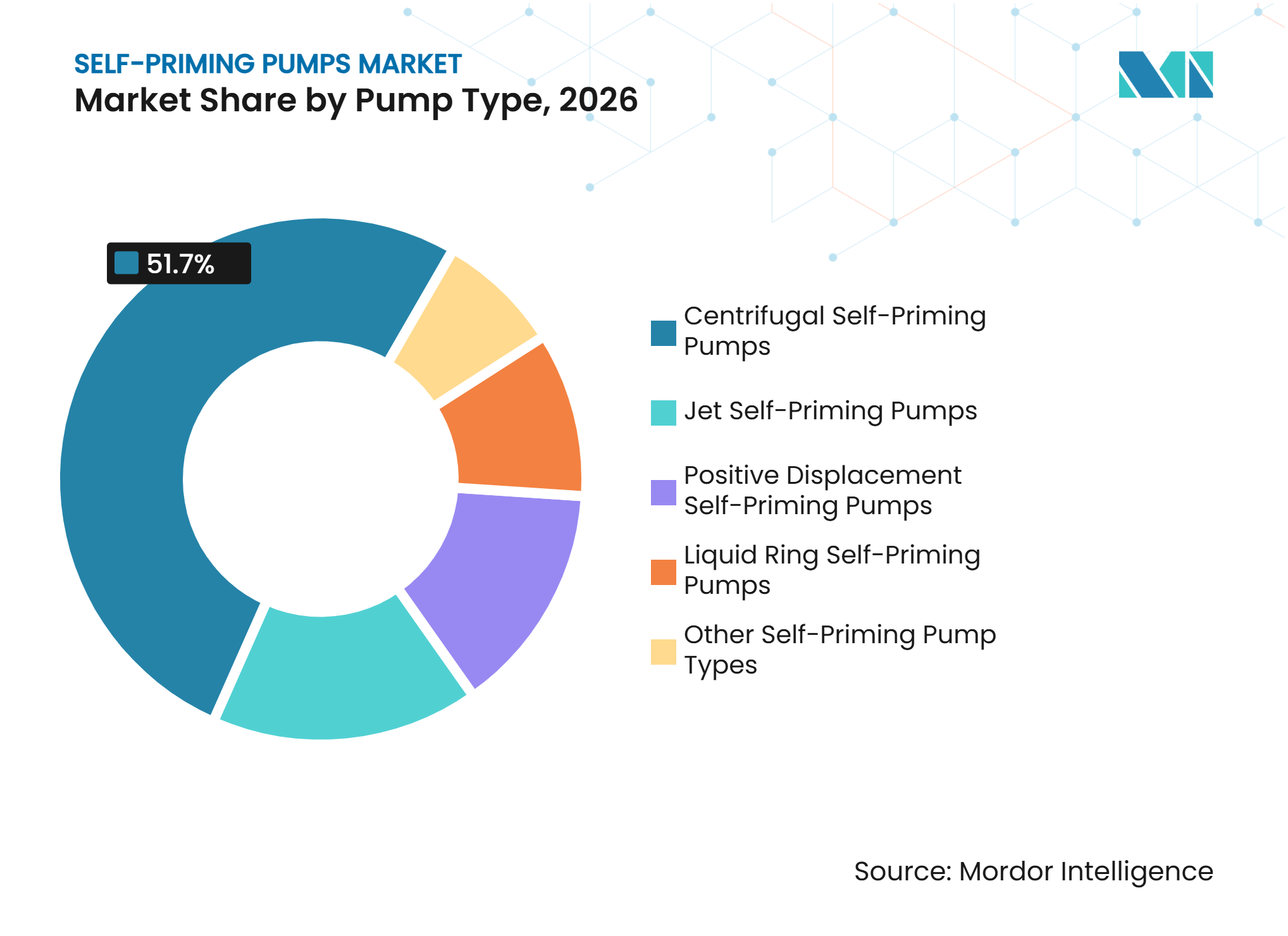
- By pump type, centrifugal self-priming pumps held 51.7% of the self-priming pumps market share in 2026, while positive displacement self-priming pumps are forecast to grow at a 5.7% CAGR through 2032.
- By design type, single-stage self-priming pumps accounted for 56.2% of the self-priming pumps market size in 2026, while multi-stage self-priming pumps are projected to expand at a 5.9% CAGR through 2032.
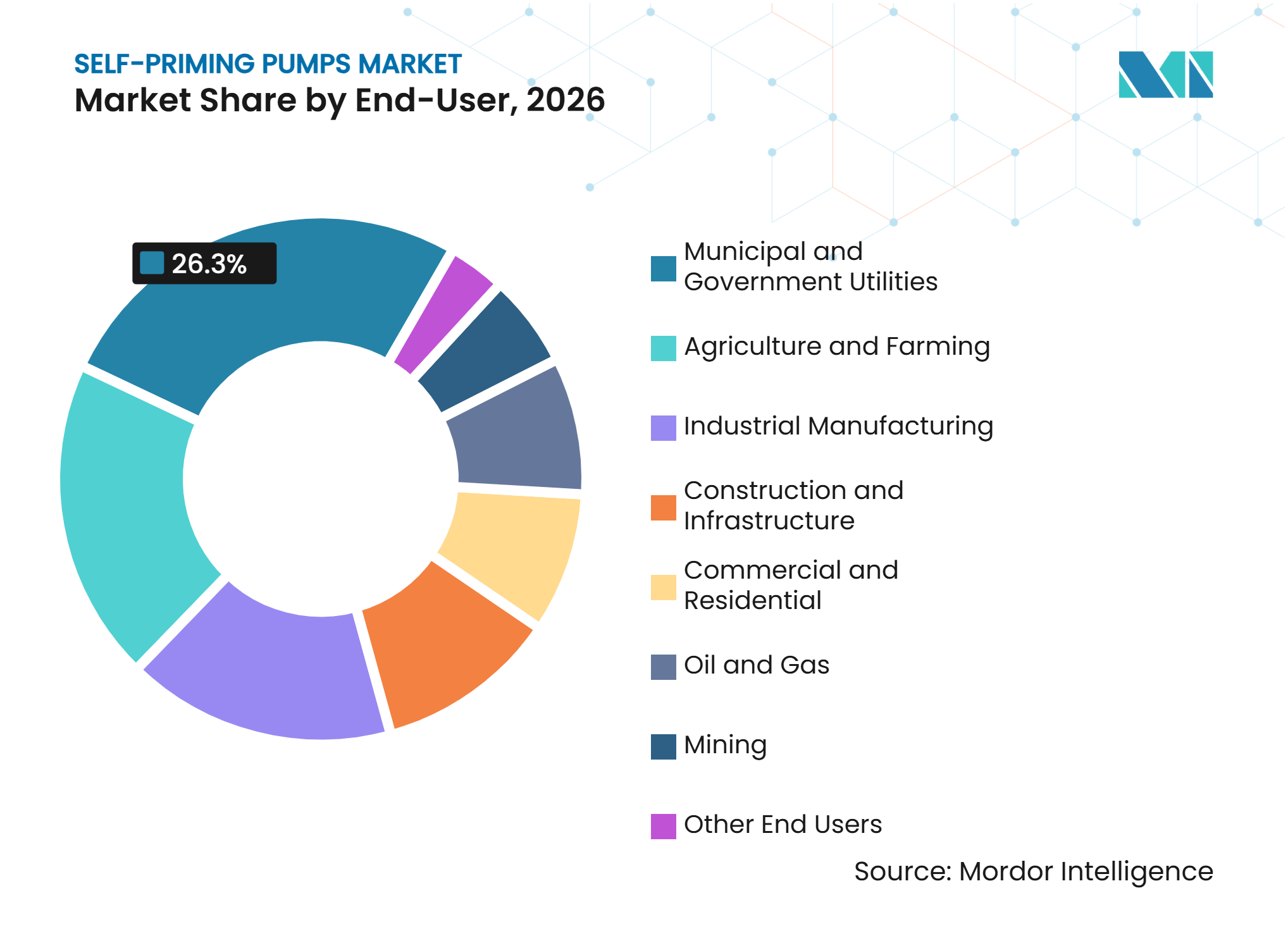
- By end user, municipal and government utilities held a 26.3% of self-priming pumps industry in 2026, while construction and infrastructure is forecast to grow at a 6.2% CAGR through 2032.
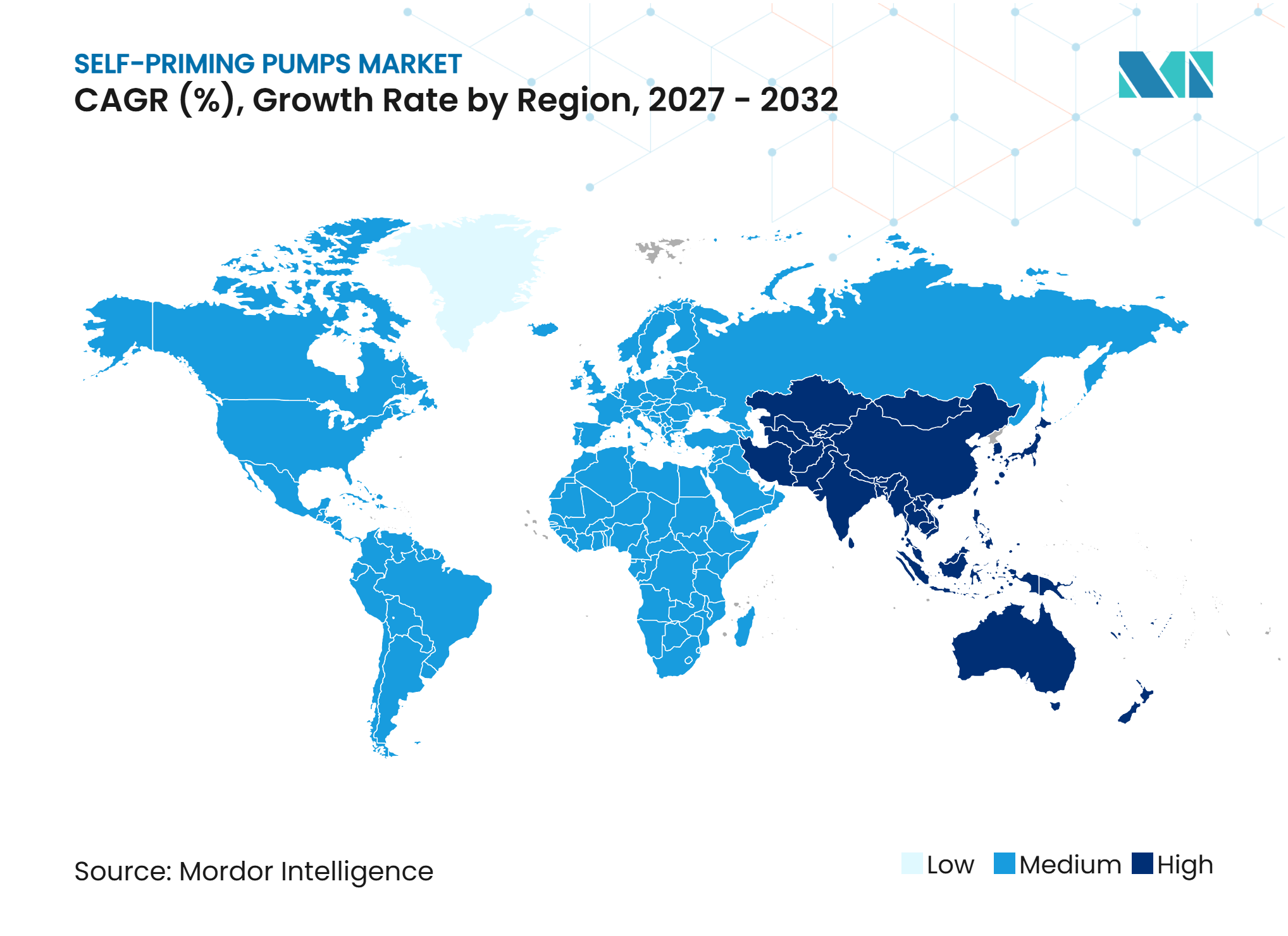
- By geography, Asia-Pacific accounted for 52.6% of the self-priming pumps market share in 2026 and is projected to grow at a 6.1% CAGR through 2032.
Note: Market numbers in this report are based on Mordor Intelligence's proprietary estimation framework, which combines nine months of actuals with Q4 projections for base year 2026.
Market Trends and Insights
Drivers Impact Analysis of Self-Priming Pumps Market*
| Driver | (~) % Impact on CAGR Forecast | Geographic Relevance | Impact Timeline |
|---|---|---|---|
| Water and Wastewater Infrastructure Modernization | +1.6% | North America, South Asia, Southeast Asia | Medium term (2–4 years) |
| Agricultural Irrigation and Water-Transfer Upgrades | +0.9% | South Asia, Southeast Asia, MENA, Sub-Saharan Africa | Long term (≥ 4 years) |
| Smart Pumping, Variable-Speed Drives, and Remote Monitoring | +0.8% | Global, with intensity in North America, Europe, China | Medium term (2–4 years) |
| Industrial Process Expansion in Emerging Economies | +0.7% | ASEAN, India, South America, Middle East | Long term (≥ 4 years) |
| Climate-Driven Flood Control and Mobile Dewatering Demand | +0.6% | Global; urban hotspots across South and Southeast Asia, Africa | Short term (≤ 2 years) |
| Above-Ground Installation and Reduced Maintenance Burden | +0.4% | Global, most pronounced in markets with technician shortages | Long term (≥ 4 years) |
| Source: Mordor Intelligence | |||
Water and Wastewater Infrastructure Modernization
Aging pipe and pump systems are shortening replacement cycles in developed economies. Houston’s FY 2025-2029 capital improvement plan allocated USD 3.9 billion to wastewater treatment facilities, including work related to lift stations, force mains, and pumping capacity. Tampa completed a USD 93 million high-service pump station improvement at the David L. Tippin Water Treatment Facility in August 2025.[1] These projects favor equipment that can be inspected and maintained without repeated confined-space entry. Long-term operations and maintenance contracts also make lifecycle service requirements more important during equipment selection. This pattern supports the self priming pumps market where above-ground access can reduce operational disruption.
Agricultural Irrigation and Water-Transfer Upgrades
Agricultural irrigation demand for automatic priming water pumps is structurally supported by two forces operating in opposite directions: the expansion of irrigated area in emerging economies and the electrification of previously diesel-powered pump fleets. India's Jal Shakti Ministry is pursuing solarization of 1.5 million existing electric pumps by 2026, with the broader ASEAN corridor showing 24.4% growth in pump equipment demand in fiscal year 2025 per Tsurumi Manufacturing's Asia segment.[2] A less-obvious implication is that electrification does not automatically reduce unit demand for self-priming designs: surface-mounted, self-priming layouts are preferred in solar-irrigation configurations because they avoid the thermally challenging submersible operating environment that solar-driven pumps face during intermittent generation cycles. Field data from Nepal's CGIAR experiment shows that solar irrigation pump utilization averages only approximately 745 hours annually, meaning frequent dry-start conditions make self-priming capability a functional requirement rather than a premium feature.
Smart Pumping, Variable-Speed Drives, and Remote Monitoring
Variable-speed drives combined with IoT-connected control panels are transforming self-priming pump economics by enabling adaptive operation across fluctuating demand profiles. Grundfos dedicated USD 333.22 million (DKK 2,206 million) to research and development in 2025, explicitly including AI, IoT, and digital platforms in its innovation roadmap, while the EU Radio Equipment Directive Delegated Act, which came into force in August 2025, now mandates cybersecurity requirements for wirelessly connected pump solutions across European markets. A consequence of this regulation is that it disproportionately raises entry barriers for smaller regional pump brands that lack the embedded firmware expertise to pass conformity assessments, effectively directing large public tenders toward manufacturers with established digital pump portfolios. Australia's AS ISO/ASME 14414 pump system energy assessment standard, scheduled for formal review in 2025, signals that system-level efficiency, not just pump-unit efficiency, is becoming the regulatory benchmark, which favors self-priming configurations equipped with intelligent pressure-sensing and auto-restart logic.
Industrial Process Expansion in Emerging Economies
Manufacturing capacity additions in ASEAN, India, and the Gulf Cooperation Council states are generating sustained demand for self-priming pumps in chemical processing, food and beverage, pharmaceutical, and water-cooling applications. KSB SE and Co. KGaA crossed the EUR 3 billion revenue threshold for the first time in 2025, with its pumps segment serving water, building technology, petrochemicals, and general industry markets across all continents. A factor that most demand models overlook is sector sequencing chemical plants and food processing facilities in Southeast Asia typically specify self-priming pumps during construction because above-ground installation reduces civil engineering costs, as submersible alternatives require reinforced sumps and waterproofed cable trays that add time and cost during greenfield builds. As these facilities move into mid-lifecycle maintenance cycles, typically five to seven years post-commissioning, they generate a predictable aftermarket parts-and-services revenue stream that is now a primary profit driver for global pump groups.
Restraints Impact Analysis of Self-Priming Pumps Market*
| Restraint | (~) % Impact on CAGR Forecast | Geographic Relevance | Impact Timeline |
|---|---|---|---|
| Raw-Material and Component Price Volatility | -0.6% | Global; most acute for manufacturers in China and Europe | Short term (≤ 2 years) |
| High Upfront Cost of Smart Pump Systems | -0.5% | Developing markets in South Asia, Sub-Saharan Africa | Medium term (2–4 years) |
| Substitution by Submersible Pump Systems | -0.4% | North America, Europe — markets with stable water tables | Long term (≥ 4 years) |
| Skilled Service Technician Shortage | -0.3% | Rural South Asia, Africa, Inland Southeast Asia | Long term (≥ 4 years) |
| Source: Mordor Intelligence | |||
Raw-Material and Component Price Volatility
Copper and rare earth permanent magnet materials, the two primary cost inputs for pump motors, experienced significant price pressure in 2024 to 2025. Chinese market data show copper prices up approximately 18% and rare earth magnetic materials up approximately 22% year-on-year as of early 2025. Export restrictions on heavy rare earth materials imposed during 2025 created supply chain stress for motor manufacturers globally. However, Grundfos A/S noted in its 2025 annual report that years of R&D investment had already eliminated heavy rare earths from its permanent magnets without compromising magnetic performance. This illustrates how tier-one manufacturers can reduce exposure to commodity cycles that affect mid-tier competitors more severely. For cast iron and stainless-steel pump casings, steel price volatility linked to Chinese production curtailments has compressed margins for commodity pump producers that cannot pass costs through to municipal tenders governed by fixed-price contracts.
High Upfront Cost of Smart Pump Systems
Variable-speed drive packages with integrated IoT monitoring add USD 800 to USD 3,500 to the upfront cost of a mid-range self-priming pump unit. This premium is prohibitive in price-sensitive markets without concessional financing mechanisms. Field research from Nepal shows that even a 60% subsidy on solar pump acquisition costs is insufficient to drive adoption among smallholder farmers without additional targeted incentives, highlighting how capital-cost sensitivity constrains technology penetration in markets that represent the fastest-growing share of long-run volume demand. Municipal buyers in developing economies face the same constraint: European-specification pumps with IE4 or IE5 motors, required under the EU's EN 16480 Minimum Efficiency Index framework, carry price premiums that exceed many public works tender budgets. This creates a two-tier global market where efficiency gains in developed markets are partly offset by continued deployment of lower-specification equipment elsewhere.
*Our forecasts treat driver/restraint impacts as directional, not additive. The impact forecasts reflect baseline growth, mix effects, and variable interactions.
Self-Priming Pumps Market Segment Analysis
By Pump Type:
Centrifugal Variants Drive Volume, Positive Displacement Gains FasterCentrifugal self-priming pumps held 51.7% of the 2026 self-priming pumps market size, supported by their suitability for high-volume, moderate-head applications in municipal water, agriculture, and construction dewatering, which are the three largest end-use verticals globally. These pumps can handle both air and liquid during priming without valves or external primer systems, reducing commissioning complexity for contractors and utilities operating large distributed pump networks. Positive displacement self-priming pumps are the fastest-growing sub-segment, projected at a CAGR of 5.7% from 2027 to 2032, driven by their precision flow characteristics in chemical dosing, oil transfer, and viscous-fluid industrial applications where centrifugal designs lose efficiency at elevated fluid viscosities. Jet self-priming pumps remain relevant in shallow-well residential and small-scale agricultural applications, while liquid ring self-priming pumps are increasingly specified in vacuum-intensive industrial processes, including packaging, paper manufacturing, and power plant condensate systems. The EU's EN 17038-3:2025 standard, which published updated EEI calculation methods for booster sets including multistage self-priming configurations, is raising the technical bar for European-market centrifugal pump units.



By Design Type:
Single-Stage Systems Dominate, Multi-Stage Momentum BuildsSingle-stage self-priming pumps account for 56.2% of the 2026 self-priming pumps market share, reflecting their established position in agriculture, light industrial, and standard municipal dewatering applications where moderate pressure heads are adequate. Their mechanical simplicity, which includes fewer wearing parts, standard seal geometries, and widely available spare components, results in lower lifecycle costs in markets where technician access is limited, reinforcing specification preference in government procurement programs across South and Southeast Asia. Multi-stage self-priming pumps represent the fastest-growing design segment at a forecast CAGR of 5.9% through 2027 to 2032, with growth concentrated in high-pressure water transfer, reverse osmosis feed systems, and pressurized fire suppression applications. Calpeda S.p.A., operating under the Wateralia group with over USD 452 million (EUR 400 million) in combined annual revenue, launched the NMX compact stainless steel centrifugal pump range in July 2025 and commissioned an 800 m2 pump test facility in May 2025, capable of multi-stage self-priming performance qualification, reflecting the investment that tier-two Italian producers are directing toward premium product lines.[3] Horizontal self-priming pumps retain the dominant installation footprint in above-grade pump houses, while vertical self-priming pumps are gaining traction in space-constrained data-center cooling and building services applications.
By End-User:
Municipal Utilities Anchor Revenue, Construction Segments SurgeMunicipal and government utilities held a 26.3% share of the 2026 self-priming pumps industry, supported by recurring infrastructure replacement programs and legally mandated service-level obligations that make pump uptime a compliance requirement. India's Jal Jeevan Mission 2.0, extended through FY 2028 to 2029, is structured around clustered pump station infrastructure linking raw water intake, treatment plants, and distribution networks, a design topology that places self-priming pumps at multiple transfer nodes within each scheme. Construction and infrastructure is the fastest-growing end-user segment at a projected 6.2% CAGR through 2027 to 2032, driven by urbanization in Southeast Asia and the Middle East, where excavation dewatering, tunneling, and foundation drainage require mobile, dry-start-capable pump systems. Agriculture and farming, the second-largest vertical by volume, is structurally supported by area-expansion programs across Central Asia (projected irrigated area growth to 10.6 million hectares by 2040) and Sub-Saharan Africa, where smallholder irrigation initiatives are creating distributed pump demand. Oil and gas and mining segments contribute a combined mid-teen share and face displacement pressure from electric-drive pump systems in decarbonization-focused operating environments, though dewatering and produced-water handling functions remain structurally dependent on above-ground self-priming configurations.

Geography Analysis
Asia-Pacific
Asia-Pacific holds the largest share of the self-priming pumps market, accounting for 52.6% of the 2026 market and projected to grow at 6.1% from 2027 to 2032, making it both the largest volume contributor and the fastest-growing region globally. China dominates the sub-regional landscape through manufacturing scale: the Wenling-Dasi pump cluster produces more than 70% of China's small-pump output and holds approximately 20% of the global export market share. China's implementation of GB 19762-2025 from March 2026 requires manufacturers to upgrade or retire low-efficiency models, creating a product-upgrade cycle that temporarily expands procurement demand while raising the baseline quality of domestically available equipment. India's Jal Jeevan Mission has generated a large pipeline of pumphouse construction, with 37,305 out of 38,386 targeted pump houses commissioned as of 2025 in Uttar Pradesh alone, and the remaining gap and operation and maintenance upgrade contracts are sustaining procurement demand through the 2027 to 2032 period. Southeast Asia contributes incremental demand through ASEAN manufacturing expansion, with factory-equipment pump installations in Thailand and Indonesia showing consistent volume growth.
North America
North America's self-priming pumps market is shaped by infrastructure replacement economics and regulatory compliance, distinguishing it from regions where demand is driven by new construction. The US Environmental Protection Agency's Clean Water State Revolving Fund supports a steady pipeline of municipal pump station rehabilitation contracts, as illustrated by Houston's USD 3.9 billion wastewater capital improvement program and Tampa's USD 93 million water treatment facility upgrade in 2025. The US also drives significant demand for emergency dewatering and flood protection pumps: approximately USD 10 billion in annual flood damage claims create a recurring procurement channel for portable self-priming systems capable of rapid deployment. Canada's water and wastewater infrastructure gap, estimated in the billions by federal assessments, is generating matching fund programs that benefit domestic suppliers. Gorman-Rupp Company recorded USD 682.4 million in net sales in 2025 (+3.4% year-on-year) with record incoming orders of USD 728.4 million (+10.5%), indicating that North American demand is accelerating into 2026.
Europe and Emerging Regions
Europe's self-priming pumps market is defined by energy efficiency compliance requirements and mature replacement demand. The EU's Water Pumps Ecodesign Regulation (547/2012) is under active review, with a March 2026 Consultation Forum session evaluating updated energy efficiency index thresholds for booster sets and multi-stage pump units; manufacturers supplying European infrastructure tenders are already adapting product lines to anticipated stricter requirements. Wilo SE reported EUR 1.919 billion in 2025 revenue (4.5% currency-adjusted growth) driven by its water management and industry segments, confirming that European demand remains resilient despite broader manufacturing sector weakness in Germany and France. South America is led by Brazil and Argentina, where agricultural irrigation expansion and industrial water supply projects sustain steady pump procurement, with Flowserve Corporation maintaining a network of Latin American joint ventures. The Middle East and Africa are emerging as a material growth region: Saudi Arabia and the UAE are investing in desalination and water reuse infrastructure that requires high-pressure self-priming feed-pump configurations, while South Africa's mining sector, facing intensifying flash flood disruptions in KwaZulu-Natal, is deploying specialized dewatering self-priming solutions from regional rental operators. Morocco's solar pump subsidy program and Egypt's water infrastructure expansion further diversify the regional demand base.
Competitive Landscape
Market Concentration
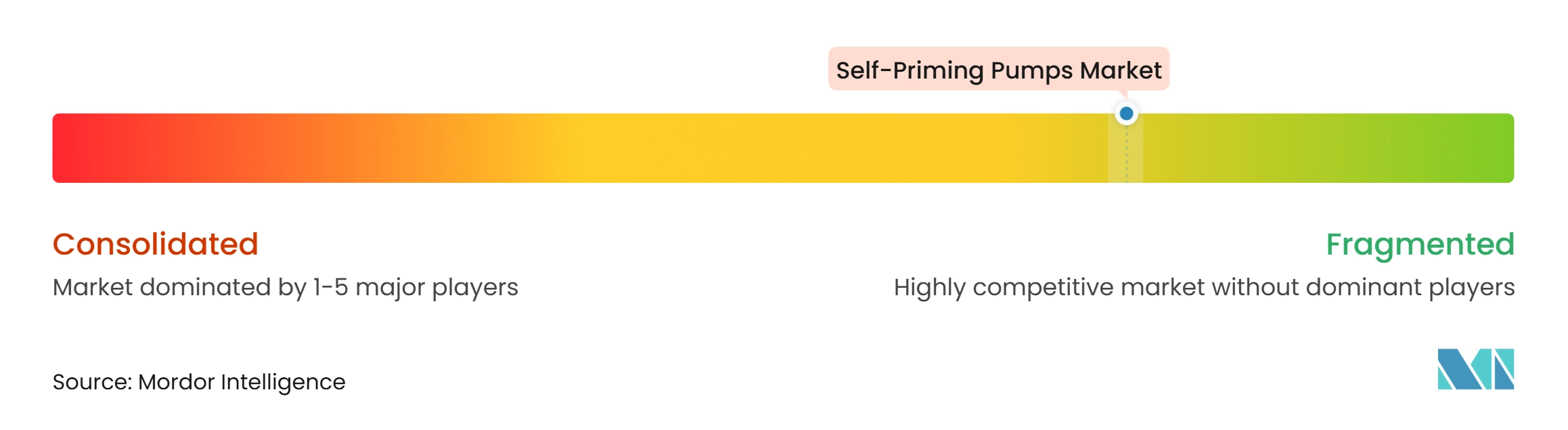
The self-priming pumps market is fragmented at the global level, where a small group of diversified pump manufacturers, including Grundfos Group, Xylem Incorporated, KSB SE and Co. KGaA, Wilo SE, Sulzer Limited, Flowserve Corporation, and Ebara Corporation, competes on technology differentiation, service network depth, and digital platform capabilities, while hundreds of regional producers in China, India, Italy, and Brazil compete on price-sensitive tenders. Xylem Incorporated's pending USD 1.46 billion acquisition of Cornell Pump Company and Roper Pump Company, citing patented self-priming capabilities and specialized suction-lift expertise, reflects an M&A approach focused on building technical capability rather than simply adding revenue scale, with the transaction expected to contribute over USD 260 million in 2026 revenue at EBITDA margins above 30%.[4] Sulzer Limited's Flow division launched a Water Treatment Center of Excellence in early 2026, consolidating multiple brand capabilities and establishing a dedicated rental solutions business after agreeing to acquire a Danish bypass pumping company, a move that extends Sulzer Limited's market access into temporary dewatering contracts that have historically been dominated by specialty rental operators. Product patent filings focused on magnetic-coupling drive systems, AI-based fault prediction, and anti-dry-run sensor integration are increasing across all tiers, with global self-priming pump patent stock exceeding 38,000 active filings, though high-value patents remain concentrated among multinational manufacturers.
Smaller manufacturers are reshaping competitive dynamics in specific niches. Varisco S.r.l., operating under Atlas Copco Group, differentiates through semi-open impeller technology designed for dirty-liquid and solids-laden flows, maintaining application specificity in wastewater and liquid waste sectors that larger generalist manufacturers address less precisely. BBA Pumps B.V. is establishing a strong position in mobile, rapid-deploy flood-response configurations through continuous product development, with its 20-year-anniversary BA series now produced with Stage V-compliant diesel engines and solar-integrated canopy panels. Compliance requirements such as the EU Radio Equipment Directive's August 2025 cybersecurity provisions for connected pumps are raising entry costs for smaller digital-pump manufacturers, reinforcing the product-qualification advantage of established manufacturers with existing radio-enabled pump platforms.
Self-Priming Pumps Industry Leaders
-
Grundfos Holding A/S
-
Xylem Inc.
-
KSB SE & Co. KGaA
-
Flowserve Corporation
-
Sulzer Ltd.
- *Disclaimer: Major Players sorted in no particular order
Self-Priming Pumps Market Companies Covered in this Report
- AMT Pump Company
- ANDRITZ AG
- BBA Pumps B.V.
- Calpeda S.p.A.
- Cornell Pump Company
- Crane Pumps & Systems, Inc.
- DESMI A/S
- Ebara Corporation
- Flowserve Corporation
- Franklin Electric Co., Inc.
- Grundfos Holding A/S
- KSB SE & Co. KGaA
- MP Pumps, Inc.
- Pentair plc
- Sulzer Ltd.
- The Gorman-Rupp Company
- Tsurumi Manufacturing Co., Ltd.
- Varisco S.r.l.
- WILO SE
- Xylem Inc.
Recent Industry Developments in Self-Priming Pumps Market
- August 2026: Xylem Inc. announced an agreement to acquire Cornell Pump and Roper Pump from Indicor for USD 1.46 billion, strengthening its presence in industrial and municipal markets. The acquisition expands Xylem Inc.'s portfolio with engineered pumping technologies designed for demanding fluid-handling applications, including slurry transport, solids handling, and challenging suction-lift operations.
- February 2026: Franklin Electric launched the MHp Series Self-Priming Horizontal Multistage Pumps, expanding its portfolio with a pump range designed for demanding industrial and agricultural applications. The pumps feature a priming system that rapidly removes air bubbles, ensuring fast start-up, continuous operation, and reduced downtime.
- November 2025: KSB Pumps and Valves launched the ELN 150 "Imvubu" self-priming wastewater pump, designed and developed in South Africa to address challenging African wastewater conditions. The pump features a 77.3 mm free passage, enabling reliable handling of raw sewage, wipes, rags, and debris while reducing clogging and downtime.
- May 2025: Mangla Pumps launched the BULLET 1 HP Mini Self-Priming Pump, a compact, high-efficiency water-lifting solution designed for residential and light commercial water supply applications. The pump features a 1 HP (0.75 kW) single-phase motor and a self-priming monoblock design, enabling reliable operation without manual priming.
Global Self-Priming Pumps Market Report Scope
A self-priming pump is a type of centrifugal pump designed to automatically evacuate air and gases from its suction line. It uses an internal liquid-retention chamber or reservoir to mix residual fluid with incoming air during startup. This generates a partial vacuum that draws liquid up from a source located below the pump without requiring manual filling. Once all trapped air is expelled, the pump transitions into standard liquid-pumping operation. This design is well-suited for applications where the pump is positioned above the fluid level, such as dewatering or drainage.
The global self-priming pumps market is segmented by pump type, design type, end-user industry, and geographic region. By pump type, the market is segmented into centrifugal, jet, positive displacement, liquid ring, and other self-priming pump types. By design type, the market is segmented into single-stage, multi-stage, horizontal, and vertical self-priming pumps. By end user, the market is segmented into municipal and government utilities, agriculture and farming, industrial manufacturing, construction and infrastructure, oil and gas, mining, commercial and residential, and other end users. The report also covers the market size and forecasts for the global self-priming pumps market across 26 countries in key regions. For each segment, the market sizing and forecasts are provided in value terms (USD).
Segmentation Overview
| Centrifugal Self-Priming Pumps |
| Jet Self-Priming Pumps |
| Positive Displacement Self-Priming Pumps |
| Liquid Ring Self-Priming Pumps |
| Other Self-Priming Pump Types |
| Single-Stage Self-Priming Pumps |
| Multi-Stage Self-Priming Pumps |
| Horizontal Self-Priming Pumps |
| Vertical Self-Priming Pumps |
| Municipal and Government Utilities |
| Agriculture and Farming |
| Industrial Manufacturing |
| Construction and Infrastructure |
| Oil and Gas |
| Mining |
| Commercial and Residential |
| Other End Users |
| North America | United States |
| Canada | |
| Mexico | |
| Europe | Germany |
| France | |
| Italy | |
| Spain | |
| United Kingdom | |
| Poland | |
| Russia | |
| Rest of Europe | |
| Asia-Pacific | China |
| India | |
| Japan | |
| South Korea | |
| Australia | |
| Indonesia | |
| Vietnam | |
| Thailand | |
| Rest of Asia-Pacific | |
| South America | Brazil |
| Argentina | |
| Chile | |
| Rest of South America | |
| Middle East and Africa | Saudi Arabia |
| United Arab Emirates | |
| Egypt | |
| South Africa | |
| Morocco | |
| Rest of Middle East and Africa |
| By Pump Type | Centrifugal Self-Priming Pumps | |
| Jet Self-Priming Pumps | ||
| Positive Displacement Self-Priming Pumps | ||
| Liquid Ring Self-Priming Pumps | ||
| Other Self-Priming Pump Types | ||
| By Design Type | Single-Stage Self-Priming Pumps | |
| Multi-Stage Self-Priming Pumps | ||
| Horizontal Self-Priming Pumps | ||
| Vertical Self-Priming Pumps | ||
| By End User | Municipal and Government Utilities | |
| Agriculture and Farming | ||
| Industrial Manufacturing | ||
| Construction and Infrastructure | ||
| Oil and Gas | ||
| Mining | ||
| Commercial and Residential | ||
| Other End Users | ||
| By Geography | North America | United States |
| Canada | ||
| Mexico | ||
| Europe | Germany | |
| France | ||
| Italy | ||
| Spain | ||
| United Kingdom | ||
| Poland | ||
| Russia | ||
| Rest of Europe | ||
| Asia-Pacific | China | |
| India | ||
| Japan | ||
| South Korea | ||
| Australia | ||
| Indonesia | ||
| Vietnam | ||
| Thailand | ||
| Rest of Asia-Pacific | ||
| South America | Brazil | |
| Argentina | ||
| Chile | ||
| Rest of South America | ||
| Middle East and Africa | Saudi Arabia | |
| United Arab Emirates | ||
| Egypt | ||
| South Africa | ||
| Morocco | ||
| Rest of Middle East and Africa | ||
Key Questions Answered in the Report
What is the current size of the market and how fast is it growing?
The Global Self-Priming Pumps Market is estimated at USD 29.79 billion in 2026 and is projected to reach USD 40.41 billion by 2032, registering a CAGR of 5.21% during the forecast period.
Which pump type dominates the market, and which segment is growing the fastest?
Centrifugal self-priming pumps hold the largest market share at 51.7% in 2026, driven by their widespread use in water transfer, dewatering, irrigation, and municipal applications. Positive displacement self-priming pumps are the fastest-growing segment, expanding at an estimated CAGR of 5.7%, driven by increasing demand in chemical processing, oil and gas, slurry handling, and high-viscosity fluid applications.
Which region leads the self-priming pumps market and what is driving its growth?
Asia-Pacific is both the largest market, with a 52.6% share in 2026, and the fastest-growing region, at a CAGR of 6.1%. Growth is driven by large-scale infrastructure projects, wastewater treatment investments, agricultural modernization programs
Who are the key companies and what competitive strategies are shaping the market?
Key participants include Xylem Inc., Flowserve Corporation, KSB SE and Co. KGaA, Sulzer Ltd., ITT Goulds Pumps, Gorman-Rupp Company, Pentair plc, Ebara Corporation, Tsurumi Manufacturing Co., Ltd., and Wilo SE. Strategic priorities include smart-pump digitalization, energy-efficient product development, and aftermarket service expansion.
What are the major challenges restraining market growth?
Key restraints include the higher upfront cost of smart and IoT-enabled pumping systems, increasing competition from submersible pump technologies, and the growing adoption of borehole pumps in deep-well irrigation and groundwater extraction applications.