
Resorts Market Size and Share
Market Overview
| Study Period | 2021 - 2031 |
|---|---|
| Market Size (2026) | USD 446.70 Billion |
| Market Size (2031) | USD 644.71 Billion |
| Growth Rate (2026 - 2031) | 7.61 % |
| Fastest Growing Market | Middle East and Africa |
| Largest Market | Asia-Pacific |
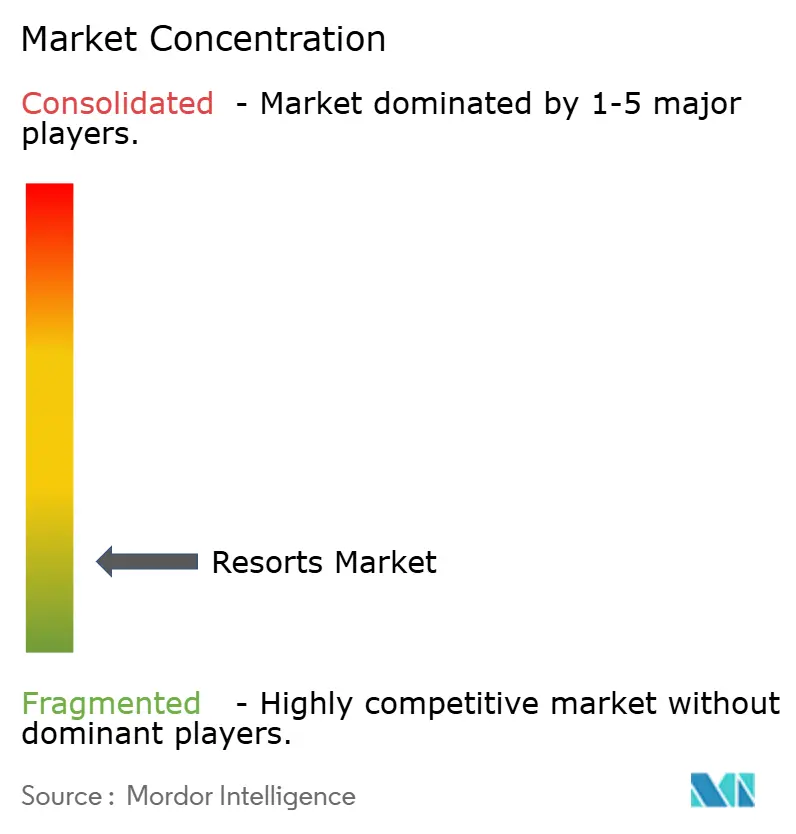
| Market Concentration | Low |
Major Players *Disclaimer: Major Players sorted in no particular order Image © Mordor Intelligence. Reuse requires attribution under CC BY 4.0. | |
Resorts Market Analysis by Mordor Intelligence
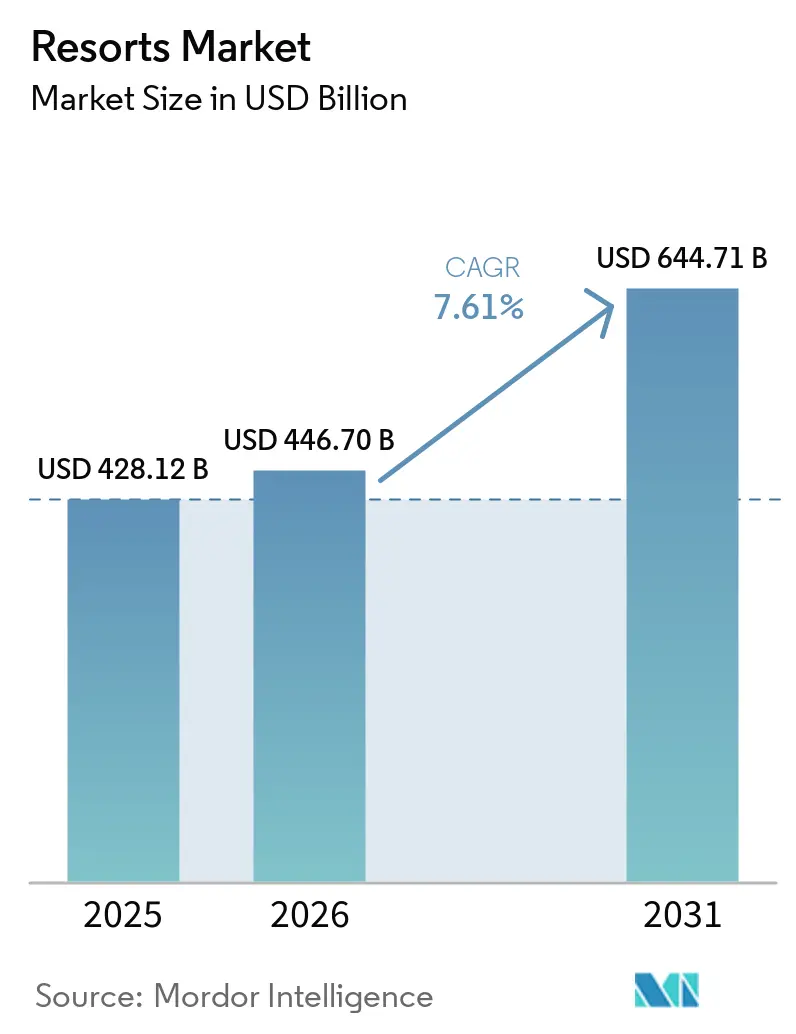
The Global Resorts Market was valued at USD 428.12 billion in 2025 and is estimated to grow from USD 446.70 billion in 2026 to reach USD 644.71 billion by 2031, at a CAGR of 7.61% during the forecast period (2026–2031). Travel and tourism activity supported the market in 2025, with the sector contributing a record USD 11.60 trillion to global GDP and growing faster than the broader economy, sustaining leisure demand across resort destinations. UN Tourism reported 1.52 billion international arrivals in 2025 and USD 1.90 trillion in receipts, supporting longer-haul resort stays and higher guest spending. The market is also being shaped by a shift toward wellness-focused stays and digital booking channels, while operators are deploying loyalty programs, real estate tie-ins, and AI-based guest tools to improve conversion and revenue capture. The market remains fragmented, leaving room for regional brands and independent operators, even as large chains expand all-inclusive, branded residence, and management-led models. Climate exposure, capital intensity, and labor availability continue to limit execution speed in several destinations. Future growth will depend on how well operators balance expansion with resilience, staffing, and development discipline[1].
Key Report Takeaways
- By resort type, Beach Resorts commanded a 38.42% share of the Global Resorts Market in 2025, while Wellness & Spa Resorts are projected to expand at the highest CAGR of 8.24% by 2031.
- By price range, Mid-Scale properties accounted for a 34.81% share of the Global Resorts Market in 2025, while Luxury Resorts are projected to expand at the highest CAGR of 8.55% by 2031.
- By booking mode, Direct Booking held a 43.94% share of the Global Resorts Market in 2025, while Online Travel Agencies are projected to expand at the highest CAGR of 9.83% by 2031.
- By tourism type, Domestic Tourism accounted for a 62.12% share of the Global Resorts Market in 2025, while International Tourism is projected to expand at the highest CAGR of 9.14% by 2031.
- By geography, Asia-Pacific held a 32.18% share of the Global Resorts Market in 2025, while the Middle East & Africa is projected to expand at the highest CAGR of 8.96% by 2031.
Note: Market size and forecast figures in this report are generated using Mordor Intelligence’s proprietary estimation framework, updated with the latest available data and insights as of January 2026.
Global Resorts Market Trends and Insights
Drivers Impact Analysis*
| Driver | (~) % Impact on CAGR Forecast | Geographic Relevance | Impact Timeline |
|---|---|---|---|
| Rising Demand for Experience-Led Leisure Travel | +2.5% | Global | Medium term (2-4 years) |
| Growth in Wellness and Mental-Health-Oriented Stays | +1.4% | Global, with stronger adoption in the Asia-Pacific and Europe | Medium term (2-4 years) |
| Premiumization and Hyper-Exclusive Resort Offerings | +1.0% | Middle East & Africa, Asia-Pacific, North America | Long term (≥ 4 years) |
| Expansion of Smart Resort Operations and Guest Personalization | +0.8% | Global, with strong adoption in North America and East Asia | Medium term (2-4 years) |
| Climate-Resilient Resort Redevelopment at Scarce Prime Destinations | +0.4% | Island and coastal destinations globally | Long term (≥ 4 years) |
| Fractional and Branded Residence Integration Within Resort Assets | +0.4% | North America, Middle East & Africa, Asia-Pacific | Long term (≥ 4 years) |
| Source: Mordor Intelligence | |||
Rising Demand for Experience-Led Leisure Travel
Travel spending is shifting toward resort formats that offer a more complete stay rather than a room-only proposition, which directly supports the global resorts market. The WTTC reported that travel and tourism supported 366 million jobs globally in 2025 and accounted for 1 in 3 net new jobs created worldwide, reflecting the strong link between service-intensive leisure formats and broader industry expansion. Resorts benefit as travelers increasingly seek local food, cultural programming, outdoor activities, and place-based experiences within a single property. UNWTO expects international arrivals to continue rising in 2026, supported by major events such as the Milano-Cortina Winter Olympics and the FIFA World Cup, sustaining destination travel demand for resort operators. This supports rate resilience and longer stays in the global resorts market, particularly when operators can package experiences that differentiate them from standard hotel supply.
Growth in Wellness and Mental-Health-Oriented Stays
Wellness travel is emerging as a significant growth driver for the global resorts market, as guests increasingly associate vacations with recovery, prevention, and mental restoration. The Global Wellness Institute projected the wellness economy to grow at 7.6% annually from 2024 to 2029, reaching nearly USD 9.8 trillion, placing wellness spending on a faster growth path than the broader economy[2]. Its 2026 trends report also identified longevity travel, sleep-focused restoration, AI-designed itineraries, and demand for cooler-climate wellness destinations as key forces shaping resort offerings. These trends give resorts a basis to invest in structured wellness programming rather than optional spa add-ons, as guests are now seeking defined outcomes from their stays. For the global resorts market, this shift supports higher pricing, broader seasonality, and stronger demand in Asia-Pacific and Europe, where wellness adoption is already well established.
Premiumization and Hyper-Exclusive Resort Offerings
High-spending travelers continue to favor privacy, design quality, and lower-density formats, driving growth in the global resorts market. Marriott announced record global growth in 2025, including 114 luxury deals covering 15,301 rooms, indicating that capital continues to flow toward upper-end resort and hospitality products. The same announcement highlighted 55 branded-residence deals signed in 2025, suggesting that expansion is increasingly tied to mixed-use and real estate economics rather than room revenue alone. Exclusive formats can justify larger upfront development budgets when part of the return is recovered through sales of residences or long-stay ownership-linked demand. Growth in the global resorts market is therefore not only a pricing story but also a capital structure story that favors operators with brand recognition and development partners.
Expansion of Smart Resort Operations and Guest Personalization
Digital personalization is emerging as a practical growth driver for the global resorts market by simultaneously improving discovery, conversion, and in-stay revenue capture. Amadeus expanded its AI strategy across hospitality in 2026, reflecting the redesign of guest search, merchandising, and service workflows to enable faster decision-making and more personalized offers. Minor Hotels unveiled a global data and AI platform for its 640-plus properties, with deployment targeted within 2026, indicating a clear operator push toward connected guest data and automation[3]. Resorts benefit from this more than many urban hotels because they offer a wider set of services, including dining, wellness, excursions, and family activities. Consequently, technology in the global resorts market is shifting from a support function to a revenue-generating labor-efficiency tool.
Restraints Impact Analysis*
| Restraint | (~) % Impact on CAGR Forecast | Geographic Relevance | Impact Timeline |
|---|---|---|---|
| High Capital Intensity and Long Payback Periods | -1.8% | Global | Long term (≥ 4 years) |
| Destination Volatility from Weather and Climate Disruption | -0.8% | Island and coastal destinations | Long term (≥ 4 years) |
| Labor Scarcity in Remote and Seasonal Resort Markets | -0.6% | North America and remote global destinations | Medium term (2-4 years) |
| Rising Compliance Burden for Land Use, Water Use, and Sustainability Standards | -0.4% | Global, with stricter enforcement in Europe, Australia, and parts of the Asia-Pacific | Medium term (2-4 years) |
| Source: Mordor Intelligence | |||
High Capital Intensity and Long Payback Periods
High upfront costs remain the most significant structural restraint on the global resorts market. Resort projects typically require more infrastructure, more site preparation, and longer pre-opening timelines than urban hotels. The Four Seasons Resort and Residences Red Sea at Shura Island welcomed its first guests in May 2026 through a 50/50 joint venture backed by SAR 2 billion (USD 0.53 billion) in debt financing, with total development costs reaching SAR 2.6 billion (USD 0.69 billion), or approximately USD 693 million. This cost profile illustrates why greenfield resort development often depends on joint ventures, sovereign capital, or large institutional backing. The financial burden is heavier for highly seasonal assets, as debt repayment depends on a narrower set of peak demand months. Consequently, development in the global resorts market remains concentrated among brands and sponsors that can absorb long gestation periods and uneven cash flows in the early years.
Destination Volatility From Weather and Climate Disruption
Weather and climate disruption directly constrain the global resorts market, as many of the largest resort clusters are in coastal, island, and heat-sensitive destinations. Host Hotels & Resorts highlighted adaptation work across its portfolio in 2025, including flood barriers, emergency power systems, and resilience-focused property upgrades, indicating that climate exposure has become a core asset management consideration[4]. Cost pressures extend beyond repairs, as insurance pricing, lending terms, and maintenance planning can all tighten for exposed properties. This particularly affects mid-tier operators, which lack the balance sheet flexibility of larger global groups. Climate volatility can therefore slow both development activity and operating margin expansion in destinations where natural risk is rising faster than mitigation capacity.
*Our forecasts treat driver/restraint impacts as directional, not additive. The impact forecasts reflect baseline growth, mix effects, and variable interactions.
Segment Analysis
By Resort Type: Beach Dominance Persists, Wellness Resets the Growth Curve
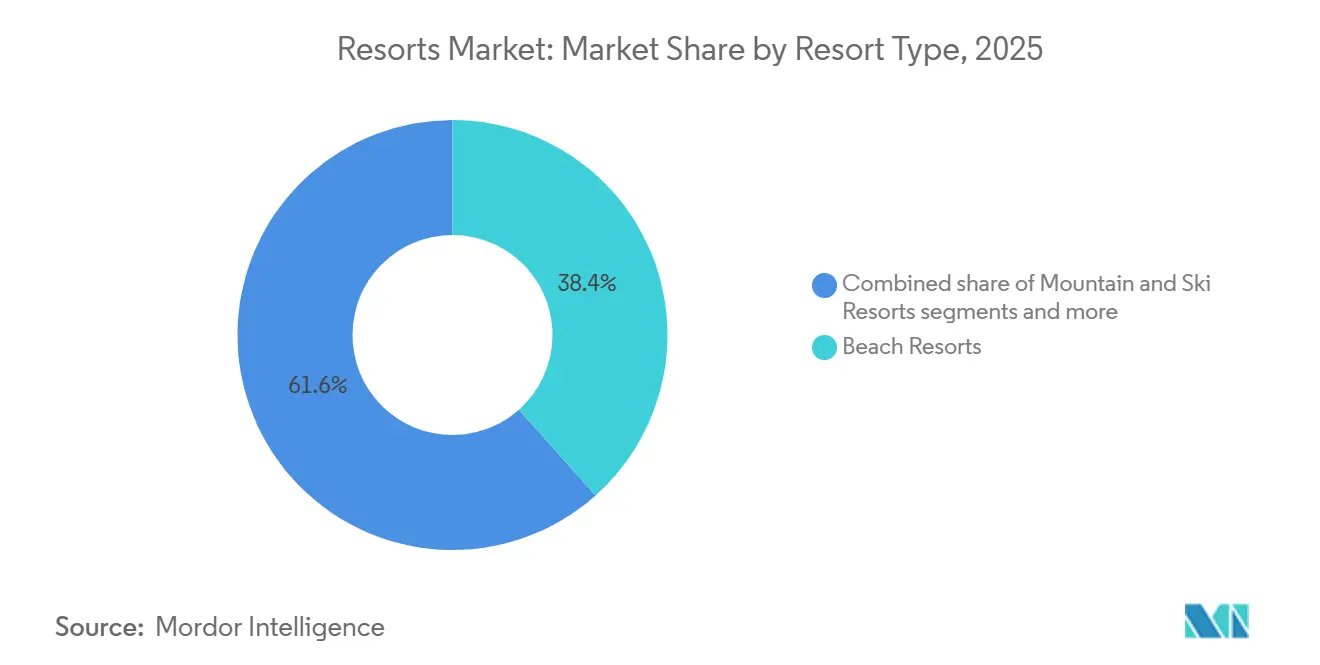
Beach Resorts accounted for 38.42% of revenue in 2025, making them the largest resort-type segment in the global resorts market. This position reflects the wide geographic spread of coastal tourism and the large installed base of resort inventory across Asia-Pacific, the Mediterranean, and the Caribbean. The segment benefits from a broad customer mix, including families, couples, short-haul leisure travelers, and destination-event demand. Beach resorts represent the core of the global resorts market, absorbing demand across both domestic and international travel. Mountain and ski properties, eco and nature formats, and other resort types remain relevant but operate within a narrower destination base and often face greater seasonality or permitting constraints.
Wellness and Spa Resorts are forecast to grow at an 8.24% CAGR from 2026 to 2031, making them the fastest-growing resort-type segment in the global resorts market. Growth is driven by increasing consumer willingness to spend on stays that combine rest, therapy, sleep support, and preventive health themes with travel. GWI's 2026 wellness travel trends indicate that guests increasingly expect structured programming rather than basic spa access, strengthening pricing power and investment appeal. This also provides the global resorts market with a means to reduce dependence on peak leisure seasons by attracting wellness-focused travelers across more months of the year.

By Price Range: Mid-Scale Anchors Volume as Luxury Commands Rate
Mid-scale properties accounted for 34.81% of the global resorts market in 2025, maintaining their position as the largest segment by revenue. This segment benefits from broad affordability and the rising travel aspirations of middle-income households across Asia-Pacific, Latin America, and parts of Europe. Guests can access resort amenities without paying the highest nightly rates, which strengthens the value proposition. Budget properties remain relevant in price-sensitive corridors, while upper mid-scale formats bridge accessibility and comfort. The mid-scale tier provides the volume base that helps operators maintain occupancy even when discretionary spending softens.
Luxury resorts are forecast to expand at an 8.55% CAGR through 2031, making them the fastest-growing price tier in the global resorts industry. Marriott's 2025 global growth update showed continued momentum in luxury signings and branded residences, confirming that major operators continue to view these formats as high-return expansion paths. Luxury guests typically spend more across rooms, dining, wellness, and private experiences, supporting stronger revenue per occupied room. Branded residence integration also helps offset part of the capital burden associated with high-end resort development. Consequently, future value growth in the global resorts market is more heavily weighted toward upscale and luxury formats, even though mid-scale remains the largest segment by current size.
By Booking Mode: Direct Loyalty Tested by Platform Consolidation
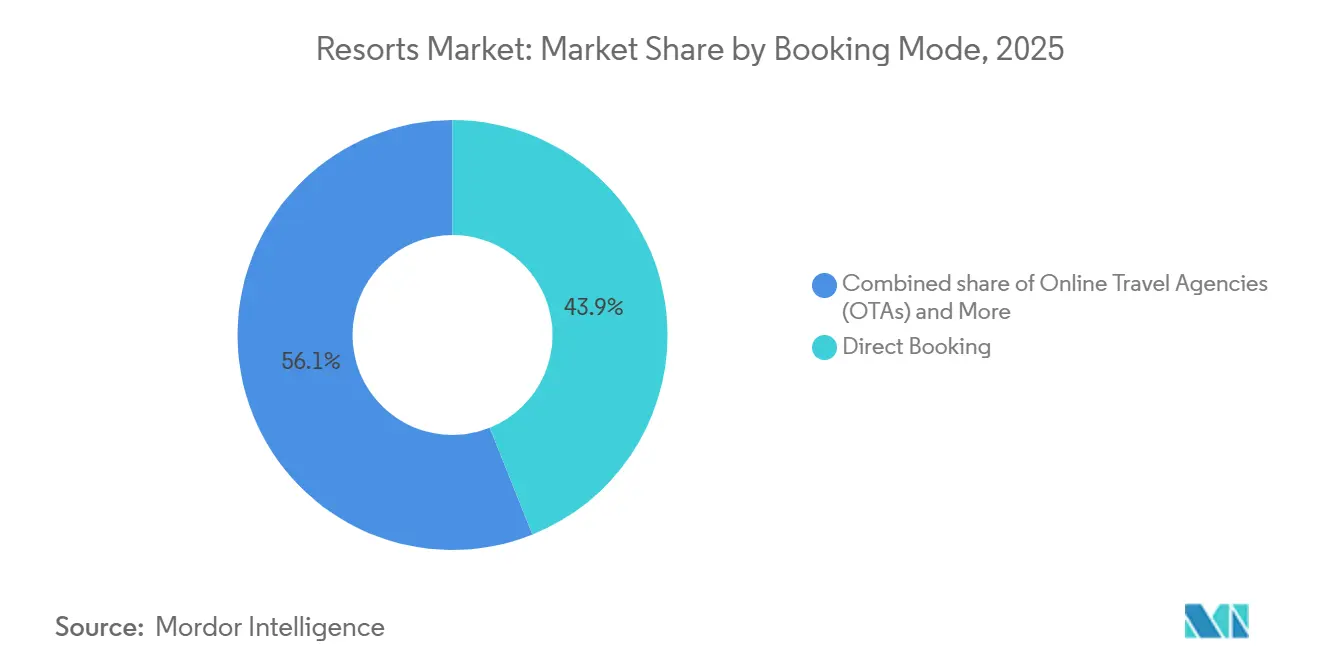
Direct bookings accounted for 43.94% of total bookings in 2025, ahead of other channels in the global resorts market. This position reflects the sustained effectiveness of brand websites, loyalty programs, member pricing, and direct service touchpoints that large operators have developed over time. Direct channels also allow resorts to retain ownership of guest data and reduce commission pressure, which is particularly important for higher-value stays. For repeat leisure travelers, the direct relationship can influence room conversions as well as the sale of dining packages, upgrades, and experiences. Direct booking remains the strongest channel in the global resorts market due to its role in protecting margins and supporting lifecycle marketing.
Online travel agencies (OTAs) are forecast to grow at a CAGR of 9.83% from 2026 to 2031, making them the fastest-growing booking channel in the global resorts market. Amadeus noted that AI-driven commerce is reshaping how travelers search and book, favoring channels that combine inspiration, comparison, payment, and confirmation in a single flow. OTAs are well-positioned in this environment, as they aggregate options and compete on digital visibility and booking simplicity. For resorts, OTAs can expand market reach but may compress net margins when commission costs increase. The global resorts market is therefore likely to see an ongoing balance between direct loyalty-driven demand and OTA-driven acquisition demand.
By Tourism Type: Domestic Volumes Hold, International Spend Accelerates
Domestic tourism accounted for 62.12% of revenue in 2025, making it the largest tourism-type segment in the global resorts market. This dominance reflects shorter planning cycles, lower travel friction, and large internal tourism corridors in countries such as India, the United States, China, and Brazil. Domestic resort demand is also easier to sustain when cross-border travel becomes more expensive or more difficult to arrange. Operationally, domestic guests provide the base occupancy that helps many properties stabilize across weekdays, school holidays, and seasonal demand fluctuations, making domestic travel the primary volume driver in the global resorts market.
International tourism is forecast to grow at a 9.14% CAGR through 2031, making it the fastest-growing tourism segment in the global resorts market. UN Tourism reported that international tourism receipts reached USD 1.9 trillion in 2025 and projected that 2026 travel would remain supported by major event-driven demand. PATA projected Asia-Pacific inbound arrivals to exceed pre-pandemic levels from 2026 onward, with strong bilateral flows expected across major corridors. International guests tend to stay longer and spend more per trip, increasing the segment's revenue contribution even when traveler counts are lower than domestic demand, making international travel a key growth driver for resort destinations and branded leisure operators.
Geography Analysis
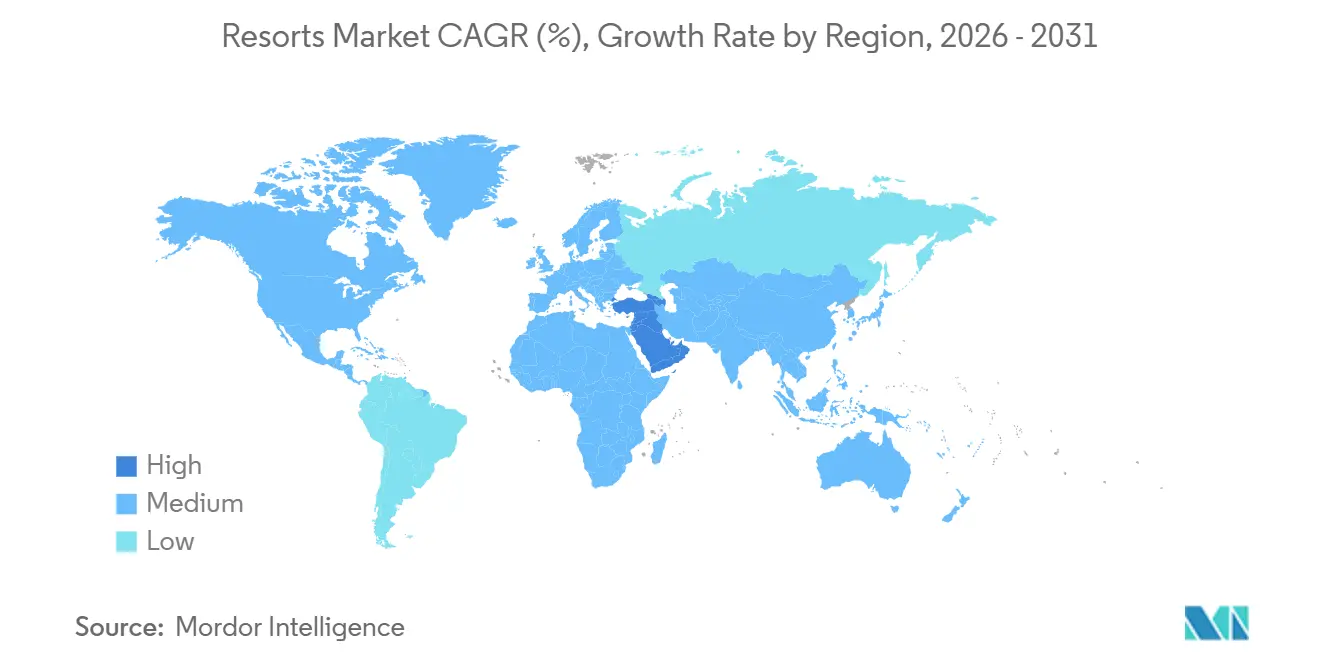
Asia-Pacific held 32.18% of the global resorts market share in 2025, maintaining its position as the largest regional market. WTTC reported that the region generated USD 3.29 trillion in travel and tourism GDP in 2025, expanding by 8.1%, the fastest pace among all regions. UNWTO recorded 331 million international arrivals in the Asia-Pacific in 2025, up 6% from 2024, indicating favorable demand conditions for resort assets. India remained one of the most significant demand drivers within the region, as domestic leisure travel, destination weddings, wellness retreats, and short-break travel continued to support new resort signings across beach, wildlife, spiritual, and hill destinations. Asia-Pacific, therefore, held both the largest current base in the global resorts market and a strong development pipeline supported by domestic and inbound travel.
The Middle East & Africa is forecast to grow at an 8.96% CAGR through 2031, making it the fastest-growing region in the global resorts market. WTTC reported that Saudi Arabia generated USD 178 billion in travel and tourism GDP in 2025, while the UAE generated USD 68.5 billion, reflecting Gulf investment and visitor flows supporting new hospitality supply. Red Sea Global's Four Seasons project at Shura Island officially opened its doors in May 2026 at a total development cost of SAR 2.6 billion (USD 0.69 billion), anchoring the initial phase of the island's broader multi-resort rollout. For the global resorts market, the Middle East & Africa represented a growing source of new room inventory and an increasingly competitive destination for long-haul leisure spend.
North America remained significant to the global resorts market due to its established hotel base, high spending levels, and concentration of resort demand in Florida, Hawaii, Mexico's coastal corridors, and the Caribbean. WTTC reported that North America generated USD 3.05 trillion in travel and tourism GDP in 2025, though growth was more moderate at 1.0%. Europe retained its relevance through sustained international receipts growth in 2025, with UNWTO reporting gains across key destinations, including the United Kingdom, France, Spain, and Türkiye. South America held a smaller current share, but global operators continued to expand their presence there through management agreements and portfolio additions, including Marriott's broader regional growth and Accor's addition of Royal Holiday Group agreements. Collectively, these regions demonstrated that the global resorts market had a broad geographic base, even as the strongest growth momentum remained concentrated in the Asia-Pacific and the Middle East & Africa.
Competitive Landscape
The global resorts market remains highly fragmented, with competition spread across international hotel groups, regional resort operators, boutique properties, and luxury wellness brands. Companies compete through diversified brand portfolios, asset-light expansion strategies, loyalty programs, and destination-focused resort development rather than relying solely on owned properties. Management agreements, franchise models, and branded residences support network expansion while enabling operators to strengthen their presence across leisure and luxury travel segments. Independent and boutique resorts differentiate themselves through personalized guest experiences, wellness offerings, and destination authenticity, ensuring competition extends beyond scale alone. Strategic priorities across the industry include all-inclusive resort development, sustainable operations, and enhanced guest engagement. Technology has become a key competitive differentiator, with operators investing in artificial intelligence, digital merchandising, workflow automation, and personalized guest services to improve operational efficiency and customer satisfaction. Sustainability and climate resilience are gaining importance as environmental performance, certification standards, and responsible resource management increasingly influence brand reputation, investment decisions, and long-term asset value. Competitive advantage in the global resorts market is increasingly determined by an operator's ability to combine strong brand recognition, high-quality guest experiences, digital innovation, disciplined expansion strategies, and sustainable destination management while adapting to evolving traveler expectations.
Resorts Industry Leaders
-
Marriott International, Inc.
-
Hilton Worldwide Holdings Inc.
-
Hyatt Hotels Corporation
-
Accor S.A.
-
InterContinental Hotels Group PLC
- *Disclaimer: Major Players sorted in no particular order
Recent Industry Developments
- June 2026: Club Med and VICI Properties announced the acquisition and planned redevelopment of the Carambola Beach Resort in St. Croix, United States Virgin Islands. VICI Properties will fund the redevelopment of the 150-key property under a long-term triple-net lease, with construction targeted for summer 2026 and reopening planned for Q4 2027. The deal marks Club Med's return to the United States, expected to create 200 direct jobs, with BREEAM and Green Globe certifications targeted.
- April 2026: Minor Hotels launched a global data and AI platform across its 640+ properties, targeting full deployment by 2026. Built outside legacy systems, the platform incorporates generative AI, intelligent agents, and automation from day one.
- September 2025: Hyatt Hotels Corporation announced a management agreement for Secrets Macao Beach Punta Cana in the Dominican Republic. The adults-only, all-inclusive property will feature 406 rooms, including 111 swim-out suites and 13 panoramic high-floor suites, 9 restaurants, 9 bars, and a convention center accommodating up to 1,000 guests, with an opening targeted for 2026.
- July 2025: Marriott completed the acquisition of citizenM, adding over 35 hotels and nearly 9,000 rooms to its portfolio and expanding its lifestyle and urban presence across Europe and North America.
Global Resorts Market Report Scope
| Beach Resorts |
| Mountain & Ski Resorts |
| Wellness & Spa Resorts |
| Eco & Nature Resorts |
| Other Resort Types (Golf Resorts, Island Resorts etc) |
| Budget |
| Mid-Scale |
| Upper Mid-Scale |
| Luxury |
| Direct Booking |
| Online Travel Agencies (OTAs) |
| Travel Agencies & Tour Operators |
| Domestic |
| International |
| North America | United States |
| Canada | |
| Mexico | |
| South America | Brazil |
| Peru | |
| Chile | |
| Argentina | |
| Rest of South America | |
| Europe | United Kingdom |
| Germany | |
| France | |
| Spain | |
| Italy | |
| BENELUX (Belgium, Netherlands, Luxembourg) | |
| NORDICS (Denmark, Finland, Iceland, Norway, Sweden) | |
| Rest of Europe | |
| Asia-Pacific | India |
| China | |
| Japan | |
| Australia | |
| South Korea | |
| South-East Asia (Singapore, Malaysia, Thailand, Indonesia, Vietnam, and The Philippines) | |
| Rest of Asia-Pacific | |
| Middle East & Africa | United Arab Emirates |
| Saudi Arabia | |
| South Africa | |
| Nigeria | |
| Rest of Middle East & Africa |
| By Resort Type | Beach Resorts | |
| Mountain & Ski Resorts | ||
| Wellness & Spa Resorts | ||
| Eco & Nature Resorts | ||
| Other Resort Types (Golf Resorts, Island Resorts etc) | ||
| By Price Range | Budget | |
| Mid-Scale | ||
| Upper Mid-Scale | ||
| Luxury | ||
| By Booking Mode | Direct Booking | |
| Online Travel Agencies (OTAs) | ||
| Travel Agencies & Tour Operators | ||
| By Tourism Type | Domestic | |
| International | ||
| By Geography | North America | United States |
| Canada | ||
| Mexico | ||
| South America | Brazil | |
| Peru | ||
| Chile | ||
| Argentina | ||
| Rest of South America | ||
| Europe | United Kingdom | |
| Germany | ||
| France | ||
| Spain | ||
| Italy | ||
| BENELUX (Belgium, Netherlands, Luxembourg) | ||
| NORDICS (Denmark, Finland, Iceland, Norway, Sweden) | ||
| Rest of Europe | ||
| Asia-Pacific | India | |
| China | ||
| Japan | ||
| Australia | ||
| South Korea | ||
| South-East Asia (Singapore, Malaysia, Thailand, Indonesia, Vietnam, and The Philippines) | ||
| Rest of Asia-Pacific | ||
| Middle East & Africa | United Arab Emirates | |
| Saudi Arabia | ||
| South Africa | ||
| Nigeria | ||
| Rest of Middle East & Africa | ||
Key Questions Answered in the Report
What is the size outlook for global resorts through 2031?
The global resorts market size is projected to rise from USD 446.70 billion in 2026 to USD 644.71 billion by 2031, at a 7.61% CAGR, driven by sustained leisure demand and stronger premium and international travel flows.
Which resort type is growing the fastest worldwide?
Wellness & Spa Resorts are forecast to grow the fastest at an 8.24% CAGR through 2031, supported by stronger spending on longevity, sleep, and mental wellness travel themes.
Which price segment currently leads resort revenue?
Mid-Scale properties led with 34.81% of revenue in 2025, showing that accessible resort pricing still anchors the largest demand pool even as luxury grows faster.
What is driving online booking growth for resorts?
Online Travel Agencies are forecast to expand at a 9.83% CAGR through 2031, driven by AI-led discovery, easier comparison, and integrated booking flows that improve convenience and conversion.
Why does domestic travel still matter so much for resorts?
Domestic tourism accounted for 62.12% of revenue in 2025 because it depends less on visas and long-haul air travel, and it supports large internal leisure corridors such as India, the United States, China, and Brazil.
Which region offers the strongest growth opportunity ahead?
The Middle East & Africa is projected to grow the fastest at an 8.96% CAGR through 2031, while Asia-Pacific remains the largest regional base with a 32.18% share in 2025.