
Residual Current Circuit Breaker Market Size and Share
Market Overview
| Study Period | 2022 - 2032 |
|---|---|
| Market Size (2027) | USD 588.93 Million |
| Market Size (2032) | USD 908.34 Million |
| Growth Rate (2027 - 2032) | 9.05 % |
| Fastest Growing Market | Asia-Pacific |
| Largest Market | Asia-Pacific |
| Market Concentration | Medium |
Major Players *Disclaimer: Major Players sorted in no particular order Image © Mordor Intelligence. Reuse requires attribution under CC BY 4.0. | |
Residual Current Circuit Breaker Market Analysis by Mordor Intelligence
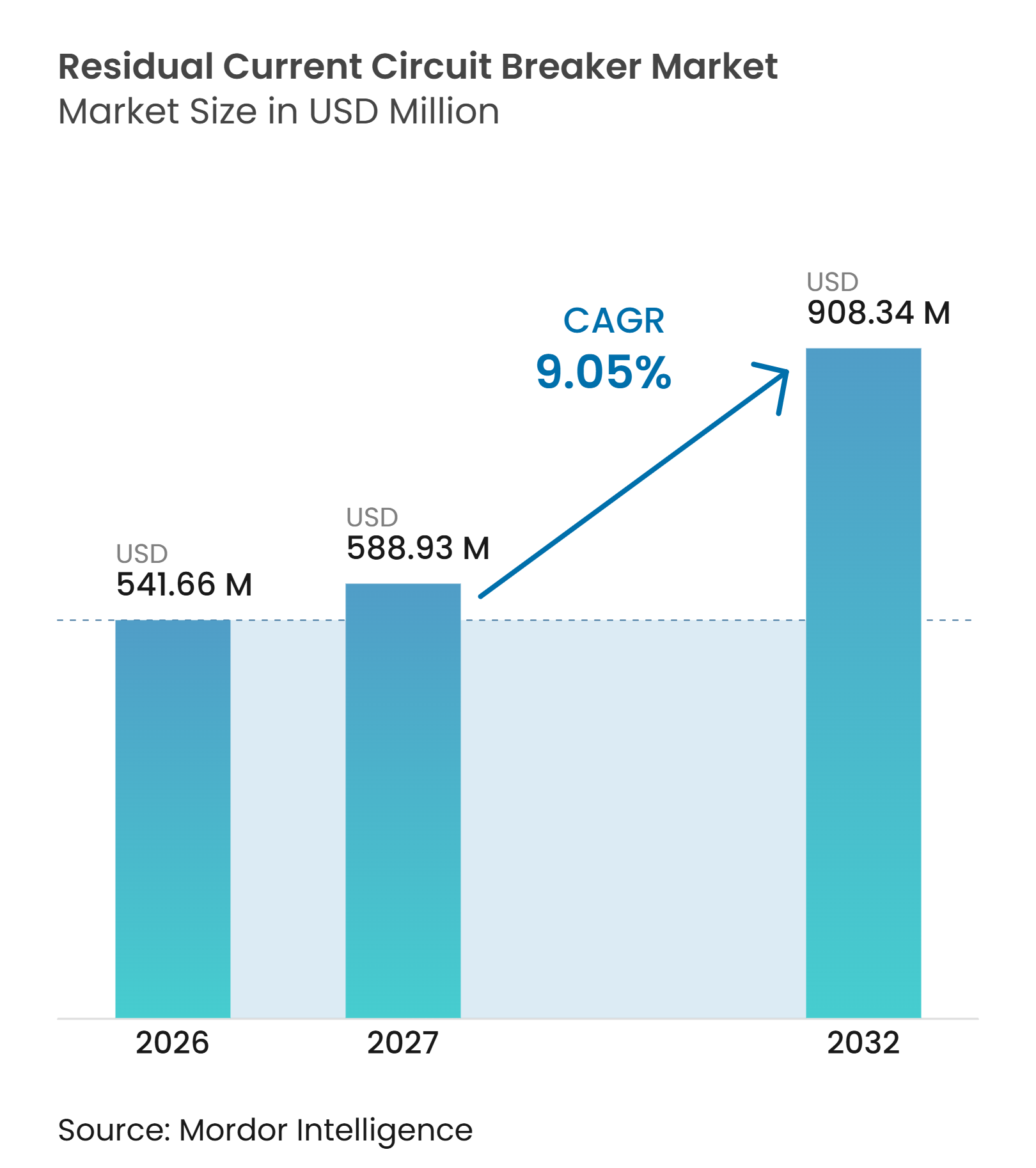
The Residual Current Circuit Breaker Market size is expected to increase from USD 541.66 million in 2026 to USD 588.93 million in 2027 and reach USD 908.34 million by 2032, growing at a CAGR of 9.05% over 2027-2032. Electrical safety regulations are expanding the range of circuits that require residual current protection, particularly in residential, wet area, commercial panel, and industrial equipment applications.[1] Electrification is also shifting the product mix, as EV chargers, solar equipment, battery systems, heat pumps, and variable-speed drives can generate residual currents that standard AC devices do not address. As a result, demand is growing for Type A, Type F, and Type B products, while standard two-pole devices continue to support large residential volumes. Suppliers are responding through product redesign, smaller panel footprints, remote diagnostics, and certification programs that provide installers with clearer device selection guidance. Price pressure remains concentrated in basic residential products, which is encouraging larger suppliers to focus on higher-rated, industrial, and application-specific protection equipment.
Key Report Takeaways
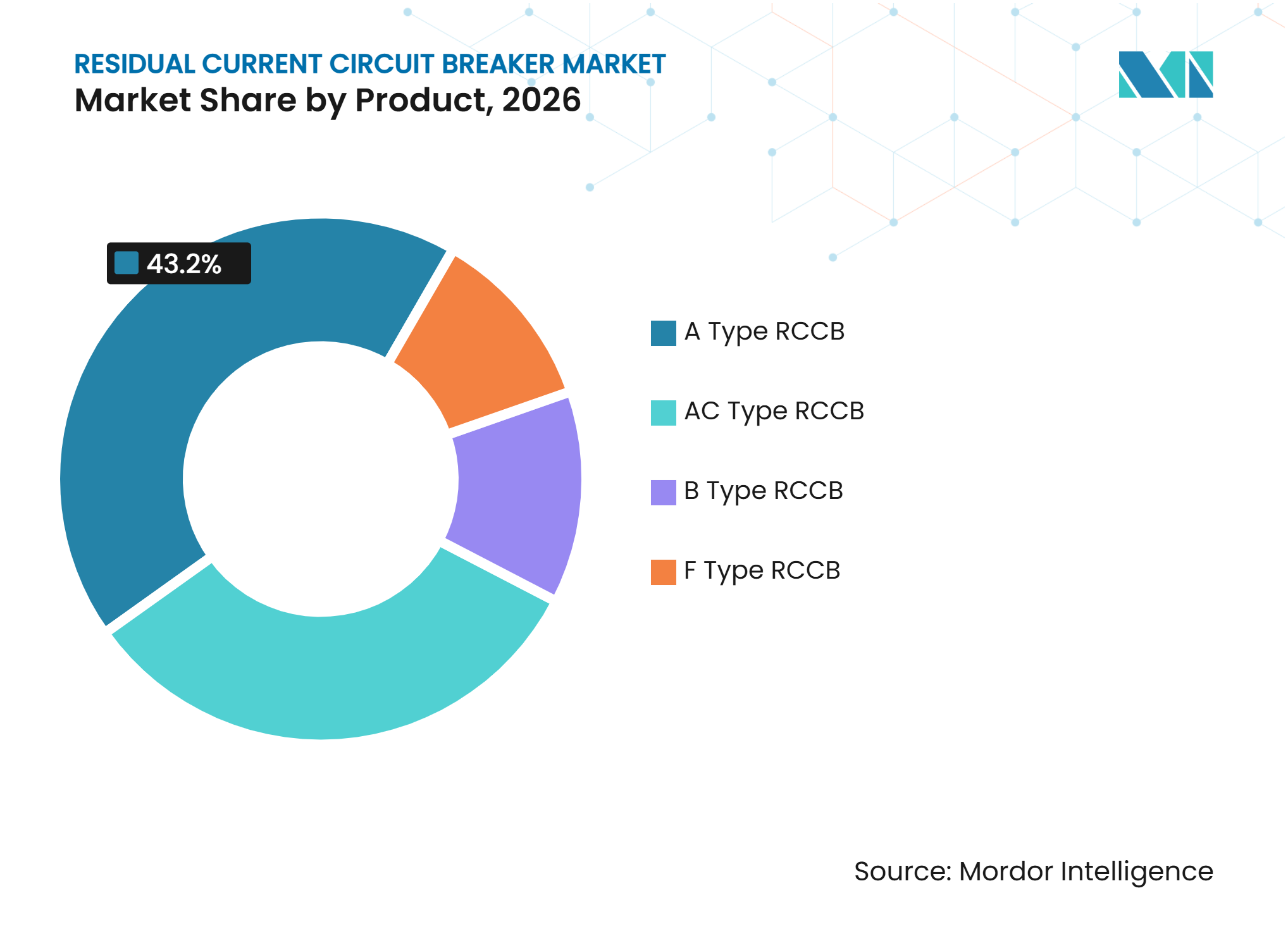
- By product type, Type A holds 43.2% of the residual current circuit breaker market share in 2026, while Type B is forecast to grow at a 10.2% CAGR through 2032.
- By pole configuration, two-pole devices account for 57.6% of the residual current circuit breaker market share in 2026, while four-pole devices are forecast to grow at a 9.6% CAGR through 2032.
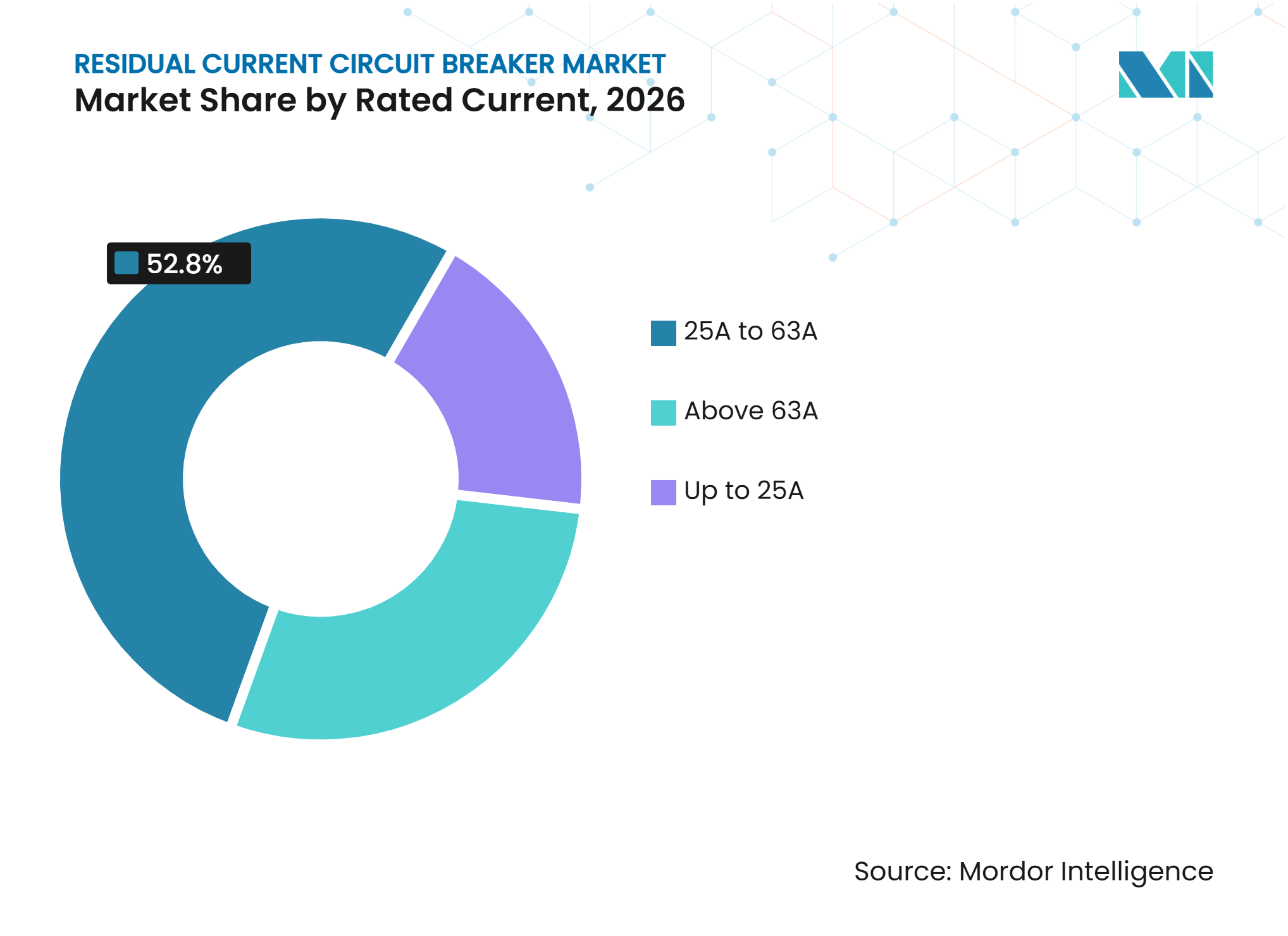
- By rated current, the 25A to 63A range holds 52.8% share in 2026, while the above-63A range is forecast to grow at a 9.8% CAGR through 2032.
- By end user, residential applications account for 41.3% share in 2026, while industrial applications are forecast to grow at a 9.7% CAGR through 2032.
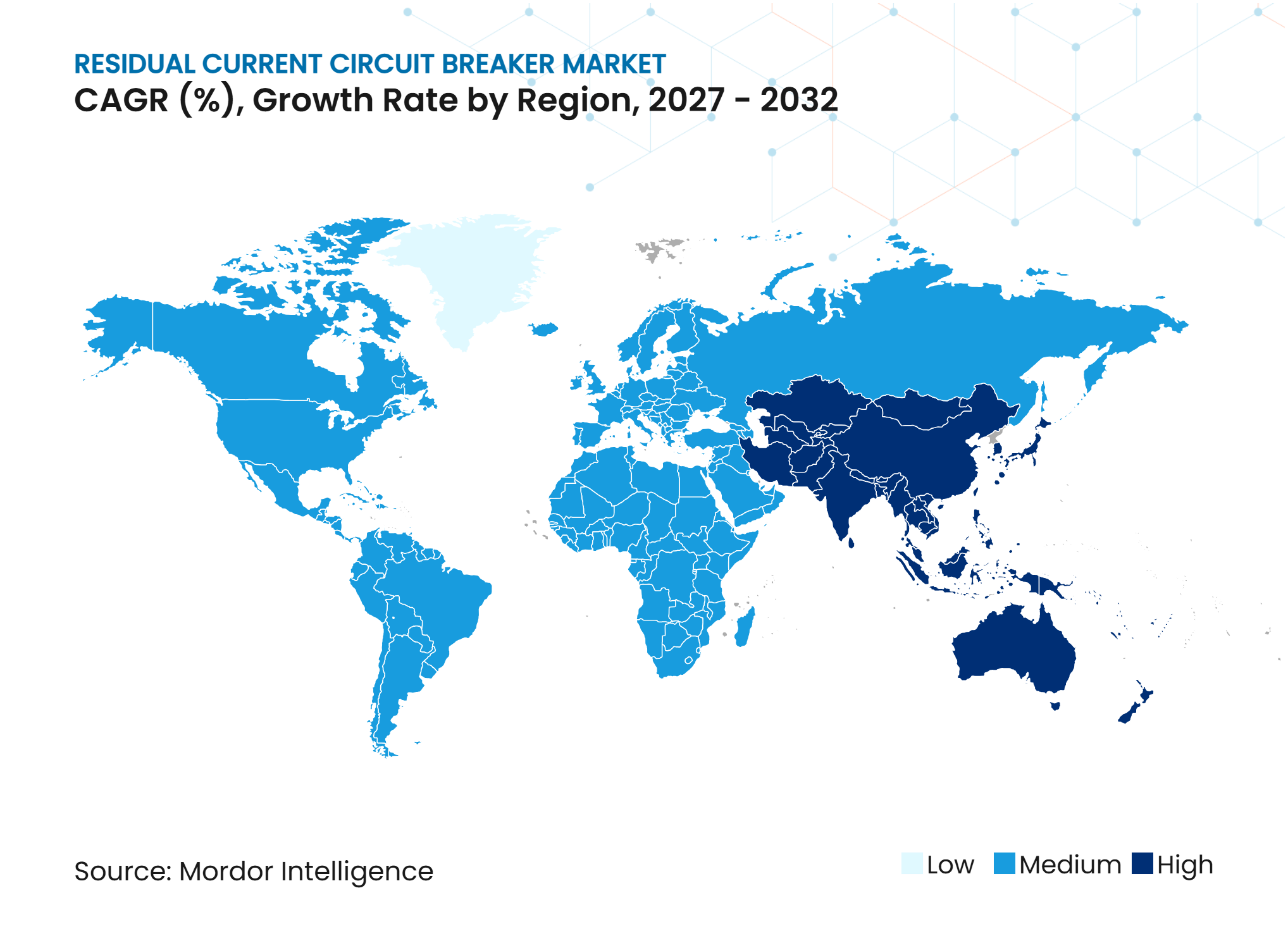
- By geography, Asia-Pacific holds 33.2% share in 2026 and is forecast to grow at a 9.5% CAGR through 2032.
Note: Market numbers in this report are based on Mordor Intelligence's proprietary estimation framework, which combines nine months of actuals with Q4 projections for base year 2026.
Market Trends and Insights
Drivers Impact Analysis of Residual Current Circuit Breaker Market*
| Driver | (~) % Impact on CAGR Forecast | Geographic Relevance | Impact Timeline |
|---|---|---|---|
| Electrical-Safety Regulations and Building-Code Enforcement | +2.8% | Global, with strongholds in Europe, India, and Asia-Pacific | Short term (≤ 2 years) |
| Construction, Electrification, and Electrical-Panel Replacement | +2.4% | Asia-Pacific core, including India, Vietnam, and Indonesia, with spillover to Middle East and Africa | Medium term (2-4 years) |
| EV Charging and Renewable-Energy Integration | +1.6% | Europe, China, and North America | Medium term (2-4 years) |
| DC-Rich Loads Increasing Demand for Type B and Type F Protection | +0.9% | Europe, China, and North America | Medium term (2-4 years) |
| Smart-Building and Digital-Protection Adoption | +0.7% | North America, Western Europe, and Asia-Pacific Tier-1 cities | Long term (≥ 4 years) |
| Higher Protection Intensity in Data Centers and Industrial Automation | +0.6% | Global, concentrated in North America, Europe, and Asia-Pacific | Long term (≥ 4 years) |
| Source: Mordor Intelligence | |||
Electrical-Safety Regulations and Building-Code Enforcement
Electrical safety regulations represent the strongest near-term demand driver for the residual current circuit breaker market, as compliance requirements mandate product installation or replacement. Germany's DIN VDE 0100-701:2025-06 extended residual current protection requirements for bathroom circuits and fixed water heaters, with a transition period running through December 2027. The update also directs installers toward Type A or Type B devices where high-frequency loads are present, rather than treating every circuit as a basic AC application. India made the revised IS 12640 Part 1:2024 requirements mandatory for licensed manufacturers from January 25, 2025, including updated compliance expectations for RCCBs. IEC 61008-1:2024 updated the technical framework used by manufacturers for household and similar RCCBs, covering product testing and qualification requirements. These regulatory changes provide the residual current circuit breaker market with a more predictable demand base, as installations cannot defer required safety work indefinitely.
Construction, Electrification, and Electrical-Panel Replacement
New buildings, grid extensions, and panel upgrades are expanding the installed base for the residual current circuit breaker market. India, Vietnam, and Indonesia continue to add housing, commercial facilities, and manufacturing capacity, all of which require new distribution boards and circuit protection. Modern projects are designed to current protection standards, reducing the role of legacy AC-only specifications at the point of installation. In mature European markets, electrical panel replacement supports demand as older housing stock is adapted for energy efficiency equipment and higher electrical loads. This creates a broad demand base that combines new construction with retrofit activity, rather than dependence on a single building cycle. The residual current circuit breaker market benefits when panel replacement enables contractors to install devices matched to current load types and approval requirements.
EV Charging and Renewable-Energy Integration
EV charging and distributed energy systems are increasing the need for devices capable of detecting DC-related fault currents. IEC-based EV installation guidance requires each charging point to have individual residual current protection with a rated operating current not exceeding 30 mA, along with protection against DC fault currents above 6 mA.[2] A Type B device can provide this protection directly, while Type A or Type F devices may be combined with an appropriate residual DC detecting device. HD Hyundai Electric began mass production of RCCBs designed for EV chargers in 2025, indicating that dedicated charging applications have reached a scale that supports specialized production. Solar inverters and battery systems present similar requirements, as power electronics can generate waveforms that conventional protection devices may not detect. These developments are shifting the residual current circuit breaker market toward higher-value products across residential, parking, and commercial applications.
DC-Rich Loads Increasing Demand for Type B and Type F Protection
Inverter-based heat pumps, HVAC equipment, solar systems, and industrial drives are changing the detection requirements for protection devices. Standard AC products do not cover every residual current waveform associated with power electronic loads, making product selection increasingly application-specific. Hager and Vaillant introduced a Type B HP RCCB solution for air-source heat pump installations in 2025, designed to address smooth DC and high-frequency leakage currents. The product operates at frequencies above 20 kHz, illustrating how equipment manufacturers can influence protection device selection through validated system designs. This relationship reduces the role of open-channel price competition, as the product becomes part of an equipment specification. The residual current circuit breaker market gains value from this shift, even where equipment volumes grow more slowly than those of low-cost residential devices.
Restraints Impact Analysis of Residual Current Circuit Breaker Market*
| Restraint | (~) % Impact on CAGR Forecast | Geographic Relevance | Impact Timeline |
|---|---|---|---|
| Premium Cost of DC-Sensitive and High-Frequency RCCBs | -1.2% | Global, most pronounced in Middle East and Africa and South Asia | Short term (≤ 2 years) |
| Price Competition in Commodity Residential AC Devices | -0.9% | Asia-Pacific and South America | Short term (≤ 2 years) |
| Nuisance-Tripping Risk in Harmonics-Heavy Installations | -0.6% | Industrial-heavy regions, including Europe and East Asia | Medium term (2-4 years) |
| Installer Competency Gaps in Mixed-Source Protection Coordination | -0.5% | Emerging markets, including Middle East and Africa, South Asia, and Southeast Asia | Medium term (2-4 years) |
| Source: Mordor Intelligence | |||
Premium Cost of DC-Sensitive and High-Frequency RCCBs
Type B and Type F products cost more than basic Type AC products because they require more complex sensing capability and additional qualification. IEC 61008-1:2024 provides the general requirements for household RCCBs, while Type B and Type F products must also respond to the current forms generated by advanced loads. This cost difference is most significant where electrical panel budgets are restricted and compliance enforcement is uneven. As a result, lower-cost AC equipment can remain the default choice in some price-sensitive installations, even when the connected equipment calls for a higher device type. Competitive offerings from Chinese manufacturers may narrow the price gap, but they do not eliminate the costs associated with device design, testing, and approvals. This dynamic can slow the adoption of advanced devices in South Asia, Southeast Asia, and parts of the Middle East and Africa.
Price Competition in Commodity Residential AC Devices
Commodity residential devices face strong price competition because high volumes and common specifications make product comparison straightforward. Basic two-pole AC devices are widely used in home distribution boards, giving manufacturers an incentive to compete on cost rather than features. Shanghai's 2025 circuit-breaker supervision sampling found non-compliant products in e-commerce channels, illustrating the risk that aggressive pricing can introduce under-specified devices into the supply chain.[3] International suppliers must maintain compliance, support, and local approvals while competing against lower-cost alternatives. This limits revenue growth in the largest unit-volume category, even as demand for household protection continues. It also encourages manufacturers in the residual current circuit breaker market to place greater commercial emphasis on commercial, industrial, and application-specific product lines.
*Our forecasts treat driver/restraint impacts as directional, not additive. The impact forecasts reflect baseline growth, mix effects, and variable interactions.
Residual Current Circuit Breaker Market Segment Analysis
By Product Type:
Type Upgrade Cycle Supports Higher-Value DemandA Type held 43.2% of 2026 revenue in this product group because it is widely used in residential and commercial circuits that include electronic loads. It detects sinusoidal AC and pulsating DC residual currents, making it a common code-aligned option for modern distribution boards. The product benefits from established installer familiarity and broad availability across major electrical equipment brands. AC Type products remain relevant in installations operating under older specifications, particularly where the load profile is simple and replacement budgets are constrained. However, newer requirements and more electronic appliances make AC Type less suitable for many new installations. India's revised IS 12640 Part 1:2024 requirements are part of this broader movement toward updated RCCB compliance. The residual current circuit breaker industry is therefore moving from a simple price-led product hierarchy to a selection process shaped by the loads on each circuit.
F Type products sit between A Type and B Type devices in their ability to manage complex current forms from equipment such as variable-speed drives and some air-conditioning systems. Hager describes Type F applications in commercial HVAC settings where higher-frequency residual currents affect device selection. B Type is forecast to expand at a 10.2% CAGR through 2032, making it the fastest-growing product group in the residual current circuit breaker market. It is suited to applications such as EV charging where smooth DC fault-current protection is required, without relying on a separate RDC-DD arrangement. Its higher value per unit means revenue can grow faster than unit shipment counts alone suggest. Product developers are also using this category to build closer relationships with charging, heating, and energy-system manufacturers. This gives the product type segment a clearer route to differentiation than standard AC devices.



By Pole Configuration:
Four-Pole Demand Follows Three-Phase Installation GrowthTwo-pole products accounted for 57.6% of the residual current circuit breaker market size in 2026, reflecting the large number of single-phase residential and light-commercial circuits. Their compatibility with compact DIN-rail boards and individual miniature circuit breakers keeps them central to high-volume panel designs. Basic two-pole configurations are also easier to price competitively because they are produced at scale and use well-established installation practices. Suppliers continue to improve product density in this category as board space becomes more limited. The underlying competitive priority remains compact protection equipment for space-constrained boards. This keeps two-pole demand important even as the residual current circuit breaker market becomes more technically differentiated.
Four-pole devices are forecast to grow at a 9.6% CAGR through 2032 as three-phase applications expand in commercial and industrial locations. They provide protection for installations such as larger distribution boards, logistics sites, manufacturing panels, and three-phase EV charging equipment. IEC 61008-1:2024 revised requirements across RCCB configurations and added tests related to temporary overvoltage and aluminum conductor terminals. The revision creates a practical point for suppliers to update and requalify their four-pole designs. Hager's Type B HP offering includes four-pole configurations for heat-pump installations, linking three-phase electrification with higher-class residual-current protection. These systems use more complex equipment and generally carry a higher protection value per installation. As a result, the residual current circuit breaker industry can capture higher revenue in this configuration even when total unit demand remains below two-pole volumes.
By Rated Current:
Mid-Range Volumes Coexist with Higher-Current Value GrowthThe 25A to 63A range held 52.8% of 2026 revenue because it covers common residential and small-business distribution board requirements. This range supports many mainstream circuit and main-incomer applications, making it the production focus for major suppliers. Chint's current product range includes residual-current protective devices across multiple frame sizes, reflecting the importance of this broad middle range. Havells also lists RCCB offerings for its Indian electrical-protection portfolio, including higher-class options on request. The segment retains strong demand because basic circuit ratings are anchored in building design, replacement work, and established installer practice. It also remains exposed to price competition because specification differences are less visible in many standard household applications.
The above-63A segment is forecast to record a 9.8% CAGR through 2032, supported by industrial subpanels, commercial distribution boards, data-center equipment, and higher-power charging infrastructure. These applications require products that can operate at higher rated currents and meet demanding system requirements. Fuji Electric's catalog includes earth-leakage circuit breakers across large frame sizes, demonstrating the available product scope for industrial installations. Larger devices are sold in lower unit volumes than the 25A to 63A band, but their average value is higher. Industrial automation and data-center expansion can therefore shift revenue toward this category without displacing the mid-range unit-volume base. The residual current circuit breaker market has a clear opportunity in this band where performance, ratings, certification, and engineering support matter more than initial price.

By End User:
Residential Volume Remains Important While Industry Adds ValueResidential users accounted for 41.3% of the residual current circuit breaker market size in 2026 because household circuits remain the largest installed base for residual-current protection. Building codes and consumer safety expectations support the use of RCCBs in new homes, renovations, bathrooms, and other circuits where electrical safety is required. Residential demand is mainly served through compact two-pole products, but EV charging and heat-pump adoption are creating selective demand for Type A, Type F, and Type B equipment. Havells' 2026 price list includes HLi and Type B configurations, indicating a wider residential product choice in India. Commercial users form the middle layer of demand across offices, retail, hospitality, and mixed-use buildings. Their varied circuit requirements can increase the number of product variants needed in each board and support a broader mix of ratings and sensitivities.
Industrial applications are forecast to grow at a 9.7% CAGR through 2032, the highest rate among end-user groups in the residual current circuit breaker market. Manufacturing systems use variable-frequency drives and other equipment that require careful coordination of fault protection and may need Type F or Type B capability. Data centers and high-value process facilities also place greater weight on dependable protection because unexpected shutdowns can be costly.[4] Utilities and infrastructure remain a smaller application group but gain support from transport electrification, water treatment, and grid-related projects. Higher rated-current devices and type-specific products give suppliers a route to higher revenue per project in these applications. The residual current circuit breaker industry is increasingly shaped by the need to match device behavior to complex power loads rather than simply install a standard residential unit.
Geography Analysis
Asia-Pacific
Asia-Pacific held 33.2% of the residual current circuit breaker market in 2026 and is forecast to grow at a 9.5% CAGR through 2032. China combines a large domestic equipment base with an extensive manufacturing and export presence, including CHINT product lines that cover several RCCB series and frame sizes. India adds a compliance-based demand driver through the mandatory revision to IS 12640 Part 1:2024 for licensed manufacturers. Vietnam and Indonesia support new demand through housing, commercial construction, and manufacturing investment that require new electrical panels. ABB expanded its building-solutions portfolio and appointed a retail distributor in Vietnam in 2025, including the GSJ200 RCCB in its offering. The region is also developing higher-value demand as local suppliers introduce digital functions, broader ratings, and products for inverter-based loads. China's standards system provides regulatory influence through national requirements for residual-current protective devices, while export suppliers must also meet IEC-based approvals.
Europe
Europe's demand is sustained by established electrical-safety regulations and an active cycle of product qualification. Germany's updated DIN VDE guidance widens protection requirements in wet areas and supports replacement work in existing buildings. The EU Low Voltage Directive continues to set a compliance framework for electrical equipment placed on the European market, including conformity and traceability requirements. Legrand renewed a CB test certificate for its DX3 and RX3 RCCB range in 2025, illustrating the ongoing recertification work associated with product compliance. Europe also has a strong base of heat pump, EV, and building-modernization projects that increase demand for devices compatible with power-electronic loads. Hager's Type B HP solution, developed with Vaillant, is an example of suppliers using application engineering to address this requirement. This favors companies that can offer technical support, approvals, and clear product-selection guidance alongside the device itself.
North America, South America, Middle East, and Africa
North America uses a distinct ground-fault protection framework based on the NEC and UL 1053 rather than the IEC RCCB classification used in many other regions. NOARK introduced the L1H RCCB with UL 1053 and IEC/EN 61008-1 certification in 2026, demonstrating a route for IEC-platform products to serve North American channels. South American demand is concentrated in construction-led markets where local electrical standards and imports shape product availability. Middle East and Africa demand is supported by construction and infrastructure programs, but advanced devices can face cost and installer-capability constraints. Legrand launched its Power and Protection range in Egypt in 2025 for residential and commercial applications, reflecting stronger local attention to compliant protection products. The residual current circuit breaker market in these regions is likely to grow through new installations first, while retrofit demand develops as local codes and skilled installation capacity become more established. The need for UL listing in North America and IEC conformity in other regions means compliance remains a central factor in geographic expansion.
Competitive Landscape
Market Concentration
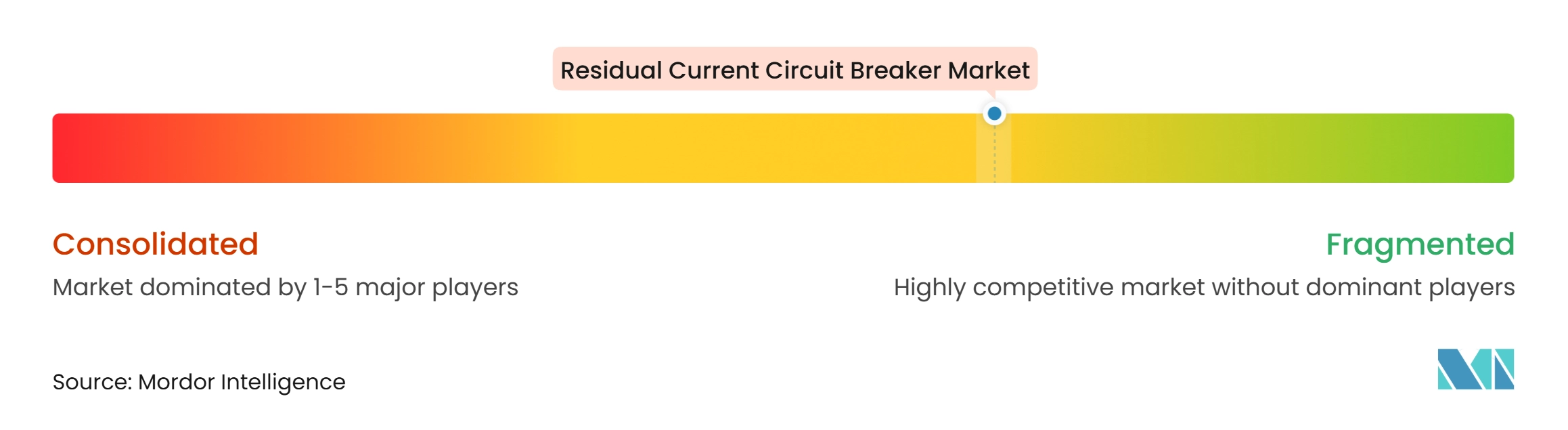
The residual current circuit breaker market is moderately consolidated, with European multinationals and large Asian manufacturers serving different parts of the product range. ABB, Schneider Electric, Siemens, Eaton, Legrand, Hager, and other established suppliers compete through technical range, approvals, distribution, and system integration. CHINT, Delixi Electric, and other Asian suppliers compete strongly in high-volume products while expanding their certifications and product capabilities. Competitive differences are becoming more defined as EV chargers, heat pumps, and industrial electronics require more specialized protection. This makes type classification, high-frequency performance, and panel integration important factors alongside price. Suppliers with a deep installed base can also use product renewal cycles to introduce compact designs and upgraded digital functions.
Siemens and DOMO Chemicals announced in February 2025 that SENTRON 5SV3 RCCB housings would use TECHNYL 4EARTH recycled polyamide 6 with 50% recycled content. This demonstrates that material choices can influence public procurement and project specifications where sustainability requirements apply. Hager and Vaillant's 2025 Type B HP product collaboration offers a second example, linking circuit protection to a validated heat pump application rather than leaving selection entirely to the distribution channel. HD Hyundai Electric's 2025 EV-charger RCCB production provides a third example of a supplier creating a product line for a defined electrification application. These actions reflect competition based on application fit, product validation, and compliance readiness, and make it harder for suppliers of basic products to compete on unit price alone.
Opportunity remains in higher-current Type B configurations and in devices that satisfy multiple regional certification pathways. Fuji Electric's earth-leakage circuit breaker catalog shows the breadth of higher-frame industrial equipment available for these applications. NOARK's dual-certified product illustrates how an IEC-platform manufacturer can address the North American compliance barrier. The competitive field remains broad, as the available data does not provide combined market shares for the leading players. European suppliers retain an advantage in application engineering and established approvals, while Asian suppliers have scale and widening product portfolios. The residual current circuit breaker market is differentiated by technical suitability and regional compliance as much as by manufacturing cost. The available evidence supports a moderate level of concentration rather than dominance by a small group. This balance leaves room for specialists that can demonstrate performance in demanding installations, while broad-line suppliers can use local availability and certification portfolios to compete for larger panel and project specifications.
Residual Current Circuit Breaker Industry Leaders
-
Schneider Electric SE
-
Siemens AG
-
ABB Ltd.
-
Eaton Corporation plc
-
Legrand SA
- *Disclaimer: Major Players sorted in no particular order
Residual Current Circuit Breaker Market Companies Covered in this Report
- ABB Ltd.
- CHINT Group
- Delixi Electric
- Doepke Schaltgeräte GmbH
- Eaton Corporation plc
- ETI Elektroelement d.d.
- Fuji Electric Co., Ltd.
- Gewiss S.p.A.
- Hager Group
- Havells India Limited
- Hyundai Electric & Energy Systems Co., Ltd.
- Larsen & Toubro Limited
- Legrand SA
- LS ELECTRIC Co., Ltd.
- Mitsubishi Electric Corporation
- Noark Electric
- Rockwell Automation, Inc.
- Schneider Electric SE
- Siemens AG
- Socomec Group
Recent Industry Developments in Residual Current Circuit Breaker Market
- July 2026: Schneider Electric SE launched the Acti9 iC60 H3 3-Phase Residual Current Circuit Breaker with Overcurrent Protection (RCBO), expanding its Acti9 low-voltage protection portfolio for commercial and industrial applications. The Type A RCBO combines protection against overloads, short circuits, and earth-fault currents in a compact design, requiring only 3 modules compared to the conventional 7-module RCBO configuration.
- July 2026: Schneider Electric SE launched the Easy9 Pro range in South Africa, expanding its final-distribution portfolio for residential and small-to-medium commercial applications. The range includes miniature circuit breakers (MCBs), residual current circuit breakers (RCCBs), auxiliaries, and accessories, offering breaking capacities up to 10 kA to address applications requiring higher short-circuit protection.
- April 2026: Siemens AG announced plans to build a new carbon-neutral digital factory in Sibiu, Romania, representing a multi-million-euro (EUR) investment dedicated to the production of low-voltage SENTRON electrical protection devices. The planned 14,500 m² facility, scheduled for operation by 2028, will manufacture products including miniature circuit breakers (MCBs), residual current circuit breakers (RCCBs), residual current circuit breakers with overcurrent protection (RCBOs), and electronic circuit protection devices (ECPDs).
- March 2026: ABB Ltd introduced the DS30 1P+N RCBO, the world's slimmest voltage-independent 10 kA residual current circuit breaker with overcurrent protection (RCBO). The device combines earth leakage protection, overload protection, and short-circuit protection within a compact 17.6 mm single-module width, enabling up to 50% space savings compared to conventional two-module RCCB and MCB combinations.
Global Residual Current Circuit Breaker Market Report Scope
A Residual Current Circuit Breaker (RCCB) is an electrical safety device that continuously monitors and compares the current flowing through the live and neutral conductors. It operates on Kirchhoff's Current Law, which assumes that incoming and outgoing currents should be equal. If it detects an imbalance caused by earth leakage, such as current leaking through a faulty appliance or a person touching a live wire, it trips instantly to disconnect the supply. This rapid action prevents severe electric shocks and reduces the risk of electrical fires. However, an RCCB must be paired with an MCB, as it does not include built-in overload protection.
The global residual current circuit breaker (RCCB) market is segmented by product type, pole configuration, rated current, end user, and geography. By product type, the market is segmented into AC Type RCCBs, A Type RCCBs, F Type RCCBs, and B Type RCCBs. By pole configuration, the market is segmented into two-pole RCCBs and four-pole RCCBs. By rated current, the market is segmented into up to 25A, 25A to 63A, and above 63A. By end user, the market is segmented into residential, commercial, industrial, and utilities and infrastructure. The report also covers the market size and forecasts for the global RCCB market across 25 countries in key regions. For each segment, the market sizing and forecasts are provided on the basis of value (USD).
Segmentation Overview
| AC Type RCCB |
| A Type RCCB |
| F Type RCCB |
| B Type RCCB |
| Two-Pole RCCB |
| Four-Pole RCCB |
| Up to 25A |
| 25A to 63A |
| Above 63A |
| Residential |
| Commercial |
| Industrial |
| Utilities and Infrastructure |
| North America | United States |
| Canada | |
| Mexico | |
| Europe | Germany |
| France | |
| Italy | |
| Spain | |
| United Kingdom | |
| Norway | |
| Netherlands | |
| Russia | |
| Rest of Europe | |
| Asia-Pacific | China |
| India | |
| Australia | |
| Indonesia | |
| Vietnam | |
| Thailand | |
| Rest of Asia-Pacific | |
| South America | Brazil |
| Argentina | |
| Chile | |
| Rest of South America | |
| Middle East and Africa | Saudi Arabia |
| United Arab Emirates | |
| Egypt | |
| Nigeria | |
| Oman | |
| Rest of Middle East and Africa |
| By Product Type | AC Type RCCB | |
| A Type RCCB | ||
| F Type RCCB | ||
| B Type RCCB | ||
| By Pole Configuration | Two-Pole RCCB | |
| Four-Pole RCCB | ||
| By Rated Current | Up to 25A | |
| 25A to 63A | ||
| Above 63A | ||
| By End User | Residential | |
| Commercial | ||
| Industrial | ||
| Utilities and Infrastructure | ||
| By Geography | North America | United States |
| Canada | ||
| Mexico | ||
| Europe | Germany | |
| France | ||
| Italy | ||
| Spain | ||
| United Kingdom | ||
| Norway | ||
| Netherlands | ||
| Russia | ||
| Rest of Europe | ||
| Asia-Pacific | China | |
| India | ||
| Australia | ||
| Indonesia | ||
| Vietnam | ||
| Thailand | ||
| Rest of Asia-Pacific | ||
| South America | Brazil | |
| Argentina | ||
| Chile | ||
| Rest of South America | ||
| Middle East and Africa | Saudi Arabia | |
| United Arab Emirates | ||
| Egypt | ||
| Nigeria | ||
| Oman | ||
| Rest of Middle East and Africa | ||
Key Questions Answered in the Report
What is driving demand for residual current circuit breakers?
Building-code enforcement, panel replacement, EV charging, renewable-energy systems, and inverter-based loads are increasing demand for devices that can detect more complex residual currents.
How large is the residual current circuit breaker market?
The market is valued at USD 541.66 million in 2026 and is projected to reach USD 908.34 million by 2032, at a CAGR of 9.05% for 2027-2032.
Which RCCB type is growing the fastest?
Type B is forecast to grow at a CAGR of 10.2% through 2032, as EV charging and other DC-rich applications require enhanced protection.
Why are Type B RCCBs used for EV charging?
EV installations require protection against DC fault currents above 6 mA, which can be provided by a Type B device or a suitable device combination.
Which region is expected to grow the fastest?
Asia-Pacific is forecast to grow at a CAGR of 9.5% through 2032, supported by construction activity, manufacturing investment, product supply, and safety-code upgrades.
What is the main challenge for advanced RCCBs?
Higher prices for Type B and Type F devices can slow adoption where budgets are constrained or technical enforcement is inconsistent.