
Residential Backup Power Market Size and Share
Market Overview
| Study Period | 2022 - 2032 |
|---|---|
| Market Size (2027) | USD 19.07 Billion |
| Market Size (2032) | USD 24.73 Billion |
| Growth Rate (2027 - 2032) | 5.34 % |
| Fastest Growing Market | Asia-Pacific |
| Largest Market | North America |
| Market Concentration | Medium |
Major Players *Disclaimer: Major Players sorted in no particular order Image © Mordor Intelligence. Reuse requires attribution under CC BY 4.0. | |
Residential Backup Power Market Analysis by Mordor Intelligence
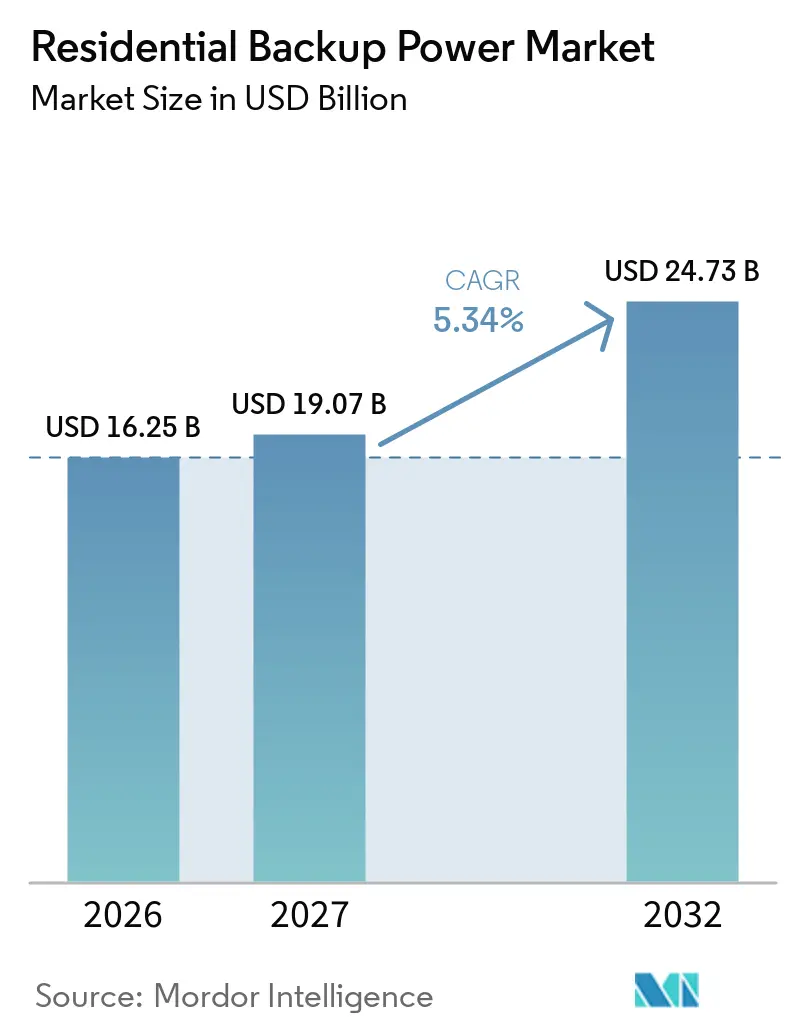
The residential backup power market size is expected to increase from USD 16.25 billion in 2026 to USD 19.07 billion in 2027 and reach USD 24.73 billion by 2032, at a CAGR of 5.34% over 2027-2032. More frequent and prolonged power interruptions have made household resilience a practical purchase consideration, shaping the residential backup power market. US customers experienced 11 hours of interruptions in 2024, with hurricanes Beryl, Helene, and Milton accounting for 80% of those hours.[1] Households are also operating more connected equipment, electric vehicles, heat pumps, and home-office systems, increasing the loads they need to maintain during outages. Solar-plus-storage systems and utility dispatch programs are expanding the role of the residential backup power market beyond emergency use. Competitive strategies increasingly combine equipment, installation networks, financing, software, and participation in virtual power plant programs.
Key Report Takeaways
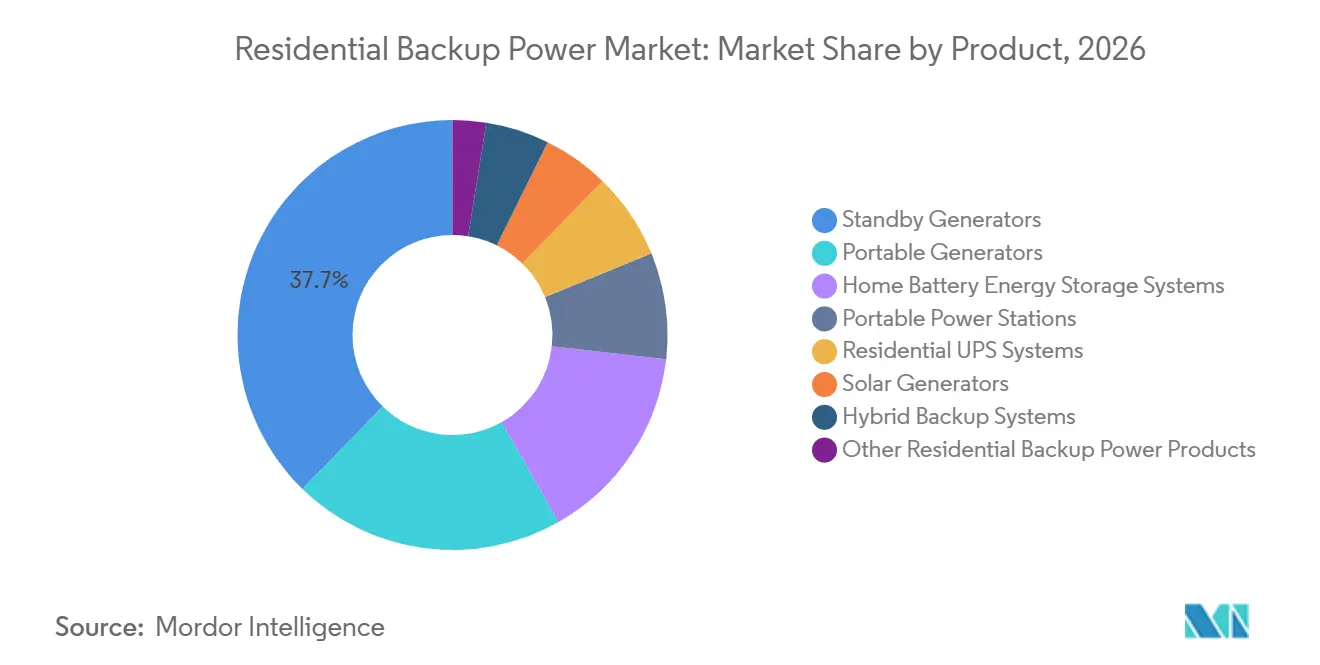
- By product, standby generators held 37.7% of the residential backup power market share in 2026, while home battery energy storage systems are forecast to grow at a 7.2% CAGR through 2032.
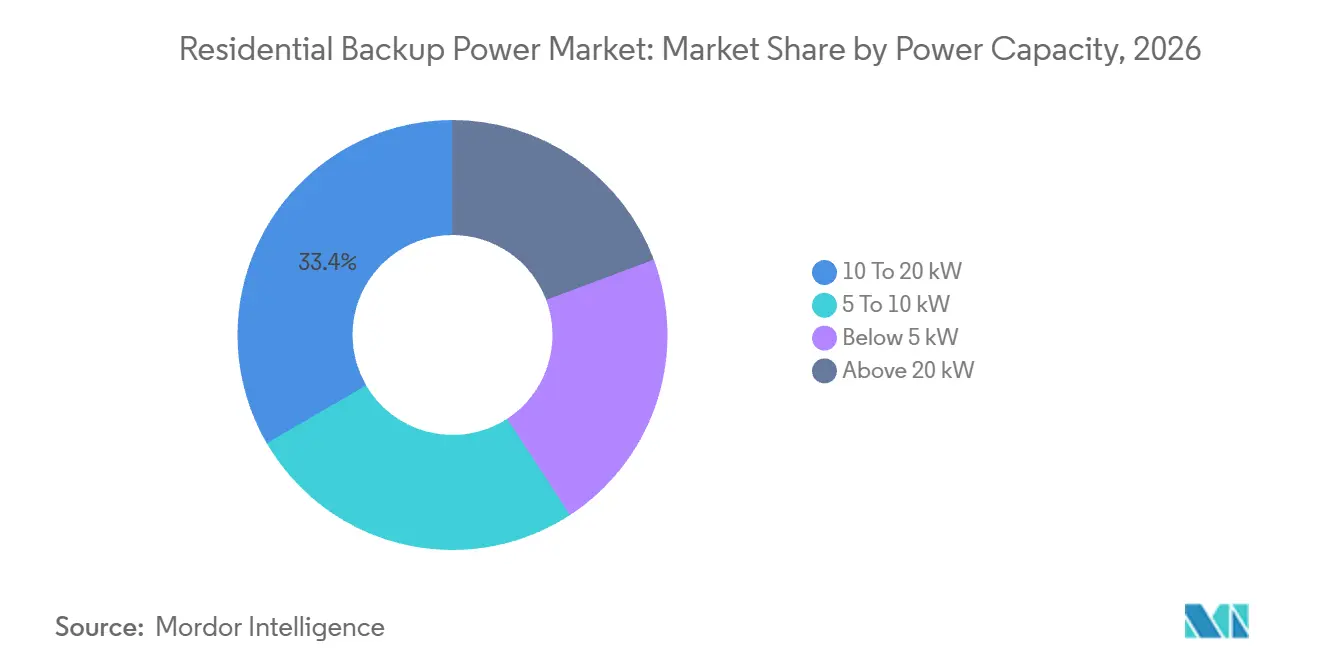
- By power capacity, the 10 to 20 kW segment accounted for 33.4% of the residential backup power market size in 2026, while the below 5 kW segment is forecast to grow at a 5.9% CAGR through 2032.
- By geography, North America held 41.5% of the residential backup power market share in 2026, while Asia-Pacific is projected to expand at a 6.4% CAGR through 2032.
Note: Market numbers in this report are based on Mordor Intelligence's proprietary estimation framework, which combines nine months of actuals with Q4 projections for base year 2026.
Market Trends and Insights
Drivers Impact Analysis of Residential Backup Power Market*
| Driver | (~) % Impact on CAGR Forecast | Geographic Relevance | Impact Timeline |
|---|---|---|---|
| Increasing Grid Outages and Extreme Weather Events | +1.8% | Global, concentrated in North America, Southeast Asia, and Southern Europe | Short term (≤ 2 years) |
| Rooftop Solar and Solar-Plus-Storage Adoption | +1.5% | North America, Europe, and Asia-Pacific | Medium term (2-4 years) |
| Rising Residential Electrification and Digital Load Dependence | +0.9% | North America, EU, and East Asia | Medium term (2-4 years) |
| Automated Load Orchestration for High-Surge Household Loads | +0.5% | North America and Western Europe | Medium term (2-4 years) |
| Residential Backup as a Grid-Interactive Distributed Energy Resource | +0.4% | North America, Germany, and Australia | Long term (≥ 4 years) |
| Smart Home Energy Management and Remote Backup Monitoring | +0.7% | Global, with early gains in North America and Northern Europe | Medium term (2-4 years) |
| Source: Mordor Intelligence | |||
Increasing Frequency of Grid Outages and Extreme Weather Events
Grid interruptions are changing how households assess the value of residential backup power. Major events caused nearly 9 hours of U.S. customer interruptions in 2024, compared with nearly 4 hours annually during the prior decade. Weather-related outages cost U.S. residential and commercial customers an annual average of USD 67 billion from 2018 to 2024, with costs reaching USD 121 billion in 2024.[2] Demand for residential backup power is therefore extending beyond areas historically exposed to hurricanes. Wildfires, ice storms, and extreme heat events are causing multi-day interruptions in the Midwest, Pacific Northwest, and parts of Europe. These conditions support demand for systems that can protect refrigeration, communications, medical equipment, and basic household functions, while also widening the customer base for automatic systems in regions where backup equipment was previously optional.
Rooftop Solar and Solar-Plus-Storage Adoption
Solar adoption is expanding the addressable base for battery systems in the residential backup power market. Batteries were installed with 37% of new U.S. residential solar systems in 2025, compared with 25% in 2024. The battery attachment rate reached 74% in California, while the non-California rate more than doubled from 7% to 17%. Reduced export compensation is strengthening the financial case for self-consumption in several regions. Germany had more than 2.5 million residential solar-plus-storage systems in early 2026, while retail electricity prices of EUR 0.35 to EUR 0.37 per kWh remained well above solar export compensation of EUR 0.07 to EUR 0.08 per kWh. This gap makes stored solar power more valuable to households than exported electricity and gives suppliers a reason to offer integrated solar, battery, inverter, and energy-management packages.
Rising Residential Electrification and Digital Load Dependence
Electrification is increasing capacity requirements within the residential backup power market. The U.S. Department of Energy estimates that broad level 2 electric vehicle charger adoption raises national residential site energy use by 7.2% due to added charging demand. Heat pumps, connected devices, electric vehicle charging, and home-office equipment have increased the number of loads households may want to protect. A short outage can now interrupt income-generating work and connectivity, not only lighting and refrigeration. This expands demand for automatic load management, remote monitoring, and systems that prioritize high-surge household loads. Vendors are responding with equipment that can coordinate circuits rather than simply supply a fixed amount of power. These requirements favor larger standby units and battery systems that can be configured around household priorities.
Residential Backup as a Grid-Interactive Distributed Energy Resource
Grid-interactive programs are changing the economics of the residential backup power market. California utilities dispatched 535 MW from more than 100,000 residential batteries during a 2-hour event in July 2025, and the program was assessed as planning-grade reliable (SUNRUN.COM). Sunrun's CalReady program reached 75,000 batteries in 2025. Tesla reported 89,000 U.S. Powerwall virtual power plant dispatch events during 2025 and more than USD 10 million in owner earnings. Such programs allow a household battery to serve both backup and grid-support functions. Smart home energy management and remote monitoring support participation by matching battery output to changing home demand. FERC Order 2222 also provides a pathway for distributed energy resources to participate in wholesale electricity markets, which can help reduce system payback periods.
Restraints Impact Analysis of Residential Backup Power Market*
| Restraint | (~) % Impact on CAGR Forecast | Geographic Relevance | Impact Timeline |
|---|---|---|---|
| High Installed Cost and Limited Financing Access | -0.9% | Global, most acute in emerging markets and low-income U.S. households | Short term (≤ 2 years) |
| Battery Degradation, Replacement Risk, and Warranty Uncertainty | -0.4% | Global | Medium term (2-4 years) |
| Interconnection, Permitting, and Fire-Safety Friction | -0.3% | North America and EU member states | Short term (≤ 2 years) |
| Limited Backup Duration and Capacity Constraints for Extended Outages | -0.2% | Global, particularly rural and hurricane-affected regions | Medium term (2-4 years) |
| Source: Mordor Intelligence | |||
High Installed Cost and Limited Financing Access
Installed cost remains a central barrier in the residential backup power market. A whole-home standby generator with an automatic transfer switch typically costs USD 10,000 to 20,000 to install in the United States. A 10 kWh lithium iron phosphate (LFP) battery system with solar integration costs USD 1,200 to 1,500 per kWh in 2026, creating a similar capital hurdle. The expiration of the US Section 25D residential credit at the end of 2025 increased price uncertainty for batteries, particularly where component eligibility affects tax credit access. Interconnection rules, local permits, fire-safety requirements, and differing interpretations by the authority having jurisdiction can add cost and delay installation. Sonnen and Solrite offer a Texas program with 60 kWh of storage for USD 20 per month and no upfront cost, but these financing models remain limited in scale. Limited backup duration during extended outages also leads customers to weigh system capacity and fuel access against a lower initial price.
Battery Degradation, Replacement Risk, and Warranty Uncertainty
Battery performance over time remains an important restraint in the residential backup power market. Manufacturers commonly warrant LFP systems to retain 70 to 80% of nameplate capacity over 10 years. High temperatures and limited thermal management can cause performance losses that exceed modeled rates. A recall of Tesla Powerwall 2 units in Australia in September 2025 demonstrated how safety concerns can create costs and reputational exposure for battery suppliers. UL 9540 system testing and NFPA 855 installation guidance are central safety references, while local rules can require additional setback distances. Installers and homeowners must also consider the cost of future replacement, particularly when a battery module cannot be independently exchanged. These factors can slow adoption when buyers compare long-term ownership costs with the simpler fuel and maintenance profile of a conventional generator.
*Our forecasts treat driver/restraint impacts as directional, not additive. The impact forecasts reflect baseline growth, mix effects, and variable interactions.
Residential Backup Power Market Segment Analysis
By Product:
Conventional Generation Still Leads, but Batteries Redefine GrowthStandby generators held 37.7% of the residential backup power market share in 2026, making them the leading product segment. Their position reflects established dealer and installer networks, particularly in areas exposed to hurricanes and winter storms. These systems provide a reliable option for households that need power for several days and can access fuel. Generac reported USD 2.3 billion in residential revenue during 2025, compared with USD 2.4 billion in 2024, as lower major-event outage activity reduced second-half demand. The company estimated home standby generator penetration at 6.75% of its US addressable owner-occupied single-family home base, indicating considerable remaining scope for adoption.[3]
Home battery energy storage systems represent the fastest-growing product category, with the residential backup power market size for this segment expected to grow at a 7.2% CAGR through 2032. Falling lithium iron phosphate (LFP) cell costs, higher solar attachment rates, and virtual power plant income opportunities support this growth. Tesla exceeded 1 million Powerwall installations worldwide in September 2025, representing 6.7 GW of battery capacity across 30 countries. Enphase Energy shipped 706.1 MWh of IQ Batteries in 2025, a 36% increase from 2024. Portable generators continue to serve price-sensitive users and partial-load applications, while portable power stations offer an entry-level alternative using LFP battery chemistry. Residential UPS products remain focused on home offices and medical equipment, and hybrid systems that combine gas generation with batteries are being positioned for extended outage conditions. IEC 62040 remains a recognized quality benchmark for the UPS category.

By Power Capacity:
Mid-Range Holds the Market, Small Systems Chase Fastest GrowthThe 10 to 20 kW segment accounted for 33.4% of the residential backup power market share in 2026. This range covers many whole-home standby generator installations in North America and larger battery stacks for electrified households. Generac's air-cooled residential standby generators span 7.5 to 26 kW, placing much of its portfolio within this capacity range. Generac also launched its first 28 kW air-cooled unit during fiscal 2025 as part of a broader platform update. The 5 to 10 kW range addresses medium-load homes and is a competitive range for solar-plus-storage inverter suppliers. Enphase Energy, SolarEdge Technologies, SMA Solar Technology, and Chinese original equipment manufacturers compete in this tier through efficiency, grid interaction, and installer workflow features.
The below-5 kW category is forecast to grow at a 5.9% CAGR through 2032, the fastest rate among power capacity segments. This residential backup power market size segment is supported by portable power stations, residential UPS systems, and entry-level batteries for renters and apartment residents. Smaller products provide backup for communications, lighting, refrigeration, and selected circuits without requiring permanent installation. Australia's Cheaper Home Batteries Program had supported more than 400,000 household battery installations and 11.2 GWh of cumulative capacity by May 2026.[4] The above-20 kW category serves large homes and small-commercial crossover users, where liquid-cooled equipment from Generac, Rehlko, and Cummins is used. Capacity limits remain relevant during extended outages, as small batteries and portable systems may require load reduction, recharging, or additional support.
Geography Analysis
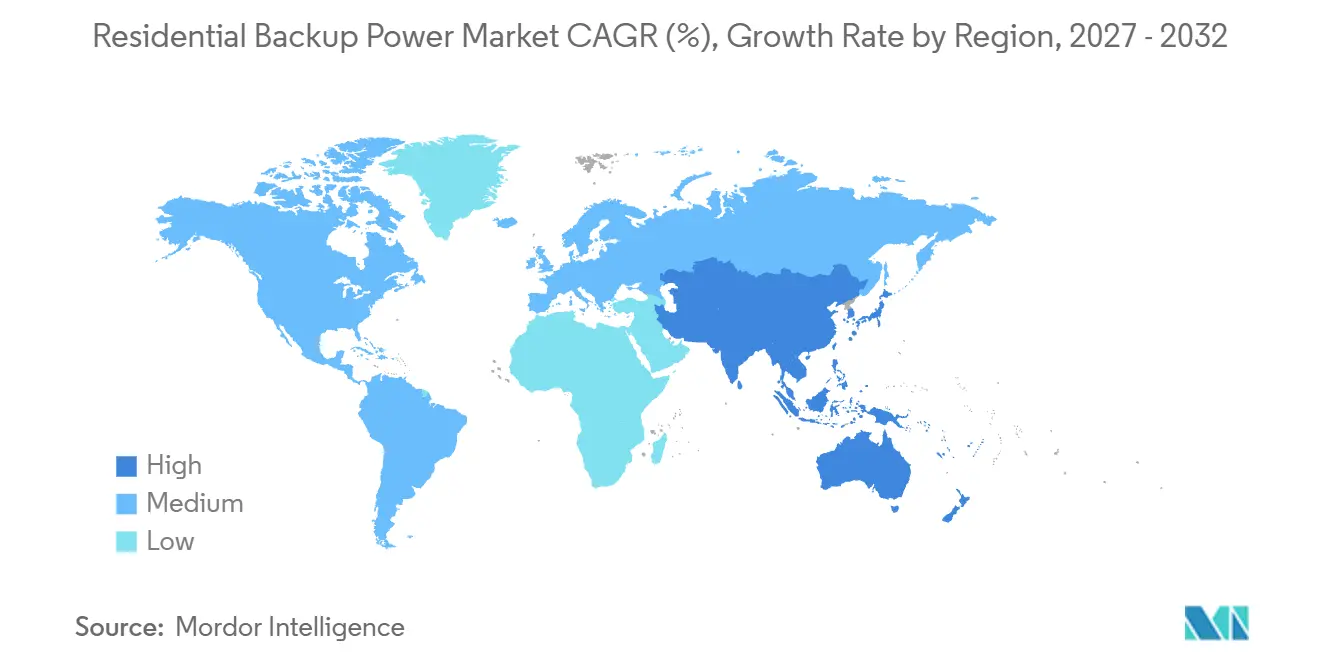
North America held 41.5% of the residential backup power market in 2026. The region has the largest installed base of automatic standby generators and a growing base of home battery systems. Generac's residential revenue declined 6.8% in 2025, as the second half of the year saw fewer major outage events compared with the hurricane-active period in 2024. This result illustrates the event-driven variation in annual equipment demand, even as power reliability risks remain material. NEC Articles 705 and 706 and NFPA 855 govern interconnection and installation safety, while local interpretations can create varying permitting requirements.
Asia-Pacific is forecast to expand at a 6.4% CAGR through 2032, the fastest growth rate among all regions in the residential backup power market. India's PM Surya Ghar Muft Bijli Yojana had reached 1.6 million residential rooftop solar installations and 4.9 GW of residential rooftop capacity by July 2025. Australia expanded the Cheaper Home Batteries Program from AUD 2.3 billion to AUD 7.2 billion over four years, targeting 2 million household batteries by 2030. Japan selected 13 battery aggregators under a JPY 9 billion (USD 58 million) subsidy program for distributed storage integration. Sharp Corporation launched an 11.5 kWh LFP residential battery in Japan in September 2026.
Europe is an established residential backup power market, with Germany, Italy, the United Kingdom, and Spain as significant country markets. Germany's large installed base reflects the wide gap between household electricity prices and solar export compensation. The European industry association expects 13.2 GWh of residential storage installations in 2026, 7% higher than in 2025. South America and the Middle East and Africa are earlier-stage regions, where demand in Brazil, South Africa, Saudi Arabia, and the United Arab Emirates is supported by uneven grid reliability, solar adoption, premium housing development, and energy security needs.
Competitive Landscape
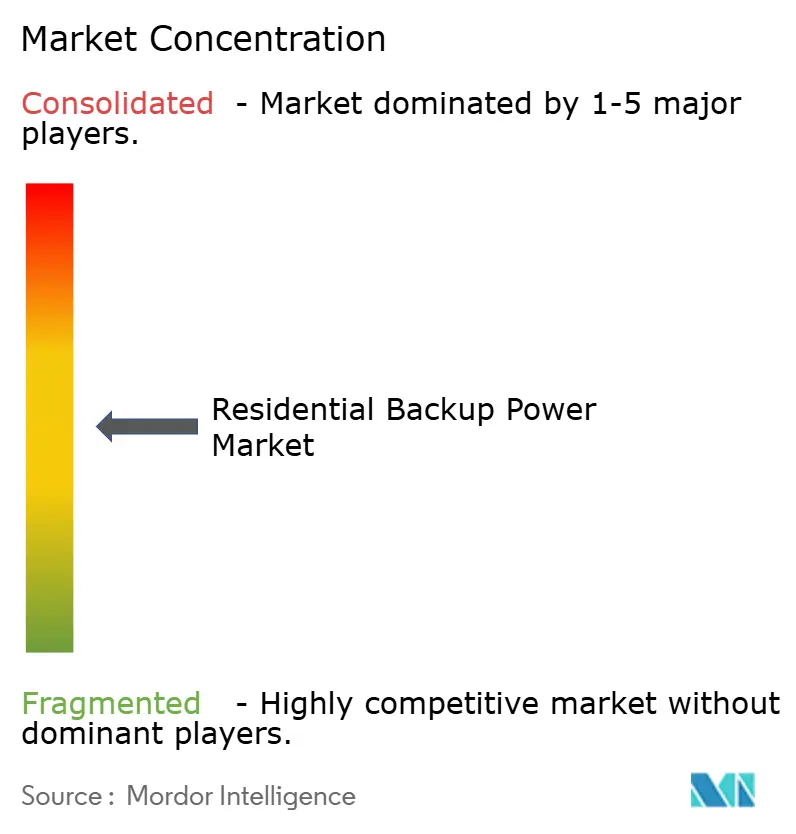
The residential backup power market has a moderate level of concentration in standby generators and a fragmented structure in batteries, solar generators, and portable power stations. Generac, Rehlko, Cummins, and Honda have established dealer and installer networks in the North American standby generator category. Generac's estimated 6.75% home standby penetration rate indicates that suppliers can still capture demand by converting households that do not yet own backup equipment. Channel coverage, financing access, and installation capacity can therefore matter as much as equipment specifications. This segment of the residential backup power market remains focused on durable systems for households with frequent or extended outage exposure.
Battery competition brings together consumer electronics firms, electric vehicle manufacturers, solar inverter providers, and conventional power equipment suppliers. Tesla, Inc. had installed more than 1 million Powerwalls globally by September 2025, giving the company scale in hardware deployment and virtual power plant participation. Tesla, Inc. also stated that the Powerwall 3 integrated inverter lowered installation cost by USD 0.18 per watt compared with its predecessor. Enphase Energy expanded its ecosystem by beginning US shipments of the IQ EV Charger 2 in December 2025, linking electric vehicle charging to solar and IQ Battery systems. BYD Company Limited introduced the Battery-Box Mega and a residential energy ecosystem in June 2026, covering energy management, outage protection, and electric vehicle integration.
Suppliers are competing through integrated offerings rather than through battery hardware alone. Sonnen GmbH and Solrite launched a battery-only virtual power plant offering in Texas in February 2026, using a subscription model intended to reduce upfront costs. The residential backup power market also includes portable power station brands that compete on manufacturing cost, rapid product updates, and retail reach. Grid-interactive products can create an additional revenue stream for homeowners, but they require utility arrangements, software capability, and regulatory approval. No combined global market share data for the leading companies was provided, so a market concentration score cannot be calculated from the available evidence without generating a new estimate.
Residential Backup Power Industry Leaders
-
Tesla, Inc.
-
Generac Holdings Inc.
-
Rehlko
-
Cummins Inc.
-
Schneider Electric SE
- *Disclaimer: Major Players sorted in no particular order
Residential Backup Power Market Companies Covered in this Report
- ABB Ltd
- Atlas Copco AB
- BLUETTI
- Briggs & Stratton, LLC
- BYD Company Limited
- Caterpillar Inc.
- Champion Power Equipment, Inc.
- Cummins Inc.
- Eaton Corporation plc
- EcoFlow Inc.
- Enphase Energy, Inc.
- Exide Industries Limited
- Generac Holdings Inc.
- Honda Motor Co., Ltd.
- Huawei Technologies Co., Ltd.
- LG Energy Solution, Ltd.
- Panasonic Holdings Corporation
- Pylon Technologies Co., Ltd.
- Rehlko
- Schneider Electric SE
- SMA Solar Technology AG
- SolarEdge Technologies, Inc.
- Sonnen GmbH
- Tesla, Inc.
- VARTA AG
Recent Industry Developments in Residential Backup Power Market
- September 2026: Sharp launched the Eee Storage JH-WB2621 for the Japanese residential market. The 11.5 kWh lithium iron phosphate (LFP) battery offers a 21% capacity increase in a 35% smaller footprint compared with previous models and supports both whole-home and selected-circuit backup. Initial production was set at 1,000 units per month.
- June 2026: BYD Energy Storage introduced a residential energy ecosystem at Smarter E Europe 2026, including the Smart Ecobox energy-management platform, Backup-Box outage protection solution, AC Charging Box for electric vehicle (EV) integration, and the Battery-Box Mega product family.
- February 2026: Solrite Energy and Sonnen launched a battery-only virtual power plant (VPP) offering in the ERCOT market. The program deploys 60 kWh Sonnen Battery systems with no upfront customer cost and targets 10,000 households and 600 MWh of enrolled storage capacity by the end of 2026.
- September 2025: Tesla announced that Powerwall surpassed 1 million installations globally across more than 30 countries. The installed fleet represented approximately 6.7 GW of capacity, delivered 1.6 TWh of stored energy during 2025, and supported about 89,000 virtual power plant dispatch events.
Global Residential Backup Power Market Report Scope
Residential backup power refers to systems and equipment designed to supply electricity to homes during power outages, grid failures, or emergencies. These systems include standby generators, portable generators, home battery energy storage systems, solar generators, UPS systems, and hybrid backup solutions. Residential backup power systems maintain the operation of essential household appliances, lighting, communication devices, and security systems when the main power supply is unavailable.
The Global Residential Backup Power Market is segmented by product into standby generators, portable generators, home battery energy storage systems, portable power stations, residential UPS systems, solar generators, hybrid backup systems, and other residential backup power products. By power capacity, the market is segmented into below 5 kW, 5-10 kW, 10-20 kW, and above 20 kW. The report also covers the market size and forecasts for the global residential backup power market across 26 countries in key regions. For each segment, the market sizing and forecasts are provided on the basis of value (USD).
Segmentation Overview
| Standby Generators |
| Portable Generators |
| Home Battery Energy Storage Systems |
| Portable Power Stations |
| Residential UPS Systems |
| Solar Generators |
| Hybrid Backup Systems |
| Other Residential Backup Power Products |
| Below 5 kW |
| 5–10 kW |
| 10–20 kW |
| Above 20 kW |
| North America | United States |
| Canada | |
| Mexico | |
| Europe | Germany |
| France | |
| Italy | |
| Spain | |
| United Kingdom | |
| Poland | |
| Russia | |
| Rest of Europe | |
| Asia-Pacific | China |
| India | |
| Japan | |
| South Korea | |
| Australia | |
| Indonesia | |
| Vietnam | |
| Thailand | |
| Rest of Asia-Pacific | |
| South America | Brazil |
| Argentina | |
| Chile | |
| Rest of South America | |
| Middle East and Africa | Saudi Arabia |
| United Arab Emirates | |
| Egypt | |
| South Africa | |
| Morocco | |
| Rest of Middle East and Africa |
| By Product | Standby Generators | |
| Portable Generators | ||
| Home Battery Energy Storage Systems | ||
| Portable Power Stations | ||
| Residential UPS Systems | ||
| Solar Generators | ||
| Hybrid Backup Systems | ||
| Other Residential Backup Power Products | ||
| By Power Capacity | Below 5 kW | |
| 5–10 kW | ||
| 10–20 kW | ||
| Above 20 kW | ||
| Geography | North America | United States |
| Canada | ||
| Mexico | ||
| Europe | Germany | |
| France | ||
| Italy | ||
| Spain | ||
| United Kingdom | ||
| Poland | ||
| Russia | ||
| Rest of Europe | ||
| Asia-Pacific | China | |
| India | ||
| Japan | ||
| South Korea | ||
| Australia | ||
| Indonesia | ||
| Vietnam | ||
| Thailand | ||
| Rest of Asia-Pacific | ||
| South America | Brazil | |
| Argentina | ||
| Chile | ||
| Rest of South America | ||
| Middle East and Africa | Saudi Arabia | |
| United Arab Emirates | ||
| Egypt | ||
| South Africa | ||
| Morocco | ||
| Rest of Middle East and Africa | ||
Key Questions Answered in the Report
What is driving demand for residential backup power solutions?
Demand is supported by longer and more frequent grid outages, growing solar-plus-storage adoption, household electrification, and utility battery dispatch programs.
How large is the residential backup power market?
The residential backup power market is estimated at USD 19.07 billion in 2027 and is forecast to reach USD 24.73 billion by 2032, at a CAGR of 5.34%.
Which residential backup product is growing fastest?
Home battery energy storage systems are forecast to grow at a CAGR of 7.2% through 2032, the highest rate among the product categories covered in this report.
Which power capacity segment leads household backup demand?
The 10 to 20 kW segment accounted for 33.4% of revenue in 2026, reflecting its suitability for whole-home generator applications and larger home battery systems.
Which region has the strongest growth outlook for home backup systems?
Asia-Pacific is forecast to grow at a CAGR of 6.4% through 2032, supported by rooftop solar installations and household battery programs.
What challenges limit residential battery adoption?
Upfront costs, financing availability, permitting requirements, safety standards, degradation risk, and limited backup duration during extended outages can slow adoption.