
Power Distribution Component Market Size and Share
Market Overview
| Study Period | 2022 - 2032 |
|---|---|
| Market Size (2027) | USD 26.91 Billion |
| Market Size (2032) | USD 34.77 Billion |
| Growth Rate (2027 - 2032) | 5.26 % |
| Fastest Growing Market | Asia-Pacific |
| Largest Market | Asia-Pacific |
| Market Concentration | Medium |
Major Players *Disclaimer: Major Players sorted in no particular order Image © Mordor Intelligence. Reuse requires attribution under CC BY 4.0. | |
Power Distribution Component Market Analysis by Mordor Intelligence
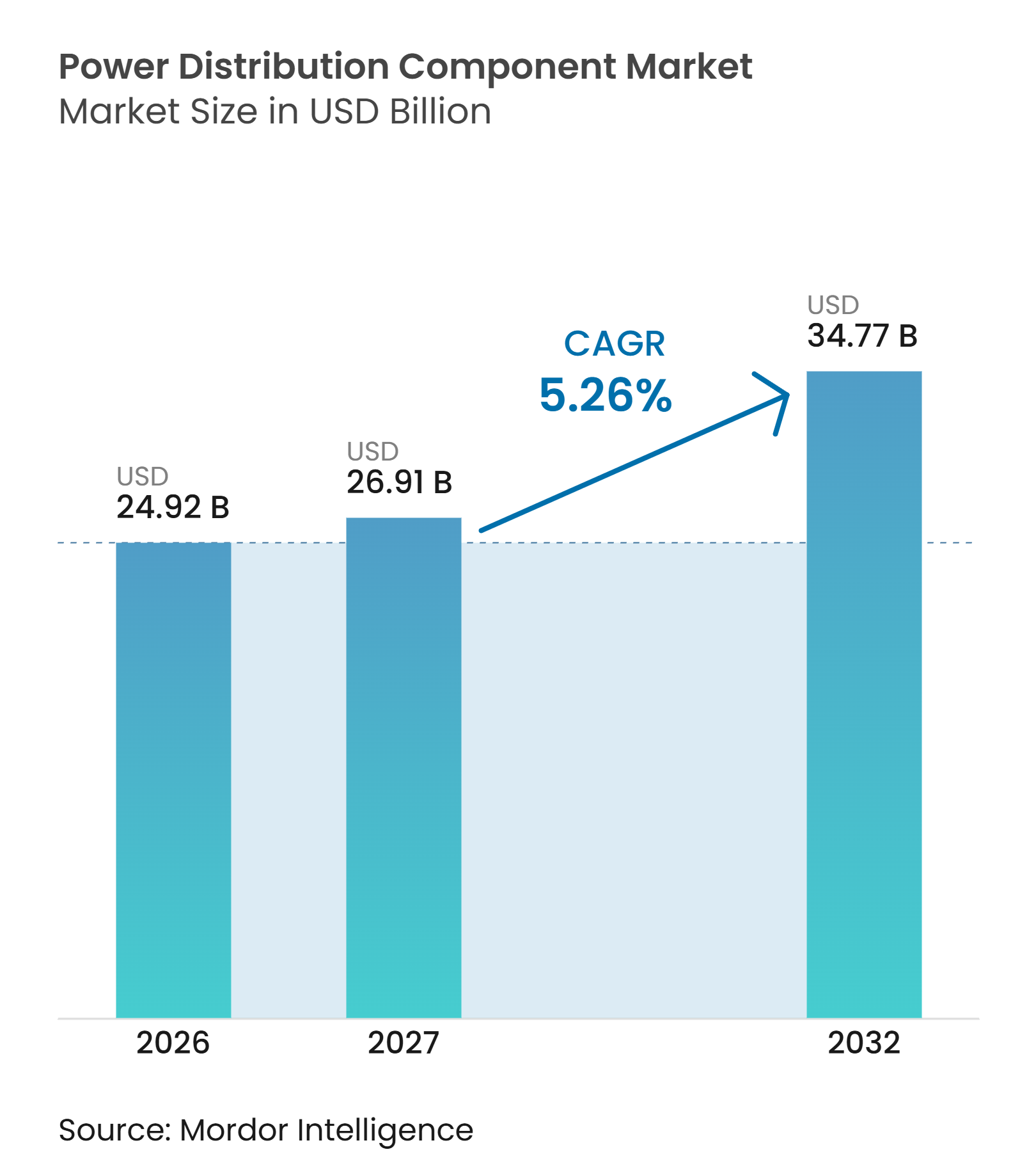
The Power Distribution Component Market size is projected to expand from USD 24.92 billion in 2026 and USD 26.91 billion in 2027 to USD 34.77 billion by 2032, at a CAGR of 5.26% between 2027 and 2032. The power distribution components market is supported by replacement needs in aging grids, new renewable connections, and higher electricity demand from transport, buildings, factories, and data centers. Utilities are also moving from individual equipment purchases toward larger packages that combine switching, protection, and monitoring equipment. Supply constraints in high-voltage equipment make production capacity, certified designs, and reliable delivery important competitive factors. The power distribution components market also faces higher equipment costs during the shift to SF₆-free designs and delays in grid connection approvals. These conditions favor suppliers that can support utilities from equipment design through commissioning in the power distribution components market.
Key Report Takeaways
- By product type, switchgear held 35.4% of the power distribution components market share in 2026, while motor control panels are forecast to grow at a 5.7% CAGR through 2032.
- By voltage rating, below 11 kV held 29.6% of the power distribution components market share in 2026, while above 132 kV is forecast to grow at a 5.9% CAGR through 2032.
- By insulation type, air-insulated components held 57.1% revenue share in 2026, while vacuum-insulated components are forecast to grow at a 6.1% CAGR through 2032.
- By end-use industry, energy and utilities held 27.8% revenue share in 2026, while data centers and IT infrastructure are forecast to grow at a 6.9% CAGR through 2032.
- By geography, Asia-Pacific held 41.4% revenue share in 2026 and is forecast to grow at a 5.5% CAGR through 2032.
Note: Market numbers in this report are based on Mordor Intelligence's proprietary estimation framework, which combines nine months of actuals with Q4 projections for base year 2026.
Market Trends and Insights
Drivers Impact Analysis of Power Distribution Component Market*
| Driver | (~) % Impact on CAGR Forecast | Geographic Relevance | Impact Timeline |
|---|---|---|---|
| Grid Modernization and Aging-Asset Replacement | +1.3% | Global, with strong need in North America, Europe, and Japan | Short term (≤ 2 years) |
| Renewable-Energy Integration and Network Expansion | +1.0% | Global, with Asia-Pacific, Europe, and South America leading by volume | Medium term (2-4 years) |
| Electrification of Transport, Buildings and Industry | +0.6% | North America, Europe, China, and India | Medium term (2-4 years) |
| Artificial-Intelligence Data-Center Load Growth | +0.7% | North America, Europe, Southeast Asia, and the Middle East and Africa | Short term (≤ 2 years) |
| Smart-Grid, Internet of Things (IoT) and Distribution-Automation Adoption | +0.4% | Global, with early gains in the United States, Germany, South Korea, and Australia | Long term (≥ 4 years) |
| Railway Electrification and Medium-Voltage Network Expansion | +0.2% | Europe, India, Southeast Asia, and the Middle East | Medium term (2-4 years) |
| Source: Mordor Intelligence | |||
Grid Modernization and Aging-Asset Replacement
Replacement of aging distribution equipment remains a stable source of demand for the power distribution components market. The U.S. Department of Energy reported that 55% of in-service distribution transformers, or nearly 40 million units, exceed their 33-year expected service life. A transformer replacement can also require associated switchgear, protection relays, and busbars, which expands the value of a utility order. This creates a practical advantage for suppliers that can deliver compatible equipment across several product lines. T&D Europe reported more than EUR 9 billion in announced manufacturing capacity investments by its 11 members between June 2024 and May 2025.[1] The replacement backlog gives the power distribution components market a demand base that is less dependent on new construction cycles.
Renewable-Energy Integration and Network Expansion
Wind and solar generation create operating conditions that call for faster protection and more flexible switching equipment. A 2025 review in Energy Reports identified voltage control, system inertia, and operational congestion as key challenges in distribution grids with high levels of intermittent renewable generation.[2] Renewable projects increasingly need substation packages as part of their grid connection requirements. This shifts some buying decisions from utilities to project developers and engineering contractors. The Energy Transitions Commission projects annual global grid investment requirements to reach USD 850 billion in the 2030s, compared with USD 370 billion in 2024, with distribution accounting for 28% of the required investment.[3] This investment pipeline supports demand for the power distribution components market across protection, switching, and interconnection equipment.
Electrification of Transport, Buildings and Industry
Fast-charging hubs above 150 kW require dedicated switching and protection equipment that resembles a compact medium-voltage substation. The same pattern is visible in heat-pump connections, battery storage, and automated production lines. E.ON announced a procurement program of more than EUR 6 billion for cables, switchgear, and transformers to support German grid connections for electrification and renewable generation.[4] These projects increase demand for equipment that can manage variable loads and bidirectional power flows. Motor-driven processes in water, wastewater, and industrial sites also require control panels with variable-frequency drives. This broadening connection base supports the power distribution components market beyond traditional utility spending.
Artificial-Intelligence Data-Center Load Growth
Data center developers are securing electrical equipment earlier in project planning because switchgear and transformers can determine the delivery schedule. The International Energy Agency expects global data center electricity use to rise from 415 TWh in 2024 to 945 TWh by 2030. GE Vernova reported USD 2.4 billion in data center-related orders in the first quarter of 2026, exceeding its full-year 2025 total. Powell Industries reported an April 2026 data center switchgear order exceeding USD 400 million and a total backlog of USD 2.4 billion. ABB has stated that 800 V DC systems can reduce current from 12,500 A to 750 A in high-density data center applications, changing busbar and switchgear design requirements. This concentrated load growth is accelerating orders in the power distribution components market.
Restraints Impact Analysis of Power Distribution Component Market*
| Restraint | (~) % Impact on CAGR Forecast | Geographic Relevance | Impact Timeline |
|---|---|---|---|
| High Upfront Cost of Advanced and SF₆-Free Equipment | -0.5% | Europe, North America, and emerging markets | Short term (≤ 2 years) |
| Limited Grid Capacity and Interconnection Bottlenecks | -0.4% | North America, Europe, and Asia-Pacific | Medium term (2-4 years) |
| Raw-Material Price Volatility and Component Lead Times | -0.3% | Global, with high exposure in high-voltage equipment | Short term (≤ 2 years) |
| Cybersecurity Exposure in Connected Substations | -0.2% | North America and Europe, with early adoption in Asia-Pacific | Long term (≥ 4 years) |
| Source: Mordor Intelligence | |||
High Upfront Cost of Advanced and SF₆-Free Equipment
The shift away from SF₆ raises upfront equipment costs for utilities and industrial buyers. Schneider Electric's AirSeT and ABB's SF₆-free UniSec offerings require new manufacturing capacity and component designs. The European Commission found in its October 2025 market survey that one manufacturer did not expect full compliant high-voltage production above 145 kV until late 2026 or 2027. Limited supply can delay price reductions during the technology transition. Utilities that recover costs through multi-year tariff reviews may not be able to pass through higher capital costs quickly. Financing access is also uneven for smaller utilities in emerging economies, which can slow adoption in parts of the power distribution components market.
Limited Grid Capacity and Interconnection Bottlenecks
Grid connection queues can postpone projects that would otherwise require new distribution equipment. The World Resources Institute reported that power constraints can extend data center construction schedules by 24 to 72 months. Equipment shortages add to permitting and transmission constraints. Grid-enhancing technologies can improve available transmission capacity, but they do not eliminate the need for distribution-side switching and protection upgrades. Delayed connections can defer orders even when end-user demand remains strong. This creates an execution risk for equipment suppliers, utilities, and the power distribution components market.
*Our forecasts treat driver/restraint impacts as directional, not additive. The impact forecasts reflect baseline growth, mix effects, and variable interactions.
Power Distribution Component Market Segment Analysis
By Product Type:
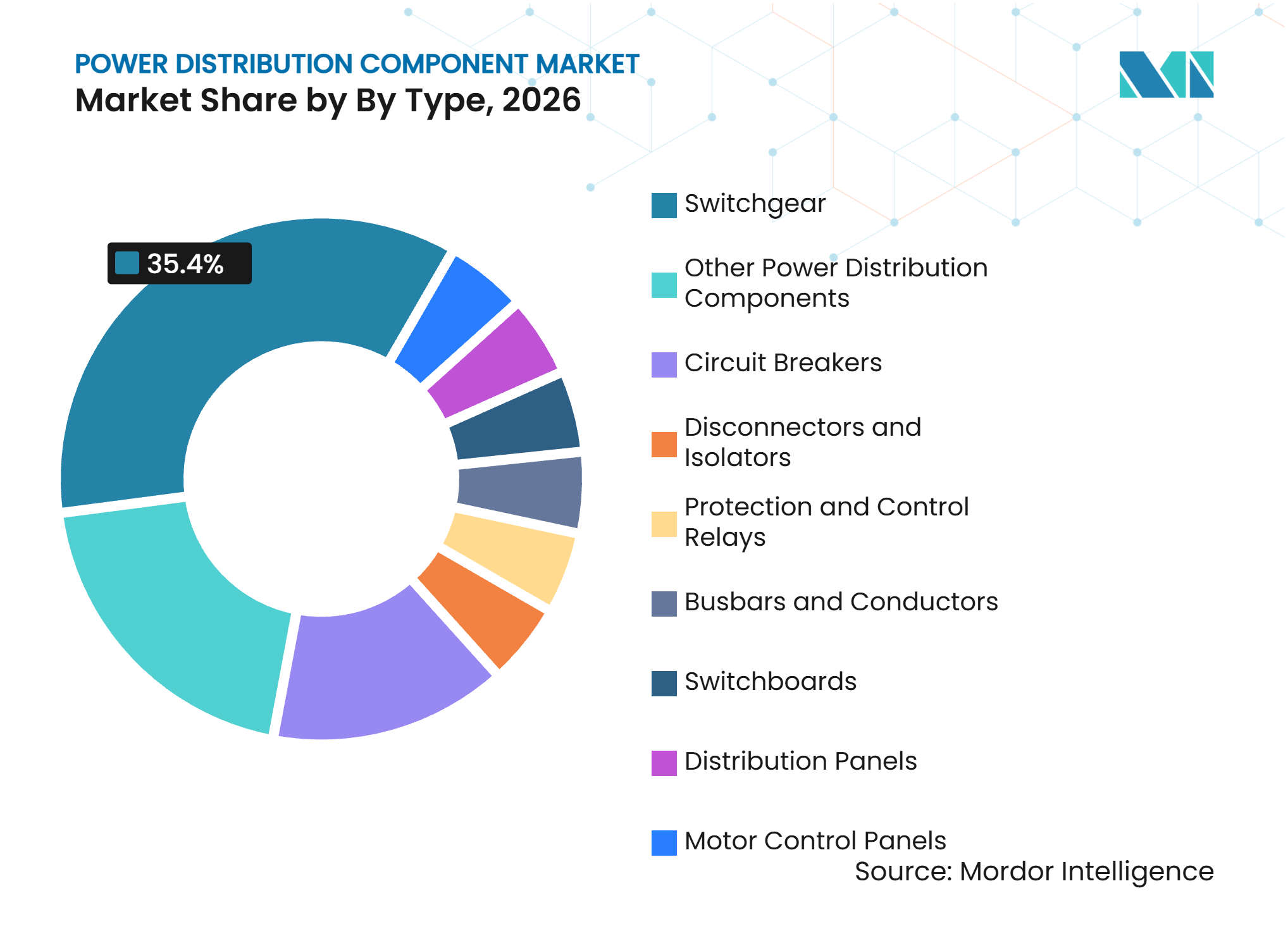
Motor Control Panels Drive the Next Growth CycleSwitchgear held 35.4% of revenue in 2026, making it the largest product category in utility, industrial, and commercial installations. Its scale reflects the need for circuit protection at every voltage level and in nearly every electrical network configuration. Circuit breakers, disconnectors, and protection relays are commonly purchased with switchgear because they protect the same feeders and substation bays. Switchboards and distribution panels also serve offices, mixed-use projects, and commercial facilities, linking demand to building electrification. This broad application base gives the power distribution components market a recurring replacement layer alongside new construction demand.
Motor control panels are forecast to record the fastest 5.7% CAGR through 2032, supported by data center cooling, automated manufacturing, and pumping applications. Eaton reported that data center orders were 200% above the prior-year level in the fourth quarter of 2025. LS ELECTRIC reported more than USD 673 million in data center orders in a single year. Variable-frequency drive panels help operators manage energy use and control motor performance in water, wastewater, and industrial facilities. The power distribution components industry benefits when suppliers combine panel design, protection devices, busbars, and power quality capability in one system.



By Voltage Rating:
Ultra-High-Voltage Tier Moves from Fringe to Growth EngineBelow 11 kV held 29.6% of revenue in 2026, supported by the large volume of residential, commercial, and light-industrial connections. This voltage band is central to local networks, building equipment, and frequent equipment replacement in mature distribution systems. The 11 kV to 33 kV and 33 kV to 66 kV bands serve distribution feeders and industrial supply, while 66 kV to 132 kV connects larger networks. Each range requires different insulation, testing, and protection settings, so suppliers must maintain broad technical portfolios. This mix gives the power distribution components market a wide installed base across local, regional, and industrial networks.
Above 132 kV is forecast to grow at a 5.9% CAGR through 2032 as high-voltage direct current projects, cross-border links, and offshore wind connections expand. State Grid Corporation of China announced CNY 4 trillion in fixed-asset investment for 2026 to 2030, including a target to expand cross-provincial transmission capacity by 30%. Extra-high-voltage projects require specialized gas-insulated switchgear, breakers, and protection systems at each transmission node. Japan and South Korea also require corrosion-resistant equipment for offshore wind applications, including SF₆-free designs. The power distribution components market benefits because a transmission connection needs several coordinated equipment packages, not a single switching device.
By Insulation Type:
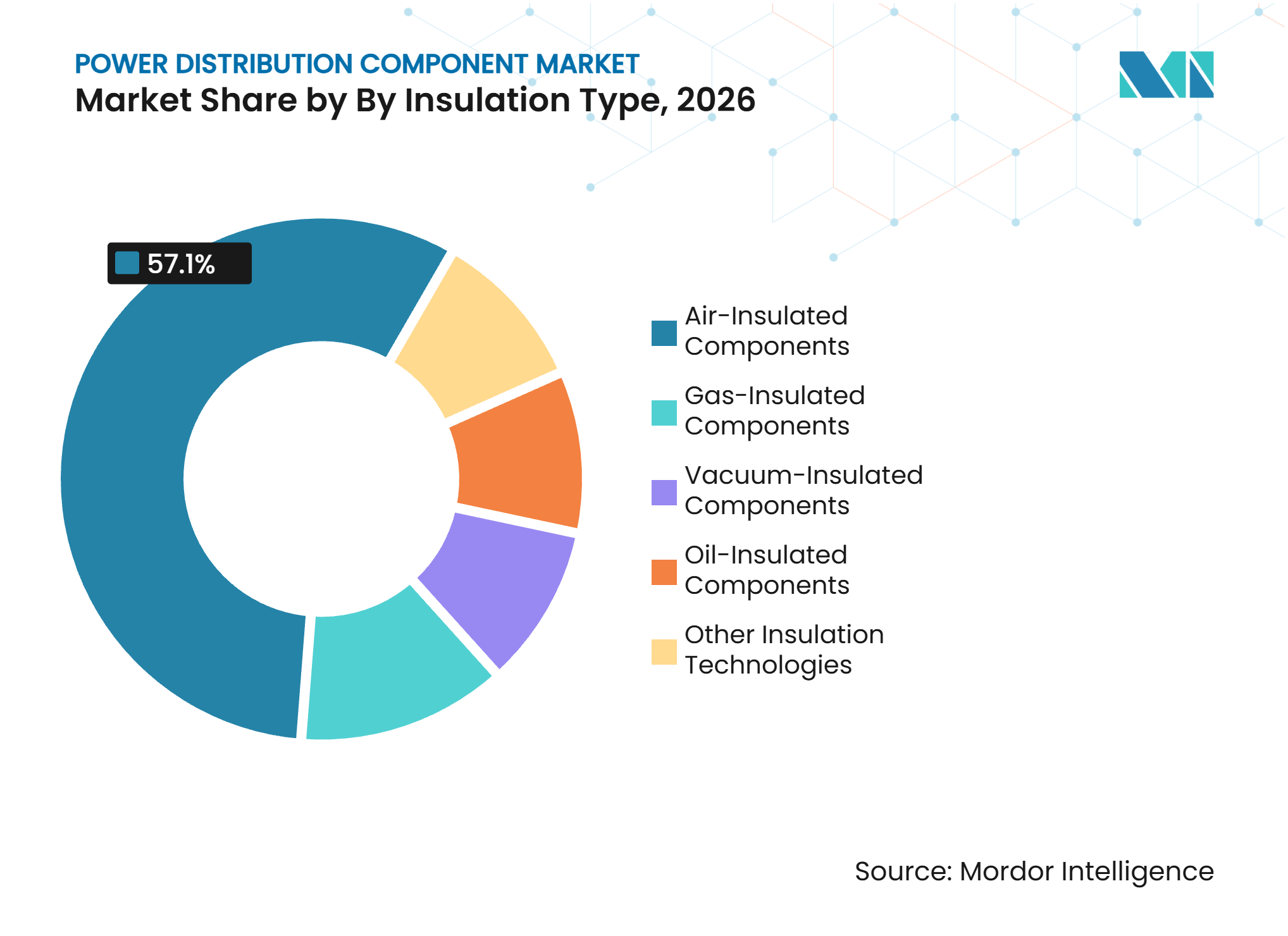
Vacuum Technology Rises as SF₆ Exits the Distribution TierAir-insulated components held 57.1% of revenue in 2026 and remained the largest insulation category across low and medium-voltage applications. They are cost-effective, familiar to field teams, and practical to maintain where space constraints are limited. Gas-insulated components remain important in dense urban sites and high-voltage applications where compact design matters. Oil-insulated and older technologies continue to support refurbishment needs in systems that remain in service. The installed base and available service skills keep air insulation central to the power distribution components market.
Vacuum-insulated components are forecast to grow at a 6.1% CAGR through 2032 as buyers prepare for the SF₆ transition. Schneider Electric states that more than 150,000 SF₆-free medium-voltage functions have been installed through its AirSeT platform. EU F-gas rules establish a staged path away from SF₆ in new medium-voltage equipment, beginning with 24 kV equipment in 2026. Manufacturers are changing designs, testing, and production capacity, while technical standards influence how new equipment is specified. The power distribution components industry faces higher entry barriers when customers require certified performance and established service support.

By End-Use Industry:
Data Centers Emerge as a Structural Demand CenterEnergy and utilities held 27.8% of revenue in 2026, reflecting their role as the main buyers of transmission and distribution equipment. Industrial facilities also require recurring replacement and expansion of power distribution assets, while oil and gas sites need rugged equipment for demanding conditions. Residential and commercial buildings buy large volumes of low-voltage equipment even though individual orders have lower values. Transportation and railways require dedicated medium-voltage traction equipment as networks become more electrified. These end uses give the power distribution components market a diverse base of recurring demand.
Data centers and IT infrastructure are forecast to grow at a 6.9% CAGR through 2032, making this the fastest-growing end-use segment. GE Vernova reported that air-insulated switchgear represented nearly USD 5 billion of its electrification equipment backlog in the second quarter of 2026. The company planned 10,500 air-insulated switchgear shipments in 2026, compared with 9,000 units in 2025. Hyperscale operators order against computing capacity plans, which shortens conventional equipment planning cycles and increases the value of delivery certainty. The power distribution components market also serves healthcare and institutional sites that need high-reliability systems with emergency-power integration.
Geography Analysis
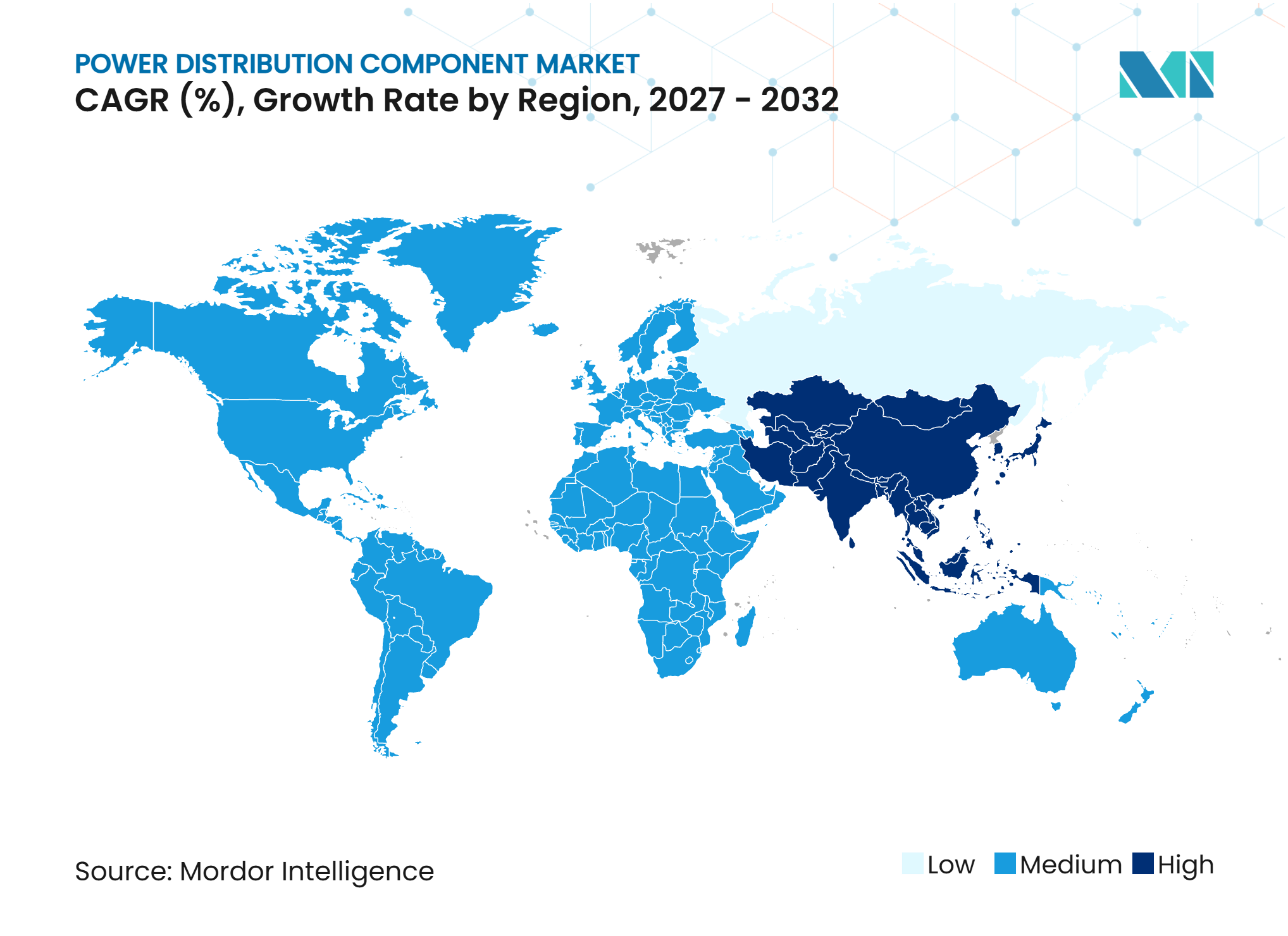
Asia-Pacific held 41.4% of revenue in 2026 and is forecast to expand at a 5.5% CAGR through 2032. China is a major source of regional demand because its 2026 to 2030 State Grid investment plan totals CNY 4 trillion. The plan covers higher cross-provincial transmission capacity and continued distribution network expansion. India also has a significant grid pipeline, with the Central Electricity Authority supporting new network capacity. Japan, South Korea, Indonesia, and Thailand add demand through offshore wind and grid reinforcement requirements, supporting the power distribution components market across several equipment categories.
Europe is a key region for regulatory change and technology adoption. The European Union's F-gas requirements are pushing utilities and suppliers toward SF₆-free medium-voltage systems. Germany's grid modernization is linked to electrification, renewable energy, and industrial demand. Siemens committed EUR 300 million in July 2026 to expand switchgear manufacturing in Frankfurt and build a supply facility in Offenbach. The United Kingdom, Poland, France, and Spain add demand through offshore wind, grid transition, rural connections, and electric vehicle (EV) charging, creating a sustained project pipeline for the power distribution components market.
North America combines grid replacement needs with rapid data center development. GE Vernova announced almost USD 600 million in U.S. factory investment in January 2025, including switchgear capacity. South America requires ruggedized medium-voltage equipment for Brazil's network expansion and Chile's mining sector, while the Middle East and Africa are building higher-voltage capacity through clean-energy projects and national grid upgrades. Standards alignment with International Electrotechnical Commission (IEC) requirements can broaden supplier participation in regional tenders and extend the power distribution components market into new infrastructure programs.
Competitive Landscape
Market Concentration
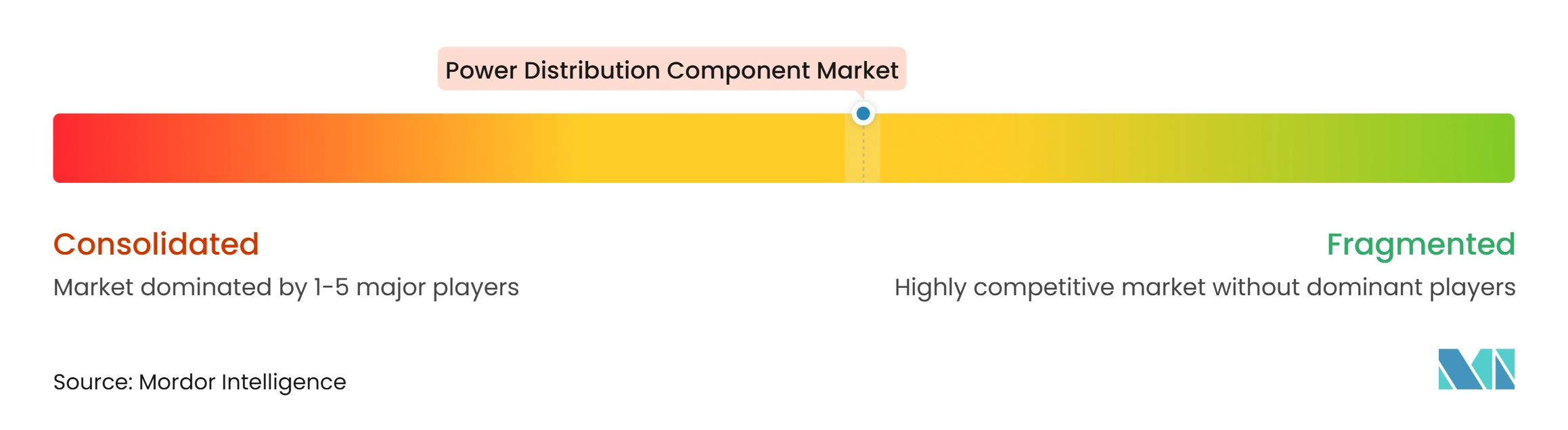
The power distribution components market is moderately concentrated among major global suppliers and fragmented across smaller regional manufacturers. ABB, Siemens, Schneider Electric, Hitachi Energy, and GE Vernova compete for large utility and data center contracts. CHINT, LS ELECTRIC, and WEG have strong regional positions and compete in selected international tenders. Scale in manufacturing, certification, and engineering support matters because integrated suppliers can provide switchgear, relays, breakers, and busbars in a single package.
Capacity expansion is a central competitive response to higher order volumes. ABB announced USD 200 million in medium-voltage manufacturing investment across Europe in May 2026, including a USD 100 million facility in Dalmine, Italy. The program includes air-insulated and SF₆-free switchgear, gas-insulated switchgear, vacuum interrupters, and protection relays. Siemens' July 2026 German program is intended to add capacity for data center, e-mobility, and industrial equipment. These investments aim to improve delivery times and strengthen local manufacturing coverage.
Open opportunities include SF₆-free equipment above 145 kV, prefabricated data center distribution systems, and connected protection systems. The European Commission's 2025 survey indicated that large-scale compliant high-voltage supply may not fully ramp until 2026 or 2027. ABB deployed its UniSec V500 SF₆-free switchgear for Enedis across French substations in June 2026. Powell Industries shows that a specialist can win a major order with certified designs and available capacity. These conditions favor vendors that pair certified products with responsive local service and reliable manufacturing capacity.
Power Distribution Component Industry Leaders
-
Schneider Electric SE
-
ABB Ltd.
-
Siemens AG
-
Eaton Corporation plc
-
GE Vernova Inc.
- *Disclaimer: Major Players sorted in no particular order
Power Distribution Component Market Companies Covered in this Report
- ABB Ltd.
- Bharat Heavy Electricals Limited
- CG Power and Industrial Solutions Limited
- CHINT Group Corporation
- Eaton Corporation plc
- Fuji Electric Co., Ltd.
- G&W Electric Company
- GE Vernova Inc.
- HD Hyundai Electric Co., Ltd.
- Hitachi Energy Ltd.
- Hubbell Incorporated
- Hyosung Heavy Industries Corporation
- Larsen & Toubro Limited
- LS ELECTRIC Co., Ltd.
- Lucy Electric UK Limited
- Mitsubishi Electric Corporation
- Ormazabal International S.L.U.
- Powell Industries, Inc.
- Rittal GmbH & Co. KG
- S&C Electric Company
- Schneider Electric SE
- Siemens AG
- TBEA Co., Ltd.
- Toshiba Energy Systems and Solutions Corporation
- WEG S.A.
Recent Industry Developments in Power Distribution Component Market
- October 2026: Siemens announced more than USD 200 million across two new U.S. facilities in Pendergrass, Georgia, and Grand Prairie, Texas, to produce electrical switchgear and distribution panels for AI data centers, creating over 1,500 jobs.
- July 2026: Siemens committed EUR 300 million to expand switchgear manufacturing in Frankfurt am Main and build a new supplier facility in Offenbach, Germany, targeting data center, e-mobility, and industrial end markets, with production at the new facility expected to begin in spring 2027 and up to 700 jobs planned by 2030.
- May 2026: ABB announced USD 200 million in medium-voltage manufacturing across Europe, including a USD 100 million facility in Dalmine, Italy, and 5 additional national-factory expansions producing air-insulated and SF₆-free switchgear, gas-insulated switchgear, vacuum interrupters, and protection relays.
- April 2026: Powell Industries received a medium-voltage switchgear order exceeding USD 400 million from a data center operator, lifting its total backlog to USD 2.4 billion.
Global Power Distribution Component Market Report Scope
Power distribution components are electrical devices and assemblies used to control, protect, isolate, and distribute electrical power from substations and distribution networks to end users across residential, commercial, industrial, and infrastructure applications. These components include switchgear, circuit breakers, disconnectors and isolators, protection and control relays, busbars and conductors, switchboards, distribution panels, and motor control panels. They are designed to manage electrical loads, interrupt fault currents, prevent equipment damage, facilitate safe maintenance, and ensure reliable power delivery across different voltage levels. Power distribution components are commonly installed in electrical substations, utility distribution networks, commercial buildings, industrial facilities, data centers, healthcare institutions, transportation infrastructure, and oil and gas installations. Depending on voltage requirements, operating conditions, and installation environments, these components incorporate different insulation technologies, including air, gas, vacuum, and oil insulation.
The Global Power Distribution Component Market is segmented by product type, voltage rating, insulation type, and end-use industry. By product type, the market is segmented into switchgear, circuit breakers, disconnectors and isolators, protection and control relays, busbars and conductors, switchboards, distribution panels, motor control panels, and other power distribution components. By voltage rating, the market is segmented into below 11 kV, 11 kV to 33 kV, above 33 kV to 66 kV, above 66 kV to 132 kV, and above 132 kV. By insulation type, the market is segmented into air-insulated components, gas-insulated components, vacuum-insulated components, oil-insulated components, and other insulation technologies. By end-use industry, the market is segmented into residential, commercial buildings, industrial facilities, energy and utilities, data centers and IT infrastructure, oil and gas, transportation and railways, healthcare and institutional facilities, and other end-use industries. The report also covers the market size and forecasts for the global power distribution component market across 26 countries in key regions, including North America, Europe, Asia-Pacific, South America, and the Middle East and Africa. For each segment, market sizing and forecasts are provided on the basis of value (USD).
Segmentation Overview
| Switchgear |
| Circuit Breakers |
| Disconnectors and Isolators |
| Protection and Control Relays |
| Busbars and Conductors |
| Switchboards |
| Distribution Panels |
| Motor Control Panels |
| Other Power Distribution Components |
| Below 11 kV |
| 11 kV to 33 kV |
| Above 33 kV to 66 kV |
| Above 66 kV to 132 kV |
| Above 132 kV |
| Air-Insulated Components |
| Gas-Insulated Components |
| Vacuum-Insulated Components |
| Oil-Insulated Components |
| Other Insulation Technologies |
| Residential |
| Commercial Buildings |
| Industrial Facilities |
| Energy and Utilities |
| Data Centers and IT Infrastructure |
| Oil and Gas |
| Transportation and Railways |
| Healthcare and Institutional Facilities |
| Other End-Use Industries |
| North America | United States |
| Canada | |
| Mexico | |
| Europe | Germany |
| France | |
| Italy | |
| Spain | |
| United Kingdom | |
| Poland | |
| Russia | |
| Rest of Europe | |
| Asia-Pacific | China |
| India | |
| Japan | |
| South Korea | |
| Australia | |
| Indonesia | |
| Vietnam | |
| Thailand | |
| Rest of Asia-Pacific | |
| South America | Brazil |
| Argentina | |
| Chile | |
| Rest of South America | |
| Middle East and Africa | Saudi Arabia |
| United Arab Emirates | |
| Egypt | |
| South Africa | |
| Morocco | |
| Rest of Middle East and Africa |
| By Product Type | Switchgear | |
| Circuit Breakers | ||
| Disconnectors and Isolators | ||
| Protection and Control Relays | ||
| Busbars and Conductors | ||
| Switchboards | ||
| Distribution Panels | ||
| Motor Control Panels | ||
| Other Power Distribution Components | ||
| By Voltage Rating | Below 11 kV | |
| 11 kV to 33 kV | ||
| Above 33 kV to 66 kV | ||
| Above 66 kV to 132 kV | ||
| Above 132 kV | ||
| By Insulation Type | Air-Insulated Components | |
| Gas-Insulated Components | ||
| Vacuum-Insulated Components | ||
| Oil-Insulated Components | ||
| Other Insulation Technologies | ||
| By End-Use Industry | Residential | |
| Commercial Buildings | ||
| Industrial Facilities | ||
| Energy and Utilities | ||
| Data Centers and IT Infrastructure | ||
| Oil and Gas | ||
| Transportation and Railways | ||
| Healthcare and Institutional Facilities | ||
| Other End-Use Industries | ||
| By Geography | North America | United States |
| Canada | ||
| Mexico | ||
| Europe | Germany | |
| France | ||
| Italy | ||
| Spain | ||
| United Kingdom | ||
| Poland | ||
| Russia | ||
| Rest of Europe | ||
| Asia-Pacific | China | |
| India | ||
| Japan | ||
| South Korea | ||
| Australia | ||
| Indonesia | ||
| Vietnam | ||
| Thailand | ||
| Rest of Asia-Pacific | ||
| South America | Brazil | |
| Argentina | ||
| Chile | ||
| Rest of South America | ||
| Middle East and Africa | Saudi Arabia | |
| United Arab Emirates | ||
| Egypt | ||
| South Africa | ||
| Morocco | ||
| Rest of Middle East and Africa | ||
Key Questions Answered in the Report
What is the forecast for power distribution components through 2032?
The sector is projected to grow from USD 24.92 billion in 2026 to USD 34.77 billion by 2032, at a 5.26% CAGR, led by grid renewal, new connections, and capacity upgrades globally over the forecast period.
Which product category has the largest share?
Switchgear leads product demand with 35.4% revenue share in 2026 because utilities, factories, and buildings all require circuit protection.
Which equipment type is expected to grow fastest?
Motor control panels are projected to expand at a 5.7% CAGR through 2032, supported by cooling, manufacturing, and pumping systems.
Why are data centers increasing demand for electrical equipment?
Data centers require early procurement of switchgear and protection systems, while global data center electricity use is projected to reach 945 TWh by 2030.
Which region leads global demand?
Asia-Pacific leads with 41.4% revenue share in 2026 and is forecast to grow at a 5.5% CAGR through 2032, supported by Chinese and Indian grid investment.
How is the SF₆ phaseout affecting equipment procurement?
The 2026 EU rules for new 24 kV equipment are encouraging purchases of vacuum and other SF₆-free switchgear designs, changing product testing, supplier qualification, and factory planning decisions.