
Personal Care Services Market Size and Share
Market Overview
| Study Period | 2021 - 2031 |
|---|---|
| Market Size (2026) | USD 498.67 Billion |
| Market Size (2031) | USD 714.83 Billion |
| Growth Rate (2026 - 2031) | 7.47 % |
| Fastest Growing Market | North America |
| Largest Market | Asia-Pacific |
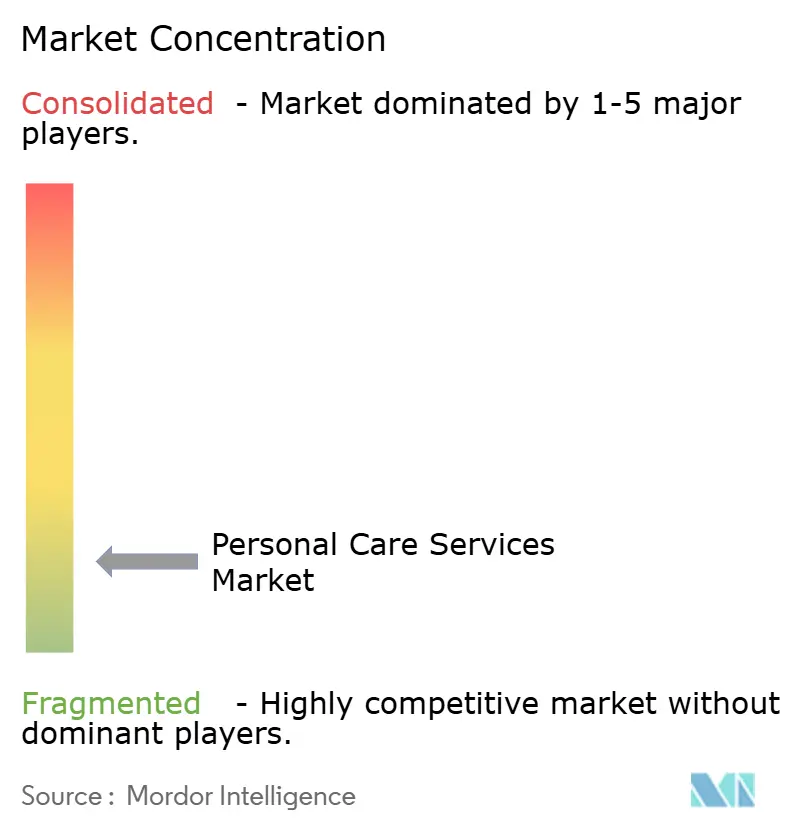
| Market Concentration | Low |
Major Players *Disclaimer: Major Players sorted in no particular order Image © Mordor Intelligence. Reuse requires attribution under CC BY 4.0. | |
Personal Care Services Market Analysis by Mordor Intelligence
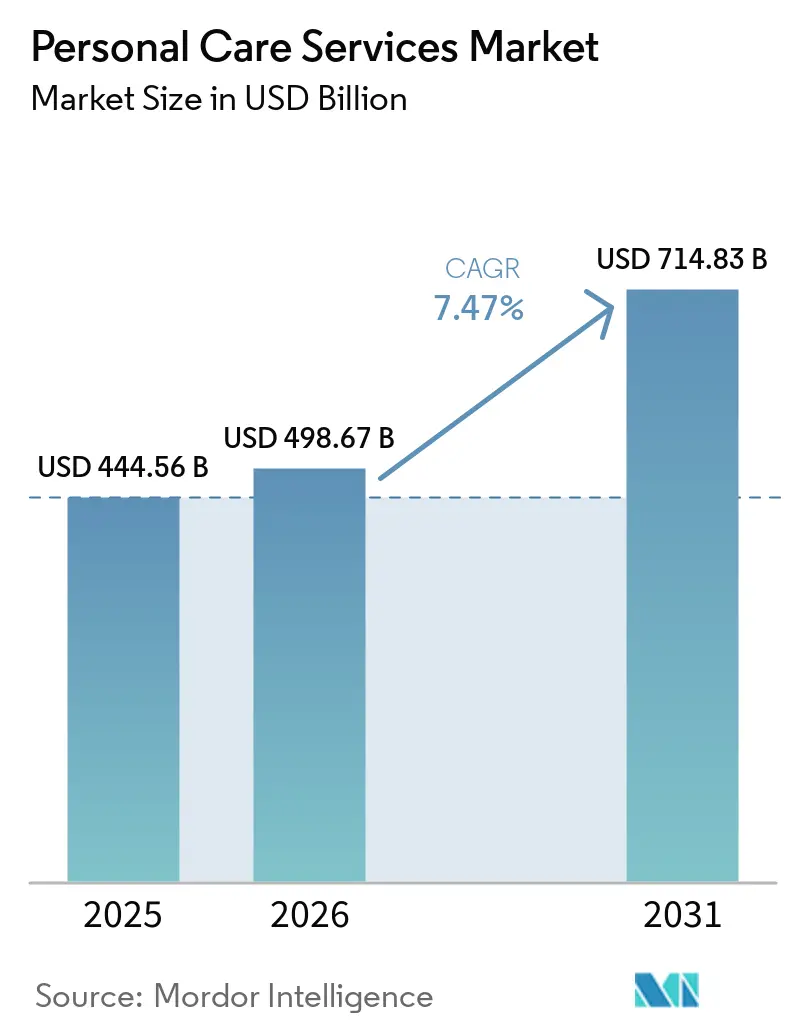
The Global Personal Care Services Market was valued at USD 444.56 billion in 2025 and estimated to grow from USD 498.67 billion in 2026 to reach USD 714.83 billion by 2031, at a CAGR of 7.47% during the forecast period (2026-2031). Growth is driven by professional grooming, wellness, and appearance-related services, which are increasingly treated as recurring household expenses rather than occasional purchases. The Global Wellness Institute reported that the global wellness economy reached USD 6.3 trillion in 2023 and is forecast to reach USD 9.8 trillion by 2029, with personal care and beauty among the segments expected to exceed USD 1 trillion by 2029[1]Global Wellness Institute, “The Global Wellness Economy Hits a Record USD 6.8 Trillion and Is Forecast to Reach USD 9.8 Trillion by 2029,” Global Wellness Institute, globalwellnessinstitute.org. Demand for specialized treatments, recurring memberships, and professional services that at-home products do not fully replace continues to support market expansion. Growth remains uneven across formats, as subscription-led models are expanding faster than the broader market, while labor availability and operating costs remain active constraints.
Key Report Takeaways
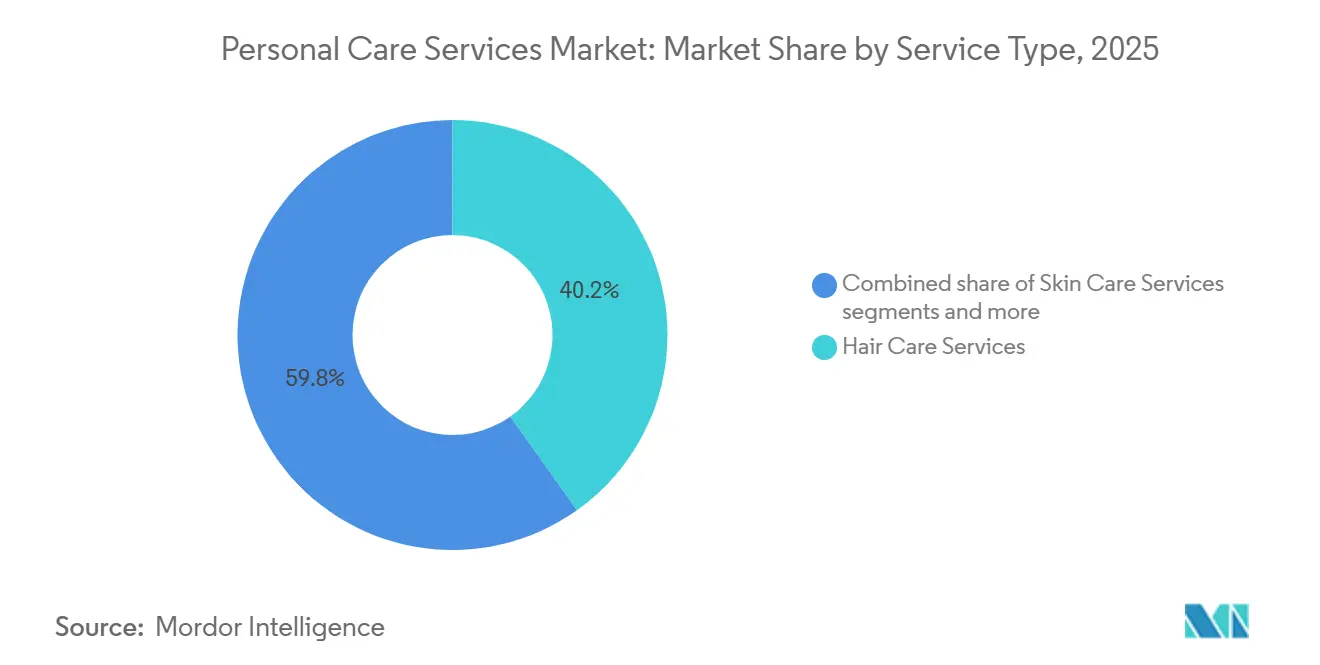
- By service type, Hair Care commanded a 40.16% share of the Global Personal Care Services Market in 2025, while Nail Care is projected to grow at the highest CAGR of 10.10% by 2031.
- By end user, Women commanded a 65.45% share of the Global Personal Care Services Market in 2025, while Men are projected to grow at the highest CAGR of 9.30% by 2031.
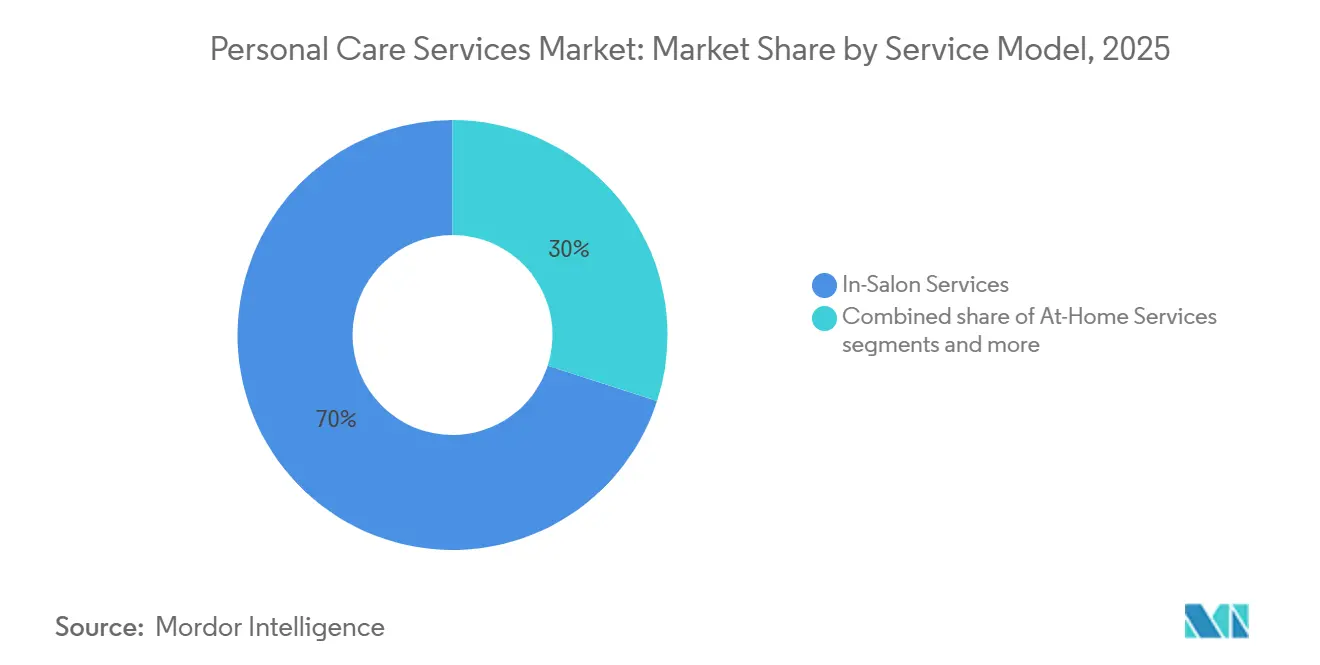
- By service model, In-Salon Services commanded a 70.03% share of the Global Personal Care Services Market in 2026, while Subscription and Membership Services are projected to grow at the highest CAGR of 12.45% by 2031.
- By price tier, Mid-Range Services commanded a 45.89% share of the Global Personal Care Services Market in 2025, while the Premium Tier is projected to grow at the highest CAGR of 10.10% by 2031.
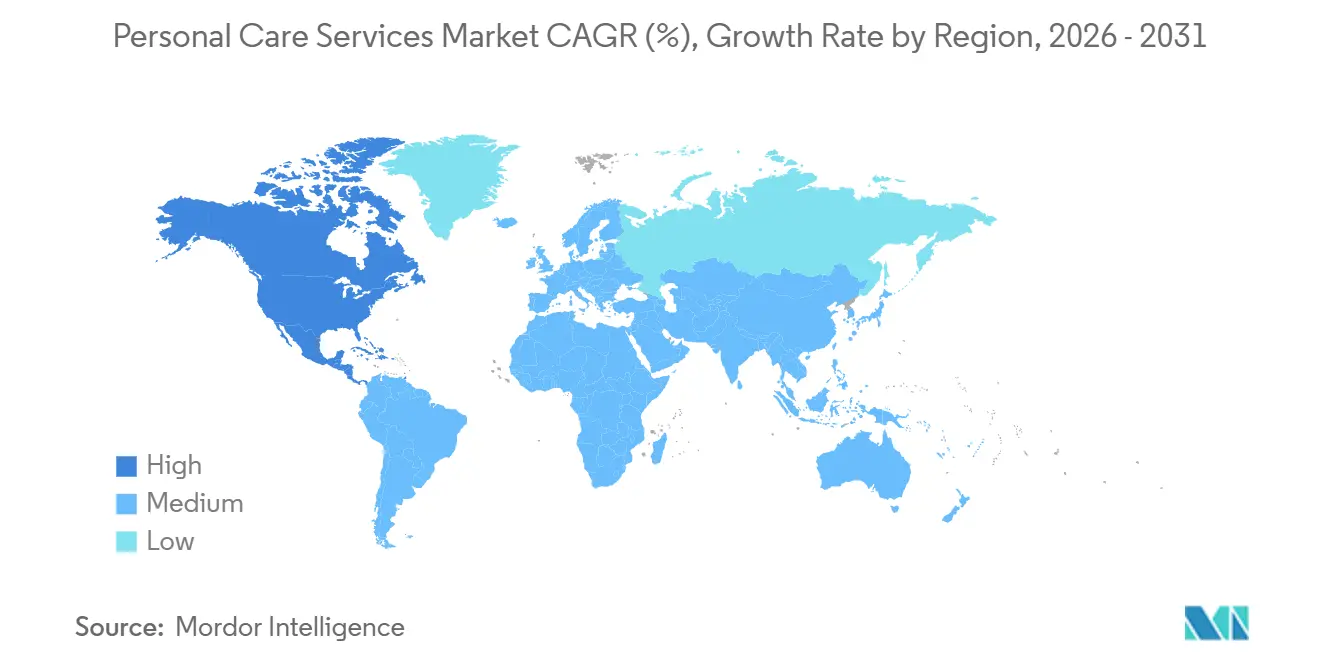
- By geography, Asia-Pacific commanded a 35.12% share of the Global Personal Care Services Market in 2025, while North America is projected to grow at the highest CAGR of 10.17% by 2031.
Note: Market size and forecast figures in this report are generated using Mordor Intelligence’s proprietary estimation framework, updated with the latest available data and insights as of January 2026.
Global Personal Care Services Market Trends and Insights
Drivers Impact Analysis*
| Driver | (~) % Impact on CAGR Forecast | Geographic Relevance | Impact Timeline |
|---|---|---|---|
| Rising Demand for Premium Grooming and Self-Care | +2.1% | Global, with concentrations in North America, Western Europe, and Asia-Pacific urban | Medium term (2-4 years) |
| Growth of Subscription and Membership-Based Salon Models | +1.5% | North America, with spillover to Western Europe and Australia | Short term (≤ 2 years) |
| Increasing Male Grooming and Specialty Service Consumption | +1.2% | Global, with the highest momentum in North America, Western Europe, and urban Asia-Pacific | Medium term (2-4 years) |
| Digitization of Booking, Payments, and Loyalty Programs | +0.9% | Global, with North America and Asia-Pacific, Europe and Middle East, and Africa following | Short term (≤ 2 years) to Medium term (2-4 years) |
| Expansion of Franchise-Led Multi-Unit Service Formats | +0.8% | North America, with Asia-Pacific as a secondary growth zone | Medium term (2-4 years) to Long term (≥ 4 years) |
| Rising Wellness-Linked Personal Care Spending | +1.0% | Global, with the strongest pull in high-income markets | Long term (≥ 4 years) |
| Source: Mordor Intelligence | |||
Rising Demand for Premium Grooming and Self-Care Experiences
Repositioning treatments as results-driven routines rather than one-time indulgences is increasing average ticket values across the global personal care services market. The Global Wellness Institute reported that personal care and beauty were one of six wellness sectors, indicating sustained consumer spending on services aligned with wellness and self-care habits. This shift is broadening demand for scalp treatments, clinical facials, and other specialist formats that deliver visible outcomes and stronger repeat rates. Wellness-linked spending is significant because it increases willingness to pay for services that combine expertise, personalization, and measurable progress. Operators that reposition their service offerings around efficacy and wellness relevance are better placed to capture higher-value demand and protect margins.
Growth of Subscription and Membership-Based Salon Models
Subscription and membership programs are improving revenue quality in the global personal care services market by converting irregular visits into recurring spending patterns. Zenoti reported 24% membership sales growth in 2024 across salons, waxing centers, and medspas, identifying memberships as a primary driver of growth across most tracked categories[2]Zenoti, “Beauty Wellness Industry Statistics 2025, The Zenoti 2025 Benchmark Report,” Zenoti, zenoti.com. This model reduces seasonal fluctuations, lowers dependence on walk-in traffic, and provides operators with a more stable base for staffing and retail planning. Digital tools are reinforcing this trend; in 2025, Great Clips stated that its mobile app had surpassed 25 million downloads following updates that expanded ReadyNext text alert functionality. The global personal care services market is moving toward a model in which booking, payments, loyalty, and memberships are integrated, improving retention and generating more predictable monthly revenue.
Increasing Male Grooming and Specialty Service Consumption
Male demand is emerging as a significant growth driver for the global personal care services market, even though women still account for the largest share of spending. This shift is driving service demand for beard sculpting, scalp care, facials, and other specialist treatments that were previously outside standard male routines. Sport Clips reinforced this trend in April 2026 when it launched its Fans First client experience commitment across nearly 1,800 locations, indicating that large operators are investing in more personalized, experience-focused male service formats. Male grooming in the global personal care services market is moving from a narrow, haircut-led category toward a broader recurring services opportunity with stronger rebooking potential.
Digitization of Booking, Payments, and Loyalty Programs
Digital systems are becoming a basic operating requirement in the personal care services market, as they improve appointment flow, reduce idle chair time, and support repeat customer engagement. Great Clips reported in 2025 that app upgrades helped lift adoption past 25 million downloads, indicating that digital check-in has become part of customer retention rather than a convenience feature. This shift also supports loyalty programs, automated reminders, and better use of customer history, enabling salons to tailor offers and rebooking prompts. The expansion of franchise-led multi-unit formats is helping larger operators standardize technology, training, and promotions across wider store networks. Large-scale operators can use data, brand consistency, and centralized systems to grow faster in dense urban markets and secondary cities where organized salon formats are still expanding.
Restraints Impact Analysis*
| Restraint | (~) % Impact on CAGR Forecast | Geographic Relevance | Impact Timeline |
|---|---|---|---|
| Labor Shortages and High Staff Turnover | -1.2% | Global, with the sharpest pressure in North America and Western Europe | Short term (≤ 2 years) to Medium term (2-4 years) |
| Sensitivity to Discretionary Spending Cycles | -0.9% | Global, with stronger exposure in lower-income consumer segments | Short term (≤ 2 years) |
| Rental and Occupancy Cost Pressure in Prime Locations | -0.7% | Urban North America, Western Europe, and Asia-Pacific tier-1 cities | Medium term (2-4 years) |
| Service Standardization Challenges Across Franchised Networks | -0.5% | North America and Europe | Long term (≥ 4 years) |
| Source: Mordor Intelligence | |||
Labor Shortages and High Staff Turnover
Labor availability remains one of the clearest restraints on the global personal care services market, as service revenue depends directly on trained staff, utilization rates, and client continuity. Vagaro reported in 2025 that 90% of service professionals across personal care industries experienced moderate to high stress, while 40% cited work-life balance challenges and 78% pointed to rising supply costs as significant financial burdens. According to Vagaro's April 2025 report, the United States Bureau of Labor Statistics projected that employment for barbers, hairstylists, and cosmetologists is expected to grow 7% through 2033, reflecting sustained demand for trained professionals rather than a short-term hiring gap[3]Vagaro, “Vagaro Vantage Report Explores Why Employment in Barber and Beauty Industries Projected to Grow Faster Than Most Industries,” BusinessWire, businesswire.com. High turnover weakens the market not only through recruitment costs but also through client migration, as customers follow individual stylists rather than the salon brand. This pressure is more pronounced in franchised systems, where rapid network expansion can expose uneven service standards if training quality, operational discipline, and staff retention do not keep pace.
Sensitivity to Discretionary Spending Cycles
Consumer spending pressure is a real restraint for the global personal care services market, as households becoming more cautious can reduce service frequency. This risk is most pronounced in higher-end and add-on categories, where clients may defer treatments, reduce service bundling, or trade down, even while maintaining core grooming appointments. Rental and occupancy costs are also narrowing unit economics in prime city locations, particularly for independent operators and formats that rely on larger store footprints. These cost pressures limit expansion flexibility and raise the break-even threshold for new outlets. Operators that rely on memberships, tighter scheduling, and higher productivity per chair are better positioned to manage demand swings and fixed-cost inflation.
*Our forecasts treat driver/restraint impacts as directional, not additive. The impact forecasts reflect baseline growth, mix effects, and variable interactions.
Segment Analysis
By Service Type: Hair Care Anchors Revenue, Nail Care Commands the Growth Agenda
Hair care accounted for 40.16% of the global personal care services market revenue in 2025, making it the largest service category. This position reflects the essential, high-frequency nature of haircuts, color, and treatment services across broad age groups and income levels. Nail care is projected to grow at a 10.10% CAGR through 2031, making it the fastest-growing service type in the market, supported by rising consumer interest in nail artistry, gel extensions, and related formats that customers prefer receiving from trained technicians.
Skin care generates less revenue than hair care but is increasingly strategic as more salons introduce clinical facials, dermaplaning, and LED-based treatments. Spa and wellness services contribute meaningfully by connecting beauty services with broader self-care routines and supporting higher average transaction values. The Global Wellness Institute's 2025 update noted that the wider wellness economy continues to expand, providing personal care and beauty with a stronger long-term spending base. For market operators, hair care provides a stable utilization floor, while nail and skin services offer stronger growth potential and clearer service differentiation, shaping investment decisions across service offerings.



By End User: Women Lead in Volume, Men Drive the Incremental Opportunity
Women accounted for 65.45% of the Global Personal Care Services Market share in 2025, making them the largest end-user segment. This position reflects both the wider range of services consumed and the higher average visit frequency across hair, skin, nail, and related categories. Men are projected to grow at a 9.30% CAGR through 2031, making them the fastest-growing end-user group in the market. This shift indicates that male spending is moving beyond routine haircuts into specialist services with higher value per visit. Children and unisex formats remain relevant as supporting categories, contributing recurring family traffic and serving markets where inclusive beauty norms are gaining ground.
Male demand is expanding as grooming routines become broader and more specialized. Sport Clips' 2026 rollout of its Fans First service commitment demonstrates how organized operators are adapting store experience, personalization, and brand positioning to retain repeat male customers. Men are entering through haircut-led channels but increasingly moving into scalp care, beard services, facials, and maintenance-oriented treatment plans. Once acquired, these customers can strengthen rebooking and attachment rates, particularly in franchise systems built around clear service routines and familiar environments.
By Service Model: In-Salon Dominance Masks Subscription's Structural Disruption
In-salon services accounted for 70.03% of the global personal care services market in 2026, confirming that professional, in-chair delivery remains the core service model. This dominance reflects the tactile, experiential, and trust-based nature of treatments that require physical execution, visible hygiene standards, and direct consultation. Subscription and membership services are forecast to expand at a 12.45% CAGR through 2031, making them the fastest-growing model in the market. At-home and mobile services are growing but function more as complements to traditional salons than as full substitutes. Market economics are shifting toward recurring and digitally managed customer relationships, while physical service delivery remains central.
Membership-led formats are gaining importance by improving visibility into repeat demand and reducing revenue volatility. Zenoti reported 24% membership sales growth in 2024 across salons, waxing centers, and medspas, highlighting the growing importance of recurring programs as a practical growth lever. Great Clips recorded app usage rising past 25 million downloads in 2025, illustrating how booking and loyalty systems are becoming part of the operating scale. These tools help salons rebook faster, reduce missed appointments, and personalize communication with less manual effort. Operators that combine strong physical service execution with technology-enabled memberships and customer history management are likely to hold a structural advantage over time.
By Price Tier: Mid-Range Holds the Center, Premium Captures the Value-Add
Mid-range services accounted for 45.89% of revenue in 2025, maintaining their dominance in the global personal care services market. This tier balances affordability with service quality, making it suitable for a broad customer base seeking professional outcomes without higher pricing. The upper tier is projected to grow at a CAGR of 10.10% through 2031, indicating faster value addition at the top end of the market compared to the mid-range. This growth is supported by specialist treatments, improved experience design, and greater consumer willingness to pay for visible or lasting results.
Economy services remain relevant, particularly in emerging markets where accessibility and routine haircuts serve as the primary entry point into organized personal care spending. The Global Wellness Institute's 2025 outlook notes that wellness-linked spending is becoming more embedded in routine consumer behavior, favoring higher-tier services aligned with self-care and outcome-focused positioning. Value-conscious consumers continue to sustain demand for mid-range and economy tires, particularly during periods of tighter household budgets. Growth at the upper end depends on demonstrating clear value, while mass-market growth depends on consistency, convenience, and stable pricing. Operators that clearly differentiate higher-tier treatment value from basic service utility are better positioned to capture both repeat visits and discretionary upgrades.
Geography Analysis
Asia-Pacific held 35.12% of the global personal care services market in 2025, making it the largest regional contributor by revenue. The region's scale is supported by urbanization, rising disposable incomes, and the influence of K-beauty and J-beauty routines, which have increased demand for multi-step, expert-administered services. NielsenIQ reported in October 2025 that Asia-Pacific led global beauty growth at 14.3%, with China's hair and skin care categories remaining strong and Douyin posting 49% growth as a beauty commerce channel. Digital beauty discovery is shortening the path from product awareness to salon appointment demand. India also remains an important part of the regional mix, as beauty demand is spreading beyond metropolitan areas and supporting organized salon expansion into smaller cities.
North America is the fastest-growing region, with a forecast CAGR of 10.17% through 2031. The Global Wellness Institute reported in 2025 that North American per-capita wellness spending stood at USD 6,029 annually. Growth is driven not only by increased traffic but also by better monetization through technology, memberships, and layered service offerings.
Europe holds a significant share, supported by a mature salon culture across Western Europe. South America, led by Brazil and Chile, is developing a stronger beauty culture, while the Middle East and Africa are attracting more investment in hospitality and lifestyle spending. Across these markets, success depends on aligning with local spending patterns, service preferences, and labor availability.

Competitive Landscape
The Global Personal Care Services Market remains highly fragmented, with leading brands accounting for only a limited portion of overall revenue, while independent salons, local service providers, and regional franchise networks continue to dominate many markets. This fragmented structure reflects the industry's relationship-driven nature, where customer loyalty, stylist expertise, convenient locations, and consistent service quality often influence purchasing decisions more than brand size alone. Major operators such as Great Clips, Regis Corporation, Sport Clips, Ulta Beauty, and Supercuts have strengthened their positions by combining recognizable brands with standardized operating models, digital appointment platforms, and disciplined franchise management.
Competition is increasingly shaped by technology adoption, operational efficiency, and scalable business models rather than network expansion alone. Recent acquisitions and private equity investments demonstrate growing confidence in franchise-based personal care platforms that generate recurring revenue through memberships, subscription programs, and standardized service delivery. These developments highlight an industry shift toward businesses that leverage digital tools, centralized operations, and customer retention programs to improve profitability and support long-term expansion.
The market also presents significant opportunities across male grooming, clinical-aesthetic services, hybrid beauty concepts, and mobile or on-demand service delivery, particularly in underserved suburban and emerging urban markets. Leading operators continue to strengthen customer experience through service innovation, digital engagement, and selective geographic expansion, while independent providers remain competitive by offering personalized services, specialized treatments, and strong local customer relationships. As a result, competitive success depends less on the size of the salon network and more on the ability to combine service quality, workforce retention, technology integration, and convenient customer access.
Personal Care Services Industry Leaders
Great Clips
Regis Corporation
Sport Clips
Ulta Beauty
Supercuts
- *Disclaimer: Major Players sorted in no particular order

Recent Industry Developments
- May 2026: General Atlantic completed a take-private of European Wax Center at an enterprise value of USD 640 million, announced on February 10, 2026, at a 45% markup to the preceding closing price. The deal removed the 1,000-plus center waxing franchise from public markets, replacing existing notes with USD 460 million of new 6.4% Class A-2 notes, reflecting private capital's view of the membership-based personal care franchise as a durable, leverageable cash flow asset.
- April 2026: Following Transom Capital Group's acquisition of WellBiz Brands from KSL Capita, the company signed 56 franchise agreements in Q1 2026 across its Drybar, Elements Massage, Amazing Lash Studio, Fitness Together, and Radiant Waxing brands. The platform operates over 700 locations across the United States, Canada, Europe, and the Middle East.
- April 2026: At its 2026 National Huddle in Louisville, Sport Clips announced its "Fans First" client experience framework across approximately 1,800 locations. The initiative focuses on a personalized in-store experience, associate investment, and partnership development, targeting the men's haircare segment amid competition from technology-enabled barbershop operators.
- March 2026: Ulta Beauty reported Q4 and full-year fiscal 2025 results, planning 50–60 net new United States stores and USD 400 - 450 million in capital expenditure for fiscal 2026. The "Ulta Beauty Unleashed" strategy includes a new regional distribution center in the Northwest, supply chain automation, and expansion of salon and wellness services across its 1,500-plus United States store network, alongside international franchise entry into the Middle East.


Global Personal Care Services Market Report Scope
| Hair Care Services |
| Skin Care Services |
| Nail Care Services |
| Spa and Wellness Services |
| Other Personal Care Services |
| Women |
| Men |
| Children |
| Unisex |
| In-Salon Services |
| At-Home Services |
| Mobile Services |
| Subscription / Membership Services |
| Premium |
| Mid-Range |
| Economy |
| North America | United States |
| Canada | |
| Mexico | |
| South America | Brazil |
| Peru | |
| Chile | |
| Argentina | |
| Rest of South America | |
| Europe | United Kingdom |
| Germany | |
| France | |
| Spain | |
| Italy | |
| BENELUX (Belgium, Netherlands, and Luxembourg) | |
| NORDICS (Denmark, Finland, Iceland, Norway, and Sweden) | |
| Rest of Europe | |
| Asia-Pacific | India |
| China | |
| Japan | |
| Australia | |
| South Korea | |
| South East Asia (Singapore, Malaysia, Thailand, Indonesia, Vietnam, and Philippines) | |
| Rest of Asia-Pacific | |
| Middle East and Africa | United Arab Emirates |
| Saudi Arabia | |
| South Africa | |
| Nigeria | |
| Rest of Middle East and Africa |
| By Service Type | Hair Care Services | |
| Skin Care Services | ||
| Nail Care Services | ||
| Spa and Wellness Services | ||
| Other Personal Care Services | ||
| By End User | Women | |
| Men | ||
| Children | ||
| Unisex | ||
| By Service Model | In-Salon Services | |
| At-Home Services | ||
| Mobile Services | ||
| Subscription / Membership Services | ||
| By Price Tier | Premium | |
| Mid-Range | ||
| Economy | ||
| By Geography | North America | United States |
| Canada | ||
| Mexico | ||
| South America | Brazil | |
| Peru | ||
| Chile | ||
| Argentina | ||
| Rest of South America | ||
| Europe | United Kingdom | |
| Germany | ||
| France | ||
| Spain | ||
| Italy | ||
| BENELUX (Belgium, Netherlands, and Luxembourg) | ||
| NORDICS (Denmark, Finland, Iceland, Norway, and Sweden) | ||
| Rest of Europe | ||
| Asia-Pacific | India | |
| China | ||
| Japan | ||
| Australia | ||
| South Korea | ||
| South East Asia (Singapore, Malaysia, Thailand, Indonesia, Vietnam, and Philippines) | ||
| Rest of Asia-Pacific | ||
| Middle East and Africa | United Arab Emirates | |
| Saudi Arabia | ||
| South Africa | ||
| Nigeria | ||
| Rest of Middle East and Africa | ||


Key Questions Answered in the Report
What is the 2031 value forecast for the Global Personal Care Services Market?
The market is forecast to reach USD 714.83 billion by 2031, rising from USD 498.67 billion in 2026 at a 7.47% CAGR.
Which service category leads global revenue?
Hair care led the market in 2025 with a 40.16% revenue share, supported by high visit frequency and broad demographic demand.
Which service category is growing the fastest through 2031?
Nail care is the fastest-growing service type, with a projected 10.10% CAGR through 2031.
Which end-user group is expanding the quickest?
Men are the fastest-growing end-user segment, with a projected 9.30% CAGR through 2031, even though women still hold the largest share.
Which region is growing the fastest?
North America is expected to post the fastest regional growth, with a 10.17% CAGR through 2031.
Page last updated on:


 Your data is secure and never sold or shared.


