
Online Education Market Size and Share
Market Overview
| Study Period | 2022 - 2032 |
|---|---|
| Market Size (2027) | USD 285.13 Billion |
| Market Size (2032) | USD 346.24 Billion |
| Growth Rate (2027 - 2032) | 3.96 % |
| Fastest Growing Market | Asia-Pacific |
| Largest Market | North America |
| Market Concentration | Low |
Major Players *Disclaimer: Major Players sorted in no particular order Image © Mordor Intelligence. Reuse requires attribution under CC BY 4.0. | |
Online Education Market Analysis by Mordor Intelligence
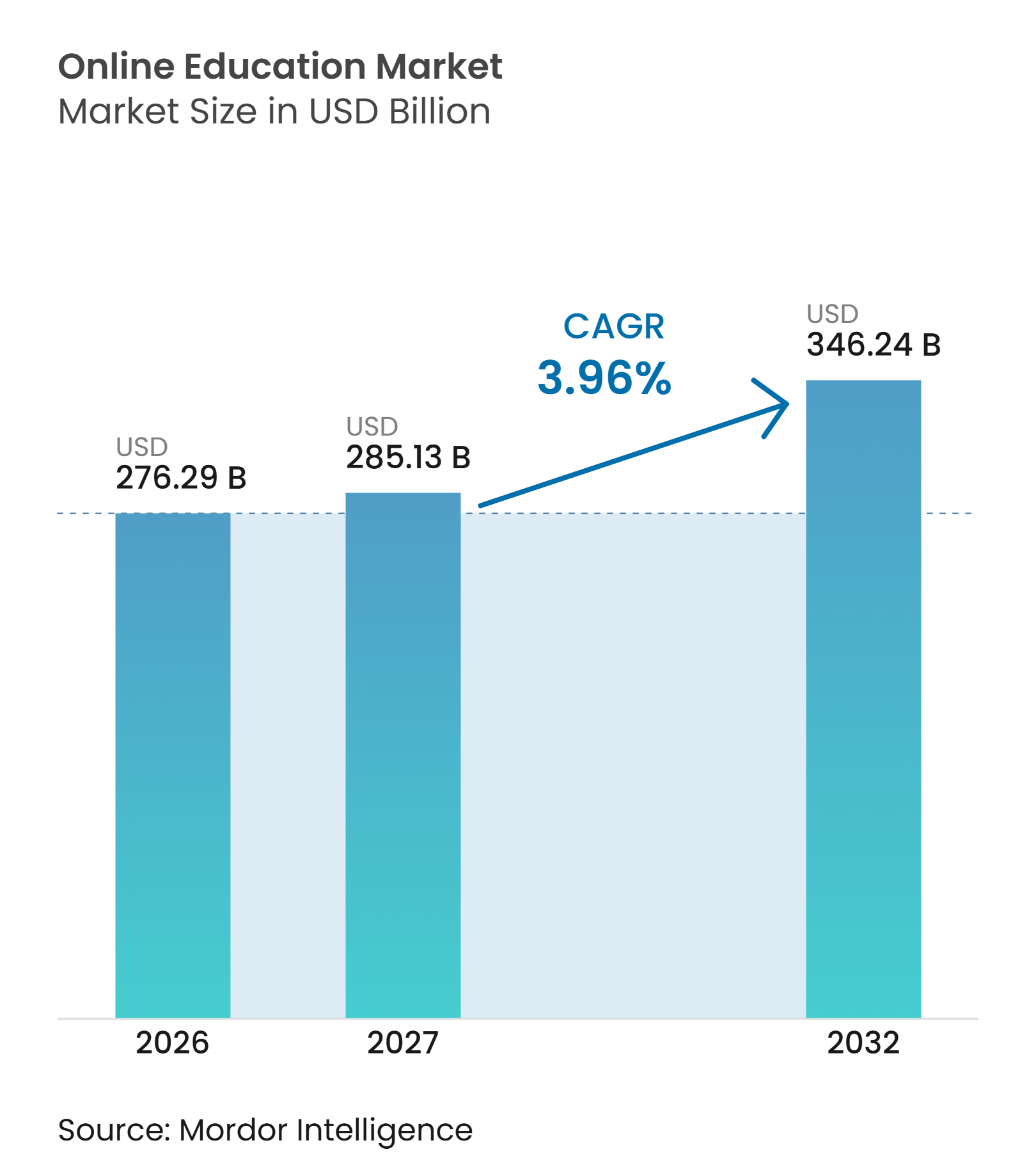
The global online education market size was valued at USD 276.29 billion in 2026 and is estimated to grow from USD 285.13 billion in 2027 to reach USD 346.24 billion by 2032, at a CAGR of 3.96% during the forecast period (2027-2032). Growth in the online education market is supported by expanding mobile connectivity, employer-funded skills programs, and public investment in digital learning systems. Competitive pressure from free and freemium offerings constrains average selling prices, while institutional contracts provide providers with a more durable revenue base. Platforms that combine consumer reach with enterprise learning, verified credentials, and workflow integrations are better positioned to increase contract values and retain buyers. Asia-Pacific remains important to the global online education market, as government platforms, industry partnerships, and a large base of mobile-first learners support affordable delivery at scale. However, low course completion rates, uneven rural connectivity, and language requirements continue to limit participation in several high-potential markets.
Key Report Takeaways
- By learning model, self-paced learning accounted for 52.60% of the global online education market share in 2026, while adaptive learning is projected to grow at a 4.85% CAGR through 2032.
- By deployment, cloud deployment accounted for 72.40% of the global online education market share in 2026 and is projected to grow at a 4.96% CAGR through 2032.
- By offering, content and courses accounted for 42.80% of the global online education market share in 2026, while assessment and credentialing is projected to grow at a 4.74% CAGR through 2032.
- By end user, individual learners accounted for 76.40% of the global online education market share in 2026, while corporate and enterprise organizations are projected to grow at a 4.68% CAGR through 2032.
- By geography, North America accounted for 35.20% of the global online education market share in 2026, while Asia-Pacific is projected to grow at a 4.41% CAGR through 2032.
Note: Market numbers in this report are based on Mordor Intelligence's proprietary estimation framework, which combines nine months of actuals with Q4 projections for base year 2026.
Market Trends and Insights
Drivers Impact Analysis of Online Education Market*
| Driver | (~) % Impact on CAGR Forecast | Geographic Relevance | Impact Timeline |
|---|---|---|---|
| Smartphone and High-Speed Internet Penetration | +0.9% | Global, with stronger gains in Asia-Pacific, Sub-Saharan Africa, and Southeast Asia | Short term (≤ 2 years) |
| Corporate Upskilling and Reskilling for AI-Enabled Work | +0.8% | Global, strongest in North America, Europe, and Asia-Pacific technology hubs | Medium term (2-4 years) |
| Government Digital-Education Initiatives | +0.6% | Asia-Pacific, Europe, and the Middle East and Africa | Medium term (2-4 years) |
| Flexibility and Cost Advantages Versus Classroom Training | +0.4% | Global, most pronounced in South America and South East Asia | Short term (≤ 2 years) |
| University, Employer, and Platform Micro-Credential Partnerships | +0.5% | North America, Australia, Europe, and early-stage Asia-Pacific and Middle East and Africa | Medium term (2-4 years) |
| AI-Powered Personalization and Automated Content Creation | +0.7% | Global, concentrated among platforms with large learner datasets | Long term (≥ 4 years) |
| Source: Mordor Intelligence | |||
Smartphone and High-Speed Internet Penetration
Mobile broadband serves as a primary entry point to the global online education market in many emerging economies. The International Telecommunication Union (ITU) reported 99 mobile broadband subscriptions per 100 inhabitants worldwide in 2025, while 5G covered 55% of the global population. It also reported that 6 billion people, or 74% of the global population, were online in 2025[1]. This infrastructure supports the global online education market by enabling short, frequent learning sessions through mobile-optimized courses, downloadable content, and low-data learning formats. Expanding digital public learning platforms are making mobile access increasingly relevant, enabling learners to access formal courses, skill development, and credit-linked programs through a single device. However, the offline population continues to constrain the global online education market, particularly in regions with limited device affordability, unreliable electricity, and inadequate broadband connectivity.
Corporate Upskilling and Reskilling for AI-Enabled Work
Corporate learning demand is shifting toward shorter programs that help employees use AI tools and build job-specific skills. LinkedIn’s 2025 Workplace Learning Report found that 49% of learning and development professionals identified a skills crisis[2]. Microsoft committed USD 4 billion over five years through its Elevate initiative to support AI cloud technology and skilling programs for schools, community colleges, and nonprofit organizations. The initiative aims to help 20 million people earn AI credentials within two years. This shift supports global online education platforms that can serve large employer cohorts, track skills progress, and integrate with talent management systems.
Government Digital-Education Initiatives
Government investment generates demand for platforms and content that differs from consumer-funded enrollment. China released a national digital education strategy in April 2025 covering AI integration, lifelong learning, and international cooperation. In 2025, the Smart Education of China platform had more than 160 million registered users and recorded over 61.3 billion views. India’s SWAYAM platform recorded more than 51.5 million enrollments across over 16,530 courses, and 401 universities permitted up to 40% credit transfer under the National Education Policy 2020. These initiatives expand access and establish digital learning standards but can increase price competition for commercial providers serving academic learners. The global online education market requires locally relevant content, interoperable systems, and alignment with national credit-transfer and quality-assurance frameworks.
Flexibility and Cost Advantages Versus Classroom Training
Online learning reduces travel and scheduling constraints for individuals unable to attend full-time programs. OECD data showed that average government expenditure per tertiary student across OECD countries was USD 15,102 in 2025, while private expenditure averaged USD 6,343. Access to online learning platforms increased from 52% to 81% of schools across OECD countries between 2020 and 2025. The cost advantage extends beyond course fees, as learners can continue working while completing short programs. This flexibility is relevant, as alternative pathways support working professionals and students seeking recognized learning alongside formal education. Employer tuition support and stackable credentials further encourage repeat learning expenditure rather than a single full-time enrollment decision.
Restraints Impact Analysis of Online Education Market*
| Restraint | (~) % Impact on CAGR Forecast | Geographic Relevance | Impact Timeline |
|---|---|---|---|
| Low Completion Rates and Learner-Engagement Friction | -0.5% | Global, most acute in the consumer MOOC segment | Short term (≤ 2 years) |
| Rural and Low-Income Connectivity Gaps | -0.4% | Sub-Saharan Africa, South Asia, rural Asia-Pacific, and parts of South America | Medium term (2-4 years) |
| Multilingual Content and Localization Complexity | -0.3% | Asia-Pacific, Middle East and Africa, South America, and parts of Europe | Medium term (2-4 years) |
| Privacy, Child-Safety, and AI-Governance Compliance Burden | -0.3% | Global, including jurisdictions with data protection and AI rules | Long term (≥ 4 years) |
| Source: Mordor Intelligence | |||
Low Completion Rates and Learner-Engagement Friction
Low course completion remains a challenge for consumer-oriented online learning platforms. A study published in 2015 analyzed 221 massive open online courses (MOOCs) and reported a median completion rate of 12.6%, with rates ranging from 0.7% to 52.1%. These findings highlight the difficulty of sustaining learner engagement, although the results should not be treated as a current industry-wide completion benchmark. A 2025 study of more than 5,000 user records found that greater video consumption and quiz participation were associated with higher completion rates[3]. For online education providers, improving learner engagement and supporting measurable learning progress may help strengthen perceived course value and retention. Platforms can explore progress reminders, personalized learning paths, interactive assessments, and coaching to address disengagement and improve the learning experience.
Rural and Low-Income Connectivity Gaps
Connectivity gaps limit access to online education in areas where it could generate the greatest social and workforce benefits. The World Bank reported in 2025 that approximately one-third of the global population remained offline, primarily in rural, low-income, and fragile settings[4]. ITU data showed that internet usage was 36% in Africa and 23% in low-income countries, compared with 94% in high-income economies. Globally, rural internet access reached 58%, versus 85% in urban areas. A World Bank assessment of AI-powered education tools in India and Nigeria identified intermittent electricity, limited device availability, and unreliable broadband as key barriers for learners who could benefit most. Providers need offline-capable, low-bandwidth, and mobile-light products to serve these areas effectively.
*Our forecasts treat driver/restraint impacts as directional, not additive. The impact forecasts reflect baseline growth, mix effects, and variable interactions.
Student & Learner Behavior Analysis
The 2025 Coursera Learner Outcomes Report, based on 52,862 learners across 179 countries, found that 38% enrolled to advance in their current careers, 21% to secure their first professional job, and 20% to change careers. Additionally, 11% pursued personal interests, while 8% aimed to start or grow a business. After completing courses, 46% reported salary increases and 27% moved to higher job levels. These findings indicate that career advancement and employability were key motivations among online learners surveyed.
Learners also showed demand for flexible formats. The 2025 University of Oxford report found that 55% of respondents preferred blended learning, combining online and face-to-face instruction. Meanwhile, 45% preferred live and self-directed online learning, while 38% preferred fully face-to-face study. Respondents valued flexible schedules, completion certificates, high-quality video content, assessment feedback, and expert interaction. On average, they expected to spend 3-8 hours per week on online courses, highlighting the importance of manageable workloads and flexible delivery.
Education Performance Intelligence
UNESCO reported that global higher education enrollment reached 264 million students in 2025, more than double the 2000 level. The gross enrollment ratio was 9% in Sub-Saharan Africa, compared with 43% globally, highlighting disparities in access. However, enrollment data does not establish student-teacher ratios or confirm instructor shortages. UNESCO data showed that 40% of primary schools and 50% of lower-secondary schools worldwide had internet connectivity, limiting digital instruction. Online courses, recorded lectures, and automated assessments expand access but do not independently address qualified teacher shortages. Providers that combine scalable delivery with instructor support, feedback, and accessible content can help institutions expand capacity.
Geographic access and digital readiness shape demand for online learning. ITU’s Global Connectivity Report 2025 found internet-use gaps exceeding 60 percentage points in some countries between people with tertiary education and those with primary education or less. In India, APAAR provides a unique 12-digit academic identifier linked to DigiLocker and the Academic Bank of Credits, supporting digital records, credit transfers, flexible learning pathways, and interoperable credentials. Providers must assess institution density, connectivity, affordability, and local recognition requirements when identifying underserved markets.
Online Education Market Segment Analysis
By Learning Model:
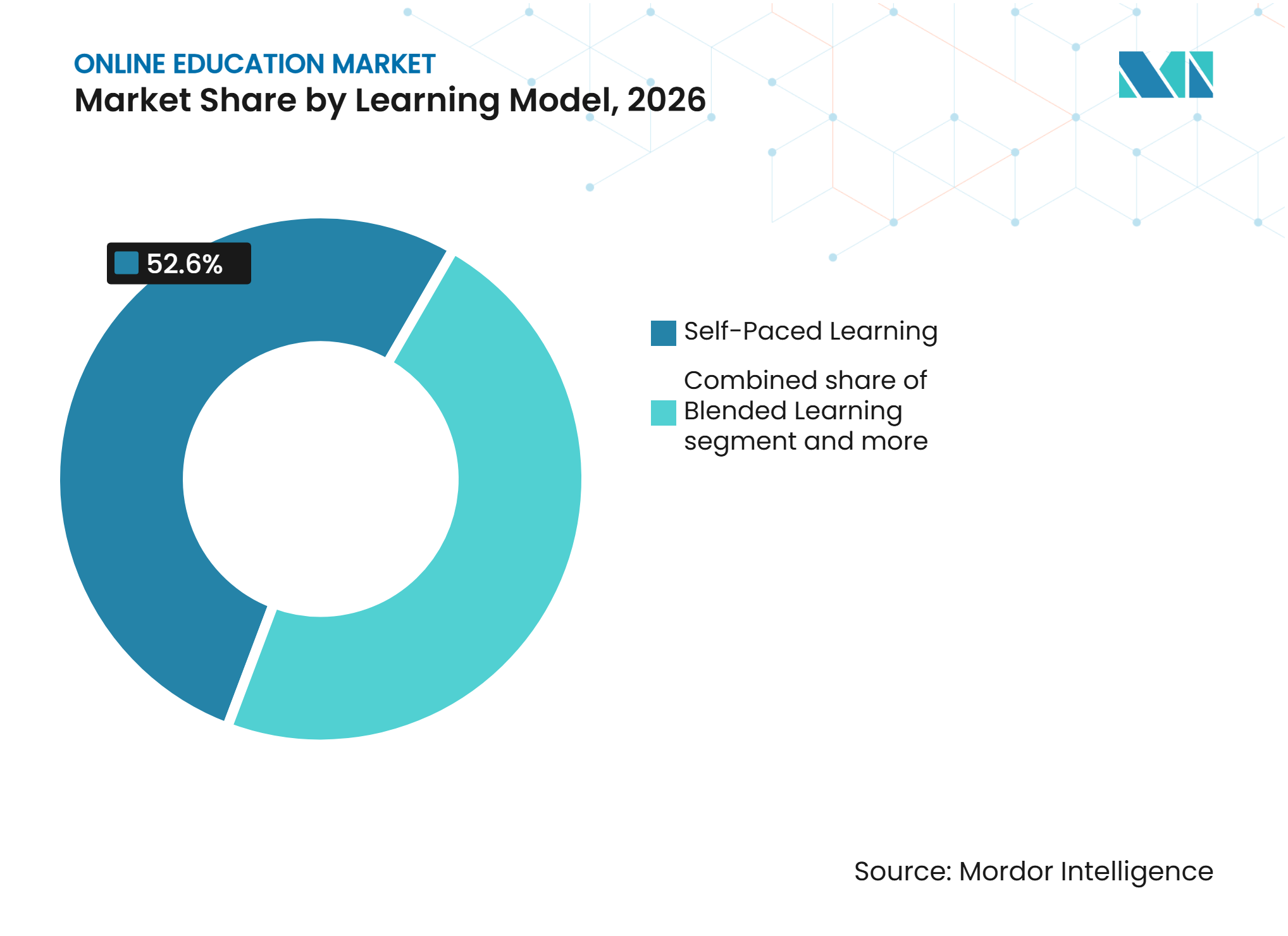
Self-Paced Learning Leads Revenue While Adaptive Learning Builds MomentumSelf-paced learning accounted for 52.60% of revenue in 2026, driven by flexible schedules and no fixed attendance or instructor availability. Coursera reported 197.3 million cumulative registered learners at the end of 2025, demonstrating the scale of self-paced catalogs. Instructor-led learning serves executive education and complex technical programs, where live feedback and accountability support higher prices. Blended programs combine online materials and in-person assessments where supervised learning is required.
Adaptive learning is the fastest-growing model, with the global online education market projected to grow at a 4.85% CAGR from 2027 to 2032. It adjusts content based on learner performance, engagement, and knowledge gaps. A 2025 meta-analysis found positive evidence for AI-driven personalized learning outcomes. Udemy’s 2025 AI Fluency Packages demonstrate coaching, role-playing, and skills mapping. Mobile learning and microlearning enable frequent, short sessions. The opportunity is strongest for providers that improve outcomes without significant user friction.



By Deployment:
Cloud Infrastructure Supports Scale and IntegrationCloud deployment accounted for 72.40% of the global online education market share in 2026 and is projected to grow at a 4.96% CAGR through 2032. It requires lower upfront hardware investment, scales with enrollment, and provides continuous software updates. Cloud systems also integrate learning data with human resources, customer, and performance management systems. The 2025 APEC Education Ministerial Meeting supported AI-integrated, learner-centered models that rely on adaptive learning technologies.
On-premises systems remain relevant in government, defense, financial services, and healthcare, where data sovereignty requirements are strict. Buyers may prevent learner records from leaving an institution or national jurisdiction. Hybrid architectures retain sensitive data on-site while using cloud-based analytics or AI tools for selected functions. Data governance therefore influences deployment decisions alongside functionality and price. The global online education industry must support secure integration and flexible deployment models to compete for regulated contracts.
By Offering:
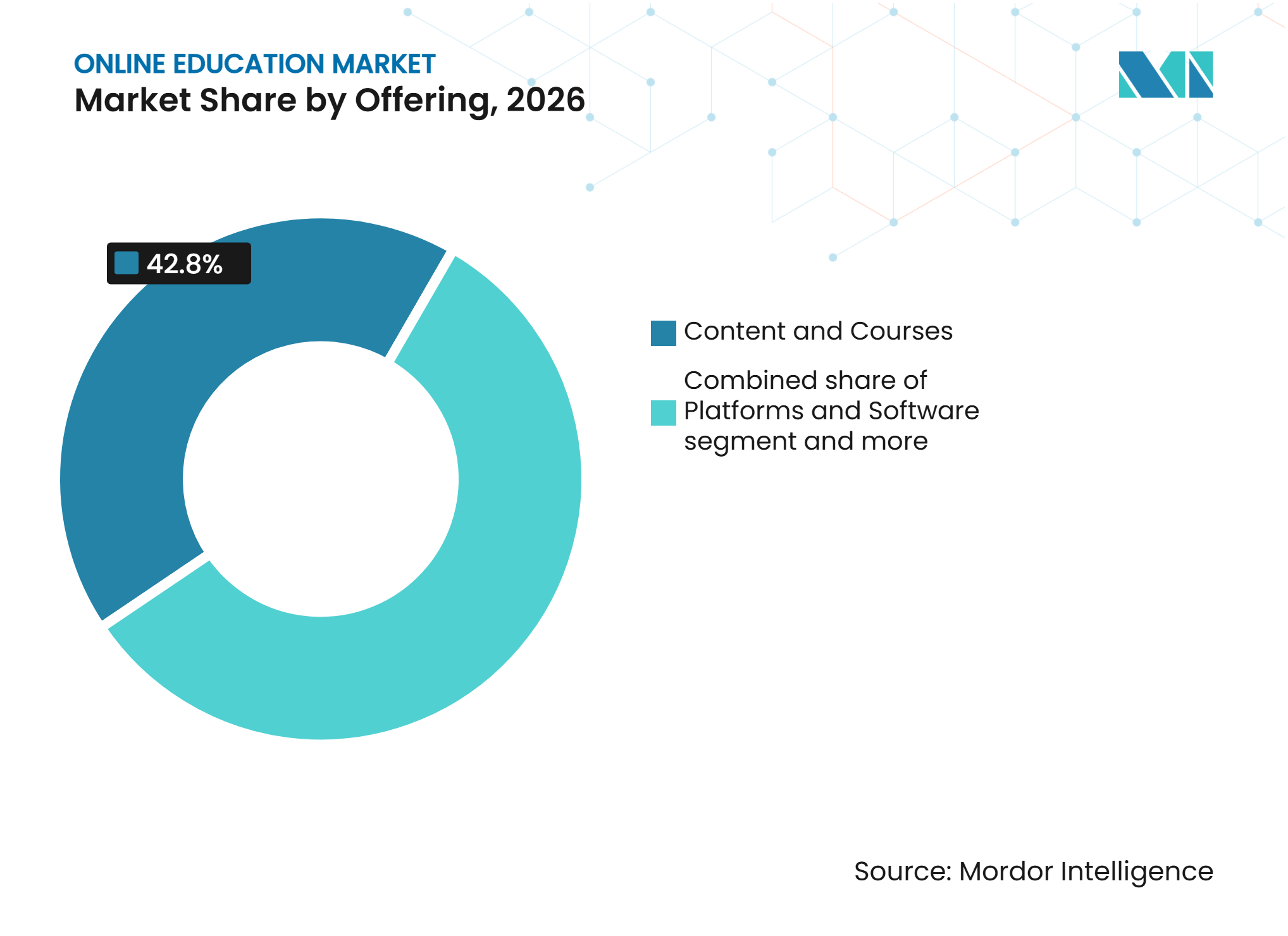
Content and Courses Lead While Credentialing Gains ImportanceContent and courses accounted for 42.80% of global online education market revenue in 2026. Course libraries attract learners, influence platform discovery, and shape employer purchasing decisions. Pearson reported 4% underlying revenue growth to GBP 3,577 million (USD 4,825.77 million) in 2025, reflecting the conversion of established curriculum assets into digital products. Platforms and software, including learning management systems, authoring tools, and learning experience platforms, remain significant offerings. These products face price competition at the lower end, while enterprise providers differentiate through analytics, skills mapping, and integrations.
Assessment and credentialing are the fastest-growing offering segment, projected to grow at a 4.74% CAGR through 2032. Employers increasingly seek verifiable skills evidence beyond course completion. IBM micro-credentials introduced by 2U through edX in 2025 combined technical curriculum, live instruction, self-paced learning, and capstone projects. Services and instruction remain relevant for learners requiring coaching, mentoring, or tutor support.

By End User:
Individual Learners Lead While Enterprise Demand Supports Higher-Value ContractsIndividual learners accounted for 76.40% of global online education market revenue in 2026. This group includes career changers, students supplementing formal education, and lifelong learners pursuing personal development. UNESCO recorded 264 million higher-education students globally in 2025, 25 million more than in 2020. Online degrees, hybrid courses, and micro-credentials complement traditional study pathways. Despite their scale, individual learners remain price sensitive.
Corporate and enterprise organizations are the fastest-growing end-user group, with a forecast CAGR of 4.68% through 2032. Buyers favor multi-seat contracts and seek measurable outcomes, skills evidence, and talent workflow integration. LinkedIn reported that organizations with strong learning and development programs were 42% more likely to be advanced in AI adoption. Government procurement also supports demand for national learning systems and citizen skilling. These buyers often require data governance and hosting controls, increasing demand for secure deployment, skills analytics, and recognized credentials.
Geography Analysis
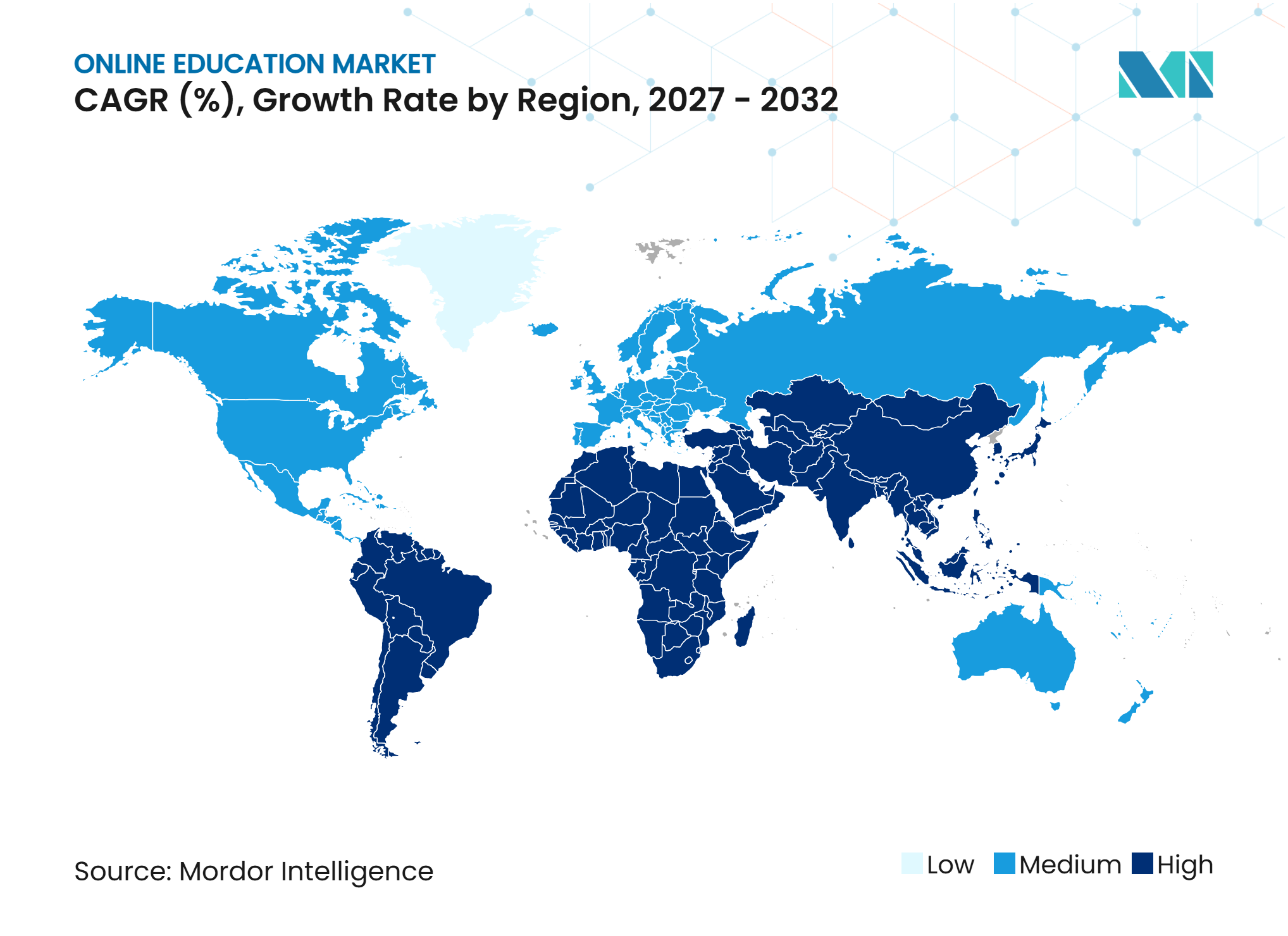
North America accounted for 35.20% of the global online education market in 2026, supported by corporate learning budgets, learning management system adoption, and a mature higher education sector. Coursera reported USD 757.5 million in total global revenue in 2025, reflecting demand across its consumer and enterprise learning businesses. Microsoft’s Elevate initiative supports AI skilling through schools, community colleges, and nonprofit organizations. In Canada and Mexico, online education opportunities should be assessed using country-specific evidence on enterprise learning demand, internet and mobile access, and employer investment in workforce skills.
Asia-Pacific is the fastest-growing region, while the global market is projected to grow at a 4.41% CAGR from 2027 to 2032. China’s Smart Education platform reached over 160 million registered users and 61.3 billion views in 2025. India combines large learner volumes with digital public infrastructure; SWAYAM recorded over 5.15 crore enrollments across 16,530 courses, and SWAYAM Plus has 76 industry memorandums of understanding. South Korea, Japan, Australia, Indonesia, Vietnam, and the Philippines support enterprise, higher education, and mobile-first learning demand.
Europe benefits from the Digital Education Action Plan 2021-2027 and Erasmus+ initiatives. Pearson’s Virtual Learning and Enterprise Learning and Skills segments grew 8% and 6%, respectively, in 2025. Coursera’s Europe, Middle East, and Africa revenue reached USD 185.9 million. Brazil, the United Arab Emirates, and Saudi Arabia support demand, while Sub-Saharan Africa’s 36% internet use constrains access.
Education Infrastructure & Development Intelligence
Government expenditure determines educational resources and digital learning infrastructure adoption. The OECD’s Education at a Glance 2025 reported average spending of USD 12,438 per student in primary, secondary, and post-secondary non-tertiary education, compared with USD 15,102 in tertiary education, including R&D. Education’s share of government expenditure declined from 10.9% in 2015 to 10.1% in 2022, increasing pressure to demonstrate outcomes. Digital providers can differentiate through cost-effective, scalable delivery and measurable results.
Private investment combines technology, workforce skilling, and acquisitions. In July 2025, Microsoft announced USD 4 billion through Microsoft Elevate to support education and AI-skilling credentialsCoursera’s merger with Udemy and Docebo’s acquisition of 365Talents strengthened their online learning and workforce-skills capabilities. India’s National Educational Alliance for Technology (NEAT) listed 393 EdTech firms and 171 products in a July 2025 government update, with 25% of course coupons reserved free for economically and socially disadvantaged students. China’s Smart Education platform reached 164 million users and 61.3 billion page views by April 2025.
Competitive Landscape
Market Concentration
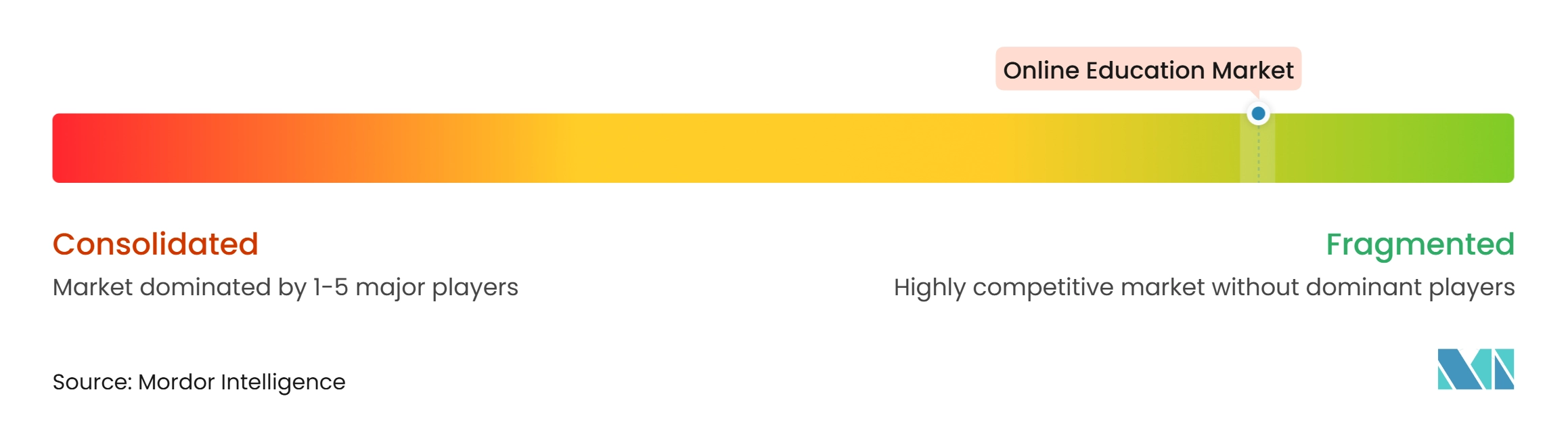
The global online education market has low concentration, with fragmented competition across consumer learning, corporate training, academic learning systems, language learning, assessment, and credentialing. In May 2026, Coursera completed an all-stock combination with Udemy, creating a combined company with pro forma 2025 revenue exceeding USD 1.5 billion and expected annual cost synergies of USD 115 million within 24 months. Pearson acquired eDynamic Learning in 2025 to strengthen its career and technical education portfolio. Docebo acquired 365Talents for USD 54.6 million in cash consideration, with potential contingent payments. These transactions reflect efforts to expand scale, vocational content, and skills intelligence capabilities.
Specialization, localization, and technology also shape competition. DataCamp, Pluralsight, and Go1 focus on data skills, technology training, and content aggregation, respectively. During its 2025 product cycle, Coursera introduced AI translation and dubbing in 26 languages, AI-powered course creation, and role-based AI tutoring. In India, PM eVIDYA integrates DIKSHA, SWAYAM, 200 Direct-to-Home (DTH) TV channels, radio, and other digital learning resources. DIKSHA had over 2 crore registered users as of March 2026, while SWAYAM recorded over 5.8 crore enrollments as of January 2026. Private providers can differentiate through specialized courses, employer partnerships, recognized credentials, learner support, and multilingual delivery.
Online Education Industry Leaders
-
Coursera, Inc.
-
Pearson plc
-
Udemy, Inc.
-
LinkedIn Learning
-
2U, Inc., including edX
- *Disclaimer: Major Players sorted in no particular order
Online Education Market Companies Covered in this Report
- Coursera, Inc.
- Udemy, Inc.
- LinkedIn Learning, Microsoft Corporation
- Pearson plc
- 2U, Inc., including edX
- Duolingo, Inc.
- Instructure Holdings, Inc.
- Docebo S.p.A.
- Skillsoft Corp.
- Pluralsight LLC
- Udacity, Inc.
- Khan Academy, Inc.
- upGrad Education Private Limited
- Unacademy
- DataCamp, Inc.
- Go1 Pty Ltd
- Moodle Pty Ltd
- D2L Corporation
- PhysicsWallah (PW)
- Cengage Group
Recent Industry Developments in Online Education Market
- May 2026: Coursera completed its all-stock combination with Udemy, creating a skills platform with pro forma 2025 revenue exceeding USD 1.5 billion and USD 115 million in annual cost synergies expected within 24 months. Former Coursera and Udemy stockholders own 59% and 41%, respectively.
- January 2025: Docebo acquired France-based 365Talents for USD 54.6 million, plus up to USD 5.1 million in 2027 earn-outs. The acquisition added AI-powered skills intelligence, gap detection, and workforce profiling capabilities to Docebo’s learning platform.
- December 2025: Coursera and Udemy announced an all-stock merger valued at USD 2.5 billion, based on December 16, 2025, closing prices. Both boards approved the transaction, which offered Udemy stockholders 26% above its closing price. Insight Partners and New Enterprise Associates signed support agreements.
- December 2025: Skillsoft and edX partnered to integrate courses from Oxford Saïd Business School, Harvard University, and the London School of Economics into Skillsoft Percipio, aligning university-led content with skills-gap priorities and AI workforce transformation.
Global Online Education Market Report Scope
The global online education market report analyzes digital learning solutions delivered through online platforms worldwide. The market is segmented by learning model (Self-Paced Learning, Instructor-Led Learning, Blended Learning, Adaptive Learning, and Others), deployment, offering, end user, and geography. The study examines key drivers, including smartphone and high-speed internet penetration, corporate upskilling and reskilling, government digital-education initiatives, flexibility and cost advantages, micro-credential partnerships, and AI-powered personalization, alongside restraints such as low completion rates, connectivity gaps, multilingual content complexity, and privacy and AI-governance requirements. It evaluates education investment, infrastructure development, student enrolment, tuition fees, learner behaviour, technological developments, and regulatory factors. The report provides market size and growth forecasts, regional and country-level analysis, competitive landscape assessment, market concentration, market share analysis, strategic developments, and profiles of leading providers. It also explores opportunities in low-bandwidth and offline-first learning, localized content, and verified skills-to-employment pathways. Market estimates and forecasts are presented in value (USD) across all covered segments.
Segmentation Overview
Key Questions Answered in the Report
What is the projected value of online education by 2032?
The sector is projected to reach USD 346.24 billion by 2032, growing at a 3.96% CAGR from 2027 to 2032.
Which learning model holds the largest share?
Self-paced learning leads with 52.60% revenue share in 2026 because it offers flexible access to learners.
Why is adaptive learning growing faster than other learning models?
Adaptive learning is forecast to grow at 4.85% through 2032 because it adjusts content pathways using learner performance and engagement data.
What makes India important for digital learning providers?
SWAYAM has more than 5.15 crore enrollments and more than 16,530 courses, while industry partnerships support skills development in AI, data analytics, and healthcare.
Which end-user group is growing fastest?
Corporate and enterprise organizations are forecast to grow at 4.68% CAGR through 2032 as employers increase AI and workforce skills investment.
What are the main obstacles to wider adoption?
Low completion rates, rural connectivity gaps, localization demands, and privacy and AI governance requirements can limit participation and raise delivery costs.