
Mud Pumps Market Size and Share
Market Overview
| Study Period | 2022 - 2032 |
|---|---|
| Market Size (2027) | USD 1.31 Billion |
| Market Size (2032) | USD 1.61 Billion |
| Growth Rate (2027 - 2032) | 4.21 % |
| Fastest Growing Market | Asia-Pacific |
| Largest Market | North America |
| Market Concentration | Medium |
Major Players *Disclaimer: Major Players sorted in no particular order Image © Mordor Intelligence. Reuse requires attribution under CC BY 4.0. | |
Mud Pumps Market Analysis by Mordor Intelligence
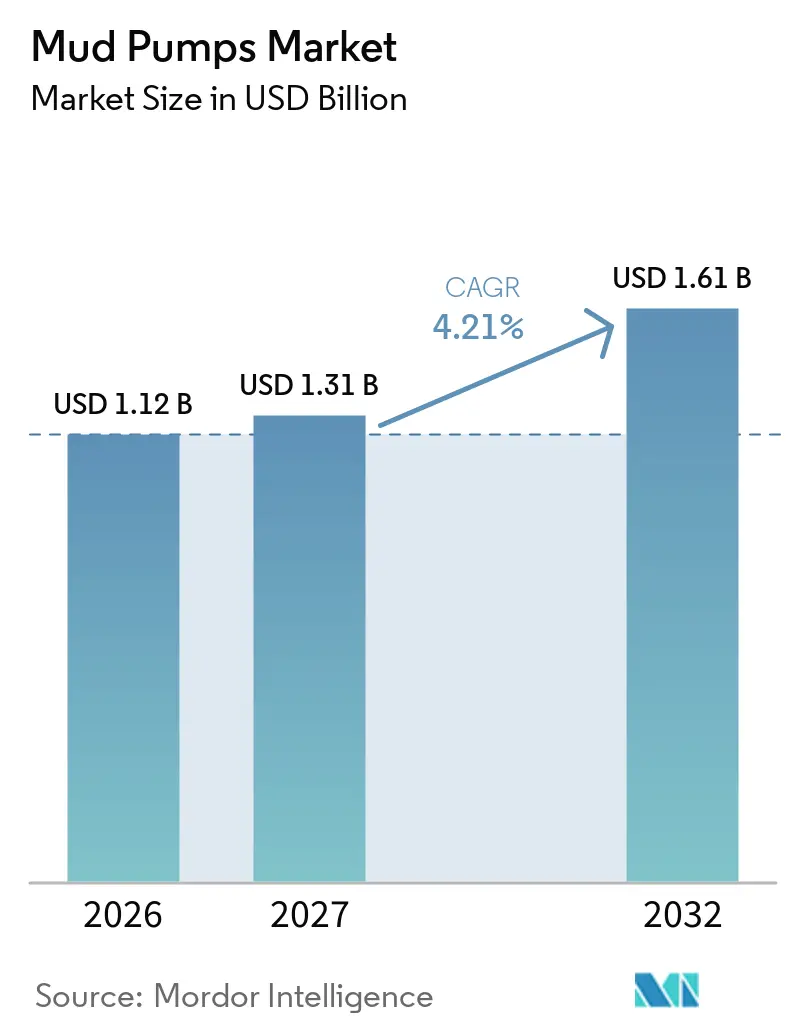
The mud pumps market size is projected to expand from USD 1.12 billion in 2026 and USD 1.31 billion in 2027 to USD 1.61 billion by 2032, at a CAGR of 4.21% between 2027 and 2032. Active drilling across conventional and unconventional basins supports demand for reliable circulation equipment, while longer wells increase the value of each installed pump package. The market is also moving toward equipment that can maintain steady flow at high pressure and provide clearer drilling data. Suppliers are responding through electric drive systems, digital controls, and service models that reduce unplanned downtime. Demand from geothermal drilling, water wells, and aftermarket rebuilding provides support when oil and gas drilling budgets slow. Cost pressure from oil price swings and high-grade steel procurement can still limit new equipment orders.
Key Report Takeaways
- By pump type, triplex pumps held 52.5% of 2026 revenue, while quintuplex pumps are forecast to grow at a 5.8% CAGR through 2032.
- By drive system, fuel engine-driven pumps held 56.4% of 2026 revenue, while electric-driven pumps are forecast to grow at a 4.8% CAGR through 2032.
- By end use, oil and gas drilling held 72.3% of 2026 revenue, while geothermal drilling is forecast to grow at a 5.2% CAGR through 2032.
- By pressure rating, the 5,000 to 7,500 PSI class held 39.6% of 2026 revenue, while the above 10,000 PSI class is forecast to grow at a 4.9% CAGR through 2032.
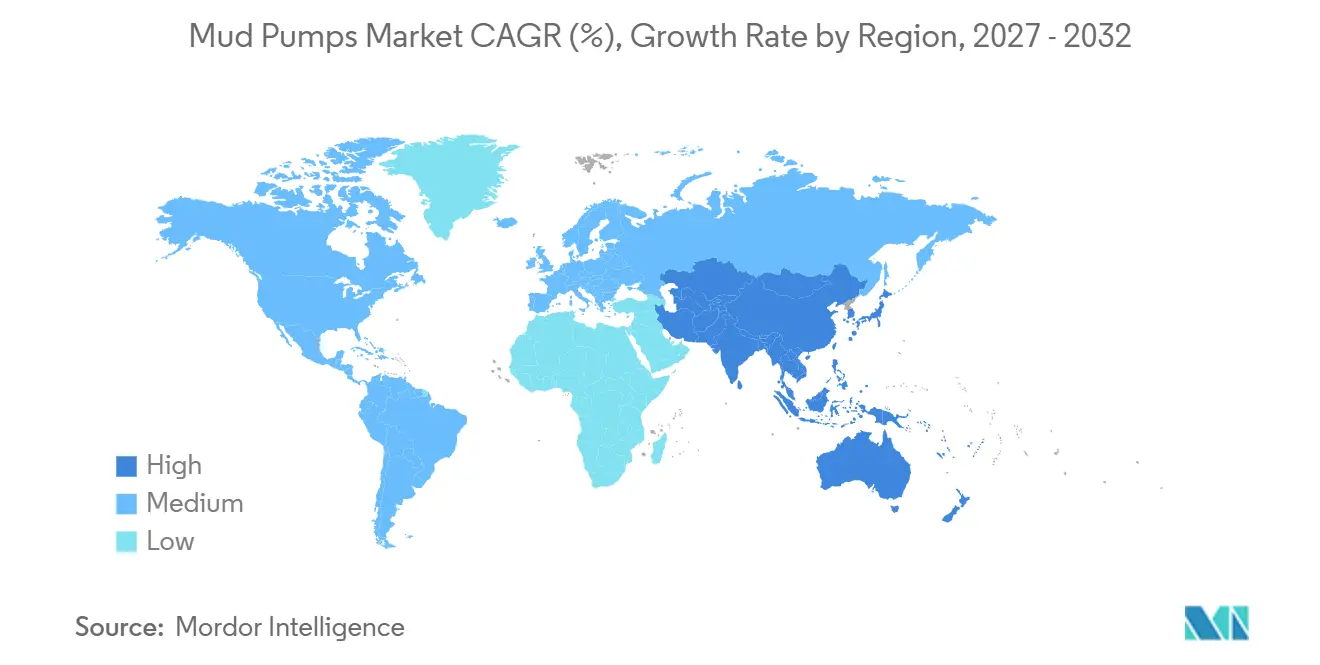
- By geography, North America held 36.2% of 2026 revenue, while Asia-Pacific is forecast to grow at a 5.4% CAGR through 2032.
Note: Market numbers in this report are based on Mordor Intelligence's proprietary estimation framework, which combines nine months of actuals with Q4 projections for base year 2026.
Market Trends and Insights
Drivers Impact Analysis of Mud Pumps Market*
| Driver | (~) % Impact on CAGR Forecast | Geographic Relevance | Impact Timeline |
|---|---|---|---|
| Rising Drilling Intensity Across Conventional and Unconventional Wells | +1.1% | Global, with North America and the Middle East as primary contributors | Short term (≤ 2 years) |
| Longer Horizontal, Deepwater, and High-Pressure Wells | +0.9% | North America for horizontal shale, Latin America and Asia-Pacific for deepwater | Medium term (2-4 years) |
| Electrification, Digital Monitoring, and Predictive Maintenance | +0.7% | Global, with advanced adoption in North America and Europe | Long term (≥ 4 years) |
| High-Pressure Qualification and Fluid-End Lifecycle Engineering | +0.4% | Offshore basins globally and high-pressure onshore operations in the Middle East and China | Medium term (2-4 years) |
| Localized Aftermarket Hubs and Rebuild Economics | +0.3% | Middle East, North America, and Asia-Pacific core markets, with spillover to the Middle East and Africa | Medium term (2-4 years) |
| Geothermal and Mineral-Exploration Drilling Expansion | +0.5% | Western United States, Europe, Indonesia, and Kenya Rift Valley | Long term (≥ 4 years) |
| Source: Mordor Intelligence | |||
Rising Drilling Intensity Across Conventional and Unconventional Wells
Upstream capital deployment provides a base level of demand for drilling fluid pumps in the mud pump market. The U.S. rotary rig count stood at 599 for the week ending September 25, 2026, up 50 units from the prior year, with horizontal rigs numbering 541. Each horizontal rig typically requires multiple pumps working together to maintain circulation through extended laterals. Longer laterals and additional drilling stages raise the required duty cycle per rig, and higher drilling productivity does not reduce the need for pumps. Abu Dhabi National Oil Company Drilling reported USD 1.45 billion in FY2025 net profit and is deploying 70 integrated drilling services rigs by year-end 2026, supporting equipment demand in the United Arab Emirates and nearby Gulf markets.[1] India also approved the Samudra Manthan program with INR 84,084 crore in funding for offshore exploration through FY2030-31, including INR 43,200 crore for 60 deepwater exploratory wells.
Longer Horizontal, Deepwater, and High-Pressure Wells
Longer horizontal wells, deepwater development, and high-pressure drilling are changing the required specifications in the mud pump market. Deepwater programs require more consistent pressure control and reduce the suitability of basic pump designs. Petrobras approved investments above BRL 60 billion for the Sergipe Deepwater project across SEAP I and SEAP II, covering 32 wells and 2 floating production platforms, supporting demand for high-specification equipment capable of operating at substantial water depth and high bottom-hole temperatures. BP's Kaskida development in the U.S. Gulf of Mexico received approval in March 2026 for a USD 5 billion project targeting reservoirs beyond 30,000 feet. These wells can increase pump content per project, even where the number of wells does not rise at the same pace.
Electrification, Digital Monitoring, and Predictive Maintenance
Electrification is making the pump a more integrated part of the drilling rig power and control system. Drilling electrification in China's Sichuan-Chongqing shale operations has exceeded 95%, reducing well completion costs by more than 30% and extending power infrastructure across the operating area. Variable-frequency drives allow operators to adjust pump stroke rates more precisely than diesel prime movers, supporting flow control in response to changing formation conditions. Bentec states that its optiPUMP system can synchronize up to four mud pumps through a single operating interface and reduce nonproductive time from pump failures by 20%.[2] Digital monitoring also shifts supplier revenue toward parts, rebuilds, and maintenance support, as vibration, liner wear, and pressure data can identify equipment needs before failure occurs.
Geothermal and Mineral-Exploration Drilling Expansion
Geothermal drilling is broadening the end-use base for the mud pump market. Financing for next-generation geothermal systems reached USD 2.2 billion in 2025, an 80% increase from the preceding year, according to the Society of Petroleum Engineers Journal of Petroleum Technology. Geothermal wells often encounter rock temperatures above 150°C, which can shorten the life of conventional elastomer components, increasing the value of high-temperature fluid-end assemblies and repeat service work. Italy, Taiwan, and Indonesia have policy frameworks supporting a broader geographic base for geothermal development. Mineral exploration for lithium brines and copper also uses circulation-intensive drilling systems, adding demand outside oil and gas drilling.
Restraints Impact Analysis of Mud Pumps Market*
| Restraint | (~) % Impact on CAGR Forecast | Geographic Relevance | Impact Timeline |
|---|---|---|---|
| Crude-Oil Price Volatility and Drilling-Budget Cyclicality | -0.5% | Global, concentrated in North American and Middle Eastern capital expenditure cycles | Short term (≤ 2 years) |
| Emissions Compliance and Capital Reallocation Toward Lower-Carbon Energy | -0.4% | North America and Europe, with Asia-Pacific emerging | Long term (≥ 4 years) |
| Qualification Bottlenecks for High-Horsepower Offshore Equipment | -0.3% | Global deepwater basins, most acute in Brazil and West Africa | Medium term (2-4 years) |
| Concentration in High-Grade Steel and Precision-Machining Supply | -0.3% | Global, with stronger effects in North America and Europe | Medium term (2-4 years) |
| Source: Mordor Intelligence | |||
Crude-Oil Price Volatility and Drilling-Budget Cyclicality
Crude oil price volatility is an immediate restraint on new equipment orders in the mud pump market. The US rig count fell from 775 in January 2023 to 526 in August 2025, and recovered to 599 in September 2026. When oil prices weaken, operators tend to extend the useful life of installed pumps rather than replace them. This reduces demand for new units and increases the relative importance of aftermarket rebuilding. Independent pump manufacturers and service suppliers face greater exposure to this dynamic than large oilfield service companies, as they have less geographic diversification. The impact can be uneven, as drilling contractors may continue spending on repairs while delaying purchases of complete pump packages.
Concentration in High-Grade Steel and Precision-Machining Supply
High-grade alloy steel and precision machining are essential inputs for fluid ends, cylinders, pistons, and valve assemblies. US tariffs of 25% on steel and aluminum imports took effect in March 2025 and were reported to increase oil country tubular goods costs by an estimated 15%. Similar materials are used in many pressure-bearing pump components, creating a direct cost challenge for equipment suppliers. The Organisation for Economic Co-operation and Development expects more than 40% of new steelmaking capacity entering the market during 2025 to 2027 to rely on blast furnace and basic oxygen furnace production. Supply concentration in the United States, Germany, and China also makes procurement of specialized forging and machining services more sensitive to lead times. These conditions can compress supplier margins or increase the price of high-specification equipment in the mud pump market.
*Our forecasts treat driver/restraint impacts as directional, not additive. The impact forecasts reflect baseline growth, mix effects, and variable interactions.
Mud Pumps Market Segment Analysis
By Pump Type:
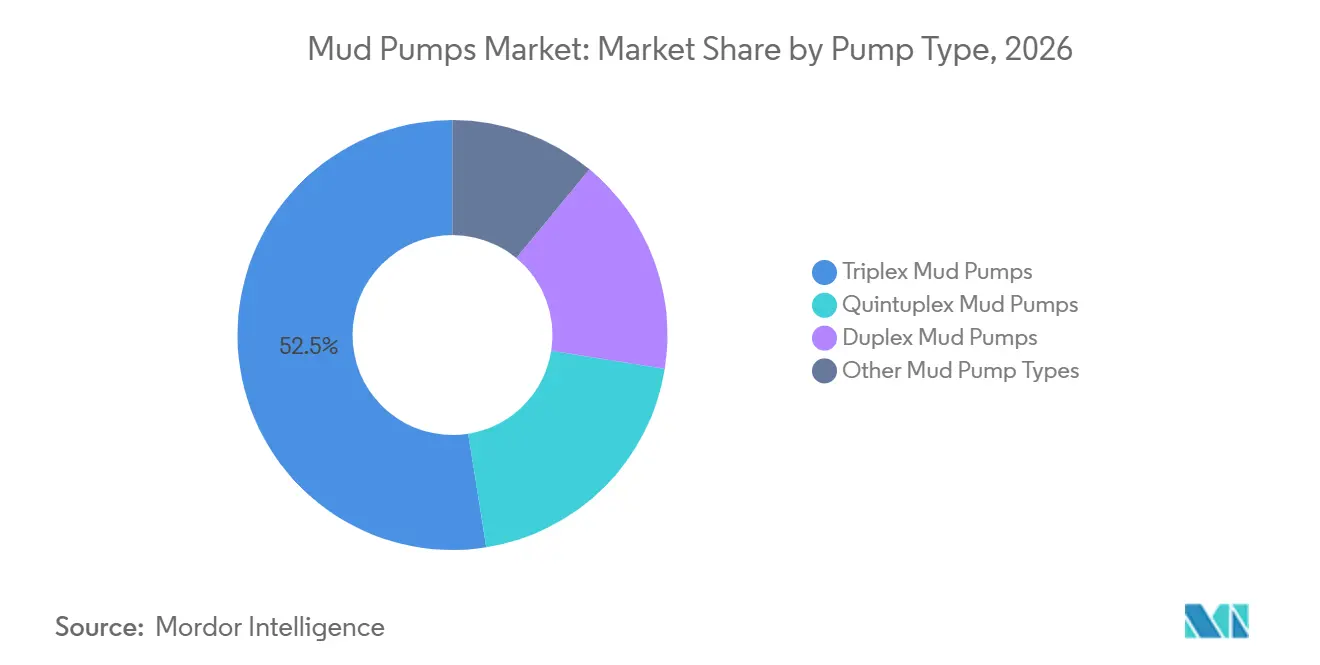
Quintuplex Gains Ground in High-Specification DrillingTriplex pumps held 52.5% of mud pump market revenue in 2026, giving them the largest share within pump types. Triplex designs have a long service record, and spare parts are widely available across established drilling regions. Duplex pumps continue to serve legacy rigs, lighter water well work, and mineral exploration where simpler construction remains practical. Quintuplex pumps are the fastest-growing pump type, with a projected CAGR of 5.8% through 2032. Their role is expanding in deepwater and high-pressure, high-temperature wells that require stable fluid delivery and reliable downhole telemetry.
A quintuplex design can deliver 40% more flow than a triplex pump within the same horsepower class, while reducing flow pulsation from 23% to 7%, according to EW Pumps. Lower pulsation can improve the quality of measurement-while-drilling and logging-while-drilling data. Quintuplex units can also reduce surface footprint compared with two comparable triplex units. There is therefore a clear case for quintuplex equipment in applications where offshore space, pressure stability, and operating labor are significant considerations. API 7K qualification can extend the entry period for a new pump model by 12 to 24 months, but the same process supports premium pricing once offshore operators accept the design.

By Drive System:
Electric Drives Build a Higher-Value Equipment CategoryFuel engine-driven pumps accounted for 56.4% of mud pump market revenue in 2026. Remote and off-grid drilling locations still depend on these configurations because electric power infrastructure may be unavailable or unreliable. Diesel-driven systems remain practical in parts of Sub-Saharan Africa, Southeast Asia, and Latin America. Electric-driven pumps are the fastest-growing drive system, with a forecast CAGR of 4.8% through 2032. Their growth is tied to rig electrification, which allows one power system to support multiple drilling functions.
China's Sichuan-Chongqing shale operations achieved electrification rates above 95%, and the program reduced energy consumption by more than 20% and emissions by more than 30% compared with diesel alternatives. Pumbaaev converted F-1600 diesel mud pump sets to permanent-magnet synchronous motor drives for Zhongyuan Petroleum Engineering in 2026.[3] This conversion demonstrates that electric configurations are moving beyond large new-build projects into mature onshore operations. The mud pump market can obtain higher equipment value from digital drives, sensors, and diagnostic functions than from a basic mechanical package. Hydraulic drives retain a small role in mobile and compact well-servicing applications.
By End Use:
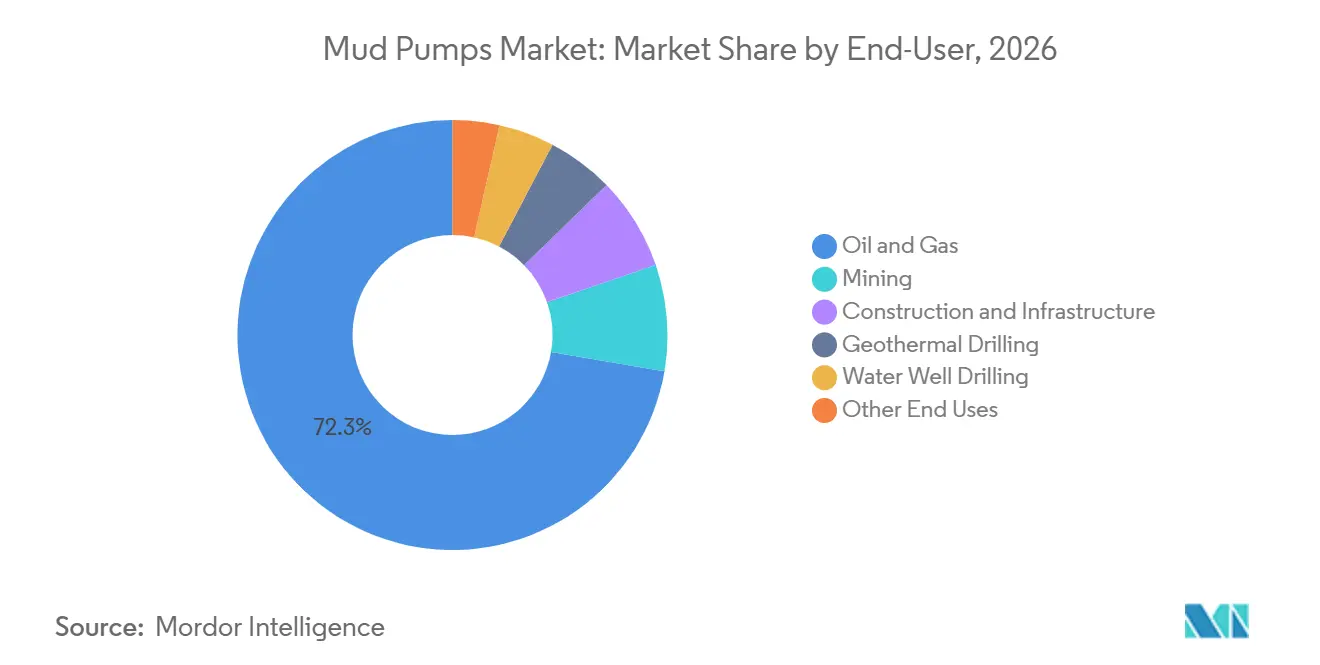
Oil and Gas Retains Scale While Geothermal ExpandsOil and gas drilling represented 72.3% of mud pump market revenue in 2026 and remained the leading end use. High-horsepower drilling rigs and complex wells account for a large share of equipment spending in this segment. Mining is a smaller but durable application, as exploration drilling requires fluid circulation and borehole stability. Water well drilling serves low-pressure, high-volume uses, particularly in African and South Asian markets where rural water infrastructure programs support procurement. These end uses give the mud pump market exposure to drilling activity beyond upstream oil and gas.
Geothermal drilling is the fastest-growing end use, with a projected CAGR of 5.2% through 2032. Geothermal wells require continuous circulation of dense, high-temperature fluids to stabilize boreholes in fractured rock. Temperatures above 150 °C can increase fluid-end wear and shorten service intervals compared with oil and gas applications. Next-generation geothermal project financing reached USD 2.2 billion in 2025, supporting the development of a broader customer base for high-temperature drilling systems.[4] Coal bed methane and scientific drilling add smaller, specialized sources of demand.
By Pressure Rating:
Mid-Range Pumps Lead While Ultra-High Pressure AdvancesThe 5,000 to 7,500 PSI class held 39.6% of mud pump market revenue in 2026. This range aligns with the operating requirements of many onshore triplex units in shale and conventional vertical wells. The up-to-5,000 PSI category serves lower-horsepower applications and older equipment fleets, and is under pressure as newer rigs are configured for deeper wells and more demanding completion programs. The 7,500 to 10,000 PSI range remains relevant for high-specification offshore drilling and high-pressure, high-temperature formations. The 5,000 to 7,500 PSI range continues to reflect the broad installed base of workhorse pump systems.
The above-10,000 PSI class is forecast to grow at a CAGR of 4.9% through 2032. Extended-reach drilling and ultra-deepwater work can require standpipe pressure beyond conventional equipment ratings. The mud pump market for this pressure class benefits from wells where deeper targets and longer laterals raise circulation requirements. BP's Kaskida project targets reservoirs beyond 30,000 feet, illustrating the type of operating environment that may require upgraded pressure capability. Higher pressure requirements can increase the need for premium triplex or quintuplex designs, stronger fluid ends, and more rigorous qualification.
Geography Analysis
North America held 36.2% of mud pump market revenue in 2026, reflecting the installed base in the Permian Basin, Haynesville, Bakken, and Gulf of Mexico. The U.S. rig count reached 599 by late September 2026, with the Permian operating 270 rigs, 17 more than a year earlier. Canada reported 208 rigs during the same week. Longer laterals in the Permian can extend sustained pumping periods and increase fluid-end wear, supporting capacity upgrades and service demand in the mud pump market.
Europe remains smaller in volume but requires technically capable equipment for North Sea wells and geothermal drilling. Extended-reach wells from fixed platforms create demand for high-specification triplex and quintuplex equipment. Italy, Germany, and the United Kingdom are developing geothermal activity that requires high-temperature configurations. Asia-Pacific is the fastest-growing region, with a projected CAGR of 5.4% through 2032. India approved Samudra Manthan funding for offshore exploration, including 60 deepwater exploratory wells.
Indonesia is advancing deepwater activity, including planned work at South Andaman and the Mako gas field, while PetroChina began its 2026 Jabung drilling program with 6 development wells and more than 180 workover and service activities. South Korea, Japan, and Australia support demand through offshore maintenance and geothermal exploration. Brazil's Buzios, Raia, and Sergipe Deepwater projects support a multiyear procurement cycle for high-specification systems. Equinor began drilling the USD 9 billion Raia gas project in Brazil in March 2026 at a water depth of 2,900 meters. Argentina's Vaca Muerta provides unconventional onshore demand, while the Middle East and Africa retain equipment needs for drilling, intervention, and developing offshore fields.
Competitive Landscape
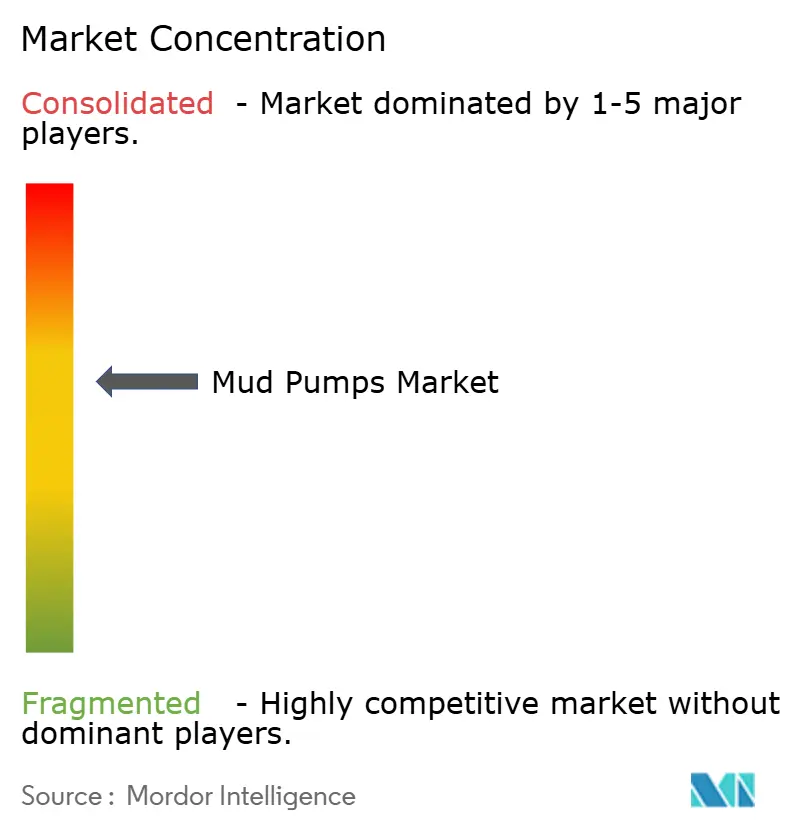
The mud pump market is moderately concentrated at the original equipment manufacturer level. National Oilwell Varco holds the largest installed base through integrated drilling packages and relationships with rig builders and national oil companies. MHWirth serves premium offshore and floating-rig applications, while legacy Gardner Denver brands retain a broad onshore installed base. Honghua Group, Shandong Kerui Petroleum Equipment, and Jereh Group are expanding their presence in cost-sensitive international markets. Their integrated rig packages are particularly relevant in Southeast Asia and the Middle East, where buyers often evaluate price alongside the ability to supply a complete equipment package.
Weatherford and SLB use integrated service models that combine equipment deployment with managed pressure drilling and digital monitoring. These models can support longer customer relationships than a hardware-only sale. National Oilwell Varco reported a USD 4.34 billion Energy Equipment booking backlog in Q4 2025, reflecting continued forward order activity in its equipment business. National Oilwell Varco also received a multiyear contract for RigSense 4.0 and WellData 4.0 instrumentation across a global drilling contractor's international fleet. These developments indicate that digital subscriptions can complement equipment revenue in the mud pump market.
Weatherford received a managed pressure drilling contract from Ventura Offshore for the SSV Victoria rig in Brazil's Buzios Field in May 2026. PUMBAAEV's 2026 electric conversion project also indicates that equipment providers are pursuing electrification opportunities at existing fields. American Block, Mud King Products, and Ohara Corporation compete through parts availability and lead-time response, while Drillmec and Bentec connect mud pump specifications to proprietary land-rig packages. The mud pump market therefore comprises large integrated suppliers, specialized package builders, and parts-focused firms.
Mud Pumps Industry Leaders
-
NOV Inc.
-
SLB NV
-
Halliburton Company
-
Baker Hughes Company
-
Weatherford International plc
- *Disclaimer: Major Players sorted in no particular order
Mud Pumps Market Companies Covered in this Report
- NOV Inc.
- SLB
- Halliburton Company
- Baker Hughes Company
- Weatherford International plc
- Flowserve Corporation
- Ingersoll Rand Inc.
- Honghua Group Limited
- China National Petroleum Corporation
- American Block Inc.
- Bentec GmbH Drilling and Oilfield Systems
- Drillmec S.p.A.
- MHWirth AS
- Ohara Corporation
- Shandong Kerui Petroleum Equipment Co., Ltd.
- Jereh Group
- Mud King Products, Inc.
- KSB SE and Co. KGaA
- Xylem Inc.
- The Weir Group PLC
- Kirloskar Ebara Pumps Limited
Recent Industry Developments in Mud Pumps Market
- April 2026: Petrobras approved the final investment decision for the SEAP I project in the Sergipe-Alagoas Basin. Together with SEAP II, the development includes 32 wells and two floating production storage and offloading units, with investments exceeding BRL 60 billion. The large drilling scope directly increases demand for drilling equipment, including mud pumps, fluid-handling systems, and associated consumables.
- March 2026: BP's Kaskida project in the US Gulf of Mexico received approval for a development valued at approximately USD 5 billion. The project targets reservoirs deeper than 30,000 feet in about 6,000 feet of water depth and is expected to produce up to 80,000 barrels per day. Such high-pressure, high-temperature (HPHT) drilling environments require high-capacity triplex or quintuplex mud pump systems capable of supporting deepwater drilling operations.
- March 2026: Equinor commenced drilling activities for the Raia gas project in Brazil's Campos Basin using the Valaris DS-17 drillship at water depths of approximately 2,900 meters. Deepwater drilling campaigns of this scale require continuous utilization of high-pressure mud circulation equipment, creating direct demand for mud pump systems and aftermarket services.
Global Mud Pumps Market Report Scope
Mud pumps are heavy-duty, high-pressure reciprocating pumps designed to circulate drilling fluids down a wellbore and back to the surface during oil, gas, and geothermal exploration. They maintain hydrostatic pressure, cool and lubricate the drill bit, and carry rock cuttings away from the bottom of the hole. As these pumps handle highly abrasive and viscous fluids under immense pressure, they are built with rugged, wear-resistant components such as triplex or quintuplex pistons to prevent equipment failure.
The global mud pumps market is segmented by pump type into duplex mud pumps, triplex mud pumps, quintuplex mud pumps, and other mud pump types. By drive system, the market is segmented into electric-driven mud pumps, fuel engine-driven mud pumps, and other drive systems. By end use, the market is segmented into oil and gas, mining, construction and infrastructure, geothermal drilling, water well drilling, and other end uses. By pressure rating, the market is segmented into up to 5,000 PSI, 5,000-7,500 PSI, 7,500-10,000 PSI, and above 10,000 PSI. The report also covers the market size and forecasts for the global mud pumps market across 26 countries in key regions. For each segment, the market sizing and forecasts are provided on the basis of value (USD).
Segmentation Overview
| Duplex Mud Pumps |
| Triplex Mud Pumps |
| Quintuplex Mud Pumps |
| Other Mud Pump Types |
| Electric-Driven Mud Pumps |
| Fuel Engine-Driven Mud Pumps |
| Other Drive Systems |
| Oil and Gas |
| Mining |
| Construction and Infrastructure |
| Geothermal Drilling |
| Water Well Drilling |
| Other End Uses |
| Up to 5,000 PSI |
| 5,000–7,500 PSI |
| 7,500–10,000 PSI |
| Above 10,000 PSI |
| North America | United States |
| Canada | |
| Mexico | |
| Europe | Germany |
| France | |
| Italy | |
| Spain | |
| United Kingdom | |
| Poland | |
| Russia | |
| Rest of Europe | |
| Asia-Pacific | China |
| India | |
| Japan | |
| South Korea | |
| Australia | |
| Indonesia | |
| Vietnam | |
| Thailand | |
| Rest of Asia-Pacific | |
| South America | Brazil |
| Argentina | |
| Chile | |
| Rest of South America | |
| Middle East and Africa | Saudi Arabia |
| United Arab Emirates | |
| Egypt | |
| South Africa | |
| Morocco | |
| Rest of Middle East and Africa |
| By Pump Type | Duplex Mud Pumps | |
| Triplex Mud Pumps | ||
| Quintuplex Mud Pumps | ||
| Other Mud Pump Types | ||
| By Drive System | Electric-Driven Mud Pumps | |
| Fuel Engine-Driven Mud Pumps | ||
| Other Drive Systems | ||
| By End Use | Oil and Gas | |
| Mining | ||
| Construction and Infrastructure | ||
| Geothermal Drilling | ||
| Water Well Drilling | ||
| Other End Uses | ||
| By Pressure Rating | Up to 5,000 PSI | |
| 5,000–7,500 PSI | ||
| 7,500–10,000 PSI | ||
| Above 10,000 PSI | ||
| By Geography | North America | United States |
| Canada | ||
| Mexico | ||
| Europe | Germany | |
| France | ||
| Italy | ||
| Spain | ||
| United Kingdom | ||
| Poland | ||
| Russia | ||
| Rest of Europe | ||
| Asia-Pacific | China | |
| India | ||
| Japan | ||
| South Korea | ||
| Australia | ||
| Indonesia | ||
| Vietnam | ||
| Thailand | ||
| Rest of Asia-Pacific | ||
| South America | Brazil | |
| Argentina | ||
| Chile | ||
| Rest of South America | ||
| Middle East and Africa | Saudi Arabia | |
| United Arab Emirates | ||
| Egypt | ||
| South Africa | ||
| Morocco | ||
| Rest of Middle East and Africa | ||
Key Questions Answered in the Report
What is the projected size of the global mud pump market by 2032?
The global mud pump market is forecast to reach USD 1.61 billion by 2032, rising from USD 1.31 billion in 2027, at a CAGR of 4.21%.
Which pump type leads global drilling demand?
Triplex pumps held the largest share of pump-type revenue at 52.5% in 2026.
Why are quintuplex pumps growing faster than other pump types?
Quintuplex pumps are forecast to grow at a CAGR of 5.8% through 2032, driven by demand from deepwater and high-pressure wells that require steadier flow and lower pulsation.
Which drive system is growing fastest for drilling fluid pumps?
Electric-driven pumps are forecast to grow at a CAGR of 4.8% through 2032, supported by the adoption of electrification, variable-frequency drives, and digital controls.
How important is geothermal drilling for demand?
Geothermal drilling is the fastest-growing end-use segment, forecast to grow at a CAGR of 5.2% through 2032, contributing to diversification in the mud pump market.
Which region is expanding most rapidly?
Asia-Pacific is forecast to grow at a CAGR of 5.4% through 2032, supported by offshore programs in India and Indonesia and drilling activity in China.