
Mountain and Snow Tourism Market Size and Share
Market Overview
| Study Period | 2026 - 2031 |
|---|---|
| Market Size (2026) | USD 20.34 Billion |
| Market Size (2031) | USD 29.65 Billion |
| Growth Rate (2026 - 2031) | 7.83 % |
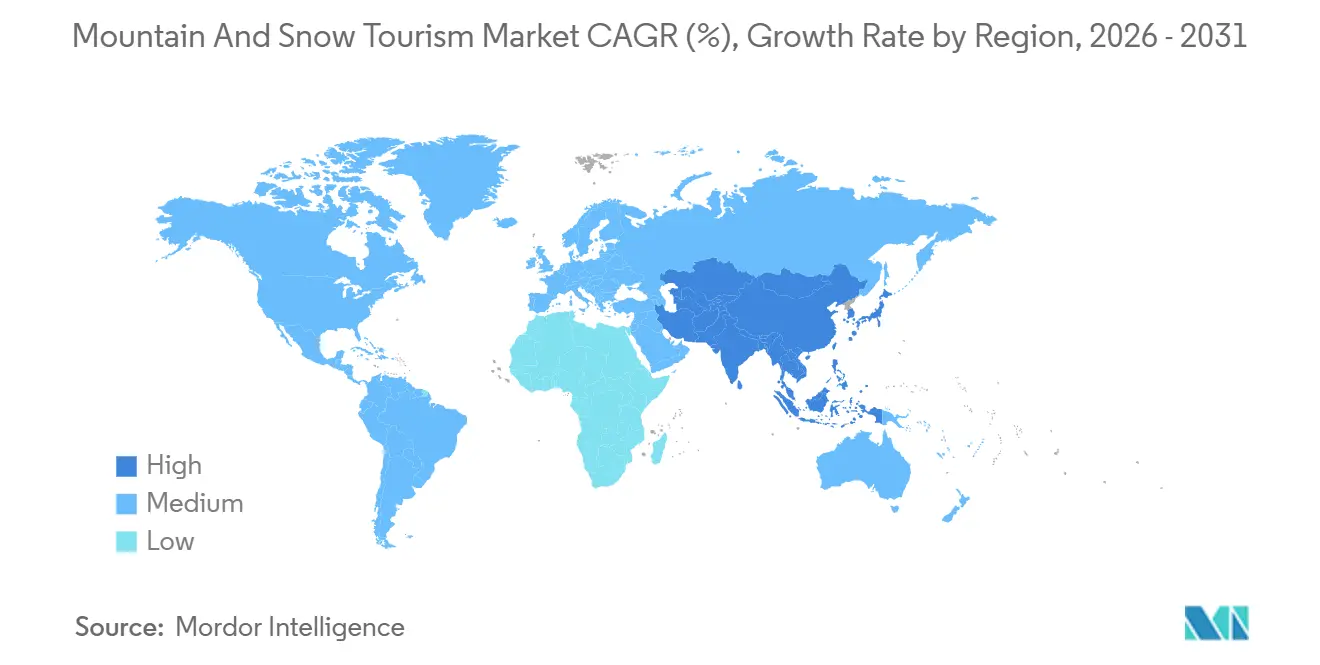
| Fastest Growing Market | Asia-Pacific |
| Largest Market | Europe |
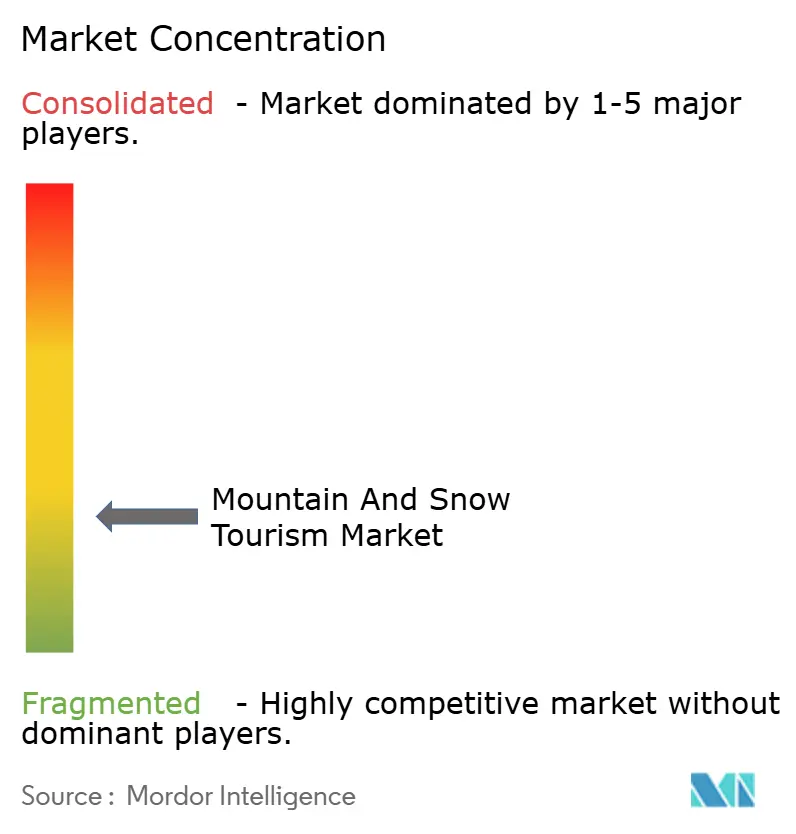
| Market Concentration | Low |
Major Players *Disclaimer: Major Players sorted in no particular order Image © Mordor Intelligence. Reuse requires attribution under CC BY 4.0. | |
Mountain and Snow Tourism Market Analysis by Mordor Intelligence
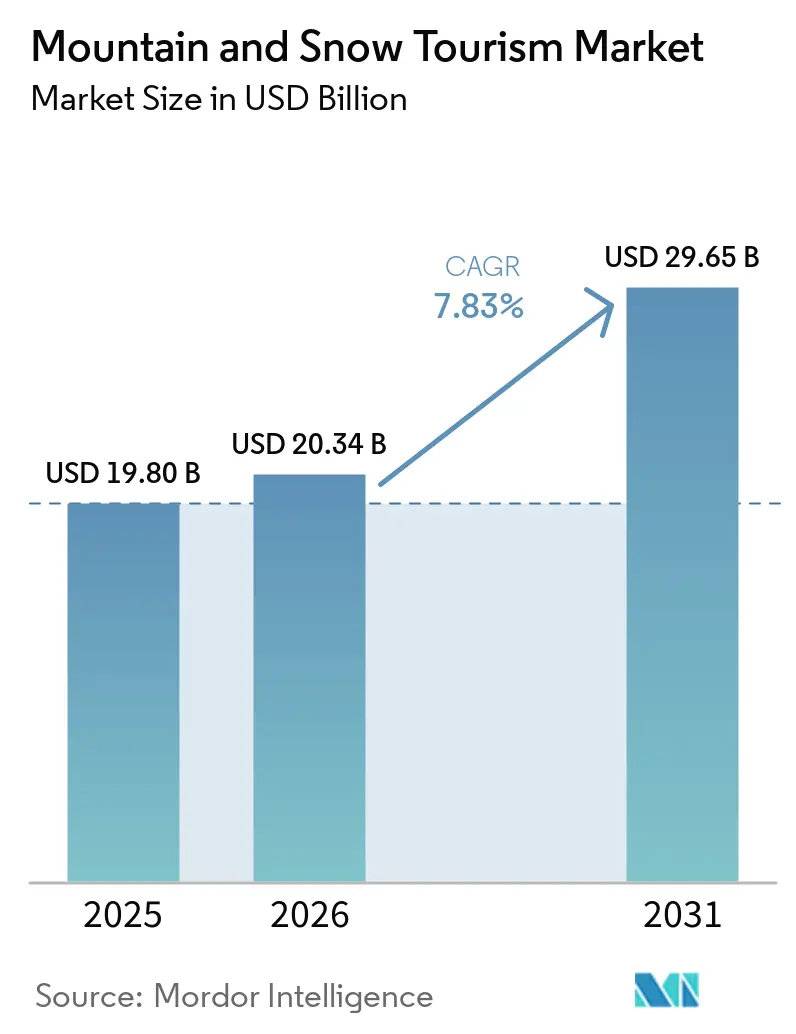
The Global Mountain and Snow Tourism Market is expected to grow from USD 19.80 billion in 2025 to USD 20.34 billion in 2026 and is forecast to reach USD 29.65 billion by 2031 at 7.83% CAGR over 2026–2031. Demand strengthened in 2026 following the 2024/25 winter season, which recorded 399 million global skier visits, the highest since 2000 and surpassing the 2018/19 peak. This reflects a shift toward activity-based and nature-focused travel rather than a temporary recovery[1]. The market is influenced by the adoption of pass ecosystems, digital booking platforms, and strategies to balance demand across seasons. Europe was the largest regional base in 2025 due to its Alpine infrastructure, while Asia-Pacific is expected to grow faster through 2031, driven by China's ski capacity expansion and increased winter tourism in Japan. Challenges include weather variability, high costs, and labor shortages, but resorts with advanced snowmaking and year-round offerings have shown resilience compared to lower-altitude and seasonal sites. Competition remains fragmented at the resort level, but access to gateway resorts, global pass networks, and direct distribution is concentrated among a few large operators.
Key Report Takeaways
- By service type, skiing led with 40.34% of the Global Mountain and Snow Tourism Market share in 2025, while snowboarding is projected to grow at an 8.75% CAGR through 2031.
- By tourist type, domestic tourists held 56.91% of the Global Mountain and Snow Tourism Market share in 2025, while international tourists are projected to grow at an 8.23% CAGR through 2031.
- By booking channel, online booking accounted for 58.52% of the Global Mountain and Snow Tourism Market size in 2025 and is also the fastest-growing channel at a 9.14% CAGR through 2031.
- By geography, Europe led with 36.73% share of the Global Mountain and Snow Tourism Market in 2025, while Asia-Pacific is projected to grow at an 8.93% CAGR through 2031.
Note: Market size and forecast figures in this report are generated using Mordor Intelligence’s proprietary estimation framework, updated with the latest available data and insights as of January 2026.
Global Mountain and Snow Tourism Market Trends and Insights
Drivers Impact Analysis*
| Drivers | (~) % Impact on CAGR Forecast | Geographic Relevance | Impact Timeline |
|---|---|---|---|
| Rising participation in ski and snow adventures | +1.8% | Global, concentrated in Asia-Pacific, North America, Europe | Short term (≤ 2 years) |
| Growth of online-first trip discovery and booking | +0.9% | Global, with Asia-Pacific and North America leading adoption rates | Medium term (2-4 years) |
| Year-round resort diversification lifting asset utilization | +0.7% | Europe, North America, spill-over to Asia-Pacific | Medium term (2-4 years) |
| Premium wellness and family packages increasing spend per trip | +0.6% | Europe (Alps), North America, emerging in Asia-Pacific | Medium term (2-4 years) |
| Global multi-resort passes redirecting long-haul demand | +0.5% | North America, Europe, expanding to Japan and Australia | Medium term (2-4 years) |
| Heat-escape demand is expanding summer mountain travel adjacencies | +0.4% | Europe (Alps), Asia-Pacific highlands, emerging in Middle East and Africa highlands | Long term (≥ 4 years) |
| Source: Mordor Intelligence | |||
Rising participation in ski and snow adventures
Global Mountain and snow tourism has expanded its participant base beyond pre-pandemic levels, with growth seen in both established and emerging destinations. The winter season of 2024/25 recorded the highest global skier visits since 2000, surpassing previous records. In the United States, the number of operating ski areas increased, reflecting confidence in sustained demand[2]. Reports indicated that attendance gains translated into stronger per-guest economics, with higher average ticket yields and reinvestment per visit. Snowboarding participation also grew, with notable increases among Hispanic and younger participants, signaling a more diverse and resilient demand for this market.
Growth of online-first trip discovery and booking
Digital platforms are central to global mountain and snow tourism market, integrating lift access, lodging, rentals, and activities. Online bookings have become the fastest-growing channel and continue to gain market share. In August 2025, Alpinco introduced a platform combining bookings, accommodations, lift products, and activities for Hafjell, Kvitfjell, and Oppdal, aiming to retain guests within operator-controlled digital systems[3]. Booking Holdings reported in May 2025 that bundled transactions, combining multiple travel products in one booking, grew significantly year-over-year in the first quarter. This shift is crucial for operators, as seamless direct booking experiences enhance conversions, capture package spending, and reduce reliance on fragmented offline sales channels.
Year-round resort diversification lifting asset utilization
Global mountain and snow tourism market is transitioning from a winter-focused model, marking a significant shift in resort strategies. Vail Resorts reported that summer visits and lodging demand at its North American properties in FY2025 helped offset weaker winter performance in some areas. In Switzerland, the Jungfrau Railway Group achieved record visitor numbers, while Grindelwald-First and the Mürren cable railway experienced year-over-year growth. Schilthorn Cableway noted increased visitors to Mürren-Allmendhubel, with summer traffic showing substantial growth. These developments highlight the growing importance of non-winter mountain tourism as a key revenue driver. This shift reduces reliance on a short winter season and promotes consistent use of lifts, scenic transport, dining, and wellness facilities.
Premium wellness and family packages increasing spend per trip
Wellness and family-focused offerings are increasing spending per stay in global mountain and snow tourism market by expanding travel motivations beyond skiing. Stakeholders in Leukerbad highlighted year-round tourism as a priority, with wellness, health, and family travel as key themes. This alignment reflects a shared vision among operators and local stakeholders for stable, higher-value demand. Club Med initiated construction of a new resort in Sansicario within the Vialattea ski area, signaling confidence in mountain formats that combine lodging, family activities, and all-inclusive services. These packages attract non-skiing companions and multi-generational groups, enhancing occupancy rates and optimizing the use of restaurants, thermal facilities, and guided experiences.
Restraints Impact Analysis*
| Restraints | (~) % Impact on CAGR Forecast | Geographic Relevance | Impact Timeline |
|---|---|---|---|
| Climate-driven snow unreliability at low and mid-altitudes | -1.2% | European Alps, lower-elevation North American resorts, Japan (Honshu) | Long term (≥ 4 years) |
| High snowmaking, lift, labor, and insurance cost inflation | -0.8% | North America (Rocky Mountain), Central Alps, Scandinavia | Medium term (2-4 years) |
| Workforce housing shortages in resort towns | -0.4% | North America, Alpine Europe | Medium term (2-4 years) |
| Data fragmentation weakens destination monetization and capacity planning | -0.3% | Global, concentrated in emerging Asia-Pacific and Middle East and Africa markets | Medium term (2-4 years) |
| Source: Mordor Intelligence | |||
Climate-driven snow unreliability at low and mid-altitudes
Snow variability driven by climate change remains a key challenge for global mountain and snow tourism market, affecting visit reliability and returns on investment. A study published in 2025 examined snowline elevation across Alpine basins from 1980 to 2024, revealing trends of delayed snowfall, earlier melting, and reduced snowpack. These conditions have already caused closures of many lower-elevation European ski areas. In the United States, snowfall during the 2025/26 season fell below the 10-year average, with several Western regions operating under average conditions. Research on French Alpine operators found no significant link between increased snowmaking investments and improved financial performance, even in seasons with minimal natural snow. Lower-altitude operators face dual pressures from declining natural snow reliability and uncertain returns on adaptation spending.
High snowmaking, lift, labor, and insurance cost inflation
Rising operating and capital costs in snowmaking, lifts, labor, and risk coverage are limiting the global mountain and snow tourism market. Research highlighted that snowmaking accounts for a significant portion of daily operating expenses at large Swiss resorts, with water demand expected to increase substantially under current climate trends. Snowmaking has delayed critical decisions, tied resorts to higher costs, and diverted attention from essential climate adaptation strategies. In the United States, capital expenditures for upcoming seasons include investments in new lifts, with per-visit reinvestment also increasing. These cost trends are challenging for the market, as it cannot fully pass additional expenses to consumers due to variable factors such as weather, trip timing, and travel budgets[4].
*Our forecasts treat driver/restraint impacts as directional, not additive. The impact forecasts reflect baseline growth, mix effects, and variable interactions.
Segment Analysis
By Service Type: Skiing Holds the Core Revenue Position While Adjacent Experiences Broaden Demand
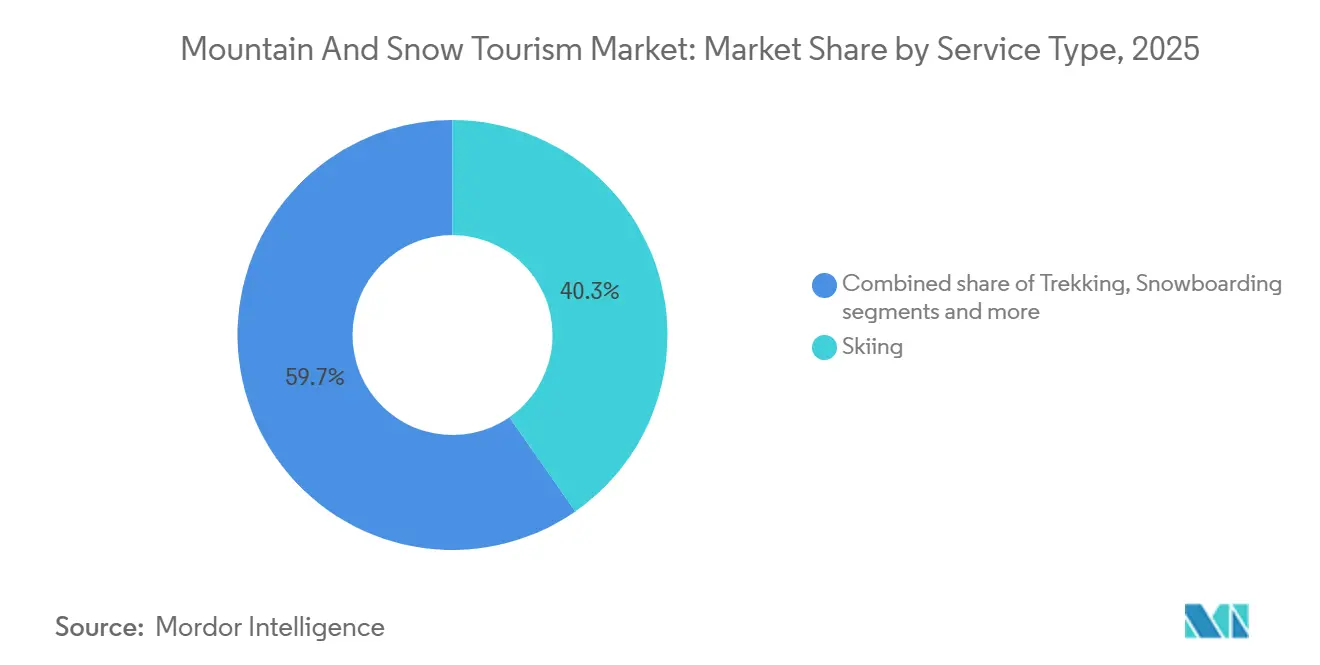
Skiing accounted for 40.34% of the global mountain and snow tourism market size in 2025, serving as the core activity around which lift systems, ski schools, lodging packages, and season passes are structured. In the United States, season passes represented 49% of skier visits in 2024/25, highlighting their importance in skier behavior and operator revenue planning. This reliance gives skiing a structural advantage, as resorts focus capacity, marketing, and investments on repeat skiers. Trekking, rides, and scenic mobility are also gaining importance, catering to visitors seeking mountain access without engaging in technical snow sports. The Jungfrau Railway Group’s Experience Mountains segment grew 3.9% in 2025, demonstrating steady demand for scenic transport despite regional shifts in winter-specific activities.
Snowboarding is projected to grow at an 8.75% CAGR through 2031, making it the fastest-growing segment in the global mountain and snow tourism market. In 2024, snowboarding participation rose by 9%, driven by Hispanic and first-time participants, indicating a broader demographic appeal. Sledding, tubing, and snowmobiling remain key feeder activities, lowering the skill barrier for first-time visitors and families. Wellness and other mountain experiences are also expanding, retaining non-ski spending within resorts through thermal facilities, spa packages, and guided leisure products. In Leukerbad, wellness and health ranked among the top year-round tourism themes, supporting the shift toward diversified service offerings that extend beyond skiing in the mountain and snow tourism market.

By Tourist Type: Domestic Demand Provides the Base While International Travel Lifts Spending Power
Domestic tourists accounted for 56.91% of the global mountain and snow tourism market share in 2025, establishing local and regional demand as a key stabilizing factor for resort systems. Domestic travelers face fewer challenges with visas, currency fluctuations, and airfare costs compared to international visitors. In China, ski resorts recorded 118 million visits between November 1, 2025, and January 31, 2026, generating CNY 69.15 billion (USD 9.88 billion) in consumption. France also maintained a strong domestic base during the 2025/26 season, with peak seasonal mountain accommodation occupancy reaching 73%, a 2.5% increase from the previous winter. This domestic demand helps operators manage weather and economic volatility more effectively than destinations heavily dependent on foreign arrivals.
International tourists contributed 43.09% of 2025 revenue and are projected to grow at a CAGR of 8.23% through 2031, highlighting the increasing role of cross-border travel. International visitors comprised nearly 80% of total ski-country arrivals during peak winter corridors in 2024/25, accounting for about 90% of total spending. JNTO data showed Japan welcomed 42.68 million inbound visitors in 2025, a 15.8% year-over-year increase. International mountain tourists typically stay longer, purchase bundled products, and spend more on transportation, lodging, and ancillary services. Although smaller in number, this group’s higher per-visit spending positions it as a significant growth driver for the mountain and snow tourism market.
By Booking Channel: Online Sales Lead Discovery and Conversion While Offline Channels Retain Advisory Value
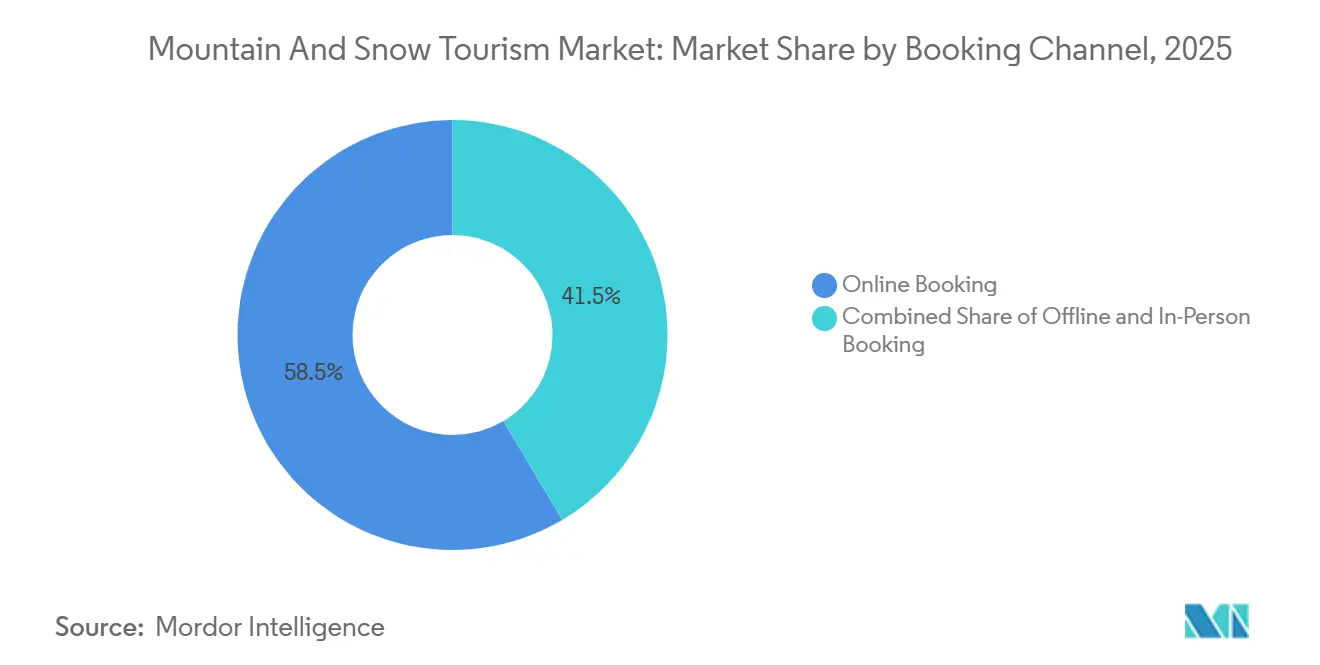
Online bookings captured 58.52% of 2025 revenue and are projected to grow at a 9.14% CAGR through 2031, making it the largest and fastest-growing channel in the global mountain and snow tourism market. This reflects the shift toward digital platforms for trip planning, price comparisons, bundled packages, and mobile bookings. Alpinco launched a unified direct booking platform in August 2025, integrating accommodation, lift access, and activities across its three resorts to meet online demand. Booking Holdings reported a 35% year-over-year increase in connected transactions in Q1 2025, highlighting the value of multi-product bookings. Online control also helps operators build direct guest relationships and reduce reliance on third-party sellers.
Offline and in-person bookings show the continued importance of advisory-led and resort-side channels in the market. These channels are essential for first-time skiers, older travelers, and families needing itinerary support. Specialist ski tour operators also use these channels to bundle flights, transfers, hotels, lift passes, and ski school. Offline channels remain significant but are shifting toward trip design, reassurance, and personalized support rather than volume generation.
Geography Analysis
Europe accounted for 36.73% of the global mountain and snow tourism market share in 2025, driven by unmatched Alpine resort density, lift capacity, and accommodation depth. France supported this position in 2025/26 with a 1% rise in national ski area frequency, a 6% increase in mountain station sport retail revenue, and EUR 90 million (USD 105.9 million) in estimated regional economic impact from 370,000 booked accommodation nights. A 68.6% occupancy rate across ski accommodations in 2025/26 highlighted strong Alpine lodging demand. Switzerland remained significant, with the Jungfrau Railway Group attracting 3,909,700 visitors in 2025, leveraging winter sports and scenic mountain experiences. In the Nordics, SkiStar reported FY2024/25 sales of SEK 4,631 million (USD 504.0 million), reflecting the growing role of Scandinavian resorts in Europe.
Asia-Pacific is projected to grow at an 8.93% CAGR through 2031, making it the fastest-expanding region in the market. China recorded 35 million resort visits in November 2025 and 118 million visits between November 1, 2025, and January 31, 2026, with inbound international visits to ski resorts rising 89.2% year-over-year. Southern China saw increased indoor ice-and-snow investments, indicating growth beyond northern ski zones. Japan reported 42.68 million inbound visitors in 2025, with international visitors contributing significantly to spending at top ski destinations, emphasizing cross-border demand.
North America ranked as the second-largest region, supported by destination resorts, season-pass adoption, and a strong domestic skier base. The United States recorded 61.5 million skier visits in 2024/25, though weather challenges reduced visits to 52.6 million in 2025/26. Canada benefited from cross-border demand through prominent resorts. South America served as a counter-seasonal option, while the Middle East and Africa showed long-term investment potential. Europe leads in scale, Asia-Pacific drives future growth, and North America remains a key profit center.
Competitive Landscape
Global mountain and snow tourism market is fragmented by the number of resorts, with ski resorts spread across 68 countries. However, operators managing destination-class access and large pass ecosystems hold significant influence. Vail Resorts, operating multiple resorts, reported substantial revenue in FY2025, demonstrating the impact a single operator can have. Alterra Mountain Company, through its Ikon network, expanded to numerous destinations for the 2026/27 season, covering North America, Europe, and Asia-Pacific. Pass coverage increasingly shapes access, loyalty, and travel planning, reducing the influence of individual resort marketing. Smaller operators remain relevant locally but have limited control over long-haul demand and digital distribution.
Strategic expansion continues to shape the market, with operators focusing on adding inventory and strengthening international positions. Vail Resorts acquired Crans-Montana Mountain Resort in Switzerland, marking its second European property after Andermatt-Sedrun. The company also announced a capital plan for 2026, emphasizing investments in its European assets. Club Med’s foundation stone event for its Sansicario resort highlights ongoing developments in Alpine mountain travel. These actions reflect the importance of controlled access and destination networks in maintaining competitiveness.
Distribution control is becoming as critical as resort ownership. Alpinco launched a unified booking and destination platform, enabling operators to retain spending within their ecosystems. Booking Holdings reported growth in bundled transactions, showing how digital platforms are capturing value from integrated mountain travel packages. DERTOUR Group’s acquisition of Hotelplan Group brought ski specialists like Inghams under its umbrella, aligning with digital expansion goals. Competition in the market now revolves around network reach, inventory, and digital control, rather than solely on local appeal.
Mountain and Snow Tourism Industry Leaders
-
Vail Resorts, Inc.
-
Alterra Mountain Company
-
Compagnie des Alpes
-
SkiStar AB
-
Boyne Resorts
- *Disclaimer: Major Players sorted in no particular order
Recent Industry Developments
- May 2026: Vail Resorts plans a 2026 capital investment of USD 234 - 239 million, focusing on core maintenance, European resort growth projects (Andermatt-Sedrun and Crans-Montana), and Resource Efficiency Transformation initiatives.
- March 2026: Alterra Mountain Company introduced the 26/27 Ikon Pass, offering access to 76 destinations across 5 continents and 13 countries. The pass expands resort access in Japan and strengthens the network’s global presence.
- February 2026: Club Med has started building a 500-room mountain resort in Cesana Torinese, Sansicario, within the Vialattea ski area, aiming for a December 2028 opening. The resort will accommodate up to 1,000 guests.
- February 2026: Ski resorts in China recorded 118 million visits between November 1, 2025, and January 31, 2026, including 1.255 million international visits, an 89.2% year-over-year increase. Total spending at resorts and nearby areas reached CNY 69.15 billion (USD 9.88 billion).
Global Mountain and Snow Tourism Market Report Scope
| Skiing |
| Trekking |
| Rides and Scenic Mobility |
| Sledding and Tubing |
| Snowmobiling |
| Snowboarding |
| Wellness and Other Mountain Experiences |
| Domestic |
| International |
| Online Booking |
| Offline and In-Person Booking |
| North America | United States |
| Canada | |
| Mexico | |
| South America | Brazil |
| Peru | |
| Chile | |
| Argentina | |
| Rest of South America | |
| Europe | United Kingdom |
| Germany | |
| France | |
| Spain | |
| Italy | |
| BENELUX (Belgium, Netherlands, and Luxembourg) | |
| NORDICS (Denmark, Finland, Iceland, Norway, and Sweden) | |
| Rest of Europe | |
| Asia-Pacific | India |
| China | |
| Japan | |
| Australia | |
| South Korea | |
| South East Asia (Singapore, Malaysia, Thailand, Indonesia, Vietnam, and Philippines) | |
| Rest of Asia-Pacific | |
| Middle East And Africa | United Arab Emirates |
| Saudi Arabia | |
| South Africa | |
| Nigeria | |
| Rest of Middle East And Africa |
| By Service Type | Skiing | |
| Trekking | ||
| Rides and Scenic Mobility | ||
| Sledding and Tubing | ||
| Snowmobiling | ||
| Snowboarding | ||
| Wellness and Other Mountain Experiences | ||
| By Tourist Type | Domestic | |
| International | ||
| By Booking Channel | Online Booking | |
| Offline and In-Person Booking | ||
| By Geography | North America | United States |
| Canada | ||
| Mexico | ||
| South America | Brazil | |
| Peru | ||
| Chile | ||
| Argentina | ||
| Rest of South America | ||
| Europe | United Kingdom | |
| Germany | ||
| France | ||
| Spain | ||
| Italy | ||
| BENELUX (Belgium, Netherlands, and Luxembourg) | ||
| NORDICS (Denmark, Finland, Iceland, Norway, and Sweden) | ||
| Rest of Europe | ||
| Asia-Pacific | India | |
| China | ||
| Japan | ||
| Australia | ||
| South Korea | ||
| South East Asia (Singapore, Malaysia, Thailand, Indonesia, Vietnam, and Philippines) | ||
| Rest of Asia-Pacific | ||
| Middle East And Africa | United Arab Emirates | |
| Saudi Arabia | ||
| South Africa | ||
| Nigeria | ||
| Rest of Middle East And Africa | ||
Key Questions Answered in the Report
What is the 2031 outlook for mountain and snow tourism revenue?
The global mountain and snow tourism market is forecast to reach USD 29.65 billion by 2031 from USD 20.34 billion in 2026, which implies a 7.83% CAGR over 2026 to 2031.
Which region leads to current demand and which one is growing the fastest?
Europe held 36.73% of 2025 revenue, while Asia-Pacific is projected to grow the fastest at an 8.93% CAGR through 2031.
Which service category is largest today and which one is gaining momentum fastest?
Skiing remained the largest service type with 40.34% share in 2025, while snowboarding is projected to post the fastest growth at 8.75% CAGR through 2031.
How important are online bookings for mountain trips now?
Online booking already represented 58.52% of 2025 revenue and is forecast to grow at 9.14% CAGR, which keeps digital channels at the center of trip discovery and conversion.
Why are international travelers important for ski destinations even when domestic demand is larger?
Domestic travelers led with 56.91% share in 2025, but international travelers are growing faster at 8.23% CAGR and tend to deliver higher spend per trip, as seen in Japan where they accounted for a much larger share of visitor spending than visitor count.
What are the biggest operational risks for resorts through 2031?
The main constraints are unreliable snow at lower altitudes, rising snowmaking and lift costs, workforce housing shortages, and fragmented data systems that weaken direct monetization and guest retention.