
Mechanical Energy Storage Market Size and Share
Market Overview
| Study Period | 2022 - 2032 |
|---|---|
| Market Size (2027) | USD 25.63 Billion |
| Market Size (2032) | USD 60 Billion |
| Growth Rate (2027 - 2032) | 18.54 % |
| Fastest Growing Market | Asia-Pacific |
| Largest Market | Asia-Pacific |
| Market Concentration | Low |
Major Players *Disclaimer: Major Players sorted in no particular order Image © Mordor Intelligence. Reuse requires attribution under CC BY 4.0. | |
Mechanical Energy Storage Market Analysis by Mordor Intelligence
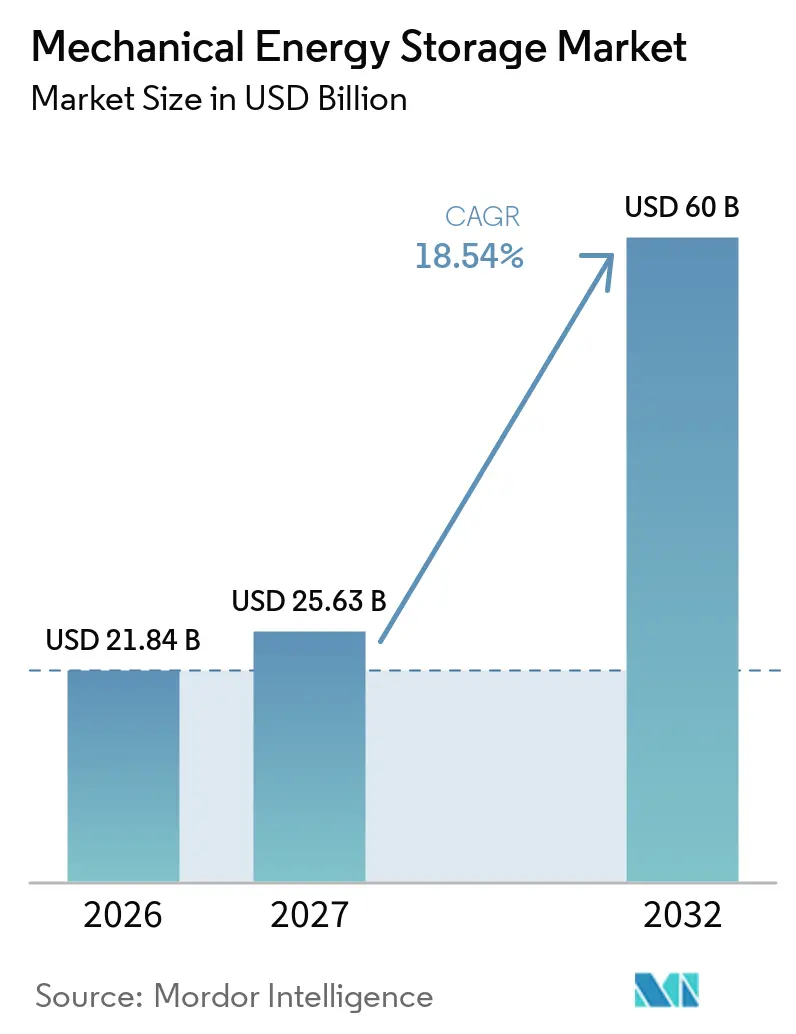
The mechanical energy storage market size is projected to be USD 21.84 billion in 2026, USD 25.63 billion in 2027, and reach USD 60 billion by 2032, growing at a CAGR of 18.54% from 2027 to 2032. The market is benefiting from renewable generation that cannot always be absorbed at the time of production. Grid operators are placing greater value on assets that can respond quickly and operate for longer periods, which broadens the market beyond its traditional role in bulk pumped hydro. Pumped hydro remains the established technology at scale, while compressed air, flywheel, gravity, and liquid air systems address more specific needs. Each technology is evaluated against the duration of the grid service required, site conditions, and the availability of long-term contractual support. Commercial opportunity depends increasingly on capacity payments, long-term contracts, and procurement rules that recognize discharge duration, particularly for projects that require predictable revenue before construction begins. This supports established equipment suppliers, provides emerging developers a clearer path to financing large projects, and places greater value on demonstrated delivery capability, dependable equipment supply, and credible long-term offtake arrangements.
Key Report Takeaways
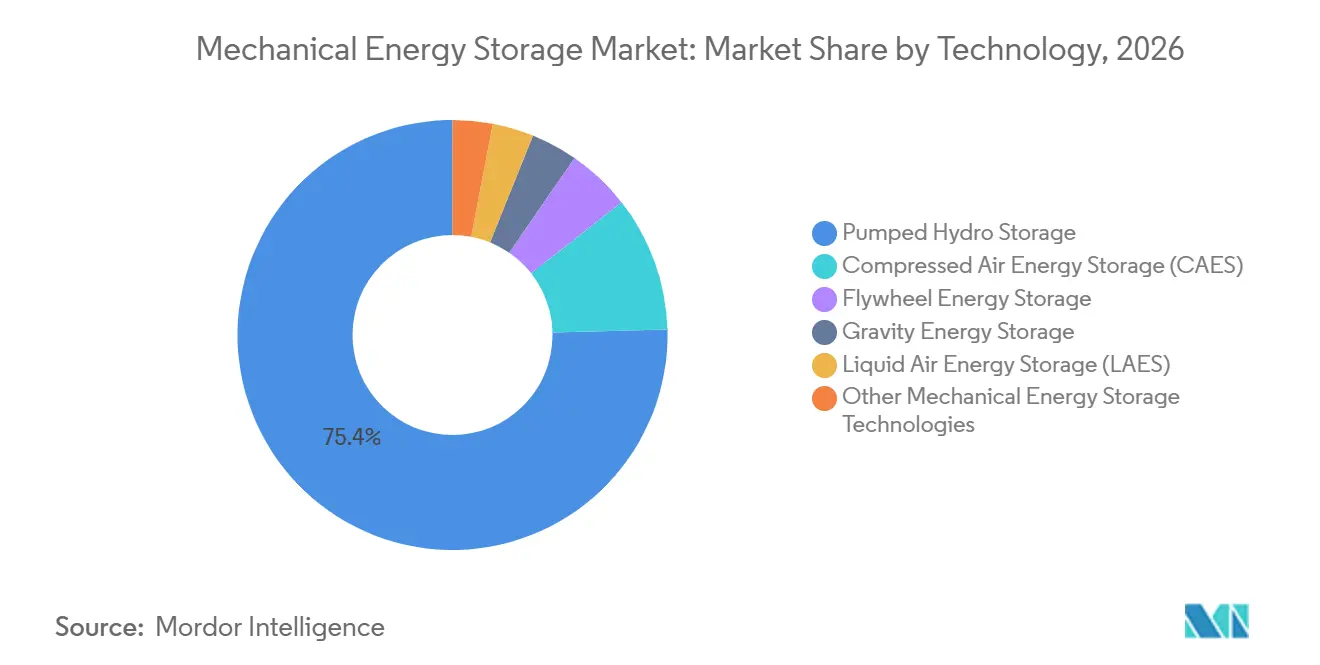
- By technology, pumped hydro storage held 75.4% of the mechanical energy storage market share in 2026, while flywheel energy storage is projected to grow at a 19.3% CAGR through 2032.
- By capacity, projects above 500 MW accounted for 48.3% of the mechanical energy storage market share in 2026, while the 101 to 500 MW category is projected to expand at a 19.1% CAGR through 2032.
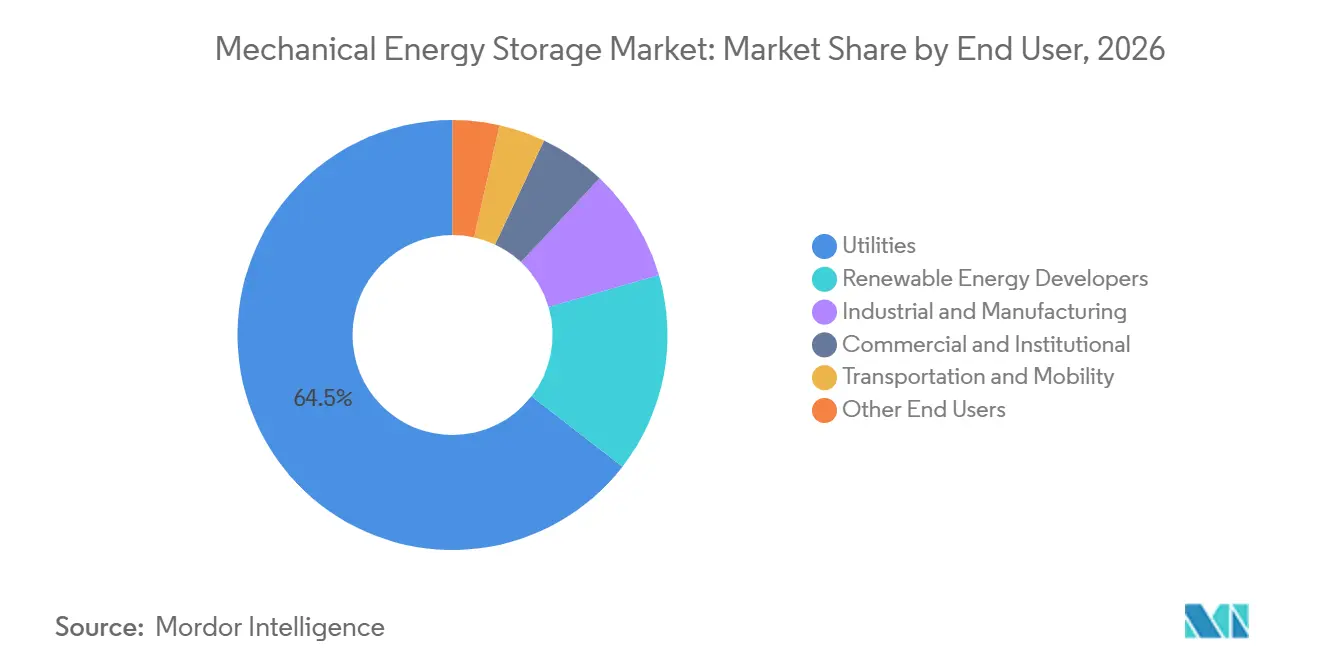
- By end user, utilities held 64.5% of the mechanical energy storage market share in 2026, while renewable energy developers are projected to grow at a 19.9% CAGR through 2032.
- By geography, Asia-Pacific accounted for 49.2% of the mechanical energy storage market share in 2026 and is projected to grow at an 18.9% CAGR through 2032.
Note: Market numbers in this report are based on Mordor Intelligence's proprietary estimation framework, which combines nine months of actuals with Q4 projections for base year 2026.
Market Trends and Insights
Drivers Impact Analysis of Mechanical Energy Storage Market*
| Driver | (~) % Impact on CAGR Forecast | Geographic Relevance | Impact Timeline |
|---|---|---|---|
| Renewable Curtailment and Grid Flexibility | +5.2% | Global, concentrated in Asia-Pacific and Western Europe | Short term (≤ 2 years) |
| Long-Duration Storage Procurement | +4.1% | North America, Europe, Asia-Pacific | Medium term (2-4 years) |
| Decarbonization and Capacity-Market Support | +3.6% | Global, with early gains in the European Union, United Kingdom, and Australia | Medium term (2-4 years) |
| Hydropower Repowering and Industrial-Site Reuse | +2.3% | Europe, Japan, Central and South Asia, with spill-over to South America | Long term (≥ 4 years) |
| Corporate Demand for Firm Clean Power | +1.9% | North America, Europe, Australia | Medium term (2-4 years) |
| Mine, Quarry, and Subsurface-Asset Reuse | +1% | Asia-Pacific core, with spill-over to Europe and South America | Long term (≥ 4 years) |
| Source: Mordor Intelligence | |||
Renewable Curtailment and Grid Flexibility Requirements
Renewable curtailment is converting grid flexibility from a planning issue into a direct operating cost. This pattern strengthens the case for mechanical energy storage to absorb excess solar and wind output, particularly where networks face recurring oversupply at the same hours each day. A Nature Communications study found that 20 TWh of long-duration storage in a zero-carbon Western North American grid could reduce curtailment by 92%.[1] More frequent cycling can improve revenue visibility for assets that buy power when prices are low and sell it during constrained periods. The value proposition is strongest where curtailment, price volatility, and system balancing needs occur together. This linkage brings storage decisions closer to everyday grid operations rather than treating them solely as long-term infrastructure planning.
Grid Modernization, Long-Duration Procurement, and Capacity Support
Long-duration storage is increasingly being addressed through procurement and capacity mechanisms rather than general policy statements, which improves visibility for the mechanical energy storage market. India's pumped hydro guidelines included an interstate transmission charge waiver and environmental review exemptions for off-stream projects.[2] The United States investment tax credit also applies to standalone mechanical storage, reducing a prior disparity in treatment compared with battery systems. These frameworks improve the commercial case for projects whose value depends on delivering capacity over many hours. They also make project comparisons more consistent, as developers can demonstrate how discharge duration affects the value awarded to a resource. This is important for technologies that have different construction profiles but serve similar long-duration needs.
Decarbonization Targets, Asset Repowering, and Site Reuse
Decarbonization targets are creating demand that spot power prices alone may not support. Aging hydro plants also provide a practical route to add flexible capacity without developing an entirely new site. Voith's Grimsel 4 order covered two variable-speed 70 MW pump turbines, while its work in Spain and Romania reflects continued investment in rehabilitation. Reusing mines, quarries, and underground structures could broaden site options for gravity and compressed-air systems where conventional pumped hydro is difficult to permit. These approaches remain longer-term opportunities, as engineering, water, geological, and community requirements still determine whether a site can progress.
Corporate Demand for Firm, 24/7 Clean Power
Large power users are seeking clean power contracts that offer more dependable output. Google, Meta, Amazon, and Microsoft accounted for 49% of corporate clean-power deals signed in 2025. Google also signed a 396 MW power purchase agreement with Fervo Energy in September 2026 for enhanced geothermal output. Tesla signed a long-term agreement covering 90% of Project Sterling's 1 TWh annual output in Arizona, supported by 360 MW of 4-hour battery storage.[3] The mechanical energy storage market can serve the longer-duration gap where a firm supply arrangement requires 8 to 20 hours of dispatchable energy, a period less easily served by systems designed primarily for short peak periods.
Restraints Impact Analysis of Mechanical Energy Storage Market*
| Restraint | (~) % Impact on CAGR Forecast | Geographic Relevance | Impact Timeline |
|---|---|---|---|
| High Capital Requirements and Long Payback | -2.4% | Global, most acute in emerging markets | Long term (≥ 4 years) |
| Lengthy Permitting and Construction Timelines | -1.8% | Global, most acute in North America and Europe | Medium term (2-4 years) |
| Site, Geological, and Water Constraints | -1.5% | Global, structurally limits large-scale pumped hydro expansion | Long term (≥ 4 years) |
| Battery Cost Deflation in Short-Duration Uses | -2.1% | Global, concentrated in applications below 8 hours | Short term (≤ 2 years) |
| Source: Mordor Intelligence | |||
Capital, Permitting, and Site Constraints
Capital requirements remain the primary commercial constraint for large mechanical storage assets and a defining factor for the mechanical energy storage market. A large pumped hydro plant can require USD 1.5 billion to USD 3 billion in initial investment and take 8 to 15 years from development to revenue generation. Hydrostor's 500 MW and 4,000 MWh Willow Rock project required a USD 775 million, 25-year offtake agreement and a conditional USD 1.76 billion loan guarantee before approaching financial close. These requirements favor developers with established institutional relationships, long development pipelines, and the ability to assemble offtake, engineering, equipment, and financing commitments well before construction begins. Permitting, environmental review, geological conditions, and water availability further limit the number of suitable projects. Revenue-floor mechanisms can reduce financing risk, but they do not remove the technical and construction risk of assets above 200 MW. Project sponsors must still demonstrate that civil works, equipment integration, and operational assumptions can be delivered on the schedule presented to lenders. This keeps financing discipline central to project selection throughout development, construction, commissioning, and the first years of operation in each local power system.
Battery Cost Deflation and Short-Duration Substitution
Lithium iron phosphate batteries are displacing mechanical technologies in many applications below 4 hours, and the substitution boundary is moving toward 8 hours. Global storage installations reached 92 GW and 247 GWh in 2025, 23% above 2024 levels, with battery systems accounting for most new capacity. This does not eliminate the role of pumped hydro and advanced compressed air in long-duration balancing and transmission deferral. Duration-based capacity requirements reinforce the distinction between shorter battery systems and longer-duration assets. Flywheel suppliers face a more direct challenge, as batteries with cycle lives above 10,000 cycles can serve some frequency-regulation requirements. Flywheels retain a clearer role where sub-second response, very high cycling, or chemical fire risk are decisive factors.
*Our forecasts treat driver/restraint impacts as directional, not additive. The impact forecasts reflect baseline growth, mix effects, and variable interactions.
Mechanical Energy Storage Market Segment Analysis
By Technology:
Pumped Hydro Anchors Scale While Flywheels AdvancePumped hydro held 75.4% of the mechanical energy storage market share in 2026, while flywheel energy storage is forecast to grow at a 19.3% CAGR through 2032. Pumped hydro retained this position because its installed base exceeded 200 GW globally in 2025. This large installed base supports established service, upgrade, and equipment markets across plants that require modern controls, variable-speed capability, and renewed pump-turbine equipment. Flywheel systems address high-cycle and fast-response grid services that require repeated, short discharges. The Rushan 100 MW all-flywheel frequency-regulation station connected to the grid in July 2025, creating a reference point for larger standalone applications. The mechanical energy storage market for flywheels is supported by their expected role in systems that need rapid inertia response and dependable performance during grid disturbances.
Flywheel systems use magnetically levitated high-speed designs associated with 85% to 95% discharge efficiency and cycle lives above 200,000 cycles. Advanced compressed air projects are moving toward the 200 MW to 500 MW range. Gravity and liquid air systems have fewer commercial references, although Energy Vault Corporation and Highview Power are developing projects intended to provide those references. Buoyancy-based storage remains exploratory and has no confirmed commercial deployment in the forecast period. Pumped hydro may lose some percentage share as newer formats expand faster, though its absolute revenue contribution can still rise because 243 GW of pumped hydro was under construction globally in 2025.

By Capacity:
Large Projects Lead While Mid-Range Systems Grow FasterProjects above 500 MW accounted for 48.3% of the mechanical energy storage market share in 2026. This reflects conventional pumped hydro installations in Japan, the United States, China, and Western Europe, where individual plants can exceed 1,000 MW. The 101 to 500 MW range is projected to grow at a 19.1% CAGR through 2031. Advanced compressed-air projects are often designed within this range because it suits grid connections and purpose-built cavern conditions. Hydrostor also announced its proposed 500 MW Quinte project in Ontario for long-duration procurement.
Below-10 MW and 10 to 50 MW projects serve industrial, microgrid, and high-cycle flywheel needs. These applications are relevant to island grids, military facilities, and sites that require uninterrupted power-quality support. The 51 to 100 MW range sits between industrial demand and transmission-scale development, and is relevant in Latin America and ASEAN, where grid expansion is often incremental. Projects above 50 MW can face additional environmental requirements in parts of Asia-Pacific, making capacity selection both a commercial and permitting decision. Developers must align a proposed design with grid needs, land conditions, and the applicable review process. The mechanical energy storage market benefits when developers match capacity to a grid service and a realistic approval path, rather than selecting a project size based solely on nominal output. This alignment reduces the risk that a technically valid project lacks a suitable customer, grid connection, or permitting route, and supports a more disciplined development pipeline for technologies with limited commercial operating history.
By End User:
Utilities Lead While Renewable Developers ExpandUtilities held 64.5% of the mechanical energy storage market share in 2026. Their position reflects the capital requirements of major projects and their role as system operators in regulated power systems. Renewable energy developers are forecast to grow at a 19.9% CAGR through 2032 as storage is increasingly linked to wind and solar projects. GE Vernova received an order for 9 pumped-storage units rated at 150 MW each for Megha Engineering and Infrastructures Limited's 1.35 GW Upper Sileru project in India.[4] The order demonstrates how infrastructure developers can pursue projects that were previously more closely associated with utilities. Long-term power purchase agreements make this broader participation more viable.
Industrial users require mechanical storage for power-quality management in semiconductor, pharmaceutical, and data-center facilities. Flywheels are relevant where frequent cycling and fast response have greater value than long discharge duration. Commercial and institutional users remain concentrated in campus microgrids. Transportation demand includes regenerative braking recovery for rail networks and buffer storage at ports. These uses are smaller than utility-scale storage but technically proven, and they diversify the mechanical energy storage market beyond large grid projects. Their practical value is linked to the cost of outages, the quality of the local power supply, and the operating requirements of the facility using the equipment. Adoption depends on whether users prioritize reliability, cycle life, and safety over initial equipment cost, particularly where interruptions impose operating losses or strict performance requirements apply.
Geography Analysis
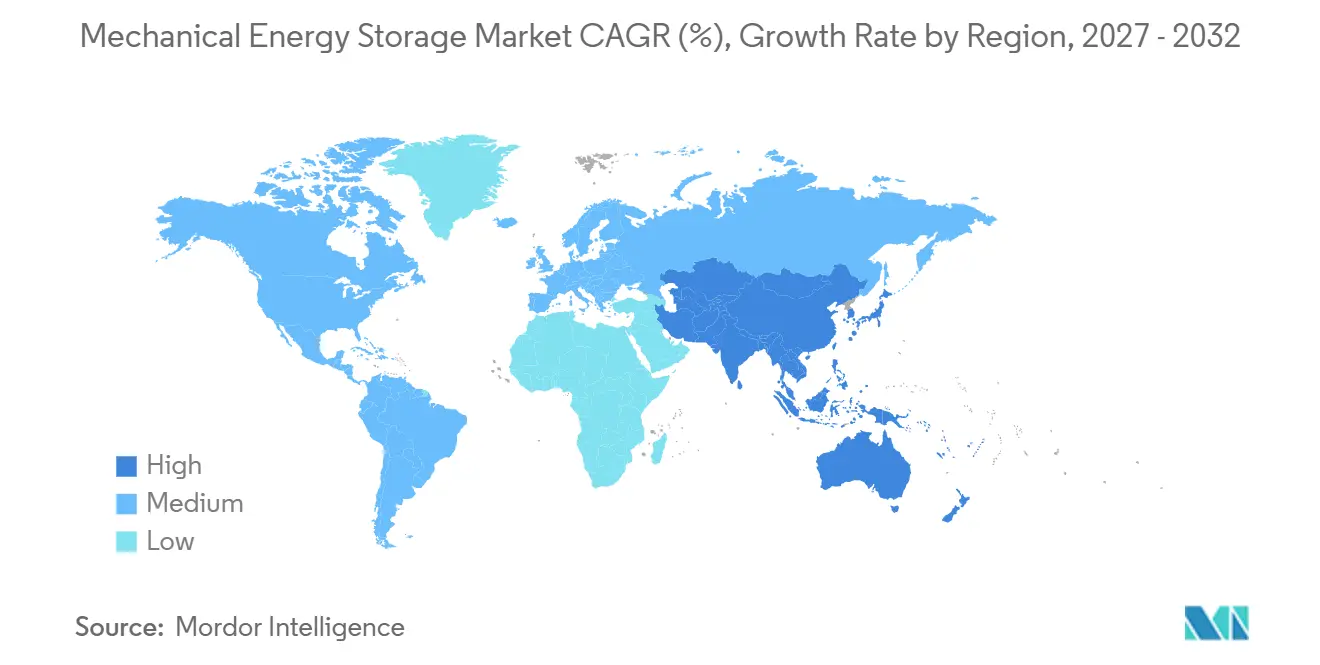
Asia-Pacific accounted for 49.2% of the mechanical energy storage market share in 2026 and is projected to grow at an 18.9% CAGR through 2032. According to the International Hydropower Association, China commissioned 7.48 GW of pumped storage in 2025 and had 218 GW under construction. India is targeting 100 GW of pumped storage by 2035-36, up from nearly 6 GW today. GE Vernova commissioned the first 250 MW variable-speed unit at Tehri in June 2025. Toshiba Energy Systems won an order for a 200 MW adjustable-speed system for Kyogoku Unit 3 in Japan in July 2026. Vietnam, Indonesia, and Australia contribute additional demand based on their respective renewable integration requirements.
North America is the second-largest regional market, with the strongest opportunity in 500 MW-scale advanced compressed-air projects. US storage installations reached 58 GWh in 2025, 30% above 2024 levels. Willow Rock in California, Quinte in Ontario, and Copper Valley in Arizona represent advanced projects in this size range. Hydrostor signed a February 2026 agreement with California Community Power for 50 MW from Willow Rock. The United States pumped-storage pipeline exceeded 60 GW at the end of 2025. Federal incentives, state long-duration mandates, and Ontario procurement offer different routes to revenue certainty, each assigning different responsibilities to utilities, developers, and public authorities.
Europe is characterized by pumped-hydro rehabilitation, liquid-air development, and early gravity-storage activity at former industrial sites. Voith's work at Grimsel 4, Torrejón, and Lotru-Ciunget reflects this rehabilitation trend. Highview Power's Carrington facility is planned at 50 MW and 300 MWh, with the grid-stability island operating from 2026 and the full system expected in 2027. South America has longer-term potential from Brazil's hydropower base and Chilean wind curtailment. In the Middle East and Africa, Energy Vault and Eskom agreed in May 2026 to develop a 25 MW, 100 MWh gravity-storage project in South Africa. The agreement provides a framework that could scale to 4 GWh across Southern Africa, establishing an early reference for advanced mechanical storage outside conventional pumped hydro.
Competitive Landscape
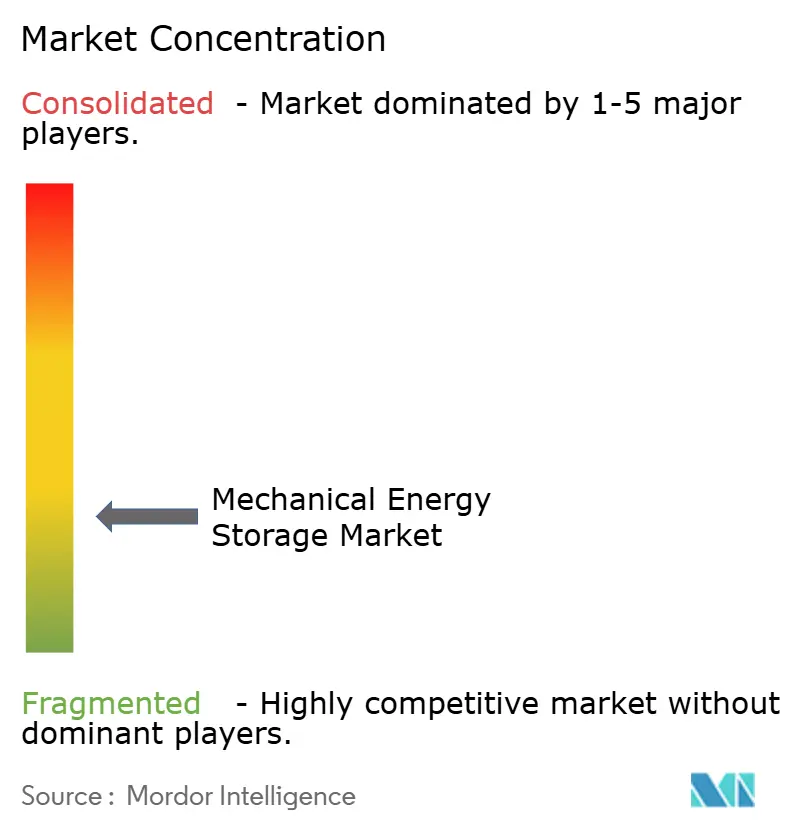
The mechanical energy storage market has a concentrated equipment tier and a more fragmented emerging-technology tier. Voith, ANDRITZ, GE Vernova, Toshiba Energy Systems, Siemens Energy, and Hitachi Energy are established suppliers for pumped-hydro equipment. Hydrostor, Highview Power, Energy Vault, and Boding Energy compete in advanced compressed air, liquid air, gravity, and flywheel applications. Variable-speed pump-turbine capability is becoming a standard technical requirement for major projects. ANDRITZ won an order for equipment at Tata Power's 1,000 MW Bhivpuri project in March 2026. Voith secured the electro-mechanical package for JSW Energy's 1,500 MW Bhavali project in India. GE Vernova's Tehri commissioning demonstrated the application of variable-speed technology at scale.
Digital controls and cybersecurity are becoming part of the competitive offering for pumped-hydro upgrades. Chinese manufacturers are pursuing lower flywheel component costs through local production of magnetic-levitation bearing systems. Hydrostor closed a USD 230 million equity round in August 2026, with participation from Baker Hughes, Goldman Sachs Alternatives, CPP Investments, and Canada Growth Fund. Baker Hughes also placed orders for up to 1.4 GW of compression and expander equipment. This type of equipment partnership can reduce integration risk and strengthen lender confidence. Developers without a commercial reference plant or committed equipment supply face a more difficult path to financial close.
Corre Energy and Storelectric remain active in European compressed-air development, though financial close for a first commercial project had not been identified in the available material. This leaves an opportunity for developers that can deliver a bankable 100 MW to 300 MW plant where capacity payments support long-duration operation. Flywheel providers can also differentiate through proven response speed and compliance with grid-code inertia standards. These dynamics create competition in the mechanical energy storage market between established project-delivery capacity and technologies seeking their first scalable commercial references. Procurement rules and financing relationships can be as important as equipment performance in this context. Suppliers that can provide complete technical packages, proven delivery records, and reliable contractual support have an advantage when project decisions move from development to funding. The mechanical energy storage market is therefore concentrated in mature pumped-hydro equipment but less concentrated in newer storage formats, where commercial project histories and specialized supply chains are still developing. Competition may shift as newer developers achieve financial close, complete construction, and establish operating records that customers and lenders can evaluate.
Mechanical Energy Storage Industry Leaders
-
Voith GmbH and Co. KGaA
-
Andritz AG
-
GE Vernova, Inc.
-
Siemens Energy AG
-
Toshiba Energy Systems and Solutions Corporation
- *Disclaimer: Major Players sorted in no particular order
Mechanical Energy Storage Market Companies Covered in this Report
- ABB Ltd.
- Active Power, Inc.
- Amber Kinetics, Inc.
- Andritz AG
- Beacon Power LLC
- Calnetix Technologies
- Corre Energy B.V.
- Energy Vault Holdings, Inc.
- General Electric Company
- Gravitricity Ltd.
- Green Gravity
- Highview Power
- Hitachi Energy Ltd.
- Hydrostor Inc.
- Mitsubishi Heavy Industries, Ltd.
- Siemens Energy AG
- Storelectric Ltd.
- Stornetic GmbH
- Sulzer Ltd.
- Toshiba Energy Systems and Solutions Corporation
- Voith GmbH and Co. KGaA
- VYCON, Inc.
Recent Industry Developments in Mechanical Energy Storage Market
- May 2026: Energy Vault and Eskom signed a Strategic Development Agreement to deploy a 25 MW / 100 MWh EVx 2.0 gravity energy storage system at the Hendrina Power Station in South Africa. The agreement also establishes a framework for deploying up to 4 GWh of gravity-based storage across the Southern African Development Community (SADC) region by 2035.
- April 2026: Voith received a contract from Kraftwerke Oberhasli AG to supply two 70 MW variable-speed pump turbines for the Grimsel 4 Pumped Storage Project in Switzerland, reflecting Europe's continued investment in flexible renewable energy infrastructure.
- March 2026: ANDRITZ secured an order from Tata Power to supply three reversible pump turbines, motor-generators, and electro-mechanical equipment for the 1,000 MW Bhivpuri Pumped Storage Project in Maharashtra, India. The project supports India's expanding pumped-storage pipeline and renewable energy integration.
- January 2026: Hydrostor and Baker Hughes signed a strategic technology and equity agreement to advance Hydrostor's Advanced Compressed Air Energy Storage (A-CAES) projects. The agreement includes equipment orders of up to 1.4 GW, covering compression, expander, motor, and generator equipment from Baker Hughes, for Hydrostor's flagship projects in North America and Australia.
Global Mechanical Energy Storage Market Report Scope
Mechanical energy storage refers to technologies that store energy in mechanical form and release it as electricity when needed. These systems store energy through physical mechanisms such as water elevation, compressed air, rotational motion, gravity, or liquefied air, and convert it back into electrical power during discharge. Mechanical energy storage technologies include pumped hydro storage, compressed air energy storage (CAES), flywheel energy storage, gravity energy storage, and liquid air energy storage (LAES). They are widely used for grid balancing, renewable energy integration, peak-load management, and long-duration energy storage applications due to their reliability, scalability, and long operational life.
The global mechanical energy storage market is segmented by technology into pumped hydro storage, compressed air energy storage (CAES), flywheel energy storage, gravity energy storage, liquid air energy storage (LAES), and other mechanical energy storage technologies. By capacity, the market is segmented into below 10 MW, 10-50 MW, 51-100 MW, 101-500 MW, and above 500 MW. By end user, the market is segmented into utilities, renewable energy developers, industrial and manufacturing, commercial and institutional, transportation and mobility, and other end users. The report also covers the market size and forecasts for the global mechanical energy storage market across 26 countries in key regions. For each segment, the market sizing and forecasts are provided on the basis of value (USD).
Segmentation Overview
| Pumped Hydro Storage |
| Compressed Air Energy Storage (CAES) |
| Flywheel Energy Storage |
| Gravity Energy Storage |
| Liquid Air Energy Storage (LAES) |
| Other Mechanical Energy Storage Technologies |
| Below 10 MW |
| 10–50 MW |
| 51–100 MW |
| 101–500 MW |
| Above 500 MW |
| Utilities |
| Renewable Energy Developers |
| Industrial and Manufacturing |
| Commercial and Institutional |
| Transportation and Mobility |
| Other End Users |
| North America | United States |
| Canada | |
| Mexico | |
| Europe | Germany |
| France | |
| Italy | |
| Spain | |
| United Kingdom | |
| Poland | |
| Russia | |
| Rest of Europe | |
| Asia-Pacific | China |
| India | |
| Japan | |
| South Korea | |
| Australia | |
| Indonesia | |
| Vietnam | |
| Thailand | |
| Rest of Asia-Pacific | |
| South America | Brazil |
| Argentina | |
| Chile | |
| Rest of South America | |
| Middle East and Africa | Saudi Arabia |
| United Arab Emirates | |
| Egypt | |
| South Africa | |
| Morocco | |
| Rest of Middle East and Africa |
| By Technology | Pumped Hydro Storage | |
| Compressed Air Energy Storage (CAES) | ||
| Flywheel Energy Storage | ||
| Gravity Energy Storage | ||
| Liquid Air Energy Storage (LAES) | ||
| Other Mechanical Energy Storage Technologies | ||
| By Capacity | Below 10 MW | |
| 10–50 MW | ||
| 51–100 MW | ||
| 101–500 MW | ||
| Above 500 MW | ||
| By End User | Utilities | |
| Renewable Energy Developers | ||
| Industrial and Manufacturing | ||
| Commercial and Institutional | ||
| Transportation and Mobility | ||
| Other End Users | ||
| By Geography | North America | United States |
| Canada | ||
| Mexico | ||
| Europe | Germany | |
| France | ||
| Italy | ||
| Spain | ||
| United Kingdom | ||
| Poland | ||
| Russia | ||
| Rest of Europe | ||
| Asia-Pacific | China | |
| India | ||
| Japan | ||
| South Korea | ||
| Australia | ||
| Indonesia | ||
| Vietnam | ||
| Thailand | ||
| Rest of Asia-Pacific | ||
| South America | Brazil | |
| Argentina | ||
| Chile | ||
| Rest of South America | ||
| Middle East and Africa | Saudi Arabia | |
| United Arab Emirates | ||
| Egypt | ||
| South Africa | ||
| Morocco | ||
| Rest of Middle East and Africa | ||
Key Questions Answered in the Report
What is the projected value of the mechanical energy storage market by 2032?
The market is projected to reach USD 60 billion by 2032, growing at an 18.54% CAGR from 2027.
Which technology holds the largest share of the mechanical energy storage market?
Pumped hydro held a 75.4% share in 2026, supported by a global installed base of over 200 GW.
Which mechanical storage technology is growing the fastest?
Flywheel energy storage is projected to expand at a 19.3% CAGR through 2032.
Why are utilities major buyers of mechanical storage systems?
Utilities held a 64.5% share of end-user demand in 2026, as large-scale projects require system-level planning and significant capital investment.
Which region is expanding the fastest in the mechanical energy storage market?
Asia-Pacific held a 49.2% share in 2026 and is projected to grow at an 18.9% CAGR through 2032.
What are the main constraints on large mechanical storage projects?
High upfront costs, lengthy permitting processes, site constraints, and competition from batteries in shorter-duration applications remain the main constraints.