
Industrial Steam Turbine Market Size and Share
Market Overview
| Study Period | 2022 - 2032 |
|---|---|
| Market Size (2027) | USD 4.19 Billion |
| Market Size (2032) | USD 5.47 Billion |
| Growth Rate (2027 - 2032) | 5.47 % |
| Fastest Growing Market | Asia-Pacific |
| Largest Market | Asia-Pacific |
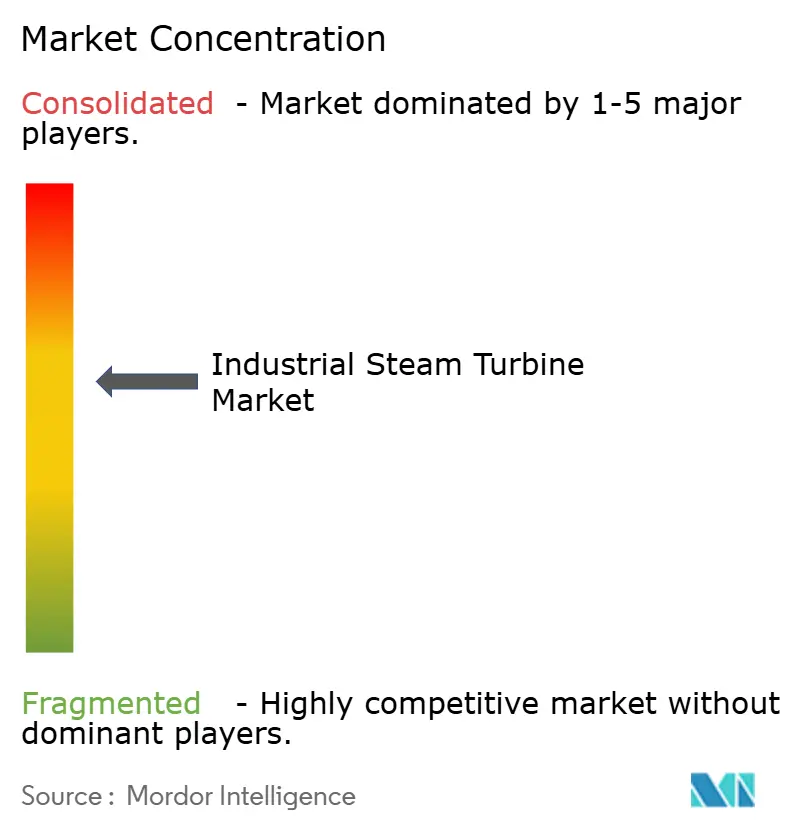
| Market Concentration | Medium |
Major Players *Disclaimer: Major Players sorted in no particular order Image © Mordor Intelligence. Reuse requires attribution under CC BY 4.0. | |
Industrial Steam Turbine Market Analysis by Mordor Intelligence
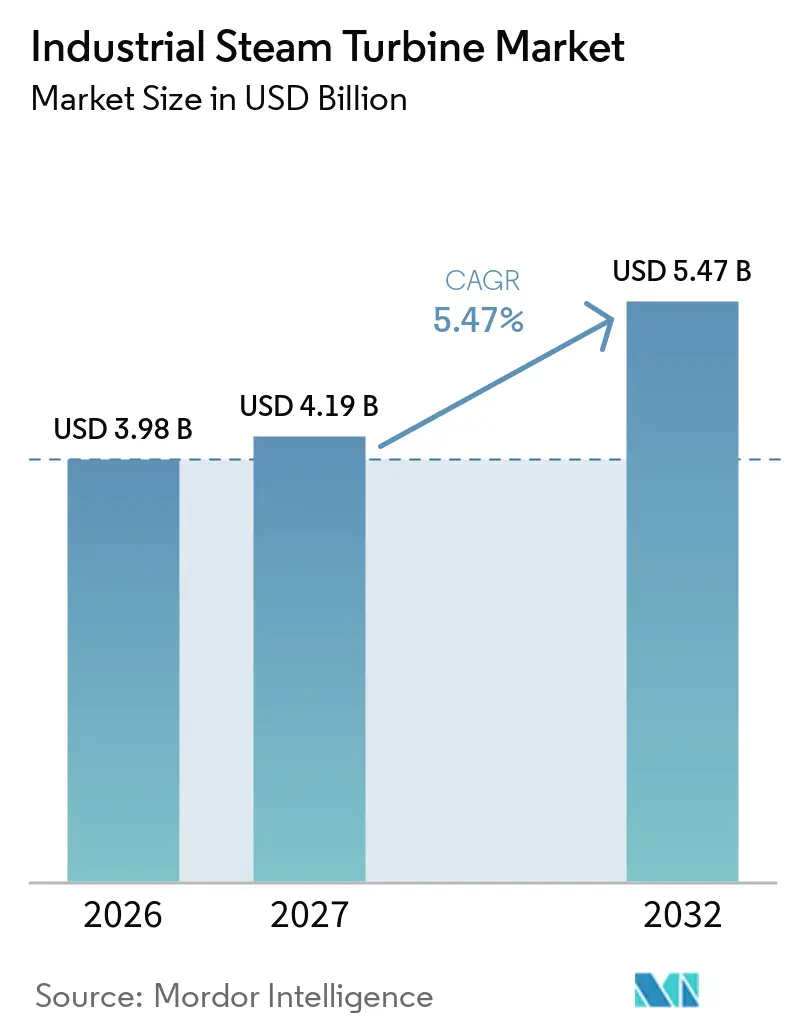
The industrial steam turbine market size was USD 3.98 billion in 2026 and is forecast to reach USD 5.47 billion by 2032, growing at a CAGR of 5.5% from 2027 to 2032. The market continues to serve industrial sites that require dependable process steam, mechanical drive capacity, and on-site electricity generation. Full electrification remains difficult in several industrial settings, as grid connections, electricity-to-gas price relationships, and policy frameworks are still developing across the EU, China, and ASEAN. This creates a clear role for steam-cycle equipment in high-temperature processes and in facilities that cannot yet shift economically to electric alternatives. Combined heat and power projects, waste-heat recovery systems, and replacement demand from aging fleets support orders, while suppliers compete through service agreements, faster delivery, and digital monitoring. The market also faces pressure from electric motor drives in smaller mechanical-drive applications and from water constraints that can affect the use of condensing systems.
Key Report Takeaways
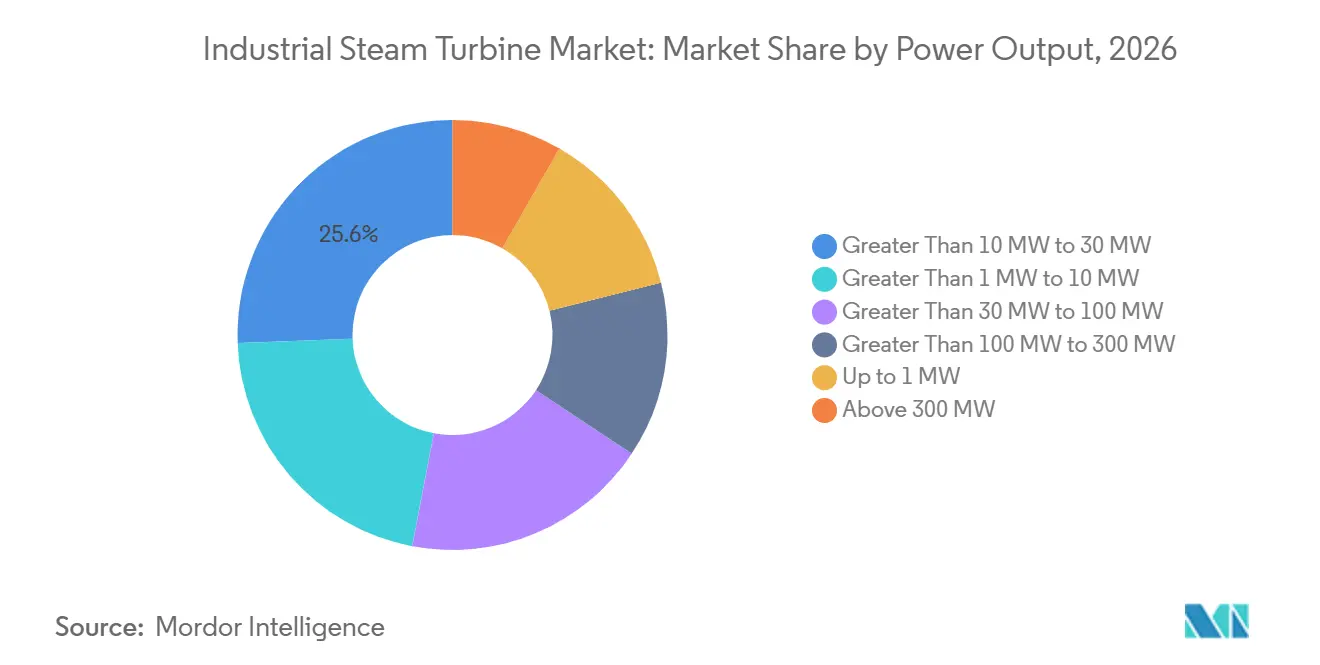
- By power output, the greater-than-10 MW to 30 MW segment held 25.6% of the Industrial Steam Turbine Market share in 2026, while the greater-than-30 MW to 100 MW segment is forecast to grow at a 5.9% CAGR through 2032.
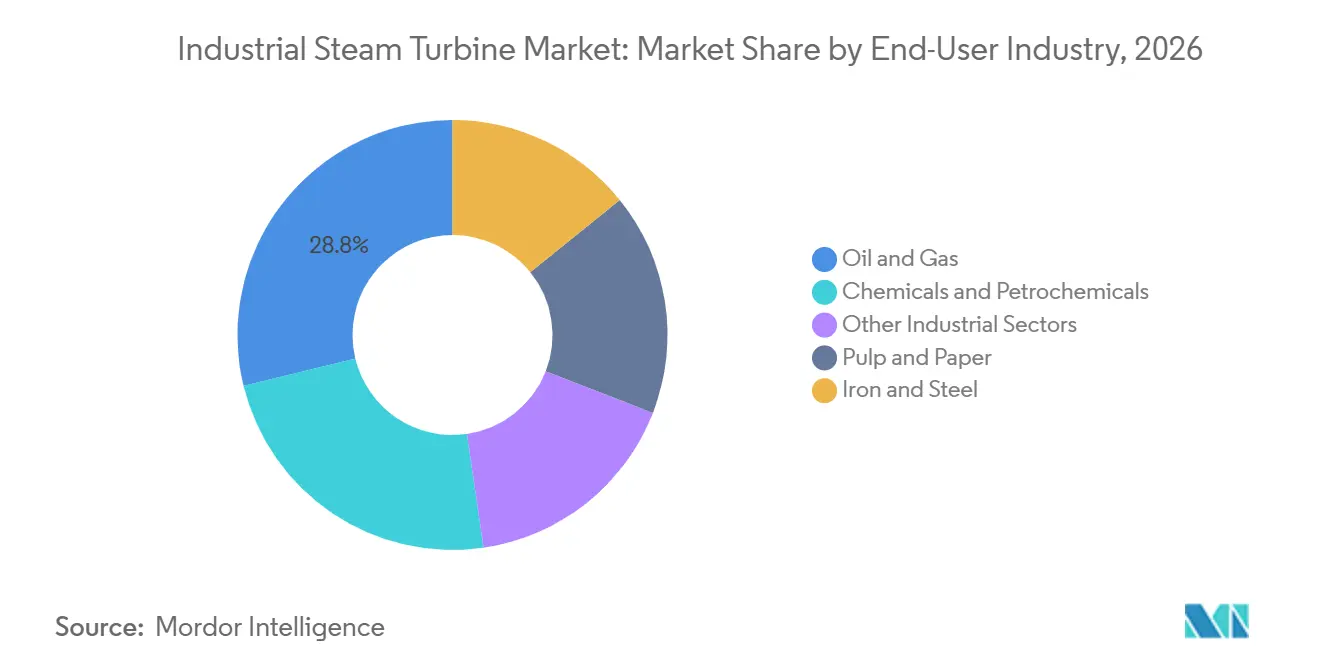
- By end-user industry, oil and gas held 28.8% of the Industrial Steam Turbine Market share in 2026, while chemicals and petrochemicals is forecast to expand at a 6.2% CAGR through 2032.
- By geography, Asia-Pacific accounted for 43.7% of the Industrial Steam Turbine Market share in 2026 and is forecast to grow at a 5.8% CAGR through 2032.
Note: Market numbers in this report are based on Mordor Intelligence's proprietary estimation framework, which combines nine months of actuals with Q4 projections for base year 2026.
Market Trends and Insights
Drivers Impact Analysis of Industrial Steam Turbine Market*
| Driver | (~) % Impact on CAGR Forecast | Geographic Relevance | Impact Timeline |
|---|---|---|---|
| Industrial Decarbonization and Heat-to-Power Adoption | +1.3% | Global, with early momentum in EU and China | Medium term (2-4 years) |
| Expansion of Industrial Combined Heat and Power | +1.2% | EU, India, Southeast Asia | Medium term (2-4 years) |
| Aging Turbine Fleet Modernization | +0.9% | North America, Europe, Japan | Short term (≤ 2 years) |
| Waste Heat Recovery and Waste-to-Energy Deployment | +0.8% | APAC core, spill-over to MEA and South America | Medium term (2-4 years) |
| Industrial Power-Reliability Requirements | +0.6% | Middle East, South and Southeast Asia | Short to medium term |
| Hydrogen-Ready and Flexible Steam-Cycle Upgrades | +0.4% | EU, Japan, North America | Long term (≥ 4 years) |
| Source: Mordor Intelligence | |||
Industrial Decarbonization and Heat-to-Power Adoption
Industrial decarbonization strategies are reinforcing near-term steam turbine demand rather than reducing it. Where combustion processes generate high-temperature steam as a byproduct, as in cement, chemicals, and refinery operations, installing a back-pressure or extraction condensing turbine to recover that energy is the lowest-cost carbon abatement option currently available. The IEA's December 2025 analysis concluded that electrifying low-temperature industrial heat is technically feasible but constrained by grid connection delays, unfavorable power-to-gas price ratios, and a policy framework that is "still in early stages." This policy gap supports steam turbine demand: facilities that cannot yet justify electrification still require reliable on-site power, and the steam cycle remains the incumbent technology. A secondary implication is that industrial decarbonization mandates for rotating equipment are creating a structured replacement cycle, as plants must upgrade to higher-efficiency turbines to meet emissions benchmarks, even while deferring electrification decisions.[1]
Expansion of Industrial Combined Heat and Power
Combined heat and power (CHP) steam turbine deployment is accelerating as efficiency gains translate into both environmental and financial benefits. Overall CHP system efficiency can reach 70-80%, compared to 45-55% for a separate heat and power supply, according to US DOE assessments.[2] A notable demand signal is emerging from industrial parks, which the IEA identifies as key deployment nodes, particularly across ASEAN, where integrated industrial estates can share steam and power infrastructure. India's Bureau of Energy Efficiency reinforces this through its Perform, Achieve and Trade (PAT) scheme, which mandates energy intensity reductions across energy-intensive sectors, including iron and steel, pulp and paper, and chemicals, sectors where CHP steam turbine retrofits are among the most viable compliance options. Siemens Energy's SST-series steam turbines (2-250 MW), qualified across back-pressure and condensing configurations, are directly targeted at this application.
Aging Turbine Fleet Modernization
A significant portion of the global industrial steam turbine installed base consists of units commissioned in the 1980s and 1990s that are reaching or exceeding their 30-year design lives. Turbine aging is not only an availability risk; thermodynamic degradation in aging blade profiles, seals, and nozzles can reduce efficiency by 3-8 percentage points from nameplate values, materially increasing fuel costs and emissions per unit of output. The commercial dynamic is that OEM service economics favor turbine replacement over parts overhaul beyond a certain degradation threshold, creating a structured equipment renewal pipeline. Mitsubishi Heavy Industries' Compressor International Corporation illustrated this trend by securing a contract from ExxonMobil in November 2025 to supply a footprint-replacement steam turbine for its Baton Rouge olefins plant, with the unit expected to remain in service for at least 30 years. Modern turbine retrofits using high-efficiency 3D reaction blade profiles and reduced labyrinth seal losses can recover efficiency margins of 5% or more, improving CO2 per MWh while extending asset life.
Waste Heat Recovery and Waste-to-Energy Deployment
Waste heat recovery using steam Rankine cycle turbines is gaining traction as industrial operators seek to utilize thermal streams that were previously vented or cooled. Between 20% and 50% of industrial energy input is estimated to exit as waste heat, primarily through hot exhaust gases and product cooling streams, and temperatures above approximately 370°C are well-suited to conventional steam turbine conversion. Steam turbines are becoming embedded in industrial energy system architectures as value-recovery assets rather than standalone prime movers. In the waste-to-energy segment, Triveni Turbine reflects this trend: the company's FY26 (April 2025-March 2026) revenue reached INR 21.81 billion (approximately USD 258 million), with exports, including biomass and waste-to-energy projects, growing 30% year-on-year and contributing 58% of total revenue. Turboden, a Mitsubishi Heavy Industries subsidiary, was selected by Tallgrass in March 2026 as a waste-heat-to-power provider for assets in Ohio and Indiana, further illustrating how major industrial turbine groups are expanding their presence across the waste heat value chain.
Restraints Impact Analysis of Industrial Steam Turbine Market*
| Restraint | (~) % Impact on CAGR Forecast | Geographic Relevance | Impact Timeline |
|---|---|---|---|
| High Installed Cost and Long Commissioning Cycles | -0.5% | Global, most pronounced in emerging markets | Short to medium term |
| Solar-Plus-Storage and Electric-Drive Substitution | -0.4% | Europe, North America; APAC medium-term | Medium to long term |
| Water-Availability Constraints for Condensing Systems | -0.2% | MEA, South Asia, western China | Medium to long term |
| Industrial Steam-Load Variability and Fuel-Quality Risk | -0.2% | South America, Sub-Saharan Africa, South Asia | Short to medium term |
| Source: Mordor Intelligence | |||
High Installed Cost and Long Commissioning Cycles
Capital expenditure for industrial steam turbines, encompassing the turbine island, boiler integration, steam piping, and balance of plant, can range from USD 1 million to USD 2 million per MW for mid-range units to considerably higher for custom high-pressure configurations. This cost burden disproportionately affects small and medium-sized industrial facilities in emerging economies, where project financing costs and longer procurement timelines can weaken the economic case compared to purchasing grid electricity or smaller-scale alternatives. Commissioning cycles for systems above 30 MW typically extend 24 to 36 months from contract award to commercial operation, creating a mismatch with the faster deployment timelines of modular alternatives such as reciprocating engines or smaller electric drive packages. This lead-time gap is most significant during periods of rapid industrial expansion, where operators may prioritize speed over lifecycle efficiency, a pattern increasingly observed in Southeast Asian industrial parks.
Solar-Plus-Storage and Electric-Drive Substitution
The displacement of mechanical steam turbine drives by variable-frequency electric motor drives, coupled with on-site solar power, represents the most significant long-term structural threat to sub-10 MW steam turbine demand in industrial facilities. Siemens Energy documented this substitution pathway in a September 2025 whitepaper, outlining how electric drives can replace steam turbines in petrochemical plants to reduce CO2 emissions and operating costs, drawing on the company's own brownfield electrification projects. Notably, this challenge is most acute not in greenfield plants, which are being designed with electrification from the outset, but in brownfield retrofits, where the economic disruption cost of steam system removal is gradually declining as electric motor prices fall. Operators in markets with declining renewable power costs, particularly in Europe and parts of Asia, face a growing window within which the lifecycle economics of electric substitution become compelling.
*Our forecasts treat driver/restraint impacts as directional, not additive. The impact forecasts reflect baseline growth, mix effects, and variable interactions.
Industrial Steam Turbine Market Segment Analysis
By Power Output:
Mid-Range Machines Anchor Volume; Larger Units Drive GrowthThe greater-than-10 MW to 30 MW power class holds the largest share at 25.6% in 2026, reflecting its alignment with the most common CHP and cogeneration configurations in mid-sized industrial plants across chemicals, pulp and paper, and food processing. Plants in this power band generate sufficient electrical and process steam output to offset grid purchases while remaining small enough to match process steam demand without over-sizing.
The greater-than-30 MW to 100 MW class is forecast to expand at a 5.9% CAGR between 2027 and 2032. This range serves larger refineries, petrochemical complexes, and steel facilities that require long-term self-generation. Siemens Energy offers SST-series units across 2 MW to 250 MW, including configurations that can support back-pressure and condensing requirements.[3] Everllence offers MST configurations in the 25 MW to 75 MW range that can be used with steam from hydrogen-blended boilers. Units up to 1 MW and from 1 MW to 10 MW serve smaller biomass, geothermal, and distributed applications but face more direct competition from organic Rankine cycle systems and modular electric drives. Units above 100 MW remain concentrated at large utility-adjacent industrial facilities, including integrated steel mills and major refineries.

By End-User Industry:
Oil and Gas Maintains Structural Leadership; Chemicals Emerge as the Growth CatalystOil and gas is the largest end-user in 2026 with a 28.8% share, supported by steam turbines functioning as both mechanical drives for compressors and pumps and as generators providing on-site power independence in remote production and LNG facilities. The dependence on high-reliability equipment in upstream and midstream operations creates a strong aftermarket servicing revenue stream alongside new equipment demand.
Chemicals and petrochemicals is forecast to grow at 6.2% between 2027-2032, driven by capacity expansions in blue ammonia, methanol, and ethylene, each of which integrates steam turbines for mechanical drives and combined power generation. Baker Hughes received an order in Q3 2025 to supply a steam turbine generator for the world's largest low-carbon ammonia plant, the Blue Point Number One Ammonia Project in Louisiana, confirming that chemical plant steam turbines are embedded in the decarbonization infrastructure pipeline. Pulp and paper remain a significant and stable segment: Siemens Energy in May 2025 secured a contract exceeding BRL 500 million to supply three steam turbines, one back-pressure and two condensing, for Arauco's Sucuriú pulp mill in Brazil, with the plant designed to generate over 400 MW of total energy. Iron and steel plants are notable for their use of extraction and back-pressure turbines to recover waste heat from blast furnace and coke oven gases, though this segment's growth is tempered by electric arc furnace adoption that reduces available process steam streams. Compliance with ISO 50001 energy management standards increasingly motivates industrial facilities across all these segments to optimize steam system efficiency, creating a structural upgrade demand layer on top of organic growth.
Geography Analysis
Asia-Pacific accounted for 43.7% of the Industrial Steam Turbine Market share in 2026 and is projected to grow at a 5.8% CAGR through 2032. China remains a key regional center, supported by its large industrial and coal-based operating fleet. Dongfang Electric reported RMB 78.6 billion in operating revenue for 2025 and power-station steam-turbine production of 49,069 MW. India adds incremental demand through industrial capacity development and utility-scale thermal projects. BHEL received a June 2025 letter of award from Adani Power for 6 units of 800 MW each, valued at USD 683 million (INR 65 billion).[4] Triveni Turbine reported that exports contributed 58% of FY26 revenue, with demand across Southeast Asia, Europe, and Africa. Japan also supports upgrades through energy-efficiency programs associated with the Ministry of Economy, Trade, and Industry and the Sustainable Open Innovation Initiative.
North America and Europe together represent a large and stable installed base with growing retrofit activity. North America's steam turbine demand is concentrated in refinery applications, LNG facilities, and chemical plants across the Gulf Coast, a market driven by long-term service agreements and capacity replacement rather than greenfield development. GE Vernova's remaining performance obligations stood at approximately USD 94.4 billion as of December 31, 2025, reflecting the scale of its long-cycle industrial and power equipment backlog. In Europe, EU Directive 2023/1791 on energy efficiency, requiring transposition by October 2025 and explicitly promoting high-efficiency cogeneration, is the single most consequential compliance factor driving European industrial CHP steam turbine investment. Ansaldo Energia won the contract for the combined-cycle Matra Power Plant in Hungary in December 2025, which will supply a steam turbine alongside a hydrogen-ready GT26 gas turbine, illustrating how European industrial decarbonization mandates are directing investment into high-efficiency steam cycles.
Middle East and Africa are the fastest-growing emerging geography, driven by Gulf Cooperation Council power and water megaprojects that integrate refinery steam turbine applications and large-scale cogeneration. GE Vernova announced commercial operations at the Jafurah Cogeneration Independent Steam and Power Plant in Saudi Arabia at ADIPEC in November 2025, providing up to 314 t/h of steam and 320 MW of electricity to support natural gas field operations. Doosan Enerbility secured USD 255 million (KRW 340 billion) in contracts for two Saudi combined-cycle gas turbine plant expansions, Ghazlan 2 and Hajar, in May 2025, and followed with a USD 97.5 million (KRW 130 billion) contract for Qatar's Facility E independent water and power producer project in December 2025. South America's market is led by Brazil's pulp, paper, and energy sectors, with Siemens Energy's Arauco Sucuriú contract being the most significant single industrial steam turbine award in the region in 2025. Infrastructure and grid reliability constraints limit growth in Sub-Saharan Africa, but captive power steam turbine demand in resource extraction, particularly in Nigeria, South Africa, and Kenya, is emerging.
Competitive Landscape
The industrial steam turbine market is moderately concentrated at the top, with a small group of global original equipment manufacturers, namely Siemens Energy, GE Vernova, Mitsubishi Heavy Industries, and Doosan Enerbility, holding the largest shares through technology breadth, global service networks, and long-term service agreements that lock in aftermarket revenue for 10-20 years post-delivery. Doosan Enerbility's FY2025 investor disclosure noted a 51% global market share in steam turbine generators for large-scale combined-cycle gas turbine above 350 MW (excluding China), winning 9 of 20 units tracked globally in 2024-2025. GE Vernova's Steam Power division maintains relevance through nuclear and coal transition services while shifting toward natural gas and industrial applications.
The primary competitive opportunity in the 1-30 MW sub-segment is held by specialized players such as Triveni Turbine Limited, Everllence, and Ebara Elliott Energy, which compete on application engineering, fast delivery, and local service depth. Everllence, which adopted its new identity in June 2025 as part of its "Moving Big Things to Zero" decarbonization strategy, secured a contract to supply a 13.5 MW steam turbine generator to Yara's fertilizer plant in October 2026, demonstrating how smaller-range producers are establishing positions in the chemicals and fertilizer segment.
Technology strategy is increasingly divided between hardware innovation and digital service monetization. Western original equipment manufacturers are filing patents around hydrogen-compatible blade coatings and variable inlet guide vanes for flexible cycling, while Chinese state-owned manufacturers are deploying AI-based performance monitoring platforms as embedded offerings with new units. A notable development is that Ebara Elliott Energy completed a major electrical power upgrade at its Jeannette, Pennsylvania manufacturing facility in 2025, enabling full-speed test capability to reduce lead times, directly addressing the commissioning cycle disadvantage relative to electric alternatives. ASME PTC 6.2-2011 (R2025), the reaffirmed 2025 standard for testing steam turbines in combined cycles and cogeneration applications, sets the performance verification framework that all major suppliers must satisfy for contract compliance in North American and European projects.
Industrial Steam Turbine Industry Leaders
-
Siemens Energy AG
-
GE Vernova Inc.
-
Mitsubishi Heavy Industries, Ltd.
-
Toshiba Energy Systems & Solutions Corporation
-
Doosan Škoda Power a.s.
- *Disclaimer: Major Players sorted in no particular order
Industrial Steam Turbine Market Companies Covered in this Report
- Ansaldo Energia S.p.A.
- Baker Hughes Company
- Bharat Heavy Electricals Limited
- Dongfang Electric Corporation
- Doosan Enerbility Co., Ltd.
- Doosan Škoda Power s.r.o.
- Elliott Group
- Fuji Electric Co., Ltd.
- GE Vernova Inc.
- Hangzhou Turbine Power Group Co., Ltd.
- Harbin Electric Corporation
- Kawasaki Heavy Industries, Ltd.
- MAN Energy Solutions SE
- Mitsubishi Heavy Industries, Ltd.
- Nanjing Turbine & Electric Machinery Group Co., Ltd.
- Shanghai Electric Group Co., Ltd.
- Shin Nippon Machinery Co., Ltd.
- Siemens Energy AG
- Toshiba Energy Systems & Solutions Corporation
- Triveni Turbine Limited
Recent Industry Developments in Industrial Steam Turbine Market
- October 2026: Everllence secured a contract to supply a 13.5 MW steam turbine-generator train for Yara International's fertilizer facility. The turbine will utilize process steam generated during nitric acid production to produce on-site electricity, improving overall plant energy efficiency and reducing purchased power requirements and carbon emissions. This project reflects continued investment in industrial cogeneration and steam energy recovery systems.
- May 2026: Triveni Turbine reported record FY26 revenue of INR 21.81 billion, supported by strong industrial steam turbine demand across Southeast Asia, Europe, Turkey, and Africa. Export orders accounted for 58% of revenue, while the company expanded into the geothermal power segment, reflecting growing global demand for its industrial steam turbine solutions.
- March 2026: Turboden, a subsidiary of Mitsubishi Heavy Industries, was selected by Tallgrass to provide waste-heat-to-power systems for industrial facilities in Ohio and Indiana. The project converts unused industrial thermal energy into electricity, further expanding steam turbine-based waste heat recovery applications in North America.
- December 2025: Ansaldo Energia secured a contract to supply a hydrogen-ready GT26 gas turbine, one steam turbine, and associated generators for the 521 MW Matra Power Plant in Hungary. The combined-cycle project will replace an existing lignite-fired plant and is expected to reduce CO₂ emissions by approximately 70%, reflecting continued demand for high-efficiency steam turbines in energy transition projects.
Global Industrial Steam Turbine Market Report Scope
An industrial steam turbine is a mechanical power generation device that converts the thermal energy of high-pressure steam into rotational energy through a series of turbine blades. These turbines are widely used in industrial facilities for electricity generation, mechanical drive applications, and combined heat and power (CHP) systems. Industrial steam turbines improve energy efficiency by utilizing steam produced from boilers, waste heat recovery systems, and industrial processes, making them essential in energy-intensive industries.
The global industrial steam turbine market is segmented by power output, end-user industry, and geography. By power output, the market is segmented into up to 1 MW, greater than 1 MW to 10 MW, greater than 10 MW to 30 MW, greater than 30 MW to 100 MW, greater than 100 MW to 300 MW, and above 300 MW. By end-user industry, the market is segmented into oil and gas, chemicals and petrochemicals, pulp and paper, iron and steel, and other industrial sectors. The report also covers the market size and forecasts for the global industrial steam turbine market across 29 countries in key regions. For each segment, the market sizing and forecasts are provided on the basis of value (USD).
Segmentation Overview
| Up to 1 MW |
| Greater Than 1 MW to 10 MW |
| Greater Than 10 MW to 30 MW |
| Greater Than 30 MW to 100 MW |
| Greater Than 100 MW to 300 MW |
| Above 300 MW |
| Oil and Gas |
| Chemicals and Petrochemicals |
| Pulp and Paper |
| Iron and Steel |
| Other Industrial Sectors |
| North America | United States |
| Canada | |
| Mexico | |
| Europe | Germany |
| France | |
| Italy | |
| Spain | |
| United Kingdom | |
| Poland | |
| Netherlands | |
| Russia | |
| Rest of Europe | |
| Asia-Pacific | China |
| India | |
| Japan | |
| South Korea | |
| Australia | |
| Indonesia | |
| Malaysia | |
| Thailand | |
| Philippines | |
| Rest of Asia-Pacific | |
| South America | Brazil |
| Argentina | |
| Colombia | |
| Rest of South America | |
| Middle East and Africa | Saudi Arabia |
| United Arab Emirates | |
| South Africa | |
| Kenya | |
| Egypt | |
| Nigeria | |
| Rest of Middle East and Africa |
| By Power Output | Up to 1 MW | |
| Greater Than 1 MW to 10 MW | ||
| Greater Than 10 MW to 30 MW | ||
| Greater Than 30 MW to 100 MW | ||
| Greater Than 100 MW to 300 MW | ||
| Above 300 MW | ||
| By End-User Industry | Oil and Gas | |
| Chemicals and Petrochemicals | ||
| Pulp and Paper | ||
| Iron and Steel | ||
| Other Industrial Sectors | ||
| By Geography | North America | United States |
| Canada | ||
| Mexico | ||
| Europe | Germany | |
| France | ||
| Italy | ||
| Spain | ||
| United Kingdom | ||
| Poland | ||
| Netherlands | ||
| Russia | ||
| Rest of Europe | ||
| Asia-Pacific | China | |
| India | ||
| Japan | ||
| South Korea | ||
| Australia | ||
| Indonesia | ||
| Malaysia | ||
| Thailand | ||
| Philippines | ||
| Rest of Asia-Pacific | ||
| South America | Brazil | |
| Argentina | ||
| Colombia | ||
| Rest of South America | ||
| Middle East and Africa | Saudi Arabia | |
| United Arab Emirates | ||
| South Africa | ||
| Kenya | ||
| Egypt | ||
| Nigeria | ||
| Rest of Middle East and Africa | ||
Key Questions Answered in the Report
What is the current size of the industrial steam turbine market?
The global industrial steam turbine market is valued at USD 3.98 billion in 2026 and is forecast to grow to USD 5.47 billion by 2032, expanding at a CAGR of 5.47% during 2027 to 2032.
Which end-user industry holds the largest share in the industrial steam turbine market?
Oil and gas is the largest end-user segment, holding a 28.8% share in 2026. Steam turbines in this sector serve as both mechanical drives for compressors and pumps and as on-site power generators, particularly in refineries and LNG terminals where reliability requirements are non-negotiable.
Which region dominates the industrial steam turbine market?
Asia-Pacific is both the largest and the fastest-growing region, holding a 43.7% share in 2026 and forecast to expand at a CAGR of 5.8% during 2027 to 2032.
Which power output class is growing the fastest in the industrial steam turbine market?
The greater-than-30 MW to 100 MW power class is the fastest-growing segment, forecast at a CAGR of 5.9% during 2027 to 2032, driven by large integrated petrochemical, refinery, and steel facilities that require utility-scale self-generation for energy security.
Who are the leading companies in the industrial steam turbine market?
Key producers include Siemens Energy AG, GE Vernova Inc., Mitsubishi Heavy Industries Ltd., Doosan Enerbility Co. Ltd., Baker Hughes Company, Bharat Heavy Electricals Limited, Triveni Turbine Limited, Dongfang Electric Corporation, and Everllence SE (formerly MAN Energy Solutions).